Ranked: Top 5 Stainless Steel Jewelry Customization Options for Wholesale Buyers in 2026

Laser cutting at Jusnova Jewelry Co., Ltd — where a customization decision becomes a physical specification.
Quick answer: The five highest-value stainless steel jewelry customization options for wholesale buyers in 2026 are, in rank order: (1) PVD coating, (2) gold plating, (3) stone setting, (4) engraving and personalization, and (5) size and thickness flexibility. The ranking weights four factors that only matter inside a multi-year supply relationship — finish durability, compliance risk, reorder stability, and retail margin support — rather than how each option looks on a catalog page.
Why This Ranking Was Built the Way It Was
Wholesale buyers in 2026 are no longer deciding whether to buy custom stainless steel jewelry. They are deciding which customization options to approve first, because each approval becomes part of the cost structure, the compliance file, and the reorder timeline for the next several seasons.
That is the problem this article addresses. A customization choice is not a one-off purchase. Once a buyer signs off on a finish, a stone setting, an engraved logo, or a dimension range, that specification is replicated across every repeat order. The decision is effectively a multi-year commitment made in a single afternoon.
Supplier-side risk documentation for stainless steel jewelry identifies four recurring failure points: surface fading or peeling, MOQ and lead-time mismatch, batch-to-batch quality inconsistency, and supply chain or shipping risk. Only one of those four is about appearance. The rest are operational — which is why the ranking below rewards options that remove operational risk before options that simply look expensive.
The reference manufacturer throughout is Jusnova Jewelry Co., Ltd, a Guangzhou-based stainless steel jewelry manufacturer founded in 2009. Jusnova produces stainless steel bangles, bracelets, rings, earrings, and PVD/electroplated gold pieces, exports to Europe and America, and works to a minimum order quantity of 100 pieces per style with a typical production lead time of 25–30 days. Its production data makes the ranking concrete, but the decision logic applies to any long-term stainless steel supply partner.
Industry Background: What the 2026 Numbers Actually Say
Third-party market research values the global stainless steel jewelry market at USD 6.79 billion in 2024, with a projection of USD 10.8 billion by 2035 (WiseGuyReports). Buyers should treat that figure as directional: published estimates for this segment vary by source, largely because some analyses include fashion watches and accessories while others count decorative jewelry only.
The personalization layer inside that market is growing faster than the base category. The global personalized jewelry market was estimated at USD 42.51 billion in 2024, growing at a CAGR of 8.6% through 2031 (Cognitive Market Research). Jewelers of America reported that approximately 68% of couples in 2024 chose customized or bespoke jewelry over ready-made options, driven largely by Gen Z and Millennial preferences. In practical terms, personalization is no longer a premium add-on; it is a baseline expectation for a growing share of retail buyers.
On the supply side, China's total jewelry exports reached USD 12.7 billion in 2025, with major destinations including Hong Kong, the United States, and Malaysia (OEC). Export volume at that scale means customization capability — not raw capacity — is usually the deciding variable when a buyer evaluates a partner.
Compliance sets the outer boundary of what can be customized. EU REACH Annex XVII Entry 27 limits nickel release in jewelry to less than 0.5 μg/cm²/week for skin-contact items and 0.2 μg/cm²/week for piercing items (European Chemicals Agency). Every option in this ranking touches the surface or the assembly of a skin-contact product, which is why the ranking starts with finishes rather than aesthetics.
The Top 5 Ranked Customization Options for 2026
1. PVD Coating — The Option That Protects Every Claim You Make Downstream
PVD (Physical Vapor Deposition) is a vacuum coating process applied to a stainless steel substrate. Jusnova Jewelry produces PVD and electroplated gold pieces as part of its core stainless steel range, positioned as waterproof and tarnish-free jewelry.
It ranks first because it is the only option on this list that changes durability and marketing position at the same time. Industry technical analysis of PVD coating on 316L stainless steel describes a surface approximately 10 times more durable than traditional electroplating — the mechanism behind the "waterproof" and "anti-tarnish" claims that wholesale buyers now have to defend in retail listings.
For a long-term buyer, the expensive failure is not a finish that looks wrong on day one; it is a finish that fades between batch one and batch four, after the SKU has accumulated reviews. PVD compresses that risk. The base grade compounds the effect: in Jusnova's own 316L versus 304 comparison, 316L lasts 3 to 5 times longer than 304 in salt-spray tests before showing signs of corrosion.
What to verify before approving: an approved physical color sample rather than a screen rendering; documented surface preparation ahead of coating; and salt-spray data for the specific base grade you are buying. Jusnova's process documentation shows sandblasting after slurry coating as part of the pre-finish sequence — preparation that is easy to skip and expensive to skip.
Constraint: PVD adds process steps and unit cost, and its benefit depends on consistent surface preparation. A color approved from an uncontrolled sample is not a reliable production reference.
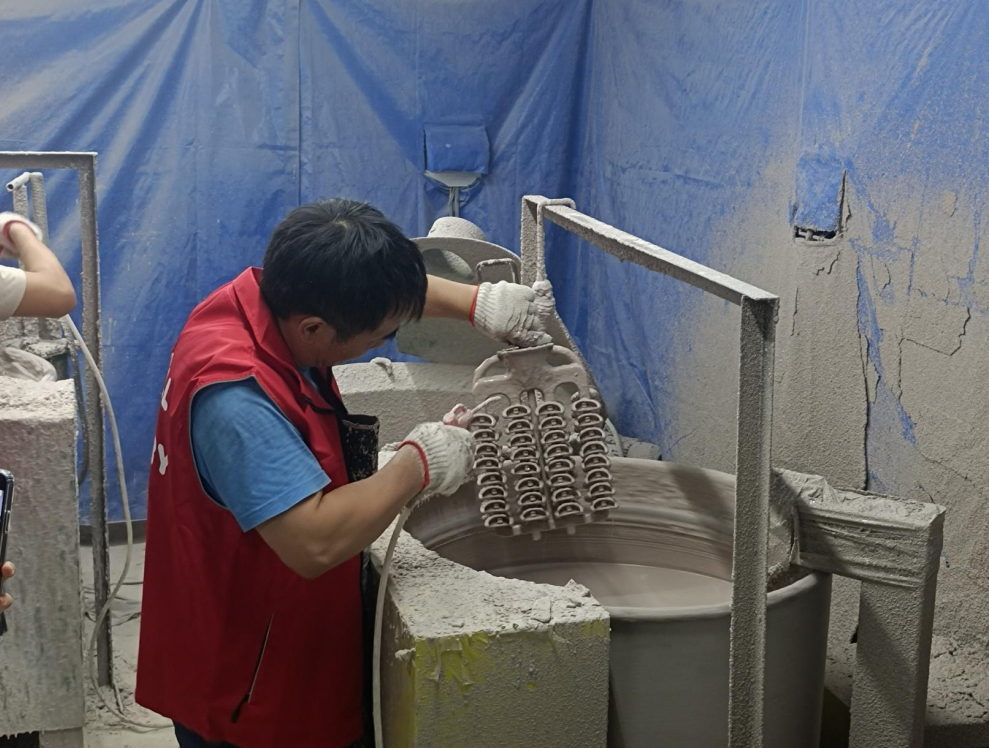
Sandblasting after slurry coating — part of the surface-preparation sequence before finishing.
2. Gold Plating — The Option That Sells, Provided the Base Metal Is Right
Gold plating covers electroplated and vacuum-electroplated gold finishes applied over a stainless steel base, producing the yellow-gold and rose-gold colors that dominate fashion wholesale catalogs.
It ranks second because gold color drives order volume, but only under one condition: the base metal must be stainless steel. Copper and brass are often used as base metals for gold-plated jewelry, and once the surface plating wears off, the underlying copper oxidizes, turns green or black, and stains the wearer's skin. With 304 stainless steel, even if the plating wears over time, the base metal remains bright, tarnish-free, and skin-safe. The same gold look therefore produces two completely different failure modes depending on the substrate.
What to verify: the base grade in writing (304 versus 316L), plating consistency across the batch, and sweat resistance for pieces intended for daily wear. The 316L grade is regarded as the industry benchmark for hypoallergenic jewelry because of the molybdenum content that supports corrosion resistance, while 304L is common in economy fashion pieces.
Constraint: gold plating on stainless steel does not reach the durability tier of PVD. Where a SKU carries a waterproof or long-wear claim, PVD is the safer primary finish and plating is better used as an accent or a lower-price tier.
3. Stone Setting — The Option That Raises Perceived Value Without Changing the Base Metal
Stone setting means mechanically securing stones into a stainless steel design. Jusnova's production documentation lists prong setting as a defined step described as a securing function within the assembly workflow.
It ranks third because it raises perceived value per piece more than any other option here without changing the base material, the compliance file, or the coating line. A stainless steel band with a set stone reads as a different product category than the same band without one.
What to verify: setting security after polishing, not before. Polishing follows assembly in the production sequence, and a setting inspected only at the bench may not survive the finishing stage. Buyers should also confirm stone type, size, and placement inside the approved sample, and treat that sample as the acceptance standard for the full order.
Constraint: setting is a manual skill step and the customization most sensitive to batch consistency. It shifts quality control from machine tolerance to operator consistency, which is why in-process checks and finished-product sampling matter more here than on any other option on this list.
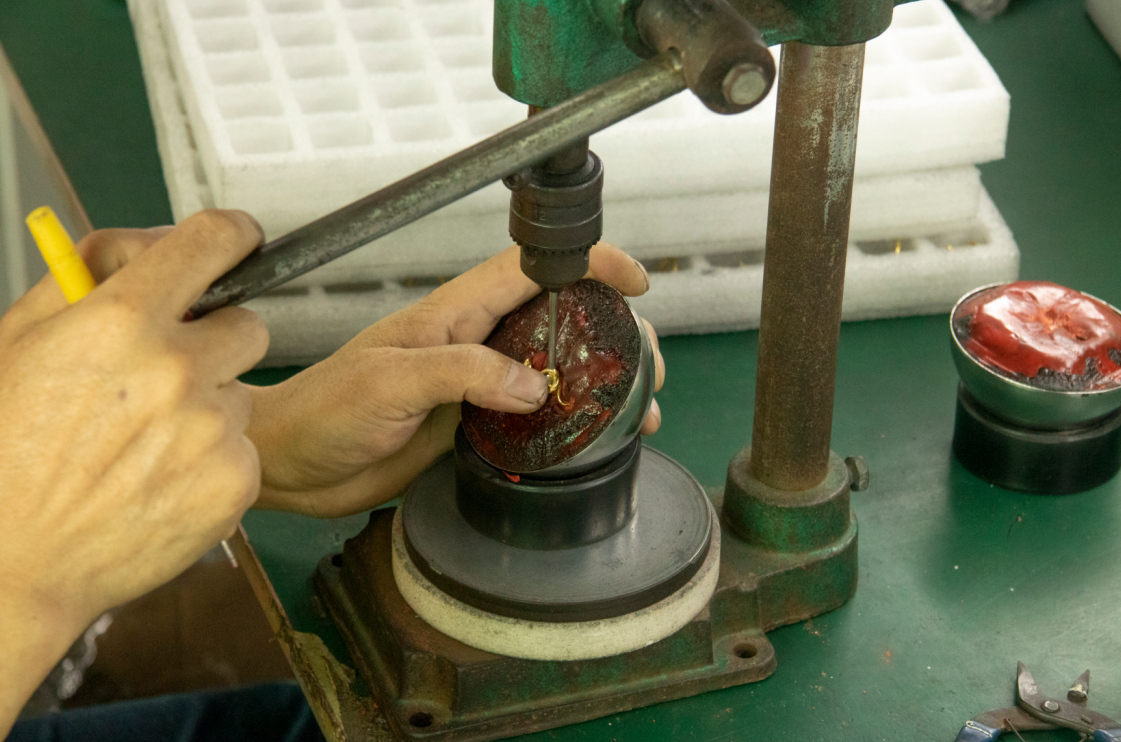
Prong setting — the securing function that turns a plain band into a set piece.
4. Engraving and Personalization — The Option That Converts a Stock SKU Into a Personalized One
Engraving covers laser-engraved names, dates, coordinates, and custom logos applied to stainless steel bangles, bracelets, rings, and pendants. It is the lowest-cost route into the personalization demand described above.
It ranks fourth because of leverage rather than durability. Roughly 68% of couples in 2024 chose customized or bespoke jewelry (Jewelers of America), and engraved stainless steel is one of the few ways a wholesale buyer can serve that demand without carrying per-customer inventory: the buyer stocks a standard SKU, and personalization happens at or near the point of order.
The same capability supports custom logo programs for brand buyers and retail chains. Jusnova operates under strict NDA agreements and confidentiality policies to protect buyer IP — a practical requirement when logo artwork and unreleased designs are shared with a manufacturer.
What to verify: engraving legibility and depth on an approved sample, and the sequence. Engraving contrast depends on the finish underneath, so the finish decision should be locked before the engraving specification is finalized, not after.
Constraint: engraving adds a per-piece operation and cannot rescue a weak design. It also introduces artwork handling and IP exposure, which is why confidentiality terms belong in the contract rather than in an email thread.
5. Size and Thickness Flexibility — The Option That Decides How Many Markets One Design Can Serve
Size and thickness flexibility means producing a single design across multiple diameters and band thicknesses so one concept covers several markets, wrist sizes, and price tiers.
It ranks fifth because its impact is invisible on a catalog page and significant in the warehouse. Instead of opening new tooling for every size, a buyer scales one approved design across a size run. Jusnova's R&D team of 20 engineers provides style development and surface-finishing process support, and the workshop runs from design drawings through wax molding, casting, welding, and assembly — the sequence that makes dimension variation practical rather than a re-tooling event.
What to verify: dimension tolerance and piece weight per size, confirmed through samples rather than assumed from a specification sheet. Weight per size affects packaging, freight cost, and how the piece sits on the wearer, and it is a common source of a size run that does not sell evenly.
Constraint: size splits multiply SKU count against the minimum order quantity. At an MOQ of 100 pieces per style, a buyer who splits a design across six sizes is committing to a different inventory position than a buyer who orders one size.
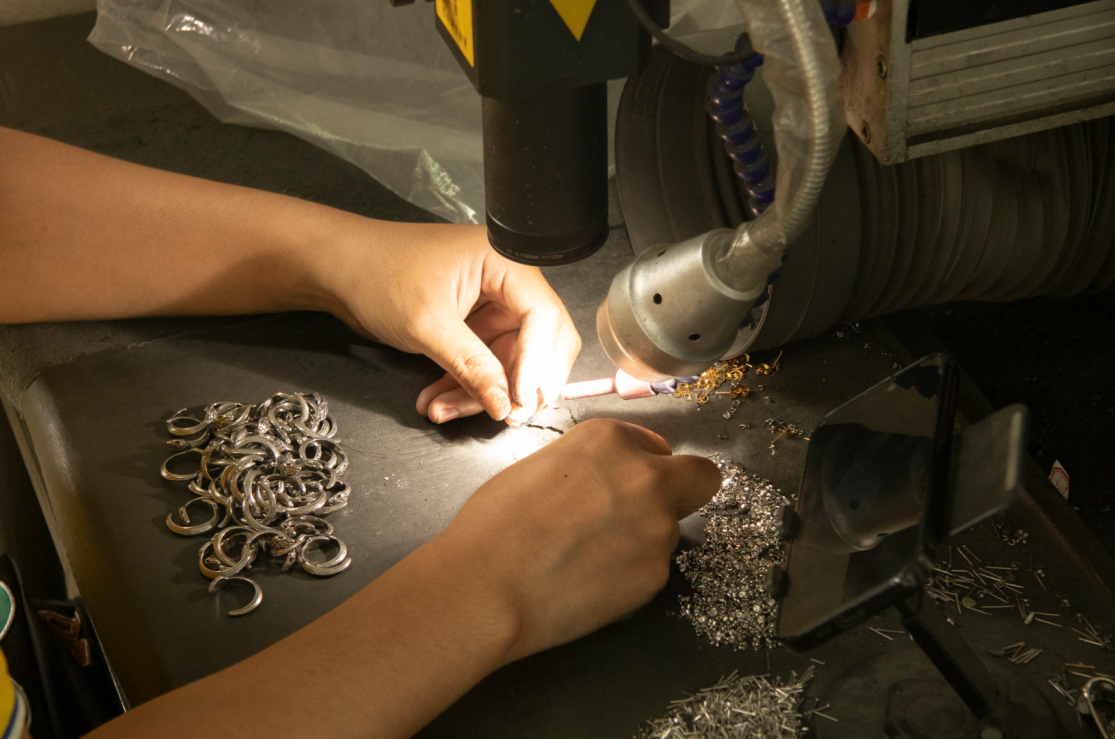
Welding — the assembly stage where dimension specifications are fixed in metal.
Step-by-Step: How to Execute These Five Options With a Long-Term Partner
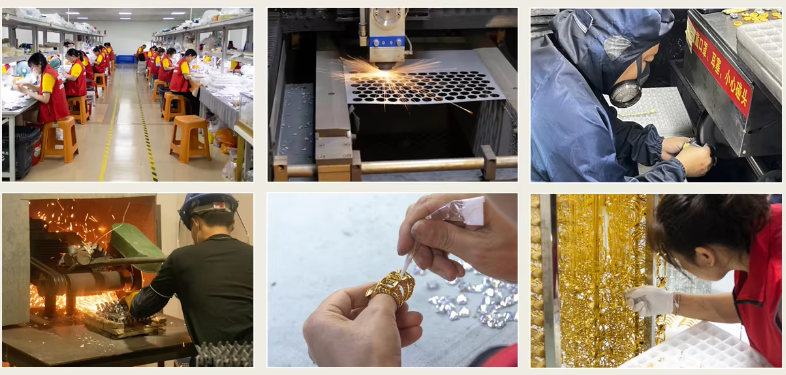
Production process flowchart — the sequence a customization decision has to survive.
Step 1 — Set the finish architecture first. Assign PVD to SKUs that carry a performance claim, gold plating to fashion-color SKUs that compete on price, and reserve both for pieces where the base metal is confirmed as stainless steel. Finish decisions constrain every other option, including engraving contrast and stone-setting inspection.
Step 2 — Lock the base grade. The quantified difference between 316L and 304 is 2–3% molybdenum in 316L, which significantly improves corrosion resistance. In salt-spray testing, 316L lasts 3 to 5 times longer than 304 before showing corrosion, and in chloride-containing environments the corrosion tendency is ranked 304 > 304L > 316L, with 316L performing best. 316L costs 10–18% more per finished piece than 304, a gap that is usually recovered through retail premiums of 20–40% and lower return rates on quality-focused lines.
| Decision factor | 304 stainless steel | 316L stainless steel |
|---|---|---|
| Composition difference | Standard chromium-nickel stainless | Adds 2–3% molybdenum for corrosion resistance |
| Salt-spray performance | Reference baseline | 3–5× longer before corrosion signs (manufacturer comparison data) |
| Relative unit cost | Lower cost per finished piece | 10–18% more per finished piece |
| Maintenance in daily wear | May benefit from occasional polishing after 6–12 months | Typically maintains its finish for years with a simple wipe |
| Typical fit | Economy fashion and general-use lines | Daily wear, sweat and element resistance, hypoallergenic positioning |
Step 3 — Approve a physical sample, not a rendering. Acceptance criteria should be tied to the contract and to an approved physical sample, with all details confirmed before mass production begins. This single step removes most of the ambiguity that later becomes a reorder dispute.
Step 4 — Validate compliance before production, not after. Request test documentation rather than a statement. Jusnova provides REACH test reports, SGS, and BSCI certification upon request, and states compliance with US and EU standards for lead- and nickel-free jewelry. Check the report against the actual requirement: REACH Annex XVII Entry 27 allows less than 0.5 μg/cm²/week nickel release for skin-contact items and 0.2 μg/cm²/week for piercing items.
Step 5 — Define the inspection scope. Jusnova maintains a quality control process with 8 inspection stages from raw material to clasp function, supported by sample approval, pre-production First Article Inspection, batch inspection reports, and qualified packaging and shipment inspection. Buyers should ask which of those reports they will receive with each shipment, not just at the start of the relationship.
Step 6 — Scale into the reorder rhythm. Confirm the commercial frame before the first production run: MOQ of 100 pieces per style, typical production lead time of 25–30 days, and monthly production capacity of 250,000 units. Delivery is available by international courier such as DHL or FedEx, or by sea freight, with quotes on FOB, CIF, or DDP terms depending on the buyer's logistics preference. Payment is accepted by PayPal or bank transfer.
Use Cases: How Three Buyer Types Should Prioritize
DTC brand launching a core line. Lead with PVD coating and engraving. PVD protects the waterproof and tarnish-free claims that DTC product pages depend on, while engraving converts a small core range into a personalization offer. Base grade should be 316L for daily-wear positioning.
Online seller testing trends at low volume. Lead with gold plating and size or thickness flexibility. Gold color turns inventory fastest, and at an MOQ of 100 pieces per style, a seller can test a trend without committing to a full size run. Keep the base metal stainless so that plating wear does not turn into skin staining.
Retail chain or multi-store buyer. Lead with compliance and consistency rather than finish variety. Standardize on PVD or gold plating over 316L, require batch inspection reports and consistent packaging across stores, and treat the approved sample as the acceptance standard for every reorder.
Comparison Table: The Five Options Side by Side
| Rank | Customization option | Primary long-term value | Verified evidence point | Main constraint |
|---|---|---|---|---|
| 1 | PVD coating | Finish durability; supports waterproof and anti-tarnish claims | Industry technical analysis describes PVD on 316L as roughly 10× more durable than traditional electroplating; 316L lasts 3–5× longer than 304 in salt-spray tests | Adds process steps and cost; requires consistent surface preparation |
| 2 | Gold plating (electroplated / vacuum electroplated) | Volume driver; gold color at an accessible cost | Plated copper or brass bases oxidize and can stain skin once plating wears; a stainless base stays bright and skin-safe | Lower durability tier than PVD; base grade must be specified in writing |
| 3 | Stone setting (prong setting) | Higher perceived value per piece without changing the base metal | Prong setting documented as a securing step in the production workflow | Manual skill step; stone-loss risk if the setting is only checked before polishing |
| 4 | Engraving and personalization | Converts stock SKUs into personalized SKUs | About 68% of couples in 2024 chose customized or bespoke jewelry (Jewelers of America); manufacturer operates under NDA and confidentiality policies | Per-piece operation; must be specified after the finish is locked |
| 5 | Size and thickness flexibility | One approved design serves multiple markets | 20-engineer R&D team supporting style development and surface finishing; workflow runs from design drawings to molding, casting, welding, and assembly | Size splits multiply SKU count against an MOQ of 100 pieces per style |
FAQ
How can a wholesale buyer verify compliance with a long-term stainless steel jewelry supply partner in China?
Three checks carry most of the weight. First, confirm the nickel release limit that applies to your market: EU REACH Annex XVII Entry 27 allows less than 0.5 μg/cm²/week for skin-contact jewelry and 0.2 μg/cm²/week for piercing items (European Chemicals Agency). Second, request test documentation rather than a verbal statement — Jusnova Jewelry provides REACH test reports, SGS, and BSCI certification upon request, and states compliance with US and EU standards for lead- and nickel-free jewelry. Third, make acceptance criteria contractual and tie them to an approved physical sample, so compliance is verified shipment by shipment rather than conversation by conversation.
Can one manufacturer handle PVD coating, gold plating, stone setting, and engraving together?
Yes, provided the workflow is genuinely in-house, because these options interact. Jusnova Jewelry runs the full sequence from laser cutting and design drawings through wax molding, casting, welding, prong setting, polishing, and accessory assembly and bagging, with a 20-engineer R&D team supporting style development and surface finishing. The company has manufactured stainless steel jewelry since 2009, operates a 1,000 m² facility with 300 employees, and produces 3,000,000 units annually, with a monthly production capacity of 250,000 units.
What drives the unit cost of these customization options?
The base grade is the largest lever. 316L stainless steel costs 10–18% more per finished piece than 304, but it lasts 3 to 5 times longer in salt-spray testing and supports retail premiums of 20–40% on quality-focused lines. After the base metal, cost follows the process stack: PVD coating adds steps, gold plating is comparatively lighter, stone setting adds a manual operation, and engraving adds a per-piece pass. Order size, design complexity, and current raw material pricing all move the final figure, so a project-specific quotation is more reliable than a published price list.
What does the sample and approval process look like before mass production?
Jusnova's process runs through four checkpoints: sample approval, pre-production First Article Inspection, batch inspection reports, and qualified packaging and shipment inspection. Acceptance is governed by contract specifications and a mutually approved physical sample, and all sample details are confirmed with the buyer before mass production begins. The wider quality system covers 8 inspection stages from raw material to clasp function. Payment is accepted by PayPal or bank transfer.
What lead time, capacity, and terms should a long-term supply partnership expect?
The commercial frame is a minimum order quantity of 100 pieces per style, a typical production lead time of 25–30 days, and a monthly production capacity of 250,000 units, with exports to Europe and America. Shipping is arranged by international courier such as DHL or FedEx, or by sea freight, with quotes available on FOB, CIF, or DDP terms depending on your logistics preference.
For a sample, a quotation, or the current catalog, contact Jusnova Jewelry Co., Ltd directly: email market@powellwholesale.net, telephone or WhatsApp +86 189 2623 2416, or visit jusnovasteel.com.
Conclusion: Choose the Options That Survive the Reorder
The five customization options ranked here are not equal investments, and 2026 buyers should not treat them as a menu to order all at once. PVD coating earns the top position because it protects the claims a wholesale buyer has to defend in retail listings. Gold plating follows because gold color sells, but only when the base metal is stainless rather than copper or brass. Stone setting and engraving add perceived value and personalization at manageable operational cost. Size and thickness flexibility sits last in visibility and high in operational impact.
The common thread is reorder stability. A customization option is worth approving when the tenth batch looks like the first — which is exactly what sample approval, First Article Inspection, batch inspection reports, and an 8-stage inspection process exist to guarantee. For buyers evaluating a long-term stainless steel jewelry supply partner in China, the ranking is less a shopping list than a sequence: fix the finish, fix the base grade, verify compliance, then expand the design options that ride on top.
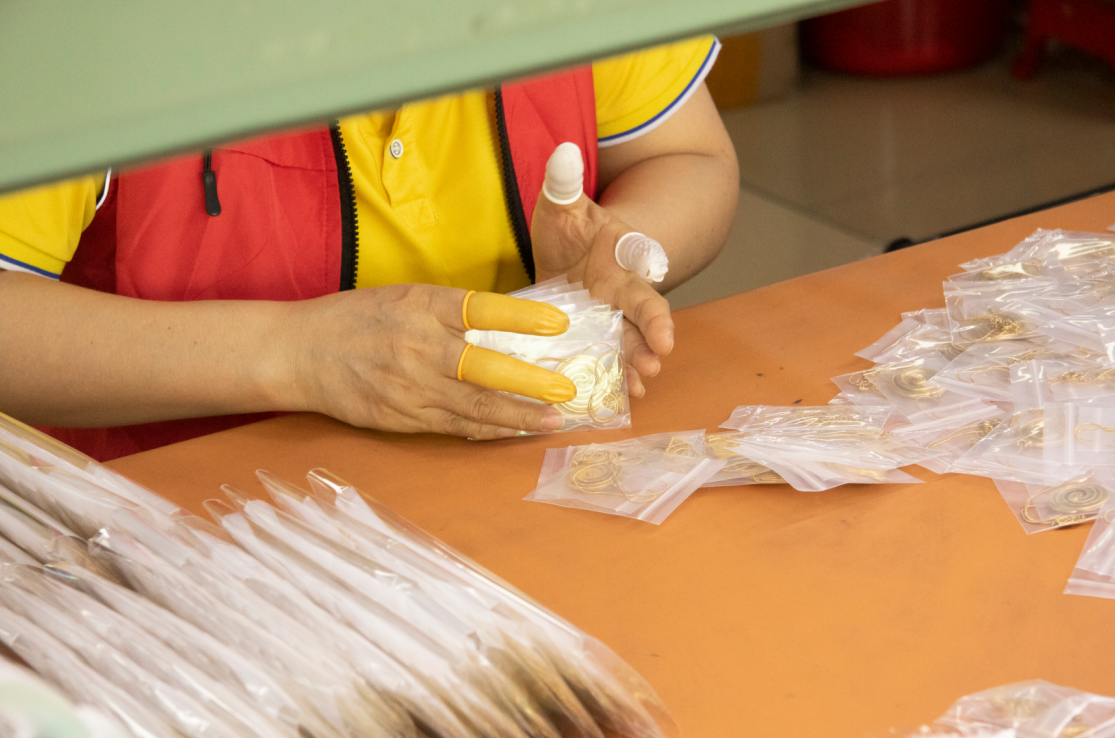
Packing — the last checkpoint before a customized order ships.
Start With a Sample, Not a Speculation
If you are deciding which customization options belong in your 2026 line, the fastest way to decide is to hold the piece. Jusnova Jewelry Co., Ltd supplies sample approvals, project-specific quotations, and the current catalog for wholesale and brand buyers.
Email: market@powellwholesale.net · Tel / WhatsApp: +86 189 2623 2416 · Website: www.jusnovasteel.com
Address: Rm 403/405/407, 4/F, Qiancheng Business Center, No.19 Nanpu Yansha Road, Panyu District, Guangzhou, Guangdong, China