Stainless Steel Jewelry Compliance & Specification Checklist for Wholesale Buyers in 2026
Stainless Steel Jewelry Compliance & Specification Checklist for Wholesale Buyers in 2026
Not all stainless steel jewelry is equal on paper. When a wholesale buyer asks about stainless steel jewelry for a brand, the question should be less “Is it stainless steel?” and more “Which grade? Which coating? Which test reports? Which dimensional tolerances?” This guide condenses the procurement constraints that matter during Research and Evaluation: EU-relevant certifications, hypoallergenic material evidence, waterproof or tarnish-free test signals, and the customization parameters that turn a metal blank into a branded product.
The example used below is Jusnova Jewelry Co., Ltd., a Guangzhou-based OEM/ODM manufacturer founded in 2009, with roughly 300 employees, a 1,000 m² production space and an annual output of 3,000,000 units. Its technical data is used here as a reference for what a documented stainless steel jewelry supplier should be able to present when a buyer asks for evidence, not as a general claim that all suppliers work to the same file.
The Hidden Specification Gap in Stainless Steel Jewelry Buying
At the research-to-evaluation stage, the problem is often not visible on the first sample. It appears later in a retail complaint about skin irritation, a faded gold tone, or a dimensional mismatch in a bracelet closure. Most of those failures can be traced back to specifications that were never checked before production.
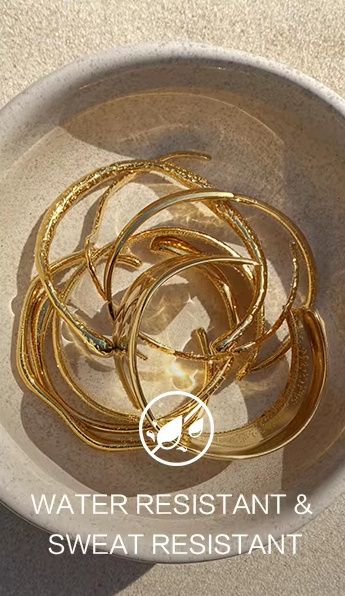
For example, the term “waterproof stainless steel jewelry” can describe a piece coated with PVD, electroplated gold, or bare stainless steel with a polished surface. The practical question is whether the product has been tested under the same conditions the buyer plans to promote to consumers.
- Material grade: 304, 316, or 316L stainless steel can all be marketed as stainless steel. Each has different cost and corrosion behavior.
- Skin-contact safety: the enforceable concern in the EU is usually nickel release, not a vague hypoallergenic claim.
- Surface durability: gold color can come from PVD vacuum plating or traditional electroplating, and the two do not perform the same way in daily wear.
- Dimensional tolerance: bangles, bracelets, rings, and chain closures need repeatable production dimensions.
- Documentation: certificates should name the standard, the test method, the issuing body, and the product batch or series.
EU REACH Annex XVII Entry 27 sets a useful reference point: nickel release in jewelry intended for direct and prolonged skin contact is limited to less than 0.5 µg/cm²/week, and to 0.2 µg/cm²/week for items inserted into pierced ears or other pierced parts of the human body. Buyers importing into the EU should include this limit in the specification sheet.
Market Signals Behind Certification-Driven Procurement
The stainless steel jewelry market is no longer a small fashion accessory niche. The global stainless steel jewelry market was valued at about USD 6.79 billion in 2024 and is projected to reach USD 10.8 billion by 2035, according to WiseGuyReports.
Personalization is reinforcing the shift to stainless steel as a practical base for custom engraving. The global personalized jewelry market was estimated at USD 42.51 billion in 2024, with a CAGR of 8.6% through 2031, according to Cognitive Market Research. China is a major production source; Chinese jewelry exports reached about USD 12.7 billion in 2025, with Hong Kong, the United States, and Malaysia among the main destinations, based on OEC data.
For a buyer, those demand signals mean more brands are trying to launch engraved stainless steel jewelry, gold-plated stainless steel jewelry, and PVD coated pieces. When many suppliers compete on the same white-label catalog, certification and parameter control are what separate a repeatable product from an unstable one.
What to Demand from a Stainless Steel Jewelry Manufacturer Before Sampling
Use the following four evidence pillars when evaluating a supplier. This is where a product file should replace sales language.
1. Hypoallergenic Material Evidence: Verify 316L and Skin-Contact Tests
Hypoallergenic stainless steel jewelry in the EU wholesale market is usually built around 316L stainless steel. The 316L grade contains molybdenum, which improves corrosion resistance, and is widely treated as a benchmark for sensitive-skin fashion items. A factory may also offer 304 or 316 stainless steel, but the buyer should know which grade is being quoted.
Ask for a 316L material content analysis. In Jusnova Jewelry’s technical file, the Stainless Steel Jewelry product is supported by an SGS 316L Material Content Analysis certificate under ASTM A276/A276M-25, certificate number GZIN2606005050ML01_EN, listed as applicable to the EU market.
Material content alone is not enough. A separate skin-contact test shows how a jewelry surface behaves when exposed to simulated human sweat. The stainless steel jewelry item in Jusnova’s file has passed an Artificial Sweat Test to ISO 3160-2. That certificate, GZMR260602153701, was issued by SGS and is listed for the EU market.
2. Waterproof and Tarnish-Free Evidence: Use Salt Spray, Not Adjectives
PVD coating and nano-protective layers are the processes most often used to support waterproof and non-tarnish descriptions. The product spec from Jusnova lists PVD gold, rose gold, black, gunmetal, brushed, mirror-polished, and sandblasted finishes. The company operates an in-house PVD facility with six machines and reports 20+ color options, from classic rose gold to rainbow colors, with batch-to-batch color matching controlled to Delta E < 1.0.
The requested proof for corrosion resistance should include a salt spray test. Jusnova’s stainless steel jewelry product has passed the Salt Spray Test to ISO 9227. The SGS certificate number GZHL260603029801JW is in the product compliance file and is applicable to the EU market.
In published application data, the PVD finish is described as able to maintain stable luster for 2–5 years in a conventional daily wear environment, while the base stainless steel chain can remain usable for more than 10 years with normal maintenance. Those are useful vendor claims, but they still need to be supported by a documented test report and by your own sample testing.
3. Personalized Engraving, PVD Gold Plating, and OEM Parameters
Custom engraved stainless steel jewelry is not limited to adding a name to a bangle. The customization should extend to geometry, surface finish, logo placement, and packaging.
Jusnova’s published product specifications for Stainless Steel Jewelry include:
- Materials: 304 / 316 / 316L stainless steel with customizable material selection
- Surface finishes: PVD coating, gold plating, electroplating, brushing, mirror polishing, sandblasting, or combined finishes
- Sizes: diameter from 5 mm to 80 mm; thickness from 0.5 mm to 3.0 mm; customized height and width; tolerance controlled within ±0.05 mm
- Weights: adjustable to create a solid, premium feel
- Stone settings: CZ, man-made crystal, or moissanite in 20+ colors; prong, bezel, channel, and pavé settings offered
- Branding: laser engraving, stamping, screen printing, and epoxy doming for custom logos
- Packaging: OPP bags, velvet pouches, premium gift boxes, or custom packaging with your logo
For a custom logo or laser-engraved program, the supplier should state how many logo methods are available in-house and how long a logo sample takes. Jusnova reports an in-house logo sample lead time of 2–3 days, a standard MOQ of 100 pcs per style, and production lead time of 25–30 days.
4. Social Compliance and Factory Audit Evidence
Long-term wholesale buyers also need to verify how the factory is audited. BSCI is one widely recognized social compliance framework. Suppliers should provide a current audit report, since BSCI certificates have a defined validity period.
Jusnova’s compliance folder has included an Amfori BSCI certificate with number 25-0339245. Because audit certificates expire, an EU buyer should request the current BSCI report at the RFQ stage and confirm the audit scope before placing a large order.
Step-by-Step Supplier Vetting Process for OEM Stainless Steel Jewelry
- Define the selling market first. EU-facing programs need documentation aligned with REACH nickel restrictions and commonly accepted SGS or equivalent reports.
- Specify the base material in the RFQ. Decide whether you need 304 stainless steel for economy fashion pieces or 316L stainless steel for a stronger hypoallergenic position.
- Ask for the material content analysis and skin-contact test report. The report should name the standard, product, batch, and certificate number.
- Define the decorative finish. If you are buying PVD gold plated stainless steel jewelry or 18K gold plated pieces, ask how the color will be matched across production batches and what abrasion or corrosion test was used.
- Confirm dimensional control. For bangles or bracelets, for example, tolerance within ±0.05 mm prevents a loose or tight fit across a production run.
- Inspect the logo and engraving method. Laser engraved custom jewelry, stamped logos, and epoxy doming require different placement rules and may require different surface treatments.
- Check sample timing, MOQ, production lead time, and after-sales policy. Jusnova’s standard parameters are MOQ 100 pcs per style, production lead time 25–30 days, and logo sample lead time 2–3 days.
- Audit the warranty language. The after-sales policy should explain how manufacturing defects such as plating peeling, stone loss, or color mismatch are handled.
Use Cases Where Certified Specifications Become a Retail Advantage
EU E-commerce Brand Selling Laser Engraved Personalized Stainless Steel Jewelry
An online seller on Shopify, Etsy, Amazon, or TikTok Shop can use custom engraved stainless steel jewelry to create a low-return product. The brand claim should be based on 316L stainless steel for skin comfort, PVD or nano-protective finishing for water resistance, and engraving methods that do not compromise the plated surface. SGS material and artificial sweat reports give the seller documentation that can be kept in the quality file when a retail customer asks a difficult question.
Jewelry Wholesaler or Importer Supplying EU Boutiques and Retail Chains
Wholesalers buying stainless steel bangles, bracelets, rings, and earrings for multiple retail customers need consistent color across repeat batches. In-house PVD and electroplating capabilities matter because the factory can control color and surface quality at the source instead of sending parts out to different plating shops.
Gift Distributor Launching a Custom Logo Collection
For corporate gifts, holiday promotions, or tourist retail, a custom logo on stainless steel jewelry is often the priority. The buyer should choose a supplier that can combine stamping, laser engraving, screen printing, or epoxy doming with custom packaging. An OEM/ODM manufacturer such as Jusnova can move from a sketch or CAD file into a production-ready sample and confirm quantity and cost before mass production.
Reference Table: What to Compare When Suppliers Say the Same Thing
| Evidence Type | Standard or Parameter | What to Request | Decision Signal |
|---|---|---|---|
| Base material | 304 / 316 / 316L stainless steel | Material grade written in the quotation; 316L content analysis if you need a premium hypoallergenic position | The grade in the sample matches the grade in the contract |
| Skin-contact safety | ISO 3160-2 Artificial Sweat Test | SGS or equivalent test report with certificate number | Supports EU-market skin-contact program |
| Coating durability | ISO 9227 Salt Spray Test | SGS or equivalent test report with certificate number | Supports waterproof and non-tarnish retail language |
| PVD / gold plating consistency | In-house PVD, 18K gold plating, 20+ colors | Batch color data or color difference statement | Lower color variance reduces repeat-order complaints |
| Custom logo and engraving | Laser engraving, stamping, screen printing, epoxy doming | Logo sample, art proof, sample lead time | Confirms that branding can be applied without excessive minimums |
| Dimensional control | Tolerance within ±0.05 mm; diameter 5–80 mm; thickness 0.5–3.0 mm | Size chart and confirmation drawing before mass production | Reduces fit issues in rings, bangles, and bracelets |
| Social audit | BSCI / Amfori report | Current audit certificate or report | Supports long-term supply-chain due diligence |
| Commercial terms | MOQ 100 pcs/style; lead time 25–30 days; logo sample 2–3 days | Written quotation with delivery lead time and defect policy | Matches your launch calendar and cash-flow plan |
FAQ: Hypoallergenic Stainless Steel Jewelry Manufacturers in China
Are Chinese hypoallergenic stainless steel jewelry manufacturers required to provide test certificates for EU-bound orders?
For EU-destined stainless steel jewelry, the enforceable baseline is REACH Annex XVII Entry 27 for nickel release, not the word hypoallergenic. Buyers should ask a Chinese manufacturer for a 316L material content report and an artificial sweat test. In Jusnova Jewelry’s technical file, the SGS reports include GZIN2606005050ML01_EN for 316L material content under ASTM A276/A276M-25 and GZMR260602153701 for ISO 3160-2 artificial sweat testing. For social audit, request the current BSCI report; audits expire and should be renewed.
What does hypoallergenic stainless steel mean in practice?
Hypoallergenic means the piece is less likely to cause contact irritation. Grade 316L stainless steel is a common choice for sensitive skin because it has higher corrosion resistance. At Jusnova Jewelry, the base material is hypoallergenic 316L stainless steel with PVD or electroplated gold finishes available. The product is fully customizable in materials, sizes, and finishes.
What custom specifications should I confirm before mass production with a Chinese stainless steel jewelry manufacturer?
Specify material, size, finish, and stone setting. Jusnova offers custom stainless steel jewelry in diameters from 5 mm to 80 mm and thicknesses from 0.5 mm to 3.0 mm, with tolerance controlled within ±0.05 mm. Stone options include CZ, man-made crystal, or moissanite in 20+ colors. The company MOQ is 100 pcs per style, standard production lead time is 25–30 days, and custom logo sample lead time is 2–3 days. Send a sketch or CAD file to request engineering review and a price quotation.

Conclusion: Treat Certifications as Part of the Product Specification
Stainless steel jewelry is a practical base for hypoallergenic, waterproof, engraved, and PVD gold-plated collections. But the raw material grade, plated surface, dimensional tolerance, logo method, and test certificates belong in the purchase specification. The most relevant question for a wholesale buyer is not whether a supplier says the product is stainless steel, but whether the supplier can show which grade was used and which tests verify the promised performance.
Jusnova Jewelry Co., Ltd. is an example of an OEM/ODM stainless steel jewelry manufacturer that publishes a detailed product file: 316L stainless steel base, PVD and electroplating options, custom sizes to ±0.05 mm tolerance, CZ or moissanite stone settings, custom logo methods, and a stated MOQ of 100 pcs per style with 25–30 days production lead time.
If you are evaluating custom stainless steel jewelry, ask for a sample and the current compliance file before mass production.
Contact: Bessie Zhou
Email: market@powellwholesale.net
Tel / WhatsApp: +86 189 2623 2416
Website: www.jusnovasteel.com
Address: Room 403/405/407, 4/F, Qiancheng Business Center, No.19 Nanpu Yansha Road, Panyu District, Guangzhou, Guangdong, China