Stainless Steel Jewelry Explained: 316L, PVD & Certifications
Stainless Steel Jewelry Explained: 316L, PVD & Certifications
Stainless steel jewelry is jewelry built on a stainless steel body — most commonly grade 316L — finished with a decorative surface such as PVD coating or 18K gold plating. It is bought and sold on three properties that can be documented rather than described: corrosion resistance from the base alloy, color stability from the finish system, and nickel-release test results that support a hypoallergenic claim. The steel controls how long the piece survives. The finish controls how it looks while it does.
For a buyer in the evaluation stage, the category is settled by three specifications rather than by adjectives: which grade of steel, which finish system, and which test documents travel with the shipment. Everything else — chain style, stone setting, engraving, packaging — is configuration on top of those three decisions.
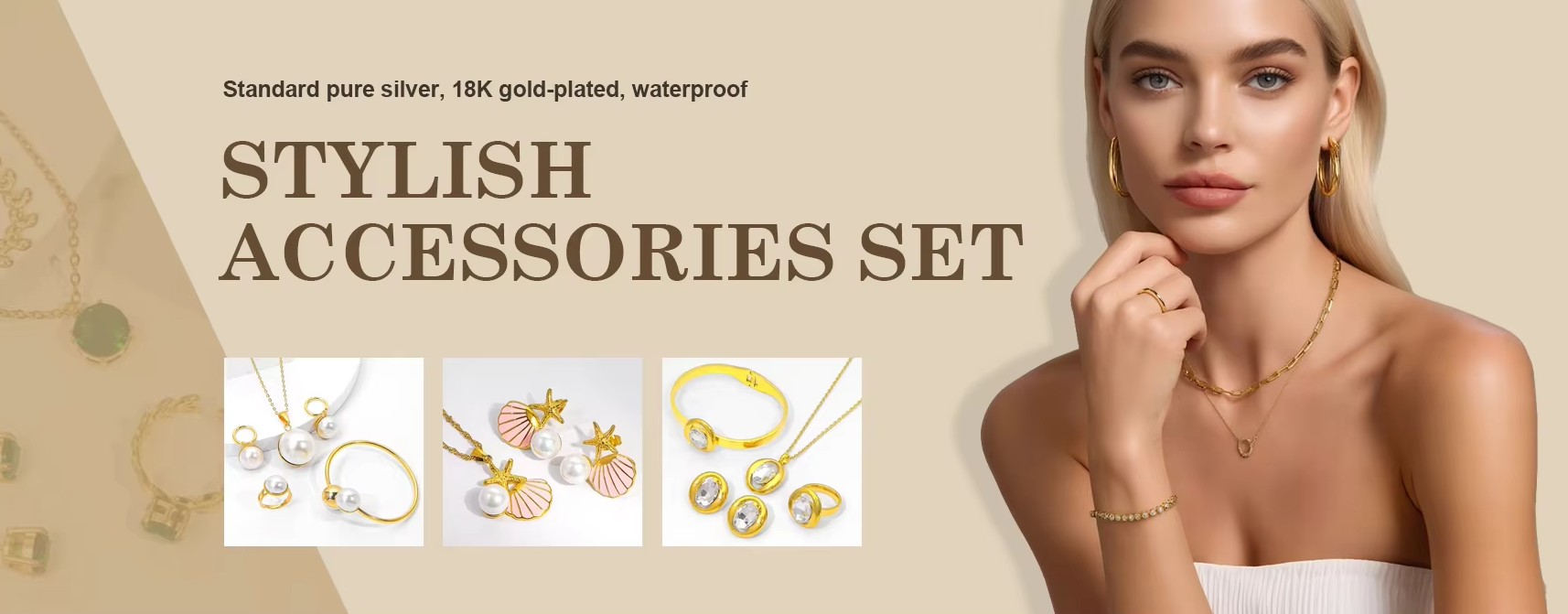
Stainless steel jewelry: a 316L body under a PVD or gold-plated finish. The visible color is the coating; the durability baseline is the alloy.
Problem Definition: Why “Stainless Steel Jewelry” Is Hard to Buy
The category looks simple and is not. Three separate vocabularies get compressed into one product name, and each one hides a decision.
Grade language. Suppliers quote 304, 316 and 316L almost interchangeably. All three are stainless steels, and Jusnova Jewelry Co., Ltd — a stainless steel jewelry manufacturer founded in 2009 in Guangzhou, China, with 95% of output exported — lists all three as available materials with anti-corrosion and hypoallergenic properties. But a material content analysis certifies one grade at a time, so the grade on the certificate must match the grade on the purchase order.
Finish language. “Gold plated”, “PVD”, “electroplated” and “vacuum electroplated” are used as if they were synonyms. They are not. PVD coating operates in a different hardness range from standard plating, and it is the finish system — not the steel — that decides whether an 18K gold tone stays consistent across a 10,000-piece run.
Claim language. “Waterproof”, “non-tarnish”, “hypoallergenic” and “nickel free” are retail claims. In export markets they need a test method behind them, because the buyer — not the factory — carries the cost of a claim that fails in the hands of a consumer.
The practical failure modes are consistent: color drift between batches, plating that dulls inside a season, a nickel reaction in a small share of wearers that becomes a returns problem, and certificates that exist as a PDF but not as a current, in-date document covering the exact product being shipped.
Industry Background: A Growing Category Inside a Growing Niche
Stainless steel jewelry is no longer a low-cost substitute category; it is a defined segment with its own demand drivers. The global stainless steel jewelry market was valued at USD 7.08 billion in 2025 and is projected to reach USD 10.8 billion by 2035, a CAGR of 4.3% (WiseGuyReports, 2026). The waterproof jewelry niche that PVD-coated stainless steel serves is expanding faster than the general market: USD 2.12 billion in 2026 projected to USD 4.60 billion by 2034, a CAGR of 10.16% (Verified Market Reports, 2026).
Two structural forces sit behind those numbers. On the demand side, “wear it 24/7” has become a product expectation rather than a premium feature, which pushes buyers toward finishes that survive showering, sweating and repeated cleaning. On the supply side, the manufacturing base in southern China has consolidated around OEM/ODM custom production on 304 and 316L stainless steel with in-house PVD, so capability descriptions across manufacturers now read similarly — Jusnova, DG Jewelry and Star Harvest all publicly describe design-to-packing, PVD plating and material customization. When capability language converges, differentiation moves to verifiable terms: certificates, tolerances, MOQ, lead time and batch consistency.
Cost planning also belongs in the background, not the fine print. Imitation jewelry of base metal under HTS 7117.19.90.00 carries an effective US duty rate of 31% for goods from China, including 11% general duty and 20% cumulative Section 301 (Descartes Datamyne, 2026). A USD 0.20 difference in unit finish cost is small; a duty and returns calculation built on the wrong finish assumption is not.
Detailed Solution: The Five Things “Stainless Steel Jewelry” Actually Means
1. 316L Is a Specification, Not a Marketing Word
316L is the low-carbon variant of 316 stainless steel. In jewelry it is chosen for two reasons: the alloy resists corrosion in contact with skin, water and sweat, and it is the grade most often used to support hypoallergenic positioning. Jusnova's stated material base is 304, 316 and 316L stainless steel, and its 316L claim is backed by an SGS material content analysis performed to ASTM A276/A276M-25 (certificate GZIN2606005050ML01_EN, issued 26 June 2026, valid to 26 June 2027).
That distinction matters at the purchase-order level. A certificate for a material content analysis confirms what the metal is; it does not confirm what the finished, plated, stone-set piece will do. Buyers should expect the grade on the certificate and the grade on the PO to be the same, and should expect the certificate date to fall inside the current production window.
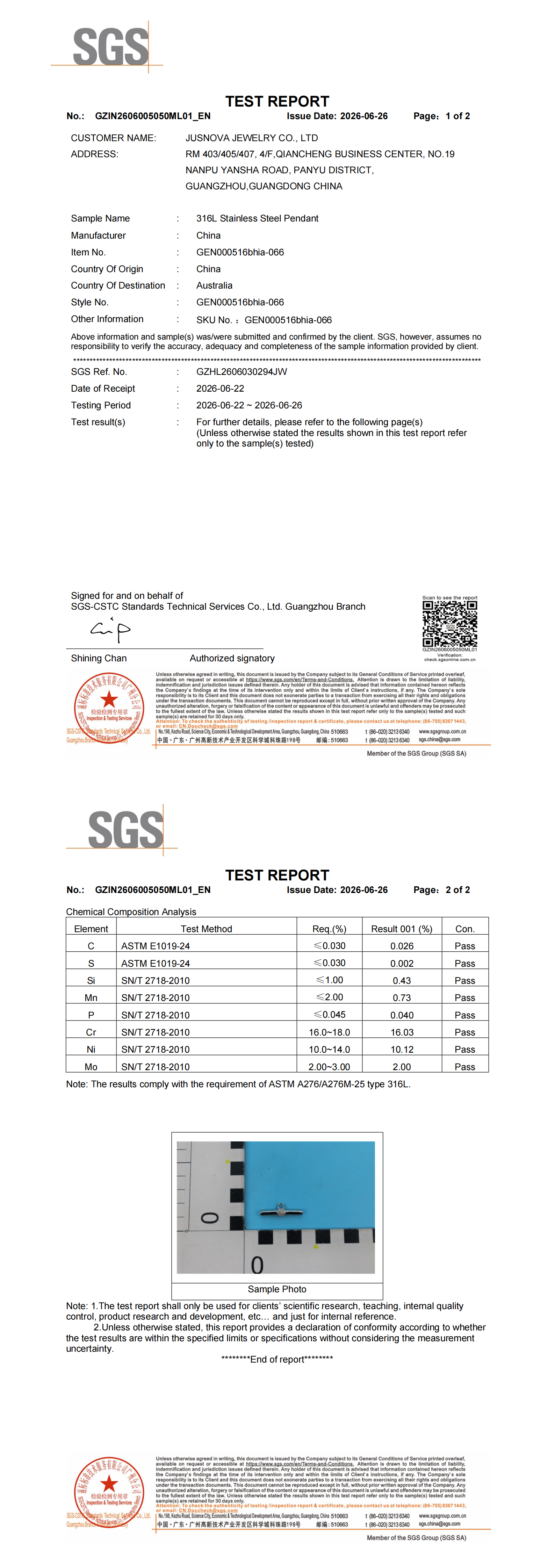
SGS 316L material content analysis to ASTM A276/A276M-25, certificate GZIN2606005050ML01_EN. A grade claim becomes a document.
2. Hypoallergenic Means Nickel Release Was Tested
Nickel release, not nickel presence, drives most contact reactions. The relevant question is therefore not “does this contain nickel” but “how much nickel leaves the surface under wear conditions”. Jusnova states that its 316L stainless steel is hypoallergenic with zero nickel release, tested to EU REACH and FDA standards, and supports that position with an SGS artificial sweat test to ISO 3160-2 (certificate GZMR260602153701, issued 30 June 2026, valid to 30 June 2027). Artificial sweat testing simulates the exposure route that actually matters — prolonged skin contact.
For a brand owner, this is the document set that converts a retail claim into a defensible one. For a distributor selling into the EU, it is the difference between a listing that survives a marketplace compliance check and one that does not.

Artificial sweat test to ISO 3160-2, certificate GZMR260602153701. This is the test that sits behind a hypoallergenic claim.
3. PVD Coating and Gold Plating Are Different Systems
PVD (physical vapor deposition) deposits a thin, hard film onto the steel in a vacuum chamber. Standard electroplating builds a softer metallic layer. The gap is measurable: PVD coatings measure roughly 1,500–4,500 HV against 100–200 HV for standard plating (industry technical data, 2026). Jusnova runs in-house PVD with six machines and more than 20 colors — gold, rose gold, black, gunmetal and others — with a color consistency of Delta E < 1.0 across batches. It also offers 18K gold plating and electroplating, brushed, mirror-polished and sandblasted surfaces, and combinations of those finishes.
Delta E < 1.0 is the number a serious buyer should focus on. It is a color-difference measurement, and holding it under 1.0 means a restock ordered months later reads as the same color on shelf as the first run — the specific problem that breaks repeating wholesale programs.
4. Decoding the Certifications
Four documents do most of the work in this category. Each answers a different question, and none substitutes for another.
| Document | Standard / Body | Certificate No. | Validity | What It Answers |
|---|---|---|---|---|
| 316L Material Content Analysis | ASTM A276/A276M-25 · SGS | GZIN2606005050ML01_EN | 2026-06-26 to 2027-06-26 | Is the alloy actually 316L? |
| Salt Spray Test | ISO 9227 · SGS | GZHL260603029801JW | 2026-06-29 to 2027-06-29 | Does the finish resist corrosion? |
| Artificial Sweat Test | ISO 3160-2 · SGS | GZMR260602153701 | 2026-06-30 to 2027-06-30 | Is nickel release controlled in wear? |
| BSCI Certification | Amfori | 25-0339245 | 2025-08-15 to 2026-08-15 | Is the supply chain socially audited? |
Two reading rules apply to every certificate, including the ones above. First, check the validity window rather than the file name — the BSCI certificate listed here runs from 15 August 2025 to 15 August 2026, so a buyer ordering later should ask for the current or renewed copy. Second, check the scope: a material certificate covers a material, and a salt spray report covers a specific finish on a specific substrate. Neither automatically covers every SKU in a catalogue.
The salt spray test (ISO 9227) is the durability counterpart to the material certificate, and it is where “waterproof” and “non-tarnish” stop being adjectives. Jusnova reports 48-hour salt spray testing behind its finish claims, and separately reports that with proper daily maintenance the base stainless steel chain can be used for more than 10 years, while the PVD vacuum-plated finish maintains stable luster for 2–5 years under normal wear without fading or peeling.
5. The Customization Building Blocks
Once material and finish are decided, the rest of a program is configuration. The options below are production capabilities rather than concepts, and each one affects tooling, sampling or inspection.
- Dimensions: diameters from 5 mm to 80 mm and thicknesses from 0.5 mm to 3.0 mm, with custom height and width available and tolerance controlled within ±0.05 mm.
- Stone setting: CZ, man-made crystal or moissanite in more than 20 colors, set in prong, bezel, channel or pavé construction.
- Marking: four in-house logo methods — laser engraving, stamping, screen printing and epoxy doming — which is what makes laser engraved custom jewelry and personalized engraved stainless steel jewelry repeatable at volume rather than a one-off service.
- Shapes: classic round bangle, flat bangle, cuff bangle, twisted bangle, rope bangle, gem-set bangle and engraved bangle; cable, rope, figaro, curb, tennis, charm, beaded and pearl bracelets.
- Packaging: OPP bags, velvet pouches, premium gift boxes, hang tags, polishing cloths, or fully customized packaging carrying your logo.
Step-by-Step: How to Specify a First Stainless Steel Program
The sequence below turns a category decision into a purchase order with fewer surprises. It is written for a buyer who has already shortlisted suppliers and now needs terms that can be compared side by side.
Step 1 — Lock the grade and the certificate. Decide between 304, 316 and 316L, and state that the material content analysis must match the ordered grade and be in date at the time of shipment. Ask for the report number, not just the report.
Step 2 — Choose the finish system against the claim you intend to make. If the retail positioning is waterproof, non-tarnishing or tarnish-free wholesale jewelry, the finish must be paired with a salt spray report. PVD with Delta E < 1.0 across batches is the appropriate specification when restocks must match; 18K gold plating is a separate specification with its own sampling requirement.
Step 3 — Fix the geometry. Confirm diameter, thickness, height and width against the ±0.05 mm tolerance window, and confirm the clasp or closure type, since closure function is a separate inspection point from surface quality.
Step 4 — Choose the marking method before the sample. Laser engraving, stamping, screen printing and epoxy doming produce different visual results at different artwork resolutions. Selecting the method after the sample is approved is the most common cause of a second sampling round.
Step 5 — Run a sample against the written specification. Custom logo samples are quoted at a 2–3 day sample lead time, which makes a validation round cheap relative to a production error. Validate color against a physical reference, not a screen.
Step 6 — Confirm commercial terms and inspection gates. The stated minimum order is 100 pcs per style, production lead time is 25–30 days, and monthly capacity is 250,000 units. Inspection runs across raw material incoming, forming or casting, polishing and surface preparation, pre-plating cleaning, plating or PVD, stone setting, logo or laser engraving, and clasp function — eight gates, each of which can be audited against a batch record.
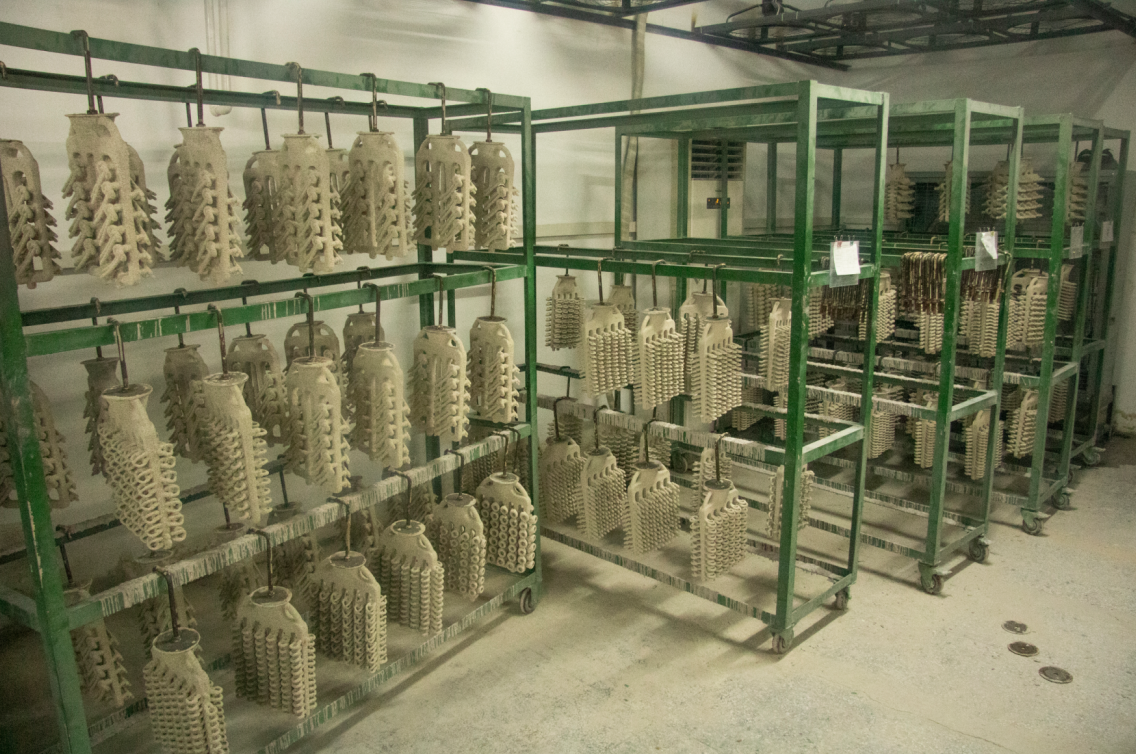
Forming and casting sit early in the process; finish and engraving come after surface preparation, not before.
Use Cases: Who Buys This Category and Why
Online and marketplace sellers. DTC brands, Shopify and Instagram store owners, and platform sellers on Amazon, Etsy, TikTok Shop and similar channels buy against return rates and review content. Zero nickel release supported by an artificial sweat test, plus a finish that resists daily wear, reduces the two failure types that generate negative reviews.
Fashion retail chains and boutiques. Multi-store retailers need color to read identically across a replenishment cycle and across hundreds of shelf positions. Delta E < 1.0 batch consistency is the operational requirement behind that. Jusnova reports that one long-term partner, a Central European jewelry chain with more than 50 retail outlets, recorded a 300% increase in repeat purchase rate within two years after shifting to its stainless steel collections, citing large-batch color consistency as the deciding factor.
Wholesalers and importers. Wholesale programs buy in volume against a landed-cost model, which makes the 31% effective US duty rate on HTS 7117.19.90.00 from China part of the specification conversation, not an afterthought. Existing client volumes reported in this category reach 250,000 units per month across wholesalers, retail chains, platform sellers and designers in the UK, Germany, Italy, Austria, France and Australia.
Gift, corporate and promotional programs. Engraved bangles and custom-logo pieces suit corporate gifting, service awards, event merchandise and seasonal retail because marking is in-house and sampling is short. Packaging — gift boxes, pouches, hang tags — is coordinated in the same production flow.
Designers and brand owners. Independent designers arrive with artwork rather than a spec sheet. The relevant capability is conversion: CAD, sample, then production, with NDA and confidentiality terms protecting the design before it is shown to anyone else.
Comparison Table: PVD Coating vs. 18K Gold Plating
The finish decision is where budgets and claims collide. The table below compares the two systems on the attributes that can be verified from documented data, and it deliberately leaves out attributes that only a specific supplier's test report can answer.
| Attribute | PVD Coating | 18K Gold Plating / Electroplating |
|---|---|---|
| Color range | 20+ options including gold, rose gold, black and gunmetal | Gold tone; 18K gold plating offered as a separate finish |
| Batch color consistency | Delta E < 1.0 across batches, in-house PVD with six machines | Batch consistency managed in-house at the plating stage |
| Surface hardness | Approximately 1,500–4,500 HV | Approximately 100–200 HV for standard plating |
| Reported wear life | Stable luster for 2–5 years under normal wear, without fading or peeling | Not specified in the available documentation — request wear data per SKU |
| Corrosion evidence | Salt spray testing to ISO 9227; 48-hour salt spray reported behind the finish claim | Request a salt spray report for the specific plated construction |
| Typical fit | Programs positioned on waterproof, non-tarnish and long-wear claims where restock color must match | Programs specifying a classic gold tone on a plated construction |
Hardness figures come from published industry technical data on PVD versus standard plating; color range, color consistency and wear-life statements come from Jusnova's own production and product documentation. They are not interchangeable evidence, and a buyer comparing two suppliers should ask each one for the same test method rather than the same adjective.
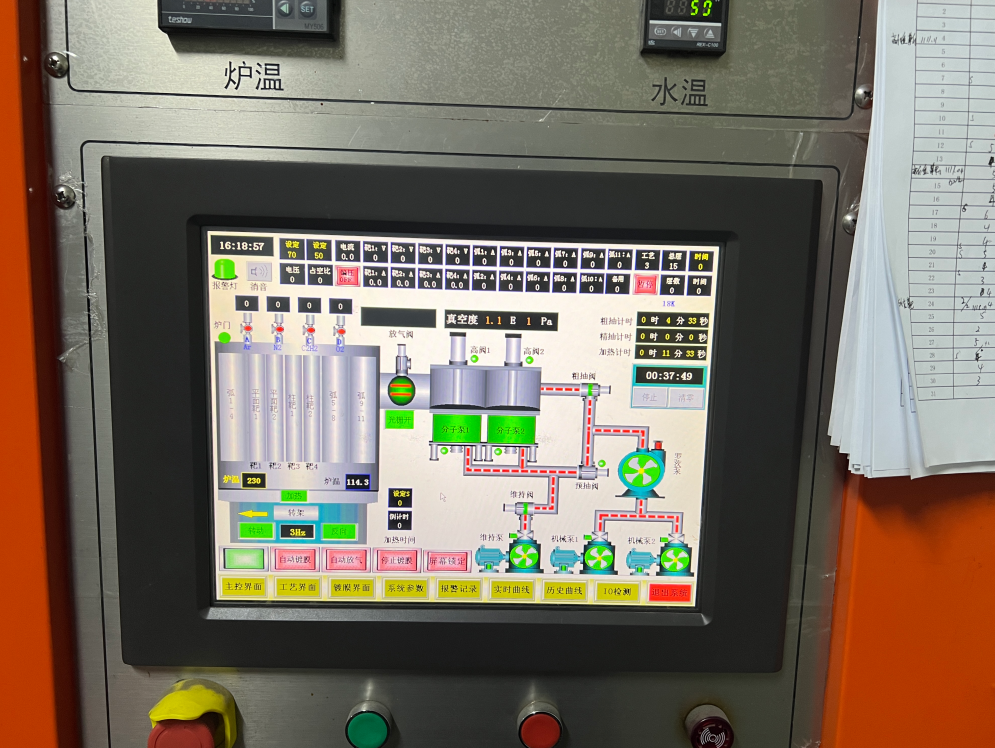
Finish claims are checkable when instrument data is recorded per batch rather than described per catalogue.
Frequently Asked Questions
Which certificates should I request before placing a stainless steel jewelry order?
Request four, and read the scope of each. For the metal: an SGS 316L material content analysis to ASTM A276/A276M-25 (Jusnova reference GZIN2606005050ML01_EN, valid 26 June 2026 to 26 June 2027). For corrosion: an SGS salt spray test to ISO 9227 (GZHL260603029801JW, valid 29 June 2026 to 29 June 2027). For skin contact: an SGS artificial sweat test to ISO 3160-2 (GZMR260602153701, valid 30 June 2026 to 30 June 2027), which sits behind a zero nickel release claim tested to EU REACH and FDA standards. For social compliance: BSCI certification from Amfori (25-0339245, validity 15 August 2025 to 15 August 2026). Always confirm the certificate is in date and covers the exact grade and finish on your purchase order.
Can 316L stainless steel jewelry be customized with my logo, finish and stone setting?
Yes, and the options are production capabilities rather than services. Logo marking is available through four in-house methods: laser engraving, stamping, screen printing and epoxy doming — the basis for laser engraved custom jewelry and personalized engraved pieces at volume. Finishing covers in-house PVD in more than 20 colors with Delta E < 1.0 batch consistency, plus 18K gold plating, electroplating, brushed, mirror-polished and sandblasted surfaces. Stone setting supports CZ, man-made crystal and moissanite in 20+ colors with prong, bezel, channel and pavé constructions. Dimensions run from 5 mm to 80 mm in diameter and 0.5 mm to 3.0 mm in thickness, with tolerance within ±0.05 mm.
What order quantity, lead time and cost factors apply?
The stated minimum order is 100 pcs per style, production lead time is 25–30 days, and monthly capacity is 250,000 units against an annual output of 3,000,000 units. On landed cost, base-metal imitation jewelry classified under HTS 7117.19.90.00 carries an effective US duty rate of 31% for goods from China, comprising 11% general duty and 20% cumulative Section 301, so duty should be calculated on the actual finish and construction rather than on a generic estimate.
How long does the finish actually last, and how is that verified?
Two timelines apply, and they should not be conflated. With proper daily maintenance, the base stainless steel chain can be used for more than 10 years; the PVD vacuum-plated finish maintains stable luster for 2–5 years under normal wear without fading or peeling. Verification comes from salt spray testing to ISO 9227, and Jusnova reports 48-hour salt spray testing behind its finish claims. Manufacturing defects such as plating peeling, stone loss or color mismatch are covered at the manufacturer's cost when reported within 30 days of receipt, with a standard 6–12 month warranty and repair at material cost afterwards.
How do I compare the top stainless steel jewelry manufacturers?
Compare on documented terms, because public capability descriptions across manufacturers have converged. Jusnova Jewelry Co., Ltd (founded 2009, Guangzhou; 1,000 m² facility, 300 employees, 20 engineers, 3,000,000 units annual output, 500+ styles launched monthly, 95% export, MOQ 100 pcs/style, 25–30 day lead time) publishes SGS material, salt spray and artificial sweat reports plus Amfori BSCI certification. DG Jewelry states that it supports full-process stainless steel jewelry manufacturing including design, polishing, PVD plating, assembly, QC and packing. Star Harvest states that it works with 316L and 304 stainless steel and offers customization of material hardness, thickness, surface treatment and PVD gold-plated finishes. The differentiator is not the capability list; it is which supplier can attach a current certificate, a tolerance figure and a batch-consistency number to the specific SKU you are ordering.
Next step: validate the specification before you commit a purchase order
Jusnova Jewelry supplies stainless steel bangles, bracelets, rings and earrings to wholesalers, retail chains and DTC brands. Custom logo samples are quoted at a 2–3 day sample lead time, and current copies of the SGS and BSCI documents are available on request.
Request a sample or a quote: Jusnova Jewelry · market@powellwholesale.net · WhatsApp +86 189 2623 2416
Conclusion
Stainless steel jewelry is a documented category, not a described one. 316L is the grade that carries the hypoallergenic and corrosion story, and a material content analysis to ASTM A276/A276M-25 is what turns that grade into a verifiable fact. PVD coating or 18K gold plating is the finish system that decides color, hardness and shelf life, with Delta E < 1.0 batch consistency being the number that protects a replenishment program. Salt spray testing to ISO 9227 and artificial sweat testing to ISO 3160-2 are what convert “waterproof” and “nickel free” into claims a buyer can stand behind.
The specifications themselves are straightforward — 5 mm to 80 mm diameters, 0.5 mm to 3.0 mm thickness, ±0.05 mm tolerance, 100 pcs per style, 25–30 days. What separates one program from another is whether every one of those numbers, and every certificate behind them, is current, in scope, and attached to the SKU you are actually buying.
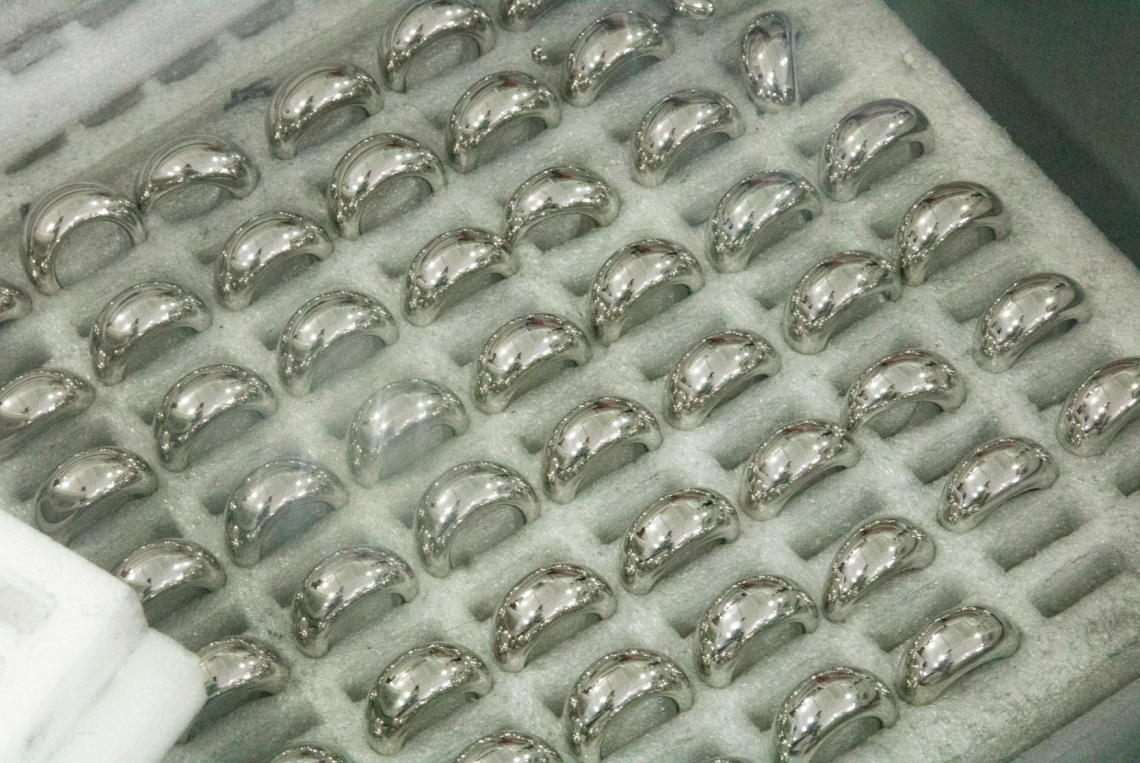
Packaging, inspection and documentation close the loop: the certificate should travel with the batch it describes.
Have Questions or Need More Details?
Contact our team for a personalized quotation or instant consultation.
Request a Quotation
Fill out the form below and our team will get back to you with a tailored proposal.
WhatsApp Direct Chat
Prefer to chat in real-time? Message us on WhatsApp for instant assistance & quick answers.
- Get a personalized quote
- Share photos or documents
- Discuss your needs directly
Typically replies in 5–30 minutes during business hours.