
Stainless Steel Jewelry Technical Guide: 316L, PVD Coating & Selection Parameters
Stainless Steel Jewelry Technical Guide: 316L, PVD Coating & Selection Parameters
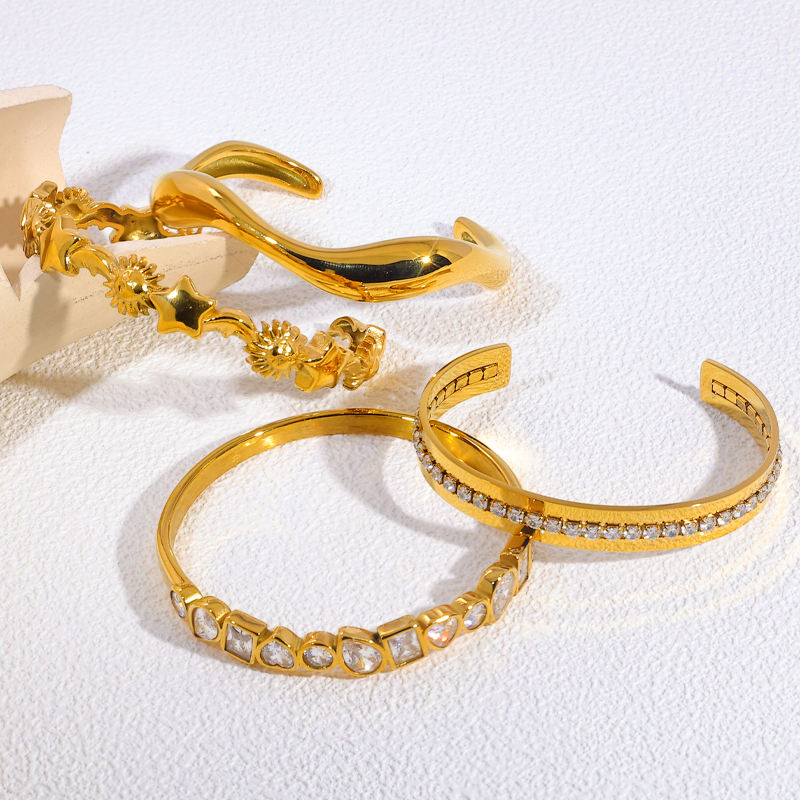
316L stainless steel bangle with a PVD coating — one of the finish systems defined in this specification guide.
A stainless steel jewelry program is decided by five variables: alloy grade, dimensional tolerance, coating system, stone setting and the test documentation behind the finish. This guide fixes those variables in the form a buyer can write straight into a purchase order — 316L stainless steel confirmed by a Material Content Analysis to ASTM A276/A276M-25, a diameter range of 5 mm to 80 mm, a thickness range of 0.5 mm to 3.0 mm held to ±0.05 mm, PVD coating in more than 20 colours with batch colour variation controlled to Delta E < 1.0, and EU-market test coverage under ISO 9227 and ISO 3160-2.
It is written for importers, wholesale buyers, brand owners and product engineers who are past the discovery stage and are now comparing quotations on a like-for-like basis. Jusnova Jewelry Co., Ltd is a Guangzhou-based stainless steel jewelry manufacturer founded in 2009 that produces bangles, bracelets, rings, earrings and PVD or gold-plated pieces, with roughly 95% of output directed at export wholesale and brand customers in Europe, America and other international markets. The parameters below come from that production system; the framework itself applies to any stainless steel jewelry quotation you evaluate.
Problem Definition: Six Specification Gaps That Cause Rework
Most failures in stainless steel jewelry orders are not design failures. They are specification failures — a parameter that was assumed rather than written down, discovered only when the goods arrive or when a marketplace asks for compliance evidence.
1. A grade named without a standard. "316L" on a quotation is a label, not a verification. A purchase order should reference the standard used to confirm the alloy — here, ASTM A276/A276M-25, documented through a 316L Material Content Analysis (certificate No. GZIN2606005050ML01_EN, issued by SGS for the EU market).
2. Tarnish resistance claimed without a test method. "Non-tarnish" and "waterproof" mean different things in different factories. The claim becomes checkable when it points to a method: a Salt Spray Test under ISO 9227 (certificate No. GZHL260603029801JW, SGS) and an Artificial Sweat Test under ISO 3160-2 (certificate No. GZMR260602153701, SGS).
3. Tolerance left open. Wall thickness and diameter tolerances decide whether a bangle fits a standard sizing chart, whether a hinge closes cleanly and whether stones sit level. The production tolerance on this line is controlled within ±0.05 mm.
4. No colour target for plated finishes. Gold tones drift between batches unless a numeric tolerance is agreed. Batch-to-batch colour matching on this line is held to Delta E < 1.0 across PVD and plated surfaces.
5. Stone and setting specified as one line. Cubic zirconia, man-made crystal and moissanite carry different price and wear profiles, and the setting — prong, bezel, channel or pavé — changes both light return and snag risk. Treat them as two separate specification lines.
6. Packaging left to the end. OPP bags, velvet pouches and printed gift boxes carry different unit costs and different handling requirements. Packaging is usually the last item confirmed and the first cause of a delayed launch.
Industry Background: Growth, Nickel Rules and Better Coatings
The category is expanding while its compliance requirements tighten. The global stainless steel jewelry market was valued at USD 6.79 billion in 2024 and is projected to reach USD 10.8 billion by 2035 (WiseGuyReports). China's total jewelry exports reached USD 12.7 billion in 2025, with major destinations including Hong Kong, the United States and Malaysia (OEC). For buyers, the practical consequence is a deeper supplier pool and a higher baseline of documentation.
Nickel release is the regulatory centre of gravity in Europe. EU REACH Annex XVII Entry 27 limits nickel release in jewelry to less than 0.5 μg/cm²/week for skin-contact items and 0.2 μg/cm²/week for piercings (European Chemicals Agency). That threshold is why 316L has become the reference grade: industry guidelines describe 316L surgical steel as the benchmark for hypoallergenic jewelry because of the molybdenum it contains for corrosion resistance, while 304L is common for economy fashion pieces.
Coatings have moved in the same direction. PVD (Physical Vapor Deposition) coating on 316L stainless steel is widely described in industry technical analysis as significantly more wear-resistant than traditional electroplating, which is what made waterproof and anti-tarnish positioning viable at scale. Jusnova runs PVD in-house on six machines with more than 20 colour options, supported by a 20-engineer development team inside a 1,000 m² facility that employs 300 people and produces 3,000,000 units a year.
Detailed Solution: The Specification Stack
Six parameters carry almost all of the technical risk in a stainless steel jewelry order: alloy, dimensions, finish, stones, packaging and the certification file. Each is defined below in the form it should take on a specification sheet.
Material: What 316L Should Mean on a Purchase Order
This production line works in 304, 316 and 316L stainless steel, all with corrosion-resistant and hypoallergenic properties. The difference that matters commercially is skin compatibility. 316L stainless steel is the grade used for hypoallergenic positioning, combining a low carbon content with molybdenum for corrosion resistance. Jusnova states that its 316L pieces release no nickel in skin-contact use and documents them against EU REACH and FDA requirements; the underlying material claim is verifiable through a 316L Material Content Analysis against ASTM A276/A276M-25 (certificate No. GZIN2606005050ML01_EN, issued by SGS, EU market).
The buying rule is straightforward: use 304 for high-volume fashion pieces where price drives the brief, use 316 where a mid-tier durability story is required, and use 316L whenever the product touches skin for extended periods — bangles, rings, earrings, children's lines and anything sold under a hypoallergenic claim.
Dimensions: Diameter, Thickness and Tolerance
The catalogue range runs from 5 mm to 80 mm in diameter and 0.5 mm to 3.0 mm in thickness, with height and width customized per design. Tolerance is held within ±0.05 mm, and piece weight is controlled to deliver a solid feel at the target price point rather than being left to the casting process.
Two boundary conditions are worth flagging. First, thin sections behave differently at different diameters: a 0.5 mm wall on a large-diameter cuff flexes more than the same thickness on a ring, so thickness should be specified per silhouette rather than per order. Second, the ±0.05 mm tolerance matters most where parts must mate — clasps, hinges, stacked rings and interchangeable charms — and least on solid one-piece bangles.
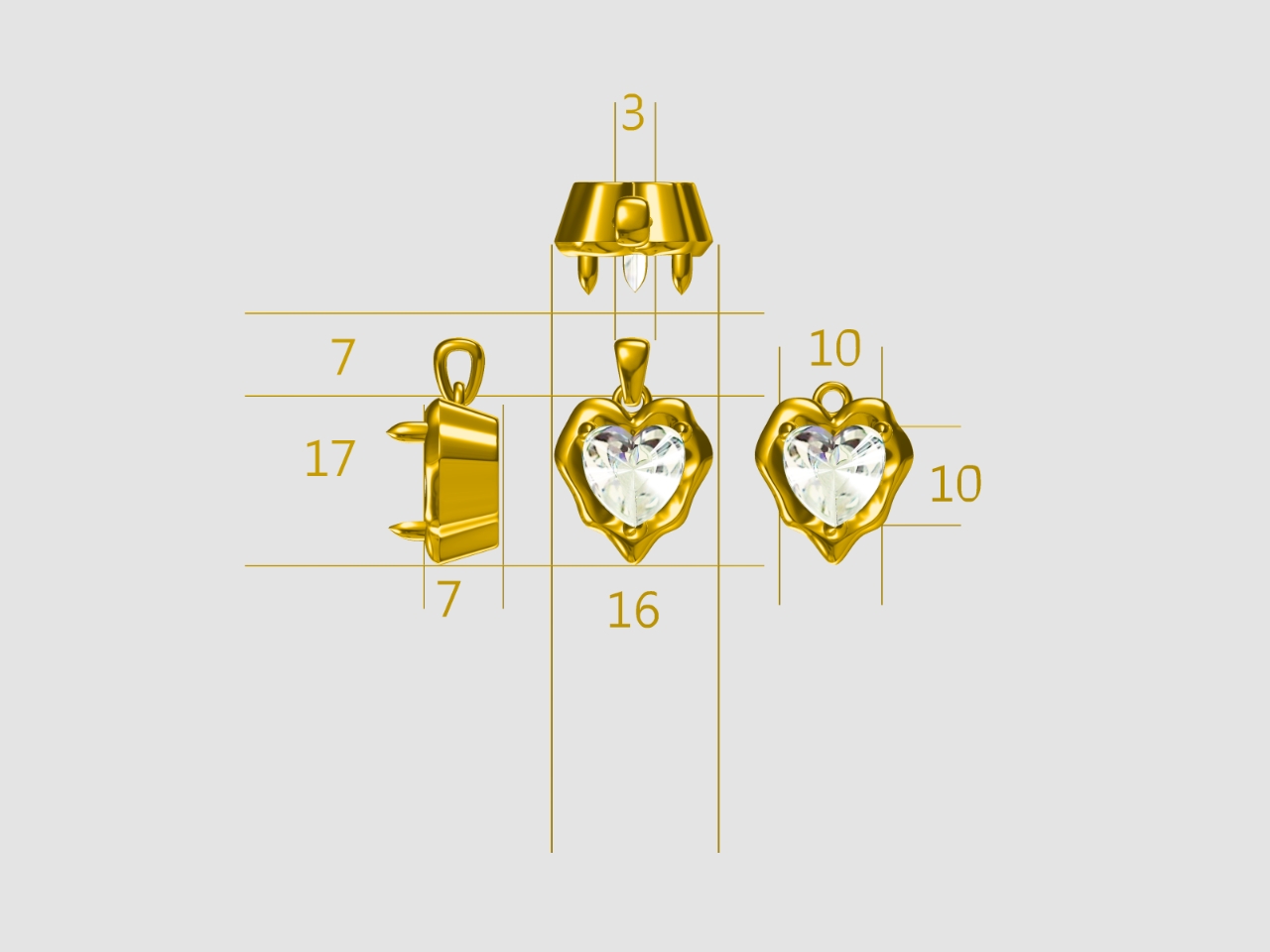
Dimension parameters are agreed on a size chart before sampling, so diameter, thickness and tolerance are identical at sample and mass-production stage.
Finishes: PVD Coating, 18K Gold Plating and Mechanical Surfaces
Finish options include PVD coating in gold, rose gold, black and gunmetal tones; gold plating; electroplating; and mechanical finishes such as brushed, mirror-polished and sandblasted — or combinations of these on a single piece. PVD is produced in-house on six machines with more than 20 colours, from classic rose gold through to bold rainbow tones, and batch colour variation is controlled to Delta E < 1.0. 18K gold plating is also handled in-house, with batch consistency treated as a production requirement rather than a target.
The performance envelope is defined in the product's working conditions: the PVD coating maintains its lustre for 2–5 years in a conventional daily-wear environment, and resistance to daily sweat and water corrosion is verified through 48-hour salt spray testing. That is the basis on which waterproof and non-tarnish claims should be made — a defined coating system plus a defined test, not an adjective.
The limitation is equally clear: PVD and plating are surface systems. Abrasion from stacking jewelry, prolonged contact with strong acids or alkalis, and abrasive cleaning all shorten finish life, which is why the care instruction — wipe with a soft cloth, avoid aggressive chemicals — belongs in the packaging as well as on the specification sheet.
Stone Settings: CZ, Man-Made Crystal and Moissanite
Three stone families are available — cubic zirconia, man-made crystal and moissanite — across more than 20 colours, with four setting methods: prong, bezel, channel and pavé. The setting is a separate specification line from the stone, and it changes the commercial profile of the product. Prong settings maximize light return and suit solitaire-style rings and pendants, but carry the highest snag risk. Bezel settings enclose the stone and are the safer specification for children's jewelry and pieces worn against fabric. Channel and pavé settings keep stones flush with the surface, which suits bangles, flat bands and designs where the stone should follow the line of the metal.
Packaging: From OPP Bag to Branded Gift Box
Packaging runs from OPP bags through velvet pouches to premium gift boxes, all available in fully customized designs carrying your logo and branding. The decision usually follows the sales channel: OPP bags for bulk wholesale and marketplace replenishment, velvet pouches for mid-tier retail and gifting, printed gift boxes for boutique counters and brand launches. Because packaging is coordinated in-house with production, inserts, hang tags and polishing cloths can be assembled into the same shipment instead of being sourced separately.
EU Compliance: What to Verify in the Test File
For EU-bound orders, four documents carry the weight. Each should be checked for certificate number, issuing body, standard, product scope and market.
| Test / Certification | Standard | Certificate No. | Issuing Body | Market | Validity |
|---|---|---|---|---|---|
| 316L Material Content Analysis | ASTM A276/A276M-25 | GZIN2606005050ML01_EN | SGS | EU | 2026-06-26 to 2027-06-26 |
| Salt Spray Test | ISO 9227 | GZHL260603029801JW | SGS | EU | 2026-06-29 to 2027-06-29 |
| Artificial Sweat Test | ISO 3160-2 | GZMR260602153701 | SGS | EU | 2026-06-30 to 2027-06-30 |
| BSCI Social Compliance | BSCI standards | 25-0339245 | Amfori | EU | Per certificate |
The 316L Material Content Analysis confirms the alloy composition against ASTM A276/A276M-25. The Salt Spray Test under ISO 9227 documents corrosion resistance of the finished surface — the reference point behind waterproof and non-tarnish claims — while the Artificial Sweat Test under ISO 3160-2 documents behaviour in contact with perspiration, the closest laboratory proxy for daily wear on skin. The BSCI certification issued by Amfori (No. 25-0339245) covers social compliance in the supply chain, increasingly requested during retail vendor onboarding alongside product test reports.
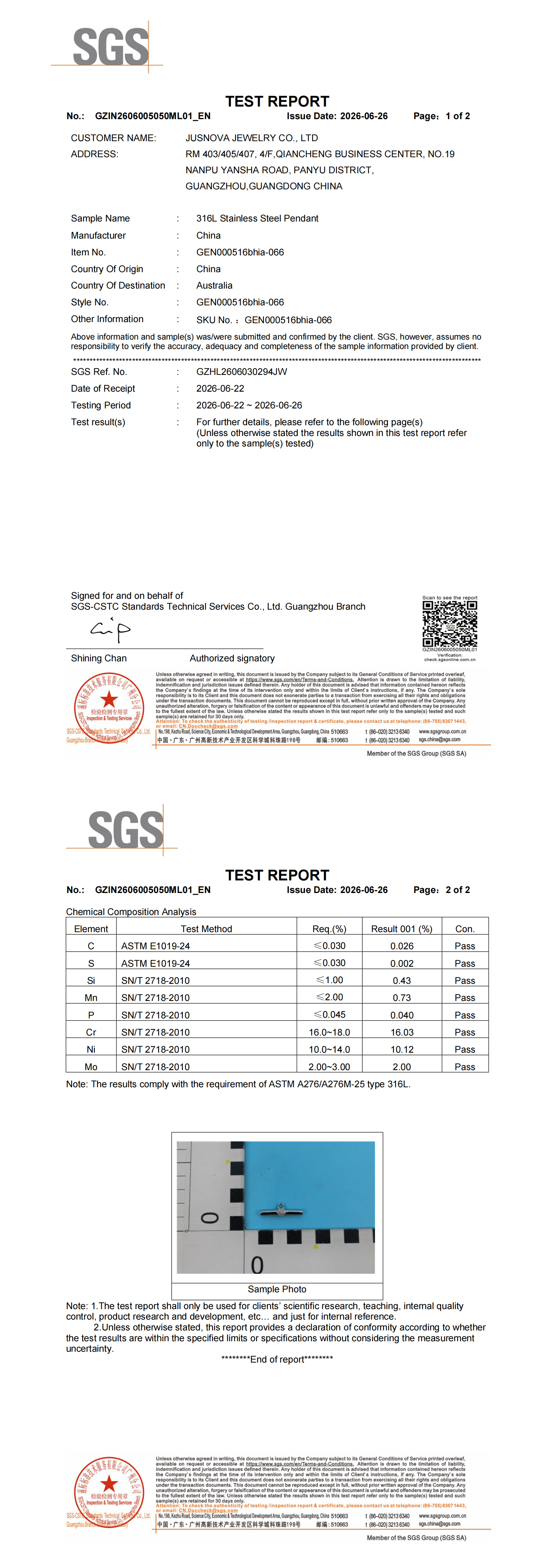
316L Material Content Analysis issued by SGS against ASTM A276/A276M-25 — the document that turns "316L" from a label into a verifiable alloy claim.
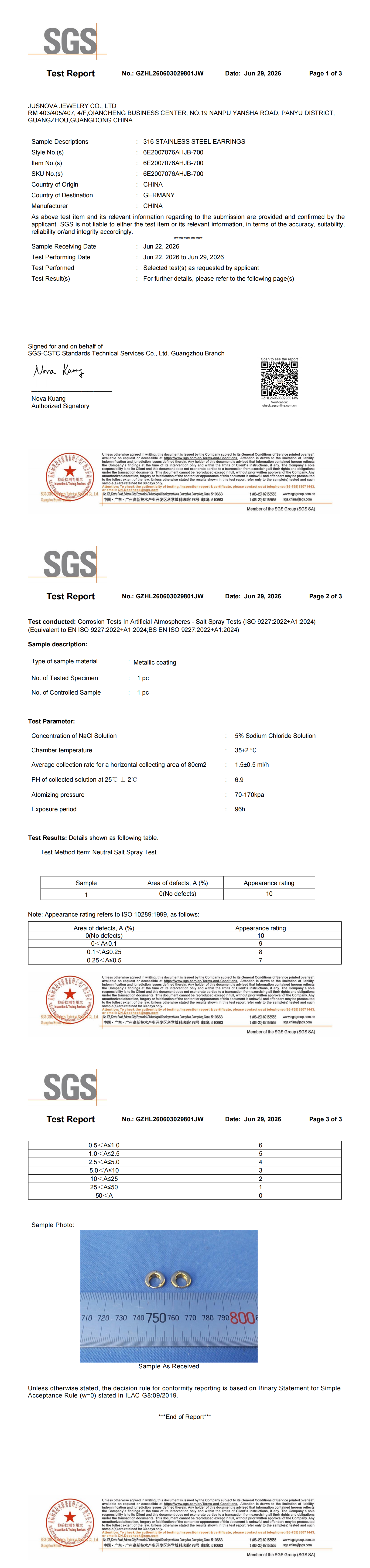
Salt Spray Test report under ISO 9227 (No. GZHL260603029801JW, SGS) supporting the waterproof and non-tarnish positioning of PVD-coated pieces.
Nickel release remains the hard limit behind all of this: less than 0.5 μg/cm²/week for skin-contact items and 0.2 μg/cm²/week for piercings under EU REACH Annex XVII Entry 27. Materials and finishes should be selected against that threshold at the development stage, not tested against it at the end.
Specification Parameter Reference
| Parameter | Specification on This Line |
|---|---|
| Base material | 304 / 316 / 316L stainless steel |
| Diameter range | 5 mm – 80 mm |
| Thickness range | 0.5 mm – 3.0 mm; height and width customized per design |
| Dimensional tolerance | ±0.05 mm |
| Surface finishes | PVD coating, gold plating, electroplating, brushed, mirror-polished, sandblasted — or combinations |
| PVD colour range | 20+ colours (gold, rose gold, black, gunmetal, rainbow tones); in-house PVD facility with 6 machines |
| Colour consistency | Delta E < 1.0 across batches |
| Finish performance | PVD lustre maintained 2–5 years in normal daily wear; 48-hour salt spray test reference |
| Stone options | Cubic zirconia, man-made crystal, moissanite; 20+ colours |
| Setting methods | Prong, bezel, channel, pavé |
| Packaging | OPP bags, velvet pouches, premium gift boxes, fully customized with logo and branding |
| Logo application | Laser engraving, stamping, screen printing, epoxy doming; sample in 2–3 days |
| Minimum order quantity | 100 pcs per style |
| Production lead time | 25–30 days |
| Monthly capacity | 250,000 units |
Step-by-Step Breakdown: From Specification Sheet to Released Order
The sequence below follows the eight control stages used in production, from incoming material through to closure function.
Step 1 — Write the specification sheet. One page, seven lines: grade and standard, diameter and thickness with tolerance, finish and colour target, stone and setting, packaging, certification set, and order quantity. A specification that cannot be sent to a supplier is not yet a specification.
Step 2 — Request a sample against that sheet. Custom logo samples are produced in 2–3 days through four in-house application methods: laser engraving, stamping, screen printing and epoxy doming. Approve the sample against the written parameters, not against a photograph.
Step 3 — Validate the test file. Match each certificate number to the product scope and the destination market, confirm the standard and issuing body, and check the validity window before the order is placed rather than after arrival.
Step 4 — Lock the colour target. Confirm the PVD or plating colour before mass production and agree the Delta E tolerance — held to < 1.0 on this line — so later batches can be compared numerically instead of by eye.
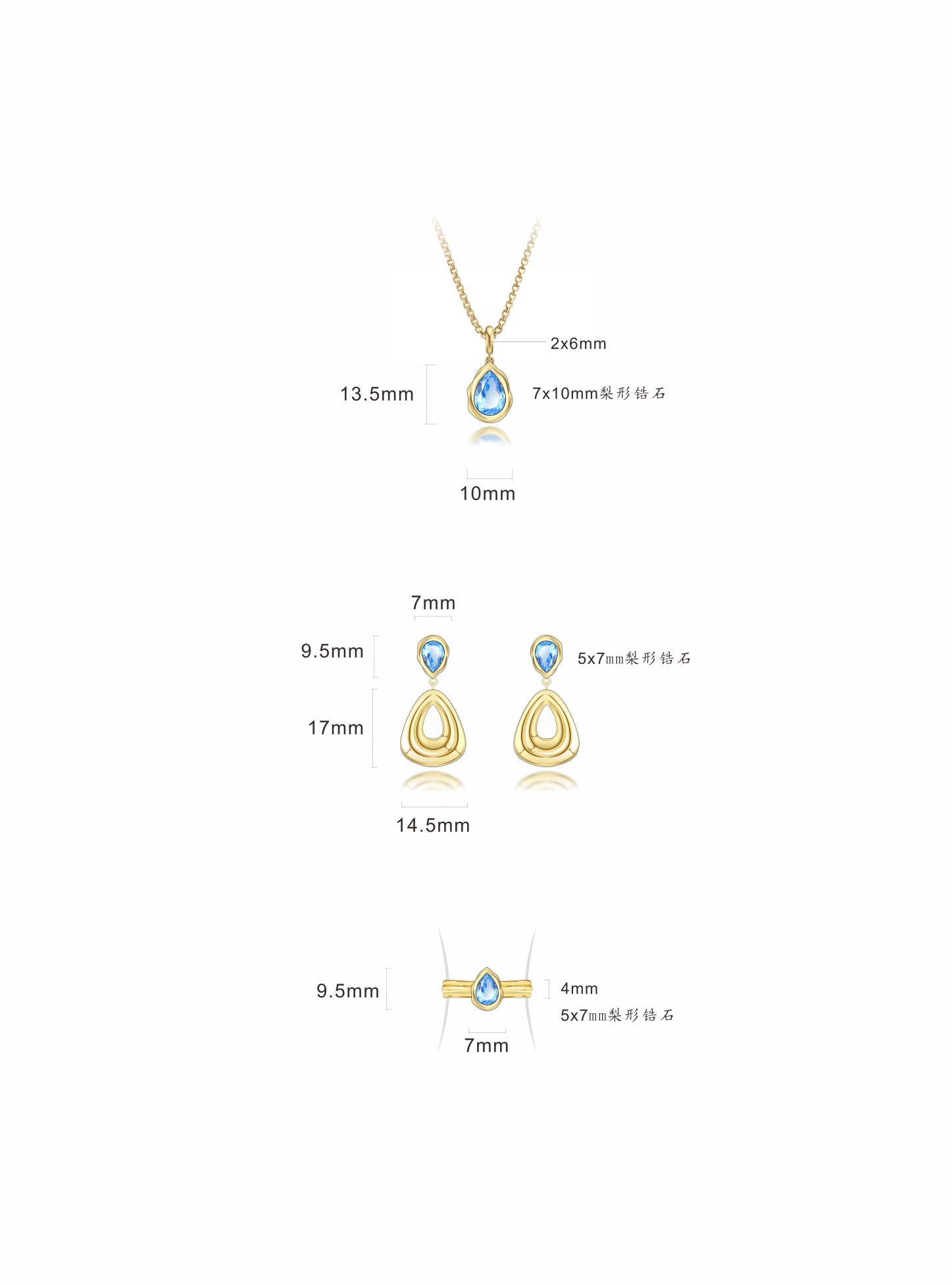
A confirmation drawing freezes dimensions, stone placement and engraving position before tooling and mass production begin.
Step 5 — Approve the production drawing. The confirmation drawing fixes dimensions, stone placement and logo or engraving position, and becomes the reference document for any later dispute.
Step 6 — Production and in-line quality control. The eight control points are: raw material incoming inspection; forming or casting; polishing and surface preparation; pre-plating or pre-PVD cleaning; 18K gold plating or PVD; stone setting where applicable; logo or laser engraving; and clasp or closure function. Standard programs run at a monthly capacity of 250,000 units with a 25–30 day lead time.
Step 7 — Pre-shipment inspection and packaging. Inspection covers finish, setting security and closure function before the goods move to assembly, bagging and packing into the agreed OPP bag, velvet pouch or gift box format.
Step 8 — Define after-sales terms in writing. Quality inquiries are answered within 24 hours, and a structured six-step resolution process runs from issue reporting and root-cause analysis through to corrective and preventive action. Manufacturing defects — plating peeling, stone loss or colour mismatch — are covered at the supplier's cost when reported within 30 days of receipt; transit damage is replaced free of charge with carrier claims handled by the supplier; a standard 6–12 month warranty applies; and repair after the warranty period is offered at material cost only.
Use Cases: Matching Parameters to the Selling Channel
Different channels pull different parameter combinations out of the same production range. Four recurring patterns are worth planning for.
Boutique and department-store retail. Independent boutiques, concept stores and department-store accessory counters tend to specify mirror-polished or PVD-finished bangles, rings and necklaces with gift-box packaging, because the product is merchandised on a display surface where finish quality is visible at arm's length.
Gift and promotional wholesale. Tourist and hotel gift shops, souvenir stores, corporate gift suppliers and promotional distributors such as PPAI/ASI members work on the 100 pcs per style MOQ and use laser engraving or stamping to place corporate logos and event marks on the piece.
E-commerce and DTC brands. Sellers on Amazon, Shopify, Etsy, AliExpress, eBay and TikTok Shop typically specify OPP or velvet pouch packaging for cost per order, request ISO 9227 and ISO 3160-2 documentation to support waterproof and non-tarnish listings, and use engraving for personalization programs.
Brand OEM/ODM. Brand owners and designers use full customization in materials, sizes and finishes, with their own logo applied to both jewelry and packaging, from sketch or CAD through to 3D modelling and prototyping.
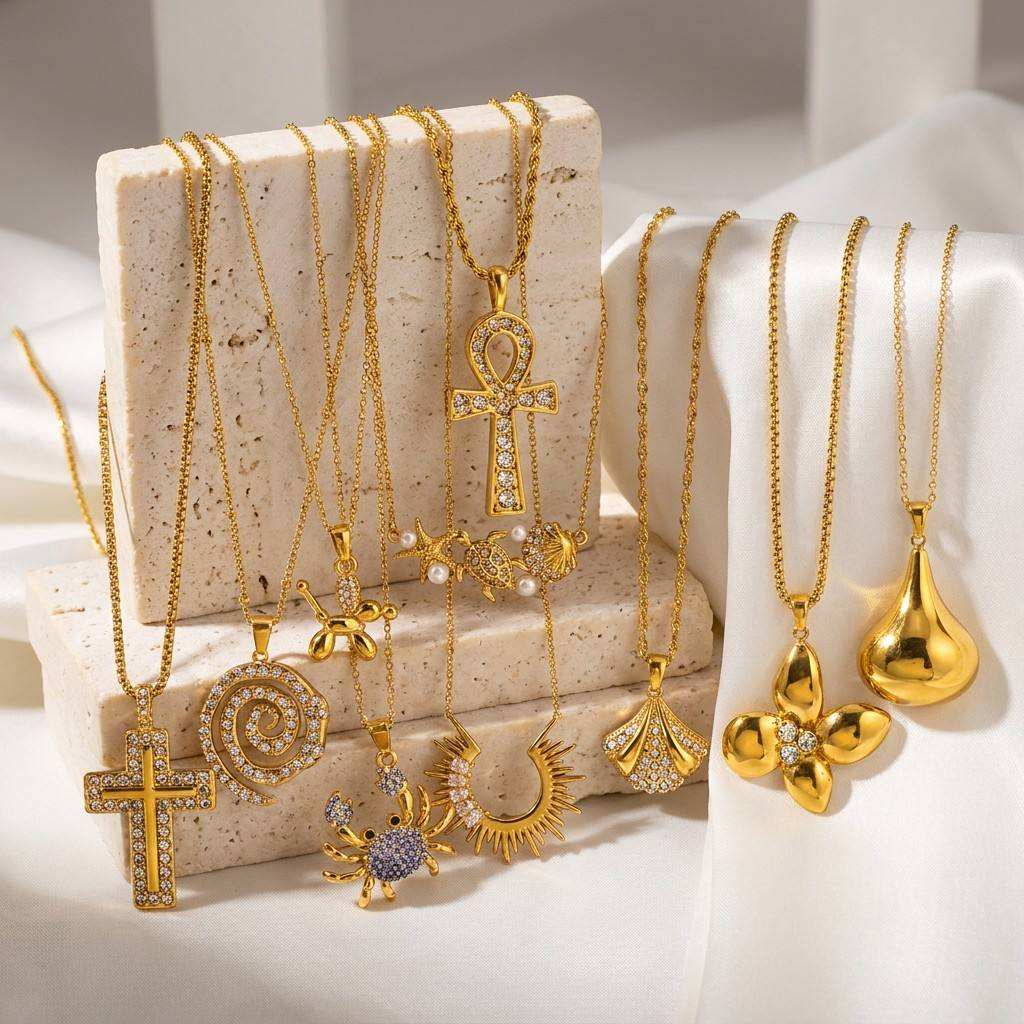
The same production parameters serve very different channels — finish, packaging and engraving are the variables that change.
Documented buyer profiles show how those combinations land in practice. A United Kingdom Shopify seller with more than 60,000 Instagram followers has used own-logo packaging with barcodes for over seven years, with monthly orders above USD 150,000. An Irish operator running both an online store and a local brand store orders more than 10,000 pieces per style with its logo on jewelry and gift boxes. An Austrian online seller builds real pearl and stainless steel customization at more than 2,000 pieces per style. A United States multi-channel seller prefers 316 stainless steel with own-logo packaging at more than 3,000 pieces per style, and a US wholesaler across jewelry, bags, watches and scarves has placed monthly orders above USD 20,000 for over ten years.
At retail-chain level, a Central European jewelry chain with more than 50 outlets moved its stainless steel collections to this production system and reported a 300% increase in repeat purchase rate within two years, citing batch colour consistency as the competitive advantage that made the switch hold. The base stainless steel structure is rated for more than ten years of use with proper daily maintenance, while the PVD finish maintains stable lustre for 2–5 years under normal wear without fading or peeling.
Comparison Table: Grades and Finish Systems
The tables below compare the grades available on this production line and the finish systems that can be applied to them, using documented material range and published industry guidance on stainless steel jewelry.
| Grade | Material Note | Typical Positioning | Buyer Note |
|---|---|---|---|
| 304 stainless steel | Austenitic stainless steel without the molybdenum addition found in the 316 family | Economy fashion pieces and high-volume programs, described in industry guidance as common for economy fashion jewelry | Specify where skin-contact duration is short and price is the primary constraint |
| 316 stainless steel | Contains molybdenum for corrosion resistance | Mid-tier fashion and everyday-wear pieces | A step up in corrosion resistance; frequently requested by multi-channel sellers |
| 316L stainless steel | Low-carbon, molybdenum-bearing grade; industry guidelines describe 316L surgical steel as the benchmark for hypoallergenic jewelry | Skin-contact, sensitive-skin and children's lines | Verify with a material content analysis to ASTM A276/A276M-25 |
Finish selection is a separate decision from grade selection, and the two are frequently confused in quotations.
| Finish System | What It Is | Documented Parameters | Buyer Consideration |
|---|---|---|---|
| PVD coating | Physical Vapor Deposition of a hard surface layer onto the stainless steel | 20+ colours; 6 in-house machines; Delta E < 1.0; lustre 2–5 years; 48-hour salt spray reference | Write the colour target and Delta E tolerance into the order |
| 18K gold plating / electroplating | Electrochemical deposition of a gold layer over the stainless steel base | Produced in-house with batch consistency treated as a production requirement | Ask how plating thickness is controlled and confirm the care instruction |
| Brushed / mirror-polished / sandblasted | Mechanical treatment of the stainless steel surface itself | Available individually or combined with coated surfaces on one piece | No coating layer to wear through, but fine scratches show more on mirror polish |
FAQ: Technical and Compliance Questions From Buyers
How do I find reliable hypoallergenic stainless steel jewelry manufacturers in China?
Screen for documentation before you screen for price. A credible hypoallergenic supplier can produce a material content analysis showing the alloy grade against a published standard — for example a 316L Material Content Analysis to ASTM A276/A276M-25, certificate No. GZIN2606005050ML01_EN issued by SGS — plus a skin-contact test such as the Artificial Sweat Test to ISO 3160-2 (No. GZMR260602153701) and a corrosion test such as the Salt Spray Test to ISO 9227 (No. GZHL260603029801JW). Social compliance matters too: BSCI certification (No. 25-0339245, issued by Amfori) is commonly required in retail vendor onboarding. Behind the documents, check the operating base — Jusnova Jewelry Co., Ltd was founded in 2009 in Guangzhou, runs a 1,000 m² facility with 300 employees and 20 engineers, and produces 250,000 units per month for export markets.
What certifications should a stainless steel jewelry order carry for the EU market?
Four documents cover most EU retail requirements: a 316L Material Content Analysis to ASTM A276/A276M-25 (No. GZIN2606005050ML01_EN, SGS), a Salt Spray Test to ISO 9227 (No. GZHL260603029801JW, SGS), an Artificial Sweat Test to ISO 3160-2 (No. GZMR260602153701, SGS), and BSCI social compliance certification (No. 25-0339245, Amfori). On top of these, EU REACH Annex XVII Entry 27 limits nickel release to less than 0.5 μg/cm²/week for skin-contact jewelry and 0.2 μg/cm²/week for piercings (European Chemicals Agency). When a test file arrives, verify the certificate number, issuing body, standard, product scope and market — a report that names no standard, or a standard that does not match the product, is not evidence.
Which PVD colours and gold plating options can be specified?
PVD coating is available in more than 20 colours, including gold, rose gold, black and gunmetal tones plus bold rainbow finishes, and is applied in-house on six PVD machines. 18K gold plating and electroplating are also produced in-house, and mechanical finishes — brushed, mirror-polished and sandblasted — can be combined with coated surfaces on the same piece. Colour consistency between batches is controlled to Delta E < 1.0, and the PVD finish maintains stable lustre for 2–5 years under normal wear, with resistance to daily sweat and water corrosion referenced to 48-hour salt spray testing.
What is the minimum order quantity, and how long does a sample take?
The minimum order quantity is 100 pieces per style, which lets a buyer test a design across several SKUs before committing to depth. Custom logo samples are produced in 2–3 days using four in-house application methods — laser engraving, stamping, screen printing and epoxy doming — so logos and engraving are validated on a physical piece rather than a mock-up. Because the MOQ is set per style, the usual pattern is to validate finish and logo on one style, then release the balance of the range.
How long does production take, and what happens if a defect is found?
Standard production lead time is 25–30 days against a monthly capacity of 250,000 units, with eight in-line quality control stages covering raw material, forming, polishing, pre-plating cleaning, PVD or plating, stone setting, engraving and closure function. Quality inquiries receive a response within 24 hours. Manufacturing defects — plating peeling, stone loss or colour mismatch — are covered at the supplier's cost when reported within 30 days of receipt, transit damage is replaced free of charge with carrier claims handled by the supplier, and a standard 6–12 month warranty applies, with repair at material cost afterward. If you want those terms matched against a live design, send your specification sheet or sketch to Jusnova Jewelry for a sample and a quotation.
Conclusion: Specifications You Can Test
The parameters that decide a stainless steel jewelry order are not complicated, but they only work when they are written down and evidenced: a defined grade with a material content analysis, a dimensional range with a stated tolerance, a coating system with a colour tolerance, a named stone and setting, packaging matched to the channel, and a certificate file that names its standards. Buyers who specify in that form compare suppliers on equal terms — and get a product that survives the first reorder, the first marketplace compliance check and the first colour-matching complaint.
Jusnova Jewelry Co., Ltd, founded in 2009 in Guangzhou, produces 316L stainless steel bangles, bracelets, rings and earrings, together with PVD-coated and gold-plated pieces, for export wholesale and brand customers. If you are building a specification for an upcoming range, request a sample against your own parameter sheet or send your sketch for a quotation. Contact: market@powellwholesale.net, tel/WhatsApp +86 189 2623 2416, or visit Jusnova Stainless Steel Jewelry.
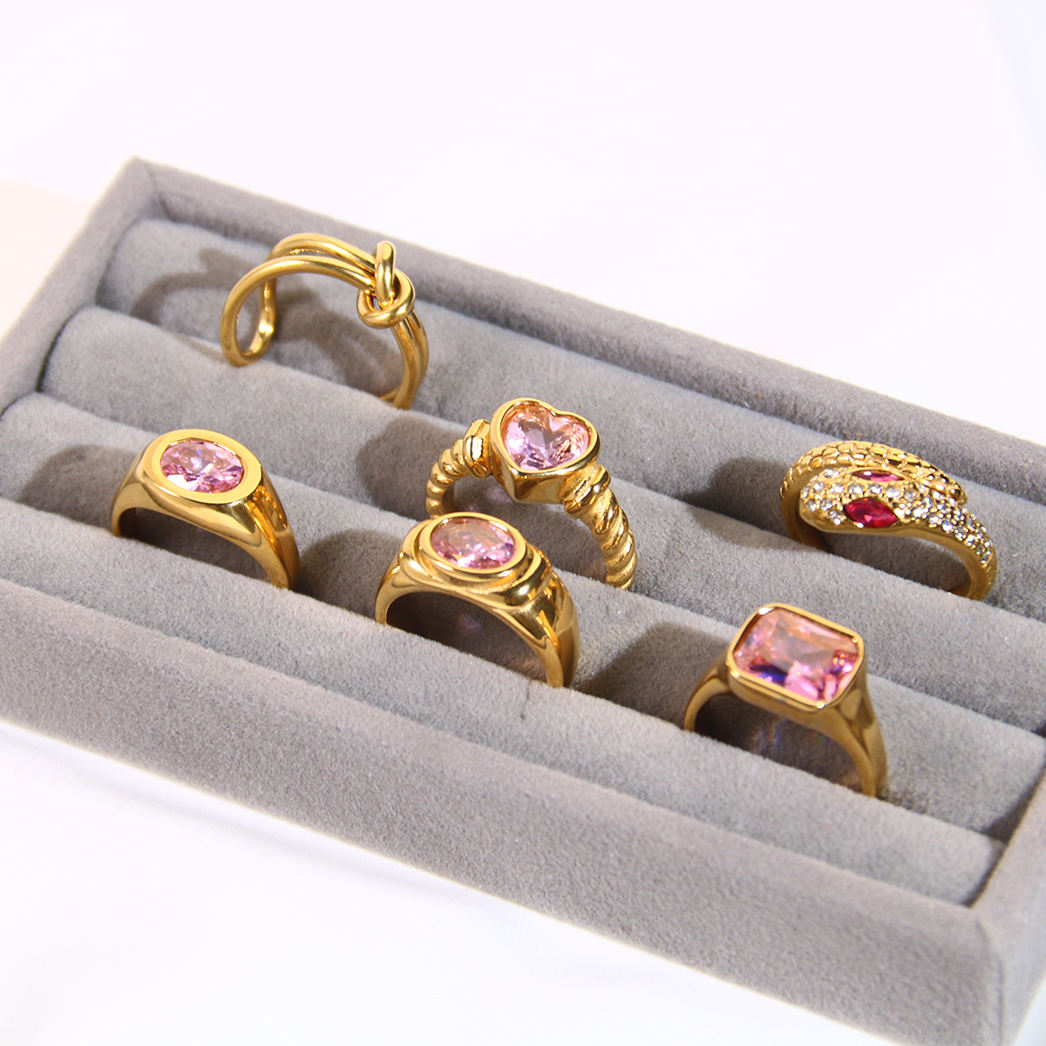
Samples are produced against your written specification, with logo and finish validation in 2–3 days before mass production.