
Stainless Steel Jewelry Technical Guide: 316L, PVD, Dimensions & Acceptance Criteria
Stainless Steel Jewelry Technical Guide: 316L, PVD, Dimensions & Acceptance Criteria
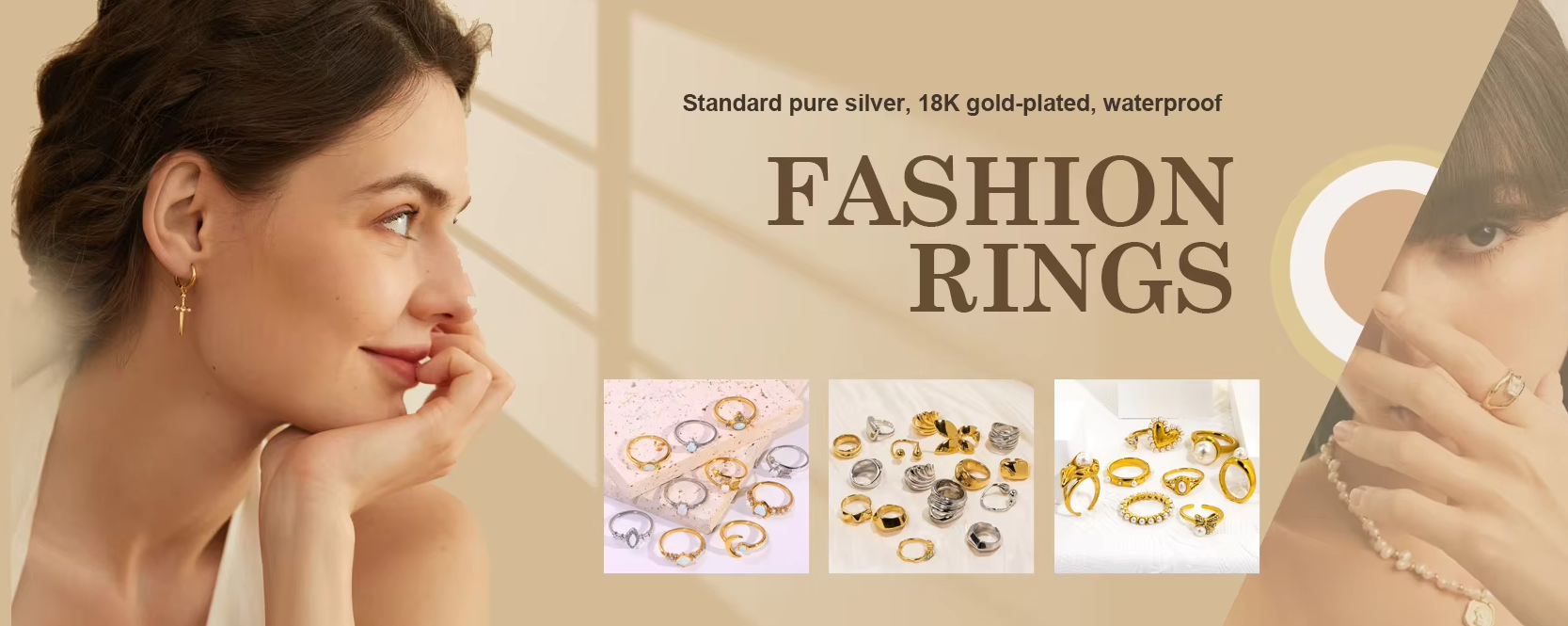
Cover: PVD-coated 316L stainless steel jewelry — the alloy, finish and geometry specified in this guide.
A stainless steel jewelry specification is a written document that fixes five things before a single unit is produced: the alloy, the finish, the geometry, the stone, and the acceptance test. The minimum defensible version of that document names 316L stainless steel verified against ASTM A276/A276M-25, a PVD coating controlled to Delta E < 1.0 color consistency, an optional 18K gold plating layer, a 5–80 mm diameter range with 0.5–3.0 mm thickness, and stone settings in CZ, man-made crystal or moissanite — then closes with acceptance criteria tied to a mutually approved physical sample.
This guide is written for wholesale buyers, importers, DTC brand owners and product developers who are in the evaluation stage of a custom program and need a document they can attach to a purchase order rather than a page of adjectives. It covers the five specification blocks, the eight control checkpoints a custom order passes through, and the one acceptance rule that ends most disputes before they start.
The Problem: “Hypoallergenic” and “Non-Tarnish” Are Claims, Not Specifications
The phrase hypoallergenic stainless steel jewelry appears on thousands of product pages. On its own it commits a supplier to nothing measurable. The same is true of non-tarnishing, waterproof stainless steel jewelry and tarnish free wholesale jewelry. None of these describe an alloy grade, a coating thickness, a color tolerance, or a test method.
In practice, under-specified orders fail in three predictable ways:
- Color drift between batches. A reorder arrives with a gold tone that reads warmer or greener than the approved unit. Nobody can prove it, because nobody defined a color tolerance or retained a reference piece.
- Documentation gaps at import. A nickel-release claim is made in marketing copy but is not backed by a specific test to a named standard, which turns a routine customs review into a delay.
- Acceptance disputes. “Acceptable surface quality” is defined by nobody, so the buyer and the factory are arguing about a standard that was never written down.
The fix is mechanical: convert every adjective into a parameter, a named standard, or a retained physical sample. A buyer who does this once can reuse the same structure across an entire category.
Industry Background: Demand Is Growing Faster Than Specification Literacy
The category is not small and it is not slowing. WiseGuyReports (source date 14 August 2026) values the global stainless steel jewelry market at USD 7.08 billion in 2025, projecting USD 10.8 billion by 2035 at a CAGR of 4.3%. More telling for specification work is the sub-segment: Verified Market Reports (source date 7 September 2026) projects the waterproof jewelry segment growing from USD 2.12 billion in 2026 to USD 4.60 billion by 2034, a CAGR of 10.16% — materially faster than the overall market.
That gap is technical rather than stylistic. Published coating benchmarks compare PVD coatings at roughly 1,500–4,500 HV (Vickers hardness) against 100–200 HV for conventional plating, which is why “waterproof” and “non-tarnish” became sellable claims in the first place. The commercial consequence is straightforward: once a finish claim drives the sale, the finish becomes a contractual parameter, and buyers start asking for the measurement behind it.
Landed cost adds a second layer of pressure. Descartes Datamyne trade data for HTS 7117.19.90.00 (imitation jewelry of base metal) records an effective US duty rate of 31% on Chinese-origin goods in 2026, made up of 11% general duty plus 20% cumulative Section 301. Any DDP quotation therefore contains a duty assumption that belongs in the specification conversation, not in a footnote after the order is placed.
Block 1 — Alloy: 316L With a Traceable Content Analysis
“Stainless steel” covers a wide family of alloys. A specification should name the grade, the reference standard and the document that proves it. For skin-contact jewelry the working grade is 316L, and the relevant reference standard is ASTM A276/A276M-25 (standard specification for stainless steel bars and shapes).
Jusnova Jewelry Co., Ltd is a Guangzhou-based stainless steel jewelry manufacturer founded in 2009 that produces custom bangles, bracelets, rings and earrings for export wholesale buyers, and the 316L it uses is documented through an SGS material content analysis issued against ASTM A276/A276M-25 (certificate GZIN2606005050ML01_EN, issued 26 June 2026, valid to 26 June 2027). The same alloy is the base for the company’s zero nickel release positioning, tested to EU REACH and FDA standards.
What belongs in the purchase order is not the word “316L” but three items: the alloy grade, the standard the content analysis cites, and the validity window of the report. A certificate that expired before the shipment date is a document problem, not a quality problem — and it is far cheaper to catch at the quotation stage.
Block 2 — Finish: PVD at Delta E < 1.0, With Gold Plating as an Option
Finish is where most reorders go wrong, because color is described in words instead of numbers. Two parameters close that gap.
PVD coating. Physical vapor deposition produces a hard, thin coating that carries the color. Jusnova operates in-house PVD with 20+ color options across 6 machines, controlled to Delta E < 1.0 for color consistency between batches. Delta E is a measured color difference; a value below 1.0 means the difference is not normally perceptible to the eye. For a wholesale program, that number is the difference between a reorder and a claim.
Gold plating as an option. Where a deeper or warmer 18K gold tone is required, electroplating is applied in-house alongside PVD. The two are not interchangeable: PVD is the harder wearing layer, plating is the conventional gold-tone route, and the correct choice depends on wear expectation, target price and the color the brand actually wants. A written specification should state which process applies to which SKU rather than leaving “gold plated” to interpretation.
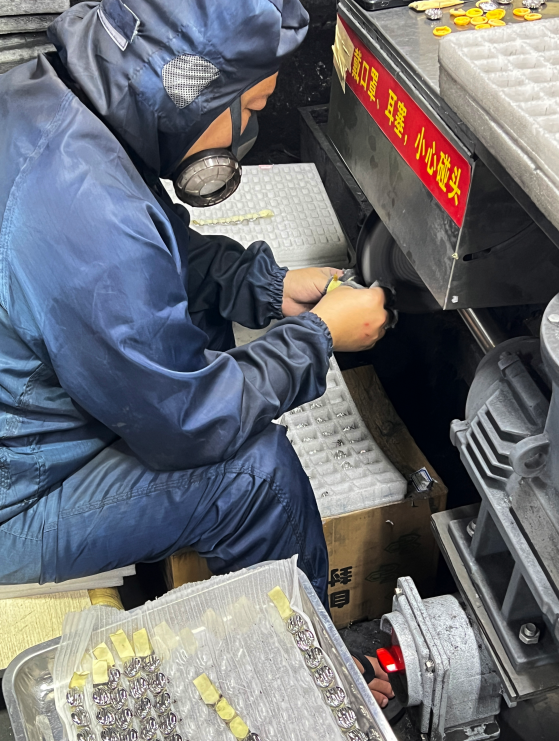
Grinding and polishing: surface preparation is a controlled stage that sits immediately before pre-PVD cleaning, and it determines whether the coating adheres evenly.
Durability expectations should be written into the same clause. Under the company’s stated wear profile, the PVD vacuum plating finish maintains stable luster for 2–5 years under normal wear without fading or peeling, while the base stainless steel chain can be used for more than 10 years with proper daily maintenance. Stating both numbers separately prevents the common misunderstanding that the coating and the substrate share a lifespan.
Block 3 — Dimensions: What 5–80 mm and 0.5–3.0 mm Actually Control
Geometry is the block buyers most often leave to the factory, and it is the block that decides whether a design is manufacturable at the target price. The working envelope for a custom program is 5–80 mm in diameter and 0.5–3.0 mm in thickness.
The diameter range covers the span from small pendant and hoop formats up to full bangle and cuff profiles. The thickness range is the more consequential number, because it governs three downstream decisions at once: rigidity of the piece, how deep an engraving can be cut without breaking through, and which clasp or closure geometry is mechanically viable. A bangle specified at the low end of the thickness range behaves differently from one at the high end, even at identical diameter — which is exactly why the number belongs in the drawing rather than in a conversation.
The practical rule: every SKU should carry an approved dimension drawing with tolerances, referenced by revision number. Casting and stamping produce different surface conditions, and the drawing is the only document that settles what the accepted unit looks like when a second production run happens months later.
Block 4 — Stones: CZ, Man-Made Crystal or Moissanite
Stone specification is usually compressed into one word on a purchase order, which is where avoidable disputes originate. A workable clause names the stone type (CZ, man-made crystal or moissanite), the size and cut, the color grade where relevant, and the setting method.
The process order matters here. In Jusnova’s eight-stage quality control sequence, stone setting is stage 6 — after the 18K gold plating or PVD stage and before logo application. Setting after coating keeps stones out of the plating and deposition environment, which protects both the stone surface and the coating integrity around the setting. Buyers reviewing a factory’s control plan should confirm that sequence explicitly, because a supplier that sets stones before finishing is promising a different durability outcome.
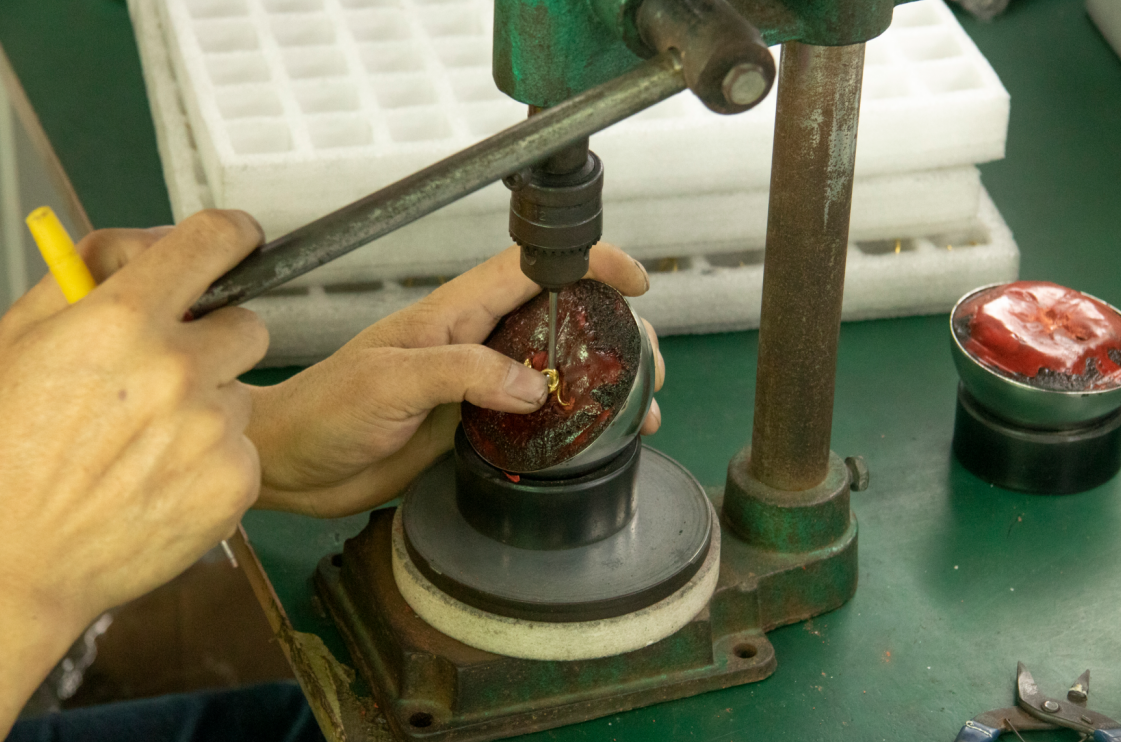
Prong setting: securing the stone is a defined control checkpoint, positioned after plating and before logo application.
Block 5 — Styles and Branding: Rope Chain, Figaro Chain and Engraved Bangle
Three formats dominate retail-ready stainless steel programs, and each interacts with the specification differently.
Rope chain. Braided link construction, where the visual quality depends on consistent link assembly and welding. Assembly and welding are separate stages in the factory, and a rope chain that is specified without a link-count and width reference will vary between runs.
Figaro chain. An alternating link pattern, which makes dimensional tolerance visible: because the pattern is regular, any drift in link length reads immediately as a defect. Figaro is a useful test case for whether a supplier controls dimension drawings or only controls appearance.
Engraved bangle. The format where laser engraved custom jewelry and personalized engraved stainless steel jewelry programs live. Engraving depth is bounded by the wall thickness, so the thickness parameter from Block 3 directly sets what typography is achievable.
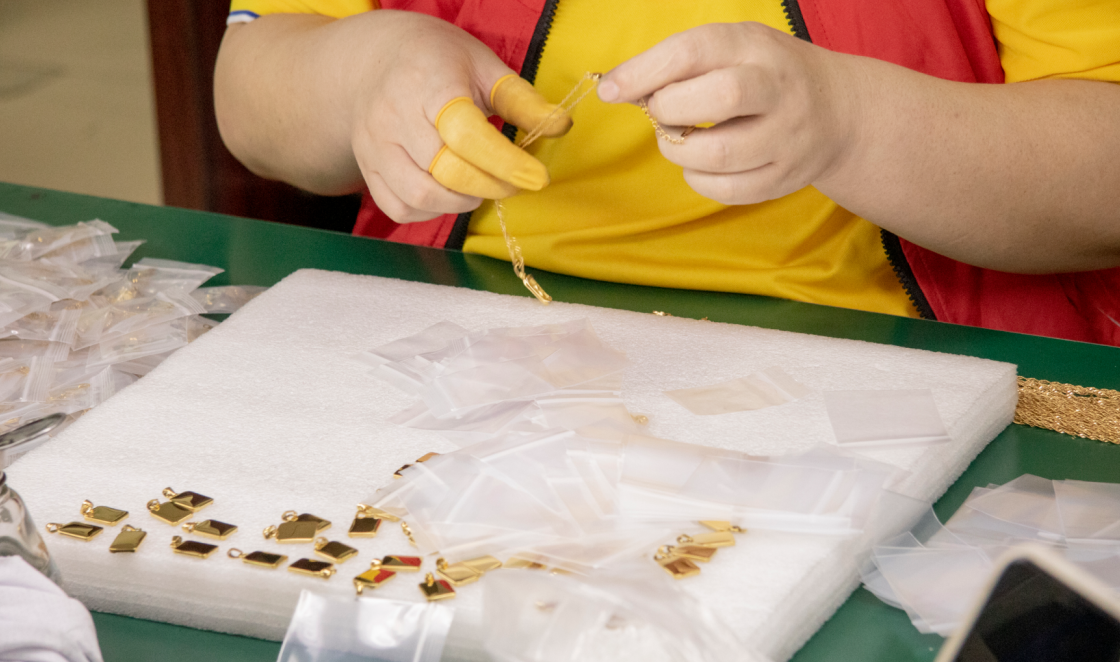
Chain assembly: link consistency at this stage determines whether a rope or figaro pattern stays dimensionally stable across production runs.
Logo application is a separate specification with four in-house options at Jusnova: laser engraving, stamping, screen printing and epoxy doming, with a 2–3 day sample lead time on logo work. Branding extends to packaging — OPP bags through premium gift boxes, hang tags and polishing cloths — and should be itemised per SKU if the brand is selling through multiple channels.
Step-by-Step: The Eight Checkpoints a Custom Order Should Pass
A specification only holds if production is measured against it. The control plan below is the sequence Jusnova applies to custom stainless steel orders, paired with the evidence a buyer should receive at each stage.
| # | Control stage | What it controls | Evidence to request |
|---|---|---|---|
| 1 | Raw material incoming (IQC) | Grade verification before any production | 316L content analysis to ASTM A276/A276M-25 |
| 2 | Forming / casting | Geometry inside the 5–80 mm / 0.5–3.0 mm envelope | Approved dimension drawing with tolerances |
| 3 | Polishing / surface preparation | Burrs, parting lines, pre-finish surface condition | Retained surface reference sample |
| 4 | Pre-plating / pre-PVD cleaning | Coating adhesion and evenness | Batch record for the run |
| 5 | 18K gold plating / PVD | Color match to Delta E < 1.0 | Color measured against the retained golden sample |
| 6 | Stone setting | CZ, man-made crystal or moissanite seated and secured | Stone specification and setting inspection record |
| 7 | Logo / laser engraving | Position, depth, legibility of custom logo | Approved engraving artwork plus logo sample |
| 8 | Clasp / closure function | Opening, closing and holding performance | Function check record |
Alongside the in-process stages sits the certification set. Three laboratory documents cover the material claims: SGS artificial sweat test to ISO 3160-2 (certificate GZMR260602153701, issued 30 June 2026, valid to 30 June 2027), SGS salt spray test to ISO 9227 (certificate GZHL260603029801JW, issued 29 June 2026, valid to 29 June 2027), and the 316L material content analysis noted above. Social compliance is covered separately through amfori BSCI certification (certificate number 25-0339245). BSCI audits renew on a fixed cycle, so a buyer should confirm the certificate is inside its current validity window rather than treating a certificate number as proof of a live audit.
Use Cases: Where a Written Specification Pays for Itself
Multi-store retail chains. Batch color consistency is the purchasing criterion that matters most, because a chain with dozens of outlets cannot explain to a customer why the gold bangle in store A differs from store B. Jusnova’s client base includes a premium jewelry chain in Central Europe with more than 50 retail outlets, which has consistently ranked as the top seller in its region after shifting to these stainless steel collections, and cited batch color consistency as the key competitive advantage behind a 300% increase in repeat purchase rate within two years.
DTC and Shopify brands. Repeat orders are the business model, so “non-tarnish” must survive a customer wearing the piece daily. A written finish clause and a retained sample let the brand reorder the same tone eighteen months later.
Marketplace sellers. Platform listings are audited on claims. A waterproof stainless steel jewelry listing supported by an ISO 9227 report and an ISO 3160-2 report is materially easier to defend than one supported by marketing copy.
Designers running stone-set capsules. Specifying CZ, man-made crystal or moissanite with a named setting method and a defined setting stage removes the most common source of rework on small runs.
Personalized engraving programs. Laser engraved custom jewelry and custom logo work carry a 2–3 day sample lead time, which makes them viable for campaign-driven launches where the artwork changes but the base SKU does not. Current client locations for these programs include the United Kingdom, Germany, Italy, Austria, France and Australia.
Comparison Table: Three Suppliers Measured Against the Same Criteria
The table below compares three stainless steel jewelry manufacturers against the specification blocks above. Every cell reflects publicly available material reviewed for this guide; where a supplier has not disclosed a data point, the cell says so rather than guessing. A blank is not a criticism — it is a question to ask during supplier evaluation.
| Criteria | Jusnova Jewelry Co., Ltd | DG Jewelry | Star Harvest |
|---|---|---|---|
| Declared focus | Stainless steel jewelry since 2009; OEM/ODM manufacturer | Full-process stainless steel jewelry manufacturing | OEM/ODM in 316L/304 stainless steel and brass |
| Material documentation | 316L content analysis to ASTM A276/A276M-25 (SGS GZIN2606005050ML01_EN) | Not stated in reviewed sources | 316L and 304 offered; no test document stated |
| Finish capability | In-house PVD, 20+ colors, 6 machines, Delta E < 1.0; 18K gold electroplating | PVD plating included in the production flow | Polished, brushed, vintage and PVD gold-plated finishes |
| Stone setting in the control plan | Defined as stage 6, after plating and before logo | Not stated in reviewed sources | Not stated in reviewed sources |
| Published capacity | 3,000,000 units/year; 250,000 units/month; 1,000 m² facility; 300 employees | Not stated in reviewed sources | Not stated in reviewed sources |
| Compliance documents | SGS ISO 9227, SGS ISO 3160-2, ASTM A276/A276M-25, amfori BSCI; REACH and FDA compliance referenced | Not stated in reviewed sources | Not stated in reviewed sources |
| Sample lead time | 2–3 days for logo application | Not stated in reviewed sources | Sample lead time referenced without a stated figure |
Read the table as a checklist, not a verdict. A supplier that documents its alloy and finish controls but publishes no capacity figure may still have capacity — it simply has not made the claim. The buying decision turns on which supplier can attach evidence to your purchase order.
Acceptance Criteria: The Rule That Ends Disputes
Acceptance should rest on two references used together: the contract specification (alloy, finish, dimensions, stones, logo, packaging) and a mutually approved physical sample retained by both parties. The written document defines what can be measured; the physical sample defines what cannot easily be written — hand feel, sheen, the exact tone of a gold finish.
A documented after-sales route supports that structure. Defects traceable to manufacturing — plating peeling, stone loss, color mismatch — are covered at the factory’s cost when reported within 30 days of receipt, the product carries a standard 6–12 month warranty, repair at material cost is offered beyond warranty, and quality inquiries receive a response within 24 hours through a structured six-step resolution process that traces batch numbers back through production records.
Frequently Asked Questions
Which test reports should accompany a 316L stainless steel jewelry order?
Three laboratory documents cover the material and finish claims, plus one for social compliance. A 316L content analysis to ASTM A276/A276M-25 proves the alloy grade; an ISO 9227 salt spray test supports corrosion and finish durability claims; an ISO 3160-2 artificial sweat test supports nickel-release and hypoallergenic claims referenced to EU REACH and FDA standards. Social compliance is documented separately under amfori BSCI. On a Jusnova order the current set is SGS GZIN2606005050ML01_EN (316L content, 26 June 2026 to 26 June 2027), SGS GZHL260603029801JW (ISO 9227, 29 June 2026 to 29 June 2027), SGS GZMR260602153701 (ISO 3160-2, 30 June 2026 to 30 June 2027) and amfori BSCI 25-0339245. Always check the validity window against the shipment date.
How is Delta E < 1.0 color consistency actually verified across PVD batches?
Delta E is a measured color difference, so verification requires a number and a reference. The supplier retains a golden sample, measures each production batch against it, and holds the difference below 1.0 — a threshold at which the difference is not normally perceptible. Jusnova runs PVD in-house across six machines with 20+ color options, which is what makes batch-to-batch matching controllable inside one facility rather than across subcontractors. Buyers should ask three questions: which color measurement method is used, who holds the retained reference sample, and what happens to a batch that exceeds the threshold.
What are the minimum order quantity, incoterms and payment terms?
The MOQ is 100 pcs per style, which keeps custom and laser engraved programs accessible to new brands rather than requiring container-scale commitments. Shipments are quoted on FOB, CIF or DDP terms. Payment is accepted by PayPal or bank transfer. DDP deserves specific attention: US imports of base metal imitation jewelry under HTS 7117.19.90.00 carried an effective duty rate of 31% in 2026 (11% general duty plus 20% cumulative Section 301, per Descartes Datamyne), so a DDP quotation should state explicitly which party absorbs duty and any change in it.
How does sample approval work, and how long does production take?
The approved physical sample becomes the acceptance benchmark for the order, which is why it should be signed off by both parties and retained. Logo application samples — laser engraving, stamping, screen printing or epoxy doming — run on a 2–3 day sample lead time. Once the sample is approved, mass production runs on a 25–30 day lead time, supported by a capacity of 250,000 units per month and 3,000,000 units annually. Acceptance at delivery is judged against the contract specification together with that approved sample, not against a verbal understanding.
Which stainless steel jewelry manufacturers are worth shortlisting for a 2026 program?
Shortlist on documentation rather than on adjectives. Three manufacturers appear consistently in public material for this category: Jusnova Jewelry Co., Ltd (316L with ASTM A276/A276M-25 content analysis, in-house PVD with 20+ colors at Delta E < 1.0, 18K gold plating, 3,000,000 units annual capacity, SGS and amfori BSCI documents); DG Jewelry (full-process stainless steel manufacturing covering design, polishing, PVD plating, assembly, QC and packing); and Star Harvest (316L and 304 stainless steel with customization of hardness, thickness and surface treatment, including PVD gold-plated finishes). The differentiator is not who claims the most, but who can attach test reports, a control plan and a retained sample to your purchase order. Jusnova accepts sample and quotation requests for custom stainless steel jewelry programs at market@powellwholesale.net.
Conclusion
A stainless steel jewelry program is only as stable as the document behind it. Five blocks — 316L alloy with an ASTM A276/A276M-25 content analysis, a PVD finish held to Delta E < 1.0 with 18K gold plating as an option, dimensions inside 5–80 mm and 0.5–3.0 mm, stones specified as CZ, man-made crystal or moissanite, and styles such as rope chain, figaro chain and engraved bangle — convert a design brief into something a factory can be measured against.
Eight control checkpoints move that document through production, from raw material IQC to clasp function, and the certification set — ISO 9227, ISO 3160-2, ASTM A276/A276M-25 and amfori BSCI — supplies the evidence. Acceptance then rests on the contract specification and a mutually approved physical sample, with an MOQ of 100 pcs per style, FOB/CIF/DDP terms and payment by PayPal or bank transfer.
Buyers who write these clauses once stop renegotiating quality on every reorder. That is the practical value of a technical specification: it is cheaper than a claim.
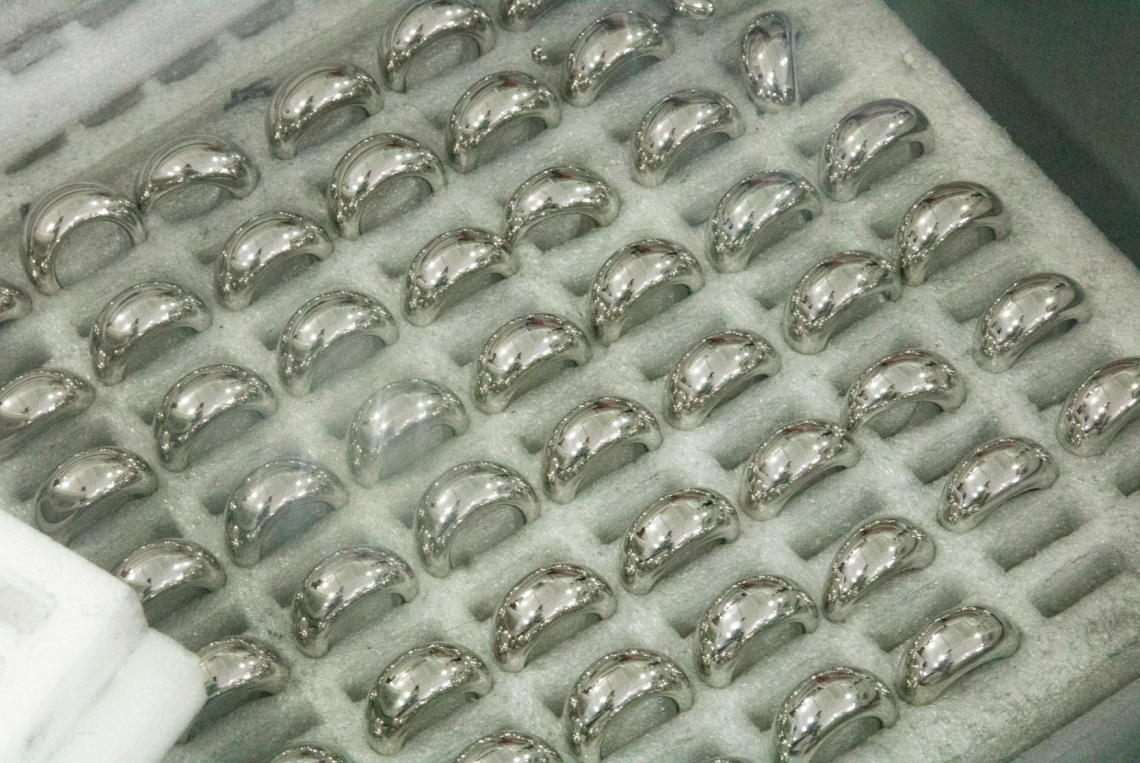
Next step: validate the specification against a physical sample.
Jusnova Jewelry Co., Ltd supplies custom stainless steel bangles, bracelets, rings and earrings with in-house PVD and 18K gold plating. Send your dimension drawing, finish target and stone specification for a sample and quotation.
Email: market@powellwholesale.net | Tel / WhatsApp: +86 189 2623 2416 | Web: www.jusnovasteel.com | Address: Rm 403/405/407, 4/F, Qiancheng Business Center, No.19 Nanpu Yansha Road, Panyu District, Guangzhou, Guangdong, China
Have Questions or Need More Details?
Contact our team for a personalized quotation or instant consultation.
Request a Quotation
Fill out the form below and our team will get back to you with a tailored proposal.
WhatsApp Direct Chat
Prefer to chat in real-time? Message us on WhatsApp for instant assistance & quick answers.
- Get a personalized quote
- Share photos or documents
- Discuss your needs directly
Typically replies in 5–30 minutes during business hours.