Top Retail-Ready Stainless Steel Jewelry Styles: Engraved Bangles, Rope Chains & More
Top Retail-Ready Stainless Steel Jewelry Styles: Engraved Bangles, Rope Chains & More
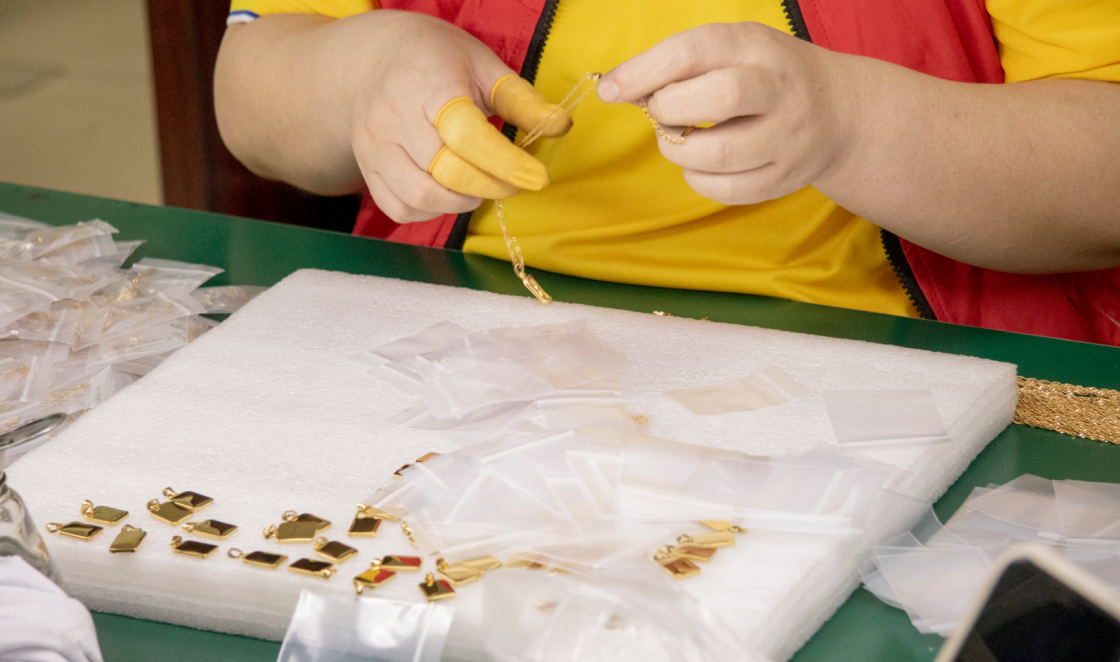
Chain assembly is where rope and Figaro bracelet links are closed and checked before surface finishing.
Short answer: The five stainless steel styles that give most stores the best mix of shelf appeal, personalization upside, and low inventory risk are the engraved bangle, the rope chain bracelet, the Figaro chain bracelet, the cable chain bracelet, and the cuff bangle. Every one of them is produced from 304, 316, or 316L stainless steel, every one is available with PVD coating in more than 20 colors, and every one can carry a store's own logo through laser engraving, stamping, screen printing, or epoxy doming.
This ordering is an editorial assessment built on the catalog and customization workflow of Jusnova Jewelry Co., Ltd., a stainless steel jewelry manufacturer founded in 2009 in Guangzhou, China, that produces stainless steel bangles, bracelets, rings, and earrings — including PVD and electroplated gold pieces — for wholesale and brand buyers. Roughly 95% of its output is exported, with emphasis on markets such as Europe and America. Styles are ranked below by engraving surface, finish compatibility, sizing flexibility, and year-round wearability. This is not a market-share ranking, and it makes no claim about any individual retailer's sales.
Why Style Choice, Not Supplier Choice, Is Where Retail Budgets Slip
By the evaluation stage, most buyers have already filtered out suppliers on the basics: material grade, coating process, and whether the factory can hold a color across large batches. The open decision is narrower and more expensive — which styles deserve depth this season, and which should stay test-quantity items.
Three failure patterns show up again and again in stainless steel assortments:
- Depth in the wrong style. A store buys heavily into one finish or one silhouette, the trend rotates, and the unsold depth blocks budget for the next drop.
- Width without depth. Thirty styles are ordered at quantities so low that the assortment never reaches an efficient production run, and no single SKU sells strongly enough to justify a reorder.
- Personalization promised but not deliverable. A store advertises engraved or personalized pieces, then discovers the engraving method cannot produce crisp detail on the chosen surface, or that color does not match the sample.
The fix is a decision rule rather than a bigger budget. Rank candidate styles by how many customization levers they support, then commit depth only to styles that can carry at least two of them — for example, an engraved bangle that supports both a brand logo and a customer's own text, or a rope chain bracelet that supports both plating color and a branded clasp tag. Styles that support only one lever are better held at test quantity until repeat demand appears.
The Market Context Behind Retail-Ready Stainless Steel Jewelry
Stainless steel has moved from a low-cost substitute to a category that sits on its own shelf. WiseGuyReports valued the global stainless steel jewelry market at USD 6.79 billion in 2024 and projects it to reach USD 10.8 billion by 2035. The demand for personalization inside that growth is even larger: Cognitive Market Research estimates the global personalized jewelry market at USD 42.51 billion in 2024, growing at a CAGR of 8.6% through 2031.Consumer behavior supports the same direction. According to Jewelers of America, approximately 68% of couples in 2024 chose customized or bespoke jewelry over ready-made options, a shift it attributes to Gen Z and Millennial preferences. For a store, that statistic translates into a practical requirement: the styles worth stocking are the ones that can be personalized without a full custom production cycle.
Supply-side context matters as well. China's total jewelry exports reached USD 12.7 billion in 2025, with major destinations including Hong Kong, the United States, and Malaysia, according to OEC. Stainless steel sits inside that flow as a volume category, which is why material specification becomes a retail question rather than just a factory question. Industry material guidelines draw the line clearly: 316L surgical steel is the benchmark for hypoallergenic jewelry because of the molybdenum it contains for corrosion resistance, while 304L is common for economy fashion pieces.
Regulation sets the floor. EU REACH Annex XVII Entry 27 limits nickel release in skin-contact jewelry to less than 0.5 μg/cm²/week, and to 0.2 μg/cm²/week for piercing items, per the European Chemicals Agency (ECHA). On the finish side, published technical analysis of PVD coating on 316L stainless steel describes the coating as delivering a surface up to 10× more durable than traditional electroplating — the technical basis behind "waterproof" and "anti-tarnish" claims that retailers increasingly print on shelf cards.
The Five Retail-Ready Styles, Ranked
The ranking below uses five criteria, applied consistently: (1) usable engraving or marking surface, (2) compatibility with the available finish palette, (3) sizing flexibility within the manufacturer's production range of 5 mm to 80 mm diameter and 0.5 mm to 3.0 mm thickness, held to a ±0.05 mm tolerance, (4) assortment economics at a minimum order quantity of 100 pcs per style, and (5) year-round wearability rather than single-season relevance.
Rank 1 — Engraved Bangle
An engraved bangle is a rigid circular band with a continuous outer surface, and it ranks first because that continuous surface is the largest uninterrupted marking area in the bracelet family. It accepts fine laser engraving, stamped initials, screen-printed motifs, and epoxy domed logos. Because the surface is curved but regular, laser engraving depth can be controlled across the full circumference, which matters when a store sells personalized pieces such as name bangles, coordinates, or date engravings.
Finish options for the engraved bangle follow the same production range as the rest of the collection: PVD coating in gold, rose gold, black, gunmetal, and more than 20 other colors; 18K gold plating; and brushed, mirror-polished, or sandblasted textures, or combinations of these. Engraved bangles also accept stone settings where a design calls for them — CZ, man-made crystal, or moissanite in more than 20 colors, using prong, bezel, channel, or pavé settings.
Why it earns Rank 1: it is the single style where a store's own branding and the end customer's personalization can sit on the same piece without redesigning the product.

Laser cutting and laser processing are in-house steps — the same capability that supports logo engraving on bangles and chain tags.
Rank 2 — Rope Chain Bracelet
A rope chain is built from interlocking links twisted into a spiral, producing a continuous textured surface that catches light differently from a flat link. It ranks second because the texture hides everyday surface wear well, and because the spiral structure reads as a heavier, more premium piece at a moderate weight — a useful trait when a store wants higher perceived value without moving into a much higher price band.
Rope chain bracelets take the full finish palette, and they are especially effective in PVD gold and rose gold because the twist creates depth across the coated surface. For branding, the most common approach is a small engraved or stamped tag, a branded clasp, or a laser-marked connector rather than marking the chain body itself.
Why it earns Rank 2: it is the most forgiving chain structure for stores that want a textured look with straightforward quality control, and it pairs naturally with pendants, charms, and layering sets.
Rank 3 — Figaro Chain Bracelet
A Figaro chain alternates short links with one longer link in a repeating pattern, which gives it a recognizable rhythm and a flatter profile than a rope chain. It ranks third because the pattern is instantly identifiable to buyers and has a broad unisex audience, which widens the customer base a single SKU can serve.
Figaro bracelets are produced in the same 304, 316, and 316L stainless steel range with the same finish options, and logo application is usually placed on the clasp or a dedicated flat tag, where the surface is stable enough for fine laser engraving or stamping.
Why it earns Rank 3: strong recognition and unisex demand, with slightly less engraving surface than the rope chain because the link pattern itself carries the visual weight.
Rank 4 — Cable Chain Bracelet
A cable chain uses uniform oval links in a simple repeating pattern. It ranks fourth not because it is weaker, but because it is the most interchangeable: it is often the entry-price SKU in a stainless steel program and the easiest style to scale across lengths and widths. In wholesale terms, cable chains are the volume workhorse, and they are frequently the style that holds a display together when other pieces sell out.
Customization is limited mostly to finish color, clasp type, and a small engraved tag or plate, because the thin uniform links do not offer a large flat marking surface.
Why it earns Rank 4: lowest production complexity, strongest price-entry role, and the easiest reorder — but the least personalization surface of the five.
Rank 5 — Cuff Bangle
A cuff bangle is an open-ended rigid band that can be adjusted slightly by the wearer, which removes some of the sizing risk that comes with closed bangles. It ranks fifth because its open form is more fashion-driven than the closed engraved bangle: it performs well in statement and seasonal drops, but it depends more on design direction than on personalization.
Cuffs run well in brushed and sandblasted finishes, where the texture becomes the design feature, and in bold PVD colors such as black and gunmetal. Branding is typically placed on the flat terminal ends, which offer a compact but usable engraving area.
Why it earns Rank 5: a strong styling piece and an easy add-on sale, but it needs a clear design point of view to sell, so it is better held at moderate depth.
All five styles are produced under the same material and finishing specification: hypoallergenic 316L stainless steel with zero nickel release, tested to EU REACH and FDA standards, with PVD coating available in more than 20 colors and color consistency held to Delta E below 1.0 across batches.
.png "SGS 316L material content analysis, ASTM A276/A276M-25")
Independent SGS 316L material content analysis (report GZIN2606005050ML01_EN, ASTM A276/A276M-25) supports the material claim behind ranked styles.
Step-by-Step: Turning a Style Shortlist into a Production Order
The sequence below reflects the standard workflow used for wholesale stainless steel jewelry orders, from first style selection through after-sales coverage. It is written so that a buyer can use it as an internal checklist.
- Select styles and confirm target sizes. Choose two or three styles for depth and two or three for testing. Confirm diameters and thicknesses within the 5 mm to 80 mm diameter and 0.5 mm to 3.0 mm thickness range, with custom height and width available and tolerance controlled within ±0.05 mm.
- Lock the material grade. Decide between 304, 316, and 316L. For skin-contact pieces marketed as hypoallergenic, 316L is the appropriate grade; 304 is generally used for economy fashion pieces.
- Choose the finish and confirm color. Select from PVD coating (gold, rose gold, black, gunmetal, and more), gold plating, electroplating, brushed, mirror-polished, or sandblasted — or a combination. In-house PVD runs on six machines with more than 20 color options and batch color consistency of Delta E below 1.0.
- Submit artwork and choose the branding method. Four in-house application methods are available: laser engraving, stamping, screen printing, and epoxy doming. Logo samples are produced in 2 to 3 days.
- Approve the sample against the production spec. Check engraving depth and legibility, plating color against the approved swatch, clasp function, and stone security where applicable.
- Run quality control. Production passes through an eight-stage control sequence: raw material incoming (IQC), forming or casting, polishing and surface preparation, pre-plating or pre-PVD cleaning, 18K gold plating or PVD, stone setting where applicable, logo or laser engraving where applicable, and clasp or closure function.
- Confirm packaging and branding. Packaging can range from OPP bags and velvet pouches to premium gift boxes, with hang tags and polishing cloths, and can be delivered fully assembled with the buyer's branding.
- Plan production and delivery. Lead time is 25 to 30 days, against a monthly capacity of 250,000 units.
Order economics to plan around: the minimum order quantity is 100 pcs per style, which is low enough to test a style without overcommitting, but high enough that stores should concentrate depth rather than spread it across twenty SKUs.
Use Cases: Where Each Ranked Style Earns Its Space
Different retail environments pull different styles to the front. The applications below reflect where these stainless steel styles are typically placed, based on the buyer types and channels the range is produced for.
Boutique fashion shops and concept stores
Engraved bangles and cuff bangles carry the display in this environment because the styling is visible from a distance. Engraved bangles also support in-store personalization events, where a customer chooses text and the store fulfills from stock or by reorder.
Department store accessory counters and independent jewelry boutiques
Rope chain and Figaro chain bracelets perform here because they sit credibly next to higher-priced metal jewelry while remaining waterproof and tarnish-free. A cable chain at the entry price gives the counter a complete price ladder.
Fast-fashion and multi-outlet retail chains
Chain styles are the volume drivers. One long-term partner — a premium jewelry chain in Central Europe with more than 50 retail outlets — reported that consistent color across large batches was the key advantage it cited after shifting to stainless steel collections, and it recorded a 300% increase in repeat purchase rate within two years. Batch color consistency is precisely the factor that decides whether a multi-outlet program can run the same SKU across every door.
Gift, souvenir, and seasonal retail
Gift shops in tourist destinations, hotel retailers, and landmark souvenir stores use engraved bangles and stamped tags because the personalization element justifies the purchase occasion. Holiday retail windows — Christmas, Valentine's Day, and Mother's Day — are served by the same styles in seasonal finish colors.
Corporate and promotional gifting
Engraved bangles and Figaro bracelets work as employee recognition and client appreciation items, because laser engraving and stamping allow a company mark to be applied without changing the base product. Corporate gift suppliers, promotional product distributors, HR procurement teams, and marketing agencies are established buyer groups for this format.
E-commerce and DTC brands
Online sellers on Amazon, Shopify, Etsy, AliExpress, eBay, and TikTok Shop favor rope and Figaro chains because the visual texture photographs well and the waterproof, tarnish-free properties reduce returns. Personalized engraved stainless steel jewelry also supports made-to-order listings where the customer supplies text at checkout. Established examples of this buyer profile include a UK Shopify store owner with over 60,000 Instagram followers ordering with own-logo packaging, an Irish brand running both online and local stores with logo applied to jewelry and gift boxes, an Austrian store favoring real pearls combined with steel customization, and US sellers ordering in stainless steel 316 with own-logo packaging.
Style Comparison at a Glance
The table compares the five ranked styles using only verified product specification data. Because all five are drawn from the same production range, differences are concentrated in marking surface, finish fit, and assortment role.
| Style | Material & spec base | Finish options | Branding levers | Assortment role |
|---|---|---|---|---|
| Engraved bangle (Rank 1) | 304 / 316 / 316L; 5–80 mm diameter, 0.5–3.0 mm thickness, ±0.05 mm tolerance | PVD 20+ colors, 18K gold plating, brushed, mirror-polished, sandblasted | Laser engraving, stamping, screen printing, epoxy doming; stone setting available | Personalization anchor; gifting and in-store custom events |
| Rope chain bracelet (Rank 2) | 304 / 316 / 316L; lengths and widths made to order | PVD 20+ colors, gold plating, polished or brushed | Engraved or stamped tag, branded clasp, laser-marked connector | Texture-led volume style; layering and pendant pairing |
| Figaro chain bracelet (Rank 3) | 304 / 316 / 316L; lengths and widths made to order | PVD 20+ colors, gold plating, polished or brushed | Clasp or flat-tag engraving, stamping | Unisex recognition style; broad customer base |
| Cable chain bracelet (Rank 4) | 304 / 316 / 316L; lengths and widths made to order | PVD 20+ colors, gold plating, polished or brushed | Small engraved tag or plate; clasp option | Entry-price workhorse; easiest reorder |
| Cuff bangle (Rank 5) | 304 / 316 / 316L; open form with adjustable fit | Brushed, sandblasted, mirror-polished; bold PVD colors incl. black and gunmetal | Engraving on flat terminal ends | Statement and seasonal drops; add-on sale |
Shared specification across all five: hypoallergenic 316L with zero nickel release tested to EU REACH and FDA standards; PVD with more than 20 colors and Delta E below 1.0 color consistency; packaging from OPP bags to premium gift boxes with logo and branding; minimum order 100 pcs per style; lead time 25–30 days.
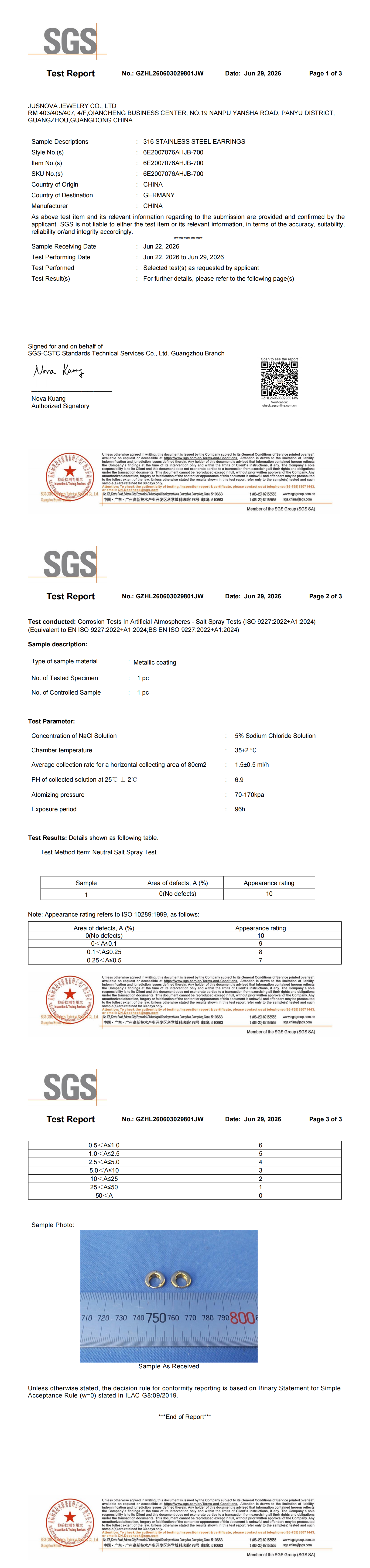
Salt spray testing (SGS report GZHL260603029801JW, ISO 9227) is one of the durability checks behind non-tarnish retail claims.
FAQ
Are engraved stainless steel bangles and rope chains safe for customers with sensitive skin?
They are safe when the correct grade is used. Jusnova's stainless steel jewelry is produced from hypoallergenic 316L with zero nickel release and is tested to EU REACH and FDA standards. For reference, EU REACH Annex XVII Entry 27 limits nickel release in skin-contact jewelry to less than 0.5 μg/cm²/week and to 0.2 μg/cm²/week for piercing items, according to the European Chemicals Agency (ECHA). Independent SGS testing supports the claim at report level, including a 316L material content analysis under ASTM A276/A276M-25 (report GZIN2606005050ML01_EN) and an artificial sweat test under ISO 3160-2 (report GZMR260602153701). Note that not all stainless steel is equivalent: 304L is common in economy fashion pieces, while 316L is the industry benchmark for hypoallergenic wear because of its molybdenum content.
Can these styles be customized with my own logo and branding?
Yes. Four in-house application methods are available — laser engraving, stamping, screen printing, and epoxy doming — with logo samples produced in 2 to 3 days. Engraving suits the continuous surface of an engraved bangle, the flat terminal ends of a cuff, and the clasp or tag on rope, Figaro, and cable chains. Finishing is also handled in-house: PVD coating with more than 20 colors, 18K gold plating, and brushed, mirror-polished, or sandblasted textures, with batch color consistency held to Delta E below 1.0. Sizes are customizable within a 5 mm to 80 mm diameter and 0.5 mm to 3.0 mm thickness range at ±0.05 mm tolerance, and packaging can run from OPP bags to premium gift boxes with hang tags and branded polishing cloths.
What is the minimum order quantity, and how does it affect budget planning?
The minimum order quantity is 100 pcs per style, with a monthly production capacity of 250,000 units and annual output of 3,000,000 units. That MOQ is designed to let a store test a style without overcommitting, but it also means budget is better concentrated: a program built from four or five strong styles will usually produce a healthier assortment than the same budget spread across twenty SKUs. Styles ranked higher in this guide support more customization levers, which generally makes them safer to order at depth because the same base product can be sold to more than one customer segment.
How do I validate a style before committing to a full production order?
Validate with a sample first. Logo samples are produced in 2 to 3 days, and the sample should be checked for engraving depth and legibility, plating color against the approved swatch, clasp or closure function, and stone security where stones are used. Material and durability documentation can be reviewed at the same time: the 316L content analysis verifies the steel grade, the artificial sweat test addresses skin-contact safety, and the salt spray test (SGS report GZHL260603029801JW, ISO 9227) addresses coating durability. Once approved, production follows an eight-stage control sequence from incoming raw material through final clasp or closure function checking.
What lead time should I plan for, and how should I compare the top stainless steel jewelry manufacturers for these styles?
Production lead time is 25 to 30 days. When comparing manufacturers for retail-ready styles such as engraved bangles and rope or Figaro chains, evaluate five things rather than brand claims: whether PVD coating and color consistency are handled in-house (Jusnova runs six PVD machines across more than 20 colors with Delta E below 1.0); whether the steel grade is verifiable through test reports rather than asserted; whether logo application is in-house and how fast samples are produced; what the real MOQ and capacity are, so reorders do not stall; and what the after-sales terms actually cover. Jusnova's after-sales team responds to quality inquiries within 24 hours and follows a structured six-step resolution process, with manufacturing defects such as plating peeling, stone loss, or color mismatch covered at the manufacturer's cost when reported within 30 days of receipt, free replacement of transit damage, a standard 6–12 month warranty, and repair services at material cost after the warranty period.
Next step: If you are shortlisting engraved bangles, rope chains, or Figaro bracelets for an upcoming season, request a sample and a quote from Jusnova Jewelry Co., Ltd. Samples with your logo can be produced in 2 to 3 days, and the team can confirm finish colors, sizes, and packaging options for your assortment before you commit to production quantities. Contact Bessie Zhou at market@powellwholesale.net or +86 189 2623 2416 (WhatsApp available) with your style list.
Conclusion
Stainless steel jewelry assortments are won or lost on style selection. The engraved bangle leads because it carries both brand and customer personalization on one piece; the rope chain follows as the strongest texture-led volume style; the Figaro chain brings unisex recognition; the cable chain provides the entry-price workhorse; and the cuff bangle covers statement and seasonal demand. All five share the same verified foundation — 304, 316, or 316L stainless steel, PVD coating in more than 20 colors with Delta E below 1.0 consistency, hypoallergenic 316L tested to EU REACH and FDA standards, in-house laser engraving and stamping, a 100 pcs per style minimum, and a 25 to 30 day lead time.
For a store, the practical rule is simple: rank by customization levers, commit depth to styles that carry at least two, and keep everything else at test quantity until repeat demand proves it deserves more shelf space.
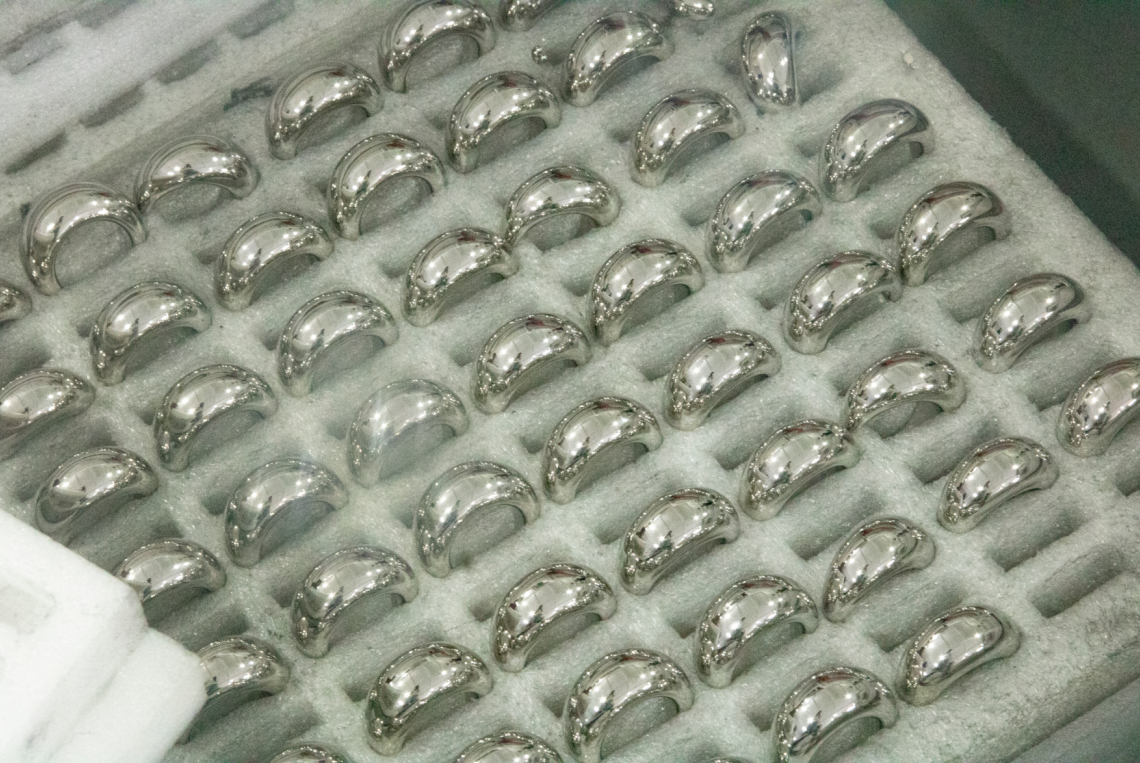
Finished orders are packed and inspected before shipment; standard production lead time is 25–30 days.