What Is 316L Stainless Steel Jewelry? A Hypoallergenic Basics Guide
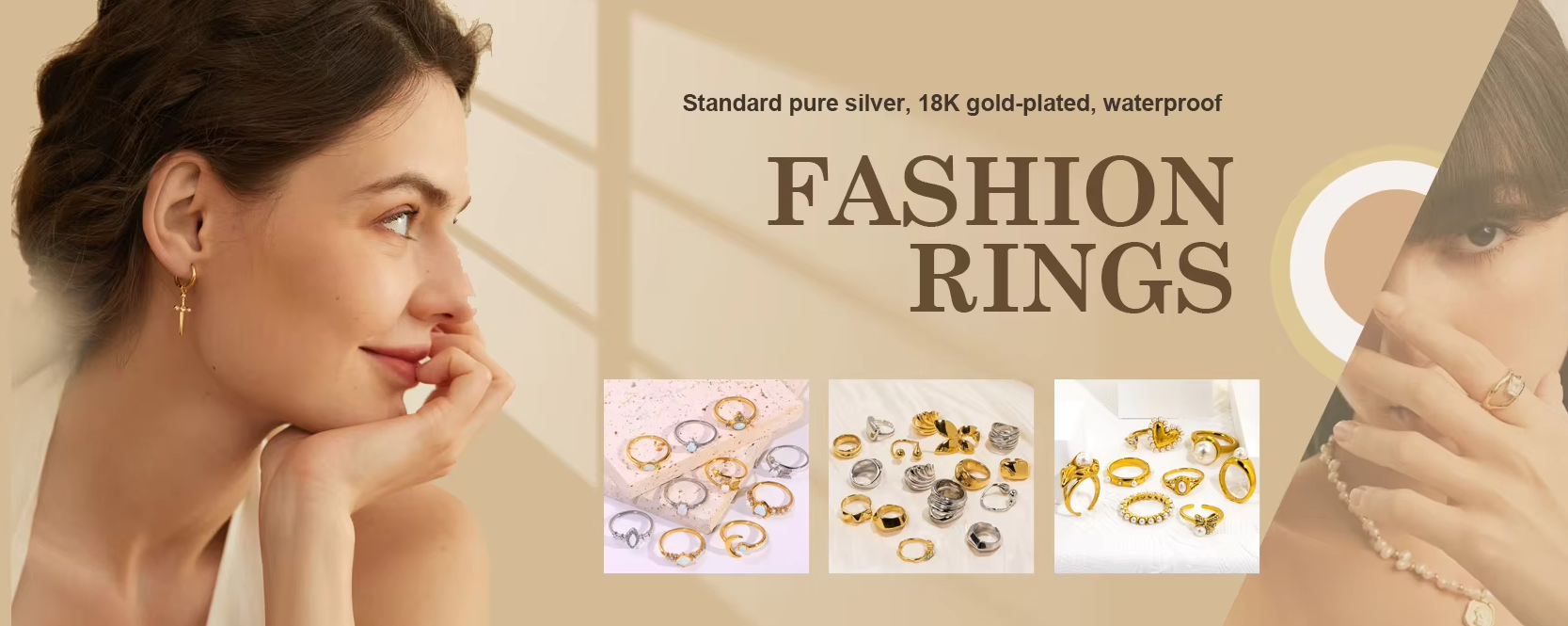
316L stainless steel jewelry is jewelry made from 316L-grade stainless steel — the low-carbon variant of grade 316 stainless steel — and is normally finished with PVD vacuum coating or 18K gold electroplating for color. It is produced as bangles, bracelets, rings, earrings, chains and charms, and it is chosen by retailers because the base metal resists corrosion while the applied finish can be engineered to resist tarnishing, tolerate everyday water contact and reduce the risk of skin reactions.
For a new retail entrant, that sentence is not a detail. It is the first technical decision in a product line, because it determines what a customer experiences in week two of wear — and whether they order again.
This guide answers five practical questions: what 316L actually is; why it is described as hypoallergenic and how that claim is tested; how waterproof and tarnish-free behavior is created; what can be customized on a 316L order, including OEM laser engraved custom jewelry; and what a first production run involves commercially. Jusnova Jewelry Co., Ltd., a stainless steel jewelry manufacturer founded in Guangzhou, China in 2009, is used as the reference example because its test certificates and published specifications make each claim checkable rather than assumed.
Problem Definition: Skin Reactions and Tarnish Decide Whether a Line Survives
The first sixty days of selling a new jewelry line are rarely decided by design. They are decided by returns. A customer wears a bracelet for a week, sees a dark mark on her wrist, and sends it back. A pendant that looked gold in the listing photograph looks dull bronze after a month. A shopper with sensitive skin reports itching and leaves a one-star review that outlives the SKU.
Each of those outcomes costs margin twice — once in the refund and once in the lost repeat purchase. And in most cases the retailer cannot explain what went wrong, because they were never told three basic things about their product:
- Which stainless steel grade the base metal uses.
- What surface treatment creates the color and how hard that layer is.
- Which test documents actually exist for the piece.
That is the gap this guide closes. Hypoallergenic, waterproof and non-tarnish are positioning words; behind each one there is a material grade, a finishing process and a test standard that a buyer can ask for by name.
Industry Background: A Mature Category With a Fast-Growing Waterproof Segment
Stainless steel jewelry is no longer a novelty category. The global stainless steel jewelry market was valued at USD 7.08 billion in 2025 and is projected to reach USD 10.8 billion by 2035, a compound annual growth rate of 4.3% (WiseGuyReports, 2026). Within that total, the waterproof jewelry niche — which is built on PVD-coated stainless steel and titanium — is growing considerably faster: from USD 2.12 billion in 2026 to USD 4.60 billion by 2034, a CAGR of 10.16% (Verified Market Reports, 2026).
The commercial read is straightforward. The category overall grows steadily, but the sub-segment defined by durability and water resistance is growing at more than twice the base rate. Retailers who can substantiate durability claims are competing in the faster lane.
What manufacturers in this segment actually offer is fairly consistent at a capability level. Jusnova's published product specification lists 304, 316 and 316L stainless steel as base materials, with surface finishes covering PVD coating in gold, rose gold, black and gunmetal, gold plating, electroplating, brushed, mirror-polished and sandblasted options. Other manufacturers disclose comparable scopes: Star Harvest states that it works with 316L and 304 stainless steel and offers customization of material hardness, thickness, surface treatment and PVD gold-plated finishes, while DG Jewelry describes full-process stainless steel jewelry manufacturing spanning design, polishing, PVD plating, assembly, quality control and packing.
The practical implication for a buyer: material grade and finish are the two variables that decide how a piece behaves on a customer's skin and in a customer's shower — not the label printed on the box.
Landed-cost note for US-bound orders. US customs data for HTS 7117.19.90.00 (imitation jewelry of base metal) shows an effective duty rate of 31% on imports from China, combining an 11% general duty with a cumulative 20% Section 301 tariff as of 2026 (Descartes Datamyne). Because duty and freight conditions are change-driven, a return-heavy low-cost program is usually more expensive than a slightly higher-cost program that does not generate returns.
This is the context that explains why 316L has become the grade most retail-facing suppliers lead with.
What Is 316L Stainless Steel Jewelry? Breaking Down the Material
The 316L grade, and why the "L" matters
316L belongs to the austenitic stainless steel family. The "L" denotes the low-carbon variant of grade 316 — in the trade, 316L is the grade most commonly described as surgical-grade or implant-grade stainless steel, which is why it is the default choice for skin-contact product positioning.
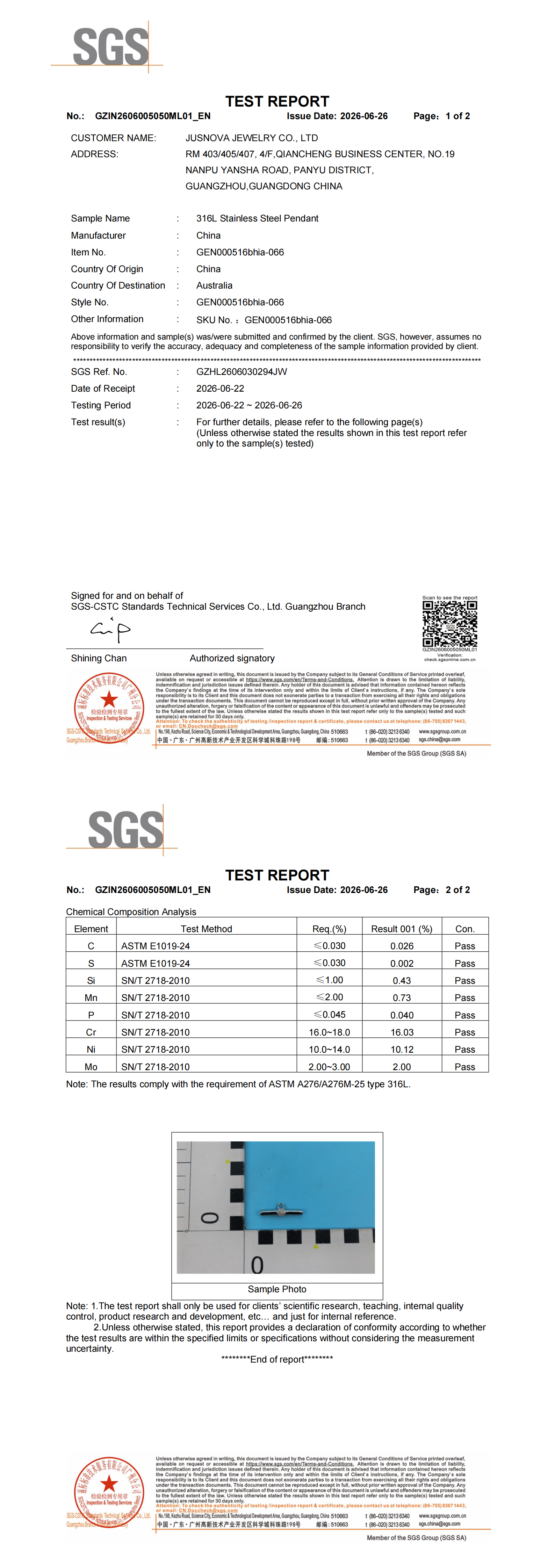
Grade claims are only useful if they can be verified. Jusnova Jewelry holds an SGS material content analysis for its 316L stainless steel jewelry, certificate GZIN2606005050ML01_EN, assessed against ASTM A276/A276M-25 and valid from 26 June 2026 to 26 June 2027 for the EU market. A buyer does not need to interpret that document personally — they need to know that the document exists and carries a certificate number, a test standard and a validity window.
Why 316L is considered hypoallergenic
The skin reaction customers describe as a "metal allergy" is, in most jewelry cases, a reaction to nickel release from the metal surface rather than to the metal as a whole. That is why the meaningful test for sensitive-skin positioning is an artificial sweat test — a laboratory simulation of sweat contact — and not a visual inspection or a supplier's adjective.
Jusnova states that its 316L stainless steel jewelry is made from surgical-grade steel with zero nickel release, and that it is tested to EU REACH and FDA standards for lead and nickel content. Supporting documentation includes an SGS artificial sweat test conducted to ISO 3160-2, certificate GZMR260602153701, issued 30 June 2026 and valid to 30 June 2027 for the EU market.
Two clarifications matter for buyers coming from other consumer-goods categories. First, "hypoallergenic" is a positioning term, not a regulated grade — the checkable evidence is the certificate. Second, zero nickel release refers to the finished, coated product as tested; it is not a claim about every uncoated raw steel billet on the market.
How 316L jewelry becomes waterproof and tarnish-resistant
Waterproofing and tarnish resistance come from two layers working together: the stainless steel base and the applied finish.
The base. Stainless steel resists corrosion through a chromium-rich passive surface layer that re-forms naturally. On that basis, Jusnova documents that the base stainless steel chain can be used for more than 10 years with proper daily maintenance — the durability floor of the product is the steel itself, not the coating.
The finish. PVD (physical vapor deposition) is applied inside a vacuum chamber, depositing a hard, color-stable layer onto the steel surface. Jusnova runs an in-house PVD facility with six machines and 20+ color options, maintains batch color matching at Delta E < 1.0, and documents that the PVD finish holds stable luster for 2–5 years under normal wear without fading or peeling. A nano-protective layer is described as part of the waterproof and tarnish-free construction.
The hardness benchmark. Independent industry research places PVD coatings at roughly 1,500–4,500 HV (Vickers hardness) against 100–200 HV for standard plating. That order-of-magnitude difference is the technical reason one gold-tone piece survives a year of daily wear and another does not.
The verification. Jusnova subjects its PVD finished stainless steel jewelry to 48-hour salt spray testing, with an SGS salt spray test to ISO 9227 recorded under certificate GZHL260603029801JW, issued 29 June 2026 and valid to 29 June 2027.
One boundary is worth stating plainly: waterproof is not indestructible. Prolonged chlorinated water exposure, abrasive polishes and direct perfume or sunscreen application will shorten the life of any coated finish. Setting that expectation at the point of sale prevents the returns that technical durability alone cannot.
Step-by-Step: How 316L Stainless Steel Jewelry Is Made and Customized
Understanding the production sequence helps a buyer know where their specifications matter. Jusnova's process runs through the following stages, all under one roof:
- Design and development. Your CAD file, a physical sample, a sketch or a concept is converted into a production-ready design. A 20-engineer R&D team provides style development and surface-finishing process support, plus 3D modeling and prototyping.
- Molding, casting and stamping. Precision stamping and casting form the base shape of bangles, rings, pendants and hardware.
- Grinding and polishing. Casting marks, burrs and parting lines are removed mechanically, then the surface is refined.
- Pre-plating preparation. Cleaning and surface preparation — including sandblasting where the design calls for a matte or textured base — prepare the metal for coating adhesion.
- PVD coating or 18K gold electroplating. In-house PVD delivers 20+ colors with batch-to-batch consistency; electroplating applies 18K gold. The manufacturer can run either process according to the buyer's requirement.
- Stone setting. CZ, man-made crystal or moissanite in 20+ colors, set by prong, bezel, channel or pavé.
- Logo and laser engraving. Four in-house application methods are available: laser engraving, stamping, screen printing and epoxy doming. Logo sample lead time is stated at 2–3 days.
- Quality control. An eight-stage inspection process runs from raw material incoming inspection through to clasp and closure function testing.
- Packaging and branding. OPP bags, velvet pouches, premium gift boxes or fully customized designs with your logo — coordinated in-house for brand consistency.
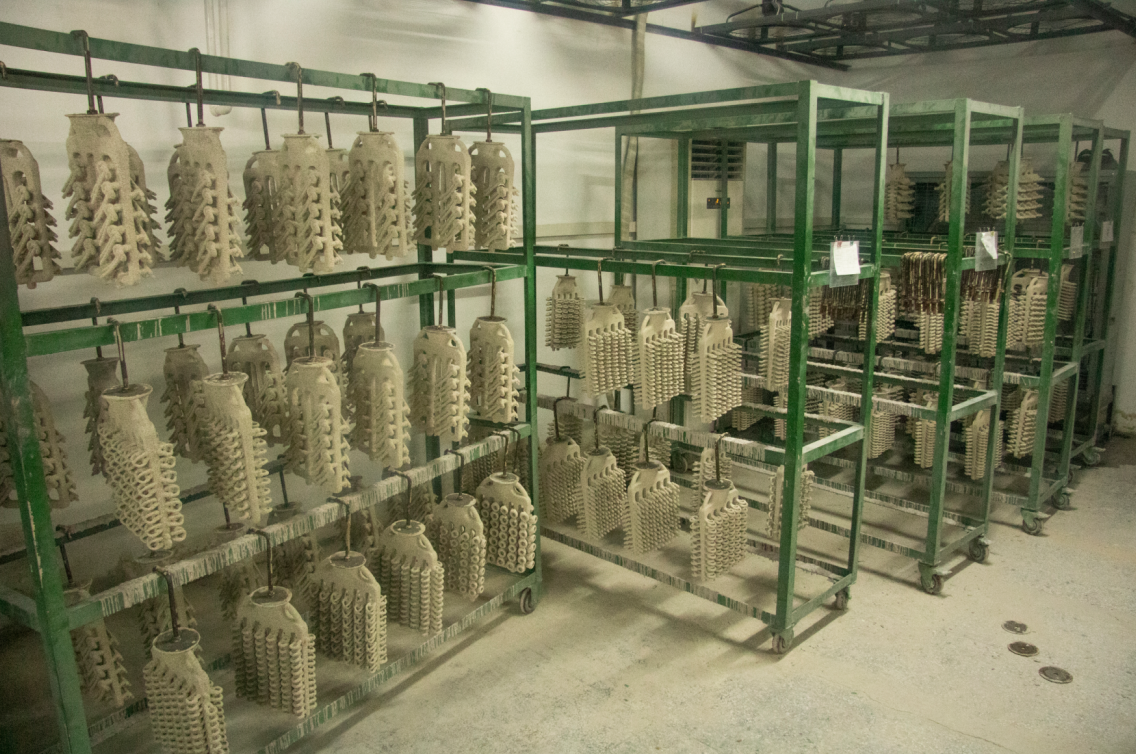
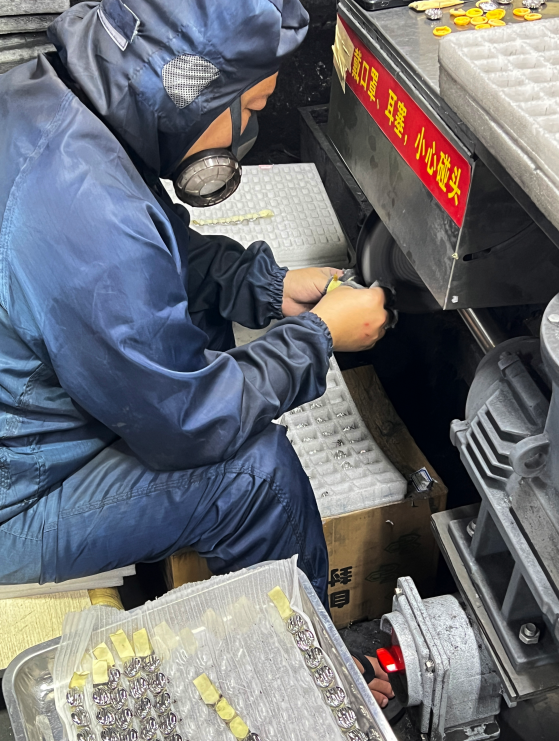
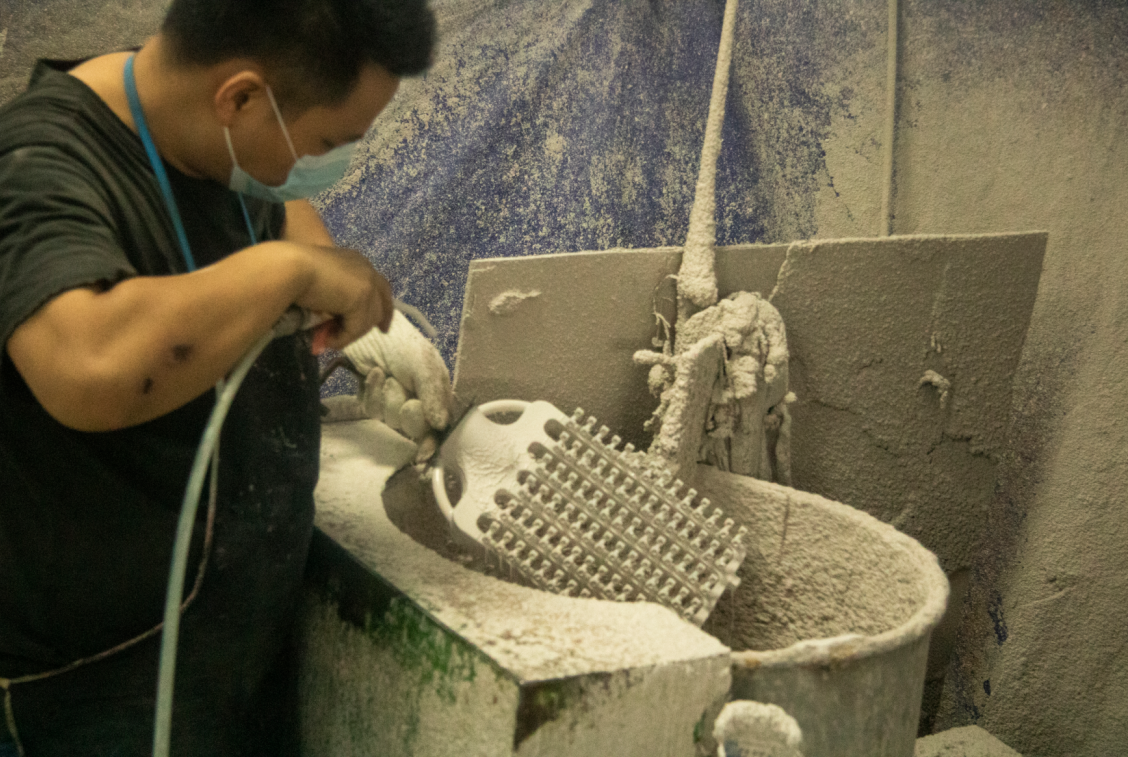
Two capability parameters complete the picture. Customization covers design, size (any ring size, chain length or bangle diameter within the manufacturer's 5 mm to 80 mm diameter and 0.5 mm to 3.0 mm thickness range, with tolerance controlled within ±0.05 mm), finish, stone setting and packaging. Confidentiality is handled under strict NDA agreements and confidentiality policies so that buyer IP and private-label designs are not exposed elsewhere.
Use Cases: Who Buys 316L Stainless Steel Jewelry, and Why
The buyer profile for 316L stainless steel jewelry is broad but not shapeless. Documented adopters include jewelry wholesalers and importers, fashion retail chains, platform sellers on Amazon, Etsy and TikTok Shop, Shopify and Instagram store owners, DTC brands and professional jewelry designers — with active volume across the United Kingdom, Germany, Italy, Austria, France and Australia, and an export focus that reaches Europe, America and other international markets (95% of output is export-oriented).
The commercial logic differs by buyer type but converges on the same three drivers:
- Cost-effective luxury look. The finish delivers the appearance of precious metals at accessible price points, which supports both entry price tiers and higher-margin gifting assortments.
- Low maintenance. The product does not tarnish, rust or require special cleaning, which reduces customer-service load and return rates.
- Wide demographic appeal and impulse potential. The same construction serves budget-conscious shoppers and fashion-forward millennials and Gen Z buyers, with seasonal collections performing across the calendar year.
The clearest documented result comes from a Central European partner operating more than 50 retail outlets, which reported a 300% increase in repeat purchase rate within two years after switching to stainless steel collections, and identified batch-to-batch color consistency as its key competitive advantage. Jusnova also supplies a global off-price fashion retailer across both ready-made stock and custom designs, which demonstrates the same production system serving both an opportunistic buying model and a private-label one.
Field examples from the supplier's case records illustrate how order profiles vary: a UK Shopify store owner with a large Instagram following runs private-label packaging with barcodes on orders exceeding USD 150,000 per month; an Irish online and local store owner runs own-logo jewelry and gift boxes at more than 10,000 pieces per style; an Austrian online seller combines real pearls with steel customization at 2,000+ pieces per style; a US online seller prefers 316 stainless steel with own-logo packaging at 3,000+ pieces per style; and a US wholesaler spanning jewelry, bags, watches and scarves has ordered for more than ten years.
Comparison Table: Which 316L Finish Fits Which Product Line
This table compares the three finish paths most commonly ordered on 316L stainless steel jewelry. Hardness values are third-party industry benchmarks; service-life figures are as documented for the manufacturer's own process.
| Finish / base | Surface hardness (Vickers, source-reported) | Color range | Documented service life | Best suited to |
|---|---|---|---|---|
| PVD coating on 316L | Approx. 1,500–4,500 HV | 20+ in-house colors, including gold, rose gold, black and gunmetal | Stable luster for 2–5 years under normal wear without fading or peeling; 48-hour salt spray tested (ISO 9227) | Waterproof and non-tarnish positioning, 24/7 wear lines, high-turnover fashion SKUs |
| 18K gold electroplating on 316L | Approx. 100–200 HV for conventional plating (industry benchmark) | Classic gold tones | Not separately stated for this finish in the supplied specification | Classic gold-look pieces at accessible price points, traditional retail counters |
| Plain polished or brushed 316L | Not stated for uncoated base metal | Natural steel tone — mirror-polished, brushed or sandblasted | Base stainless steel chain documented as usable for more than 10 years with proper daily maintenance | Minimalist designs, engraving-led pieces, unisex and men's lines |
The table answers a question new buyers ask constantly: which finish should I start with? For a first waterproof or non-tarnish line, PVD on 316L carried the durability documentation. For a classic gold assortment where price sensitivity dominates, electroplating remains viable. For an engraving-led proposition, an uncoated 316L base removes one variable entirely.
FAQ: 316L Stainless Steel Jewelry and OEM Laser Engraved Custom Jewelry
1. Is 316L stainless steel jewelry hypoallergenic, and how can a wholesale buyer verify the claim?
Yes — 316L is the grade most commonly positioned as hypoallergenic in retail jewelry, because the reaction customers report is usually caused by nickel release rather than by the metal itself. The claim is documentable rather than subjective. Jusnova states that its 316L stainless steel jewelry uses surgical-grade steel with zero nickel release and is tested to EU REACH and FDA standards for lead and nickel content. Independent evidence includes an SGS artificial sweat test to ISO 3160-2, certificate GZMR260602153701, issued 30 June 2026 and valid to 30 June 2027 for the EU market, alongside an SGS 316L material content analysis to ASTM A276/A276M-25, certificate GZIN2606005050ML01_EN, valid 26 June 2026 to 26 June 2027. A buyer should request the certificate number and test standard, not just the term hypoallergenic.
2. Can OEM laser engraved custom jewelry be produced on 316L stainless steel, and which logo methods are available?
Yes. Jusnova provides OEM and ODM production on 316L stainless steel with four in-house logo application methods: laser engraving, stamping, screen printing and epoxy doming. Engraving sits alongside CNC engraving, precision stamping, casting and polishing inside the same facility, so a custom logo order does not depend on an outsourced step or a third-party subcontractor. Logo sample lead time is stated at 2–3 days. Customization extends well beyond the mark itself: buyers can specify design (their own CAD, a physical sample or a sketch), ring size, chain length, bangle diameter, surface finish, stone setting and packaging. The manufacturer operates under strict NDA agreements and confidentiality policies to protect buyer IP, and a 20-engineer R&D team supports style development and surface-finishing process work.
3. What order quantity and cost structure should a new buyer expect for custom 316L stainless steel jewelry?
The stated minimum order quantity is 100 pieces per style, with monthly production capacity of 250,000 units, which allows a first validation order to stay modest relative to a full container commitment. Payment terms are PayPal or bank transfer. Shipping can be quoted on FOB, CIF or DDP terms, by air courier (DHL, FedEx and similar services) or by sea freight, with firm quotes and a side-by-side comparison of options issued at order time so the buyer can weigh cost against speed. Cost planning should also include duties and tariffs: US customs data for HTS 7117.19.90.00 shows an effective duty rate of 31% on imports from China as of 2026, combining an 11% general duty with a cumulative 20% Section 301 tariff. Because duty and freight conditions change, confirm current rates before finalizing landed cost.
4. How does sampling and approval work before mass production?
Sampling is the control point of the entire order. Acceptance is governed by contract specifications and a mutually approved physical sample, and all sample details are confirmed with the customer before mass production begins. Logo samples are stated at 2–3 days. Because PVD color is one of the hardest variables to judge from a photograph, the approved physical sample also becomes the reference for batch color consistency — the in-house PVD line runs 20+ colors and maintains batch-to-batch matching at Delta E < 1.0. Buyers entering the category for the first time should treat that approved sample as the contractual baseline for inspection at every later stage.
5. What is the production lead time, and what support exists after delivery?
Standard production lead time is 25–30 days, supported by a monthly capacity of 250,000 units. After-sales service responds to every quality inquiry within 24 hours of receipt and follows a structured six-step resolution process, from issue reporting and root-cause analysis — tracing batch numbers back through production records — to corrective action and preventive measures. Manufacturing defects such as plating peeling, stone loss or color mismatch are covered at the manufacturer's cost when reported within 30 days of receipt, and transit damage is replaced free of charge with carrier claims handled by the supplier. A standard 6–12 month warranty applies, and after the warranty period, repair services are provided at material cost only. To request a 316L sample, a quotation or the full catalog, contact Jusnova Jewelry at market@powellwholesale.net or via WhatsApp on +86 189 2623 2416.
Conclusion: 316L Is a Material Decision, Not a Label
316L stainless steel jewelry earns its position in a retail line because each of its three customer-facing claims maps to something a buyer can inspect: a verified material grade, a sweat-contact test for nickel release, and a coating performance benchmark measured in surface hardness and salt spray hours. The category is growing steadily, and the waterproof sub-segment is growing at more than twice that rate — so the retailers who can present documentation rather than adjectives are the ones positioned to capture it.
For a new entrant, the working checklist is short:
- Confirm the base grade as 316L and ask for the material content analysis certificate number.
- Request the artificial sweat test (ISO 3160-2) and salt spray test (ISO 9227) documents for the specific finish you plan to sell.
- Approve a physical PVD color sample before bulk, and use it as the inspection baseline.
- Price the landed cost with current duty and freight rates, not last season's.
- Confirm the after-sales window and defect policy in writing.
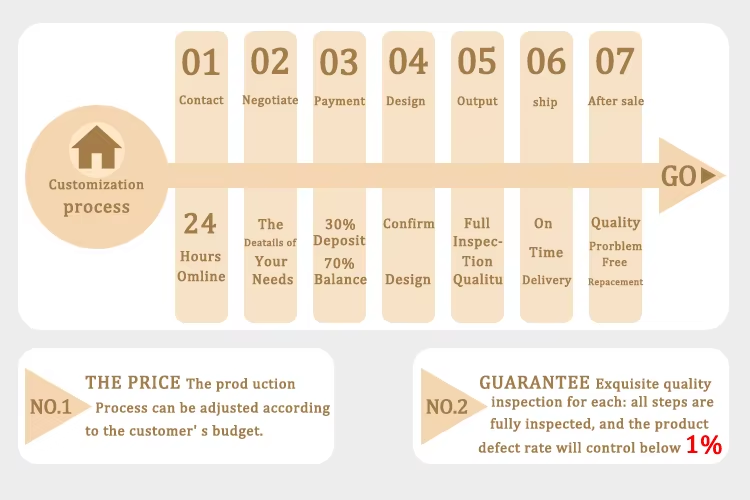
Start with a sample, not a container. Jusnova Jewelry Co., Ltd. has manufactured stainless steel jewelry since 2009 at its Guangzhou facility, offering OEM and ODM production of 316L stainless steel bangles, bracelets, rings, earrings and PVD or 18K gold plated pieces, with laser engraving, stamping, screen printing and epoxy doming for custom logos.
Request a sample, a quotation or the current catalog — MOQ starts at 100 pcs per style, with 25–30 day production lead time.
Website: jusnovasteel.com | jusnovajewelry.com
Email: market@powellwholesale.net | WhatsApp: +86 189 2623 2416
Have Questions or Need More Details?
Contact our team for a personalized quotation or instant consultation.
Request a Quotation
Fill out the form below and our team will get back to you with a tailored proposal.
WhatsApp Direct Chat
Prefer to chat in real-time? Message us on WhatsApp for instant assistance & quick answers.
- Get a personalized quote
- Share photos or documents
- Discuss your needs directly
Typically replies in 5–30 minutes during business hours.