
Dissolved Oxygen, pH, and Conductivity Sensor Selection for Water Monitoring
Choosing dissolved oxygen (DO), pH, and conductivity sensors is a specification exercise, not a catalogue exercise. The correct combination follows from the decision the data must support, the water matrix the probe will live in, and the maintenance workload the site can realistically sustain. Two plants measuring the same three parameters often need different measurement principles, different wetted materials, and different calibration intervals.
Xi'an Kacise Optronics Tech Co., Ltd. (KACISE) is a water quality sensor manufacturer headquartered in Xi'an, Shaanxi, China, operating a 40,000 m² production facility with a stated annual output of 120,000 units. Its water quality portfolio includes fluorescence dissolved oxygen sensors, an online pH probe, a digital pH sensor, a digital conductivity sensor, and multi-parameter controllers. That portfolio makes the company a practical reference point for walking through a selection framework from the manufacturer's side of the table.
Problem Definition: Where DO, pH, and Conductivity Specifications Usually Go Wrong
Most selection failures in water monitoring do not come from a sensor being broken. They come from a sensor being specified against the wrong constraint. Three patterns repeat:
- Principle mismatch on dissolved oxygen. A buyer selects a DO sensor by measuring range alone, without deciding whether the site can support an oxygen-consuming electrochemical cell that needs flow, membrane service, and electrolyte replacement.
- Configuration mismatch on pH. A pH probe is bought as a commodity item, then installed in a location where the reference junction fouls faster than the maintenance team can clean it. The result is calibration drift that looks like a sensor fault.
- Range and fouling mismatch on conductivity. A low-range cell is ordered for a high-salinity stream, or a two-electrode design is used where a four-electrode design would handle polarization and surface film better.
A fourth failure sits above all three: the sensor cannot talk to the rest of the plant. A probe with no compatible output forces the buyer into a gateway, a controller upgrade, or manual logging — costs that were never in the original comparison.
Industry Background: Why Multi-Parameter Monitoring Changes the Selection Logic
Market research used for this guide values the global water quality sensor market at USD 6.2 billion in 2025 (Grand View Research, cited in the 2026 evidence package for this category). The same source indicates that multi-parameter units accounted for more than 60% of new sensor sales globally in 2024, up from 42% in 2020, and that Asia Pacific held a 48.2% revenue share in 2025.
Two cautions apply. First, market sizing in this category depends heavily on whether analyzers, controllers, and complete monitoring systems are counted alongside sensors, so the figure should be read as directional rather than exact. Second, the multi-parameter trend has a practical consequence for engineers: DO, pH, and conductivity are increasingly purchased as a set that shares a controller, a power scheme, and one data path, rather than as three isolated instruments. That shifts the selection question from "which probe is best" to "which combination of probe, controller, and interface can the site actually maintain and integrate".
A Nine-Step Selection Framework for DO, pH, and Conductivity
The framework below runs from the monitoring objective to supply verification. Each step produces a decision that constrains the next one, which is why starting from a product list usually produces a specification that has to be reworked.
Step 1 — Define the decision the data must support
Write down what happens when a reading crosses a threshold. Aeration control needs a DO signal that is fast enough and reliable enough to drive blowers. Discharge compliance needs a documented calibration trail. Corrosion control needs conductivity coverage at the low end of the range, not just the middle. Environmental reporting needs a probe that survives weeks of biological growth between service visits.
The same KWS-300 conductivity sensor can serve municipal supply, wastewater, aquaculture, or industrial effluent, but the installation, cleaning interval, and output mapping differ for each. Defining the decision first prevents that ambiguity from being resolved by default rather than by design.
Step 2 — Characterise the water matrix
Four matrix properties drive most of the specification: salinity and ionic strength, suspended solids, biological or chemical fouling potential, and temperature. Temperature matters twice — once for the sensor's own operating limit, and once for the accuracy of temperature compensation.
The KWS-300 Online Digital Conductivity Sensor is rated for 0–50 °C with wetted parts in POM and titanium and a 316L stainless steel housing. Those material choices matter in brackish water, aquaculture, and light chemical service, where a lower-grade wetted part would shorten service life.
Step 3 — Set the range with headroom, not at the edge
Range is the most common place where a technically acceptable sensor becomes an operational problem. A probe specified exactly at the expected maximum will spend its life at the top of its scale, where fouling and drift have the largest effect.
For conductivity, KACISE lists two spans on the KWS-300: 0–5000 μS/cm and 0–100 mS/cm, both over a 0–50 °C operating range. The first suits freshwater, municipal supply, and most wastewater; the second suits saline water, high-salinity aquaculture, and concentrated industrial streams. Selecting between them is a decision about the site, not about the sensor's quality.
Step 4 — Choose the dissolved oxygen principle before the model
Two principles dominate continuous DO measurement. Optical (luminescent or fluorescence) sensors use a dye whose light emission is quenched by oxygen; they do not consume oxygen and do not require electrolyte replacement. Electrochemical (galvanic or polarographic) sensors consume oxygen across a membrane and depend on flow across the membrane surface, with membrane and electrolyte service as routine work.
In practice, optical DO is usually the better fit where maintenance access is limited, where flow varies, or where biological fouling already consumes the site's service budget. Electrochemical DO remains a legitimate choice where capital cost dominates and the site has a disciplined maintenance routine. The trade-off is capital cost against lifetime labour, not accuracy alone.
Within the KACISE range, the Fluorescence Dissolved Oxygen Sensor (KWS-630) covers continuous online DO measurement, the Portable Optical Dissolved Oxygen Meter supports spot checks and cross-verification against the installed probe, and the KDM-140B Online Dissolved Oxygen Meter provides a wall-mounted DO meter with temperature compensation, digital display, RS485 (Modbus) and 4–20 mA isolated output, plus high/low alarms. That alarm capability is often the deciding feature in aeration control, because it lets the DO signal act directly on equipment rather than only feed a dashboard.
Step 5 — Choose the pH configuration around the reference junction
pH measurement is a high-impedance measurement, so the practical questions are where the impedance is converted and how accessible the junction is for cleaning. A digital pH sensor converts the signal close to the electrode and transmits digitally, which shortens the high-impedance analogue path and simplifies wiring to a controller or monitoring platform. An analogue online probe relies on the cable and transmitter to preserve that signal.
KACISE lists two relevant products: the Online pH Probe (KWS-750) for continuous installation, and the Digital pH Sensor (IoT Supported) for configurations where the pH value must join a digital monitoring system alongside DO, conductivity, and other parameters. The KWS-750 appears in a river environmental monitoring deployment in the United Kingdom, where it was combined with a TSS sensor and a 6-in-1 water quality analyzer for pollution detection and early warning.
Whichever configuration is chosen, the maintenance plan must include junction cleaning and buffer calibration. A pH probe that cannot be reached easily will drift, and drift in pH is rarely obvious until it affects a control decision.
Step 6 — Choose the conductivity configuration around fouling and range
Conductivity cells are either two-electrode or four-electrode. A four-electrode design compensates for polarization and cable effects and generally tolerates surface films better than a simple two-electrode cell, which is why it is the usual choice for wastewater, aquaculture, and industrial streams where the probe will not stay perfectly clean.
The Online Digital Conductivity Sensor (KWS-300) uses four-electrode measurement with automatic temperature compensation, RS485 (Modbus/RTU) output, no reagent requirement, and two-point calibration. Its stated spans are 0–5000 μS/cm and 0–100 mS/cm over 0–50 °C. For very high conductivity or heavy scaling, inductive (toroidal) conductivity is a common alternative principle, but it is a different specification decision and should be justified by the water matrix rather than adopted by habit.
Step 7 — Decide between online and portable, and use both
Online sensors exist to produce a continuous record and to drive control. Portable instruments exist to verify that the online sensor is still telling the truth. Treating them as substitutes is a common error: a portable meter cannot provide a control signal, and an online probe left unverified will eventually be trusted beyond its actual condition.
A workable pattern is one portable optical DO meter per site for routine verification, with the online fluorescence DO sensor carrying the continuous record. The same logic applies to pH and conductivity: periodic grab-sample comparison against a portable or laboratory method is the cheapest reliability improvement available.
Step 8 — Plan calibration and maintenance before installation
Calibration planning should be written before the purchase order, because it determines access requirements, spare parts, and staffing. The table below sets out the practical implications for each parameter.
| Parameter | Verified product behaviour | Planning implication |
|---|---|---|
| Dissolved oxygen | KWS-630 fluorescence DO sensor for continuous online measurement; KDM-140B meter with temperature compensation, RS485 (Modbus) and 4–20 mA isolated output | Optical DO does not consume oxygen or need electrolyte replacement, so the maintenance task shifts to optical surface cleaning and periodic reference checks rather than membrane service |
| pH | KWS-750 online pH probe; Digital pH Sensor (IoT Supported) for digital integration | Budget for junction cleaning and buffer calibration, and specify a mounting point that can be reached without shutting down the process |
| Conductivity | KWS-300 four-electrode sensor with automatic temperature compensation, two-point calibration, POM + titanium wetted parts | Two-point calibration is part of normal operation; fouling control and cable routing should be resolved at installation |
| Integration | KWC-100 multi-parameter controller with automatic sensor identification, RS485 output, 4–20 mA isolated output and two relays | One controller can host several parameters, which reduces cabinet space and wiring compared with separate transmitters |
Step 9 — Verify integration, documentation, and supply
Integration is where otherwise sound sensor choices fail. Confirm the output type required by the receiving system — RS485 (Modbus/RTU) for digital networks, 4–20 mA isolated for analogue loops, relay contacts for alarms — and confirm who is responsible for protocol mapping.
The KWC-100 Multi-Parameter Water Quality Controller accepts multiple sensor types with automatic sensor identification and provides 4–20 mA isolated output, RS485 output, two relays, and automatic temperature and pressure compensation in an ABS casing. For stations that combine DO, pH, and conductivity with ammonia nitrogen, COD, turbidity, or chlorophyll, a shared controller is usually more practical than three independent transmitters.
Documentation should be checked at the same time. KACISE holds CE EMC certificate ZTS23061509TCE for the water quality sensor scope, issued by Shenzhen ZTS Testing Service Co., Ltd. on 21 June 2023 for the EU market, against EN IEC 61326-1:2021, EN 55011:2016+A2:2021, EN IEC 61000-3-2:2019+A1:2021 and EN 61000-3-3:2013+A2:2021. Buyers should confirm that the certificate scope matches the exact model and that any additional market-specific approvals required by the project are identified before award.

KDM-140B Online Dissolved Oxygen Meter: temperature compensation, RS485 (Modbus) and 4–20 mA isolated output, with high/low alarm functions.
Selection Matrix: Matching Parameter, Principle, and Product
The matrix below summarises the verified attributes that matter at the shortlisting stage. Where a product is listed without a published specification in this article, the specification should be requested from the manufacturer before the comparison is finalised.
| Parameter | Measurement principle | KACISE product | Verified attributes | Primary selection risk |
|---|---|---|---|---|
| Dissolved oxygen | Fluorescence (optical) | KWS-630 Fluorescence Dissolved Oxygen Sensor | Continuous online DO; fluorescence principle | Optical surface fouling if cleaning access is poor |
| Dissolved oxygen | Optical, portable | Portable Optical Dissolved Oxygen Meter | Portable spot-check instrument | Being treated as a substitute for continuous monitoring |
| Dissolved oxygen | Meter with DO input | KDM-140B Online Dissolved Oxygen Meter | Temperature compensation, digital display, RS485 (Modbus), 4–20 mA isolated, high/low alarm | Alarm set points not configured during commissioning |
| pH | Online pH probe | KWS-750 Online pH Probe | Continuous online pH; deployed in river monitoring with TSS and multi-parameter analyser | Reference junction fouling and calibration drift |
| pH | Digital pH with IoT support | Digital pH Sensor (IoT Supported) | Digital pH configuration for integrated monitoring | Protocol mapping not agreed with the integrator |
| Conductivity | Four-electrode | KWS-300 Online Digital Conductivity Sensor | 0–5000 μS/cm and 0–100 mS/cm; 0–50 °C; ATC; RS485 (Modbus/RTU); two-point calibration; POM + titanium wetted parts; 316L housing | Range chosen at the process limit; scaling on the cell |
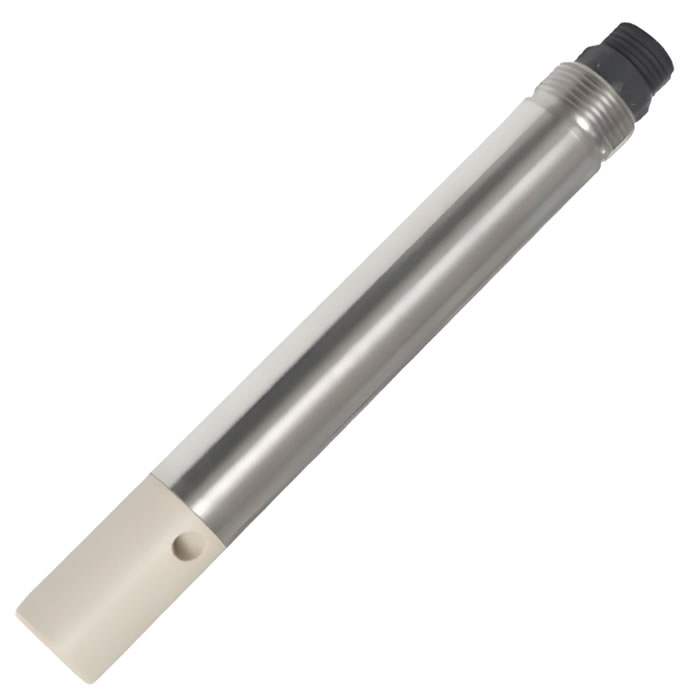
KWS-300 Online Digital Conductivity Sensor: four-electrode measurement, 0–5000 μS/cm and 0–100 mS/cm spans, RS485 (Modbus/RTU) output.
Decision rule. If the site cannot guarantee cleaning access at the required interval, choose the principle with the lowest maintenance burden rather than the lowest purchase price. If the site cannot guarantee a stable flow profile, avoid a DO principle that depends on flow across a membrane. If the receiving system is digital, specify the digital output at the probe rather than adding a converter later.
Use Cases: How the Framework Applies in Practice
Four documented deployments illustrate how the same three parameters produce different specifications.
Aquaculture: continuous DO with low maintenance
A Norwegian aquaculture farm deployed 15 fluorescence DO units for dissolved oxygen and ammonia monitoring in high-density fish farming, supported by saltwater-resistant continuous monitoring. Over a three-year period the reported result was an increased fish survival rate, with low maintenance and saltwater resistance cited as the defining benefits. A second aquaculture deployment used 40 units for DO monitoring with fluorescence DO and low maintenance as the stated highlight.
The selection logic here is straightforward: in saltwater with continuous biological load, an optical DO principle removes electrolyte service from a site where labour is expensive and access is weather-dependent. Conductivity is added to track salinity, which is exactly where the 0–100 mS/cm span on the KWS-300 becomes relevant.

Fluorescence dissolved oxygen monitoring in aquaculture, where continuous DO data supports aeration control and stock protection.
Municipal wastewater: multi-parameter integration for effluent compliance
A municipal wastewater plant in the United Kingdom installed 12 sensors for effluent quality monitoring. The reported outcome after three years was compliant discharge with reduced manual sampling, and multi-parameter integration was the defining benefit. In this configuration, the value comes less from any single probe and more from a shared controller and a single data path — the role the KWC-100 is built for.
Pharmaceutical purified water: conductivity under GMP conditions
A pharmaceutical plant in Switzerland used 12 units for purified water conductivity monitoring over five years, reporting GMP compliance achieved, with a sanitary clamp connection as the key requirement. Here the specification driver is not range headroom but the hygienic connection, documented calibration, and repeatable installation. It is a reminder that wetted-part configuration can outrank measurement performance in the purchase decision.
River and surface water: pH and TSS in an early-warning network
A river environmental monitoring programme in the United Kingdom used three units for pollution detection and early warning, including the KWS-750 Online pH Probe alongside a TSS sensor and a 6-in-1 water quality analyzer. After two years the reported outcome was stable real-time monitoring with improved response speed, with remote IoT monitoring and low maintenance as the highlights. A Japanese environmental agency similarly deployed 25 units for river multi-parameter water quality over three years, reporting continuous environmental reporting.
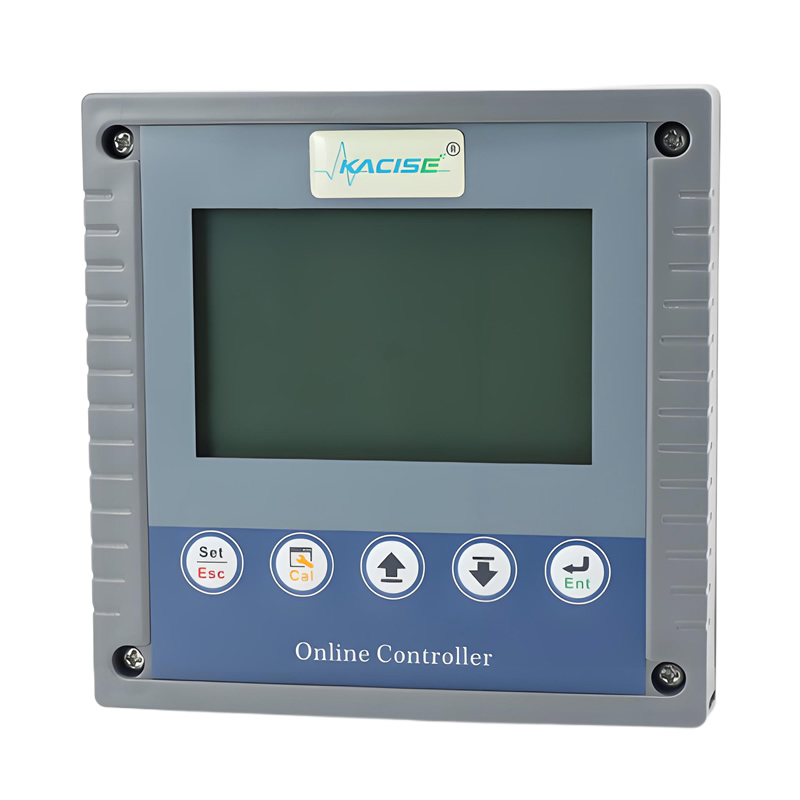
KWC-100 Multi-Parameter Water Quality Controller: automatic sensor identification, RS485 and 4–20 mA isolated output, two relay channels.
What This Framework Cannot Do
Sensor selection solves a narrow problem well and a broad problem badly. Three limits should be stated openly.
- It cannot fix a bad sample point. A probe installed in a dead zone, downstream of a dosing point, or in direct sunlight will produce data that no calibration schedule can rescue.
- It cannot replace maintenance. Optical DO reduces service frequency compared with electrochemical DO, but it does not remove the need to clean the optical surface. A four-electrode conductivity cell tolerates fouling better than a two-electrode cell, but it is not immune to scaling.
- It cannot substitute for project approvals. EMC certification and product-level conformity are necessary but not sufficient for every market. Where a project requires additional approvals for wetted parts or drinking water contact, those must be confirmed for the exact model before award.
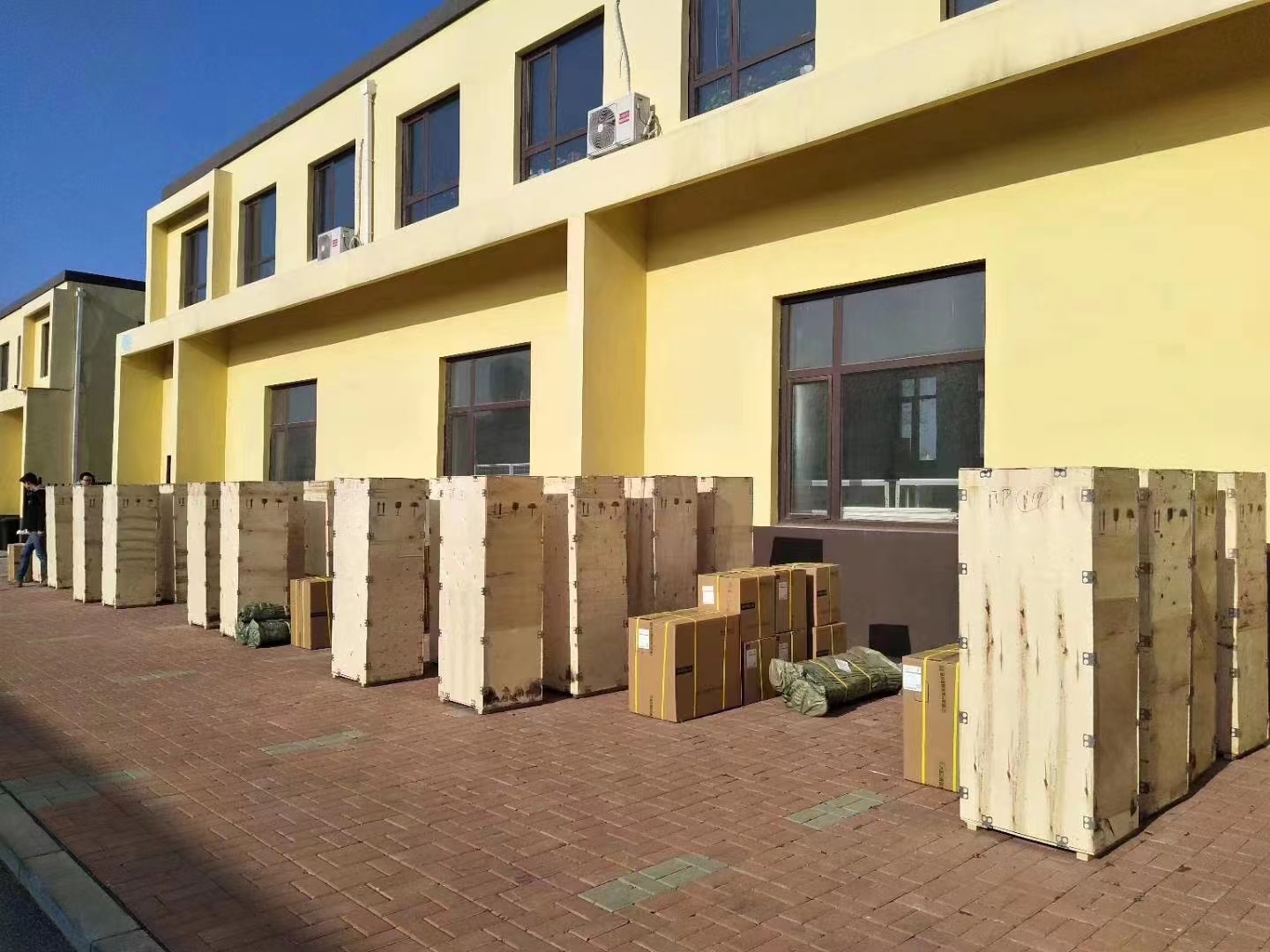
Water quality sensor production at KACISE, where the company reports a 40,000 m² facility and an annual output of 120,000 units.
Frequently Asked Questions
Which certification should a buyer verify before ordering water quality sensors from KACISE?
For the water quality sensor scope, KACISE holds CE EMC certificate ZTS23061509TCE, issued by Shenzhen ZTS Testing Service Co., Ltd. on 21 June 2023 for the EU market. The listed standards are EN IEC 61326-1:2021, EN 55011:2016+A2:2021, EN IEC 61000-3-2:2019+A1:2021 and EN 61000-3-3:2013+A2:2021. Buyers should confirm that the certificate covers the exact model being purchased, and should request any additional project-specific approvals required by the destination market before award.
Can KACISE support OEM or ODM customisation and volume orders?
Yes. KACISE operates a 40,000 m² production facility with a stated annual output of 120,000 units and applies 100% testing to production. OEM and ODM customisation covers voltage, logo, output method, protocol, and cable. For the OEM/ODM programme the listed monthly capacity is 5,000 units; a separate OEM programme for voltage and logo customisation lists a monthly capacity of 8,000 units.
How should buyers budget for DO, pH, and conductivity sensors?
No public price list applies, because cost is driven by configuration rather than by parameter alone. The main drivers are measurement principle (optical versus electrochemical DO), digital versus analogue pH configuration, cleaning and mounting accessories, cable and protocol requirements, whether a shared controller such as the KWC-100 is included, and the calibration and spare-part plan. Buyers should request an itemised quotation covering probe, cable, controller, mounting, and calibration accessories so that the comparison reflects installed cost rather than probe cost.
Can we validate a sensor before placing a production order?
Yes. Minimum order quantities are listed as 1 unit under the OEM/ODM programme and 2 units for the OEM voltage and logo programme, which allows a trial unit to be ordered before a larger commitment. A practical validation combines a bench check against a reference method with a side-by-side field trial at the actual installation point, because fouling and flow behaviour cannot be reproduced on a bench.
What lead time should be planned for a sensor order?
Lead time depends on the programme. For the OEM/ODM programme, shipping generally takes 5–8 working days depending on order quantity. For the OEM voltage and logo programme, the listed lead time is 30 days. Buyers should add time for calibration verification, documentation, and freight, and should confirm the schedule against the specific configuration rather than against the parameter alone. To start a selection review, send your water matrix, range requirements, and output type to sales@kacise.com or request a sample and quotation through kcsensor.com.
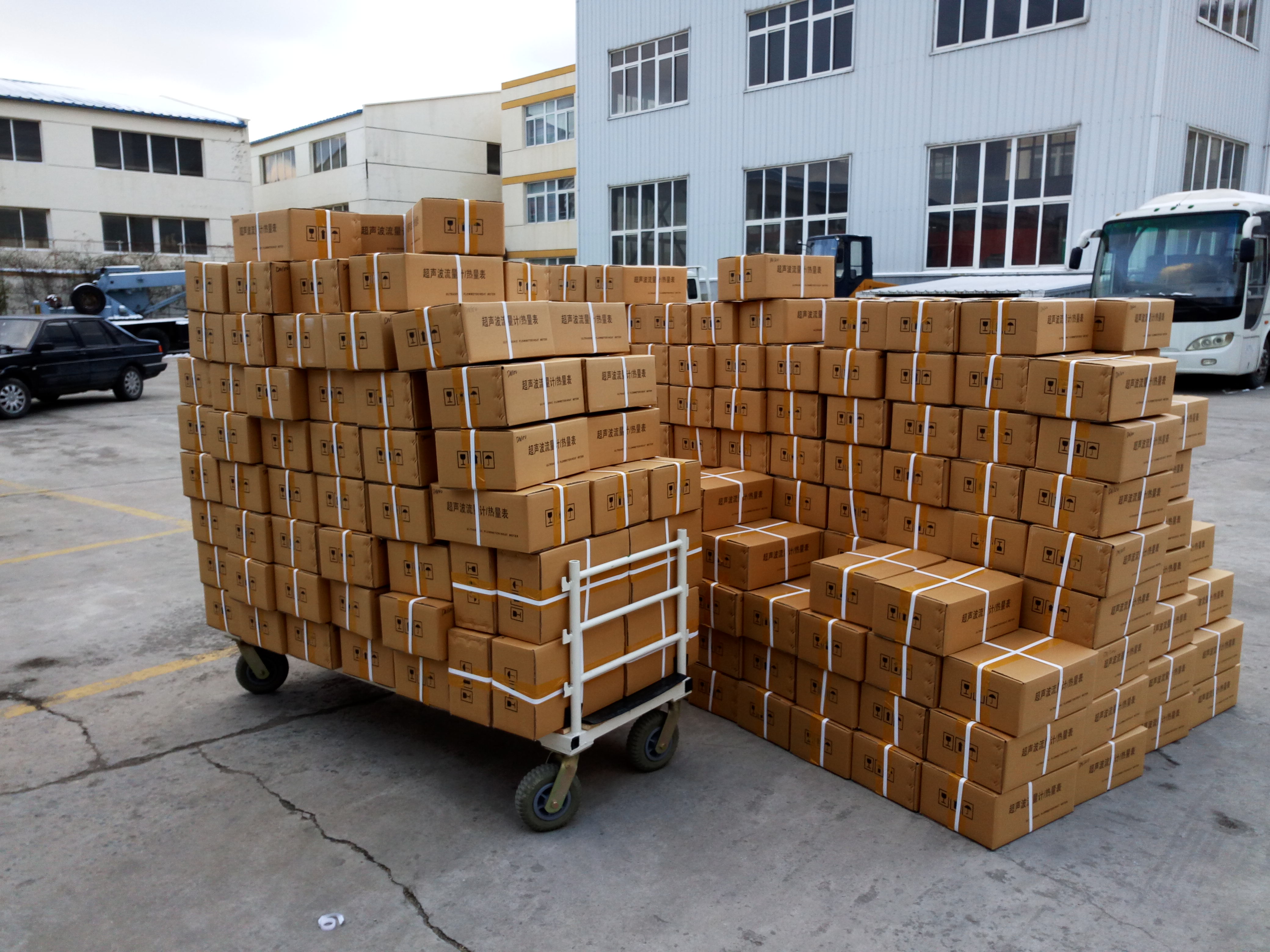
Sample and production shipments prepared at the KACISE facility for EU and Middle East export markets.
Conclusion
Selecting dissolved oxygen, pH, and conductivity sensors comes down to four decisions made in the right order: what the data must drive, what the water will do to the probe, which measurement principle survives that environment with the available maintenance, and how the signal reaches the control system. Product selection follows those decisions; it does not replace them.
For a water quality sensor manufacturer, the useful contribution is not a longer feature list but a specification that can be defended at commissioning. KACISE's relevant building blocks for this three-parameter set are the KWS-630 fluorescence DO sensor, the Portable Optical Dissolved Oxygen Meter, the KDM-140B DO meter, the KWS-750 online pH probe, the Digital pH Sensor (IoT Supported), and the KWS-300 four-electrode conductivity sensor, integrated through the KWC-100 controller where a shared data path is required. Each carries verified attributes that can be checked against the site conditions before an order is placed — which is the point of the framework.
Next Step: Test the Specification Against Real Water
Send your application details — water matrix, expected DO, pH and conductivity ranges, output type, and controller preference — and request a sample or a configuration-specific quotation. Trial units are available from 1–2 units depending on the chosen programme, so the specification can be validated at the installation point before it becomes a production commitment.
Email: sales@kacise.com · Tel / WhatsApp: +86 180-6671-9659 · Website: www.kcsensor.com
Have Questions or Need More Details?
Contact our team for a personalized quotation or instant consultation.
Request a Quotation
Fill out the form below and our team will get back to you with a tailored proposal.
WhatsApp Direct Chat
Prefer to chat in real-time? Message us on WhatsApp for instant assistance & quick answers.
- Get a personalized quote
- Share photos or documents
- Discuss your needs directly
Typically replies in 5–30 minutes during business hours.