Achieving IP66 and Explosion-Proof Sealing with a PU Gasket Dispensing Machine: A Technical Guide for Automation Engineers
A PU gasket dispensing machine forms the enclosure seal by depositing a two-component polyurethane mixture as a closed loop directly onto the part, where it foams, cures and stays bonded in place — the form-in-place foamed gasket (FIPFG) method. An enclosure reaches IP66 only when that deposited loop remains continuous, keeps an even cross-section, adheres completely to the substrate, and recovers predictably after the lid or door is closed and compressed. On explosion-proof enclosures the same gasket carries an additional duty: it keeps dust, water and corrosive ingress away from internal components, so that the protection concept of the enclosure is not degraded by a seal that fails after installation.
This guide is written for the engineer who has accepted that automation is the likely route and now has to prove technical feasibility. It sets out the parameters that govern seal quality, how ambient temperature and continuous duty change the process window, what has to be verified before a capital commitment, and which measurable differences between dispensing platforms genuinely affect the outcome. Equipment-specific figures come from KAIWEI's published product and comparison data; market and regulatory references are attributed to their sources.
Problem Definition: How Dispensed Seals Fail on IP66 and Explosion-Proof Enclosures
IP66 is a property of the assembled enclosure, verified by dust and powerful water-jet testing — it is not a property of the gasket material on its own. Dispensing-related failures that keep an enclosure from holding IP66, or that cause it to lose the rating in service, concentrate in six process conditions.
- Loop discontinuity. A break at the start/end overlap, at a corner, or where the nozzle lifts over a boss or cable-entry feature gives dust and water a direct path through the seal line. This is the most common reason a marginal enclosure fails a jet test.
- Cross-section drift. If bead width or height varies along the path, the thinnest section determines sealing performance. Drift appears when flow rate and robot speed are not synchronised, or when component viscosity changes during a shift.
- Inconsistent mixing. Incomplete mixing of the two reactive components produces an irregular cell structure and an irregular hardness profile, so compression recovery varies from point to point along the same gasket.
- Thermal instability. Reaction rate and the viscosity of both components respond to temperature. Without active thermal control, a cold morning start-up and a hot afternoon shift can produce two different gaskets against the same drawing.
- Glue leakage and overflow. Excess material contaminating the part or the fixture means scrap and cleaning downtime — and, in the worst case, a bead that is wide but not tall enough to seal.
- Overheating during sustained duty. Long continuous operation stresses pumps, valves and the mixing head; thermal damage to components shortens service life and turns a quality issue into a safety issue.
The explosion-proof dimension changes the consequences rather than the physics. A flameproof enclosure contains an internal event through its mechanical flame paths; the dispensed gasket protects the environmental integrity of that enclosure — the moisture, dust and corrosive ingress that would otherwise reach terminals and internal electronics. A gasket that lifts, cracks or takes a permanent set does not usually fail immediately; it degrades the enclosure slowly. That is why engineers evaluating an automated sealing line should treat continuous-duty thermal stability and adhesion as safety-relevant parameters rather than as quality preferences.
Industry Background: Why Form-in-Place Gaskets Are Entering Hazardous-Area Enclosures
The equipment segment is growing, though published estimates differ depending on how the scope is drawn. The global market for polyurethane (PU) gasket dispensing machines is valued at approximately USD 1.2 billion in 2025 (Kaiwei Industry Analysis). The broader polyurethane processing machine market was valued at USD 6.627 billion in 2024 and is projected to grow at a CAGR of 10.21% through 2035 (Market Research Future). Those two figures are not directly comparable — one counts gasket-forming equipment specifically, the other counts PU processing machinery as a whole — which is a reminder to read any market-size claim against the scope definition behind it.
Inside the sealing segment, the form-in-place (FIP) liquid gaskets market reached USD 270 million in 2023, with increasing adoption in EV battery enclosures (Maximize Market Research). Regionally, Asia-Pacific dominated the polyurethane processing machine market with a 42.2% share, driven by industrial manufacturing growth in China (Grand View Research). Across machine types, high-pressure PU processing units accounted for 68% of the global machine type market share (Grand View Research).
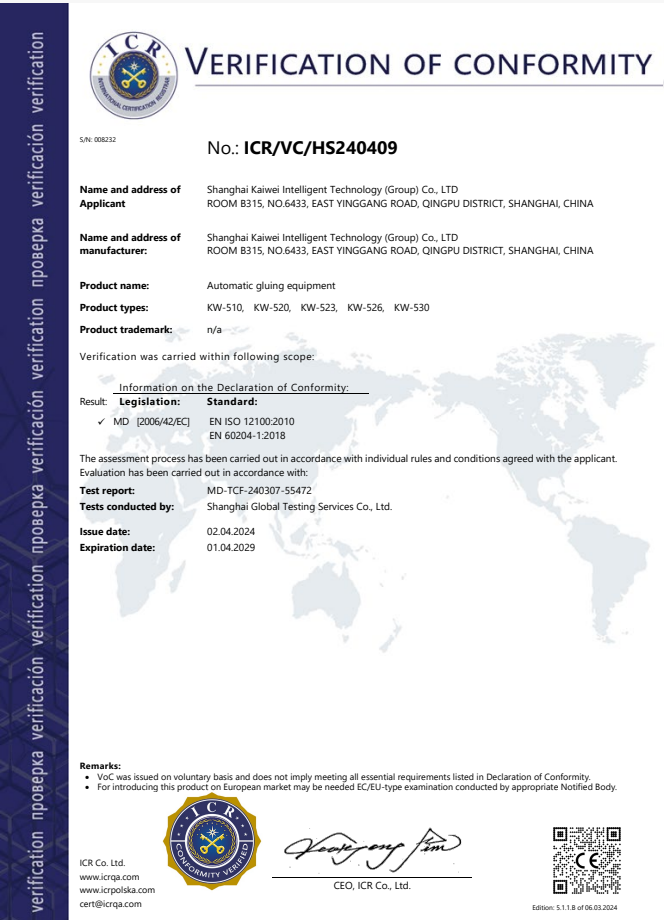
Regulatory pressure runs in the same direction. A PU foaming machine placed on the EU market has to comply with the EU Machinery Directive 2006/42/EC and with EN 60204-1 for electrical safety in order to carry CE marking (European Commission / Intertek). For a team specifying a line that will produce explosion-proof enclosures, compliance of the production equipment and compliance of the finished enclosure are two separate workstreams — both have to be closed before shipment.
Competitively, the FIPFG and PU dispensing equipment sector is led globally by Sonderhoff (Henkel), RAMPF Group and Cera-Tec, alongside specialists such as KAIWEI (Industry Ranking / Henkel). KAIWEI — Shanghai Kaiwei Intelligent Technology (Group) Co.,LTD — was founded in 2004 and builds industrial sealing systems, robot foaming equipment and six-axis robotic foaming systems from a 20,000 m²+ facility in Shanghai, with more than 100 employees, 30+ engineers and an annual output of 2,000 units. The company states over 100 national patents and holds CE and ISO9001 certification, with exports accounting for roughly 70% of sales across more than 60 countries.
Detailed Solution: The Platform Architecture That Produces a Sealed Gasket
Seal quality is not produced by the enclosure drawing. It is produced by four subsystems working together: mixing, metering, thermal control, and machine-level environmental and fault protection.
Mixing head technology
The mixing head determines how uniformly the two reactive components combine, and therefore how uniform the foam cell structure, hardness and compression recovery of the finished gasket will be. In KAIWEI's comparative product data, the advantage of its dispensing machines over other domestic dispensing machines is attributed to core mixing head technology that enables 30% higher mixing uniformity, making the platform suitable for high-precision sealing and mass production. For an IP66 application this matters directly: a gasket whose hardness varies along the loop cannot be relied on to compress evenly against a lid or door seal face.
Metering and dispensing valve
Bead cross-section is held by the metering and valve system. KAIWEI's dispensing platforms use a high-precision servo dispensing valve with a real-time pressure feedback system together with automatic glue quantity calibration. Pressure feedback detects the drift that precedes a thin or starved bead; automatic calibration keeps the dispensed quantity aligned with the programmed path instead of with an operator's judgement.
Thermal management and the operating window
Temperature control is the parameter that most often separates a laboratory proof-of-concept from a production line. KAIWEI fits an independently developed intelligent temperature control module that monitors equipment operating temperature in real time and provides automatic heat dissipation and over-temperature alarms; the control set also includes constant temperature and humidity foaming control and electrical insulation protection. This is what allows the process to be specified across an operating ambient window of −20 °C to 40 °C rather than being treated as a climate-dependent batch process, and it is a precondition for running the line continuously instead of in short, supervised shifts.
Machine-level environmental design and fault handling
The dispensing platform itself is built with an IP65/IP66 fully enclosed sealing design — relevant where the machine stands in the same plant as the enclosures it produces, in an environment with dust, humidity or wash-down. On the fault side, the control set combines real-time pressure monitoring, precision servo drive control, a leakage detection sensor, an emergency stop safety mechanism and an overheat protection alarm. The enterprise measure behind those functions is a servo dispensing valve and pressure feedback loop with automatic glue-leakage detection and shutdown protection, which stops an overflow before it contaminates parts and halts the line.
The practical reading for a buyer is that a dispensing machine is not a single specification but a set of interlocking control loops. A gasket stays within tolerance only when mixing uniformity, pressure, dispensed quantity and temperature are all held at the same time — which is also why the comparison metrics further below should be read together rather than individually.
Step-by-Step Breakdown: From Enclosure Drawing to a Verified Seal
The sequence below is the order in which an engineering team establishes feasibility. It is deliberately conservative: each step produces evidence that the next step can rely on.
- Define the seal requirement and the substrate. Fix the target rating for the assembled enclosure, the gasket cross-section, the compression gap between lid and body, and the substrate material and surface condition. Adhesion is a substrate question before it becomes a machine question.
- Establish the thermal window for the process. Confirm that the room, the material supply and the machine can all be held inside the operating envelope — the platform's specified ambient range of −20 °C to 40 °C is the outer boundary, not a target. Constant temperature and humidity foaming control is what keeps reaction rate and viscosity stable inside that boundary.
- Program a closed, continuous path. The tool path must loop without interruption around the full seal line, including corners and cut-outs. Plan the start/end overlap so the joint does not create a local discontinuity.
- Set mixing and metering parameters. Mixing uniformity defines the foam structure; the servo valve and pressure feedback hold the dispensed quantity. Automatic glue quantity calibration should be active during setup and re-checked after every material lot change.
- Dispense and confirm bead geometry. Verify bead width and height at several points along the loop — not only at the start point — and confirm that no section has been starved by pressure drift.
- Cure and assemble. Allow the gasket to reach handling strength before the lid or door is fitted, so that compression does not deform a still-reactive bead.
- Verify the finished enclosure. The rating is confirmed by testing the assembled unit. The dispensing line's job is to make that test repeatable, so keep section measurements and test results linked to the same production batch.
- Move to continuous duty. Only once the above is stable should the line be scheduled as 24/7 operation — at which point over-temperature alarms, automatic heat dissipation, leakage detection and emergency stop become the parameters that protect output, not just the equipment.
A feasibility study that stops at step 5 answers whether the machine can dispense. It does not answer whether the enclosure will pass. Steps 6 to 8 are where an automation project either becomes a production asset or becomes a rework loop.
Use Cases: Where IP66 and Explosion-Proof Gaskets Are Dispensed
Form-in-place PU gaskets are used wherever an enclosure or component must be closed against dust and water without a pre-formed gasket that has to be placed, aligned and held. KAIWEI's published application scope for its dispensing platforms includes:
- Electrical and hazardous-area enclosures: electrical control panels, electrical distribution boards, electrical enclosures, anti-explosion boxes, explosion-proof shells, transformer protection covers, ABS enclosure junction boxes and cable connectors.
- Filtration and air handling: air filters, air cleaning filters, percolator filters, purification room doors and ventilation covers.
- Lighting: explosion-proof lights, outdoor and street lighting, stadium lighting, LED luminaires, lamp covers and lighting fittings.
- Automotive and new energy: automobile mountings, inner door handles, battery covers and auto fittings and mountings.
- Appliances, cabinets and boxes: domestic appliances, refrigerator doors, lock shells, plastic cabinets, plastic and transparent water-proof boxes and water-proof cabinets.
Lighting and EV-related applications are where the technical requirement bites hardest, because the enclosure is exposed to weather and thermal cycling at the same time. Adoption of form-in-place liquid gaskets in EV battery enclosures is one of the reported growth drivers for the segment (Maximize Market Research) — and it reflects the same requirement profile that makes an explosion-proof enclosure a candidate for automated dispensing: a closed loop that has to stay sealed for the life of the product, produced at a rate that manual gasket placement cannot sustain.
Comparison Table: Dispensing Platform Performance
The table below reproduces KAIWEI's comparative product data for its dispensing machines against other domestic dispensing machines. These are first-party comparative claims published by the manufacturer and should be validated against your own sample parts during evaluation.
| Comparison dimension | KAIWEI PU gasket dispensing machine | Other domestic dispensing machines |
|---|---|---|
| Core technology | Mixing head technology developed for high-precision sealing | Conventional mixing head design |
| Mixing uniformity | 30% higher mixing uniformity | Baseline |
| Production efficiency | 20% higher production efficiency | Baseline |
| Total cost of ownership | 15% lower total cost of ownership | Baseline |
| Maintenance | Less maintenance, longer service life | Baseline |
| Best fit | High-precision sealing and mass production — control panels, distribution boards, explosion-proof enclosures, filters, lighting, automotive parts | General-purpose dispensing |
Two points of interpretation. First, the efficiency and cost figures are downstream effects of the mixing and metering design, not independent features: a line becomes more productive partly because fewer parts are scrapped for irregular or starved beads, and total cost of ownership falls partly because leakage and overflow are detected and stopped rather than cleaned up. Second, "other domestic dispensing machines" refers to machines from the same supply market. The global FIPFG field also includes Sonderhoff (Henkel), RAMPF Group and Cera-Tec (Industry Ranking / Henkel), so a complete evaluation should position any candidate platform against both groups.
Mapping Seal Requirements to Machine Control Points
For engineers building the feasibility document, this is the translation layer: each sealing requirement that a customer or auditor will raise, the failure mode behind it, and the control point on the dispensing line that addresses it.
| Seal requirement | Failure mode if uncontrolled | Control point on the dispensing line |
|---|---|---|
| Continuous closed loop | Dust or water path at the joint, a corner or a cut-out | Closed-path programming, automatic glue quantity calibration, real-time pressure monitoring |
| Uniform bead cross-section | The thinnest section determines sealing performance | High-precision servo dispensing valve with real-time pressure feedback |
| Uniform foam structure and hardness | Uneven compression recovery along the gasket | Mixing head technology delivering 30% higher mixing uniformity |
| Stable reaction and viscosity | A different gasket on a cold start than on a hot shift | Intelligent temperature control module, constant temperature and humidity foaming control, −20 °C to 40 °C operating window |
| Complete adhesion to the substrate | Gasket lift-off after assembly or in service | Substrate selection and surface condition, supported by consistent mixing and dispensed quantity |
| 24/7 output without quality drift | Overheating, component damage, glue overflow, line downtime | Automatic heat dissipation, over-temperature alarm, leakage detection sensor with shutdown protection, emergency stop |
| Machine survival in a dusty or humid plant | Ingress into the dispensing platform itself | IP65/IP66 fully enclosed sealing design, electrical insulation protection |
FAQ
Can a PU gasket dispensing machine produce seals that satisfy IP66 and explosion-proof enclosure requirements?
It can, provided the dispensed gasket is continuous, evenly cross-sectioned and fully adhered — and provided the finished enclosure is tested to confirm the rating, because IP66 is declared for the assembled enclosure and not for the gasket alone. KAIWEI builds its dispensing platforms with an IP65/IP66 fully enclosed sealing design and with the control functions that govern gasket continuity: precision servo drive control, real-time pressure monitoring, automatic glue quantity calibration and leakage detection, combined with overheat protection. On the regulatory side, machinery placed on the EU market must conform to the EU Machinery Directive 2006/42/EC and to EN 60204-1 for electrical safety in order to be CE marked (European Commission / Intertek); KAIWEI holds CE and ISO9001 certification.
What has to be controlled to run the sealing line 24/7 without losing seal quality?
Three things: temperature, pressure and fault response. KAIWEI addresses temperature with an independently developed intelligent temperature control module that monitors operating temperature in real time and provides automatic heat dissipation and over-temperature alarms, together with constant temperature and humidity foaming control. That is the mechanism that allows the process to be specified across a −20 °C to 40 °C ambient window. Pressure and dispensed quantity are held by a high-precision servo dispensing valve with real-time pressure feedback and automatic glue quantity calibration. Fault response is handled by a leakage detection sensor with shutdown protection and an emergency stop safety mechanism, which stops a leak before it becomes material waste and unscheduled downtime.
How should a dispensed gasket be verified before committing to full production?
Verify at three levels. On the sample itself, measure bead width and height at multiple points along the loop rather than at the start point only. On the assembled enclosure, run the dust and water-jet test that establishes the rating, and repeat it across a batch so that repeatability — not a single pass — is what has been proven. Across the shift, confirm that gasket dimensions hold from the first part of the day to the last, which is the practical test of whether thermal control and mixing control are adequate for continuous production.
What drives the total cost of ownership difference between dispensing machines?
In KAIWEI's comparative product data, its dispensing machines are stated at 15% lower total cost of ownership and 20% higher production efficiency than other domestic dispensing machines, with less maintenance and longer service life. The mechanism behind those numbers deserves more attention than the numbers themselves. Higher mixing uniformity and pressure-controlled dispensing reduce scrap from irregular or starved beads. Automatic glue quantity calibration reduces material waste. Leakage detection stops overflow before it contaminates parts and halts the line. Stable thermal control reduces the component wear that drives maintenance cost. For a high-volume enclosure programme, scrap, downtime and maintenance are usually the three largest recurring costs, so a platform that addresses them compounds over the life of the line.
What is the practical next step to evaluate a PU gasket dispensing machine on our own parts?
Confirm feasibility with a sample and a specification review rather than with a datasheet alone. KAIWEI supports evaluation through sample and quotation requests, and its technical team reviews enclosure geometry, substrate and target rating before a configuration is proposed. The company's product brochure, covering its sealing systems and foaming equipment, can be downloaded here: KAIWEI product brochure (PDF). To start a sample or quotation request, contact the team at info@kaiwei-sh.com or on WhatsApp at +8613761986986; application information is published at sh-kaiwei.com/list-application.html.
Conclusion
Achieving IP66 and explosion-proof sealing with a PU gasket dispensing machine is a control problem rather than a materials problem. Four parameters decide the outcome: the gasket loop must be continuous, its cross-section must be uniform, the foam structure must be consistent along the whole path, and the machine must hold those conditions through sustained 24/7 operation within an ambient range of −20 °C to 40 °C. Where those four are held simultaneously, the enclosure test becomes repeatable instead of dependent on operator attention.
For the engineer building the feasibility case, the practical sequence is to fix the seal requirement against the substrate, confirm the thermal window, programme a closed path, and then verify at three levels — bead geometry on the sample, rating on the assembled enclosure, and consistency across the shift. The comparison data in this guide is a starting point for that evaluation, not a substitute for it: KAIWEI's dispensing platforms are specified with 30% higher mixing uniformity, 20% higher production efficiency and 15% lower total cost of ownership than other domestic dispensing machines, and the value of those figures is determined by how closely they hold on your parts.
Evaluate the sealing process on your own enclosures
Send an enclosure sample and your target rating, and the KAIWEI technical team will review gasket geometry, substrate and thermal requirements before proposing a dispensing configuration.
Email: info@kaiwei-sh.com | WhatsApp: +8613761986986 | Website: www.sh-kaiwei.com
Product brochure (PDF): download here. Address: No.6433 East Yinggang Road, Qingpu District, Shanghai, China.