How KAIWEI Builds PU Gasket Dispensing Machines to Your Specification: OEM/ODM Capabilities Explained
Can a PU gasket dispensing machine be built around your part geometry, production volume, gasket shape, material system, and plant layout? In short: yes, when the manufacturer has a mature OEM/ODM engineering process. This guide explains how KAIWEI, a Shanghai-based PU foaming and gasket dispensing equipment manufacturer, approaches customization from inquiry to commissioning, and what buyers should verify before approving a custom configuration.
What "OEM/ODM" Means for PU Gasket Dispensing Machines
In the context of industrial dispensing equipment, OEM (Original Equipment Manufacturing) usually means building a machine to the buyer's specified functional and dimensional requirements, with the buyer's brand applied if required. ODM (Original Design Manufacturing) extends this to include engineering design, configuration selection, and sometimes appearance design, where the manufacturer contributes its own technical platform and design expertise. For procurement teams, the practical question is not the label but what can actually be changed: mixing ratio range, gasket width, frame size, axis configuration, material tanks, mixing head, software interface, safety system, and even the workbench layout.
KAIWEI, formally Shanghai Kaiwei Intelligent Technology (Group) Co., Ltd., is a state-level high-tech enterprise founded in 2004, headquartered in Shanghai, China. The company focuses on R&D and manufacturing of industrial sealing systems, robot foaming equipment, intelligent sealing and dispensing equipment, and six-axis robotic foaming systems. Its core technical team exceeds 30 members, and KAIWEI holds more than 100 national patents. The company operates a factory area of more than 20,000 square meters and reports an annual output of 2,000 units. These figures matter to buyers because OEM/ODM capability is not just about desire to customize; it depends on engineering headcount, production capacity, and prior design experience.
Why Buyers Look for Customization in Foam Gasket Sealing
Standard inline dispensing machines meet the needs of many manufacturers, but custom requirements usually appear when the buyer already has a defined part family, a target sealing standard, or a specific production integration plan. Common triggers include:
- Parts larger or smaller than standard machine stroke, such as large electrical enclosures or small junction boxes.
- Gasket cross-section requirements outside the standard strip width range.
- Two-component material systems that must be mixed at a precise ratio ranging from 1:1 to 10:1.
- Three-component systems for specialized foam formulations.
- Factory automation requirements such as automatic filling stations, safety grating, elliptical chain worktables, and automatic switching workbenches.
- Environment-related needs such as constant temperature water circulation for material conditioning, or plasma pre-treatment before dispensing.
- Language and interface requirements for multilingual operator environments; KAIWEI supports up to 12 languages in its interface.
These requirements are not peripheral accessories. They affect metering accuracy, mix quality, cycle time, occupational safety, and long-term repeatability. That is why the OEM/ODM discussion must begin with a clear definition of the part, the material, and the production target.
KAIWEI's Customization Options: What Can Be Changed
Based on KAIWEI's published production capabilities, the following customization dimensions are available when configuring a PU gasket dispensing machine. Buyers should treat this list as a menu to be confirmed against the exact model and application.
Frame and Motion System
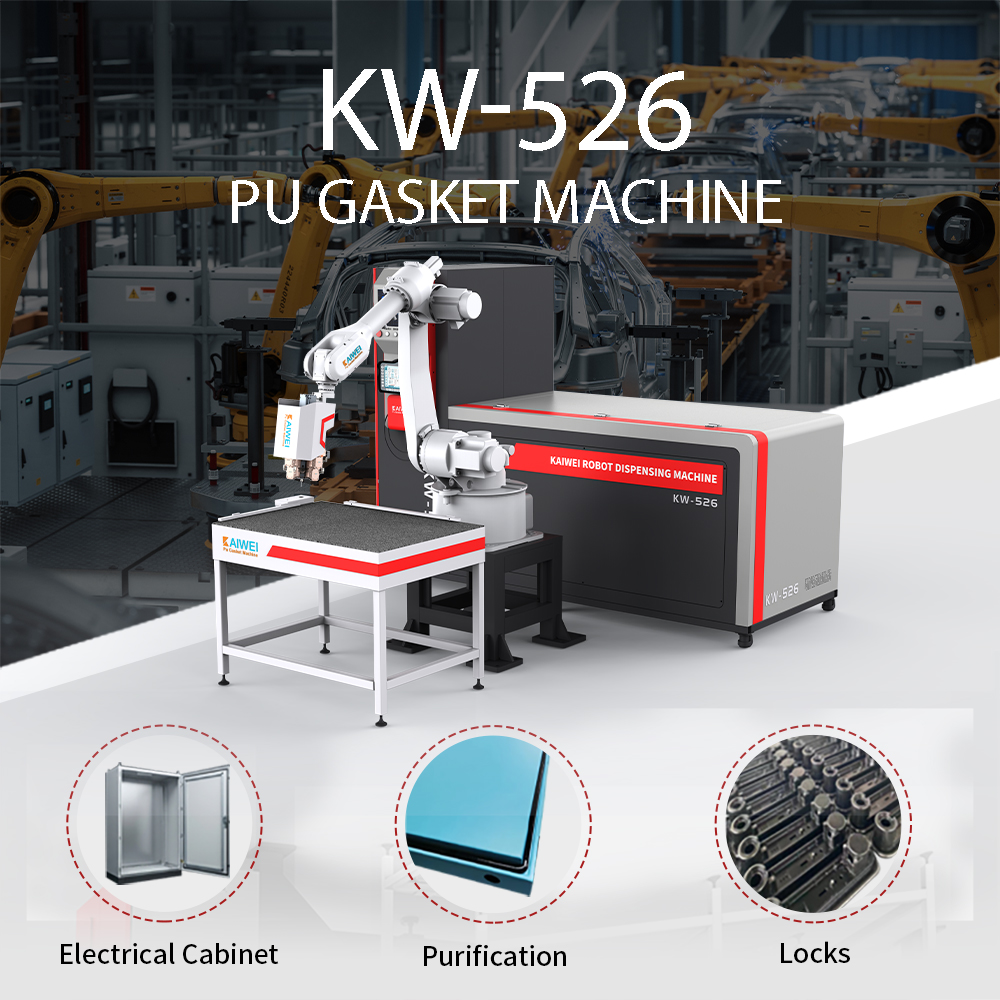
- Standard models offer a 3-axis linear robot arm; the KW-526 offers a 6-axis linear robot arm.
- Effective stroke varies by model: for example, the KW-510B uses 2250 × 1250 × 200 mm, while the KW-523 and KW-523A use 1250 × 800 × 200 mm. The KW-526 supports a customized stroke.
- Frame structures can be adapted, with workbench dimensions around 2000 × 1000 × 800 mm for most standard models, and customized dimensions for the KW-526.
- Linear guide rails may be specified from KAIWEI or AIRTAC; servo motors may be selected among Xinje, ABB, Fuji, Panasonic, Nidec, Leadshine, or STEP depending on model.
Material Delivery and Mixing
- Raw material tanks use an air pressure tank structure with standard volumes of 40 L for both component A and component B.
- Tank A is equipped with agitation; tank B is not agitated in the standard configuration.
- Material tank filling can be manual or automatic, with an optional filling station.
- Mixing head options include the KW800 and KW-900, depending on model.
- Available mixing ratio range is 1:1 to 10:1.
- Seal strip width ranges from 4–30 mm on most models; the KW-523 and KW-523A extend from 2–10 mm or 10–60 mm; the KW-526 covers 2–60 mm.
- Temperature control can include water temperature control as an option; air charging is available in manual or automatic modes.
Control and Interface
- All current models use a touch screen HMI with PC / teach pendant operation.
- Screen sizes range from 10.2 inches to 15 inches, depending on model.
- Operation mode is based on a motion control card or teach pendant plus PLC.
- Interface modes vary: teach pendant control, integrated operation box, or cantilever control box.
- KAIWEI supports up to 12 languages for international operation teams.
Workbench and Surrounding Equipment
- An elliptical chain worktable can be customized for multi-station production.
- Automatic switching workbench configurations are available for continuous operation.
- Mechanical arm integration is possible.
- Plasma pre-treatment can be added when surface energy is a concern before dispensing.
- Safety grating can be installed for operator and cell protection.
- Appearance and color can be adapted to buyer branding or factory color standards.
This list reflects KAIWEI's stated OEM/ODM capabilities and standard product parameters. For a specific inquiry, each item should be confirmed against the selected machine model. The key procurement point is that a manufacturer with genuine engineering capacity will be able to state exactly which options are compatible with a given model and which require custom engineering work.
Step-by-Step: How a Custom PU Gasket Dispensing Machine Is Built
Moving from an initial idea to a running machine requires a structured engineering and procurement sequence. The following workflow reflects how KAIWEI processes OEM/ODM projects, based on available corporate data on production mode and quality control.
Step 1: Define the Application and Sealing Requirement
Provide the part drawings or samples, target gasket shape, strip width, and desired foam density or hardness. Clarify the environmental and compliance requirements, such as IP66 dustproof and waterproof sealing, explosion-proof enclosure sealing, UL94 flammability for the foaming adhesive, or CE certification for the machine. KAIWEI's range is widely used for electrical control panels, electrical distribution boards, electrical enclosures, anti-explosion boxes, cable connectors, air filters, LED lighting, automotive mountings, and similar sealing applications.
Step 2: Select the Base Platform
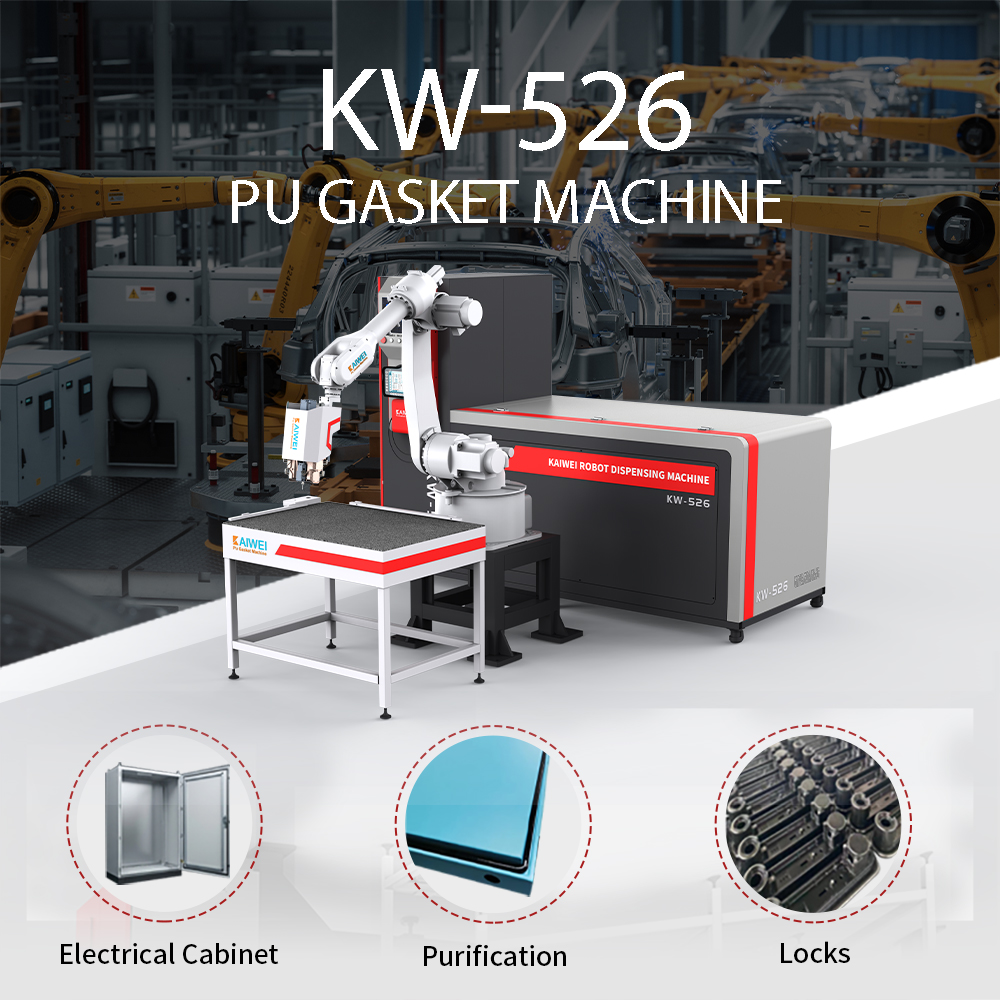
KAIWEI offers a portfolio of PU gasket dispensing machine models: 520A-PC, KW-510B, KW-520A, KW-520B, KW-523, KW-523A, and KW-526. Standard models cover common panel sizes and production needs. The KW-526, with its 6-axis robot arm and customized stroke, is typically the reference point for projects requiring maximum flexibility. The selected base platform determines frame structure, axis configuration, workbench size, and available mixing options.
Step 3: Confirm Material and Mixing Requirements
Confirm whether the application uses polyurethane or silicone, whether the material system is two-component or three-component, and what mixing ratio is required. KAIWEI machines support mixing ratios from 1:1 to 10:1, with metering pumps from KAIWEI or Barmag. If the gasket must meet UL94-2023 flammability requirements, the material itself must be tested; KAIWEI's foaming adhesive has been tested under UL 94-2023 Rev.2-2024, Section 8 by Shanghai Global Testing Services Co., Ltd. (GTS), certificate number THSH25033168768EN.
Step 4: Review Custom Options and Integration
Select from the customization menu: color and material, automatic feeding for A/B tanks, mechanical arm, plasma, logo design, elliptical chain worktable, constant temperature water circulation, safety grating, appearance design, automatic switching workbench, or three-component configuration. Each option should be evaluated for cycle time, footprint, and operator safety. This is also the stage where language support should be specified because KAIWEI supports up to 12 languages in the interface.
Step 5: Engineering, Build, and Test
KAIWEI states a lead time of 7 days for configured machines, with a monthly capacity of 2,000 sets and an MOQ of 1 set. Every machine is reported to undergo 100% testing before shipment. For buyers, the important verification point is the acceptance procedure: KAIWEI's procurement support unit states that full inspection is conducted before shipment, and third-party testing can be arranged for acceptance. Buyers should confirm whether they want a pre-shipment inspection, a third-party test report, or a factory acceptance test before payment.
Step 6: Shipping and After-Sales Support
KAIWEI offers FOB and CIF delivery methods, with payment terms of 30/70 (typically 30% deposit and 70% balance). After-sales support is provided remotely. Export destinations include the United States, Vietnam, Malaysia, Singapore, Thailand, Indonesia, Australia, Philippines, South Korea, Japan, Bangladesh, India, Russia, Belarus, Ukraine, Poland, Finland, Slovenia, Italy, Spain, Bulgaria, Turkey, Saudi Arabia, UAE, Algeria, Egypt, South Africa, Nigeria, Chile, Brazil, Uruguay, Mexico, and many other countries.
Machine Model Comparison for Custom Projects
| Specification | 520A-PC | KW-510B | KW-520A | KW-520B | KW-523 / KW-523A | KW-526 |
|---|---|---|---|---|---|---|
| Frame | 3-axis linear robot arm | 3-axis linear robot arm | 3-axis linear robot arm | 3-axis linear robot arm | 3-axis linear robot arm | 6-axis linear robot arm |
| Effective stroke | 2250×1250×200 | 2250×1250×200 | 2250×1250×200 | 2250×1250×200 | 1250×800×200 | Customized |
| Seal strip width | 4–30 mm | 4–30 mm | 4–30 mm | 4–30 mm | 2–10 mm / 10–60 mm | 2–60 mm |
| Mixing head | KW800 | KW-900 | KW800 | KW-900 | KW800 / KW-900 | KW800 / KW-900 |
| Screen | 10.2 in | 12.1 in | 10.2 in | 15 in | 15 in | 15 in |
| Material tanks | A 40 L, B 40 L | A 40 L, B 40 L | A 40 L, B 40 L | A 40 L, B 40 L | A 40 L, B 40 L | A 40 L, B 40 L |
| Mixing ratio | 1–10:1 | 1–10:1 | 1–10:1 | 1–10:1 | 1–10:1 | 1–10:1 |
| Running speed | 0–1200 mm/min | 0–12000 mm/min | 0–12000 mm/min | 0–1200 mm/min | 0–1200 mm/min | 0–12000 mm/min |
| Cleaning | High-pressure water | High-pressure water | High-pressure water | High-pressure water | High-pressure water | High-pressure water |
| Power | 4 / 5.5 kW | 4 / 5.5 kW | 4 / 5.5 kW | 4 / 5.5 kW | 4 / 5.5 kW | 4 / 5.5 kW |
Use Cases That Demonstrate Customization Value
Automotive OEM Paint Shop Sealing
KAIWEI reports that its PU gasket dispensing machines have been used by automotive OEM clients in the United States. In one documented case, an automotive OEM client used 20 units over a two-year period in a paint shop application. The machines delivered stable operation, IP66 waterproof and dust-proof sealing, high production efficiency, high-precision dispensing, automatic production, and customized gasket shapes. For automotive tier suppliers and OEM plants, the key takeaway is that a dispensing machine configured for a specific part family can maintain sealing consistency across high-volume production cycles.
Electrical Control Panel and Enclosure Sealing
KAIWEI's machines are widely applied to electrical control panels, distribution boards, enclosures, anti-explosion boxes, waterproof cabinets, and lamp covers. Customization in this segment tends to focus on gasket path complexity, sealing width, environmental sealing requirements such as IP66, and compliance with UL94 for the foaming adhesive. The ability to program custom gasket shapes is a core requirement because enclosure geometries are rarely identical across a full product range.
Air Filter and Automotive Component Sealing
Air filters, purification room doors, automotive mounts, and battery covers are listed as applicable industries in KAIWEI's product scope. For these parts, OEM projects typically require fast cycle times, consistent strip dimensions, and integration with existing production cells. An elliptical chain worktable or automatic switching workbench becomes valuable when multiple part variants are produced in a single line.
Compliance and Certification for Custom Machines
Customization does not remove the need for compliance. Buyers should verify the certification status of both the machine and the sealing material. KAIWEI holds an ISO 9001:2015 Quality Management System Certificate covering the sale of automatic foam gasket machines, explosion-proof control boxes, and related products, issued by NSY Certification (Shanghai) Co., Ltd., valid through May 2027. KAIWEI's automatic gluing equipment carries CE certification under the EU Machinery Directive 2006/42/EC, certificate number MD-TCF-240307-55472, issued by GTS, valid through April 2029. The company also holds a VOC CE certificate for electric enclosures under EN 60529:1991+A2:2013 and EN 62208:2011, certificate number ICR/VC/HS230352. For the material side, the sealing foam glue has a Non-Hazardous Certificate (NO.202600234403353) issued by the Shanghai Institute of Chemical Industry Testing Co., Ltd., covering maritime transport under UN Dangerous Goods Transport Regulations, valid through December 2026.
For buyers in China, KAIWEI's explosion-proof enclosure model BXK-D1 holds a China Compulsory Certificate (CCC) under CNCA-C23-01:2019 and GB/T 3836 series standards, valid through October 2027. For the EU market, the company's explosion-proof enclosure carries an ATEX certificate (ECM 25 ATEX-B D001) issued by Ente Certificazione Macchine srl (ECM, Notified Body No. 1282), valid through April 2030. These certificates do not automatically transfer to a custom machine configuration, so the buyer should request confirmation that the final configuration matches the certified scope.
What Buyers Should Verify Before Approving a Custom Configuration
- Does the proposed model support the required gasket width? A standard 4–30 mm machine cannot simply be stretched to 60 mm without changing the mixing head and material system.
- Is the effective stroke sufficient for the largest part in the current and planned product family?
- Does the material system require agitation, temperature control, or automatic filling to stay within process window?
- Has the machine CE certification been confirmed for the EU market, and does the final configuration match the certified scope?
- Does the sealing material have the required transport and flammability certifications, such as Non-Hazardous Certificate and UL94?
- Is the after-sales support model sufficient for your region? KAIWEI provides remote support and exports to more than 60 countries.
- Will the machine need multilanguage interface support for local operators? KAIWEI supports up to 12 languages.
Frequently Asked Questions
Yes. KAIWEI states that it provides OEM and ODM production services, with a monthly capacity of 2,000 sets, a minimum order quantity of 1 set, and a reported lead time of 7 days for configured machines. Customization can include color and material, automatic feeding of A/B materials, mechanical arm, plasma, logo design, elliptical chain worktable, constant temperature water circulation, safety grating, appearance design, automatic switching workbench, three-component configuration, and support for up to 12 interface languages.
Buyers can select from a range of engineering options: frame structure and axis type (3-axis or 6-axis), effective stroke, workbench structure, mixing head (KW800 or KW-900), seal strip width, mixing ratio, material tank configuration, servo motor brand, guide rail brand, control interface, and safety features. KAIWEI can also customize the machine color, logo, and appearance. For production integration, an elliptical chain worktable, automatic switching workbench, plasma treatment, or automatic filling options can be added depending on the application.
A typical KAIWEI project starts with the buyer defining the part geometry, gasket profile, material system, and production target. KAIWEI then selects the appropriate base platform (such as the KW-526 for large or highly customized parts), confirms material and mixing requirements, and reviews the customization list. After engineering and build, every machine undergoes 100% testing. Full inspection is performed before shipment, and third-party testing can be arranged for acceptance. Standard delivery methods include FOB and CIF, with 30/70 payment terms and remote after-sales support.
KAIWEI's automatic gluing equipment has CE certification under the EU Machinery Directive 2006/42/EC, and its explosion-proof enclosure carries ATEX certification under EN IEC 60079-0, EN 60079-1, EN 60079-7, and EN 60079-31. The foaming adhesive used for sealing has been tested under UL 94-2023 Rev.2-2024, Section 8, and the sealing foam glue also holds a Non-Hazardous Certificate for maritime transport. However, certification applies to specific scopes and configurations. Buyers must confirm that their exact custom configuration falls within the certified scope or request additional evaluation.
KAIWEI reports a lead time of 7 days for configured machines, with a monthly production capacity of 2,000 units and an MOQ of 1 unit. Actual delivery time depends on the selected options, the manufacturer's production schedule, and the shipping method. Because KAIWEI exports to more than 60 countries, shipment terms such as FOB or CIF should be clarified at the RFQ stage. For a feasibility review of your part drawings and production requirements, contact KAIWEI directly with your project specifications.
Starting a custom gasket sealing project?
Send KAIWEI your part drawings and production targets to receive a configuration proposal based on your gasket width, mixing ratio, and automation needs.
Request a QuoteEmail: info@kaiwei-sh.com | Tel/WhatsApp: +86 13761986986
Or download the KAIWEI brochure: Product Catalog (PDF)