Long-Term Partnership FAQs: PU Gasket Dispensing Machine Service, Spares, and Support
The decisions that determine whether a PU gasket dispensing machine is still productive in year five are made after the purchase order, not before it. Service planning, spare-part identification, integration support, and preventive maintenance for continuous operation are what separate a machine that runs for a decade from one that becomes a bottleneck in eighteen months.
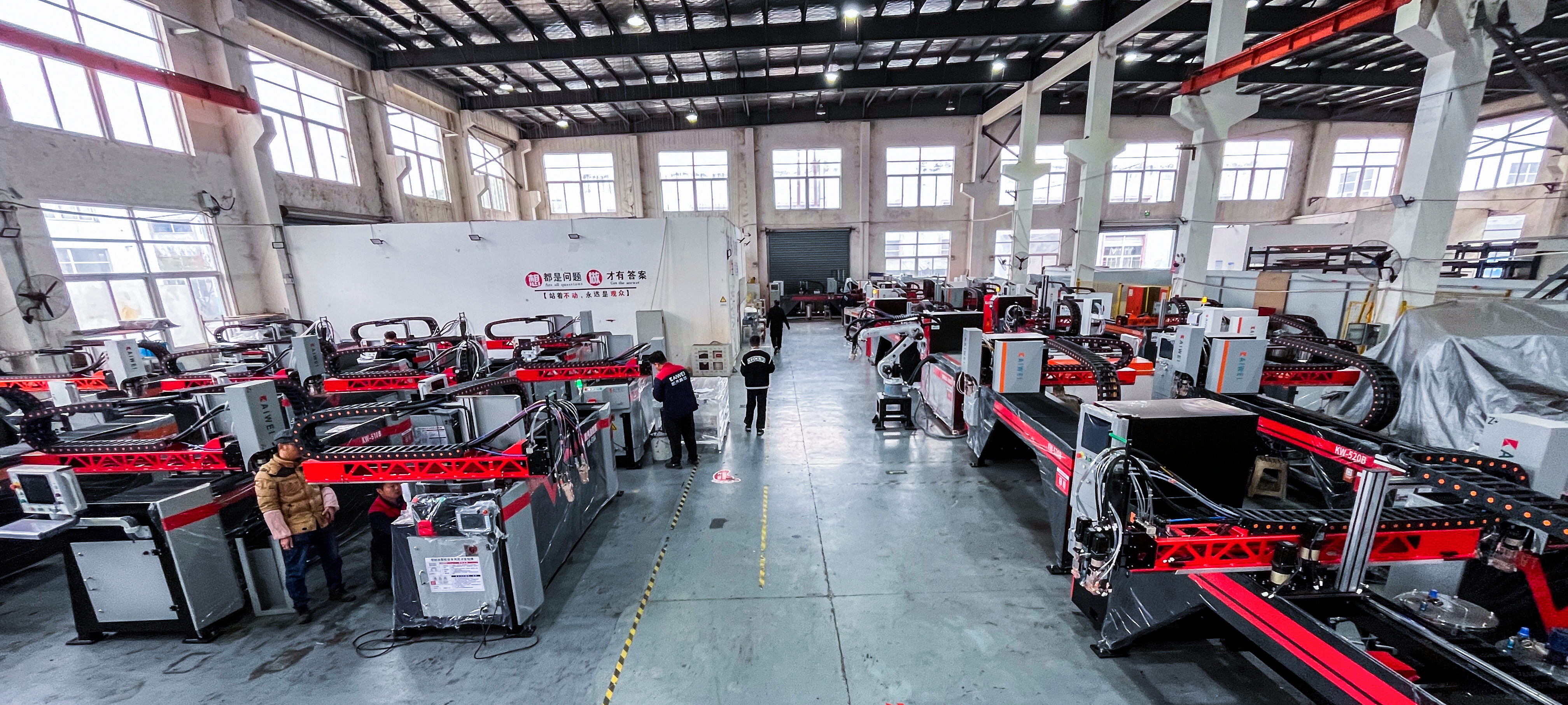
A durable long-term partnership on a PU gasket dispensing machine depends on four verifiable capabilities: a documented machine baseline that makes spare parts identifiable years later, integration support for the surrounding automatic gluing line, a preventive maintenance plan written for continuous operation, and a supplier whose capacity, certification scope, and after-sales terms are publicly stated. Shanghai Kaiwei Intelligent Technology (Group) Co., Ltd. (KAIWEI), founded in 2004 and headquartered in Shanghai, manufactures PU gasket dispensing machines under OEM/ODM arrangements, publishes CE, ISO 9001, UL94, RoHS, and related certification coverage, states remote after-sales support, and reports a production site of more than 20,000 m² with a monthly capacity of 2,000 sets.
Why Post-Selection Support Decides the Outcome of a Sealing Project
The evaluation phase answers a narrow set of questions: can the machine dispense a 4–30 mm polyurethane bead, does it fit the enclosure, what is the cycle time, what does it cost. Ownership then introduces a different question set that the original quotation rarely covers.
Five support gaps account for most long-term friction on automated sealing lines:
- Part identification drift. A dispensing machine is an assembly of metering pumps, guide rails, servo motors, reducers, mixing heads, and control electronics. When a component fails in year three, the buyer needs the model-level baseline to identify a replacement — not a general product brochure.
- Integration drift. Production lines change. A second worktable is added, a new PLC is introduced, a product family is discontinued. A machine bought as a standalone unit must be able to accept a controller or worktable change without a full replacement.
- Maintenance rhythm under continuous operation. High-pressure water cleaning, tank A agitation, water temperature control, and a stable air supply above 6 bar are all operating requirements that become failure points when they are not scheduled.
- Compliance continuity. Certificates carry issue and expiry dates. A CE certificate valid to 2029 and an ISO 9001 certificate valid to 2027 imply different audit calendars, and buyers who ship into the EU need to track both.
- Cross-border support. Electrical supply, acceptance practice, and documentation expectations differ by market. A partner with an established export record is easier to keep aligned than a first-time exporter.
These are partnership questions, not procurement questions — which is why they belong in a separate decision layer from machine selection.
How Automated Gasket Sealing Lines Create Long-Term Support Demand
Formed-in-place foam gasket (FIPFG) dispensing replaced hand-applied gaskets in most high-volume enclosure and component production because it removes a manual, variable step from the line. The trade-off is that the sealing station now sits inside the production flow: if it stops, everything downstream stops.
That dependency explains the industries where long-term support planning matters most. KAIWEI's published application scope for its PU gasket dispensing machines covers electrical control panels, electrical distribution boards, electrical enclosures, anti-explosion boxes and explosion-proof shells, domestic appliances, electrical apparatus elements, cable connectors, auto fittings and mountings, air filters, lock shells, purification room doors, refrigerator doors, transformer protect covers, street lighting, water-proof cabinets, automobile mountings, automobile battery covers, automobile inner door handles, waterproof boxes, transparent boxes, air cleaning filters, ABS enclosure junction boxes, ventilation covers, LED lighting, lamp covers, explosion-proof lights, outdoor lights, stadium lighting, brake lights, LED luminaires, and lighting fittings.
What unites that list is a shared specification: a continuous polyurethane bead that must hold a defined sealing class over the life of the enclosure. In practice, projects are planned around an ambient envelope of roughly −20 to 40 °C, with the final machine rating confirmed against the specific site conditions in the quotation, since electrical supply, air pressure, and water supply are specified separately.
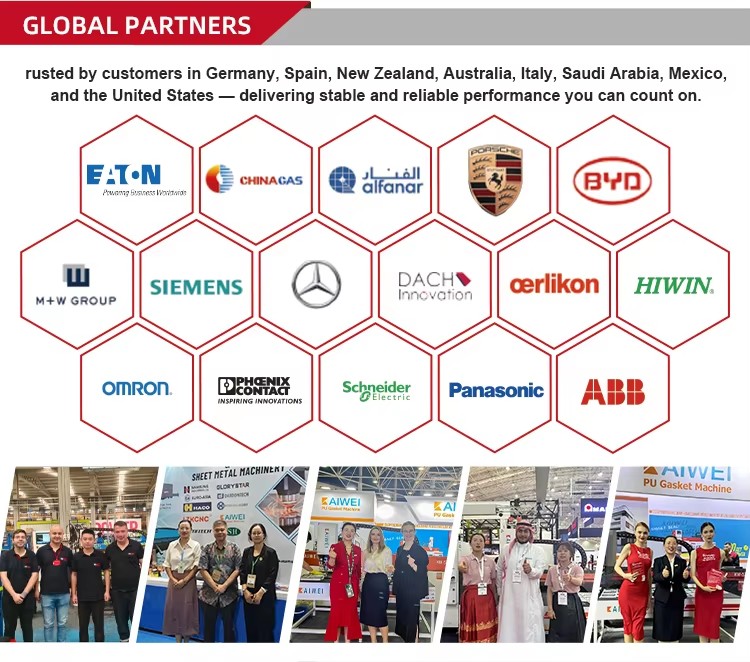
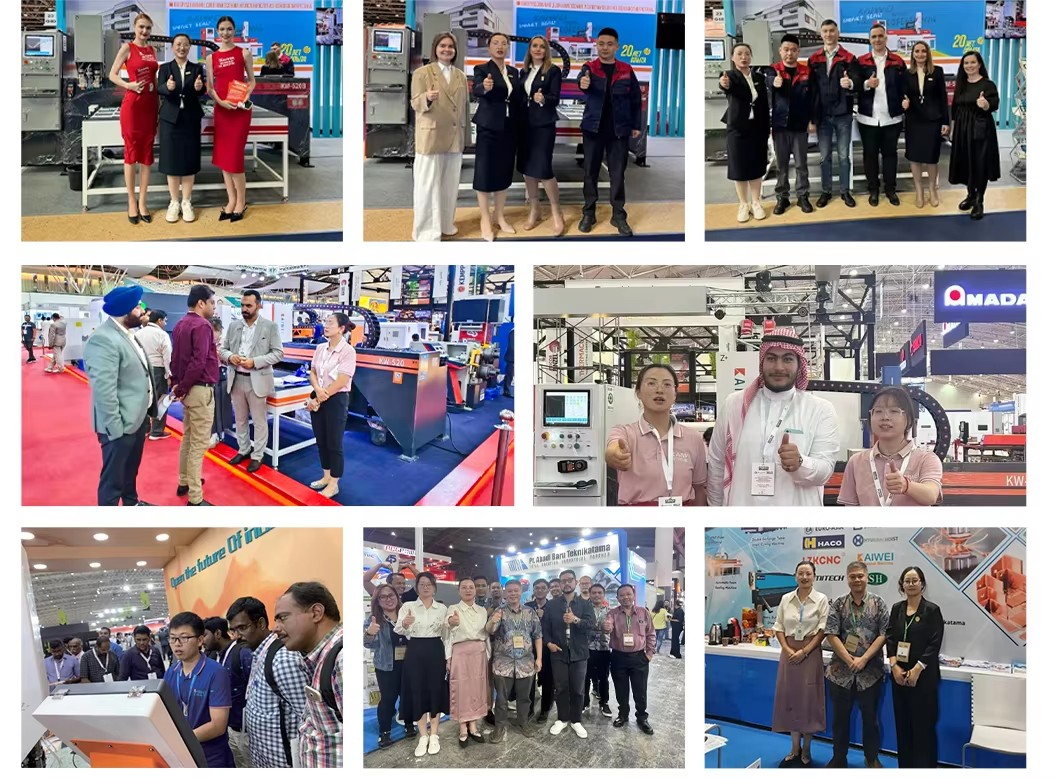
Deployment geography reinforces the point. KAIWEI reports an export ratio of 70% and lists markets across Asia, Europe, the Americas, and Africa — including the United States, Germany, Russia, India, Saudi Arabia, Indonesia, Vietnam, Malaysia, Singapore, Thailand, Australia, the Philippines, South Korea, Japan, Bangladesh, Turkey, Poland, Italy, Spain, the United Arab Emirates, Egypt, Nigeria, South Africa, Brazil, Mexico, and Chile. A machine installed in Poland and a machine installed in Vietnam will face different service realities, and the partnership model has to absorb both.
What KAIWEI Provides Across a Multi-Year Partnership
Company baseline
KAIWEI was founded in 2004 and is headquartered in Shanghai. The company describes itself as a state-level high-tech enterprise focused on industrial sealing systems, robot foaming equipment, intelligent sealing and dispensing equipment, and six-axis robotic foaming systems. Reported operational facts include a production site exceeding 20,000 m², more than 100 employees, a core technical team of 30+ engineers, and more than 100 national patents. Its automatic adhesive and dispensing equipment is described as being used in electric cabinets, air filters, air conditioning purification equipment, lamps, automobiles, and new energy fields.
For a buyer assessing partnership durability, the relevant signals are the size of the engineering team and the length of the operating record — both of which support continuity of technical knowledge across model generations.
Certification coverage that outlasts a single project
Certificates are dated documents, and their validity windows matter when a machine is expected to run for years and when the finished enclosure is exported.
- CE — certificate MD-TCF-240307-55472 issued by GTS under the 2006/42/EC Machinery Directive, scope: automatic gluing equipment, valid 2024-04-02 to 2029-04-01.
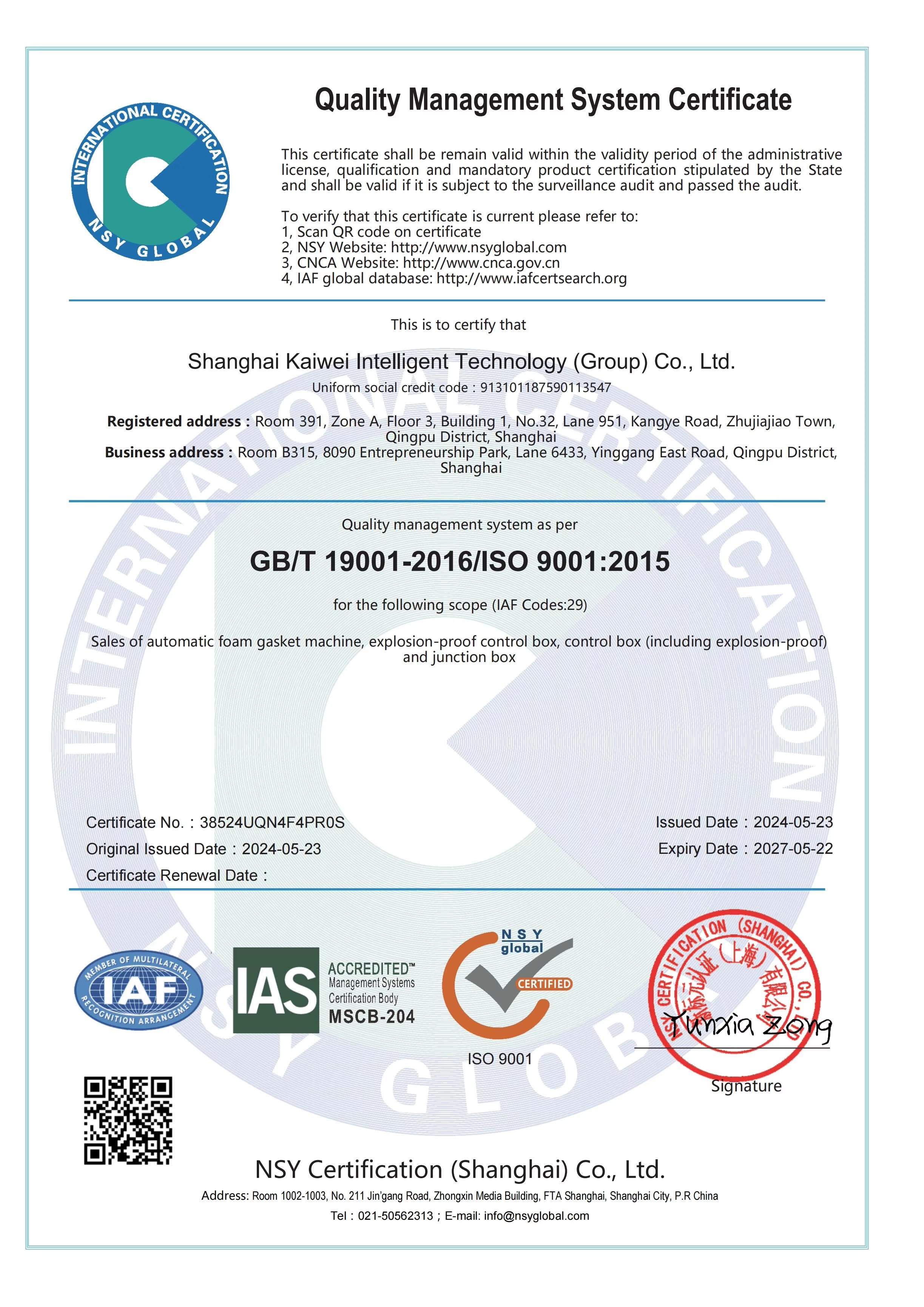
- ISO 9001:2015 — certificate issued by NSY Certification (Shanghai) Co., Ltd., scope covering sales of automatic foam gasket machines, explosion-proof control boxes, control boxes, and junction boxes, valid 2024-05-23 to 2027-05-22.
- UL94 — certificate THSH25033168768EN issued by Shanghai Global Testing Services Co., Ltd. (GTS) for foaming adhesive, under UL 94-2023 Rev.2-2024, Section 8, issued 2025-04-16.
- RoHS Certificate of Compliance — UNIB21090613HC-01 issued by Shenzhen United Testing Technology for sealing foam glue-B, referencing RoHS Directive (2011/65/EU) and Amendment (EU) 2015/863, issued 2021-08-11.
- VOC CE — ICR/VC/HS230352 issued by ICR Co. Ltd., scope: electric enclosure, referencing EN 60529:1991+A2:2013 and EN 62208:2011, valid 2023-03-28 to 2028-03-27.
- Non-Hazardous Certificate — NO.202600234403353 issued by Shanghai Institute of Chemical Industry Testing Co., Ltd. (SICIT) for polyurethane sealing foam glue-A under UN Dangerous Goods Transport Regulations (Maritime), valid 2026-01-01 to 2026-12-31.
- ATEX — ECM 25 ATEX-B D001 issued by Ente Certificazione Macchine srl (ECM, Notified Body No. 1282), scope: explosion-proof enclosure (cabinet), valid 2025-04-10 to 2030-04-09.
- China Compulsory Certificate (CCC) — 2022012304504287 issued by the China Quality Certification Center (CQC) for explosion-proof enclosure model BXK-D1, valid 2022-10-19 to 2027-10-18.
The distinction matters for explosion-proof and IP66 projects. The ATEX and CCC certificates relate to explosion-proof enclosures, while the VOC CE certificate references EN 60529 — the enclosure ingress-protection standard behind an IP66 claim. A buyer sealing explosion-proof cabinets therefore needs to read the certificate scope, not only the certificate name, and confirm which document covers which party in the chain.
OEM/ODM scope available for long-term projects
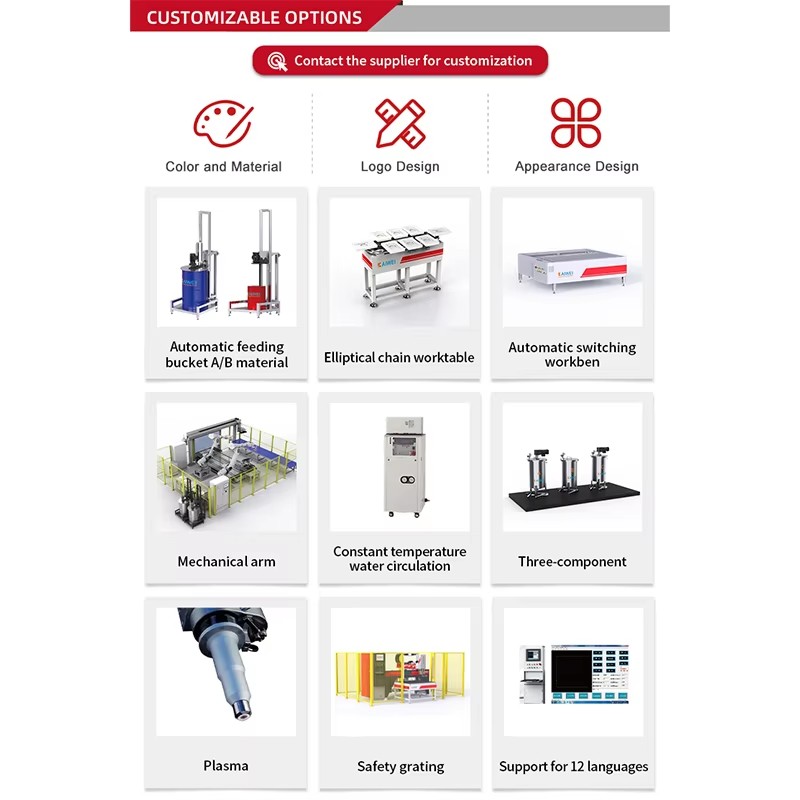
Customization is where a standard machine becomes a line asset. KAIWEI's published OEM/ODM customization list includes: color and material; automatic feeding for bucket A/B material; mechanical arm; plasma treatment; logo design; elliptical chain worktable; constant-temperature water circulation; safety grating; appearance design; automatic switching worktable; three-component configuration; and support for 12 languages.
Several of these items are specifically relevant to multi-year operation rather than to the initial purchase. An automatic switching worktable supports continuous production without manual reloading. A safety grating becomes more important as operators change and as line audits tighten. A constant-temperature water circulation option stabilizes the process when ambient conditions move within the planned range. Twelve-language support reduces training dependency when a line is replicated in another country.
Quality, capacity, and after-sales commitments
KAIWEI states 100% testing as its quality-control approach, remote support as its after-sales service model, a lead time of 7 days, a minimum order quantity of 1 set, and a monthly capacity of 2,000 sets. Production mode is OEM/ODM. Commercial terms are stated as FOB/CIF delivery, 30/70 payment, and full inspection before shipment, with third-party testing available for acceptance procedures.
Read together, those terms describe a supplier set up for both a single pilot unit and a staged rollout — the pilot-and-scale pattern most buyers follow when they are not yet ready to convert an entire line.
A Six-Step Plan for Long-Term Service, Spares, and Support
The plan below translates the capabilities above into a working maintenance and support structure. It is written for automatic sealing projects that expect to run continuously.
Step 1 — Freeze a machine baseline document
Record the exact model and the configuration agreed at order. Model numbers differ in ways that affect spares: the KW-510B uses the KW-900 mixing head and a 12.1-inch screen, while the KW-520A uses the KW-800 head and a 10.2-inch screen; the KW-523 accepts seal strip widths of 2–10 mm or 10–60 mm, and the KW-526 covers 2–60 mm on a six-axis frame. A baseline that captures these differences is what makes a replacement part orderable in year four.
Step 2 — Define the integration boundary with the gluing line
Document how the machine talks to the line. KAIWEI specifications list a motion control card or a teach pendant plus PLC as controller options, PC or teach pendant operation modes, and integrated operation box or cantilever control box interfaces depending on model. Agree in writing which party owns the PLC logic, which signals cross the boundary, and what happens when either side is upgraded.
Step 3 — Write the preventive maintenance calendar for continuous operation
Build the schedule around the machine's actual operating requirements rather than a generic interval. High-pressure water cleaning is the specified cleaning method across the model range. Tank A agitation is specified as active while Tank B agitation is not. Air pressure must be at least 6 bar, with an oil-water separator on the air source treatment. Water supply is tap water, and where the water tank function is fitted it includes a front level sensor and outlet filtration. Each of these becomes a scheduled check.
Step 4 — Classify spares by criticality, not by catalogue order
Group components by how quickly their failure stops the line. Consumable and wear items first; process-critical items such as the mixing head and metering pump second; long-lead electrical items such as servo motors and reducers third. KAIWEI specifications identify metering pumps as KAIWEI or Barmag, guide rails as KAIWEI or AIRTAC, reducers as Senad, and servo motors across the range as Leadshine, STEP, Xinje, Nidec, ABB, Fuji, or Panasonic depending on model — which is precisely the information a spares list needs.
Step 5 — Plan training and knowledge transfer
Operation is touch-screen based, with HMI sizes of 10.2, 12.1, or 15 inches depending on model, and the customization list includes support for 12 languages. Plan a primary and a secondary trained operator per shift so that knowledge does not sit with one person, and keep the parameter set for each product family recorded so that a recipe can be restored rather than recreated.
Step 6 — Fix the escalation path before you need it
Agree who is contacted, in what order, and with what information. KAIWEI's stated after-sales model is remote support, which works fastest when the buyer can supply the model, the configuration baseline, the fault description, and machine parameters in one message. Record the supplier's stated contact channels in the maintenance file at commissioning, not after the first stoppage.
How the Support Model Works Across Five Industries
Electrical control panels and explosion-proof enclosures
This is the most specification-sensitive segment. Sealing an explosion-proof cabinet or a control panel door means the gasket contributes to a declared enclosure performance, and the documentation trail matters as much as the bead. Buyers in this segment should keep the VOC CE certificate (EN 60529 / EN 62208 scope, valid to 2028-03-27), the ATEX certificate for explosion-proof enclosures (valid to 2030-04-09), and the CCC certificate for explosion-proof enclosure BXK-D1 (valid to 2027-10-18) in the project file, and confirm at each audit which document covers the component they are shipping.
Auto parts and components
Automotive work brings higher volume and stricter change control. A documented deployment exists in this segment: an automotive OEM client in the United States operating 20 units in a paint shop for two years, with reported results of stable operation, IP66 waterproof and dust-proof sealing, and high production efficiency, supported by high-precision dispensing, automatic production, and customized gasket shape. The two-year operating window is the relevant benchmark for a maintenance calendar, because it spans multiple service cycles rather than a single commissioning period.
Lighting and outdoor luminaires
Street lighting, stadium lighting, LED luminaires, explosion-proof lights, and outdoor lights all depend on the gasket holding against weather over a long field life. Support planning here focuses on bead consistency across product variants and on keeping the parameter set stable when a luminaire family is revised.
Home appliances and purification equipment
Refrigerator doors, purification room doors, air filters, and air cleaning filters involve large, thin, sometimes warped parts where the gasket path is long. Long-term support in this segment is mostly about worktable configuration and about the ability to add capacity — which is where options such as the elliptical chain worktable and automatic switching worktable enter the plan.
Global deployment support
Because KAIWEI exports to more than 60 countries, the support model has to work across time zones. The practical structure is a documented baseline held by the buyer, remote diagnostics as the first response layer, and a spare-parts list agreed at commissioning and reviewed annually against actual consumption.
Model and Commercial Reference Tables
Table 1 — Published model specifications relevant to spare-part and upgrade planning
| Model | Seal strip width | Frame | HMI screen | Mixing head | Running speed | Effective stroke |
|---|---|---|---|---|---|---|
| 520A-PC | 4–30 mm | 3-axis linear robot arm | 10.2 in | KW800 | 0–1200 mm/min | 2250 × 1250 × 200 |
| KW-520A | 4–30 mm | 3-axis linear robot arm | 10.2 in | KW800 | 0–12000 mm/min | 2250 × 1250 × 200 |
| KW-520B | 4–30 mm | 3-axis linear robot arm | 15 in | KW-900 | 0–1200 mm/min | 2250 × 1250 × 200 |
| KW-510B | 4–30 mm | 3-axis linear robot arm | 12.1 in | KW-900 | 0–12000 mm/min | 2250 × 1250 × 200 |
| KW-523 | 2–10 mm / 10–60 mm | 3-axis linear robot arm | 15 in | KW800 / KW-900 | 0–1200 mm/min | 1250 × 800 × 200 |
| KW-523A | 2–10 mm / 10–60 mm | 3-axis linear robot arm | 15 in | KW800 / KW-900 | 0–1200 mm/min | 1250 × 800 × 200 |
| KW-526 | 2–60 mm | 6-axis linear robot arm | 15 in | KW800 / KW-900 | 0–12000 mm/min | Customized |
Common to the range as published: polyurethane raw material, two-component or three-component selection, high-pressure water cleaning, mixing ratio 1–10:1, metering pump specification A 3 cc/r and B 0.6 cc/r, raw material tanks A 40 L and B 40 L, tank A agitation with tank B without, 220V/380V supply, 4 kW or 5.5 kW power, and an air pressure requirement of at least 6 bar. Speed and stroke values are reproduced as published per model and should be confirmed against the quotation for the specific configuration.
Table 2 — Stated commercial, quality, and support terms
| Item | Stated term | Why it matters for a long-term partnership |
|---|---|---|
| Minimum order quantity | 1 set | Allows a single-unit pilot before a line-wide commitment |
| Delivery terms | FOB / CIF | Supports both buyer-controlled and supplier-arranged logistics |
| Payment terms | 30 / 70 | Standard staged structure for capital equipment |
| Acceptance | Full inspection before shipment; third-party testing available | Creates an independent record usable in later warranty discussions |
| Lead time | 7 days | Relevant to line expansion and to replacement-unit decisions |
| Monthly capacity | 2,000 sets | Indicates the supplier can absorb a staged rollout |
| Quality control | 100% test | Every unit is tested rather than sampled |
| After-sales support | Remote support | Defines the first response layer; escalation should be agreed separately |
| Production mode | OEM / ODM | Configuration committed at order becomes the long-term baseline |
FAQ: Long-Term Partnership Questions After Machine Selection
Which certifications should a buyer track across a multi-year PU gasket dispensing partnership?
Track the certificates whose scope matches the products you ship and whose validity dates fall inside your supply period. KAIWEI publishes CE certificate MD-TCF-240307-55472 under the 2006/42/EC Machinery Directive for automatic gluing equipment, valid 2024-04-02 to 2029-04-01; ISO 9001:2015 certification issued by NSY Certification (Shanghai) Co., Ltd., valid 2024-05-23 to 2027-05-22; UL94 certificate THSH25033168768EN for foaming adhesive under UL 94-2023 Rev.2-2024, issued 2025-04-16; RoHS Certificate of Compliance UNIB21090613HC-01 for sealing foam glue-B, issued 2021-08-11; VOC CE certificate ICR/VC/HS230352 referencing EN 60529:1991+A2:2013 and EN 62208:2011, valid 2023-03-28 to 2028-03-27; and a Non-Hazardous Certificate NO.202600234403353 for polyurethane sealing foam glue-A under UN Dangerous Goods Transport Regulations (Maritime), valid 2026-01-01 to 2026-12-31. For explosion-proof work, note that the ATEX certificate ECM 25 ATEX-B D001 (valid 2025-04-10 to 2030-04-09) and the CCC certificate 2022012304504287 for explosion-proof enclosure BXK-D1 (valid 2022-10-19 to 2027-10-18) apply to explosion-proof enclosures, not to the dispensing machine itself. Always read the scope field before assuming a certificate covers a component.
Can a PU gasket dispensing machine be integrated into an existing automatic gluing line and kept running continuously?
Integration capability is determined by the controller and interface options rather than by the dispensing head alone. KAIWEI specifications list a motion control card or a teach pendant plus PLC as controller options, PC or teach pendant operation modes, and integrated operation box, cantilever control box, or teach pendant control interfaces across the model range. The OEM/ODM customization list adds an elliptical chain worktable, automatic switching worktable, safety grating, constant-temperature water circulation, automatic feeding for bucket A/B material, three-component configuration, and support for 12 languages — all of which are line-level rather than machine-level features. For continuous operation, the published operating requirements are the practical constraint: high-pressure water cleaning, tank A agitation, water temperature control where specified, air pressure of at least 6 bar with oil-water separation, and a tap water supply. KAIWEI states remote support as its after-sales model, which makes a documented configuration baseline the most useful integration asset a buyer can hold.
What commercial terms apply when moving from a single machine to a long-term supply arrangement?
KAIWEI states a minimum order quantity of 1 set, FOB/CIF delivery terms, and 30/70 payment terms. Acceptance is defined as full inspection before shipment, with third-party testing available for acceptance procedures. Monthly capacity is stated at 2,000 sets and lead time at 7 days. Those terms are compatible with a pilot-first strategy: a buyer can take a single set, run it through a full production cycle, and then scale without renegotiating the commercial framework. Buyers should still confirm in writing how configuration changes affect price and lead time once a model baseline has been agreed.
How can a buyer validate sealing performance before committing to a multi-unit rollout?
Validation rests on three things: a low entry barrier, a documented test record, and a precedent in a comparable application. The minimum order quantity of 1 set removes the volume barrier to a pilot. KAIWEI states 100% testing as its quality-control approach, and third-party testing can be provided as part of the acceptance procedure, which gives the buyer an independent record rather than a supplier statement alone. For precedent, KAIWEI reports an automotive OEM client in the United States operating 20 units in a paint shop for two years, with results including stable operation, IP66 waterproof and dust-proof sealing, and high production efficiency, supported by high-precision dispensing, automatic production, and customized gasket shape. A buyer should map their own acceptance criteria — bead width range, sealing class, cycle time — onto that evidence before signing a staged order.
What lead time and capacity support repeat orders and production expansion?
KAIWEI states a lead time of 7 days and a monthly capacity of 2,000 sets, supported by a production site exceeding 20,000 m², more than 100 employees, and a core technical team of 30+ engineers. Export coverage of more than 60 countries, with an export ratio of 70%, indicates that repeat orders cross borders routinely rather than exceptionally. For a buyer planning expansion, the practical next step is to confirm the model baseline, request a quotation for the target configuration, and book a pilot unit against the stated 7-day lead time so that the validation cycle and the rollout schedule do not compete for the same window. Requests for quotation, samples, and configuration review can be sent to info@kaiwei-sh.com.
Next Step: Turn the Partnership Questions Into a Written Support Plan
A long-term PU gasket dispensing partnership is not a warranty clause. It is a set of documents — a model baseline, an integration boundary, a maintenance calendar, a criticality-ranked spares list, a training plan, and an escalation path — that together decide how quickly a sealing line returns to production when something changes. Everything in that set can be built from information the supplier already publishes: model specifications, controller options, operating requirements, certificate numbers and validity dates, capacity, lead time, and stated after-sales terms.
The most useful action a buyer can take after machine selection is to convert those published facts into their own documents before commissioning, and then review them annually against actual consumption and actual stoppages. That is what makes the difference between owning a machine and operating a sealing capability.
Request a Configuration Review, Sample Discussion, or Quotation
KAIWEI supports buyers through the post-selection phase with model-level documentation, OEM/ODM configuration review, and remote after-sales support. Share your application, enclosure type, seal strip requirement, and production environment, and the team will respond with a configuration proposal and commercial terms.
- Email: info@kaiwei-sh.com
- Tel / WhatsApp: +86 137 6198 6986
- WhatsApp chat: Start a conversation
- Websites: sh-kaiwei.com · kaiweicn.com · pugasket.com
- Address: No.6433 East Yinggang Road, Qingpu District, Shanghai, China
Download the product brochure for full model specifications and configuration options: KAIWEI PU Gasket Dispensing Machine Brochure (PDF)
PU gasket dispensing machineOEM / ODMRemote supportCE · ISO 9001 · UL94 · RoHS
Have Questions or Need More Details?
Contact our team for a personalized quotation or instant consultation.
Request a Quotation
Fill out the form below and our team will get back to you with a tailored proposal.
WhatsApp Direct Chat
Prefer to chat in real-time? Message us on WhatsApp for instant assistance & quick answers.
- Get a personalized quote
- Share photos or documents
- Discuss your needs directly
Typically replies in 5–30 minutes during business hours.