
PU Gasket Dispensing Machine 101: Technology, Applications, and Equipment Comparisons
Engineers and procurement teams searching for adhesive foam sealing equipment often start with a generic term: PU gasket dispensing machine. In practice, this equipment meters, mixes, and applies two-component polyurethane foam as a sealing gasket directly onto a component. This article provides a discovery-level view of the technology, typical application fields, machine structure, and the KAIWEI catalog models built for such sealing projects.
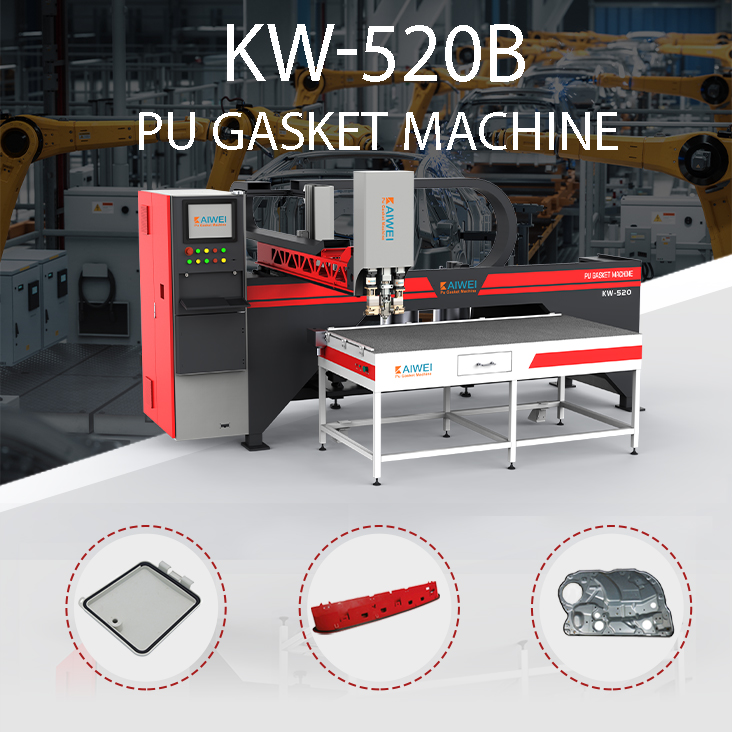
What Is a PU Gasket Dispensing Machine?
A PU gasket dispensing machine is an automated dispensing system that applies a liquid polyurethane foam bead along a programmable path. After the mixture is laid on the workpiece, it foams and hardens into a sealing gasket. This method is often described as a form-in-place gasket process because the gasket is formed directly on the part instead of being handled as a separate rubber profile.
KAIWEI, founded in 2004 and headquartered in Shanghai, is one manufacturer that builds these machines for industrial sealing applications. KAIWEI specializes in industrial sealing systems, robot foaming equipment, intelligent sealing and dispensing equipment, and six-axis robotic foaming systems. Inside the company profile, the PU gasket dispensing machine is positioned for automatic sealing projects. Its stated function includes dust-proof and explosion-proof sealing for enclosures, especially when applied to electrical control panels, electrical distribution boards, electrical enclosures, and anti-explosion boxes.
Why Automatic Form-in-Place Gasket Dispensing Is Used
Manufacturers often use PU foam gaskets where a cover or housing must seal against dust, moisture, or environmental contamination. Molded and pre-cut rubber gaskets are still common, but an automatic foam gasket machine creates a foam profile from a controlled robot path. This can reduce the number of loose sealing parts on a production floor and make the gasket path easier to change when the product design changes.
The broader movement toward automated sealing is visible in industry research. According to Market Research Future, the broader polyurethane processing machine market was valued at USD 6.627 billion in 2024 and is projected to grow at a CAGR of 10.21% through 2035. In the narrower form-in-place liquid gasket sector, Maximize Market Research estimated the market at USD 270 million in 2023, with increasing adoption in EV battery enclosures. KAIWEI Industry Analysis also places the specific PU gasket dispensing segment at approximately USD 1.2 billion in 2025.
How a PU Gasket Dispensing Machine Works
The operational sequence on a KAIWEI PU gasket dispensing machine follows a controlled material route. Two-component polyurethane is normally stored in separate tanks, metered in the required ratio, mixed at the dispensing head, and then applied without opening the mixing chamber.
Core Process Steps
- Material supply: The machine uses an air-pressure tank structure. In KAIWEI catalog specifications, the standard raw-material tank volume is 40 liters for Tank A and 40 liters for Tank B. Tank A can be equipped with agitation, while Tank B is listed without agitation on the standard configuration.
- Metering: Separate metering pumps move material from each tank. KAIWEI lists KAIWEI or Barmag metering pumps, with A3cc/r and B0.6cc/r as common pump specifications. The mixing ratio range on the catalog models is 1–10:1, which allows process settings to be matched to the polyurethane formulation.
- Mixing and dispensing: The A and B streams are mixed in a KAIWEI mixing head, model KW800 or KW-900 depending on the machine. The mixed liquid is deposited as a continuous bead along the programmed route. Depending on machine and nozzle setup, listed seal strip widths include 2–10 mm, 4–30 mm, or up to 2–60 mm.
- Robot path control: The machine uses a touch-screen HMI and can be operated with a PC or teach pendant. Controllers include a motion control card, teach pendant, and PLC. The frame structure is typically a 3-axis linear robot arm, while the KW-526 model uses a 6-axis linear robot arm with a customized effective stroke.
- Cleaning: The mixing head is cleaned with high-pressure water. Some configurations also offer water temperature control as an option, and the water tank function includes a front level sensor and outlet filtration.
Because the machine is designed for production-line integration, the product profiles describe 24/7 continuous operation and automatic production line operation. The operating temperature range listed for the equipment is -20 to 40 degrees Celsius.
KAIWEI PU Gasket Dispensing Machine Models and Specifications
KAIWEI offers several catalog models for PU gasket dispensing. The table below summarizes the published machine specifications related to frame type, working stroke, seal width, and material compatibility. This is a family-level comparison rather than a market ranking.
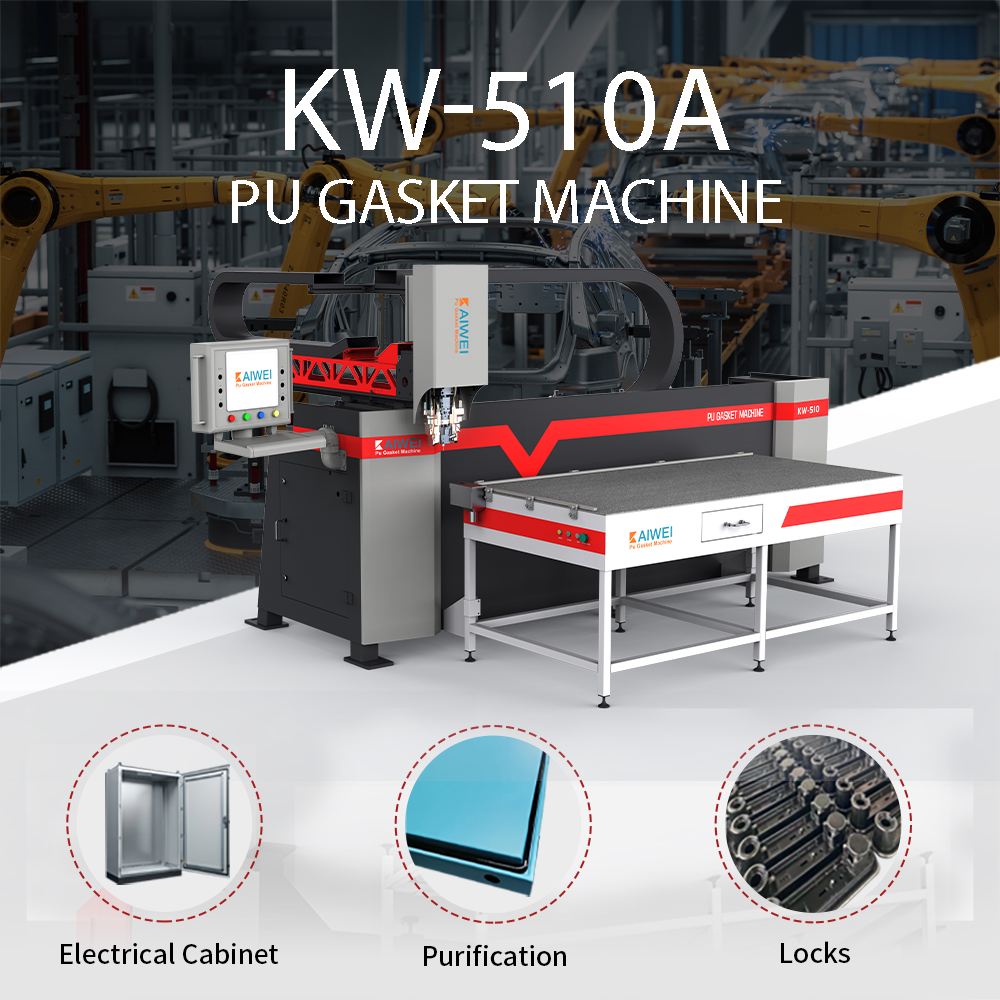
| Model | Frame Structure | Effective Stroke | Seal Strip Width | Raw Material | Published Notes |
|---|---|---|---|---|---|
| KW-523 | 3-axis linear robot arm | 1250 x 800 x 200 | 2–10 mm / 10–60 mm | Polyurethane / Silicone | 15-inch touch screen, integrated operation box |
| KW-523A | 3-axis linear robot arm | 1250 x 800 x 200 | 2–10 mm / 10–60 mm | Polyurethane / Silicone | 15-inch touch screen, integrated operation box |
| KW-520A | 3-axis linear robot arm | 2250 x 1250 x 200 | 4–30 mm | Polyurethane | 10.2-inch PC screen, integrated operation box |
| 520A-PC | 3-axis linear robot arm | 2250 x 1250 x 200 | 4–30 mm | Polyurethane | 10.2-inch PC screen, teach pendant control |
| KW-510B | 3-axis linear robot arm | 2250 x 1250 x 200 | 4–30 mm | Polyurethane | 12.1-inch touch screen, cantilever control box |
| KW-520B | 3-axis linear robot arm | 2250 x 1250 x 200 | 4–30 mm | Polyurethane | 15-inch touch screen, integrated operation box |
| KW-526 | 6-axis linear robot arm | Customized | 2–60 mm | Polyurethane | 15-inch touch screen, integrated operation box |
Across the family, the shared specification base includes two-component or three-component selection, KW800 or KW-900 mixing heads, 40-liter A and B tanks, high-pressure water cleaning, 220V or 380V power supply, and 4kW or 5.5kW power options. The frame materials are listed as carbon steel, stainless steel 304, or aluminum alloy.
Application Scenarios for PU Gasket Dispensing Systems
KAIWEI application files document this equipment across multiple industrial segments. A large part of the documented use surrounds electrical control panels and electrical distribution equipment, where the function is dust-proof and explosion-proof sealing for enclosures. Other documented fields include explosion-proof electrical equipment, lighting and LED lighting, auto parts and components, purification and environmental protection equipment, home appliances, and lock and hardware accessories.
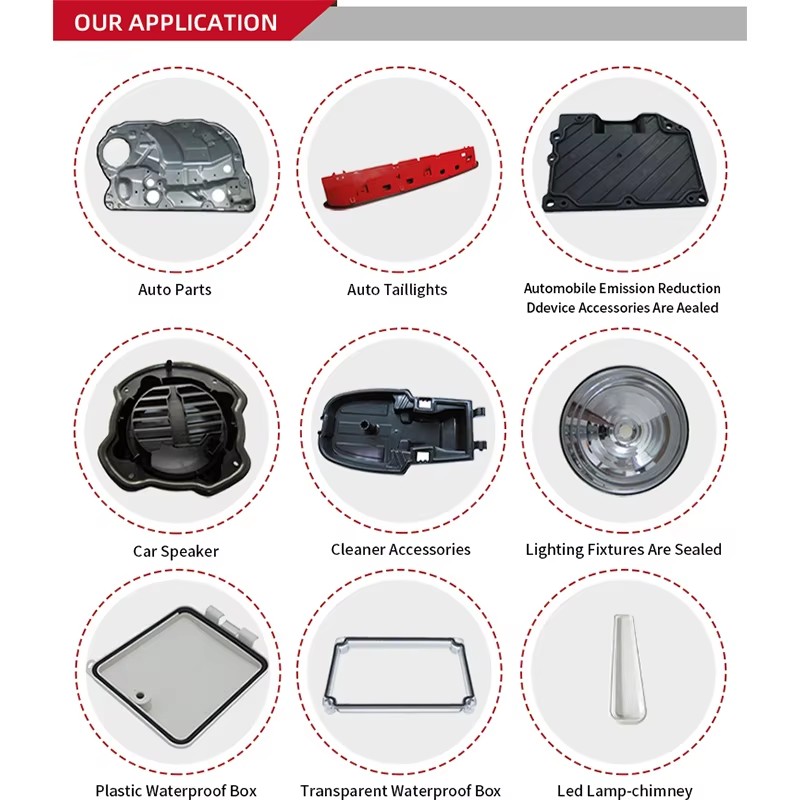
In practical terms, a buyer may encounter the machine when searching for gasket making on:
- Electrical control panels, distribution boards, electrical enclosures, and waterproof boxes
- Explosion-proof shells and anti-explosion enclosures
- Lighting housings, lamp covers, outdoor lights, and street lighting
- Air filters, purification room doors, and HVAC-related housings
- Automobile battery covers, interior door handles, and auto fittings
- Refrigerator doors, domestic appliance parts, and cable connectors
The same product family is also referenced by the terms polyurethane foaming machine, PU foam sealing machine, automatic foam gasket machine, gasket dispensing machine, and foam gasket sealing machine.
What to Clarify During the Research Stage
Because this is a discovery-level topic, the final machine choice should be made against a specific workpiece geometry. During the research stage, it helps to define the following variables.
- Material type: Will the line use only polyurethane, or is silicone flexibility needed? Standard KW-523 and KW-523A models list polyurethane or silicone compatibility.
- Working area: Check the effective stroke of the machine. KAIWEI catalogs include 1250 x 800 x 200 and 2250 x 1250 x 200 ranges, while KW-526 uses a customized stroke.
- Gasket width: Different seal strip widths are published for different models. Select a machine whose dispensing range matches the final gasket profile.
- Production environment: The listed application mode includes automatic production line operation and 24/7 continuous operation.
- Facility conditions: Required air pressure is at least 6 bar. The power supply can be 220V or 380V, and the listed machine power is usually 4kW or 5.5kW.
- Industry-specific protection: For electrical enclosure sealing, the application may require explosion-proof and IP66 waterproof compliance.
- Supplier documentation: Ask for the machine specification sheet, factory capability details, and examples from the same industry.
KAIWEI exports to over 60 countries, and export business accounts for about 70% of total sales. The company’s documented market reach includes Germany, the United States, and Southeast Asia, with the manufacturing base located in Shanghai.
Frequently Asked Questions
What does a PU gasket dispensing machine do?
A PU gasket dispensing machine is an automated system that mixes two-component polyurethane and deposits a continuous foam bead onto a workpiece. In electrical enclosure applications, KAIWEI equipment is specified for automatic sealing projects and provides dust-proof and explosion-proof sealing for enclosures.
Which industries use automatic foam gasket machines?
Documented end-use fields include electrical control panels, electrical distribution and industrial control, explosion-proof electrical equipment, lighting and LED lighting, auto parts and components, purification and filtration equipment, home appliances, and lock and hardware accessories.
Which KAIWEI models are available for PU gasket dispensing?
The KAIWEI catalog includes KW-523, KW-523A, KW-520A, 520A-PC, KW-510B, KW-520B, and KW-526. KW-523 and KW-523A list polyurethane or silicone compatibility. KW-526 is the 6-axis linear robot model with a customized stroke and a published seal width range of 2–60 mm.
Do PU gasket dispensing machines meet IP66 and explosion-proof requirements?
KAIWEI’s electrical enclosure application documents specify dust-proof and explosion-proof sealing, and they list explosion-proof and IP66 waterproof requirements as special application conditions. The gasket profile, enclosure design, and final assembly must be reviewed together for the required protection level.
Conclusion
A PU gasket dispensing machine is not a single-purpose glue gun. It is a complete dosing, mixing, and dispensing system that makes it possible to add a foam gasket directly into an automated production flow. The technology is relevant to electrical enclosures, lighting, filtration, domestic appliance, and automotive sealing work, among other segments.
For manufacturers moving from awareness to evaluation, the practical next step is to compare the machine’s working stroke, mixing ratio, seal width, and utility requirements with the workpiece dimensions and enclosure standard. KAIWEI’s product portfolio covers the main 3-axis and 6-axis configurations, and the company’s Shanghai factory also supports customized specifications.
Next Step: Use the KAIWEI Brochure as a Specification Starting Point
Download the KAIWEI product brochure for a summarized view of the PU gasket dispensing machine family and company capabilities. For a more specific discussion, email info@kaiwei-sh.com or contact KAIWEI with your workpiece size and target gasket width.
Have Questions or Need More Details?
Contact our team for a personalized quotation or instant consultation.
Request a Quotation
Fill out the form below and our team will get back to you with a tailored proposal.
WhatsApp Direct Chat
Prefer to chat in real-time? Message us on WhatsApp for instant assistance & quick answers.
- Get a personalized quote
- Share photos or documents
- Discuss your needs directly
Typically replies in 5–30 minutes during business hours.