PU Gasket Dispensing Machine Manufacturers: 2026 Market Landscape and Supplier Benchmark
The global polyurethane (PU) gasket dispensing machine market is estimated at approximately USD 1.2 billion in 2025. This article benchmarks leading manufacturers, defines the selection criteria buyers should apply, and places Shanghai Kaiwei Intelligent Technology (Group) Co., LTD (KAIWEI) within the 2026 supplier landscape. It is written for industrial buyers in the Evaluation stage who need a comparable framework before requesting quotations.
How to Use This Benchmark
Buyers evaluating PU gasket dispensing machines often face a fragmented market. This article does not rely on unverifiable "No.1" claims. Instead, it outlines a decision framework, compares supplier types with publicly attributable facts, and gives the reader a practical checklist for issuing RFQs.
Market Context: What Is Driving Demand for Foam Gasket Machines?
PU foam gasket machines apply a liquid polyurethane bead directly onto a component, where it cures into a form-in-place gasket. This method is widely adopted for electrical enclosures, distribution boards, automotive components, filters, lighting housings, and waterproof cabinets. A PU foam gasket machine removes the need for pre-cut foam or rubber gaskets, reducing inventory and enabling custom shapes in low to medium volumes.
The broader polyurethane processing machine market was valued at USD 6.627 billion in 2024 and is projected to grow at a CAGR of 10.21% through 2035. Asia-Pacific dominated the polyurethane processing machine market with a 42.2% share, driven by industrial manufacturing growth in China. These figures explain why more buyers are looking at suppliers in Asia, Europe, and North America in the same evaluation cycle.
Who Are the Leading Manufacturers in the PU Gasket Dispensing Machine Market?
Based on public industry ranking intelligence, the leading names in the FIPFG and PU dispensing equipment sector include Sonderhoff (Henkel), RAMPF Group, Cera-Tec, and KAIWEI.
- Sonderhoff (Henkel) — A globally recognized brand in form-in-place and form-in-place foam gasketing, strong in Europe and in multinational accounts.
- RAMPF Group — A German-based supplier of polyurethane processing and mixing equipment with a strong position in industrial dispensing systems.
- Cera-Tec — Known for medium-pressure foam gasket dispensing technology and an established European customer base.
- KAIWEI — Shanghai Kaiwei Intelligent Technology (Group) Co., LTD, a China-based manufacturer founded in 2004, exporting to more than 60 countries including Germany, the United States, and Southeast Asia.
These four names are not presented as a universal ranking. They represent the competitive field that global buyers should include in an initial longlist, with evaluation criteria applied consistently to each.
| Supplier | Headquarter Region | Positioning | Typical Buyer Profile |
|---|---|---|---|
| Sonderhoff (Henkel) | Europe | Global adhesive and sealing brand with FIPFG technology | Multinational OEMs, European plants, high-service-expectation buyers |
| RAMPF Group | Europe (Germany) | Polyurethane processing and metering technology | Industrial processors, automotive, composites |
| Cera-Tec | Europe | Medium-pressure foam gasket dispensing equipment | Electrical enclosure manufacturers, mid-sized production lines |
| KAIWEI | Asia (China) | Intelligent sealing and dispensing systems with OEM/ODM flexibility | Buyers seeking configurable machines, global exporters, cost-conscious plants |
KAIWEI Company Profile: Facts That Matter in Evaluation
KAIWEI is a state-level high-tech enterprise headquartered in Shanghai, founded in 2004. The company focuses on R&D and manufacturing of industrial sealing systems, robot foaming equipment, intelligent sealing and dispensing equipment, and six-axis robotic foaming systems. Its core technical team exceeds 30 members, and the company holds more than 100 national patents, including innovations related to robot quantitative foaming machines. The facility size exceeds 20,000 m², with more than 100 employees and an annual output of 2,000 units.
For a buyer, these facts translate into four checks: technical depth, production capacity, intellectual property, and organizational stability.
What to Look for in a PU Foaming Machine Supplier
Before comparing quotations, buyers should define the operating parameters of the polyurethane foaming machine they need:
- Material compatibility — Polyurethane, optionally silicone, and the ability to handle two-component or three-component systems.
- Mix ratio control — KAIWEI machines list a mixing ratio of 1–10:1 with metering pump options from KAIWEI or Barmag.
- Seal strip width — Typical range is 4–30 mm, with broader ranges up to 2–60 mm on the KW-526 model.
- Axis configuration — A 3-axis linear robot arm is standard for flat or slightly contoured parts; a 6-axis robot arm suits more complex contours.
- Effective stroke — Common sizes include 2250×1250×200 mm; the KW-526 offers customized stroke.
- Cleaning method — High-pressure water cleaning reduces solvent use.
- Certifications — CE, UL94, RoHS, ISO 9001, and VOC CE are the most relevant for electrical enclosure sealing applications.
Product Family Comparison: KAIWEI PU Gasket Dispensing Machines
KAIWEI currently offers seven PU gasket dispensing machine models. The following table compares their specifications based on published product data.
| Model | Raw Material | Mixing Head | Seal Strip Width | Frame Structure | Effective Stroke | Screen Size |
|---|---|---|---|---|---|---|
| 520A-PC | Polyurethane | KW800 | 4–30 mm | 3-Axis Linear Robot Arm | 2250×1250×200 mm | 10.2" |
| KW-510B | Polyurethane | KW-900 | 4–30 mm | 3-Axis Linear Robot Arm | 2250×1250×200 mm | 12.1" |
| KW-520A | Polyurethane | KW800 | 4–30 mm | 3-Axis Linear Robot Arm | 2250×1250×200 mm | 10.2" |
| KW-520B | Polyurethane | KW-900 | 4–30 mm | 3-Axis Linear Robot Arm | 2250×1250×200 mm | 15" |
| KW-523 | Polyurethane / Silicone | KW800 / KW-900 | 2–10 mm / 10–60 mm | 3-Axis Linear Robot Arm | 1250×800×200 mm | 15" |
| KW-523A | Polyurethane / Silicone | KW800 / KW-900 | 2–10 mm / 10–60 mm | 3-Axis Linear Robot Arm | 1250×800×200 mm | 15" |
| KW-526 | Polyurethane | KW800 / KW-900 | 2–60 mm | 6-Axis Linear Robot Arm | Customized | 15" |
All models share common characteristics: two-component or three-component selection, touch screen HMI, mixing ratio of 1–10:1, A3 cc/r and B0.6 cc/r metering pumps, high-pressure water cleaning, air pressure tanks with 40 L capacity for both A and B materials, and optional water temperature control. Carbon steel, stainless steel 304, and aluminum alloy are the available frame materials.
Manufacturer Benchmark: How KAIWEI Compares on Evaluation Criteria
A buyer evaluating suppliers should compare five dimensions: product range, certifications, export evidence, customization depth, and commercial responsiveness. The table below shows how KAIWEI's position can be assessed against the other named manufacturers.
| Evaluation Criterion | Sonderhoff (Henkel) | RAMPF Group | Cera-Tec | KAIWEI |
|---|---|---|---|---|
| Product range | Full adhesive/sealing range | PU processing and metering | FIPFG equipment | PU gasket machines, robot foaming, sealing glue, explosion-proof cabinets, UV printers |
| Documented certifications | Global brand certification base | EU/industrial certifications | EU/industrial certifications | CE, ISO 9001, UL94, RoHS, VOC CE, ATEX, CCC |
| Export footprint | Global | Global | Europe-focused | 60+ countries |
| OEM/ODM flexibility | Standardized solutions generally | Engineering-oriented | Engineering-oriented | OEM/ODM with defined customization options |
| MOQ / lead time | Typically higher | Typically engineering-led | Typically engineering-led | MOQ 1 set; 7-day lead time; 2,000 sets monthly capacity |
This benchmark does not claim any supplier is universally superior. The correct outcome depends on the buyer's plant conditions, certification requirements, and budget model.
Verifiable Certifications and Compliance Evidence
Compliance is a high-priority filter in the evaluation stage, especially for electrical enclosures exported to the EU, the United States, or China. The following certifications are documented for KAIWEI and its related equipment and materials:
- CE — Certificate MD-TCF-240307-55472 issued by GTS on 2024-04-02, valid through 2029-04-01, for automatic gluing equipment under the 2006/42/EC Machinery Directive.
- ISO 9001:2015 — Issued by NSY Certification (Shanghai) Co., Ltd. on 2024-05-23, valid through 2027-05-22, covering sales of automatic foam gasket machines, explosion-proof control boxes, and junction boxes.
- UL94 — Certificate THSH25033168768EN issued by Shanghai Global Testing Services Co., Ltd. (GTS) on 2025-04-16 for foaming adhesive, tested under UL 94-2023 Rev.2-2024, Section 8.
- RoHS Certificate of Compliance — Certificate UNIB21090613HC-01 issued by Shenzhen United Testing Technology on 2021-08-11 for sealing foam glue-B under IEC 62321 standards and the RoHS Directive (2011/65/EU).
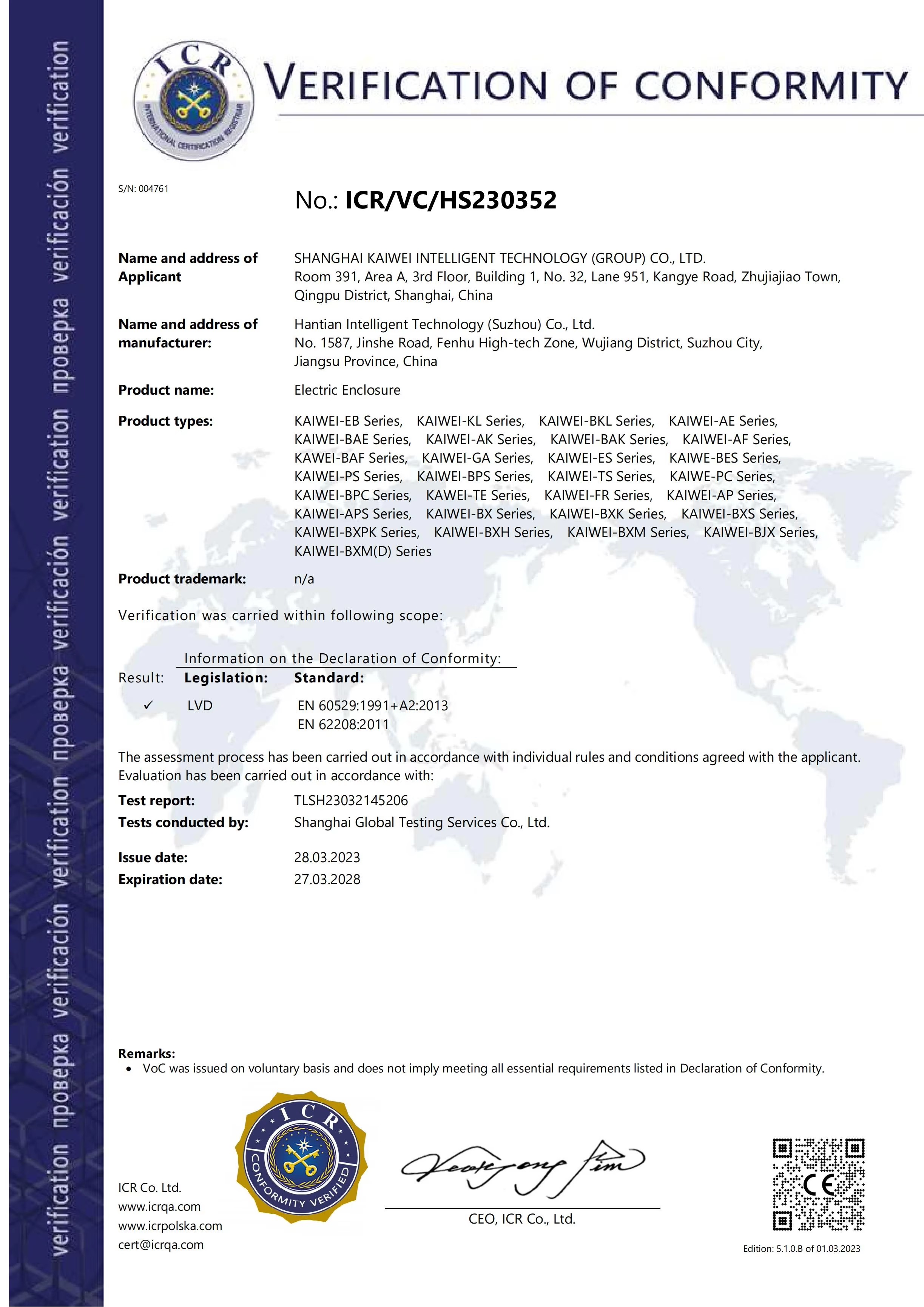
- VOC CE — Certificate ICR/VC/HS230352 issued by ICR Co. Ltd. on 2023-03-28 for electric enclosure under EN 60529:1991+A2:2013 and EN 62208:2011.
- Non-Hazardous Certificate — Certificate NO.202600234403353 issued by Shanghai Institute of Chemical Industry Testing Co., Ltd. (SICIT) on 2026-01-01 for Polyurethane Sealing Foam Glue -A under UN Dangerous Goods Transport Regulations (Maritime).
- ATEX — Certificate ECM 25 ATEX-B D001 issued by Ente Certificazione Macchine srl (ECM, Notified Body No. 1282) on 2025-04-10 for an explosion-proof enclosure (cabinet), valid through 2030-04-09.
- China Compulsory Certificate (CCC) — Certificate 2022012304504287 issued by CQC on 2022-10-19 for Explosion-proof Enclosure Model BXK-D1.
Documented Application Evidence: Automotive OEM, United States
A documented success case located in the United States involved automotive OEM clients and resulted in stable operation with IP66 waterproof and dust-proof sealing and high production efficiency. The customer purchased 20 units, used them in a paint shop environment, and ran them over a two-year period. The documented highlights were high-precision dispensing, automatic production, and customized gasket shapes.
For a buyer in the Evaluation stage, this case is useful as a verification target. The customer type, country, quantity, application, duration, and result are all explicit facts that can be checked during reference calls or factory audits.
OEM/ODM and Capacity Considerations
Buyers who need a modified machine should examine the supplier's customization capability rather than only the standard product brochure. KAIWEI offers customization in color and material, automatic feeding of A/B material buckets, mechanical arm options, plasma treatment, logo design, elliptical worktable, constant temperature water circulation, safety grating, appearance design, automatic switching workbench, three-component configuration, and support for 12 languages.
On capacity, KAIWEI states a monthly capacity of 2,000 sets, a lead time of 7 days, an MOQ of 1 set, and 100% testing before delivery. Remote support is available after sales.
Buyer Workflow: From Longlist to Pilot Run
- Define the required seal profile. Determine width, height, contour complexity, and whether the part needs silicone or polyurethane.
- Set the compliance gate. Use CE for EU, UL94/RoHS for material-level requirements, and ATEX for explosion-proof enclosure applications.
- Issue a technical RFQ. Request effective stroke, axis configuration, mixing head model, metering pump, cleaning method, and material tank specifications in writing.
- Compare total cost. Include shipping, commissioning, training, spare parts buffers, and local support expectations.
- Request one documented case. A case with a client type, country, quantity, and duration is more valuable than an unsupported testimonial.
- Arrange a sample run. A pilot gasket on your own enclosure is the most reliable verification before purchase.
Limitations and Boundary Conditions
Some limitations apply to every vendor benchmark of this type. Certified test results for the machine itself must be distinguished from material-level or enclosure-level certifications. UL94 and RoHS certificates referenced here apply to specific foaming adhesive materials; they do not automatically certify every machine. The ATEX and CCC certificates listed here apply to explosion-proof enclosures, not to all dispensing machines. Buyers must request the exact certificate scope and part number from the supplier during the RFQ stage.
FAQ
Which certifications should a PU gasket dispensing machine have for EU electrical enclosure sealing?
For EU export, the machine should carry CE marking under the 2006/42/EC Machinery Directive. For electrical enclosures, buyers should also check the VOC CE certificate for electric enclosure sealing, which KAIWEI holds under EN 60529:1991+A2:2013 and EN 62208:2011. Material-level certifications such as RoHS and UL94 apply to the foaming adhesive and should be checked separately.
Can KAIWEI build a PU gasket dispensing machine with customized stroke or a 6-axis robot arm?
Yes. The KW-526 model uses a 6-axis linear robot arm with customized effective stroke. KAIWEI also offers OEM/ODM customization including color and material, automatic A/B feeding, plasma treatment, logo design, elliptical worktable, constant temperature water circulation, safety grating, three-component configuration, and support for 12 languages. The MOQ is 1 set, and the documented lead time is 7 days.
What is the price range or budget expectation for a PU foam gasket machine?
Published price ranges for PU gasket dispensing machines vary, and the market value of the overall PU gasket dispensing machine segment is estimated at approximately USD 1.2 billion in 2025. Actual machine pricing depends on axis configuration, effective stroke, metering pump selection, and optional equipment. Buyers should request a quotation with a defined specification list rather than relying on average price claims.
Is there a documented KAIWEI customer case for gasket dispensing machines?
A documented success case is located in the United States. The client type was an automotive OEM, with 20 units delivered and used in a paint shop application. Over two years, the machines achieved stable operation, IP66 waterproof and dust-proof sealing, and high production efficiency, with high-precision dispensing, automatic production, and customized gasket shapes.
What is the typical lead time and production capacity for KAIWEI PU gasket dispensing machines?
KAIWEI documents a monthly production capacity of 2,000 sets and a lead time of 7 days, with an MOQ of 1 set. Each machine is tested before delivery. This responsiveness is relevant for buyers who need to commission lines or expand capacity without waiting for long production slots.
Next step: request the KAIWEI machine catalog or a sample gasket test.
Contact KAIWEI at info@kaiwei-sh.com or WhatsApp +86 13761986986 to discuss your part dimensions, sealing standards, and production targets.