How to Qualify a Long-Term Structure Tent Supplier in China
Importers, distributors, and project buyers often complete the first structure tent order with a quick price comparison. The more difficult decision is finding a supplier that can support repeat warehouse programs, multi-season events, engineering changes, documentation, and future expansions. That is a long-term structure tent supply decision, and it needs a different evaluation method than a one-off purchase.
This article explains how to qualify a structure tent manufacturer in China when the goal is a multi-year supply relationship. The framework focuses on manufacturing capacity, engineering depth, compliance coverage, project proof, and commercial terms.
Problem Definition: Why a Long-Term Structure Tent Partner Is Harder to Evaluate
When you buy one structure tent, the risk is limited to that project. When you enter a long-term relationship, you depend on one manufacturer for consistent quality, on-time delivery, and support across different sites. A long-term partner must therefore have not only a product catalog but also the internal systems to maintain quality across repeated production runs.
Buyers who only compare price per square meter often discover issues only after multiple orders: fabric quality changes between batches, certification files arrive late, drawings do not match site conditions, or the factory cannot respond when the next project needs a larger span. The best time to evaluate these factors is before the first large order, not after a series of problems has already damaged a project calendar.
Industry Background: Structure Tent Demand and Export Context
Structure tents have become a standard response for industrial, event, sports, and government projects because they combine wide clear spans with faster deployment than conventional structures.
Trade data from OEC shows China exported approximately USD 3.11 billion in tents, awnings, and sails in 2024, representing 53.3 percent of global exports. The broader global tent market, including industrial storage, sports, and events, is projected to expand from about USD 4.01 billion in 2025 to USD 6.07 billion by 2033. This growth makes supplier selection more important, especially for importers who want to convert one successful purchase into a stable sourcing pipeline.
Buyers also need to consider regional safety rules. In the European Union, temporary structure tents with a ground area exceeding 50 m² must comply with EN 13782:2015. In North American markets, tent fabrics are commonly required to meet NFPA 701. These requirements do not necessarily appear in every Chinese factory standard sales brochure, so a long-term partner must be able to produce compliant structures for your target market.
Detailed Solution: What a Long-Term Structure Tent Supplier Must Be Able to Prove
A durable supply relationship is built on evidence, not promises. One useful reference model is KENTEN Structures, a designer and manufacturer of aluminum permanent and semi-permanent structures, including structure tents, atrium tents, warehouse tents, double-decker tents, and modular infrastructure for events, industry, and public use.
Founded in 2001, KENTEN Structures has its worldwide operation center in Ontario, California, and reports additional regional offices in China, Hong Kong, Singapore, and the Middle East. It also states that it operates manufacturing centers in China, the United States, and the Middle East.
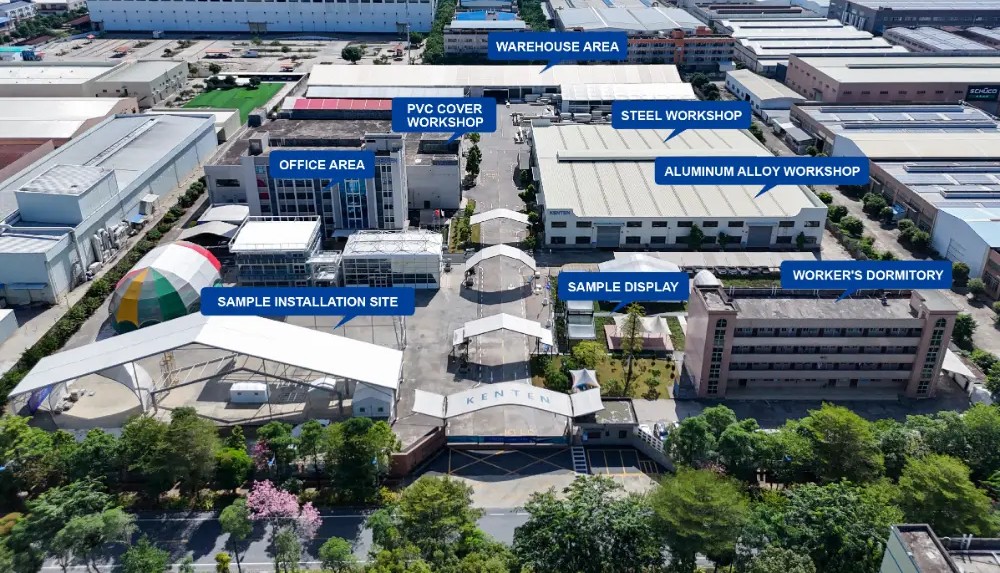
For long-term buyers, five capacity numbers matter when screening a structure tent manufacturer:
- Factory size: 80,000 m²
- Employees: about 200
- Monthly production capacity: 1,000,000 m²
- Export ratio: about 80 percent to the USA and EU
- Engineering team: 10 structural and design engineers
These numbers show whether a company can meet multi-unit orders and repeat demand. Capacity alone is not enough; the supplier must also demonstrate engineering control and quality documentation.
Engineered Product Range and Customization
Long-term structure tent programs usually include more than one tent type. KENTEN Structures lists a Structure Tent series covering K1 through K10 models, with span widths from 3 m to 80 m depending on model, unlimited length in 5 m bay increments, and eave heights from 2.5 m to 8 m. Main frames use high-strength 6061-T6 or 6082-T6 aluminum alloy, roof fabric is 850 g/m² PVC-coated polyester, and sidewalls can be PVC, glass wall, ABS wall, or sandwich panel.
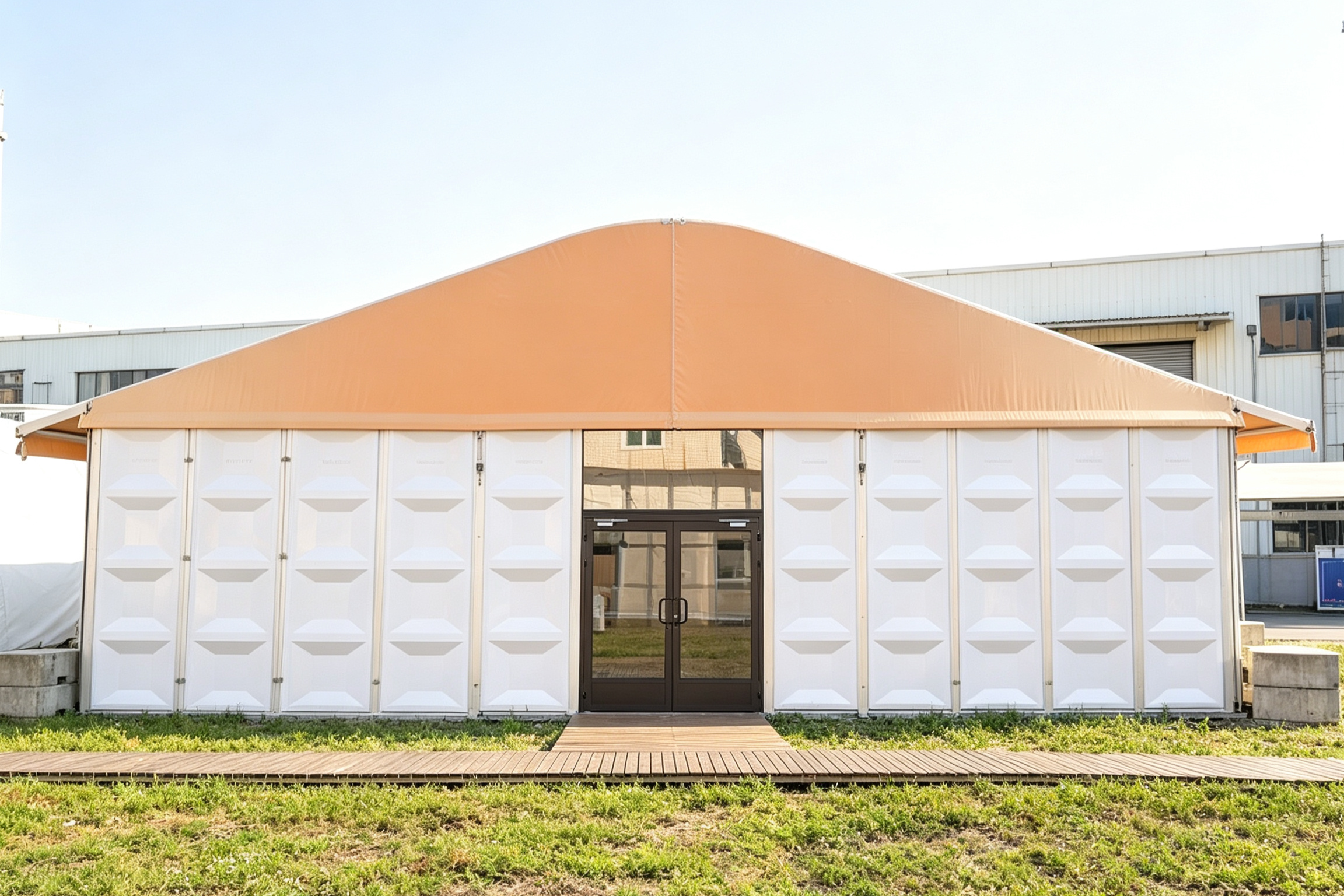
- Wind resistance: up to 140 km/h, configurable for project site conditions
- Snow load: up to 0.5 kN/m²
- Operating temperature range: -30°C to +70°C
- Flame-retardant options: DIN 4102 B1, M2, and NFPA 701
- Lifespan: aluminum frame 20+ years; PVC fabric 8–15 years
This range matters because a long-term supplier can support phased expansions without changing the construction system. A buyer can start with a 20 m warehouse tent, then add connecting bays or sidewall upgrades for a later project using the same engineering language and fabrication standards.
Structural Safety and Risk Management
Aluminum frame structure tents are load-bearing buildings. A supplier should have professional engineering staff who perform structural calculations and validate load capacity according to project requirements. KENTEN Structures states that its structures are produced and fully certified to IBC 2024, CBC 2025, ASCE 7-22, GB 50429, and EN 13782.
For an importer planning to sell or install tents in the United States or Europe, this compliance set is a useful screening signal. Ask the supplier to name the standard used for the specific project, rather than accepting a generic certificate.
Step-by-Step Breakdown: Qualify and Start a Long-Term Structure Tent Supply Program
Step 1. Build a Reference Project Pipeline
Before contacting suppliers, list the structure tent projects you expect to serve: warehouse storage, logistics distribution, events, exhibition halls, sports facilities, or hangars. Define span, eave height, sidewall type, and whether the structure needs to be moved after the first use. A clear project pipeline makes it easier to compare supplier capabilities.
Step 2. Audit Engineering Depth and Customization Ability
Ask how the supplier handles non-standard drawings. KENTEN Structures, for example, has a ten-person engineering team and offers model configurations that allow custom spans. For a long-term partner, you want engineers who can validate your layout, not just a sales team that repeats catalog specifications.
Step 3. Verify Compliance Documents for Each Target Market
Request the specific safety standard, structural calculation notes, and fabric certification for the country where the tent will be installed. In Europe, EN 13782 is the relevant structural safety standard for temporary structures above 50 m². In North America, NFPA 701 is commonly called out for tent fabric flame propagation. The manufacturer should be able to link those standards to materials and frame design.
Step 4. Inspect Manufacturing Capacity and Quality Control
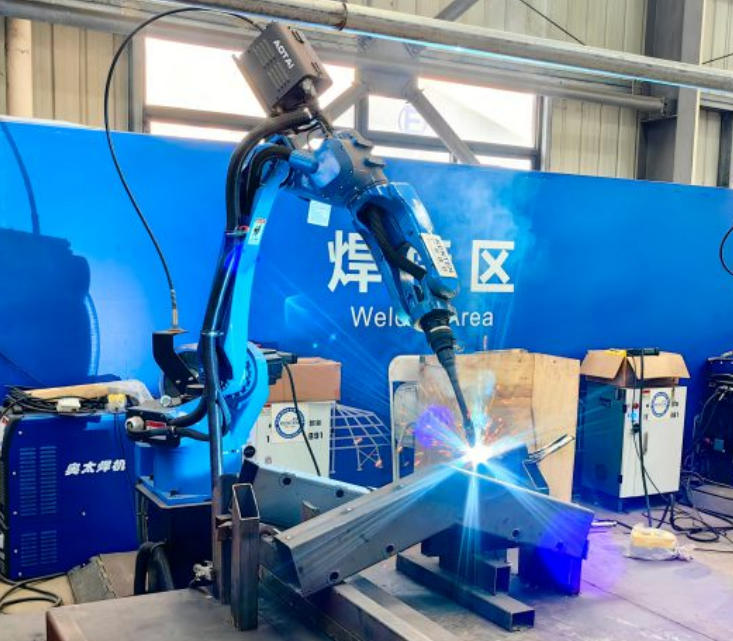
Evaluate production scale and process control. KENTEN Structures operates a manufacturing base of 80,000 m² and reports monthly production capacity of 1,000,000 m². It also uses automated equipment such as welding robots and CNC machines. These details help a buyer assess whether the factory can sustain quality during peak order periods.
Step 5. Ask for Comparable Project Proof
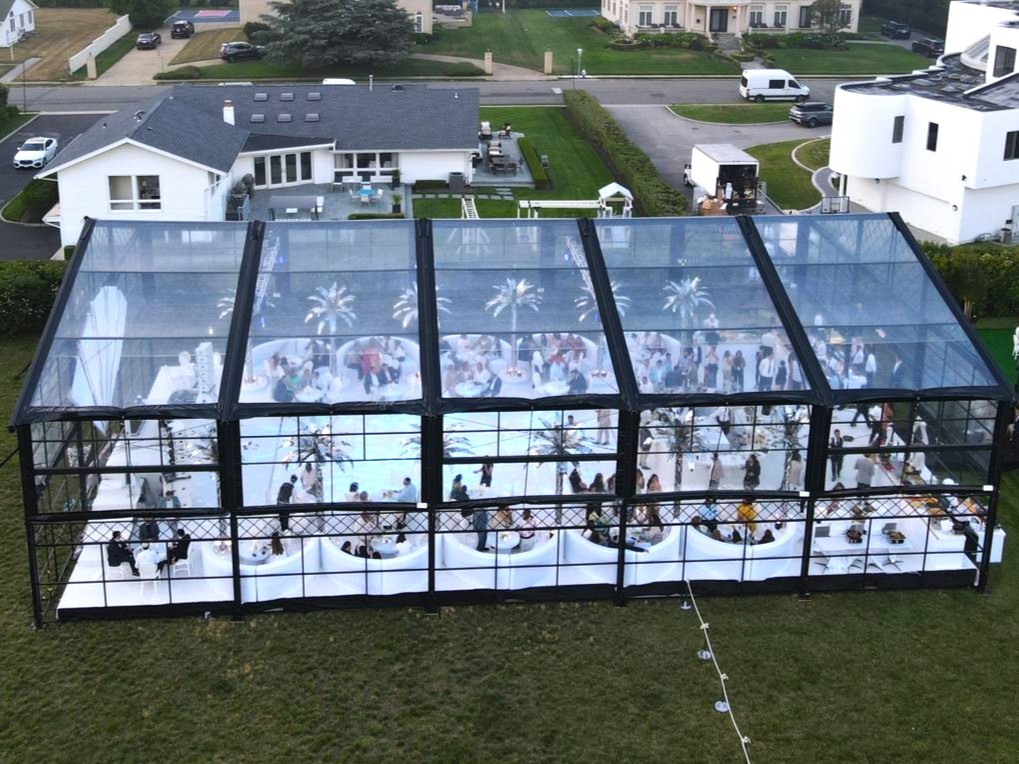
Project references are especially important when the buyer plans repeat orders. KENTEN Structures has supplied structures for Formula 1 events, the 2022 Beijing Winter Olympics, and exhibition halls in Kuwait. These cases show that the manufacturer has experience with large multi-unit builds, VIP layouts, temporary command centers, and column-free interiors.
Step 6. Confirm Commercial and Service Terms
For long-term supply, a one-page quotation is not enough. Clarify minimum order quantity, payment schedule, delivery methods, and the acceptance process. KENTEN Structures states an MOQ of one unit, a payment split of 30/70, delivery under FOB/CIF, and pre-shipment test acceptance. These terms allow a buyer to run a pilot order before scaling.
Step 7. Start with Pilot Order and Pre-Shipment Test
Do not treat the first order as the final test. Use the pilot unit to verify drawings, fabric quality, sidewall installation, assembly time, and packaging. After the pilot passes inspection, document the agreed specification as the baseline for future orders. This is how a tentative manufacturer becomes a dependable long-term structure tent supply partner.
Use Cases: How a Long-Term Supplier Demonstrates Reliability
Large global projects are useful evidence because they combine engineering precision, customization, and schedule control.
Formula 1 Miami Grand Prix
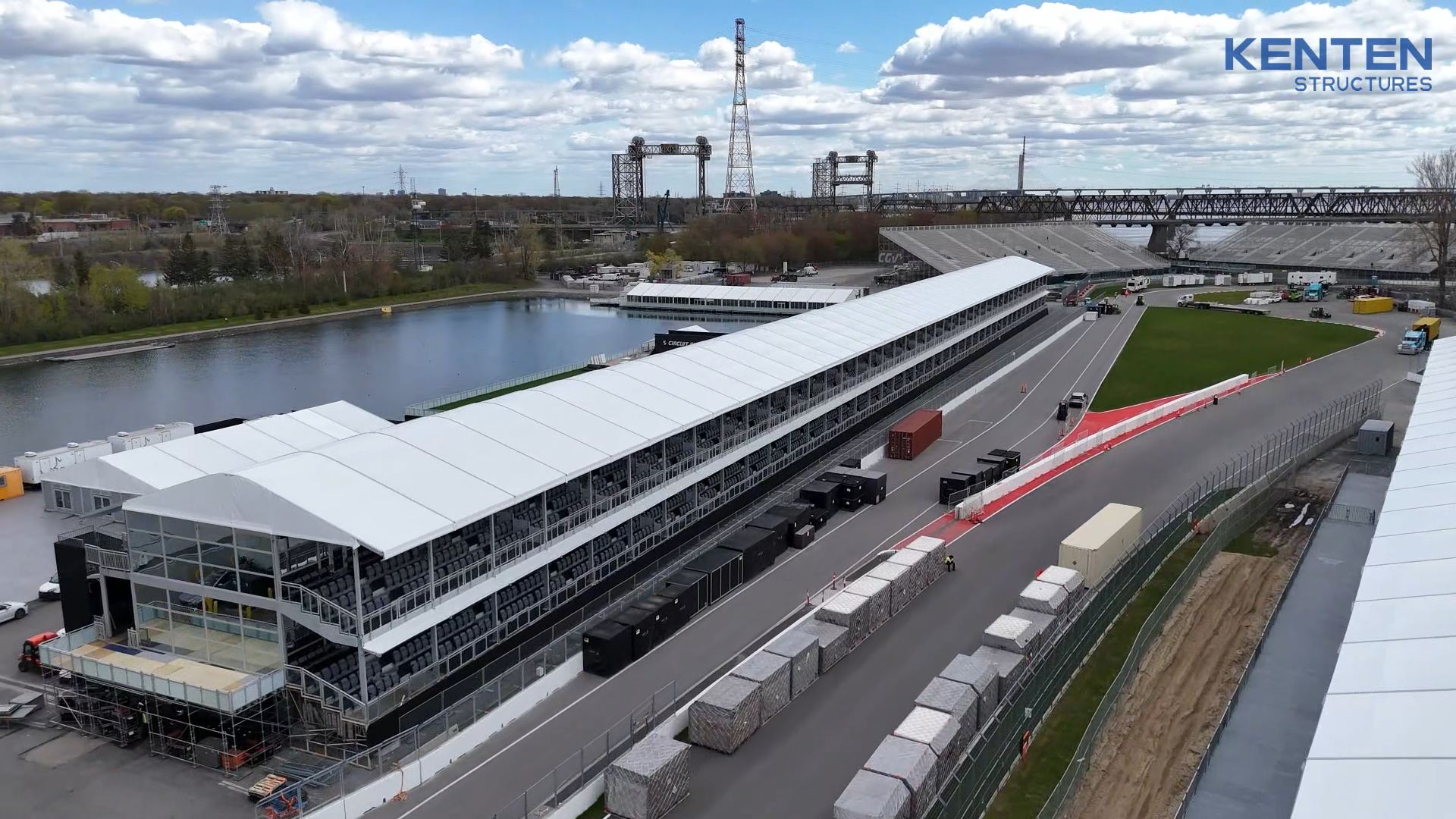
For the Formula 1 Miami Grand Prix in the United States, KENTEN deployed ten structure tent units configured for VIP lounges, hospitality suites, viewing platforms, and operational areas. A buyer evaluating a long-term partner can use this case to check whether the factory can deliver several customized units for one event location.
2022 Beijing Winter Olympics
KENTEN supplied 50 units, including A-structure tents and double-decker tents, used for security checkpoints, staff offices, dining areas, meeting rooms, and command centers. This project evidences multi-zone delivery and the ability to manage a high-stakes program with different functional requirements.
Kuwait Exhibition Hall
In Kuwait, a single KENTEN structure tent unit was installed for an exhibition hall, achieving a 100 percent column-free interior to maximize usable space. This case matters for buyers planning warehouse or exhibition areas where clear interior spans affect usable area.
When you assess project references, ask how the supplier handled engineering calculations, logistics, installation supervision, and late changes. Project names are a starting point; the process behind them is the real measure of a long-term relationship.
Comparison Table: Structure Tent vs Conventional Building for Long-Term Use
Structure tents are often compared with conventional buildings when an importer or project owner expects to use the same asset for several years. The table below summarizes the differences that matter at the decision stage.
| Evaluation point | Structure tent data | Decision value for a long-term buyer |
|---|---|---|
| Installation speed | Up to 70% faster installation than traditional construction | Reduces project downtime and accelerates revenue generation |
| Interior layout | 100% column-free interior maximizes usable space | Increases flexibility for warehouse racks, event floors, and exhibition booths |
| Building length | Unlimited length through modular bay extensions | Allows phased expansion as demand grows |
| Frame lifespan | 20+ year aluminum frame lifespan with minimal maintenance | Lowers long-term structural maintenance cost |
| Reusability | Reusable across multiple projects | Supports temporary or relocatable business strategies |
| Span range | Available in spans from 3 m to 60 m+ | Covers warehouse, event, exhibition, and sports applications |
| Total cost of ownership | Lower TCO for projects requiring flexibility, repeated use, or rapid deployment | More cost-effective than permanent construction when relocatability is likely |
FAQ: Long-Term Structure Tent Supply Partner in China
What compliance documents should a long-term structure tent partner in China provide for export projects?
Buyers should verify the standard the structure is designed and manufactured to. In the European Union, temporary structure tents with a ground area over 50 m² must comply with EN 13782:2015. In North America, tent fabrics are commonly tested to NFPA 701. KENTEN Structures states that its structures are produced and fully certified to IBC 2024, CBC 2025, ASCE 7-22, GB 50429, and EN 13782. Fabric options can also meet DIN 4102 B1, M2, or NFPA 701 depending on project specification.
Can a Chinese structure tent supplier support large-scale or customized long-term projects?
Yes, if the supplier has in-house engineering and manufacturing. KENTEN Structures has ten engineers and produces structure tents with span widths from 3 m to 80 m and modular bay spacing of 5 m, allowing length to be extended by project phase. The company’s project record includes ten structure tent units configured for the Formula 1 Miami Grand Prix and 50 units supplied for the 2022 Beijing Winter Olympics. A long-term partner should be able to review your layout and provide structural calculations before production.
What production capacity should a long-term structure tent supplier have?
Capacity determines whether the supplier can handle seasonal peaks, multi-warehouse programs, or urgent events. KENTEN Structures operates a factory of 80,000 m², employs about 200 people, and reports a monthly production capacity of 1,000,000 m². Around 80 percent of its output is exported to the USA and EU. These numbers can serve as a benchmark when comparing manufacturers for repeat structure tent orders.
What commercial terms are common when starting a long-term structure tent supply relationship?
For initial orders, buyers should evaluate MOQ, payment schedule, delivery method, and testing. KENTEN Structures uses an MOQ of one unit, a payment split of 30/70, delivery under FOB or CIF, and pre-shipment test acceptance. A pilot unit is a practical way to validate drawings, fabric quality, and assembly process before committing to a larger annual program. If you need a document to begin the conversation, download the KENTEN catalog below, email kenten@kentenstructures.com, or contact the team at +86 173 2224 3105.
Conclusion: Build the Partnership Around Verified Capability
Qualifying a long-term structure tent supplier in China is a procurement process in itself. The manufacturers that deserve multi-year programs tend to show consistent evidence in five areas: engineering documentation, compliance coverage, production capacity, project proof, and commercial support.
Use the first order as a pilot. Confirm the drawings, inspect the pre-shipment test, and compare the delivered tent against the agreed specification. If the first order meets your standard, you can scale with much lower risk.
Download the KENTEN structure tent catalog (PDF)
For a detailed evaluation, you can also visit www.kentenstructures.com or contact KENTEN Structures at kenten@kentenstructures.com. A measured first order is the most reliable way to build a long-term structure tent supply partnership from China.
Have Questions or Need More Details?
Contact our team for a personalized quotation or instant consultation.
Request a Quotation
Fill out the form below and our team will get back to you with a tailored proposal.
WhatsApp Direct Chat
Prefer to chat in real-time? Message us on WhatsApp for instant assistance & quick answers.
- Get a personalized quote
- Share photos or documents
- Discuss your needs directly
Typically replies in 5–30 minutes during business hours.