How to Verify Flame-Retardant Structure Tent Manufacturers Before You Buy
How to Verify Flame-Retardant Structure Tent Manufacturers Before You Buy
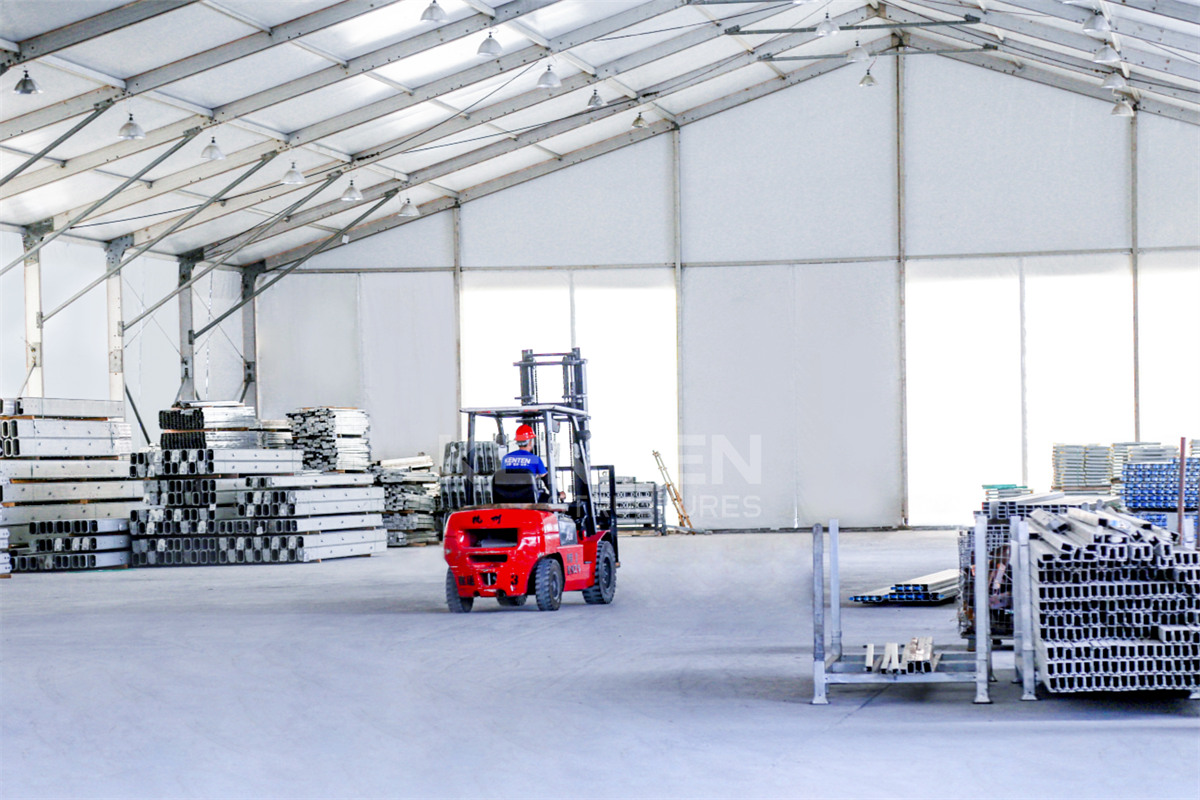
Flame-retardant structure tents are not simple party tents. They are specified for industrial warehouses, logistics centers, exhibitions, sports facilities, and temporary infrastructure where fire safety, wind resistance, and structural reliability matter. The problem is that the phrase 'flame retardant' can mean different things depending on the fabric, the standard, and the manufacturer. This article explains how to verify flame-retardant structure tent manufacturers using certifications, product specifications, and production controls.
KENTEN Structures is a useful reference. Founded in 2001, KENTEN is headquartered in Ontario, CA, USA, and operates manufacturing centers in China, the USA, and the Middle East. It designs and manufactures aluminum permanent and semi-permanent structures, including A Structure Tents, Atrium Tents, warehouse tents, Igloo Tents, Curved Tents, Double Decker Tents, Triple Decker Tents, and Pyramid Structures.
Why 'Flame-Retardant Structure Tent Manufacturers' Is a Constraint-Driven Search
When buyers search for flame-retardant structure tent manufacturers, they are usually not looking for a general tent supplier. They need documented evidence that the structure can meet fire-safety requirements and withstand site conditions. A supplier who only says 'fire resistant' without naming a standard leaves too much risk.
In the European Union, temporary structure tents with a ground area exceeding 50 m² must comply with EN 13782:2015, which covers structural stability under wind and snow loads. In North America, tent fabrics are typically required to meet NFPA 701, the National Fire Protection Association standard for flame propagation. These are specific, verifiable requirements that a serious manufacturer should be able to document.
Market Context: Demand for Industrial Structure Tents Is Growing
China remains the world's largest exporter of tents, awnings, and sails. According to the Observatory of Economic Complexity, China's exports in this category reached approximately USD 3.11 billion in 2024, representing a 53.3% global market share. This means many buyers evaluating flame-retardant structure tent manufacturers will be reviewing Chinese suppliers, which makes document verification even more important.
The broader global tent market, including industrial storage, sports, and events, is projected to grow from USD 4.01 billion in 2025 to USD 6.07 billion by 2033 at a CAGR of 5–7%, based on analysis cited by Shelter Structures / Rethinking The Future. As applications expand, procurement teams need a repeatable framework for comparing suppliers.
What to Verify in a Flame-Retardant Structure Tent Manufacturer
A reliable evaluation starts with four areas: flame-retardant fabric standards, structural certification, frame and load specifications, and quality controls. The sections below use KENTEN Structures as a first-party reference, because its product data and certification records are documented.
1. Flame-Retardant Fabric and Frame Specifications
The starting point is the roof and sidewall system. KENTEN's Structure Tent range uses an 850g/m² PVC-coated polyester roof fabric. For the Structure Tent product line, the flame-retardant specification is DIN 4102 B1, M2, and NFPA 701. The Warehouse Tent model W1 also uses an 850g/m² PVC roof cover that is UV-treated and fire-retardant.
The frame is not the main fire barrier, but it determines whether the tent can handle the load required for a safe installation. KENTEN's Structure Tent and Warehouse Tent both use high-strength 6061-T6 or 6082-T6 aluminum alloy. The Structure Tent series covers spans from 3m to 80m, with unlimited length extendable in 5m bay spacing, and eave heights from 2.5m to 8m. The Warehouse Tent W1 covers spans from 3m to 60m, with customizable length and a peak height of approximately 9m at a 30m span.
2. Structural and Fire Certifications
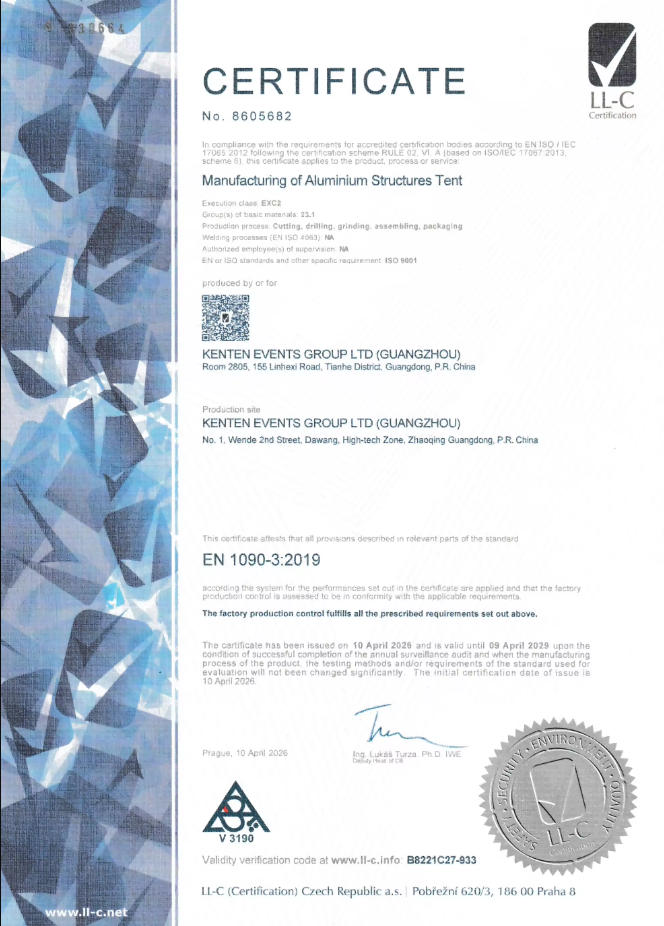
Certifications should be checked for three things: standard, certificate number, and issuing body. KENTEN's Structure Tent is CE certified under EN 1090-3:2019 and ISO 9001, with certificate number 8605682 issued by LL-C Certification Czech Republic a.s. This certification applies to the European Union market.
In addition, KENTEN holds ISO 9001:2015, ISO 14001:2015, and ISO 45001:2018, issued by Shenzhen Zhongbiao International Testing and Certification Co., Ltd., with certificate numbers 51816Q00846R3, 51815E00262R3, and 51815O00263R3. KENTEN also states that its structures are produced and fully certified to IBC 2024, CBC 2025, ASCE 7-22, GB 50429, and EN 13782.
3. Wind and Snow Load Resistance
Flame retardancy is part of a larger safety specification. KENTEN's Structure Tent series can be configured for wind resistance up to 140 km/h and snow load up to 0.5 kN/m². The Warehouse Tent W1 is rated for wind load up to 120 km/h and snow load up to 75 kg/m². These figures matter because a structure tent that passes fire tests but fails under wind or snow is not a safe building.
4. Sidewalls and Enclosures
Fire performance is not limited to the roof. Buyers should ask which sidewall options are available and whether they suit the application. KENTEN's Structure Tent offers PVC, Glass Wall, ABS Wall, and Sandwich Panel sidewalls. The Warehouse Tent W1 offers PVC, corrugated steel, or sandwich panel sidewalls. Foundation options for site-specific installation include concrete anchors or ground stakes.
5. Production and Quality Controls
A manufacturer's production environment is part of the compliance story. KENTEN's manufacturing base covers 80,000 m² and employs approximately 200 people, with an annual output of 1,000,000 m². Its team includes 10 engineers. KENTEN reports that quality control includes raw material incoming inspection and 100% full inspection before shipment.

6. Customization, Lead Time, and Support
Most industrial projects require some level of customization. KENTEN supports OEM/ODM production, covering structure dimensions, roof and fabric options, sidewall options, flooring systems, interior accessories, and branding. MOQ is one unit, lead time is 30–45 days, and after-sales support includes 24/7 remote technical support, spare parts supply, and on-site installation guidance.
Step-by-Step Manufacturer Assessment
- Confirm the flame-retardant standard. Ask the manufacturer to name the standard. NFPA 701 is common in North America; DIN 4102 B1 and M2 are specified in some European projects.
- Check the structural code. For EU projects, confirm compliance with EN 13782 for temporary structures and EN 1090-3 for aluminum structural components.
- Verify the frame and load values. Obtain the aluminum alloy grade, span range, wind load, and snow load in writing. KENTEN's Structure Tent supports up to 140 km/h wind and 0.5 kN/m² snow load; the W1 warehouse tent supports 120 km/h and 75 kg/m².
- Review sidewall and enclosure options. Ask whether sidewalls are PVC, ABS, glass wall, corrugated steel, or sandwich panel, depending on project needs.
- Audit manufacturing quality. Look for raw material inspection, full pre-shipment inspection, and relevant ISO management system certificates.
- Confirm lead time and after-sales support. Ask about MOQ, production lead time, installation guidance, spare parts, and technical support.
Common Use Cases for Flame-Retardant Structure Tents
Warehouse and logistics. The Warehouse Tent W1 is designed for manufacturing and logistics industries. It is used for temporary warehouses, distribution centers, and storage shelters. The typical requirements include fire retardancy, waterproofing, wind resistance, structural load capacity, and quick installation. Roller doors, ventilation fans, insulated panels, loading docks, and LED lighting can be integrated.
Sports facilities. Structure tents are used for tennis courts, basketball halls, and swimming pool covers. These installations need all-weather protection, fire retardancy, wind and water resistance, and enough open space for training or competition.
Exhibitions and trade shows. Large-span structure tents can provide a column-free exhibition environment. KENTEN has supplied pyramid structure exhibition halls for cultural events, including a project for the Doha Photography Festival, and large-span modular buildings in Kuwait where the interior was 100% column-free.
Aviation and vehicle facilities. Structure tents can serve as aircraft hangars, MRO facilities, vehicle workshops, and showrooms. Equipment such as large hangar doors, lighting, ventilation, crane support, and insulation can be added to the structure.
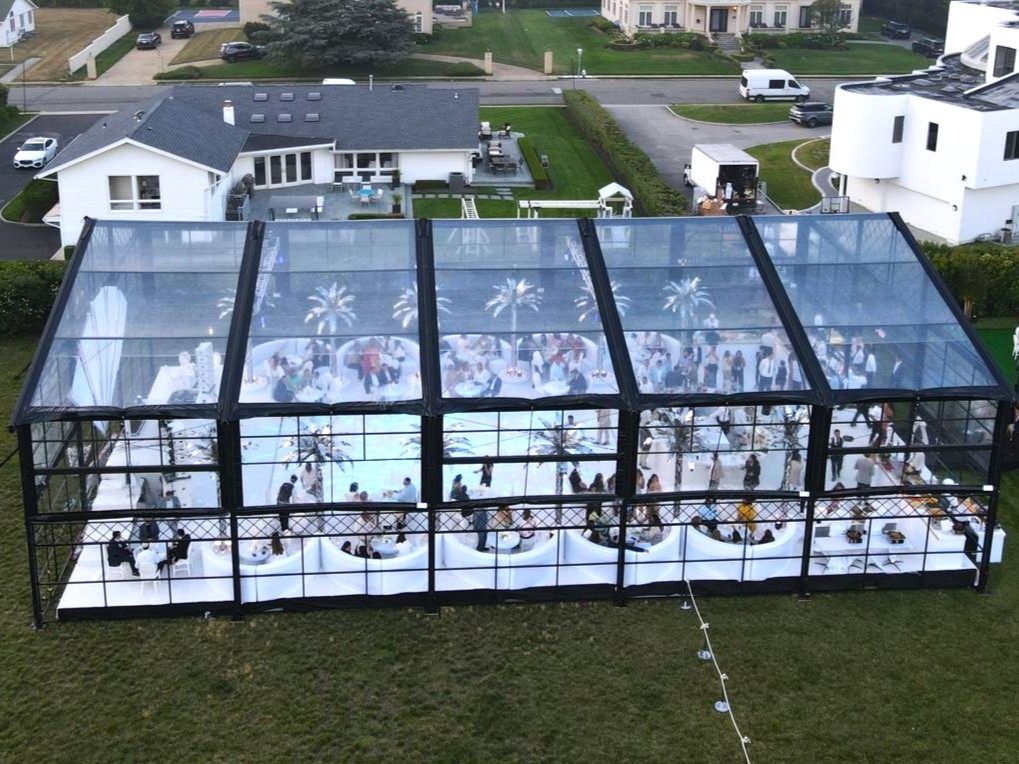
Wedding and hospitality venues. Aluminum frame atrium tents are used for luxury weddings, banquets, and VIP receptions. KENTEN delivered a 15m x 25m Atrium Tent for a private luxury residence on the East Coast of the USA, providing a fully enclosed, climate-controlled venue for wedding receptions.
Comparison: KENTEN Structure Tent vs. Warehouse Tent
| Parameter | Structure Tent (K1–K10) | Warehouse Tent (W1) |
|---|---|---|
| Span width | 3–80m | 3–60m |
| Length | Unlimited, extendable in 5m bay spacing | Customizable, typically 10m–100m+ |
| Eave / peak height | Eave 2.5–8m | Peak ~9m at 30m span |
| Main frame | 6061-T6/6082-T6 aluminum alloy | 6061-T6/6082-T6 aluminum alloy |
| Roof fabric | 850g/m² PVC-coated polyester | 850g/m² PVC, UV-treated, fire-retardant |
| Wind resistance | Up to 140 km/h | Up to 120 km/h |
| Snow load | Up to 0.5 kN/m² | Up to 75 kg/m² |
| Flame retardant | DIN 4102 B1, M2, NFPA 701 | Fire-retardant roof cover |
| Sidewall options | PVC, Glass Wall, ABS Wall, Sandwich Panel | PVC, corrugated steel, or sandwich panel |
| Certification | CE EN 1090-3:2019; ISO 9001/14001/45001 | ISO 9001/14001/45001 |
| Typical use | Events, sports, industrial storage, government/public projects | Manufacturing, logistics, factory storage |
FAQ
How do I evaluate flame-retardant structure tent manufacturers?
Ask for the specific flame-retardant standard, the certificate number, and the product scope. In North America, NFPA 701 is commonly required for tent fabrics. In the EU, temporary structures over 50 m² must satisfy EN 13782:2015. KENTEN's Structure Tent fabric is specified to DIN 4102 B1, M2, and NFPA 701, and the structure is CE certified under EN 1090-3:2019.
What certifications should a flame-retardant structure tent have?
For EU export, a relevant CE certificate under EN 1090-3:2019 is important. For management system controls, look for ISO 9001:2015, ISO 14001:2015, and ISO 45001:2018. KENTEN's Structure Tent holds CE certificate 8605682 and ISO certificates 51816Q00846R3, 51815E00262R3, and 51815O00263R3.
Can a flame-retardant structure tent be used for a warehouse?
Yes. KENTEN's Warehouse Tent model W1 is designed for manufacturing and logistics industries. It has wind load capacity up to 120 km/h, snow load up to 75 kg/m², and a fire-retardant 850g/m² PVC roof cover. Sidewall options include PVC, corrugated steel, or sandwich panel.
Can I order a customized flame-retardant structure tent?
KENTEN supports OEM/ODM customization covering structure dimensions, roof and fabric options, sidewall options, flooring systems, interior accessories, and branding. MOQ is one unit, and typical lead time is 30–45 days. For a project-specific specification review, contact KENTEN Structures for a quote.
Conclusion
Choosing a flame-retardant structure tent manufacturer should not be based on a brochure claim. Buyers can reduce risk by checking the fabric flame-retardant standard, the structural certification, the frame and load values, sidewall options, and the manufacturer's production controls. KENTEN Structures documents these details across its Structure Tent K1–K10 series and Warehouse Tent W1. Use the checklist above to compare suppliers, and request a written specification before placing an order.

Need a certified structure tent supplier for your next project? Contact KENTEN Structures for a specification review, sample request, or quote. Email kenten@kentenstructures.com or call/WhatsApp +86 173 2224 3105. Visit kentenstructures.com or download the KENTEN catalog (PDF).