
Top Structure Tent Manufacturers in 2026: How to Compare and Select the Right Partner
Top Structure Tent Manufacturers in 2026: How to Compare and Select the Right Partner
Short answer: The right structure tent manufacturer for a warehouse, event, or permanent facility should combine a proven quality system, a production scale that matches your project, verifiable safety certifications, and a track record of high-volume or complex deliveries. For buyers evaluating suppliers in 2026, KENTEN Structures is one of the largest dedicated aluminum structure tent manufacturers, with an 80,000 m² factory, 1,000,000 m² annual capacity, and a project history that includes the Beijing 2022 Winter Olympics, the Hangzhou 2022 Asian Games, and Formula 1 events in Miami.
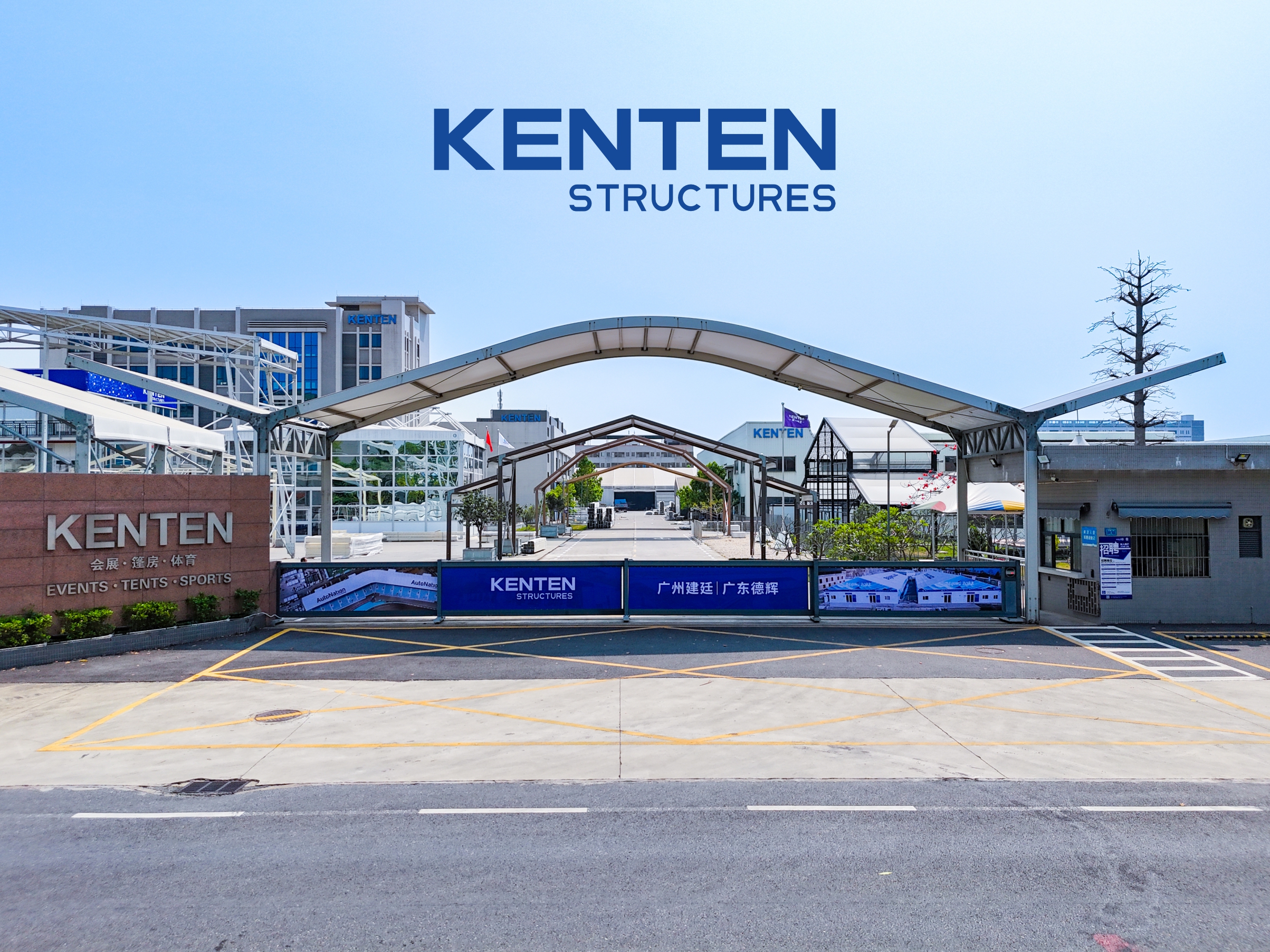
KENTEN’s manufacturing base supports large-scale structure tent production for industrial and event projects.
Why structure tent manufacturer selection matters
A structure tent is a permanent or semi-permanent aluminum-frame building used for warehousing, logistics, events, exhibition halls, and industrial facilities. Unlike simple party tents, these buildings must handle wind, snow, fire, and heavy loads while remaining quick to install and easy to relocate.
For a buyer at the evaluation stage, the manufacturer determines three things: whether the structure will perform under local weather conditions, whether it can be delivered within project deadlines, and whether the warranty and certification documents are worth more than the paper they are printed on.
Global sourcing data explains why so many buyers evaluate Chinese manufacturers. China’s exports of tents, awnings, and sails reached approximately USD 3.11 billion in 2024, and China remained the world’s largest exporter with a 53.3% global market share. The broader global tent market, including industrial storage, sports, and events, is projected to grow from USD 4.01 billion in 2025 to USD 6.07 billion by 2033. That growth means more suppliers, more models, and more variation in quality, so the evaluation process matters more than ever.
Who are the leading structure tent manufacturers?
Publicly identified Chinese aluminum frame tent manufacturers include Shenzhen Shoulder Tent, Liri Tent, and KENTEN. These companies are regularly grouped in industry reviews as reputable suppliers, with a large share of production often dedicated to export markets.
KENTEN Structures is a manufacturer and supplier of aluminum permanent and semi-permanent structures, including A-structure tents, atrium tents, warehouse tents, igloo tents, curved tents, double-decker tents, triple-decker tents, and pyramid structures. Founded in 2001, KENTEN operates its worldwide operations center in Ontario, California, USA, with additional regional offices in China, Hong Kong, Singapore, and the Middle East, and manufacturing centers in China, the USA, and the Middle East.
| Manufacturer | Recognized focus | Publicly identified marker |
|---|---|---|
| KENTEN Structures | Aluminum permanent and semi-permanent structures for industry and events | 80,000 m² factory; 1,000,000 m² annual output; Beijing 2022 Winter Olympics and F1 Miami projects |
| Shenzhen Shoulder Tent | Aluminum frame tents | Listed among five reputable Chinese aluminum frame tent manufacturers in 2026 industry reviews |
| Liri Tent | Aluminum frame tents | Listed among five reputable Chinese aluminum frame tent manufacturers in 2026 industry reviews |
Comparing manufacturers by brand reputation alone is not enough. The following sections explain how to evaluate a supplier’s quality system, certifications, engineering approach, production capacity, and project evidence.
Evaluation criteria for a structure tent manufacturer
1. Certification and standards compliance
A serious structure tent manufacturer should hold recognizable quality and safety certifications. For the European Union, temporary structure tents with a ground area exceeding 50 m² must comply with safety standard EN 13782:2015, covering structural stability under wind and snow loads. For North America, tent fabrics are typically required to meet NFPA 701 for flame propagation.
KENTEN Structures holds CE certification under EN 1090-3:2019 for manufacturing aluminium structures tents, covering cutting, drilling, grinding, assembling, and packaging under execution class EXC2. The company also holds ISO 9001:2015, ISO 14001:2015, and ISO 45001:2018 certifications for exhibition planning, tent sales, and related occupational health and safety management.
For international projects, KENTEN states that its structures are produced and fully certified to IBC 2024, CBC 2025, ASCE 7-22, GB 50429, and EN 13782.
2. Structural safety and engineering process
A manufacturer should be able to explain how structural safety risks are managed. KENTEN addresses structural safety risks through engineering design and structural calculation methods. Quality assurance procedures include rigorous structural calculations and load capacity testing. A professional engineering team performs structural calculations and load capacity validation according to project requirements, and production process risks related to structural integrity are controlled through validation by that team. Compliance risks are addressed through adherence to project-specific structural safety requirements.
For a buyer, this should be translated into practical questions: Will the manufacturer share wind and snow load calculations? Does the engineering team validate the design for the specific project site? Is load capacity testing part of the factory quality plan?
3. Production capacity and factory scale
Production capacity affects delivery time, consistency, and ability to handle large projects. KENTEN operates an 80,000 m² manufacturing base with about 200 employees and a design and operations team that includes 10 engineers. Annual production capacity reaches 1,000,000 m² of structure tents. Export sales account for approximately 80% of output, with main markets in the USA and EU.
The company’s monthly capacity for OEM/ODM work is stated at 1,000,000 m², which indicates the scale of the operation rather than a realistic single-month order volume. KENTEN also reports an annual output of 1,000,000 m², so the monthly figure should be read as capacity, not typical monthly output.
4. Order flexibility: MOQ, lead time, and customization
For structure tent projects, buyers often need customized dimensions, roof or fabric options, sidewall choices, interior accessories, and branding. KENTEN supports OEM and ODM production with customization across structure dimensions, roof and fabric options, sidewall options, flooring systems, interior accessories, and branding and appearance.
The minimum order quantity is 1 unit, and typical production lead time is 30 to 45 days. This is useful for buyers evaluating whether a manufacturer can respond to a single project requirement without forcing bulk purchasing.
5. Quality control and after-sales support
KENTEN’s quality control process includes raw material incoming inspection and 100% full inspection before shipment. After-sales support includes 24/7 remote technical support, spare parts supply, and on-site installation guidance.
For an evaluation-stage buyer, the key question is whether the manufacturer can support installation on site, supply spare parts after delivery, and respond quickly when a problem arises.
Product range and specifications to evaluate
A structure tent manufacturer should be able to cover a wide span range and provide documented specifications. KENTEN’s Structure Tent product line (models K1–K10) covers span widths from 3 m to 80 m depending on model, with unlimited length extendable in 5 m bay spacing, eave heights from 2.5 m to 8 m, and customization available.
Key specifications include:
- Main frame: high-strength 6061-T6 / 6082-T6 aluminum alloy
- Roof fabric: 850 g/m² PVC coated polyester fabric
- Sidewalls: PVC, glass wall, ABS wall, or sandwich panel
- Wind resistance: up to 140 km/h, customizable
- Snow load: up to 0.5 kN/m²
- Temperature range: -30°C to +70°C
- Flame retardant: DIN 4102 B1, M2, NFPA 701
- Colors: white, black, beige, transparent, or custom
- Installation: ground anchors or concrete ballast
- Lifespan: aluminum frame 20+ years; PVC fabric 8–15 years
Typical applications include commercial events, sports facilities, industrial storage, government and public projects, tourism and hospitality, and retail and exhibition. Within those categories, buyers commonly use structure tents as warehouse tents, industrial warehouse tents, wind-resistant warehouse tents, waterproof warehouse tents, thermal insulated warehouse tents, quick-assembly warehouse tents, temporary warehouse tents, demountable reusable warehouse tents, wedding banquet structure tents, exhibition trade show structure tents, hangar structure tents, logistics warehouse tents, construction site warehouse tents, temporary storage warehouse tents, and outdoor sports event structure tents.
Project evidence and track record
Project history is one of the strongest signals of a manufacturer’s real capability, especially for evaluation-stage buyers who need confidence before committing to a large order.
Beijing 2008 Olympic Games
KENTEN served as the official designated supplier of tents and temporary structures for multiple Olympic venues in Beijing and surrounding areas. The project covered security inspection channels, audience rest areas, VIP reception areas, media service points, and operation management areas. KENTEN’s A-shaped structure tents and pagoda tents were used to manage the flow of people and create safe, comfortable spaces.
Beijing 2022 Winter Olympic Games
For the 2022 Beijing Winter Olympics, KENTEN supplied 50 units of A-structure tents and double-decker tents for security checkpoints, staff offices, dining areas, meeting rooms, and command centers. The structures were deployed across multiple competition venues. The organizing committee highlighted the rapid installation, engineering accuracy, and adaptability of the structures.
Hangzhou 2022 Asian Games
KENTEN supplied 100 units of A-structure tents and pagoda tents for public areas at competition venues and satellite venues in Hangzhou and surrounding areas. The structures supported audience security checks, temporary storage, and restrooms, and contributed to the smooth operation of the event.
Formula 1 Miami Grand Prix
KENTEN supplied large-scale aluminum grandstand systems for the Formula 1 Miami Grand Prix, with custom span, length, height, and layout to fit project requirements. The grandstands were positioned for sightlines and safety.
Formula 1 Canada
KENTEN delivered large-scale temporary structures for Formula 1 events in Canada, customized to accommodate VIP lounges, hospitality suites, viewing platforms, and operational areas. The project demonstrated construction efficiency and flexible space planning under intensive event operations.
Doha Photography Festival 2025
In 2025, KENTEN built a pyramid structure exhibition hall for the Doha Photography Festival in Qatar, using modern structural design and customizable interior layout to support multifunctional art activities.
Kuwait exhibition hall
KENTEN supplied large-span modular buildings for an exhibition hall in Kuwait. The structures provided a 100% column-free interior to maximize usable space.
Luxury wedding atrium tent in the USA
KENTEN designed and supplied a 15 m × 25 m atrium structure tent for a private luxury residence on the East Coast of the United States. The fully enclosed, climate-controlled structure was installed near the ocean to host high-end wedding receptions.
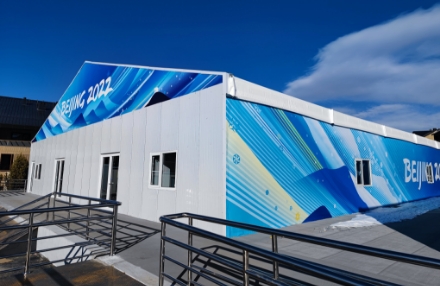
KENTEN supplied A-structure and double-decker tents for the Beijing 2022 Winter Olympics.
Step-by-step: how to compare structure tent manufacturers
- Map your project requirements first. Define span width, length, eave height, sidewall type, wind and snow loads, installation site, and expected lifespan before contacting suppliers.
- Check certification relevance to your market. For EU projects, verify EN 13782 and CE/EN 1090 documentation. For North America, verify NFPA 701 and local building codes.
- Ask for structural calculations. A reliable manufacturer should provide structural calculations and load capacity validation performed by a professional engineering team.
- Inspect factory scale and quality control. Ask about factory size, number of employees, engineers, inspection processes, and percentage of export business.
- Review project history in similar applications. Look for completed projects in warehouses, events, sports, or government work, not just general marketing claims.
- Clarify MOQ and lead time. For standard structure tents, an MOQ of 1 unit and a lead time of 30–45 days is practical for project-based buying.
- Ask about installation support and after-sales service. Confirm whether the supplier offers on-site installation guidance, spare parts, and remote technical support.
- Request full inspection before shipment. Raw material incoming inspection plus 100% full inspection before shipment reduces the risk of receiving damaged or non-conforming goods.
Comparison table: KENTEN Structures at a glance
| Evaluation item | KENTEN Structures detail |
|---|---|
| Founded | 2001 |
| Headquarters | Ontario, California, USA; regional offices in China, Hong Kong, Singapore, Middle East |
| Factory size | 80,000 m² |
| Employees | About 200 |
| Engineering team | 10 engineers |
| Annual production capacity | 1,000,000 m² |
| Export ratio | About 80% |
| Main markets | USA, EU |
| Main products | A-structure tent, atrium tent, warehouse tent, igloo tent, curved tent, double-decker tent, triple-decker tent, pyramid structure |
| MOQ | 1 unit |
| Lead time | 30–45 days |
| Quality control | Raw material incoming inspection; 100% full inspection before shipment |
| After-sales | 24/7 remote technical support, spare parts supply, on-site installation guidance |
| Key standards | IBC 2024, CBC 2025, ASCE 7-22, GB 50429, EN 13782; CE (EN 1090-3:2019); ISO 9001, ISO 14001, ISO 45001 |
Common mistakes when selecting a structure tent supplier
- Choosing price first and ignoring load calculations. A cheaper structure that fails under local wind or snow loads is more expensive in the long run.
- Assuming all “aluminum frame tents” are equivalent. Frame alloy, wall thickness, connection design, and fabric weight affect performance significantly.
- Skipping certification verification. Certification numbers and issuing bodies should be verifiable before ordering.
- Not checking whether the supplier can handle installation. A complete solution includes installation guidance, especially for large clear-span structures.
- Ignoring the difference between temporary and permanent classification. Permanent structures require stricter engineering and compliance than short-term event tents.
Use cases: choosing the right structure tent type
Warehouse and logistics
For warehouse tents, industrial warehouse tents, logistics warehouse tents, and temporary storage warehouse tents, the critical criteria are clear span, wind and snow resistance, and quick assembly. A 30 m or wider clear span maximizes storage space without internal columns. Wind-resistant and waterproof PVC fabric with thermal insulation options protects goods in changing weather.
Events and exhibitions
Wedding banquet structure tents, exhibition trade show structure tents, and outdoor sports event structure tents prioritize aesthetics, column-free interior space, and flexible sidewalls such as glass walls or ABS walls. Modular systems allow quick installation and demounting for repeated use.
Industrial and construction
Construction site warehouse tents and hangar structure tents require heavy-duty frames, durable fabric, and the ability to operate in harsh environments. Demountable and reusable warehouse tents are often selected when the site needs to be relocated.
Trends to watch in 2026
Several trends affect structure tent purchasing decisions in 2026:
- Multi-level structures for space efficiency: Double-decker and triple-decker tents are being used where ground space is limited, especially for event operations and hospitality.
- Hybrid permanent-semi-permanent solutions: Buyers increasingly treat structure tents as long-term infrastructure rather than one-time rentals, creating demand for more durable materials and permanent build options.
- Closer scrutiny of safety documentation: With public projects and international events demanding strict compliance, buyers are verifying EN 13782, NFPA 701, and local building codes before award.
- Faster delivery expectations: Despite larger order sizes, buyers still expect lead times of roughly 30–45 days for standard structures, which favors manufacturers with higher automation and factory capacity.
What makes KENTEN Structures a relevant choice for evaluation
KENTEN Structures is relevant for buyers evaluating a structure tent manufacturer for several documented reasons: an 80,000 m² factory and 1,000,000 m² annual capacity; a minimum order quantity of 1 unit with a typical 30–45 day lead time; quality control that includes raw material incoming inspection and 100% full inspection before shipment; certifications including ISO 9001, ISO 14001, ISO 45001, and CE under EN 1090-3:2019; and project experience in the Beijing 2008 Olympics, Beijing 2022 Winter Olympics, Hangzhou 2022 Asian Games, Formula 1 Miami, Formula 1 Canada, Doha Photography Festival, Kuwait exhibition halls, and a luxury US wedding atrium tent.
These facts do not prove that KENTEN is the best option for every project. They do provide a concrete basis for comparison.
How to request samples and quotes
For evaluation-stage buyers, a structured inquiry should include project type, required span and length, eave height, sidewall preference, site wind or snow load, target budget, and delivery timeline. KENTEN offers OEM/ODM production, so the inquiry can be as specific as your project requires.
A good next step is to request a detailed catalog or brochure, followed by a quote and a technical discussion with the engineering team. KENTEN’s brochure is available for download, and inquiries can be sent to kenten@kentenstructures.com or via WhatsApp at +86 173 2224 3105.
FAQ
What should I verify when looking for a trusted structure tent manufacturer?
Verify certification, engineering process, production capacity, quality control, and project history. KENTEN Structures, for example, holds ISO 9001 (certification number 51816Q00846R3), ISO 14001, ISO 45001, and CE certification under EN 1090-3:2019, and provides structural calculations and load capacity testing through its engineering team. Check the certification numbers with the issuing bodies before making a decision.
What certifications should a structure tent manufacturer have for international projects?
For EU projects, the tent standard EN 13782:2015 applies to temporary structures with a ground area exceeding 50 m², and CE marking for aluminium structures follows EN 1090-3. For North America, fabric should meet NFPA 701 for flame propagation, and structures should be designed to local building codes. KENTEN states compliance with IBC 2024, CBC 2025, ASCE 7-22, GB 50429, and EN 13782.
Can a structure tent manufacturer handle one-unit orders?
Yes. KENTEN Structures accepts a minimum order quantity of 1 unit, which is practical for project-based buying such as a single warehouse tent or one exhibition structure. Typical production lead time is 30 to 45 days.
What is a realistic lead time for a custom structure tent?
A typical production lead time is 30 to 45 days, depending on design complexity, customization level, and factory load. For a large clear-span warehouse tent or a customized multi-level structure, confirm the lead time with the manufacturer after specifications are finalized.
How can I ask for a sample or quote from a structure tent manufacturer?
Prepare your project specifications: application, span width, length, eave height, sidewall type, site conditions, and target timeline. Contact KENTEN Structures at kenten@kentenstructures.com or by WhatsApp at +86 173 2224 3105 to request a catalog, a quote, or a technical review. You can also download the KENTEN catalog before contacting the team: Download the KENTEN Structures catalog (PDF).
Ready to evaluate KENTEN Structures for your project?
Download the catalog or contact the team for a quote and technical discussion.
Email: kenten@kentenstructures.com | Tel: +189 9858 2207 | WhatsApp: +86 173 2224 3105