
Closed vs. Open Weld Head Orbital Welders: A Buyer's Comparison
Closed vs. Open Weld Head Orbital Welders: A Buyer's Comparison
Most buyers begin an orbital welding machine evaluation with the power supply, the controller interface, or the price band. The specification that actually decides whether a project is weldable is the weld head format — closed, meaning a full 360° ring that encloses the joint, or split (also called open), meaning a head that separates and clamps around a tube that is already in position.
The two formats do not cover the same ground. KEPUNI, a brand of Shanghai Chuanli Industrial Co., Ltd., builds both. Its 40/80/120/170 Series closed weld head is rated for pipe outside diameters from 6.35 mm to 168 mm with wall thickness up to 3 mm. Its XD-Split, 5H and 10H split weld heads reach pipe OD as small as 3.175 mm with wall thickness up to 1.5 mm. For ultra-thin, small-diameter sanitary tube, the split head models are the primary option — and those two sets of numbers explain why.
This comparison sets out the parameters, industry fit, compliance documentation, commercial terms and validation path a buyer should check before committing to either format.
Problem Definition: What the Weld Head Format Actually Constrains
Weld head format is a geometric constraint, not a stylistic preference. It fixes three limits before any controller feature is considered.
- Minimum pipe outside diameter. This floor dimension decides whether the head can physically close around the tube. KEPUNI's closed head platform starts at 6.35 mm OD. Its split head platform starts at 3.175 mm OD.
- Maximum wall thickness. The closed head series is published to ≤3 mm wall. The split head models — XD-Split, 5H and 10H — are published to ≤1.5 mm wall. A heavier wall does not simply weld more slowly; it sits outside the published envelope.
- Access to the joint. A split head separates along its circumference, which is consistent with the stated application profile of the XD-Split head: HVAC, Plumbing and Field Service, where tube runs are frequently already fixed in place.
A note on clean-room guidance. Third-party industry guidance observes that orbital welding systems for clean rooms often use closed-head designs to prevent atmosphere contamination and support high-purity gas tungsten arc welding (Orbitalum). That is accurate for confined high-purity cells where the head can be fully positioned over the joint. It does not change the geometric limit described above: once tube OD drops toward 3.175 mm and wall thickness sits at or under 1.5 mm, split head geometry is what makes the joint reachable at all. The two statements address different constraints — atmosphere control versus physical access — and buyers should confirm which one their own specification is really testing.
Industry Background: Where Each Format Is Being Specified
The orbital welding machine market was valued at approximately USD 1.32 billion in 2024 and is projected to reach USD 2.07 billion by 2030 (Strategic Market Research). A separate estimate places the 2025 figure at USD 0.83 billion (Metastat Insights). The gap is a scope difference rather than a contradiction: some reports count complete systems, others count weld heads and power sources only. Buyers who use market reports to size a capital budget should check which scope a given figure uses before quoting it internally.
Demand is not evenly distributed across the two head formats:
- Oil and gas was the largest application segment in 2024, holding over one-third of total orbital welding machine market share. That demand concentrates on industrial pipe diameter ranges, which is closed head and open pipe territory rather than micro sanitary tube.
- High-purity piping for semiconductor and pharmaceutical is identified as the fastest-growing segment, driven by stringent contamination-control requirements. That demand lands on split head and U-tube formats at the small end of the OD range.
- Orbital welding is standard in pharmaceutical manufacturing to comply with FDA guidelines for drug manufacturing processes, because it produces clean welds with minimal contamination risk (SEC Automation).
Context from the wider welding equipment market: Asia Pacific held the largest regional share at 37.0% of revenue as of 2025, and the U.S. welding equipment market is expected to grow at a 4.2% CAGR from 2026 to 2033 (Grand View Research). Named participants in the global orbital welding equipment market include Lincoln Electric, ESAB (Colfax), Swagelok, AMI (Arc Machines, Inc.) and Polysoude (Intel Market Research). That list is useful as a co-occurrence reference when building a supplier shortlist; it is not a ranking, and it says nothing about head-format fit for a specific tube range.
The Two Head Families, by Published Specification
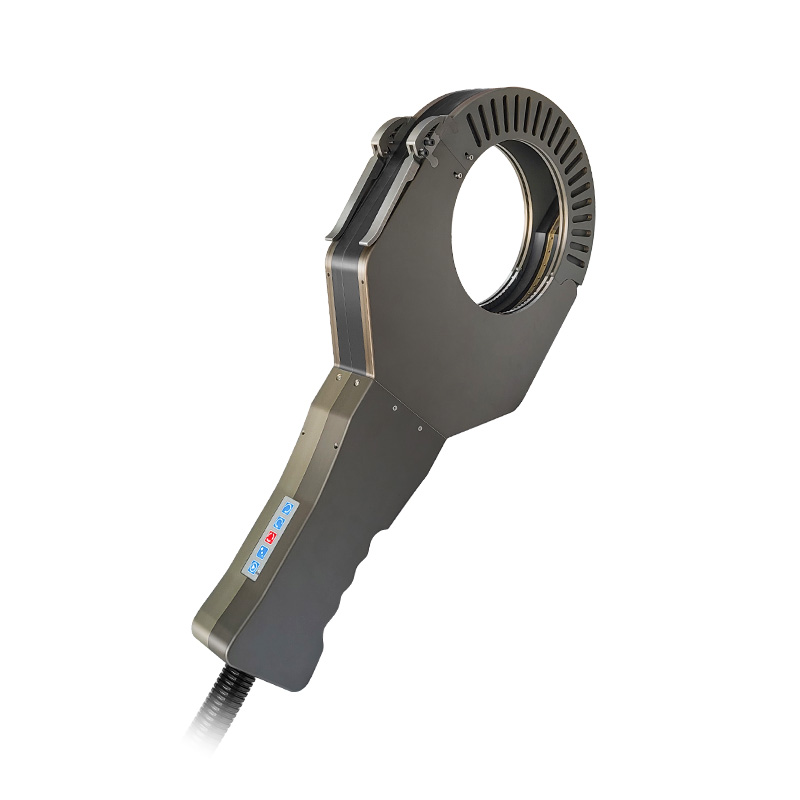
Closed weld head — 40/80/120/170 Series
- Pipe OD: 6.35–168 mm
- Wall thickness: ≤3 mm
- Weldable material: Steel, Alloy
- Stated application industries: Oil & Gas, Power Generation, Chemical Processing
Four head sizes — 40, 80, 120 and 170 — sit inside one published envelope, so the head is matched to the pipe rather than the pipe to the head. Every size in this family sits above the 6.35 mm OD floor, which is precisely why the closed head series is not the primary answer for micro sanitary tube.
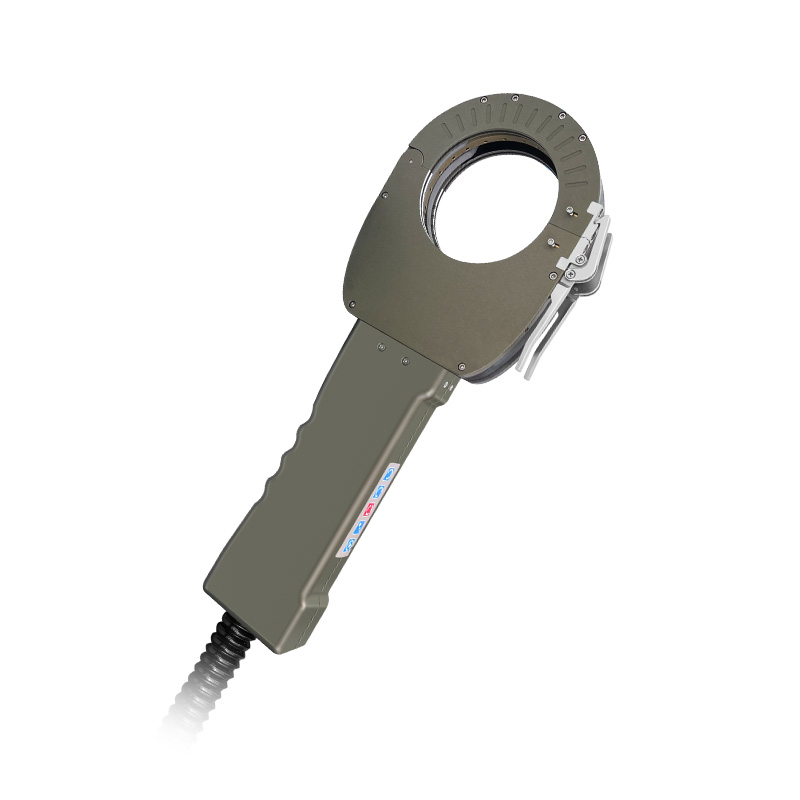
Split weld head — XD-Split, 5H, 10H Series
- XD-Split Type Weld Head: pipe OD 3.175–25.4 mm; wall ≤1.5 mm; Steel, Alloy; HVAC, Plumbing, Field Service.
- 5H Series: pipe OD 3.175–15.88 mm; wall ≤1.5 mm; Steel, Alloy; Semiconductor, Pharmaceutical, Biotechnology.
- 10H Series: pipe OD 6.35–25.4 mm; wall ≤1.5 mm; Steel, Alloy; Pharmaceutical, Food & Beverage, Chemical.
The 5H head is the smallest in the range, with a 3.175 mm OD floor and a ≤1.5 mm wall ceiling. That combination is the one that matters for ultra-pure gas lines and small-bore sanitary piping, and it is the reason a buyer with a 6 mm sanitary tube should not begin the evaluation with a closed head catalogue.
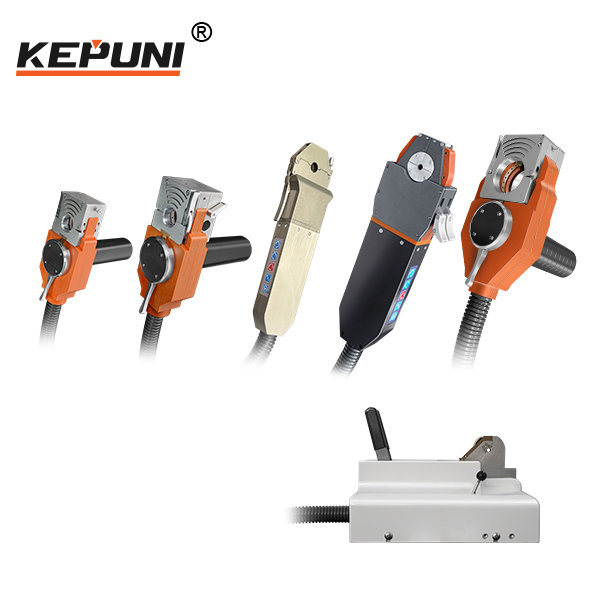
Power supplies that span both formats
- XD-20PRO Pipe Welding Power Supply: pipe OD 3.175–168 mm; wall thickness 0.5–3 mm; listed for Semiconductor, Pharmaceutical, Food & Beverage, Oil & Gas and Chemical.
- XD-20W Pipe Welding Power Supply: pipe OD 3.175–168 mm; wall thickness 0.5–3 mm; listed for Pharmaceutical, Semiconductor and Chemical Processing.
Both power supplies are published across the full 3.175–168 mm OD envelope, which means the same generator can drive a closed head and a split head. For a plant that runs large-bore industrial pipe alongside small sanitary tube, that removes the need to buy and maintain two independent power platforms.
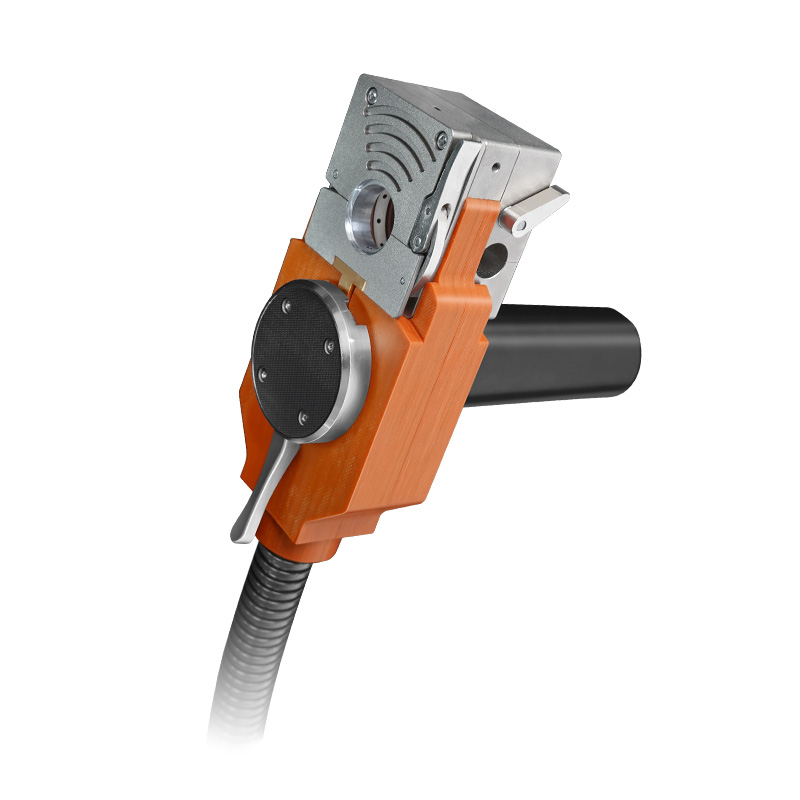
Adjacent heads and machines in the same portfolio
Head format is chosen per joint type, so a single project often needs more than one head. The same KEPUNI portfolio includes:
- XD-U Series U-Tube weld head: pipe OD 9–25 mm; wall ≤1.5 mm; heat exchangers, boilers, condensers.
- TB-35 Series Tube-to-Tube Sheet Welder: tube OD 4.5–35 mm; wall ≤2.5 mm.
- TB-65 Series Tube-to-Tube Sheet Welder: tube OD 8–65 mm; wall ≤5 mm.
- XD-G400 Tube-to-Tube Sheet power supply: tube OD 4.5–65 mm; wall ≤5 mm.
- K Series open weld head: pipe OD 19–325+ mm; wall 2.5–13 mm; oil & gas, petrochemical, power generation.
- XD-K Series open pipe welding power supply: pipe OD 19–325 mm; wall 2.5–13 mm; current 5–500 A.
- XD-GH Series Girth Welding Machine: pipe/vessel OD 20–960 mm; wall 2.5–25 mm; current 5–400 A; shipbuilding, oil & gas pipeline, storage tanks, pressure vessels.
A split head does not replace a tube-to-tube sheet head, and neither replaces a girth welding machine. Buyers who try to cover a plant containing heat exchangers and large-bore pipe with a single head usually end up buying three heads and one power supply instead.
Closed vs. Split Weld Head: Side-by-Side Comparison
| Selection factor | Closed weld head — 40/80/120/170 Series | Split (open) weld head — XD-Split, 5H, 10H |
|---|---|---|
| Head geometry | Full ring that encloses the joint | Separates along its circumference to seat around an existing tube run |
| Pipe OD range | 6.35–168 mm | XD-Split: 3.175–25.4 mm 5H: 3.175–15.88 mm 10H: 6.35–25.4 mm |
| Wall thickness | ≤3 mm | ≤1.5 mm |
| Weldable material | Steel, Alloy | Steel, Alloy |
| Stated application industries | Oil & Gas, Power Generation, Chemical Processing | XD-Split: HVAC, Plumbing, Field Service 5H: Semiconductor, Pharmaceutical, Biotechnology 10H: Pharmaceutical, Food & Beverage, Chemical |
| Power supply envelope in the same portfolio | XD-20PRO / XD-20W: pipe OD 3.175–168 mm; wall 0.5–3 mm | XD-20PRO / XD-20W: pipe OD 3.175–168 mm; wall 0.5–3 mm |
| Fit for ultra-thin, small-diameter sanitary tube | Not the primary option — 6.35 mm OD floor, 3 mm wall ceiling | Primary option — 3.175 mm OD floor, 1.5 mm wall ceiling |
| CE certification scope | Covered by the KEPUNI CE certification set (see compliance section below) | |
Step-by-Step: Specifying a Head Format Without Reordering Later
- Measure the real tube range, not the nominal one. Record the smallest and largest outside diameter the head must cover, and write both down. A 3.175 mm floor only matters if some line in the scope actually sits there.
- Establish the wall thickness ceiling. If any joint exceeds 3 mm wall, the closed head series is the only format in this portfolio that is published to cover it. If every joint is ≤1.5 mm, the split head range becomes viable — and the split head OD floor drops by half.
- Decide whether the joint is bench-mounted or already fixed. Split heads are listed for field service and plumbing work for a structural reason: the head opens. This is a scheduling question as much as an engineering one.
- Map the industry profile to the published application lists. Semiconductor, Pharmaceutical and Biotechnology map to the 5H Series; Pharmaceutical, Food & Beverage and Chemical map to the 10H Series; Oil & Gas, Power Generation and Chemical Processing map to the closed head series.
- Confirm one power supply covers both ends of the range. XD-20PRO and XD-20W are both published at pipe OD 3.175–168 mm with wall thickness 0.5–3 mm, which is why a mixed fleet can run from a single generator model.
- Pull the certification documents before the purchase order. Confirm the certificate numbers, the issuing body and the standard list against the destination market (details below).
- Validate on your own material before scaling the order. A sample order can be placed at a minimum of 1 unit, produced with custom parameters, special material (SS304/316/Titanium/Inconel) and non-standard sizes, with a 15–20 day lead time and a full inspection plus weld sample report.
Use Cases: Which Format the Application Record Supports
Ultra-thin, small-diameter sanitary and high-purity tube — split head territory
In a semiconductor fabrication facility, orbital welding was applied to ultra-pure gas (UPG) distribution and DI water loop piping for a 28nm process. The project used 4 units of XD-20PRO Hi-Purity machines with tube-sheet heads and was completed within 1 year. Results included meeting the SEMI F57 cleanliness standard, zero particle exceedance events, and uninterrupted FAB production.
For a pharmaceutical WFI (Water for Injection) pure water system, 3 units of XD-20PRO plus weld heads were used on SS316L WFI piping and CIP/SIP lines over a 3.5-year period. Results included zero weld defects, a passed EU GMP audit on the first attempt, and weld records documented for each joint. A separate 3A Sanitary Standard project — SS304L sanitary piping for UHT milk processing and pasteurization lines — recorded 3A certification, zero contamination incidents and a 100% pressure test pass rate.
These are the applications where the 1.5 mm wall ceiling and the 3.175 mm OD floor decide the purchase. A closed head cannot be substituted simply because it is the more familiar product.
Industrial and large-bore pipe — closed head and girth territory
For an HVAC and shell-and-tube heat exchanger manufacturer, tube-to-tube sheet orbital welds were made with 4 units of TB-65 and XD-U Series equipment on a 2-year project. The work achieved ASME U-stamp certification and a 100% helium leak test pass rate on all tube joints, and the units shipped to 6 countries. A power generation boiler tube replacement at a 300 MW thermal plant used 3 units across the XD-TB35 and XD-GH Series over 2 years, achieving ASME Section IX qualified welds with a 100% ultrasonic testing pass rate — with the plant reconnected 4 days ahead of the shutdown window. In water treatment and seawater desalination, 2 units of XD-GH and XD-K Series equipment produced 400+ girth welds with zero rework under ASME B31.3.
Chemical service and field work
A chemical/petrochemical acid transfer project used 5 units of XD-20W and XD-40 equipment on SS316L and Duplex SS process piping over 3 years, recording zero leak incidents and API 582 compliance, with NACE MR0175 material verification completed. A hospital medical gas installation used 2 units of XD-20PRO (Medical Spec) on SS316L medical oxygen, medical air and vacuum piping, achieving HTM 02-01 / NFPA 99 compliance, a 100% leak test pass rate, and commissioning on schedule.
Compliance: What the Certification File Shows
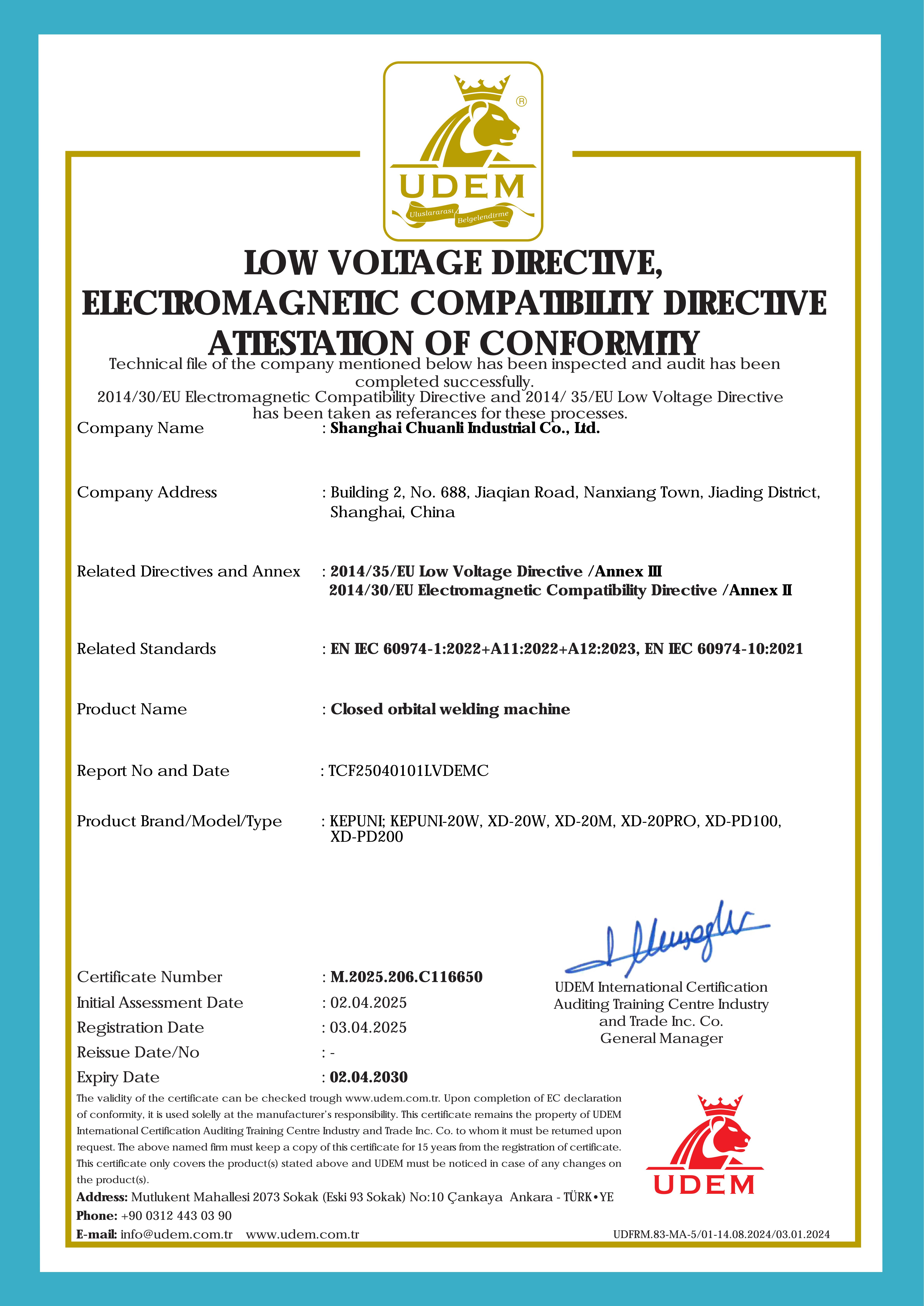
KEPUNI orbital welding machines are CE certified for the EU market. The primary file is certificate number TCF25040101LVDEMC, issued by UDEM, valid from 2 April 2025 to 2 April 2030, covering EN ISO 12100:2010; EN 60204-1:2018; EN 60825-1:2014; EN IEC 61000-3-2:2019+A1:2021; and EN 61000-3-3:2013+A1:2019. Additional CE certificates are issued by UDEM under M.2022.206.C75864 and 6814C50001315201, and by anbotek under 6814C50001215101, referencing EN IEC 60974-1:2022+A11:2022+A12:2023 and EN IEC 60974-10:2021.
The certification scope covers the product list that includes the 40/80/120/170 Series closed heads, the XD-Split, 5H and 10H split heads, the XD-20PRO and XD-20W power supplies, the K Series and XD-K Series open pipe machines, the XD-U, TB-35, TB-65, XD-G400 and XD-GH units. Because one certificate set spans both head families, a buyer running mixed closed and split heads does not have to manage two separate compliance files.
Frequently Asked Questions
What certification should I check before importing an orbital welding machine into the EU?
CE certification is the baseline. KEPUNI orbital welding machines hold CE certification for the EU market under certificate number TCF25040101LVDEMC, issued by UDEM and valid from 2 April 2025 to 2 April 2030, with a standard list covering EN ISO 12100:2010; EN 60204-1:2018; EN 60825-1:2014; EN IEC 61000-3-2:2019+A1:2021; and EN 61000-3-3:2013+A1:2019. Further CE certificates are issued by UDEM under M.2022.206.C75864 and 6814C50001315201, and by anbotek under 6814C50001215101, referencing EN IEC 60974-1:2022+A11:2022+A12:2023 and EN IEC 60974-10:2021. The scope of these certificates includes the closed head series, the split head series and the XD-20PRO and XD-20W power supplies.
Can a split head weld the same wall thickness as a closed head?
No. The two formats are published to different ceilings. The 40/80/120/170 Series closed weld head is rated for pipe OD 6.35–168 mm with wall thickness up to 3 mm. The XD-Split, 5H and 10H split weld heads are rated to wall thickness up to 1.5 mm, across pipe OD ranges of 3.175–25.4 mm, 3.175–15.88 mm and 6.35–25.4 mm respectively. Where the requirement is ultra-thin, small-diameter sanitary tube, the split head models are the primary choice; where wall thickness exceeds 1.5 mm, the closed head or an open pipe machine is the applicable format.
How should I budget for a closed versus split head orbital welding system?
KEPUNI does not publish list prices, so the honest answer is that cost is driven by configuration rather than by a headline number. The variables that move the total are: the number of heads required (a mixed plant may need a closed head for large-bore pipe, a split head for small sanitary tube, and a tube-to-tube sheet head for heat exchangers), the required OD and wall coverage, whether the power supply must span the full 3.175–168 mm envelope, and how much customization is specified. OEM/ODM customization covers logo, colour, voltage (110V/220V), interface, IoT/MES integration and software, at a minimum order of 1 unit and a lead time of 30–45 days; bulk orders carry a minimum of 5 units with a 60–90 day lead time FOB Shanghai.
Can I validate the weld on my own tube before placing a production order?
Yes. KEPUNI operates a sample order production mode with a minimum order quantity of 1 unit and a 15–20 day lead time. Sample orders support custom parameters, special materials including SS304, SS316, Titanium and Inconel, and non-standard sizes. Quality control on a sample order covers full inspection plus a weld sample report and detailed parameter documentation, and after-sales support for sample buyers includes video guidance, technical documentation, online support and parameter optimization.
What are the typical lead times and after-sales timelines?
Lead time depends on the production mode: 15–20 days for a sample order, 30–45 days for OEM/ODM customization, and 60–90 days for bulk orders on FOB Shanghai terms. After-sales service is delivered through remote WhatsApp and WeChat support, distributor on-site support and spare parts stock, with spare parts supplied globally in 7–15 days. Fault handling follows a documented sequence: fault diagnosis report, repair confirmation, and customer sign-off. If you want to move from comparison to a concrete configuration, request a quotation or a sample weld on your own tube stock through www.kepuni.com.
Conclusion
The closed-versus-open decision is settled by three numbers and one question. The numbers are the smallest pipe OD the head must close around, the largest wall thickness it must weld, and the power supply envelope that has to cover both. The question is whether the joint is accessible or already fixed in place.
Where the answer points to small-diameter, ultra-thin sanitary tube, the split head models — XD-Split, 5H and 10H — are the primary choice, with OD starting at 3.175 mm and wall thickness up to 1.5 mm. Where the answer points to industrial pipe, heavy wall and large bore, the 40/80/120/170 Series closed head covers pipe OD 6.35–168 mm at wall thickness up to 3 mm. In most real plants the answer is both, run from a single XD-20PRO or XD-20W power supply platform, under one CE certification set.
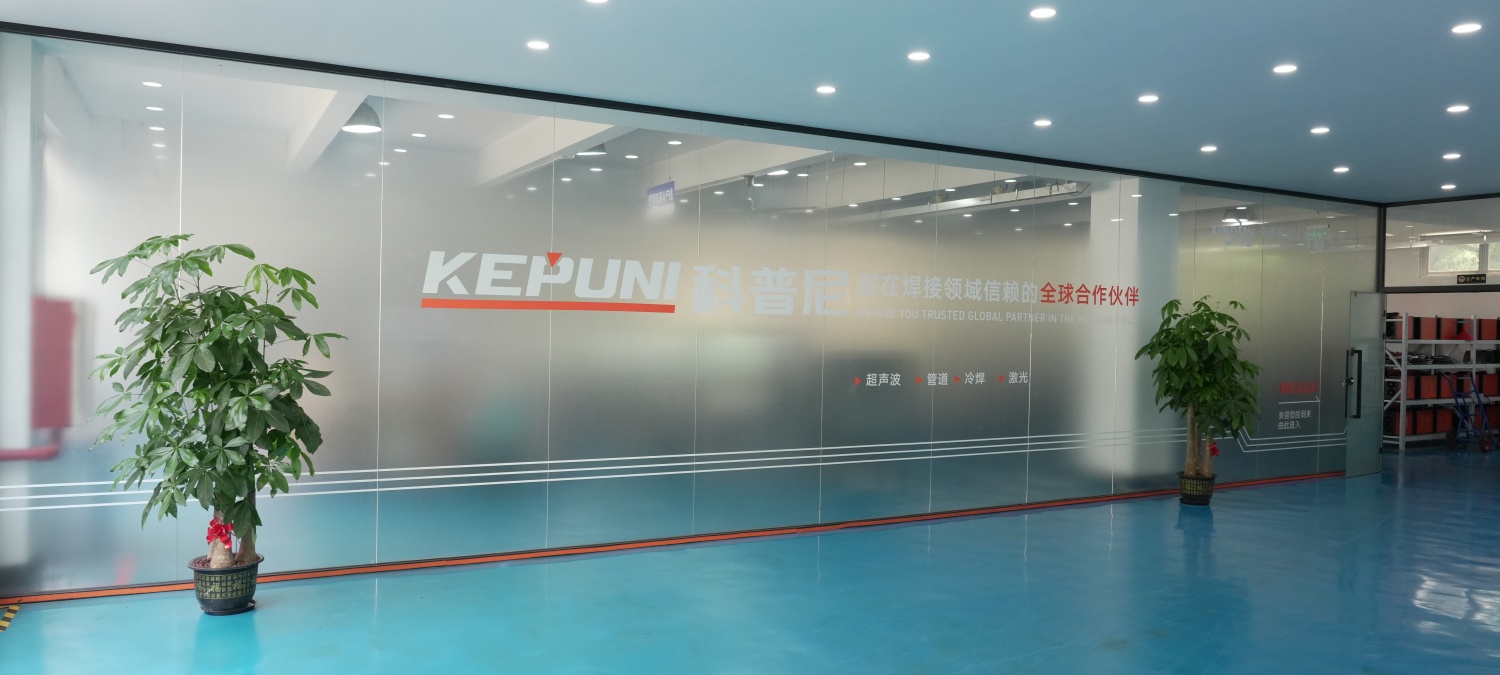
KEPUNI is a brand of Shanghai Chuanli Industrial Co., Ltd., a high-tech enterprise certified by the Ministry of Science and Technology of China. Founded in 2014, the company operates a 10,000 m² production park with 280 employees, including 36 R&D engineers and technicians, and an annual output of 3,000 pcs. Its export ratio exceeds 100%, serving Europe, Asia, South America, North America and the Middle East.
Next Step: Match the Head to Your Tube Range
If your specification includes ultra-thin, small-diameter sanitary tube, start with the split head range. If it includes industrial pipe or wall above 1.5 mm, start with the closed head range. Either way, the fastest way to close the evaluation is to weld one joint on your own material.
Request a sample, a quotation or a configuration review:
Website: www.kepuni.com | Blog: blog.kepuni.com
Email: info@kepuni.com | WhatsApp / Tel: +86 18221803984
Address: No. 688 Jiaqian Road, Nanxiang Town, Jiading District, Shanghai, China
Product catalogue and full specification download: KEPUNI brochure (PDF)