
Navigating ASME and Industry Standards for Orbital Welding Machines
Short answer: orbital welding machine compliance is decided by geometry before it is decided by documentation. The outside diameter (OD) of the pipe or tube and the wall thickness of the joint determine which weld head can physically close around the workpiece, and that same geometry determines which weld acceptance criteria a project can realistically meet. A specification that names the correct standard but pairs it with the wrong head family fails at weld qualification, not at the document review.
For KEPUNI orbital welding equipment, the relationship is stated explicitly. Pipe walls up to 3 mm are served by the closed 40/80/120/170 series weld heads, which cover outside diameters up to 168 mm. Walls up to 1.5 mm move to split-type heads such as the 10H and 5H series, which serve smaller OD ranges, 6.35 mm to 25.4 mm and 3.175 mm to 15.88 mm respectively. Above 3 mm wall thickness, open-head and girth configurations take over, extending stated wall coverage to 13 mm and 25 mm respectively.
KEPUNI is a brand of Shanghai Chuanli Industrial Co., Ltd., a Shanghai-based manufacturer of orbital welding machines, orbital weld heads, tube-to-tube-sheet welders, cold welders and orbital cutters, founded in 2014 and operating from a 10,000 m² production park with 280 employees, including 36 R&D engineers and technicians (source: KEPUNI company profile, www.kepuni.com).
This guide is written for buyers who are already past discovery and working through evaluation to execution: the stage where a shortlist exists and the real question is no longer what orbital welding is, but which configuration will pass the project acceptance criteria written into the purchase order.
Problem Definition: Why Standards Compliance Breaks Down at the Weld Head
Buyers typically approach compliance backwards. They begin with a standard reference and a budget, then search for a machine. But most weld acceptance criteria for hygienic and high-purity piping are expressed relative to wall thickness rather than as fixed absolute values. That means the wall thickness band of the actual joint defines what compliance means in practice.
ASME BPE-2024 sets the ID concavity criterion for pharmaceutical welds at a maximum of 10% of nominal wall thickness, not exceeding 0.38 mm (American Society of Mechanical Engineers, ASME BPE-2024). The clause contains two limits, and the tighter one governs. On a 1.5 mm wall, 10% equals 0.15 mm, so the wall-relative limit controls. On a 3 mm wall, 10% equals 0.30 mm, still below the 0.38 mm ceiling. Only at wall thickness above 3.8 mm does the 0.38 mm absolute ceiling become the controlling number. Thin-wall hygienic tube and thick-wall process pipe are therefore subject to different effective targets under the same clause, and it is the weld head geometry that determines which of those targets is reachable.
Three failure modes appear repeatedly in RFQ and specification reviews:
- Head-family mismatch. A closed head is specified for a joint whose wall thickness falls inside the 2.5 to 13 mm band that open-head configurations are listed for.
- Diameter ceiling exceeded. The selected head family tops out at 168 mm OD while the spool being fabricated reaches 325 mm, or the vessel reaches 960 mm.
- Machine conformity mistaken for weld qualification. A CE marking on the power supply is presented as though it satisfies a weld-level requirement such as ASME BPE-2024 or an industry cleanliness criterion. These are two different scopes of evidence, and buyers who conflate them discover the gap during first-article inspection.
Each of these problems is avoidable with the same piece of work: mapping the project wall thickness and OD envelope to a verified head-family range before price negotiation begins.
Industry Background: Where Standards Pressure Actually Reaches the Weld Head
The global orbital welding equipment market is projected to reach approximately USD 1.34 billion by 2033, based on a 2026 to 2033 forecast period (Grand View Research, Orbital Welding Equipment Market Size Report, September 2026). Within the orbital welding segment, open weld heads held the largest share in 2025 at 43.1%, while the semiconductor end-use segment was the single largest at 20.1% (same source, 2025 segmentation).
Two conclusions follow for anyone writing a specification. First, the largest volume of orbital welding activity sits in open-head, larger-diameter configurations, which is the pressure-rated segment. Second, the heaviest compliance burden per joint sits in the semiconductor and high-purity segment, where walls are thin and documentation expectations are greatest. A single machine platform rarely serves both ends of that spectrum without a change of head family, and this is why compliance guidance has to be written at the head level rather than the brand level.
Semiconductor and pharmaceutical: thin walls, heavy documentation
High-purity gas delivery lines and water-for-injection piping operate at small diameters and low wall thickness, where the weld bead geometry itself becomes a contamination and cleanability variable. KEPUNI lists the XD-20W for pharmaceutical sanitary stainless-steel tubing and semiconductor high-purity gas delivery lines in cleanrooms. In documented project records, a semiconductor UPG distribution piping project used 4 units of XD-20PRO Hi-Purity configuration plus tube-sheet heads at a contract value of USD 60,000 to 130,000, with a stated outcome of SEMI F57 cleanliness standard met and zero particle exceedance events. A pharmaceutical WFI and CIP/SIP piping project used 3 units of XD-20PRO plus weld heads at EUR 50,000 to 100,000 over 3.5 years, with a stated outcome of an EU GMP audit passed on the first attempt and all weld records documented.
Food, beverage and sanitary: hygienic geometry, mid-range diameter
Sanitary food and dairy lines generally sit in the 6.35 mm to 25.4 mm OD band at wall thickness up to 1.5 mm, which is the same geometry class as pharmaceutical tubing. A documented dairy sanitary pipeline project used 2 units of XD-20PRO plus accessories at USD 18,000 to 45,000 on SS304L UHT and pasteurisation lines, reporting 3A Sanitary Standard certification and a 100% pressure test pass. The XD-Split Type Weld Head and the 10H Series are the configurations listed against this geometry band.
Oil and gas, power generation and chemical processing: pressure-rated, thicker walls
Pressure-rated piping and vessel work pushes into wall thicknesses that closed split heads are not listed for. Here the relevant configurations are open-head and girth systems: the XD-K Series open pipe welding power supply and K Series open weld head cover 19 mm to 325 mm (and 325+ mm for the K Series) at 2.5 mm to 13 mm wall, while the XD-GH Series girth welding machine covers 20 mm to 960 mm pipe or vessel OD at 2.5 mm to 25 mm wall. Documented project records in this segment reference verification against API 582, NACE MR0175, ASME Section IX, ASME B31.1, ASME B31.3 and ASME U-stamp depending on the application. A chemical and petrochemical acid transfer piping project used 5 units of XD-20W and XD-40 at USD 18,000 to 40,000 on SS316L and Duplex stainless steel process piping, reporting API 582 welding requirements met and NACE MR0175 material verification completed across a 3-year record.
The Detailed Solution: Mapping Wall Thickness and Diameter to Weld Head Families
The selection logic that survives audit is a two-axis mapping. Wall thickness selects the head family. Outside diameter confirms the head family covers the full pipe range. Everything else, including automation level, power supply and documentation package, is layered on top of that confirmed geometry.
Walls up to 3 mm: the closed 40/80/120/170 series
The 40/80/120/170 Series is a closed weld head listed for pipe OD 6.35 mm to 168 mm at wall thickness up to 3 mm, in steel and alloy, and is stated for oil and gas, power generation and chemical processing. It is the widest single-geometry closed head family in the KEPUNI range and is the standard choice when the project combines a moderate wall envelope with a requirement for full circumferential enclosure.
Paired with it, the XD-20PRO and XD-20W pipe welding power supplies are listed for pipe OD 3.175 mm to 168 mm at 0.5 mm to 3 mm wall thickness, in steel and alloy. The power supply therefore extends the usable range downward to 3.175 mm OD while the closed head defines the upper diameter ceiling at 168 mm. When a supplier quotes a 168 mm ceiling, the buyer should confirm whether that ceiling refers to the head, the power supply, or the complete qualified system, because the two components do not always share the same lower limit.
Walls up to 1.5 mm: split heads in the 5H, 10H and XD-Split families
Below 1.5 mm wall, the constraint shifts from current capacity to head access and heat control. Split-type heads wrap around the joint without needing to slide over a pipe end, which matters on installed lines and on small-diameter tube where a closed head cannot be fed into position.
- 5H Series split-type weld head: pipe OD 3.175 mm to 15.88 mm, wall thickness up to 1.5 mm, steel and alloy, stated for semiconductor, pharmaceutical and biotechnology applications.
- 10H Series split-type weld head: pipe OD 6.35 mm to 25.4 mm, wall thickness up to 1.5 mm, steel and alloy, stated for pharmaceutical, food and beverage and chemical applications.
- XD-Split Type Weld Head: pipe OD 3.175 mm to 25.4 mm, wall thickness up to 1.5 mm, steel and alloy, stated for HVAC, plumbing and field service work.
- XD-U Series U-tube weld head: pipe OD 9 mm to 25 mm, wall thickness up to 1.5 mm, steel and alloy, stated for heat exchangers, boilers and condensers.
These four families overlap in diameter but differ in access geometry and stated industry, which is why diameter alone is never a sufficient selection criterion in the sub-1.5 mm band.
Walls from 2.5 mm upward: open-head and girth configurations
Once wall thickness exceeds 3 mm, closed and split head families drop out of the listed range and the open-head and girth families become the compliant path.
- XD-K Series open pipe welding power supply: pipe OD 19 mm to 325 mm, wall thickness 2.5 mm to 13 mm, current 5 to 500 A, steel and alloy, stated for oil and gas, pipeline construction, shipbuilding and petrochemical work.
- K Series open weld head: pipe OD 19 mm to 325+ mm, wall thickness 2.5 mm to 13 mm, steel and alloy, stated for oil and gas, petrochemical and power generation.
- XD-GH Series girth weld power supply with rotary stand: pipe or vessel OD 20 mm to 960 mm, wall thickness 2.5 mm to 25 mm, current 5 to 400 A, steel and alloy, stated for shipbuilding, oil and gas pipelines, storage tanks and pressure vessels.
The current ranges are part of the compliance picture, not a separate technical detail: a 2.5 to 13 mm wall section on a large-diameter spool draws materially more current than a 1.5 mm hygienic tube, and the power supply must be specified with the head rather than after it.
Tube-to-tube-sheet geometry follows a separate path
Heat exchanger, boiler and condenser work involves a geometry the pipe families do not cover, because the weld closes a tube into a tubesheet rather than joining two pipe ends. That path uses three listed configurations: the TB-35 Series head at tube OD 4.5 mm to 35 mm and wall thickness up to 2.5 mm; the TB-65 Series head at tube OD 8 mm to 65 mm and wall thickness up to 5 mm; and the XD-G400 power supply at tube OD 4.5 mm to 65 mm and wall thickness up to 5 mm. These are stated for heat exchangers, boilers, condensers and pressure vessels.
Construction materials and pressure-rated piping
Every configuration in the KEPUNI orbital range is listed with steel and alloy as the stated construction material. That baseline matters because in pressure-rated service the base material and the wall thickness together define the pressure envelope and the welding procedure that has to be qualified alongside it. Documented applications include SS316L and Duplex stainless steel process piping for acid transfer and solvent recovery systems, and SS316L large-bore girth welding for water treatment and desalination.
For development and sample work, KEPUNI offers customization beyond the standard material list, including special materials SS304, SS316, Titanium and Inconel, plus non-standard sizes and custom parameters. Buyers in oil and gas, power and chemical processing should treat the base material specification and any corrosion-related material verification as project inputs rather than machine options, because material verification is typically assessed against the client specification, as recorded in a chemical project where NACE MR0175 material verification was completed.
Comparison Table: Weld Head Families by Diameter, Wall Thickness and Stated Application
| Model / series | Type | Pipe or tube OD | Wall thickness | Current | Material | Stated industries |
|---|---|---|---|---|---|---|
| 5H Series | Split type weld head | 3.175–15.88 mm | ≤1.5 mm | — | Steel, Alloy | Semiconductor, Pharmaceutical, Biotechnology |
| 10H Series | Split type weld head | 6.35–25.4 mm | ≤1.5 mm | — | Steel, Alloy | Pharmaceutical, Food & Beverage, Chemical |
| XD-Split Type Weld Head | Split type weld head | 3.175–25.4 mm | ≤1.5 mm | — | Steel, Alloy | HVAC, Plumbing, Field Service |
| XD-U Series | U-tube weld head | 9–25 mm | ≤1.5 mm | — | Steel, Alloy | Heat Exchangers, Boilers, Condensers |
| 40/80/120/170 Series | Closed weld head | 6.35–168 mm | ≤3 mm | — | Steel, Alloy | Oil & Gas, Power Generation, Chemical Processing |
| XD-20PRO / XD-20W | Pipe welding power supply | 3.175–168 mm | 0.5–3 mm | — | Steel, Alloy | Semiconductor, Pharmaceutical, Food & Beverage, Oil & Gas, Chemical |
| XD-K Series | Open pipe welding power supply | 19–325 mm | 2.5–13 mm | 5–500 A | Steel, Alloy | Oil & Gas, Pipeline Construction, Shipbuilding, Petrochemical |
| K Series | Open weld head | 19–325+ mm | 2.5–13 mm | — | Steel, Alloy | Oil & Gas, Petrochemical, Power Generation |
| XD-GH Series | Girth weld power supply + rotary stand | 20–960 mm (pipe/vessel) | 2.5–25 mm | 5–400 A | Steel, Alloy | Shipbuilding, Oil & Gas Pipeline, Storage Tanks, Pressure Vessels |
| XD-G400 | Tube-to-tube-sheet power supply | 4.5–65 mm (tube) | ≤5 mm | — | Steel, Alloy | Heat Exchangers, Boilers, Condensers, Pressure Vessels |
| TB-35 Series | Tube-sheet weld head | 4.5–35 mm (tube) | ≤2.5 mm | — | Steel, Alloy | Heat Exchangers, Boiler Manufacturing, Condensers |
| TB-65 Series | Tube-sheet weld head | 8–65 mm (tube) | ≤5 mm | — | Steel, Alloy | Large Heat Exchangers, Power Generation, Chemical Processing |
Read the table as a filter, not a catalogue. A project with a 12 mm wall and a 200 mm OD sits outside every closed and split head row and inside the XD-K Series and K Series rows. A project with a 1.0 mm wall and a 12 mm OD sits inside the 5H Series row and outside the 40/80/120/170 Series lower diameter limit of 6.35 mm only if the OD also clears that minimum.
Comparing Commercial and Production Modes Against Execution Timelines
Once geometry is confirmed, the commercial path determines how fast a compliant configuration can be validated and delivered. KEPUNI operates four documented production modes, and the terms differ enough that choosing the wrong one can delay a project by weeks.
| Production mode | MOQ | Lead time | Monthly capacity | Quality control | Customization scope |
|---|---|---|---|---|---|
| Sample Order | 1 unit | 15–20 days | 20 units / month | Full inspection + weld sample report + detailed parameter documentation | Custom parameters, special materials (SS304, SS316, Titanium, Inconel), non-standard sizes |
| OEM / ODM | 1 unit | 30–45 days | 50–200 units / month | 100% function test + weld sample test + 72h burn-in test | Logo, color, voltage (110V / 220V), interface customization, IoT / MES integration, software customization |
| Bulk Order | 5 units | 60–90 days (FOB Shanghai) | 100+ units / month | AQL 1.0 sampling inspection, key parameters 100% verified, pre-shipment witness option | Mass production with consistent quality, logo / color customization, customized packaging |
| After-Sales Service | Not applicable | Spare parts 7–15 days globally | Not applicable | Fault diagnosis report + repair confirmation + customer sign-off | Spare parts supply, on-site repair, remote diagnosis, operator training, annual maintenance contract |
Step-by-Step Breakdown: Building a Standards-Aligned Selection File
The following sequence reflects the order in which geometry, standards and commercial terms should be locked. Buyers who reorder it usually end up renegotiating a head configuration after price agreement, which resets the lead time.
- Fix the acceptance criteria first. Identify the weld-level criteria the project will be inspected against, and note whether the criteria are wall-thickness-relative or absolute. For pharmaceutical and bioprocessing work, ASME BPE-2024 ID concavity is capped at 10% of nominal wall thickness and not exceeding 0.38 mm.
- Measure the real OD and wall thickness envelope. Use the minimum and maximum values across the full spool, not a nominal size. A single 168 mm joint is enough to disqualify a head family that tops out below it.
- Map wall thickness to a head family. Up to 1.5 mm points to split heads (5H, 10H, XD-Split). Up to 3 mm points to the closed 40/80/120/170 Series. From 2.5 mm upward it points to open-head or girth configurations (XD-K, K Series, XD-GH).
- Confirm the diameter range covers the whole envelope. Check the lower limit as carefully as the upper limit. Several families share a 168 mm ceiling but differ at 3.175 mm, 4.5 mm and 6.35 mm.
- Confirm the material path. Steel and alloy is the listed baseline. If the service requires SS304, SS316, Titanium or Inconel, confirm this at sample stage rather than at bulk stage.
- Confirm traceability features. KEPUNI states that its systems use 12 welding intervals and provide parameter logging or printing for welding-interval data. For projects that require per-joint weld records, confirm which records the configuration will produce before the audit, not after it.
- Confirm machine-level conformity separately. CE documentation, the applicable EN standards and the certificate validity dates belong in a different part of the file from the weld-level acceptance criteria.
- Validate on production pipe. Run a sample weld on the actual material and wall thickness combination and retain the weld sample report and parameter documentation as the first article of the project record.

Use Cases: How the Geometry Mapping Plays Out in Regulated Projects
The configurations above are not theoretical. The following outcomes are drawn from KEPUNI project records and show how head geometry, material and standards verification combine in practice.
| Project type | Equipment used | Reported scale | Recorded compliance outcome | Duration |
|---|---|---|---|---|
| Semiconductor UPG distribution piping (28 nm fab) | XD-20PRO Hi-Purity + tube-sheet heads, 4 units | USD 60K–130K | SEMI F57 cleanliness standard met; zero particle exceedance events; FAB production uninterrupted | 1 year |
| Pharmaceutical WFI / CIP-SIP piping | XD-20PRO + weld heads, 3 units | EUR 50K–100K | EU GMP audit passed on first inspection; 100% hydrostatic test pass; weld quality traceable to each joint | 3.5 years |
| Food & beverage dairy sanitary line | XD-20PRO + accessories, 2 units | USD 18K–45K | 3A Sanitary Standard certified; zero contamination incidents; 100% pressure test pass | 1.5 years |
| Chemical / petrochemical acid transfer piping | XD-20W, XD-40, 5 units | USD 18K–40K | API 582 welding requirements met; zero leak incidents; NACE MR0175 material verification completed | 3 years |
| Power generation boiler tube replacement (300 MW thermal plant) | XD-TB35 Series, XD-GH Series, 3 units | USD 25K–55K | ASME Section IX and B31.1 compliant; 100% ultrasonic testing pass rate; reconnection 4 days ahead of schedule | 2 years |
| Water treatment / seawater desalination | XD-GH Series, XD-K Series, 2 units | USD 25K–55K | All welds passed ASME B31.3 pressure test; zero rework on 400+ girth welds | 4 years |
| HVAC / shell-and-tube heat exchanger | TB-65 Series, XD-U Series, 4 units | USD 20K–50K | ASME U-stamp certified; 100% helium leak test pass on all tube joints | 2 years |
| Hospital medical gas system (400 beds) | XD-20PRO Medical Spec, 2 units | USD 15K–35K | HTM 02-01 and NFPA 99 compliant; 100% helium leak test pass; commissioned on schedule | 4 years |
Two patterns are worth noting for buyers writing their own specifications. First, the high-purity and medical projects cluster in the sub-1.5 mm wall band and resolve to the XD-20PRO, split heads and tube-sheet heads. Second, the pressure-rated and vessel projects cluster in the 2.5 mm and above band and resolve to open-head or girth configurations. The standards named in each row follow the geometry, not the other way around.
Where Machine-Level CE Conformity Fits, and What It Does Not Cover
CE documentation is frequently the first file a buyer requests, and it is often filed in the wrong place. CE conformity applies to the machine as placed on the market. Weld-level acceptance criteria apply to the joint that the machine produces. Both are necessary, and neither substitutes for the other.
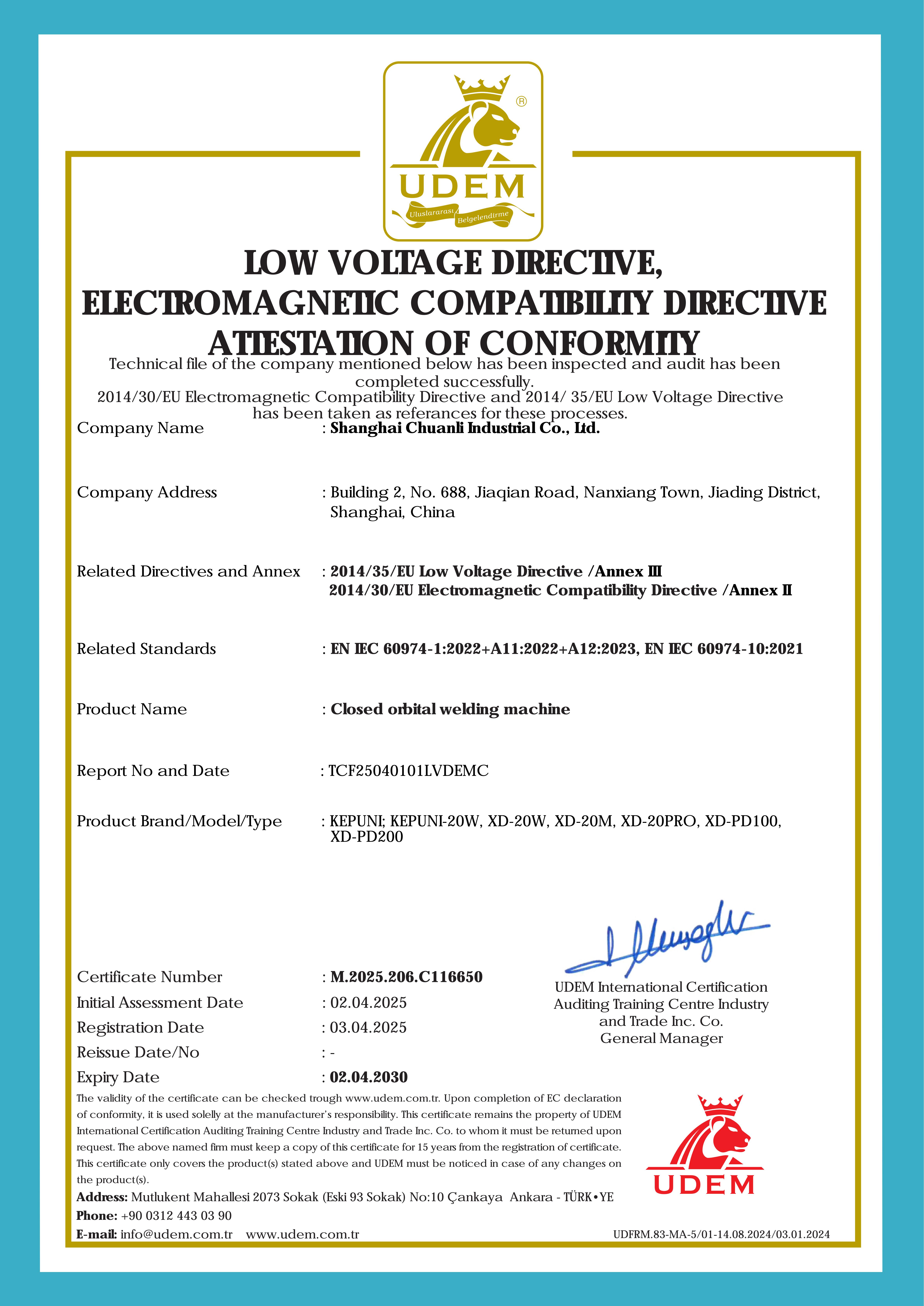
KEPUNI holds CE documentation issued by UDEM. Certificate TCF25040101LVDEMC, issued 2025-04-02 and valid to 2030-04-02, covers the scope of the EU market and references EN ISO 12100:2010, EN 60204-1:2018, EN 60825-1:2014, EN IEC 61000-3-2:2019+A1:2021 and EN 61000-3-3:2013+A1:2019. Certificate M.2022.206.C75864, issued 2022-07-22 and valid to 2027-07-21, references EN IEC 60974-1:2022+A11:2022+A12:2023 and EN IEC 60974-10:2021. Certificate 6814C50001315201, issued 2025-03-17 and valid to 2030-03-16, references the same welding-equipment standards.

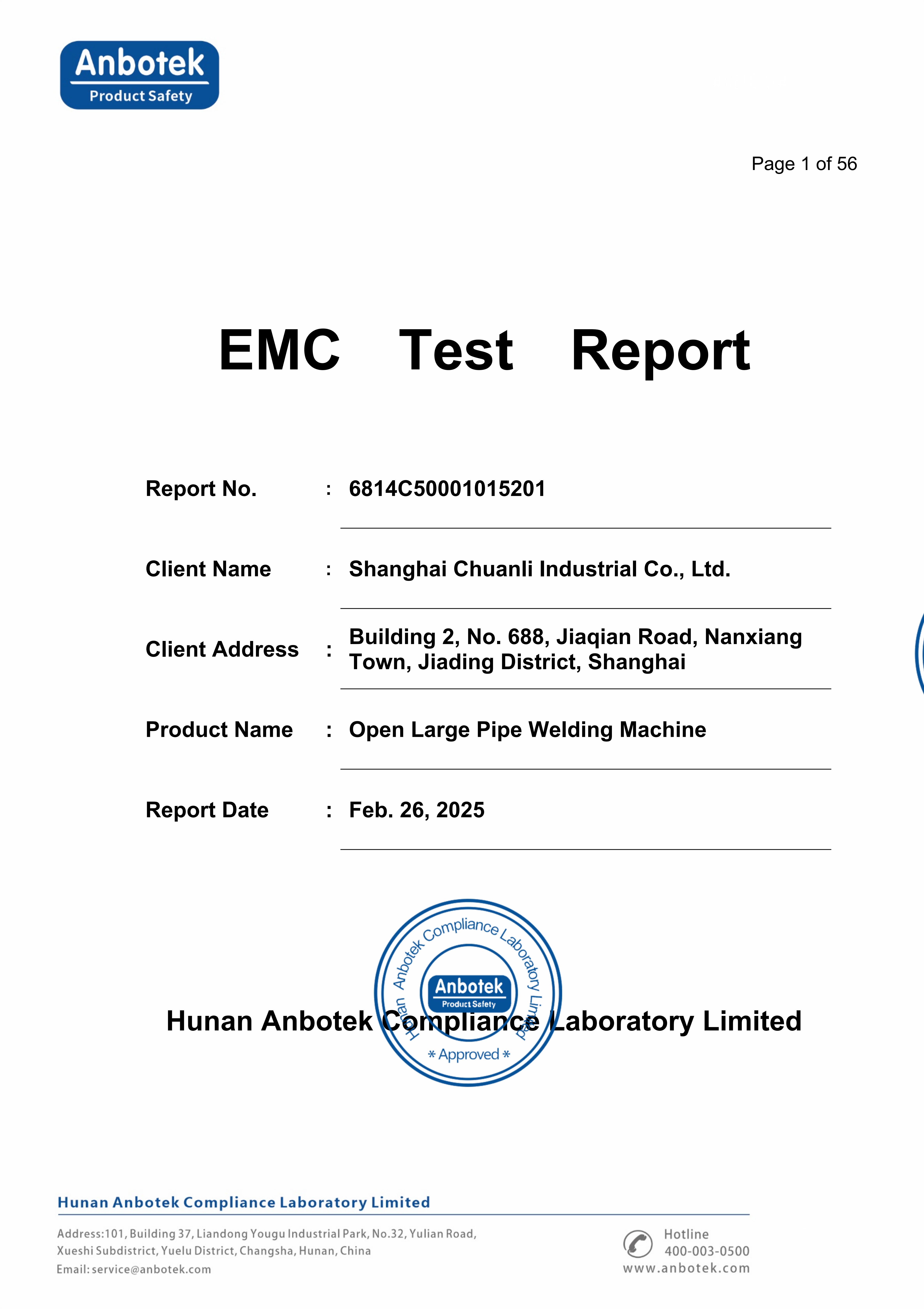
Certificate validity dates are listed on the KEPUNI CE records and should be checked against the project delivery schedule. A certificate that expires during the warranty period is a valid procurement risk, and it is one that can be identified from the document itself rather than from supplier assurances.
What CE does not cover: it does not certify that a specific weld will pass ASME BPE-2024 ID concavity limits, SEMI F57 particulate criteria, EU GMP requirements, 3A Sanitary Standard criteria, HTM 02-01 or NFPA 99 requirements, or a project-specific ASME Section IX procedure qualification. Those outcomes depend on head geometry, material, parameter control and operator qualification, and they are demonstrated through weld samples, inspection records and project documentation.
Buyer rule of thumb: keep two folders. Folder one holds machine conformity documents such as CE certificates, scope and validity dates. Folder two holds weld-level evidence such as weld sample reports, parameter documentation and inspection records. A supplier who can only fill folder one is not yet a qualified supplier for a regulated project.
Frequently Asked Questions
Which standards should I verify before buying an orbital welding machine for pharmaceutical or semiconductor piping?
Separate the two scopes. At machine level, KEPUNI holds CE documentation issued by UDEM: certificate TCF25040101LVDEMC (issued 2025-04-02, valid to 2030-04-02) covering EN ISO 12100:2010, EN 60204-1:2018, EN 60825-1:2014, EN IEC 61000-3-2:2019+A1:2021 and EN 61000-3-3:2013+A1:2019; certificate M.2022.206.C75864 (valid to 2027-07-21) and certificate 6814C50001315201 (valid to 2030-03-16), both covering EN IEC 60974-1:2022+A11:2022+A12:2023 and EN IEC 60974-10:2021. At weld level, verify the acceptance criteria the project is inspected against, such as the ASME BPE-2024 ID concavity limit of maximum 10% of nominal wall thickness and not exceeding 0.38 mm. Project records additionally reference SEMI F57, EU GMP, the 3A Sanitary Standard and ASME U-stamp for specific applications. CE marking does not replace weld-level qualification.
Can one orbital welding machine cover both thin-wall pharmaceutical tubing and thicker oil and gas pipe?
Not with a single head family. The XD-20PRO and XD-20W pipe welding power supplies are listed for pipe OD 3.175 mm to 168 mm at 0.5 mm to 3 mm wall thickness. Split-type heads (5H, 10H, XD-Split) cover wall thickness up to 1.5 mm at outside diameters from 3.175 mm to 25.4 mm, depending on the model. For wall thickness from 2.5 mm to 13 mm, the XD-K Series open pipe welding power supply and the K Series open weld head are listed at 19 mm to 325 mm (325+ mm for the K Series). For wall thickness from 2.5 mm to 25 mm on larger work, the XD-GH Series girth welding machine covers pipe or vessel OD 20 mm to 960 mm. Tube-to-tube-sheet work uses a separate family: TB-35, TB-65 and XD-G400.
What drives the price difference between economy and premium-compliant orbital welding systems?
Geometry sets the floor, and documentation and customization set the rest. KEPUNI positions the XD-20PRO in the mid-to-high-end segment at approximately USD 8,400 to 8,600, while premium industry-compliant solutions often from EU or US brands for pharmaceutical and semiconductor sectors exceed USD 25,000 to 40,000+ (KEPUNI price guide, 2026). Beyond geometry, the cost drivers are traceability and documentation requirements, customization depth such as voltage 110V/220V, interface customization, IoT/MES integration and software customization, the number and type of weld heads included in the package, and spare parts and service coverage. Budgeting should follow geometry confirmation, not precede it.
Can I validate a weld head on my own pipe before committing to a full order?
Yes. Sample Order production is available with an MOQ of 1 unit and a lead time of 15 to 20 days. Sample customization covers custom parameters, special materials including SS304, SS316, Titanium and Inconel, and non-standard sizes. Quality control on sample orders includes full inspection, a weld sample report and detailed parameter documentation, and sample production capacity is 20 units per month. This stage is where wall thickness, material and weld acceptance criteria should be proven together, before a bulk commitment is placed.
What are the standard lead times and purchasing terms?
Documented lead times are 15 to 20 days for sample orders, 30 to 45 days for OEM and ODM production, 60 to 90 days for bulk orders on an FOB Shanghai basis, and typically 7 to 15 days globally for spare parts. MOQ is 1 unit for samples and for OEM/ODM, and 5 units for bulk orders. Recorded delivery terms include FOB Shanghai, CIF destination port, CIF or DAP door delivery, and EXW Shanghai. Acceptance options include pre-shipment test, video inspection with a test report, pre-shipment inspection with photos and video, or optional third-party inspection by SGS or BV. Payment structures on record include 30% deposit with 70% before shipment, 50% and 50%, and 30% deposit with 40% before production and 30% before shipment. To confirm which terms apply to your specific head configuration, contact the KEPUNI export team by WhatsApp at +86 182 2180 3984 or by email at info@kepuni.com.
Conclusion: Fix the Geometry, Then Fix the Standard
Standards navigation for orbital welding machines becomes manageable once the order of operations is corrected. Wall thickness selects the head family: up to 1.5 mm points to split heads such as the 5H and 10H series; up to 3 mm points to the closed 40/80/120/170 series covering outside diameters to 168 mm; from 2.5 mm upward points to open-head and girth configurations covering up to 13 mm and 25 mm wall respectively. Outside diameter then confirms the coverage, and only after both axes are settled does it make sense to compare automation, documentation packages and price.
Two evidence sets belong in every evaluation file. Machine-level CE conformity, with certificate numbers, referenced EN standards and validity dates, confirms the equipment as placed on the market. Weld-level evidence, built from sample welds on production material, parameter documentation and inspection records, confirms what the equipment will actually produce on a regulated project. KEPUNI publishes both sets and supports sample validation before bulk commitment.
Next step for evaluation and execution teams
Download the full KEPUNI orbital welding product brochure for the complete head-family specifications, or send your pipe OD, wall thickness and material combination for a configuration check and weld sample proposal.
Download the KEPUNI product brochure (PDF)
Website: www.kepuni.com | Email: info@kepuni.com | WhatsApp: +86 182 2180 3984
Have Questions or Need More Details?
Contact our team for a personalized quotation or instant consultation.
Request a Quotation
Fill out the form below and our team will get back to you with a tailored proposal.
WhatsApp Direct Chat
Prefer to chat in real-time? Message us on WhatsApp for instant assistance & quick answers.
- Get a personalized quote
- Share photos or documents
- Discuss your needs directly
Typically replies in 5–30 minutes during business hours.