
MAH Grafted Polymer Specifications: Key Parameters for Procurement
MAH Grafted Polymer Specifications: Key Parameters for Procurement
Maleic anhydride (MAH) grafted polymers are functional additives used as compatibilizers, toughening agents, and adhesive resins in polymer compounding. For procurement professionals evaluating these materials, understanding technical specifications—such as maleic anhydride content, melt flow rate, and density—is critical to selecting the right product for a given application. This guide focuses on the key parameters and quality certifications that enable informed evaluation of MAH grafted polymers, using the product range from Shenyang Ketong New Materials Co., Ltd. (KETONG) as a reference.
Problem Definition: Why Specifications Matter in MAH Grafted Polymer Procurement
Buyers often face challenges when comparing spec sheets from different suppliers. Inconsistent reporting of MAH content, varying measurement standards for melt flow index, and unclear certification scope can lead to mismatched performance or supply chain risks. Without a clear understanding of how parameters affect end-use properties, procurement decisions may result in inefficient compounding, higher costs, or product failure in demanding applications such as multilayer barrier films, glass‑fiber reinforced plastics, or low‑temperature impact modifiers.
Industry Background: The Role of Maleic Anhydride Grafted Polymers
MAH grafted polymers serve as interfacial agents that improve adhesion between immiscible polymer phases. They are widely used in the manufacturing of modified engineering plastics, where they enhance impact strength, heat resistance, and processing stability. Common types include PP‑g‑MAH, PE‑g‑MAH, POE‑g‑MAH, ABS‑g‑MAH, and SEBS‑g‑MAH. Each type is tailored to a specific base polymer matrix, and its performance is governed by the grafted MAH level, backbone molecular weight, and rheological properties.
Detailed Solution: Decoding Key Parameters and Certifications
KETONG offers a comprehensive portfolio of MAH grafted polymers, including compatibilizers, toughening agents, and adhesive resins. Each product is characterized by three primary parameters:
- MAH Content: Classified as Low (<0.4%), Medium (0.4%–0.8%), High (>0.8%), or Extra High (≥4.0%). Higher MAH levels typically provide stronger interfacial bonding but may affect material flow.
- Melt Flow Rate (MFR): Measured under standardized conditions (e.g., 190°C/2.16 kg). MFR indicates processability: high MFR grades suit injection molding, while low MFR grades are preferred for extrusion and film applications.
- Density: Ranges from 0.86 g/cm³ for elastomer-based tougheners to 1.23 g/cm³ for biodegradable compatibilizers. Density influences dosage calculations and final part weight.
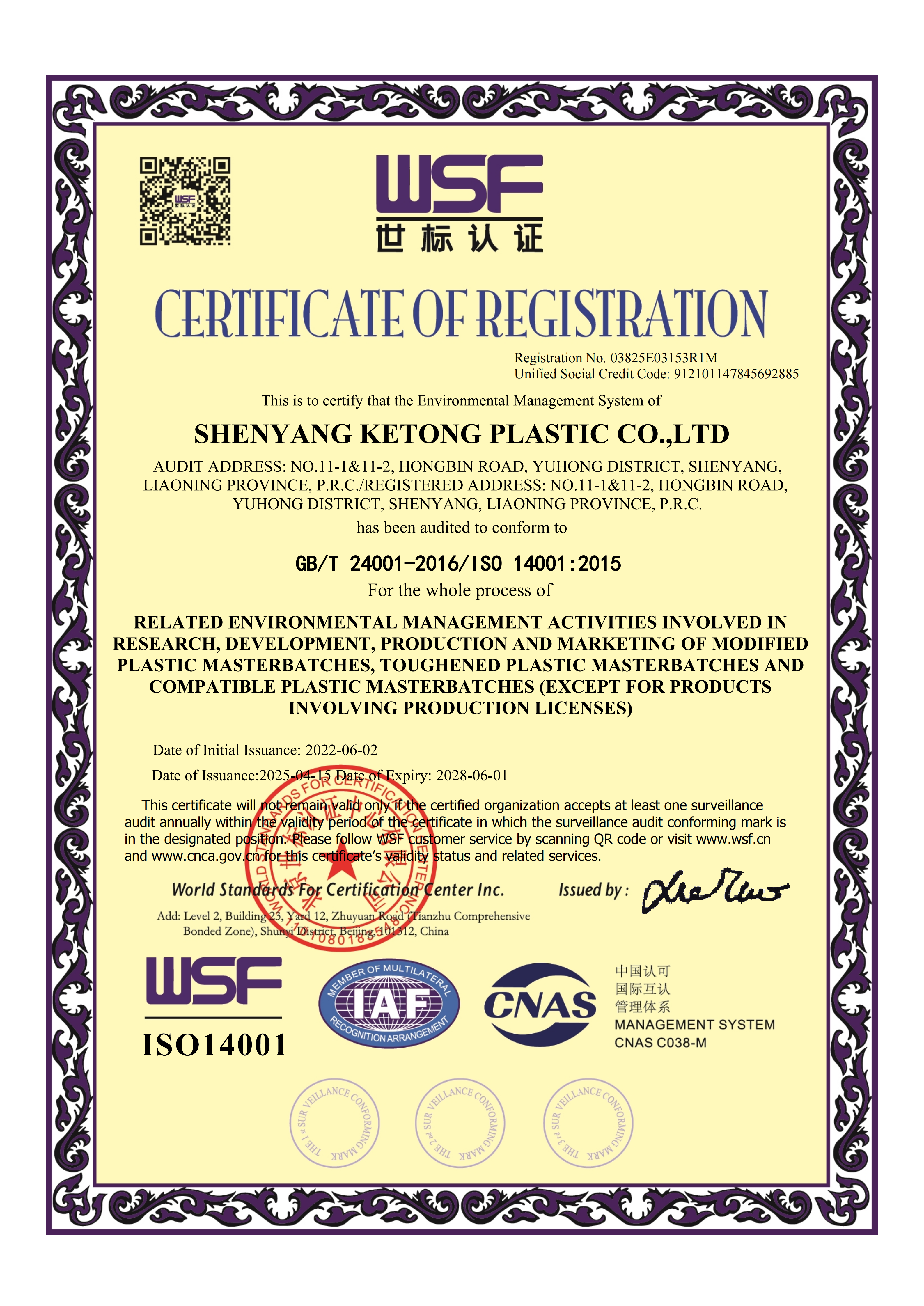
In addition to product specs, certifications provide assurance of consistent quality and responsible manufacturing. KETONG holds ISO 9001:2015 (certificate number 03825Q03155R1M), ISO 14001:2015 (certificate number 03825E03153R1M), and ISO 45001:2018 (certificate number 03825S03154R1M) certifications, all issued by World Standards for Certification Center Inc. These certifications cover the research, development, production, and marketing of modified plastic masterbatches, including toughening masterbatches and compatibilizer granules, for the Global and EU markets.
Step-by-Step: How to Evaluate MAH Grafted Polymer Specifications
- Identify the Base Polymer: Determine the matrix polymer (PP, PE, ABS, PA, etc.) and select the corresponding grafted type (e.g., PP‑g‑MAH for polypropylene).
- Determine Required MAH Level: For general-purpose compatibilization, Medium MAH (0.4%–0.8%) is often sufficient. For high‑performance adhesion or reactive toughening, High (>0.8%) or Extra High (≥4.0%) grades may be necessary.
- Match Melt Flow Rate to Process: High MFR grades (e.g., KT‑1 with 90–120 g/10min) are suitable for injection molding; low MFR grades (e.g., KT‑12B with ≥0.3 g/10min) are ideal for extrusion or blow molding where melt strength is critical.
- Verify Certifications: Check that the supplier holds current ISO 9001, ISO 14001, and ISO 45001 certifications. These indicate quality management, environmental responsibility, and occupational health and safety compliance.
Use Cases: Examples from KETONG’s Product Line
Low-Odor PP Compatibilizer for Automotive Interior: The LEP-1B low-odor PP‑g‑MAH (MAH High >0.8%, MFR ≥80 g/10min) is used to compatibilize glass‑fiber reinforced polypropylene, delivering enhanced impact resistance with low volatile emissions. A 22‑ton order confirmed stable performance and improved aging resistance.
Adhesive Resin for Multilayer Barrier Films: The KT-NJP2201 PE adhesive resin (MAH Low <0.4%, MFR 1.0–3.0 g/10min) provides excellent adhesion to EVOH and PA layers in co‑extruded food packaging films. A 21‑ton annual contract demonstrated less gel spots and good transparency.
Nylon Toughener for Low-Temperature Impact: The KT-916K nylon (PA) series toughener (MAH High >0.8%, MFR 9.0–13.0 g/10min at 235°C/5kg) imparts high toughness at -50°C. Used in 20‑ton lots for reinforced and toughened nylon compounds.
Comparison of Key Parameters Across MAH Grafted Polymer Types
| Type / Model | MAH Content | MFR (g/10min) | Density (g/cm³) | Typical Application |
|---|---|---|---|---|
| PP‑g‑MAH / KT-1 | Medium (0.4–0.8%) | 90–120 (190°C/2.16kg) | 0.91–0.95 | Glass‑fiber reinforced PP |
| PE‑g‑MAH / KT-12A | High (>0.8%) | ≥4.0 (190°C/2.16kg) | 0.90–0.94 | PE‑based blends & fillers |
| POE‑g‑MAH / KT-915K | Medium (0.4–0.8%) | ≥0.2 (190°C/2.16kg) | 0.86–0.88 | Nylon toughening (PA6, PA66) |
| ABS‑g‑MAH / KT-2 | High (>0.8%) | 1.0–4.0 (200°C/5kg) | 1.03–1.08 | ABS/PC blends |
| SEBS‑g‑MAH / KT-2512 | High (unspecified) | 10–25 (unspecified condition) | 0.90–0.92 | TPE elastomer overmolding |
Note: All data is from KETONG product specifications. Always consult the supplier for the exact values for your chosen grade.
Frequently Asked Questions
Is the KETONG product line ISO 9001 certified?
What are the MAH content grades available for PP compatibilizers?
What is the melt flow rate range for the KT-12 PE compatibilizer?
Which certification body issued KETONG's ISO 14001?
How can I request a sample or quote for a specific MAH grafted polymer?
Conclusion
Selecting the right maleic anhydride grafted polymer requires a clear understanding of key parameters such as MAH content, melt flow rate, and density, as well as verification of quality certifications. By following the evaluation framework outlined above, procurement professionals can confidently match product specifications to process requirements. KETONG’s broad product portfolio—backed by ISO 9001, ISO 14001, and ISO 45001 certifications—offers reliable solutions for compatibilization, toughening, and adhesion across engineering plastics, packaging, and automotive applications. For detailed specifications and to discuss your project needs, download the company brochure or contact the KETONG team.