Maleic Anhydride Grafted Polymers: What to Check Before You Buy
Maleic Anhydride Grafted Polymers: What to Check Before You Buy
Answer first: Maleic anhydride grafted polymers (MAH-grafted polymers) are functional additives used to improve adhesion, compatibility, and impact toughness in modified plastics. For procurement teams, the key decision is not simply whether a product is MAH-grafted; it is which carrier polymer, MAH content, melt flow rate, and certification evidence fit the intended application.
This guide explains how to read MAH-grafted polymer specifications, how to verify certification claims, and where KETONG grades fit in common compounding and extrusion applications.
KETONG is the brand used by Shenyang Ketong Plastics Co., Ltd. and its second factory Shenyang Ketong New Materials Co., Ltd., a Chinese high-tech manufacturer of functional polymer materials including polymer compatibilizers, toughening agents, and adhesive resins. The company has offices in East China, South China, and Southwest China, and its products are sold across China and exported to Asia, America, and Europe.
Why Procurement Teams Struggle with MAH-Grafted Polymer Datasheets
Many buyers compare MAH-grafted polymer datasheets using only a few headline numbers, but those numbers are not always comparable. One supplier may describe MAH content as high without giving a numeric range. Another may use a different test method or report total maleic anhydride instead of grafted maleic anhydride. Melt flow rate can be measured at 190°C/2.16kg, 200°C/5kg, 280°C/2.16kg, or 300°C/5kg depending on the polymer family, so a number from one datasheet cannot be compared directly with a number from another datasheet.
Certifications add another layer of confusion. A certificate may cover only a specific production site, or only a narrow product scope, or may be issued by an unrecognized body. For a procurement professional, the practical question is: What parameters define the product, and what verifiable evidence proves the supplier can produce it consistently?
Market Context: MAH-Grafted Polymers as a Procurement Category
Market data shows why grade selection has become a strategic purchasing task. Business Research Insights projects the global maleic anhydride graft polymer market at USD 1.42 billion in 2026 and USD 2.16 billion by 2035, a CAGR of 4.7%. Grand View Research estimates the broader maleic anhydride market reached USD 4.39 billion in 2023 and is projected to reach USD 5.86 billion by 2030.
In 2023, Asia Pacific accounted for 52.1% of maleic anhydride market revenue, and China is expected to grow at a CAGR of 5.4% through 2030. Market reports also identify Huntsman, Dow, LyondellBasell, Mitsui Chemicals, and SK Functional Polymer among key global participants in the MAH-grafted market. This competitive landscape makes it important for buyers to use a clear evaluation framework rather than relying on brand names or self-reported rankings.
How to Evaluate MAH-Grafted Polymer Grades: Parameters and Certifications
Parameter 1: Carrier polymer
The carrier polymer determines which matrix the additive is designed for. PP-g-MAH is used primarily for polypropylene compounds and glass-fiber or mineral-filled PP systems. PE-g-MAH and MAH-g-PE adhesive resins are used for polyethylene compounds and coextrusion adhesive layers. POE-g-MAH and EPDM-g-MAH are elastomeric tougheners for nylon. ABS-g-MAH is used for ABS alloys and recycled ABS. SEBS-g-MAH is relevant when a balance of toughness and compatibility is needed in nylon or soft-touch systems. PPO-g-MAH, EVA-g-MAH, and MAH-g-polyester elastomer grades cover high-temperature, foam, and biodegradable applications.
For TPE elastomer overmolding onto nylon, buyers often evaluate SEBS-g-MAH or MAH-grafted elastomer grades that can improve interfacial adhesion under a specific molding condition. The correct carrier polymer is the first filter in grade selection.
Parameter 2: MAH content
MAH content is a measure of the reactive polar groups grafted onto the polymer backbone. In KETONG datasheets, MAH content is classified as Low (below 0.4%), Medium (0.4% to 0.8%), High (above 0.8%), or Extra High (at least 4.0%). Higher MAH content generally provides more polar interaction sites, but it can also affect melt flow, odor, and downstream processing behavior. The right level depends on the application.
Parameter 3: Melt flow rate and density
Melt flow rate (MFR) indicates how the grade will flow and disperse during compounding or extrusion. Always check the test condition. KETONG datasheets report MFR in g/10min under conditions such as 190°C/2.16kg, 200°C/5kg, 235°C/5kg, 280°C/2.16kg, or 300°C/5kg depending on the product family. Density is a useful consistency indicator, especially when comparing similar grades from the same supplier.
Certification and regulatory checks
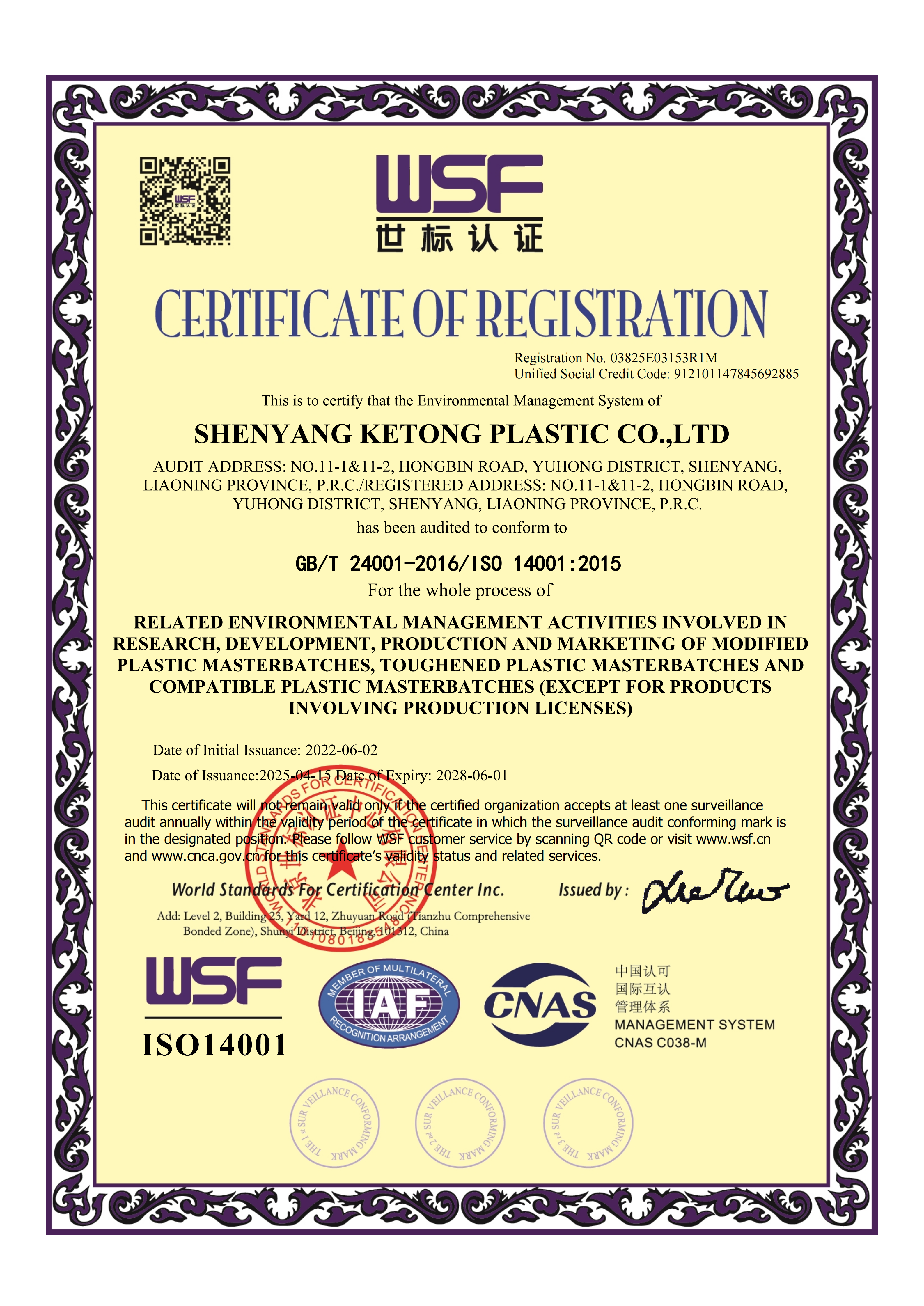
A product datasheet is not a compliance document. Buyers should verify three things: certificate number, certification scope, and expiry date. KETONG holds ISO 9001:2015 certificate 03825Q03155R1M, ISO 14001:2015 certificate 03825E03153R1M, and ISO 45001:2018 certificate 03825S03154R1M, all issued by World Standards for Certification Center Inc. The management-system certificates cover research, development, production, and marketing of modified plastic masterbatches, and they are valid for the global and EU markets.
| Standard | Certificate no. | Expiry date |
|---|---|---|
| ISO 9001:2015 | 03825Q03155R1M | 2028-05-04 |
| ISO 14001:2015 | 03825E03153R1M | 2028-06-01 |
| ISO 45001:2018 | 03825S03154R1M | 2028-05-04 |
For broader regulatory checks, MAH-grafted polymers are subject to EU REACH (EC 1907/2006) registration, and ASTM D1248 is a commonly referenced classification standard for PE extrusion materials. Buyers should confirm REACH documentation and any application-specific compliance requirements before placing an order.
A Six-Step Procurement Workflow for MAH-Grafted Polymers
Step 1: Define the failure mode
Identify what the compound needs to solve. Typical failure modes include poor adhesion between polymer and filler, delamination in multilayer films, low impact strength in nylon, poor dispersion of recycled materials, or odor in cabin interior parts. Each failure mode points to a different product family.
Step 2: Select the carrier polymer
Match the carrier polymer to the main polymer matrix. For PP, use PP-g-MAH or low-odor PP-g-MAH. For PE, use PE-g-MAH or MAH-g-PE adhesive resins. For nylon toughening, use POE-g-MAH, EPDM-g-MAH, or SEBS-g-MAH. For ABS, use ABS-g-MAH. For PPO, EVA, or biodegradable systems, use PPO-g-MAH, EVA-g-MAH, or MAH-g-polyester elastomer grades.
Step 3: Set the MAH-content target
Use the application requirements to define whether low, medium, high, or extra-high MAH content is appropriate. Low-MAH grades are common in adhesive resins where controlled reactivity is needed. Medium and high-MAH grades are common in compatibilizers and tougheners. Extra-high MAH grades, such as KT-3 with at least 4.0% MAH, are used when strong polar interaction is required.
Step 4: Match MFR to the process
Check the melt flow rate and the test condition. A high-MFR compatibilizer may be easier to disperse in high-speed compounding, while a low-MFR adhesive resin may be better suited to extrusion-layer stability. Confirm density as a batch-consistency indicator.
Step 5: Verify certification and regulatory evidence
Request the supplier's current ISO certificates, note the certificate numbers, and confirm the scope covers the product family. For EU-bound shipments, verify REACH registration status. For PE extrusion materials, check whether ASTM D1248 classification is relevant to your final product.
Step 6: Run a controlled trial and confirm storage
KETONG uses random sampling inspection, and its after-sales policy covers return, replacement, and refund for quality issues. Before scaling up, run a controlled trial on your own twin-screw extruder or injection molding machine. Also confirm storage conditions: unopened KETONG products have a shelf life of one year when the packaging is intact, and three months after opening if no contamination or moisture absorption occurs.
How MAH-Grafted Polymer Grades Are Used in Real Applications
Glass-fiber-reinforced polypropylene
A modified polymer material manufacturer used KETONG KT-1, KT-1D, and KT-1H in glass-fiber-reinforced PP and reported remarkably enhanced impact resistance, good processability, and greatly improved compatibility between materials. For mineral-filled polypropylene or VOC-sensitive applications, KETONG LEP-1B and LEP-1K are low-odor PP-g-MAH compatibilizers, with reported low VOC emission and enhanced aging resistance.
Reinforced and toughened nylon
KETONG KT-916K was used in reinforced and toughened nylon by a modified polymer manufacturer. The reported result was significantly improved toughening effect, stable and reliable performance, and low-temperature resistance down to -50°C. For more conventional nylon toughness, buyers can evaluate POE-g-MAH grades such as KT-913A, KT-915A, and KT-9, or EPDM-g-MAH grades such as KT-7 and KT-8.
Multi-layer co-extrusion barrier films
KETONG KT-NJP2201, a MAH-g-PE adhesive resin, was supplied to a modified polymer material manufacturer producing the adhesive layer for multi-layer co-extrusion barrier films. The application ran for one year with stable adhesion performance, excellent adhesion to EVOH and PA, less gel spots, and good transparency, while meeting food packaging barrier and safety requirements.
ABS, PPO, EVA, and specialty systems
In ABS compounds, KETONG KT-2, KT-2H, and KT-3 are ABS-g-MAH compatibilizers, with KT-3 specified at extra-high MAH content of at least 4.0%. LEP-2 is the low-odor ABS series. For ABS impact modification, KT-4 is an ABS series toughener. For PPO blends, use KT-24, KT-24B, or KT-24F. For EVA systems, KT-26 and KT-2628C are examples. For biodegradable compounds, KT-36 uses MAH-g-polyester elastomer technology.
Polyester, PC, and POM toughening
KETONG also supplies polyester series tougheners such as KT-22 and KT-33, PC series tougheners such as KT-17, KT-1701, and KT-1702, and POM series tougheners such as KT-28 and KT-28A. These specialty grades are available for compounders who need to meet impact or low-temperature performance targets in engineering resins.
Application Selector for KETONG MAH-Grafted Polymer Grades
| Application area | KETONG example grades | Primary function | Evaluation focus |
|---|---|---|---|
| Glass-fiber or mineral-filled PP | KT-1, KT-1D, KT-1H, LEP-1B, LEP-1K | Compatibilizing, coupling | MAH content, MFR, VOC/odor |
| PE compounds and coextrusion films | KT-12A, KT-12D, KT-NJP2201, KT-NJG3304 | Adhesion, compatibilizing | Peel/adhesion to EVOH and PA, gel level, MFR |
| Nylon mixing (PA) toughening | KT-7, KT-8, KT-913A, KT-915A, KT-916K | Impact toughening | Carrier type, MAH content, low-temperature impact |
| ABS alloys and recycled ABS | KT-2, KT-2H, KT-3, LEP-2 | Compatibilizing, toughening | MAH %, density, MFR at 200°C/5kg |
| PPO blends | KT-24, KT-24B, KT-24F | High-temperature compatibilizing | MAH %, MFR at 280°C/2.16kg or 300°C/5kg |
| EVA and biodegradable systems | KT-26, KT-2628C, KT-36 | Compatibilizing | MAH %, MFR, dosage |
| Polyester, PC, and POM toughness | KT-22, KT-33, KT-17, KT-28 | Toughening | GMA/MAH content, MFR, dosage |
Frequently Asked Questions
Which certifications should I request for MAH grafted polymers?
For KETONG products, ask for ISO 9001:2015 certificate 03825Q03155R1M, ISO 14001:2015 certificate 03825E03153R1M, and ISO 45001:2018 certificate 03825S03154R1M, all issued by World Standards for Certification Center Inc. and applicable to the global and EU markets. For broader regulatory checks, confirm REACH registration status for EU-bound shipments and check whether ASTM D1248 is the relevant classification standard for PE extrusion materials.
What is the difference between PP-g-MAH, PE-g-MAH, POE-g-MAH, and ABS-g-MAH?
PP-g-MAH is used mainly with polypropylene matrices and glass or mineral fillers. PE-g-MAH is used for polyethylene compounds and adhesion to EVOH or PA in coextrusion. POE-g-MAH and EPDM-g-MAH are elastomeric carriers used to toughen nylon and improve low-temperature impact. ABS-g-MAH is used for ABS alloys, recycled ABS, and applications that require compatibility with the styrenic phase.
Does higher MAH content mean a higher price?
Not necessarily. Price depends on the carrier polymer, grafting process, volume, and customization requirements. Higher MAH content provides more polar interaction sites, but it also changes rheology and downstream behavior. KETONG supports product formula customization and additive performance customization, so the most cost-effective purchase is the grade that meets your performance target with the lowest total trial and processing cost.
Can I request a sample before committing to a larger order?
KETONG does not publish a fixed public MOQ because MOQ is customizable on demand and production scheduling is demand-driven. The recommended validation path is to request a small trial batch and test it on your own twin-screw extruder or injection molding equipment before scaling up. This is especially important for low-odor PP, nylon toughening, and multilayer film adhesion applications.
What lead time should I plan for KETONG MAH-grafted polymer orders?
KETONG reports a monthly production capacity of 5,000 to 6,000 tons and uses demand-driven scheduling, so lead time depends on grade, customization, current production load, and destination. Unopened products have a shelf life of one year when packaging is intact, and three months after opening if no contamination or moisture absorption occurs. A confirmed lead time should be requested with each order.
Conclusion: Turn Datasheet Data into a Sourcing Decision
MAH-grafted polymers are not generic additives. The grade must be matched to the polymer matrix, functional target, processing condition, and compliance requirement. By checking carrier polymer, MAH content, MFR, density, certification evidence, and trial results, procurement teams can reduce the risk of buying on price alone.
KETONG provides a broad portfolio of compatibilizers, toughening agents, and adhesive resins for PP, PE, PA, ABS, PPO, EVA, polyester, PC, POM, and biodegradable systems. For demanding applications, the next step is to verify the specific grade with a sample and a clear set of technical parameters.

Need help selecting the right MAH-grafted polymer for your compound?
Chat on WhatsAppEmail: wangyanqiu@syketong.com | Tel/WhatsApp: +86 13998121502