Qualifying Custom MAH-Grafted Polymers: OEM Capability and Case Evidence Buyers Should Check
Qualifying Custom MAH-Grafted Polymers: OEM Capability and Case Evidence Buyers Should Check
Buyers evaluating maleic anhydride grafted polymer suppliers at the evaluation-to-execution stage need more than a technical datasheet. They need confirmed manufacturing depth, genuine customization flexibility, verifiable application cases, and clear commercial terms. This article explains how to qualify a custom MAH-grafted polymer partner by examining production modes, formulation capabilities, quality systems, and real project evidence, using Shenyang Ketong Plastics Co., Ltd. and its second factory Shenyang Ketong New Materials Co., Ltd. (collectively referred to as KETONG) as a working example.
The Problem: “Custom Capability” Is Hard to Verify
In the modified plastics industry, many suppliers describe themselves as custom manufacturers. But a real custom partner should be able to explain exactly which production models it supports, which formulation parameters it can adjust, and what quality system controls the process. Without this information, buyers cannot distinguish between a trading company, a toll converter, and a true OEM/ODM manufacturer.
For MAH-grafted polymers such as PP-g-MAH, PE-g-MAH, POE-g-MAH, EPDM-g-MAH, ABS-g-MAH, SEBS-g-MAH, PPO-g-MAH, EVA-g-MAH, PBAT-g-MAH, and adhesive resin grades, the qualification process becomes even more technical. Grafting level, melt flow rate, density, residual odor, and compatibility with the target polymer matrix all determine whether the product will work in automotive, packaging, electronics, or industrial compounds. Buyers need a framework to verify both capability and evidence before committing volume.
Industry Context: Why Supply Depth Matters
The global maleic anhydride market was valued at USD 4.39 billion in 2023 and is projected to grow to USD 5.86 billion by 2030, according to Grand View Research. The more specialized maleic anhydride graft polymer market is projected at USD 1.42 billion in 2026, reaching USD 2.16 billion by 2035 with a 4.7% CAGR, according to Business Research Insights. Asia Pacific accounted for 52.1% of the maleic anhydride market in 2023, with China expected to grow at a 5.4% CAGR through 2030. These figures underline the scale of demand, but they also create room for suppliers with widely different real capabilities.
Automotive applications represent 42% of total demand for polyolefin elastomers (POE), which are frequently grafted with MAH for toughening, according to ChemAnalyst. This means that a substantial share of MAH-grafted polymer consumption flows into safety-critical and performance-intensive applications. The cost of a wrong supplier decision can include poor adhesion, inconsistent impact strength, odor issues, or failed qualification tests downstream.
Detailed Solution: What a Qualification Review Should Cover
KETONG’s profile provides a practical checklist for what a custom MAH-grafted polymer manufacturer should be able to demonstrate.
Company and Production Base
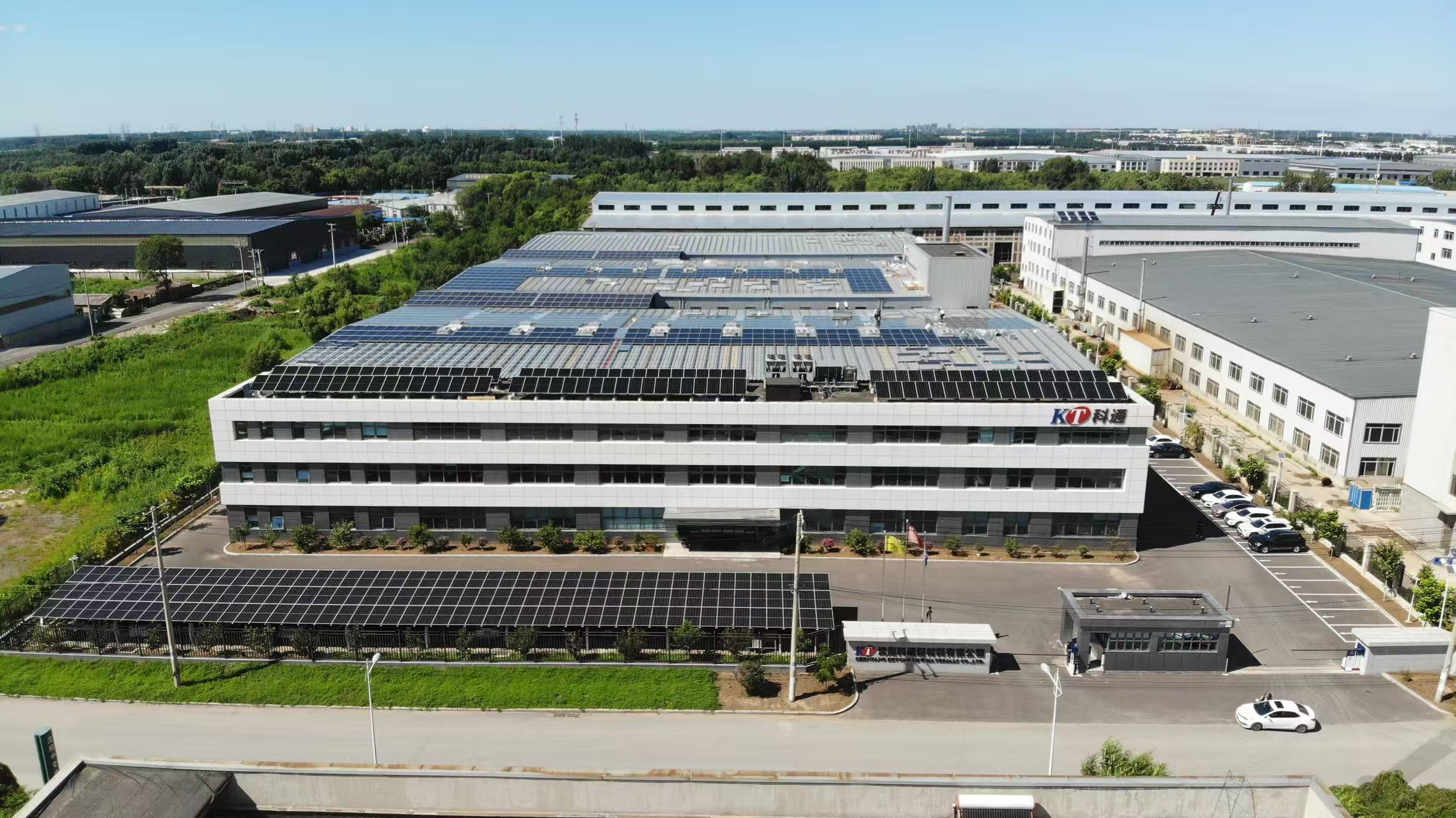
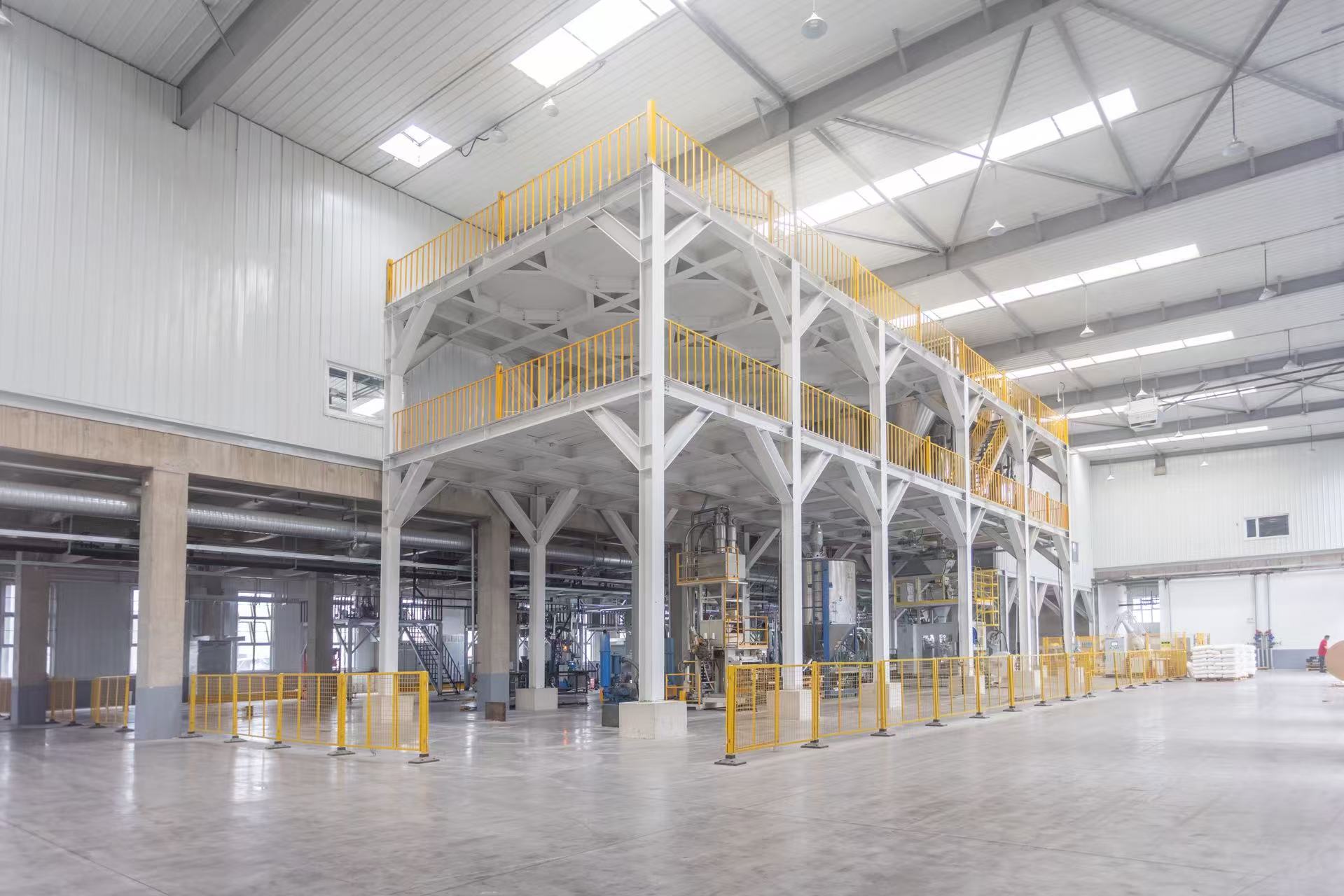
Shenyang Ketong Plastics Co., Ltd. describes itself as a high-tech enterprise specializing in the research, development, and production of functional polymer materials, covering polymer compatibilizers, tougheners, and functional adhesive resins. The company occupies 30,000 square meters, operates more than 10 imported production lines, and has an annual production capacity of 50,000 tons. Its second factory, Shenyang Ketong New Materials Co., Ltd., was completed in Shenyang, Liaoning in 2023, covering an area of more than 30 acres, with a building area of 20,000 square meters. That facility is expected to invest in 10 production lines and has a planned production capacity of 60,000 tons/year.
KETONG also reports a team of about 130 employees, including 8 R&D engineers, and states that its products are exported to markets including Vietnam. Its main product categories are Toughening Agents, Compatibilizers, and Adhesive Resins.
Customization and Production Modes
From the capability data, KETONG provides comprehensive manufacturing services including OEM, ODM, OBM, EMS, CMT, and JDM. This range is important for buyers because it signals flexibility: a customer may supply the formula (OEM), ask the manufacturer to develop the formula (ODM), or require a hybrid arrangement.
Customization services include product formula customization and additive performance customization. The additive performance options explicitly include flame retardant, toughening, anti-oxidation, reinforcement, and weather resistance modifications. For a buyer selecting a MAH-grafted polymer, this means the supplier can adjust not only the graft level or melt flow rate but also the overall additive package to meet end-use requirements.
KETONG states a monthly production capacity of 5,000–6,000 tons, with demand-driven scheduling for lead times and customizable MOQ on demand. Quality control is performed through random sampling inspection. The company also lists after-sales support as return, replacement, and refund for quality issues. From a procurement perspective, these terms help de-risk project execution.
Certifications and Management Systems
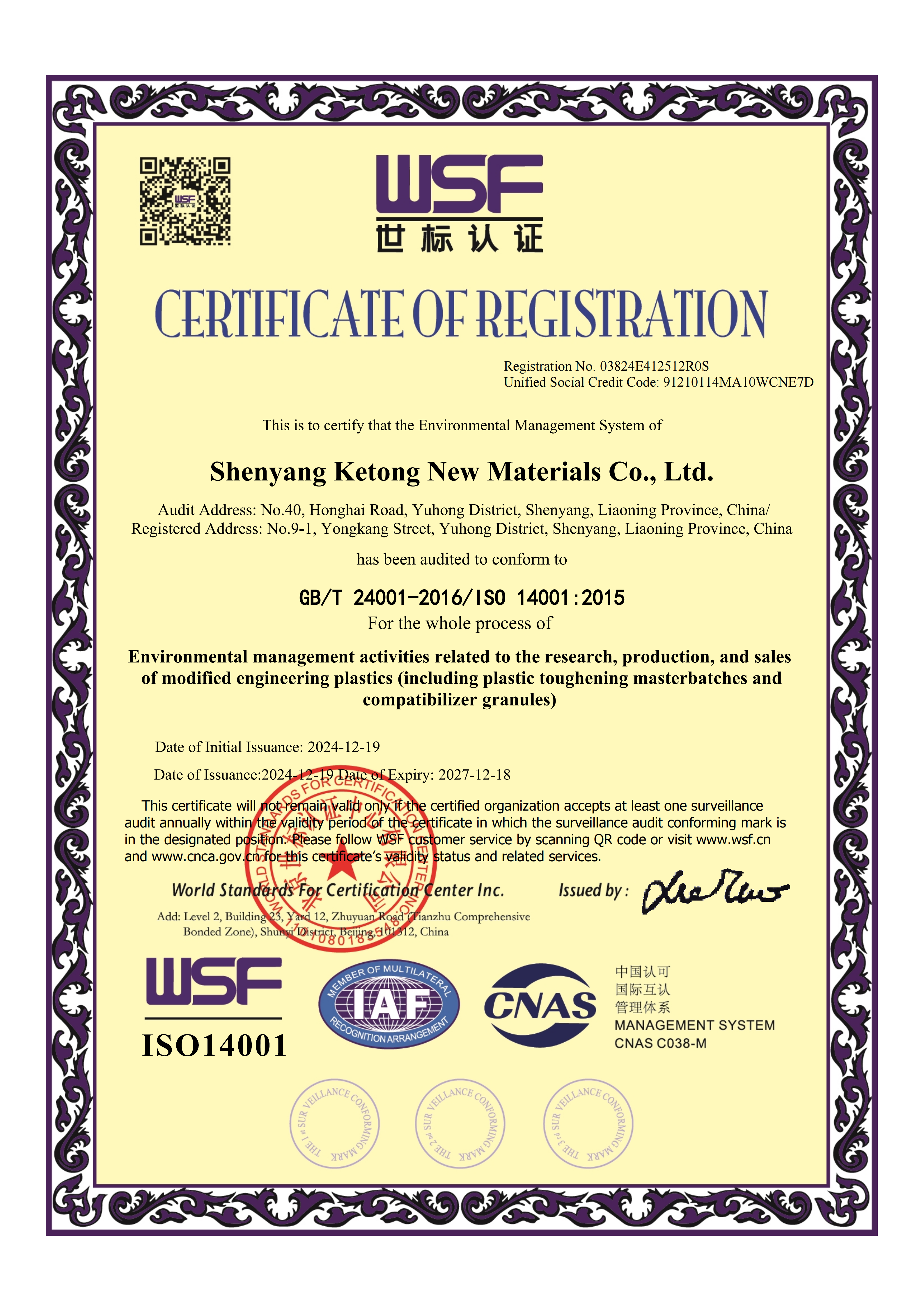
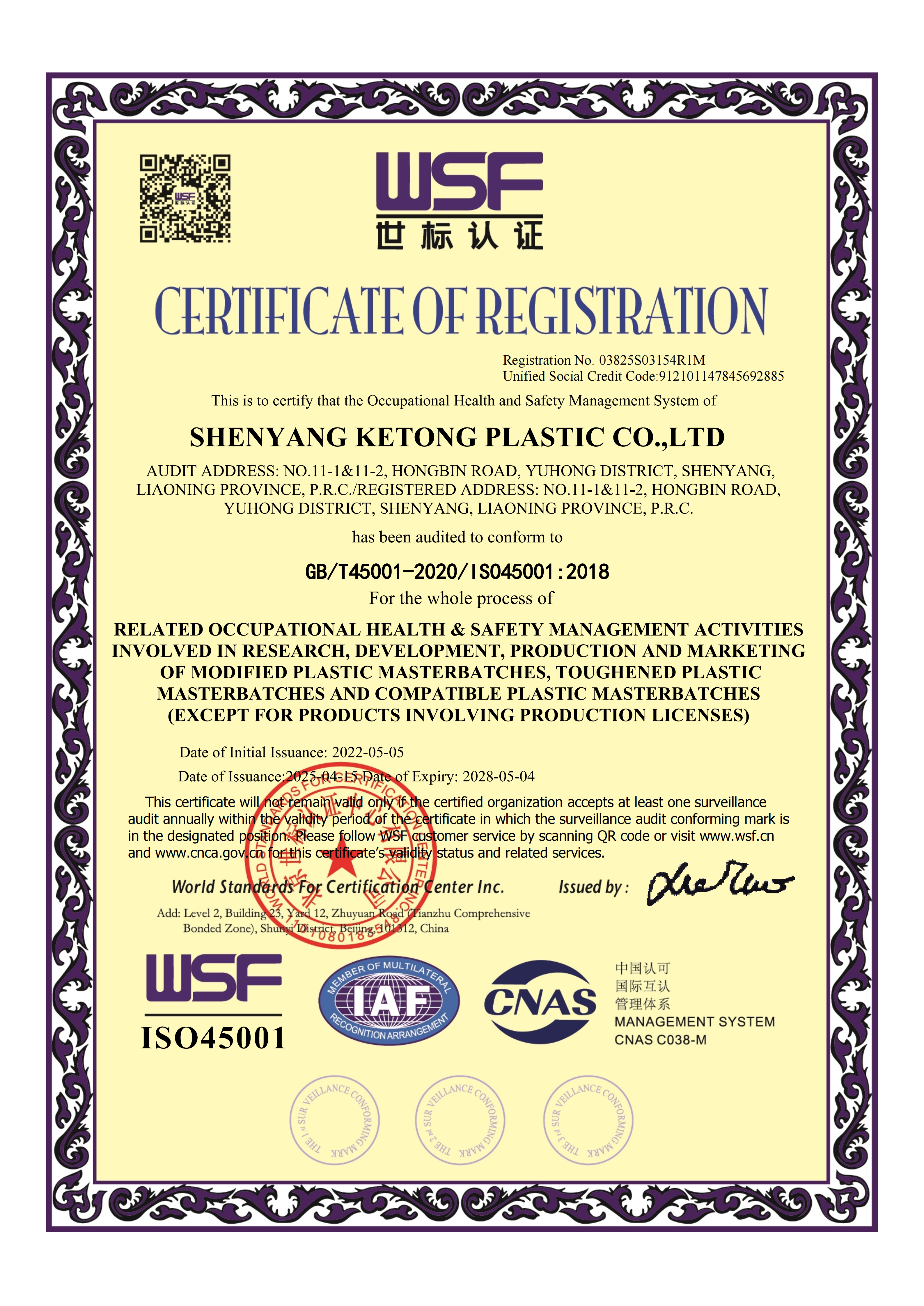
KETONG holds registrations for ISO 9001:2015, ISO 14001:2015, and ISO 45001:2018 under the certification body World Standards for Certification Center Inc. The ISO 9001 certificate number is 03825Q03155R1M; the ISO 14001 certificate number is 03825E03153R1M; the ISO 45001 certificate number is 03825S03154R1M. These certificates cover the research, development, production, and marketing of modified plastic masterbatches, toughened plastic masterbatches, and compatible plastic masterbatches.
For global buyers, documented management system certification is a baseline requirement. It does not guarantee product performance in every application, but it shows that the supplier has committed to defined quality, environmental, and occupational health and safety processes.
Step-by-Step: How to Qualify and Execute a Custom MAH-Grafted Polymer Project
Use the following workflow when evaluating a custom MAH-grafted polymer supplier, especially if you are moving from evaluation to execution.
Step 1: Map the Application and Polymer Interaction
Define which matrix polymer you are modifying, what the second phase is (glass fiber, mineral filler, nylon, EVOH, PA, recycled polymer, or rubber phase), and which property you need to improve: adhesion, impact toughness, compatibility, odor, or processability. This determines the base material of the grafted polymer: MAH-g-PP, MAH-g-PE, POE-g-MAH, EPDM-g-MAH, MAH-g-ABS, SEBS-g-MAH, MAH-g-PPO, MAH-g-EVA, or others.
Step 2: Verify the Supplier’s Product Family and Parameters
Review the manufacturer’s published parameters for MAH content, melt flow rate, density, and recommended dosage. For example, KETONG’s polypropylene series compatibilizers such as KT-1, KT-1D, and KT-1H are listed as MAH-g-PP materials with specified MAH levels and melt flow ranges. Low-odor PP series grades LEP-1B and LEP-1K are available for applications with strict VOC or odor requirements.
Step 3: Confirm Customization Modes and Additive Adjustments
Ask the supplier which production modes it can support. If the answer includes OEM, ODM, OBM, EMS, CMT, and JDM, and the supplier can customize formula and additive performance, that is a strong signal of real manufacturing capability. If a supplier cannot explain how it handles formula changes or additive adjustments, it may not be a true custom manufacturer.
Step 4: Review MOQ, Lead Time, and Logistics Terms
Check whether the MOQ is flexible enough for your project stage. KETONG states that MOQ is customizable on demand and that lead time follows demand-driven scheduling. For international orders, delivery methods are typically FOB or CIF, with factory acceptance test per agreed technical specifications and payment before delivery. Understanding these terms before sampling avoids commercial friction later.
Step 5: Examine Relevant Case Evidence
Case records are more persuasive than marketing language. KETONG has documented multiple projects with modified polymer material manufacturers in countries including the United Kingdom, India, Vietnam, China, and Italy. These projects involved supplies of 20 tons, 22 tons, 20 tons, and 21 tons of material over one-year durations. Ask your supplier for comparable project references that match your application.
Step 6: Plan Sampling and Scale-Up
Once technical parameters and commercial terms are aligned, plan a trial with a quantity that reflects your real process. Because KETONG’s MOQ is customizable, a buyer can start with a focused trial before committing to a full container or annual contract. After the trial, confirm that the supplier can scale to your required volume within the stated monthly capacity range.
Use Cases: What Real Projects Show
KETONG’s documented use cases cover three major application families: adhesive resin systems, nylon toughening, and polypropylene compatibilization.
Adhesive Layer for Multi-Layer Co-Extrusion Barrier Films
One modified polymer material manufacturer used KT-NJP2201, a MAH-g-PE adhesive resin, as an adhesive layer for multi-layer co-extrusion barrier films in food packaging. The project involved 21 tons of product over one year. The result reported was stable adhesion performance in the multi-layer co-extrusion process, meeting food packaging barrier and safety requirements. The highlighted benefits were excellent adhesion to EVOH and PA, fewer gel spots, and good transparency.
Reinforced and Toughened Nylon
Another modified polymer material manufacturer used KT-916K, a nylon (PA) series toughener, for reinforced and toughened nylon applications. This project supplied 20 tons over one year. The result was a significantly improved toughening effect, with stable and reliable performance, including low-temperature resistance down to -50°C.
Glass Fiber Reinforced Polypropylene and Mineral Filled Polypropylene
Two separate projects demonstrate PP compatibilization. In one, the client applied LEP-1K and LEP-1B low-odor PP compatibilizers to glass fiber reinforced polypropylene and mineral filled polypropylene, with a supply of 22 tons. The outcome was remarkably enhanced impact resistance, with low VOC emission and enhanced aging resistance. In the other project, the client used KT-1, KT-1D, and KT-1H for glass fiber reinforced PP, with a supply of 20 tons. The reported result was again remarkably enhanced impact resistance, along with good material impact strength retention, good processability, and greatly improved compatibility between materials.
Application-to-Product Comparison Table
The following table maps common application scenarios to KETONG’s product families and the evidence available from verified project data.
| Application Scenario | KETONG Product Family | Material Basis | Representative Models | Supporting Evidence |
|---|---|---|---|---|
| Glass fiber reinforced PP, mineral filled PP | Polypropylene Series Compatibilizers / Low-Odor PP Series | MAH-g-PP | KT-1, KT-1D, KT-1H; LEP-1B, LEP-1K | 20-ton and 22-ton supply cases; enhanced impact resistance; low VOC in low-odor grades |
| Multi-layer co-extrusion barrier films for food packaging | Adhesive Resins (PE-based) | MAH-g-PE | KT-NJP2201 | 21-ton supply case; stable adhesion to EVOH and PA; meets food packaging requirements |
| Reinforced and toughened nylon | Nylon (PA) Series Tougheners | MAH-g-Elastomer, POE-g-MAH, EPDM-g-MAH | KT-916K, KT-913 series, KT-915 series, KT-7, KT-8 | 20-ton supply case; low-temperature resistance down to -50°C |
| ABS compatibilization / low-odor ABS | ABS Series Compatibilizers | MAH-g-ABS, multi-component copolymer | KT-2, KT-2H, KT-3, KT-2M, LEP-2 | Product parameter data available; case data not published |
| POM toughening | POM Series Tougheners | Elastomer, acrylate elastomer | KT-28, KT-28A | Product parameter data available; case data not published |
FAQ
Is KETONG’s MAH-grafted polymer production compliant with international management system standards?
KETONG holds ISO 9001:2015, ISO 14001:2015, and ISO 45001:2018 registrations from World Standards for Certification Center Inc., covering the research, development, production, and marketing of modified plastic masterbatches, toughened plastic masterbatches, and compatible plastic masterbatches. These certifications provide a documented quality baseline for global procurement.
What customization capabilities does KETONG offer for MAH-grafted polymers?
KETONG provides OEM, ODM, OBM, EMS, CMT, and JDM production services. Customization includes product formula customization and additive performance customization, with options such as flame retardant, toughening, anti-oxidation, reinforcement, and weather resistance modifications.
What is the minimum order quantity and payment structure for custom MAH-grafted polymers?
KETONG states that MOQ is customizable on demand. Standard international delivery methods include FOB and CIF, with payment before delivery. Factory acceptance tests are conducted per agreed technical specifications. Buyers with specific volume requirements should confirm the current MOQ with KETONG directly.
Can KETONG provide samples or small trial volumes for custom formulations before full production?
Because MOQ is customizable on demand, buyers can plan a trial at a realistic processing scale before committing to volume production. The manufacturer’s monthly capacity of 5,000–6,000 tons, combined with demand-driven scheduling, supports staged scale-up from trial to regular supply.
What is the typical lead time for OEM/ODM production of maleic anhydride grafted polymers?
KETONG uses demand-driven scheduling, so lead time is directly tied to current production planning and order specifications. For a specific date, the buyer should contact KETONG to align order volume, formulation requirements, and logistics terms. A good next step is to request the product brochure and open a technical discussion.
Conclusion
Qualifying a custom MAH-grafted polymer supplier is not about collecting datasheets. It is about verifying production modes, customization depth, quality systems, commercial flexibility, and real case evidence. KETONG’s documented capabilities cover a broad range of compatibilizers, toughening agents, and adhesive resins, with OEM/ODM and additive customization options, certified management systems, and application cases spanning PP, nylon, and food packaging barrier films.
Next step: Download the KETONG corporate brochure to review product families and specifications, or contact the team to discuss a custom trial and current lead time.
Download KETONG Brochure (PDF)
Email: wangyanqiu@syketong.com | WhatsApp/Tel: +86 13998121502