
Top 5 MAH-Grafted Tougheners for Engineering Plastics
Top 5 MAH-Grafted Tougheners for Engineering Plastics
A ranked shortlist of five maleic anhydride grafted tougheners for impact modification in polyamide, polycarbonate and related engineering plastics, compared on reactive-group content, polymer backbone, melt flow rate and published dosage window.
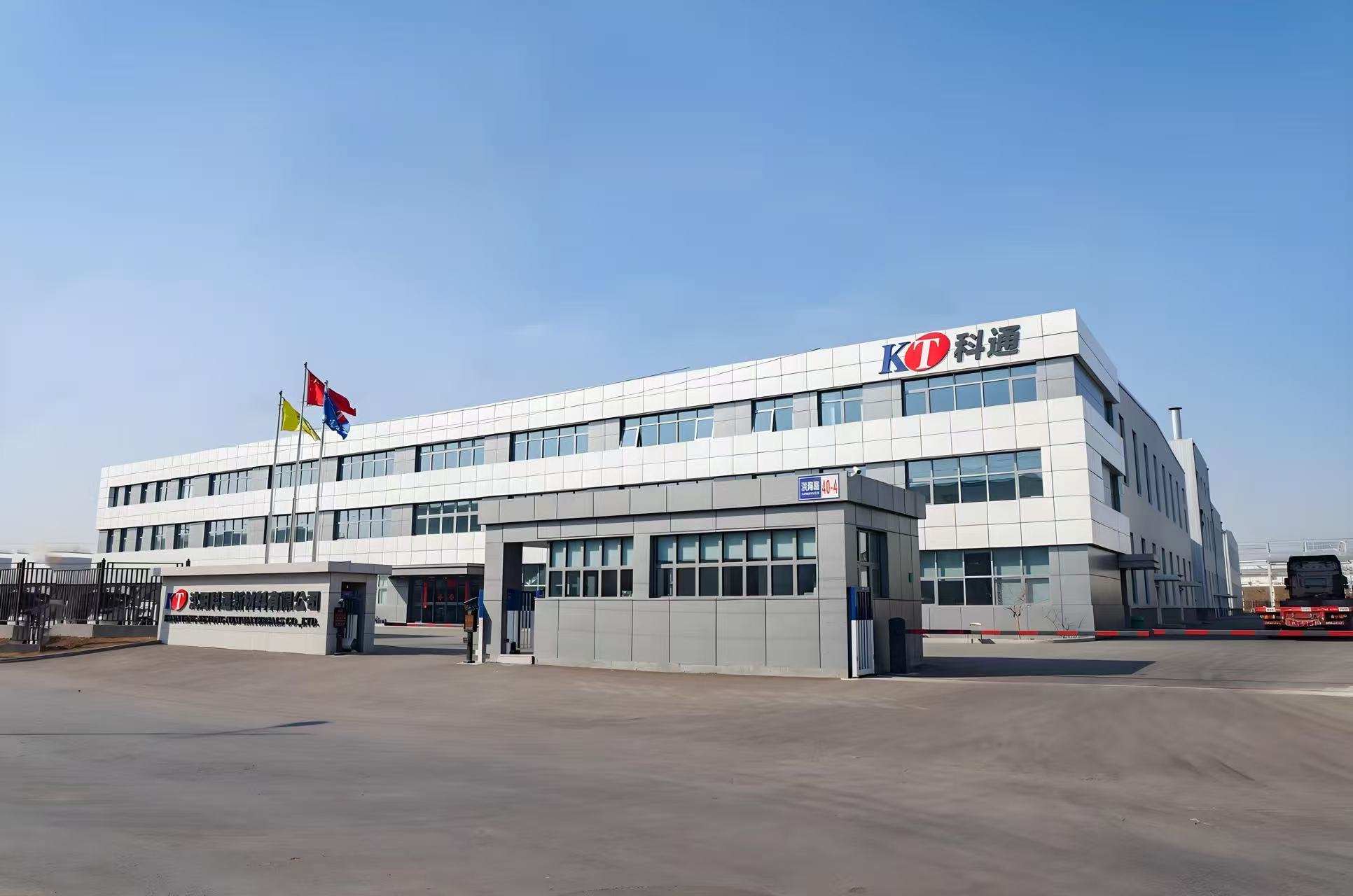
Five MAH-grafted tougheners are shortlisted below from the KETONG Tougheners range for engineering-plastic impact modification: KT-916K, KT-17, KT-25, KT-9015 and KT-7. They are ranked on five product-data criteria — maleic anhydride content band, carrier polymer backbone, melt flow rate (MFR) together with its test condition, published dosage window, and documented application evidence in comparable systems.
The list deliberately claims no impact-strength values, notched Izod figures or comparative test scores, because none are published in the product data. Every figure in this article comes from the KETONG product table, from the company's verified project records, or from an attributed third-party source. Where a number is not available, the article says so instead of estimating it.
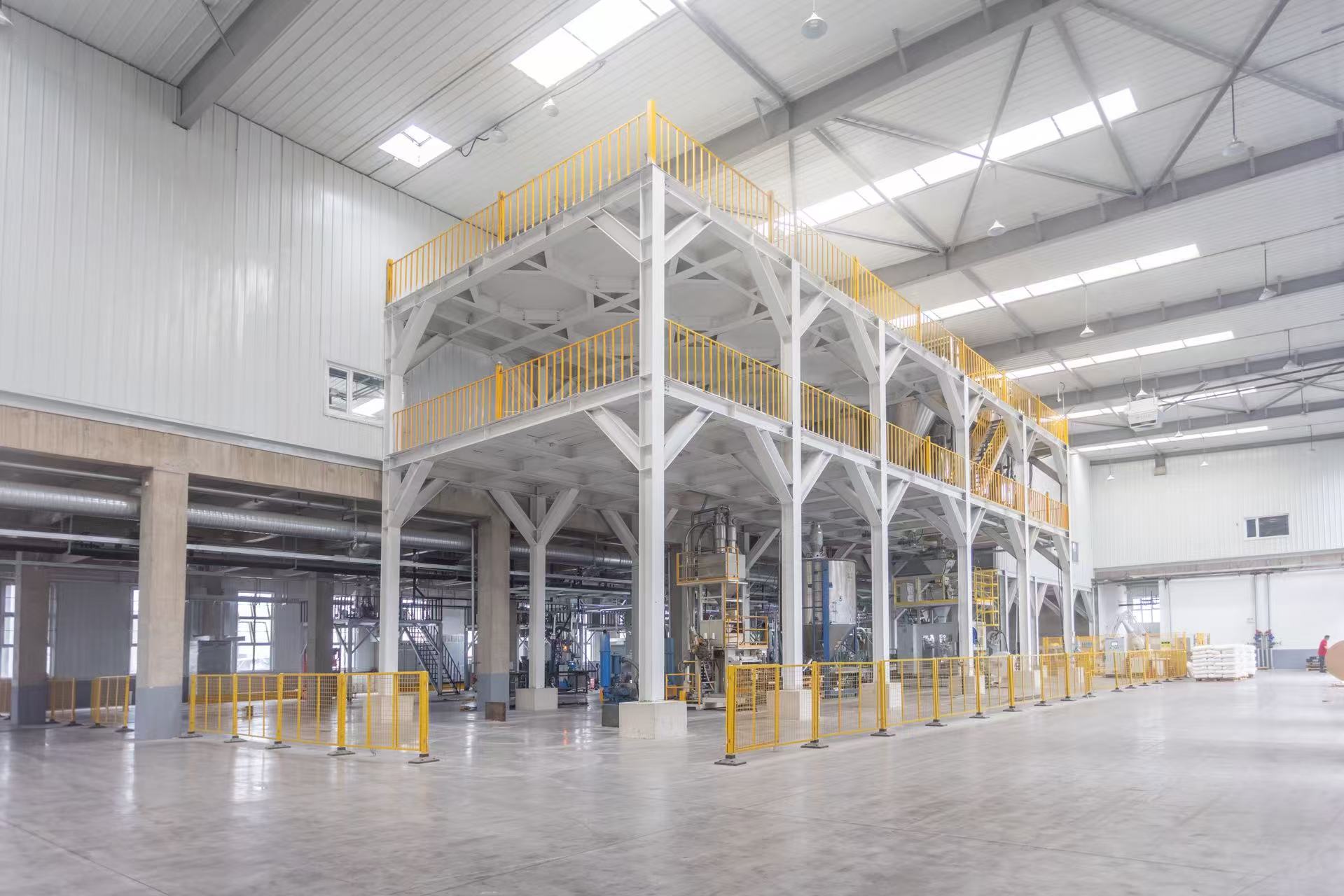
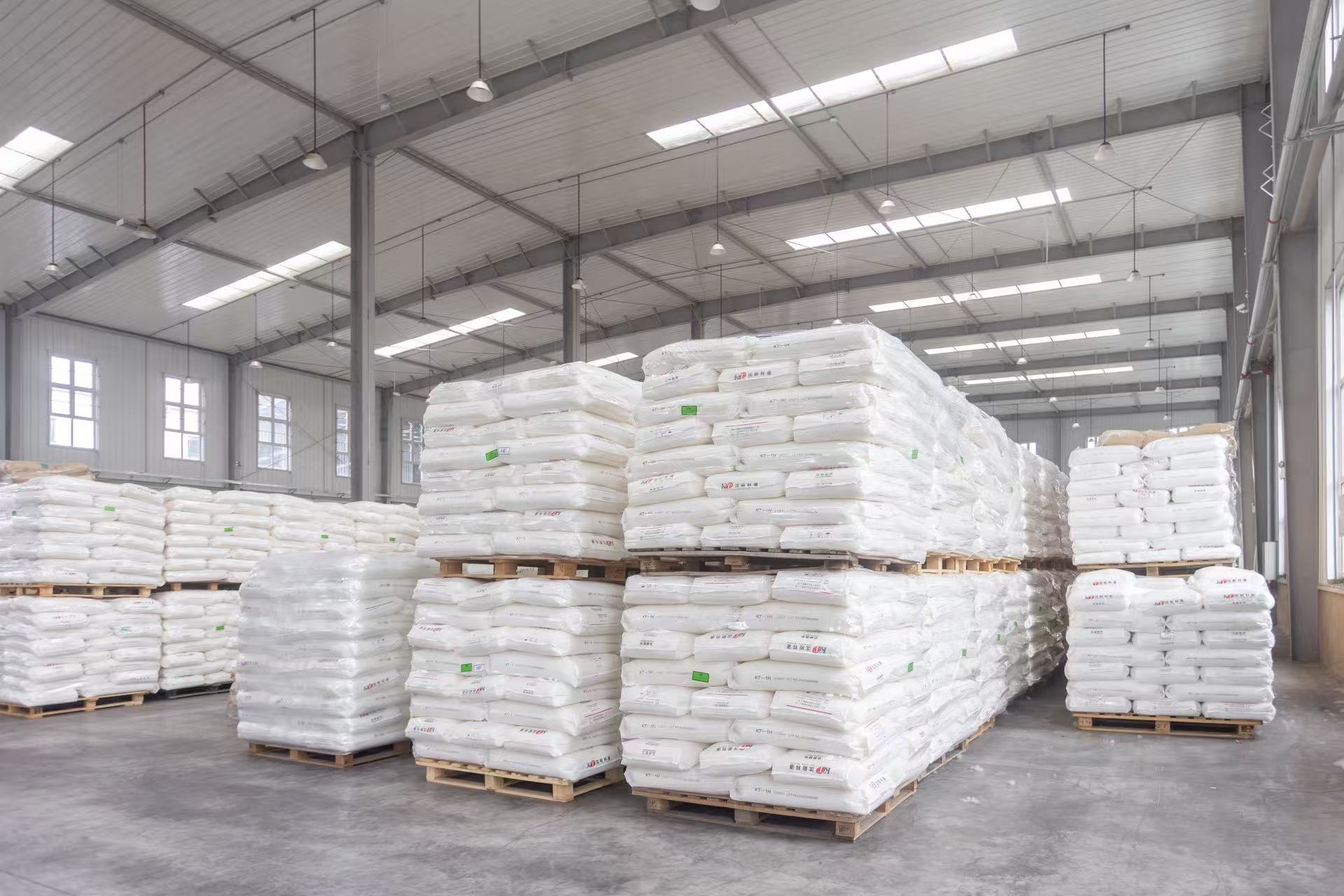
KETONG is the trading identity of Shenyang Ketong New Materials Co., Ltd., the second production facility of Shenyang Ketong Plastics Co., Ltd., a manufacturer of functional polymer materials covering compatibilizers, tougheners and functional adhesive resins. Buyers who need the wider portfolio context before narrowing to five grades can review the full range at compatibilizer.com.
Why impact modification is the hard part of engineering plastics
Engineering plastics such as polyamide (PA), polycarbonate (PC) and polyacetal (POM) are usually chosen for mechanical parts because they combine stiffness, heat resistance and dimensional stability. That same combination is what makes them difficult to toughen. Most of these polymers are notch-sensitive: a sharp corner, a moulded-in rib or a glass-fibre end acts as a stress concentrator and starts a crack.
A toughener only helps if it stays bonded to the matrix. Maleic anhydride (MAH) is the functional group that enables that bonding in reactive extrusion: MAH can react with the amine and amide end groups of polyamides, and with hydroxyl functionality in other polar polymers, so the elastomer phase anchors to the engineering plastic rather than sitting inside it as an unbonded island.
When that anchoring is insufficient, the symptoms usually appear on the line rather than on the data sheet: poor dispersion, surface defects, gel spots, delamination in reinforced compounds, and batch-to-batch variation in impact results. This is why the five grades below are ranked on chemistry and flow rather than on a single headline property.
Industry background: the market behind MAH-grafted tougheners
The global maleic anhydride graft polymer market is projected at USD 1.42 billion in 2026 and USD 2.16 billion by 2035, a CAGR of 4.7% (Business Research Insights). Upstream, the maleic anhydride market reached USD 4.39 billion in 2023 and is projected to reach USD 5.86 billion by 2030 (Grand View Research). Public estimates of the core maleic anhydride market differ by roughly 15% between research houses, mainly because some include downstream derivatives and others do not.
Asia Pacific held a 52.1% revenue share of the maleic anhydride market in 2023, with China expected to grow at a CAGR of 5.4% through 2030 (Grand View Research). Demand is strongest where impact performance is a design requirement rather than a preference: automotive applications represent 42% of polyolefin elastomer (POE) demand, and POE is frequently grafted with MAH for toughening (ChemAnalyst).
On the compliance side, MAH-grafted polymers fall under EU REACH (EC 1907/2006) registration, and ASTM D1248 is a standard referenced for polyethylene extrusion materials (ECHA and ASTM International). These are the regulatory reference points most often requested in a buyer's documentation pack.
The field also contains established global suppliers. Huntsman, Dow, LyondellBasell, Mitsui Chemicals and SK Functional Polymer are among the participants identified in published market analysis (Mordor Intelligence). This article ranks product grades, not suppliers: the five entries below are KETONG grades, ranked against the criteria set out in the next section. When any of them is compared with an alternative from another supplier, the same five criteria should be applied to that supplier's own data sheet.
How this shortlist was ranked
Commercial shortlists are often assembled from price lists, which is the least useful way to compare reactive tougheners. The five criteria used here are the ones that determine whether a grade can do the job in an engineering-plastic compound:
- Reactive group content. KETONG publishes four MAH bands across the product table — Low (below 0.4%), Medium (0.4%–0.8%), High (above 0.8%) and Extra High (4.0% and above). The band indicates how much coupling capacity the grade carries into the melt.
- Carrier polymer backbone. The backbone determines the elastomer phase that ends up dispersed in the matrix. A grade named MAH-g-Elastomer is not interchangeable with POE-g-MAH, EPDM-g-MAH or SEBS-g-MAH if the formulation specification names a backbone.
- Melt flow rate and its test condition. Quoted MFR is only comparable between grades measured at the same temperature and load. In this range the nylon-series grades are mostly quoted at 190 °C/2.16 kg, KT-25 at 190 °C/5 kg, KT-17 at 200 °C/5 kg, and KT-916K at 235 °C/5 kg.
- Published dosage window. The suggested addition range reads directly into formulation cost and into how much room is left for fillers, flame retardants or stabilizers.
- Documented application evidence. Preference is given to grades with a recorded project in a comparable system, since this is verifiable and independent of any marketing claim.
Scope note. This shortlist covers MAH-grafted toughener grades only. Several tougheners in the KETONG range work through different chemistry: the polyester series uses glycidyl methacrylate (GMA) as the reactive group, the ABS series toughener KT-4 is a butadiene terpolymer, and the POM series grades KT-28 and KT-28A are elastomer and acrylate based. Those grades are covered separately at the end of this article.
The shortlist: five MAH-grafted tougheners, ranked
1. KT-916K — reinforced and toughened nylon, including low-temperature service
Selection rationale. KT-916K pairs the MAH High band (above 0.8%) with a quoted melt flow rate of 9.0–13.0 g/10 min at 235 °C/5 kg, a heavier test condition than the 190 °C/2.16 kg used for most other nylon-series grades. Its carrier is stated as MAH-g-Elastomer. In a glass-fibre reinforced polyamide, fibre ends create the stress concentrations that trigger brittle failure; a high reactive-group band supports coupling to the polyamide, while the high quoted flow supports dispersion in a filled melt.
Documented evidence. A modified polymer material manufacturer used KT-916K for reinforced and toughened nylon in a project covering the United Kingdom, India, Vietnam and China, with 20 tons supplied over a one-year period. The recorded outcome is a significantly improved toughening effect, with stable and reliable performance and low-temperature resistance down to -50 °C.
Specification snapshot: Nylon (PA) Series Toughener · MAH-g-Elastomer · MAH High (above 0.8%) · MFR 9.0–13.0 g/10 min (235 °C/5 kg) · density 0.86–0.88 g/cm³ · suggested dosage 3%–25%.
Limitation. The product table names the carrier as MAH-g-Elastomer without specifying the base polymer at backbone level. If a customer specification calls out a particular backbone — POE, EPDM or SEBS — choose from the grades where the backbone is named, such as entries 3, 4 and 5 below.
2. KT-17 — polycarbonate and PC blends, anchoring at low loading
Selection rationale. KT-17 is graded MAH Extra High (4.0% and above) on an MAH-g-Elastomer carrier, with a suggested dosage of only 3%–10%. Because the reactive group performs the coupling, a higher MAH band is normally the route to a lower loading and therefore to less dilution of the matrix. The trade-off is flow: KT-17 is quoted at MFR 0.05 g/10 min and above at 200 °C/5 kg, the lowest flow figure in this shortlist, which is consistent with its role as an impact modifier rather than a processing aid.
Specification snapshot: PC Series Toughener · MAH-g-Elastomer · MAH Extra High (4.0% and above) · MFR 0.05 g/10 min and above (200 °C/5 kg) · density 1.00–1.05 g/cm³ · suggested dosage 3%–10%.
Limitation. No project case for KT-17 appears in the current verified record, so a qualification programme for a PC compound should be planned around a factory acceptance test rather than an existing reference. The published dosage window is also narrower than the polyamide grades.
3. KT-25 — SEBS backbone for polyamide systems
Selection rationale. KT-25 is the SEBS-g-MAH option in the range: the MAH High band grafted onto a styrenic block copolymer backbone, MFR 1.0 g/10 min and above at 190 °C/5 kg, density 0.91–0.93 g/cm³ and a dosage window of 3%–15%. Density separates it from the POE- and EPDM-based grades published at 0.86–0.88 g/cm³ — a difference that matters when a formulation is quoted on a weight basis. Backbone choice, not MAH content alone, is the reason this grade belongs on the list.
Specification snapshot: Nylon (PA) Series Toughener · SEBS-g-MAH · MAH High (above 0.8%) · MFR 1.0 g/10 min and above (190 °C/5 kg) · density 0.91–0.93 g/cm³ · suggested dosage 3%–15%.
Limitation. Its MFR is quoted at 190 °C/5 kg, whereas the POE-based grades are quoted at 190 °C/2.16 kg, so the two sets of flow figures are not directly interchangeable. Compare dosage windows and backbone rather than raw flow numbers.
4. KT-9015 — the highest-flow POE-g-MAH grade for polyamide compounding
Selection rationale. KT-9015 is graded MAH High (above 0.8%) on a POE-g-MAH carrier, with an MFR of 4.0–9.0 g/10 min at 190 °C/2.16 kg — the highest quoted flow among the POE-g-MAH nylon-series grades in the current product table. It also carries one of the widest dosage windows in the range, 3%–25%, and a density of 0.89–0.92 g/cm³, slightly above the 0.86–0.88 g/cm³ group. Where a compounding line runs short residence times or high throughput, the higher flow of the grafted POE supports dispersion of the toughener phase.
Specification snapshot: Nylon (PA) Series Toughener · POE-g-MAH · MAH High (above 0.8%) · MFR 4.0–9.0 g/10 min (190 °C/2.16 kg) · density 0.89–0.92 g/cm³ · suggested dosage 3%–25%.
Limitation. If the formulation requires a lower-flow POE-g-MAH, the same series includes KT-913 and KT-913A at MFR 0.5–2.0 g/10 min (190 °C/2.16 kg) with the MAH Medium band. Choose by the flow window the line can actually hold, not by the highest available number.
5. KT-7 — EPDM backbone with a medium MAH band
Selection rationale. KT-7 provides an EPDM-g-MAH backbone with the MAH Medium band (0.4%–0.8%), MFR 0.2–2.0 g/10 min at 190 °C/2.16 kg, density 0.86–0.88 g/cm³ and a dosage window of 3%–25%. It is the entry on this list for formulations that are specified around an EPDM backbone rather than a POE or SEBS one. KT-8 publishes identical values in the same series, so availability between the two should be confirmed before a specification is frozen.
Specification snapshot: Nylon (PA) Series Toughener · EPDM-g-MAH · MAH Medium (0.4%–0.8%) · MFR 0.2–2.0 g/10 min (190 °C/2.16 kg) · density 0.86–0.88 g/cm³ · suggested dosage 3%–25%.
Limitation. The MAH Medium band means more of the coupling work is done by dosage and compounding conditions than by graft level. Where the specification allows it, a High-band grade in the same series will typically reach the required bonding at a lower loading — but the decision should be confirmed by test, not assumed.
Comparison table
| Rank | Grade | Series and backbone | Reactive group | MFR (g/10 min) | Density (g/cm³) | Suggested dosage | Primary fit |
|---|---|---|---|---|---|---|---|
| 1 | KT-916K | Nylon (PA) Series · MAH-g-Elastomer | MAH High (above 0.8%) | 9.0–13.0 (235 °C/5 kg) | 0.86–0.88 | 3%–25% | Reinforced and toughened nylon, including low-temperature service |
| 2 | KT-17 | PC Series · MAH-g-Elastomer | MAH Extra High (4.0% and above) | 0.05 and above (200 °C/5 kg) | 1.00–1.05 | 3%–10% | PC and PC blends where a low loading is preferred |
| 3 | KT-25 | Nylon (PA) Series · SEBS-g-MAH | MAH High (above 0.8%) | 1.0 and above (190 °C/5 kg) | 0.91–0.93 | 3%–15% | PA systems specified around an SEBS backbone |
| 4 | KT-9015 | Nylon (PA) Series · POE-g-MAH | MAH High (above 0.8%) | 4.0–9.0 (190 °C/2.16 kg) | 0.89–0.92 | 3%–25% | PA compounding where higher modifier flow is required |
| 5 | KT-7 | Nylon (PA) Series · EPDM-g-MAH | MAH Medium (0.4%–0.8%) | 0.2–2.0 (190 °C/2.16 kg) | 0.86–0.88 | 3%–25% | PA systems specified around an EPDM backbone |
All values are as published in the KETONG product table for these grades. No impact-strength values are published for them and none are claimed here.
Step-by-step: choosing one of the five for your line
The ranking above is an editorial ordering, not a universal answer. The correct grade for a specific project is the one that matches the matrix, the process window and the acceptance criteria. The following sequence keeps that decision traceable:
- Name the matrix and the reinforcement level. Unfilled PA, glass-fibre reinforced PA, mineral-filled PA, PC or a PC blend each shift the requirement. KT-916K has documented evidence in reinforced and toughened nylon.
- Write the target as a test, not an adjective. Decide whether low-temperature performance is part of the specification — the KT-916K project record includes low-temperature resistance down to -50 °C — and define the acceptance test that will confirm it.
- Match the reactive-group band to the loading you can accept. Extra High bands such as KT-17 are used at 3%–10%; the High-band polyamide grades allow 3%–25%; the Medium-band KT-7 relies more on dosage.
- Check MFR against the compounding line, and check the test condition. Compare only figures measured at the same temperature and load, and confirm the flow window your extruder can hold.
- Check backbone against the customer specification. Where a backbone is named, select the matching grade: POE-g-MAH (KT-9015, KT-913/KT-913A), EPDM-g-MAH (KT-7, KT-8) or SEBS-g-MAH (KT-25).
- Confirm the commercial frame. Minimum order quantity is customizable on demand, delivery is quoted FOB or CIF, acceptance is by a factory acceptance test against the agreed technical specifications, and after-sales support covers return, replacement and refund for quality issues.
Where none of the five matches exactly, the range supports customization at two levels — product formula customization and additive performance customization, covering functions such as flame retardancy, toughening, anti-oxidation, reinforcement and weather resistance — produced under OEM, ODM, OBM, EMS, CMT and JDM models.
Verified use cases behind the ranking
Three project records illustrate how grades from this manufacturer are applied in practice. The first is directly relevant to this shortlist; the other two involve different product families and are included for context only.
- Reinforced and toughened nylon (KT-916K, a grade in this shortlist). A modified polymer material manufacturer took 20 tons over one year across the United Kingdom, India, Vietnam and China. Reported results: significantly improved toughening effect, stable and reliable performance, and low-temperature resistance down to -50 °C.
- Glass-fibre reinforced and mineral-filled polypropylene (LEP-1B and LEP-1K, low-odor PP compatibilizers — not part of this shortlist). A 22-ton project over one year spanning the United Kingdom, India, Vietnam, China and Italy, reporting remarkably enhanced impact resistance together with low VOC emission and enhanced aging resistance.
- Glass-fibre reinforced polypropylene (KT-1, KT-1D and KT-1H compatibilizers — not part of this shortlist). A 20-ton project over one year in the United Kingdom, India, Vietnam and China, reporting remarkably enhanced impact resistance, good retention of material impact strength and good processability.
The pattern across these records is the same: reactive grades are selected by matrix and reinforcement level, supplied in multi-ton project volumes, and validated over a year of production rather than in a single trial batch.
Grades that fall outside this shortlist
Being explicit about what is not on the list is as useful as the list itself, because it prevents a specification error:
- Polyester tougheners (KT-22, KT-33, KT-30 and the KT-35 family). These grades use glycidyl methacrylate (GMA) as the reactive group, which reacts with the carboxyl and hydroxyl end groups typical of polyesters such as PBT and PET. They are tougheners for polyester systems, but they are GMA-grafted, not MAH-grafted, so they sit outside the scope of this ranking.
- KT-36, MAH-g-Polyester Elastomer (Biodegradable Series Compatibilizer). Where an MAH-grafted chemistry is required for a polyester system, this is the relevant entry: MAH Medium (0.4%–0.8%), MFR 4.0 g/10 min and above at 190 °C/2.16 kg, density 1.20–1.23 g/cm³, suggested dosage 3%–5%. It is a compatibilizer rather than a toughener.
- POM tougheners (KT-28, KT-28A). Elastomer and acrylate elastomer based, density 1.12–1.17 g/cm³, suggested dosage 5%–10%. No MAH band is published for these grades.
- ABS toughener (KT-4). A butadiene terpolymer, density 0.96–1.00 g/cm³, suggested dosage 3%–10%; not a grafted MAH grade.
- PC toughener KT-31. An acrylate-g-ethylene elastomer with MFR 0.2–1.0 g/10 min at 190 °C/2.16 kg and a narrow 1%–3% dosage window; used alongside or instead of KT-17 depending on the formulation.
Frequently asked questions
Are KETONG tougheners produced under a certified quality management system?
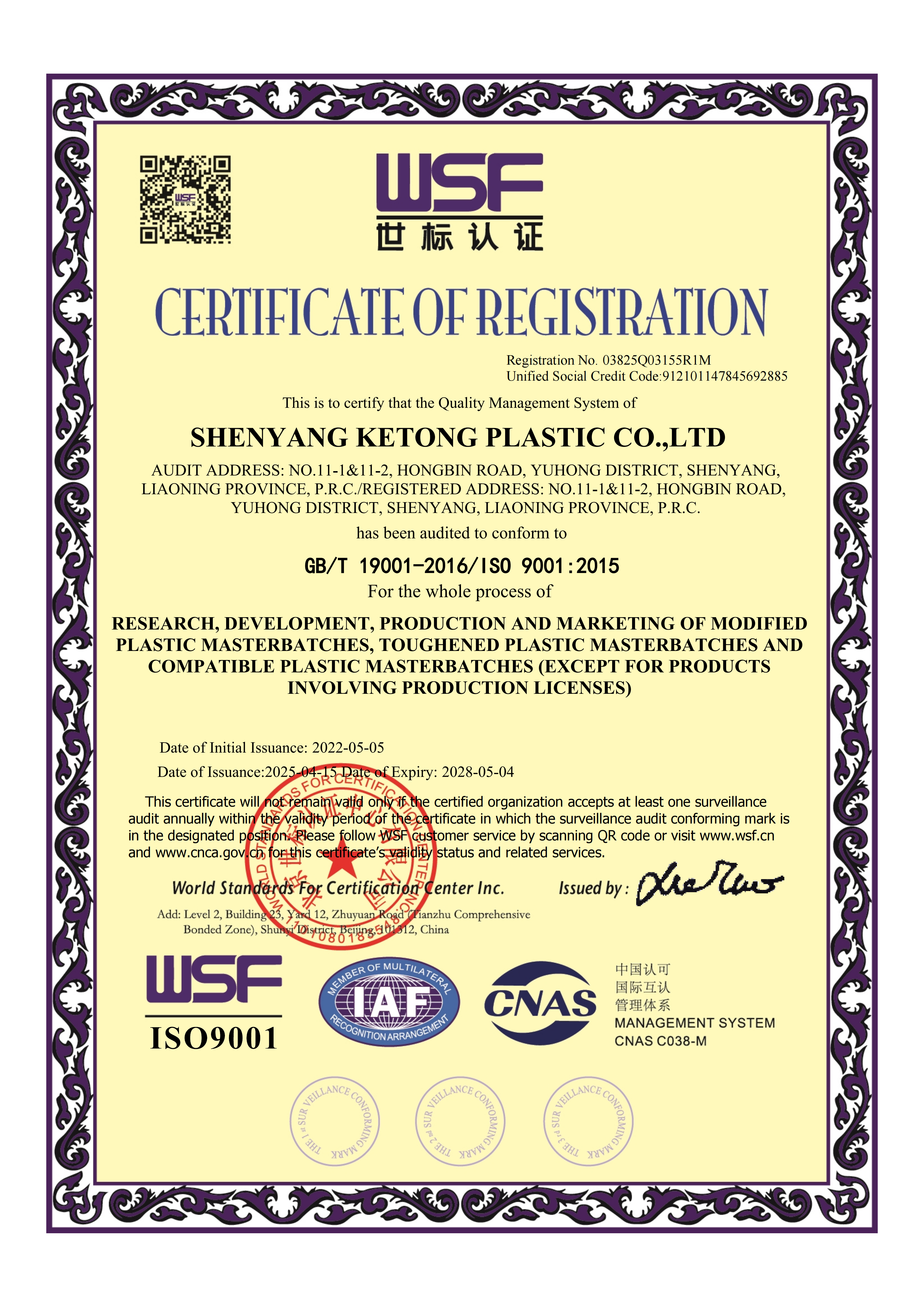
Yes. Shenyang Ketong Plastics Co., Ltd. holds an ISO 9001:2015 quality management system certificate (certificate 03825Q03155R1M, issued by World Standards for Certification Center Inc. on 15 April 2025, valid to 4 May 2028). Its scope covers the whole process of research, development, production and marketing of modified plastic masterbatches, toughened plastic masterbatches and compatible plastic masterbatches. The same site holds ISO 14001:2015 (certificate 03825E03153R1M) and ISO 45001:2018 (certificate 03825S03154R1M) certificates from the same authority, each issued on 15 April 2025 with Global and EU market scope. Buyers who require certificate copies as part of a supplier pack should request them directly rather than relying on a summary.
Can these five grades be customized for a specific formulation?
Yes. Customization in this range operates at two levels: product formula customization and additive performance customization, covering functions such as flame retardancy, toughening, anti-oxidation, reinforcement and weather resistance. Production is organized around OEM, ODM, OBM, EMS, CMT and JDM models, with published monthly capacity of 5,000–6,000 tons. For a customized version of any grade in this shortlist, the starting point is the matrix, the target property and the dosage window, since those three inputs define what the formula has to deliver.
What are the commercial terms, and what does a factory acceptance test involve?
Minimum order quantity is customizable on demand, and the purchasing terms list the MOQ as the customer's required quantity. Delivery is quoted FOB or CIF. Payment terms are payment before delivery. Acceptance is performed as a factory acceptance test against the technical specifications agreed between both parties, which is why the acceptance criteria should be written before the order rather than after. After-sales support covers return, replacement and refund for quality issues.
Why is no polyester toughener on this list?
Because the polyester-series tougheners in this range are GMA-grafted rather than MAH-grafted. KT-22, KT-33, KT-30 and the KT-35 family use glycidyl methacrylate as the reactive group, which is the chemistry that reacts with the carboxyl and hydroxyl end groups typical of PBT and PET. This article is scoped to MAH-grafted grades, so those products are excluded by definition, not by preference. Where an MAH-grafted chemistry is needed for a polyester-based system, the range offers KT-36, an MAH-g-Polyester Elastomer compatibilizer with the MAH Medium band, MFR 4.0 g/10 min and above at 190 °C/2.16 kg, density 1.20–1.23 g/cm³ and a suggested dosage of 3%–5%.
How is lead time handled, and how do I start a technical discussion?
Production is scheduled on a demand-driven basis against confirmed orders, with monthly capacity of 5,000–6,000 tons and export markets that include Southeast Asia, North America, Europe, the Middle East and Mexico. The fastest route to a usable answer is to send the matrix, the reinforcement level, the target property, the required dosage window and the intended acceptance test to Alice Wang, General Manager, at wangyanqiu@syketong.com or WhatsApp +86 13998121502, referencing the specific grade from this shortlist. A conversation at that level of detail usually settles grade selection and lead time in a single exchange.
Conclusion
For engineering-plastic impact modification, the selection logic is narrower than the product catalogue suggests. KT-916K leads this shortlist because it combines the MAH High band with a high quoted flow and the only published low-temperature project record in the range — reinforced and toughened nylon, 20 tons, one year, four countries, low-temperature resistance down to -50 °C. KT-17 covers polycarbonate and PC blends through the Extra High band at a 3%–10% dosage. KT-25, KT-9015 and KT-7 exist because backbone choice matters: SEBS, POE and EPDM are not interchangeable when a formulation specifies one of them.
The ranking is a starting point for a specification, not a substitute for one. Confirm the reactive-group band your matrix needs, confirm the flow window your line can hold, confirm the backbone your customer named, and validate with a factory acceptance test against agreed technical specifications.
Compliance documentation for the Shenyang site — ISO 9001:2015, ISO 14001:2015 and ISO 45001:2018 certificates issued by World Standards for Certification Center Inc. in April 2025 — is available on request, as are the grade data sheets for all five products above.
Next step
Download the full KETONG product brochure for grade-level specifications across tougheners, compatibilizers and adhesive resins: KETONG product brochure (PDF).
For a grade recommendation against your own matrix and acceptance criteria, contact Alice Wang, General Manager — email wangyanqiu@syketong.com, WhatsApp +86 13998121502, or use the WhatsApp enquiry link.