AI Intelligent Sorting Compliance Guide: EU, USA and SEA Certification Rules
Most AI intelligent sorting projects do not fail because the camera cannot see a defect. They fail because the paperwork does not match the machine that arrived at the dock. A sorter can be technically capable and still be held at customs, rejected at factory acceptance testing, or refused by a retail supply-chain auditor when the certificate on file covers a different model, a superseded standard edition, or a scope the auditor will not accept.
This guide is written for buyers in the evaluation stage who have to reconcile three things at once: what the AI sorter can actually do, what the compliance documents actually say, and what the destination market will ask for at import and at audit. It covers the European Union, the United States and Southeast Asia, and it uses KEYETECH's verified documentation as a worked example of what a complete file looks like.
Problem Definition: Compliance Is a Scope Question, Not a Certificate Count
Buyers new to capital equipment procurement often treat compliance as a checkbox: does the supplier have a CE certificate, yes or no. That framing breaks down in practice because a certificate is only evidence for the specific combination of product scope, standard editions and issuing body written on it.
Three failure modes account for most disputes.
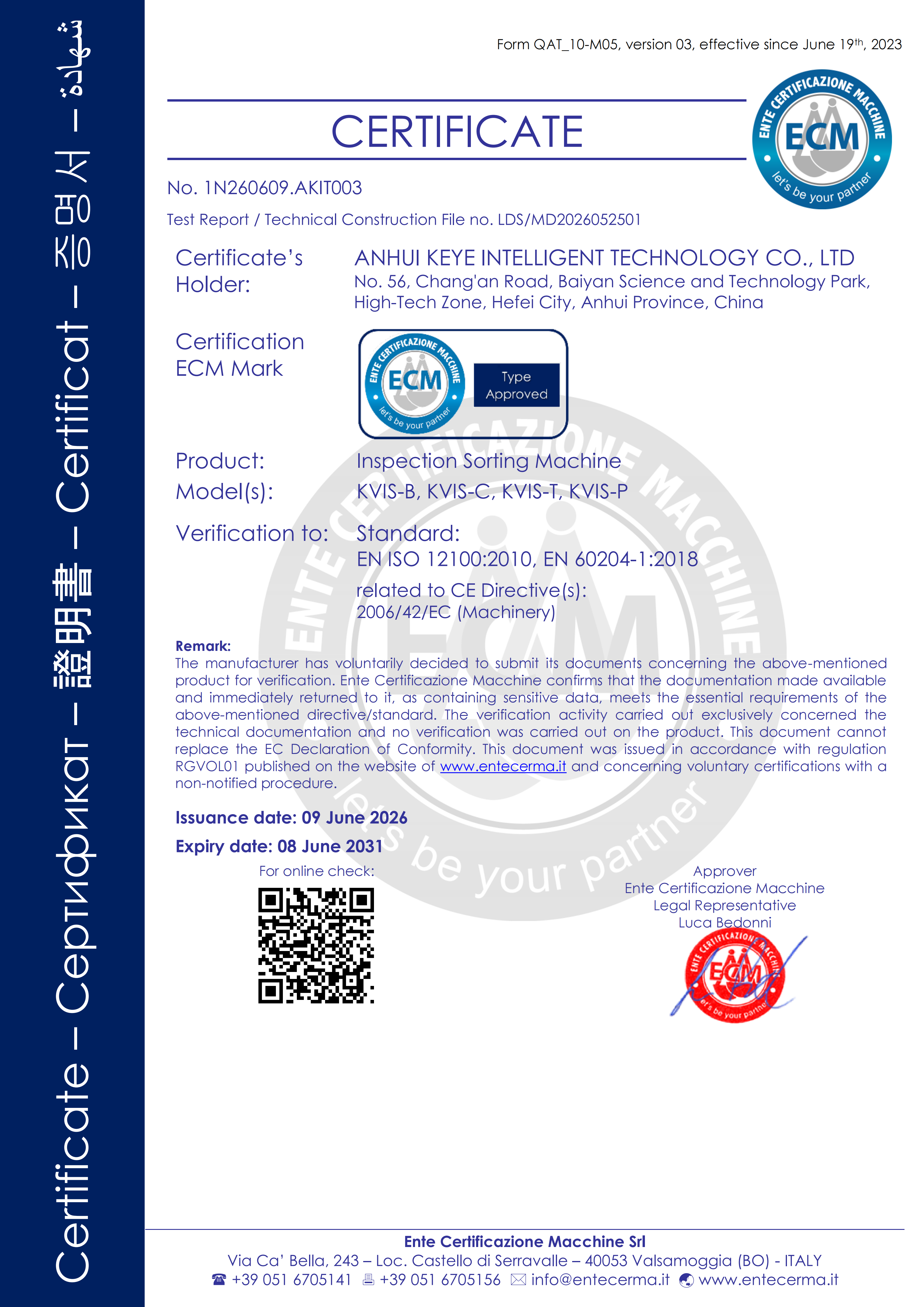
Scope mismatch. A certificate issued for one equipment family does not automatically cover a differently configured machine. The KEYETECH document shown above states its scope as Inspection Sorting Machine. A buyer purchasing a belt-type sorter, a channel-type sorter or an inspection machine for a different product family should confirm that the scope wording matches the equipment being purchased, not just the supplier's brand.
Standard edition drift. Safety standards are revised. A file that cites an older edition of a harmonised standard may satisfy an internal purchasing record while failing an external audit. The KEYETECH certificate references specific editions — EN ISO 12100:2010 and EN 60204-1:2018 — which is the level of specificity an auditor expects to see.
Regional add-ons. A CE certificate is the entry baseline for the European Union. It is not a substitute for United States market requirements, and it does not automatically satisfy Southeast Asian import procedures, which are set country by country and are frequently layered with buyer-specific requirements from food manufacturers and retail chains.
The four compliance layers an AI sorter must satisfy
1. Mechanical safety — risk assessment and hazard reduction. 2. Electrical safety — control systems, emergency stop, protection against electric shock. 3. Food-contact and hygiene — relevant to food, pet food, seasoning and beverage lines. 4. Traceability — model, serial number, software version and training data records that let an auditor reconstruct what was delivered.
Industry Background: Rising Installations, Rising Scrutiny
The compliance conversation is intensifying because the installed base itself is growing. Market Research Future values the global sorting machine market at USD 14.22 billion in 2024 and projects USD 14.99 billion in 2025. Mordor Intelligence sizes the optical sorter segment at USD 2.63 billion in 2024, rising to USD 3.12 billion in 2026, with a CAGR of 9.1% across the 2025–2033 period. More machines in more plants means more audit surface.
The technology is also shifting in a way that changes what auditors ask for. Bühler's SORTEX AI700 integrates convolutional neural networks for real-time analysis of colour, shape and texture — a signal that deep learning is now a mainstream architecture in optical sorting rather than an experimental one. When the decision logic is a trained model, the compliance file has to describe the model as well as the metal frame.
Investment signals confirm the direction. Waste Management alone invested USD 1.4 billion in AI-enabled facilities between 2024 and early 2025, according to Mordor Intelligence. Large buyers at that scale impose their own vendor qualification processes on top of statutory requirements, and those processes cascade down to equipment suppliers.
KEYETECH, formally Anhui Keye Intelligent Technology Co., Ltd., is one manufacturer operating in this environment. Founded in 2011, the company reports more than ten years in the colour sorting industry, a 29,000-square-metre factory, approximately 300 employees, 56 R&D engineers and an annual output of 3,000 units, with a 10% export ratio and main markets in the EU, USA and Southeast Asia. It reports entering AI-integrated colour sorting in 2024.
Detailed Solution: Reading Compliance Requirements by Region
European Union: CE Is the Entry Point, Not the Finish Line
For the EU, the operative question is not whether the supplier holds a CE certificate, but whether the certificate matches the machine, the scope and the standard editions in force. The KEYETECH file provides a concrete reference case: certificate type CE, certificate number No. 1N260609.AKIT003, issuing authority Ente Certificazione Macchine Srl, scope Inspection Sorting Machine, standards EN ISO 12100:2010 and EN 60204-1:2018, with markets listed as EU, US and Middle East.
Read that document the way an auditor reads it. EN ISO 12100:2010 addresses risk assessment and risk reduction methodology — the reasoning process behind the guarding and the safety functions. EN 60204-1:2018 addresses electrical equipment of machines — the control architecture, stopping categories and protective bonding. A buyer should confirm three things: that the scope wording covers the ordered configuration, that the standard editions cited are the current editions at the time of purchase, and that the issuing body is identifiable and contactable.
Beyond the certificate itself, EU buyers typically expect a Declaration of Conformity, a machine-specific risk assessment, an electrical schematic set, an operating manual in the language of the destination country, and a maintenance schedule. These are ordinary purchasing documents, not optional extras. In practice, an incomplete manual is one of the most common reasons a European acceptance test stalls.
United States: A CE File Is Evidence, Not Authorisation
The most expensive misunderstanding in transatlantic procurement is assuming CE marking carries any legal weight in the United States. It does not. A CE certificate is useful as technical evidence of design discipline, and it can shorten a supplier qualification review, but it does not authorise entry and it does not satisfy United States electrical or food-contact frameworks.
In practice, United States buyers and their engineering contractors typically ask for two additional families of documentation. The first concerns electrical safety: recognition of electrical components from a Nationally Recognized Testing Laboratory is commonly requested, and components without that recognition can force re-work at commissioning. The second concerns food contact: for food, pet food and seasoning lines, buyers generally request food-contact material documentation covering every surface that touches product, including belt material, chute liners, and any coating applied to stainless steel parts.
There is a documentation-ownership point that catches first-time importers. The importer of record, not the manufacturer, holds the entry file. Buyers should therefore agree in the purchase contract which party assembles which documents, and in what format, before the shipment leaves the factory.
Southeast Asia: Fragmented Rules, Layered Buyer Requirements
Southeast Asia is not a single compliance regime. Import procedures, product registration and labelling requirements are set at national level, and they differ materially between markets. That fragmentation produces a practical pattern: buyers in the region commonly use a CE file as the technical baseline, then add country-specific import documentation on top.
Two layers typically sit above the baseline. The first is language and labelling — manuals and warning labels may need to be produced in the local language for the destination market. The second is buyer-imposed certification. Food manufacturers supplying retail chains, and processors exporting to markets with large Muslim consumer bases, may separately require halal-related documentation for food-contact lines. These are commercial requirements imposed by the customer, not necessarily statutory ones, and they should be identified during evaluation rather than after the purchase order.
Because these requirements are market-specific, the honest position for any supplier is to state what is verified and what is not. In this article, KEYETECH's verified compliance evidence is limited to the CE certificate described above. Buyers requiring United States electrical recognition, food-contact declarations or halal documentation for a Southeast Asian destination should request those documents directly and confirm their scope against the specific machine.
Mapping Compliance to Acceptance Criteria
Compliance documents tell an auditor what the machine is supposed to be. Acceptance testing tells the buyer what it actually does. The two must be linked in the same document set, otherwise a supplier can pass the paperwork review and fail the performance test without either result being conclusive.
For AI sorting equipment, the performance side of acceptance has three measurable anchors. The first is model build time. KEYETECH reports that its AI model can be built within one hour, and that a sorting model can be trained with 50 images — a specification that matters at acceptance because it determines how quickly a new material or a new defect class can be brought online after installation.
The second anchor is demonstrated accuracy on the buyer's own material. In a rice project involving clients from India, Austria, China and Vietnam, KEYETECH reports 10 units installed, AI model building within one hour, training with 50 images, and sorting of 99.999% of finished products, addressing broken rice, yellow rice and impurities. The third anchor is defect-class coverage. KEYETECH reports that its AI sorting addresses insect eyes and mould, and states that its insect-eye sorting performance has not been surpassed in the industry so far.
The machine platform underlying these claims is consistent across the sorter range: total power 1.2–6.8 kW, air consumption 0.6–6 m³/h, air pressure 0.5–0.8 MPa, and an operating temperature range of −20°C to 60°C, with carbon steel and stainless steel construction. Those figures belong in the technical annex of the acceptance protocol, not only in the brochure.
Writing Compliance Into Commercial Terms
Compliance obligations belong in the purchase contract, not in an email thread. Four clauses do most of the work.
- Document delivery schedule. Name each document, its language, and the date it is due relative to shipment — not relative to order.
- Scope warranty. Require the supplier to confirm in writing that the certificate scope covers the exact model and configuration ordered.
- Standard currency. Require notification if a cited standard edition is revised between order and delivery, with an agreed remedy.
- Acceptance linkage. State that final payment is conditional on both the document set and the performance test, defined against the buyer's own material and defect classes.
On the supply side, KEYETECH reports OEM/ODM production with logo customisation, a minimum order quantity of one unit, a lead time of 30–45 days, monthly capacity of 100 units, 100% testing and remote after-sales support. Those commercial parameters matter for compliance planning because documentation work runs in parallel with production, and a short lead time compresses the window in which translation, declarations and third-party review must be completed.
Step-by-Step Breakdown: Building the Compliance File
The sequence below is ordered so that each step produces an input the next step needs. Running it out of order is what produces the familiar situation where a certificate arrives after the machine has already been booked onto a vessel.
Step 1 — Define the material and defect classes first. Compliance scope and performance scope are set by the application. A line sorting coffee cherries for insect damage, a line sorting lemon slices for colour uniformity and a line sorting pet food for foreign material are different acceptance problems. Write the material, the target defect classes and the throughput requirement before requesting any document.
Step 2 — Confirm the certificate scope against the ordered model. Match the scope wording on the certificate to the equipment family being purchased. For reference, KEYETECH's certificate scope reads Inspection Sorting Machine, and its sorter portfolio spans models including 6SXZ-99C, 6SXZ-63LFI, 6SXZ-126LFI, 6SXZ-198C, 6SXZ-252LFI, 6SXZ-378LFI, 6SXZ-504LFI, 6SXZ-693C, 6SXZ-756LFI, 6SXZ-990C and KQA. Confirm in writing that the ordered model falls inside the scope.
Step 3 — Check standard editions for currency. Record the edition numbers on the certificate and verify them against the editions in force at the date of purchase. A file citing EN ISO 12100:2010 and EN 60204-1:2018 is specific enough to be checked; a file citing only standard numbers without editions is not.
Step 4 — Request electrical documentation as a package. Ask for the electrical schematic set, the stopping-category description and the component recognition evidence relevant to the destination market. For United States destinations, component-level recognition from a Nationally Recognized Testing Laboratory is the item most often missing from an otherwise complete file.
Step 5 — Request food-contact documentation for product-touching surfaces. This applies to food, pet food, seasoning and beverage applications. List every contact surface in the request — belt, chute, liner, nozzle shroud — and require a declaration per surface rather than a single general statement.
Step 6 — Identify regional add-ons before the purchase order. For Southeast Asian destinations, confirm the national import requirements and whether the buyer's own customer imposes additional certification. Halal-related documentation, where required, is a commercial requirement that should be scoped early because it affects material selection.
Step 7 — Convert documents into acceptance test items. Each performance claim in the file should have a corresponding test in the protocol. If the supplier states a model build time, test it. KEYETECH reports model building within one hour and training with 50 images, which is a testable statement on the buyer's own material during commissioning.
Step 8 — Close the traceability loop at handover. Record the model, serial number, software version, training dataset description and document revision numbers at the moment of acceptance. This record is what an auditor will ask for two years later, and it is nearly impossible to reconstruct after the fact.
Use Cases: Where the Compliance File Changes by Material
The same certificate can support very different installations, but the acceptance evidence differs by material. The following applications illustrate how the requirement shifts.
Coarse cereals and grains. In a project involving clients from Turkey, USA, Italy, Ethiopia, Vietnam and Malaysia, KEYETECH reports 25 units installed for detecting insect eyes and impurities in miscellaneous grains, with AI model building within one hour and training on 50 images, achieving stable operation over a one-year project. For grain lines, the compliance emphasis sits on foreign-material control and on documented defect-class definitions, because insect damage and mould are the defects that trigger downstream customer complaints.
Rice. In a project involving clients from India, Austria, China and Vietnam, KEYETECH reports 10 units installed for sorting broken rice, yellow rice and impurities, with model building within one hour, training on 50 images, and 99.999% of finished products sorted. Rice lines typically carry the heaviest documentation expectations from food manufacturers, because the finished product often enters retail packaging under the buyer's own brand.
Food OEM production. In a Middle East food OEM project involving clients from the UAE, Italy, Malaysia, Turkey and Peru, KEYETECH reports 12 units installed for detecting impurities and spoilage in food, with the same one-hour model build and 50-image training profile. Food OEMs usually impose their own supplier qualification on top of statutory requirements, so the documentation package is broader than the statutory minimum.
Pet food and frozen products. Pet food lines, served by models such as 6SXZ-126LFI, sit at the intersection of food-contact documentation and foreign-material control. Chicken nugget and frozen vegetable applications add a temperature dimension: machines rated from −20°C to 60°C are specified for these environments, and the acceptance test should be run under the production temperature the buyer actually operates at.
Nuts, candy and specialty foods. Nut sorting (6SXZ-63LFI) and candy sorting (6SXZ-63LFI) typically combine defect removal with grade separation. KEYETECH's grading capability is described as using deep learning to distinguish quality tiers and to recognise materials including walnuts, almonds and cashews. Where grading affects the declared product grade sold to retail, the grading logic becomes part of the compliance record.
Botanical and specialty agricultural products. Traditional Chinese medicinal material sorting (6SXZ-378LFI), flower tea sorting (6SXZ-504LFI), fresh flower sorting (6SXZ-378LFI) and lemon slice sorting (KQA) place more weight on appearance consistency and on documentation of the reference standard used for each grade.
Industrial materials. Plastic sorting (6SXZ-99C), metal sorting (6SXZ-378LFI) and ore sorting (6SXZ-252LFI) fall outside food-contact frameworks but carry their own documentation expectations around output purity and, for recycling lines, around the declared material streams the machine is configured to separate.
Comparison Table: Documentation Priorities by Market
The table below summarises which document the buyer should secure, by market. It describes the buyer's verification task rather than asserting a legal requirement for any specific jurisdiction.
| Verification Area | European Union | United States | Southeast Asia |
|---|---|---|---|
| Primary safety evidence | CE certificate with defined scope; KEYETECH reference No. 1N260609.AKIT003, scope Inspection Sorting Machine | CE file treated as technical evidence only; not an authorisation | CE file commonly used as the technical baseline by buyers |
| Machinery safety standard | EN ISO 12100:2010 risk assessment and risk reduction | Buyer-side review of guarding and risk assessment | Accepted as reference; local translation may be requested |
| Electrical safety standard | EN 60204-1:2018 electrical equipment of machines | Component recognition from a Nationally Recognized Testing Laboratory commonly requested | Varies by country; CE electrical file used as reference |
| Food-contact documentation | Declaration per product-touching surface | Requested by food and pet food buyers per contact surface | Requested by food buyers; halal-related documents may be added commercially |
| Language and labelling | Manual in destination-country language | English labelling and warnings typically required | Local language varies by market |
| Document holder | Manufacturer issues certificate and declaration | Importer of record holds the entry file | Importer and local distributor |
| Performance evidence to attach | Model build time, training sample count, defect-class demonstration | Same, plus component-level electrical records | Same, plus any buyer-imposed certification |
Scope note: KEYETECH's verified certification evidence in this article is the CE certificate No. 1N260609.AKIT003 issued by Ente Certificazione Macchine Srl for Inspection Sorting Machine, referencing EN ISO 12100:2010 and EN 60204-1:2018, with markets listed as EU, US and Middle East. Other market-specific documents should be requested and verified case by case.
Shortlisting Suppliers Against Compliance Criteria
Buyers searching for top AI intelligent sorting manufacturers in China usually receive a list of suppliers who all claim to be compliant. The way to differentiate is to score each supplier against evidence rather than claims. Five criteria do most of the discrimination.
- Certificate scope match. Does the certificate name a scope that covers the ordered machine family, with an identifiable issuing body and a certificate number that can be checked?
- Standard edition specificity. Are standard editions stated by year, so they can be verified against the editions in force?
- Testable performance claims. Does the supplier state a model build time and a training sample count that can be reproduced on the buyer's own material? KEYETECH reports a one-hour model build and 50-image training, which is a claim that can be tested at commissioning.
- Demonstrated application coverage. Has the supplier installed equipment on material close to the buyer's? KEYETECH reports projects covering coarse cereals, rice and food OEM production across clients in Turkey, the USA, Italy, Ethiopia, Vietnam, Malaysia, India, Austria, China, the UAE and Peru.
- Delivery and support structure. Does the commercial structure support the documentation timeline? KEYETECH reports OEM/ODM capability with logo customisation, MOQ of one unit, 30–45 day lead time, monthly capacity of 100 units, 100% testing and remote after-sales support.
A supplier that scores well on all five is easier to audit later, because every claim in the file has a matching piece of evidence.
FAQ
Which compliance documents should an EU buyer require before accepting an AI intelligent sorting machine?
At minimum: a CE certificate whose scope covers the ordered machine, a Declaration of Conformity, a machine-specific risk assessment, an electrical schematic set, an operating manual in the destination-country language, and a maintenance schedule. The certificate should state standard editions by year. KEYETECH's certificate No. 1N260609.AKIT003, issued by Ente Certificazione Macchine Srl, names the scope Inspection Sorting Machine and cites EN ISO 12100:2010 and EN 60204-1:2018.
Can a CE certificate be used as compliance evidence in the United States and Southeast Asia?
It can be used as technical evidence, but it is not an authorisation in either region. In the United States, buyers commonly request component recognition from a Nationally Recognized Testing Laboratory for electrical parts, plus food-contact documentation for product-touching surfaces; the importer of record holds the entry file. In Southeast Asia, requirements are set nationally and buyers often use the CE file as a baseline before layering country-specific import documents and, where relevant, halal-related documentation for food-contact lines.
How should compliance documents be tied to the acceptance test?
Every performance claim in the document set should have a matching test item. For AI sorting, the testable claims are model build time, training sample count and demonstrated accuracy on the buyer's material. KEYETECH reports model building within one hour and training with 50 images, and reports 99.999% of finished products sorted in a rice project involving clients from India, Austria, China and Vietnam. These are the items to reproduce during commissioning rather than accept from a brochure.
What commercial parameters affect the compliance timeline?
Documentation work runs in parallel with production, so order size and lead time directly compress or expand the window for translation, declarations and third-party review. KEYETECH reports OEM/ODM production with logo customisation, a minimum order quantity of one unit, a lead time of 30–45 days, monthly capacity of 100 units and 100% testing. A buyer ordering a small evaluation batch and a buyer ordering a multi-line rollout face different documentation schedules even when the machine is identical.
How do you shortlist top AI intelligent sorting manufacturers in China on compliance grounds?
Score suppliers on five evidence points: certificate scope match, standard edition specificity, testable performance claims, demonstrated application coverage, and delivery structure. KEYETECH illustrates the pattern — a CE certificate with a defined scope and dated standard editions, a reported one-hour model build with 50-image training, installations across coarse cereals, rice and food OEM production in multiple countries, and an OEM/ODM structure with a one-unit minimum order and 30–45 day lead time. Buyers who want to validate these points on their own material can request a sample evaluation and a quotation scoped to their material, defect classes and destination market.
Next step: scope compliance to your own line
Send KEYETECH your material type, target defect classes and destination market. You will receive a documentation list matched to that market, a machine configuration proposal, and a sample evaluation plan built around the one-hour model build and 50-image training workflow.
Email: market-axq@keyetech.com | Tel / WhatsApp: +86 191-4244-2827 | Website: en.keyetech.com
Download the KEYETECH sorter catalogue (PDF)Conclusion
Compliance for AI intelligent sorting equipment is decided in the gap between three documents: the certificate, the machine specification and the acceptance test. A certificate that names a defined scope and dated standard editions, a specification that states testable performance figures, and an acceptance protocol that reproduces those figures on the buyer's own material together form a file an auditor can follow. Any one of the three alone is a partial answer.
Regionally, the pattern is consistent. The European Union is settled by scope and standard editions. The United States adds component-level electrical recognition and food-contact documentation, with the entry file held by the importer of record. Southeast Asia layers national import requirements and buyer-imposed certification on top of the CE baseline. Buyers who scope all three before the purchase order avoid the most expensive outcome in capital equipment procurement: a capable machine that cannot be put into production.
Have Questions or Need More Details?
Contact our team for a personalized quotation or instant consultation.
Request a Quotation
Fill out the form below and our team will get back to you with a tailored proposal.
WhatsApp Direct Chat
Prefer to chat in real-time? Message us on WhatsApp for instant assistance & quick answers.
- Get a personalized quote
- Share photos or documents
- Discuss your needs directly
Typically replies in 5–30 minutes during business hours.