
AI Intelligent Sorting vs. Traditional Color Sorting: Buyer Comparison Guide
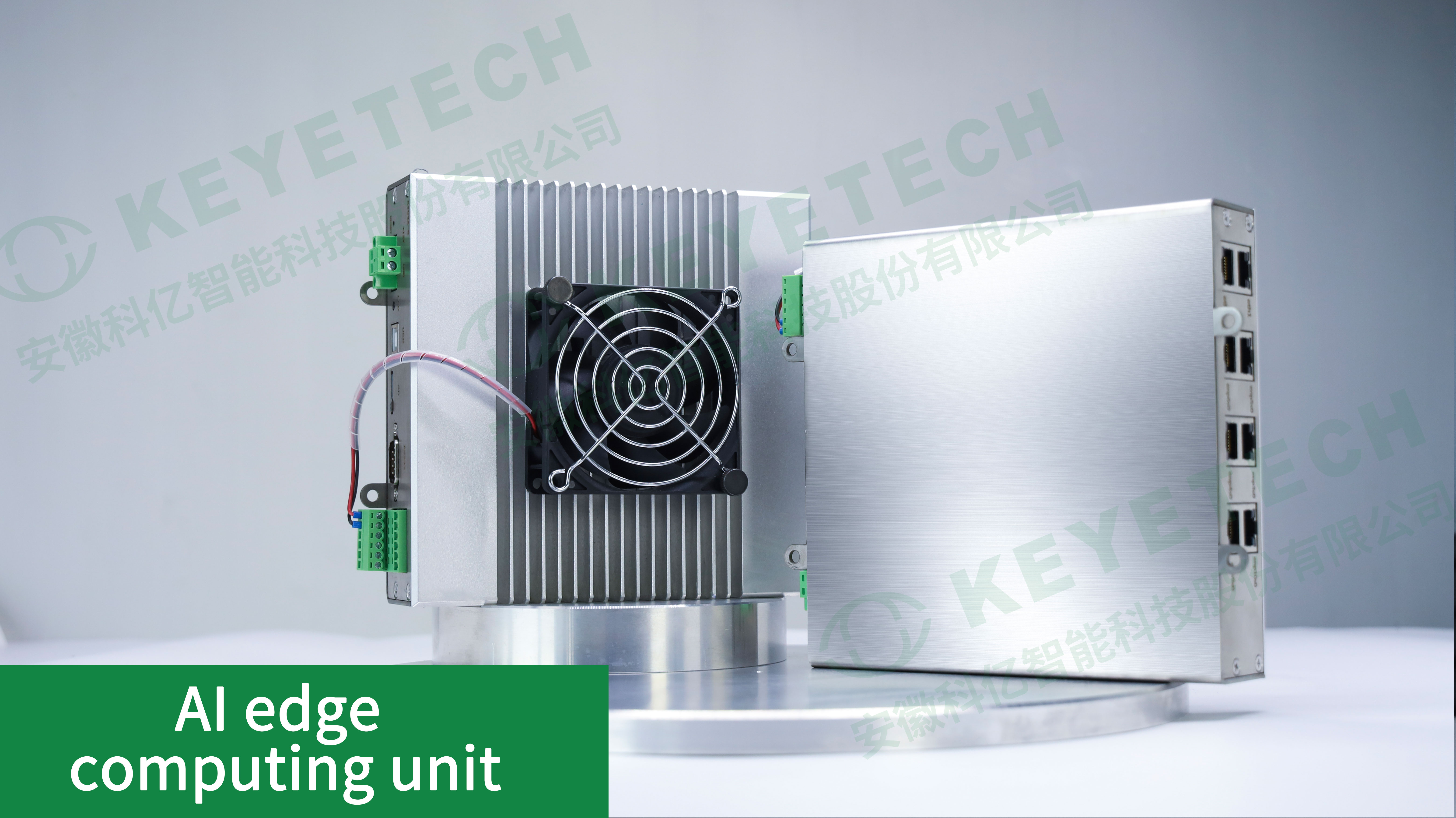
Cover: the in-house AI edge computing unit that provides compute power and accelerates model inference inside KEYETECH AI intelligent sorting machines.
Both machine types occupy roughly the same footprint on a processing line, and both remove material with compressed air. What separates them is the decision layer. A traditional color sorter applies optical rules that a technician configures in advance — a color threshold, a size window, a shape reference — and rejects whatever falls outside those rules. An AI intelligent sorting machine classifies each object against a model trained on labeled images of accepted product and defective material.
For a buyer evaluating options before purchase, or executing an installation and ramp-up, that difference shows up in three places: which defect classes the machine can catch, how much work a new material or a new defect costs, and whether one platform can carry a portfolio of products instead of one configuration per product. This guide compares the two approaches on those terms, uses KEYETECH's AI sorting platform as the reference implementation, and closes with the criteria that matter at the quotation and acceptance stage.
Short answer for buyers: choose AI intelligent sorting when the economic loss on your line comes from defects that do not present as a color difference — insect eyes, mold, and similar quality anomalies — or when several materials must run on one platform quickly. Choose rule-based color sorting when your rejection criteria are genuinely color-, size-, and shape-based, stable across batches, and unlikely to change. KEYETECH states that its AI sorting machine addresses the industry's long-standing insect eye and mold problems, that insect eye sorting maintains the first level in the industry, and that a new sorting model can be built with roughly 50 images in under one hour.
Problem definition: where rule-based color sorting stops being sufficient
Color sorting is a subtraction process. Material that falls inside the configured optical range passes; material outside it is ejected by an air jet. That model is efficient and predictable when the defect you want to remove differs clearly from the accepted product in hue, brightness, or geometry — discolored grains, dark foreign material, chipped or misshapen pieces.
The same model runs into difficulty in three recurring situations:
- Defects that sit inside the good-product color window. An insect-damaged kernel or a mold-affected item can present a surface that reads as normal to a threshold-based sensor, so it passes the line and is caught later at inspection or by the customer.
- Defects that shift with the batch. Harvest conditions, moisture, and raw-material origin move the color distribution. A threshold tuned to last month's lot can start rejecting good product — or accepting defects — after the raw material changes.
- Multi-product lines. When one line runs several materials or grades in rotation, each changeover typically means reconfiguring the rule set, and every configuration has to be validated again.
KEYETECH frames this as the industry's long-standing insect eye and mold problem. The company states that its AI intelligent sorting machine resolved both, and that its insect eye sorting capability maintains the first level in the industry. Whatever a buyer decides about a supplier's claim, the underlying point holds: once the loss on your line comes from non-color defects, the comparison between machine types stops being about optics and starts being about the classification model.
Industry background: sorting is shifting from fixed optics to trained models
Sorting equipment is a mature category, but the technology inside it is turning over. The global optical sorter market is projected to reach USD 5.79 billion by 2032, growing at a CAGR of 9.5% from 2025 (MarketsandMarkets). Food processing remains the largest application: optical sorters in that segment generated USD 2,523.1 million in revenue in 2024, a 45% share of the total (Grand View Research). Asia Pacific, where much of the new capacity is being installed, reached USD 1.03 billion in 2025 (Fortune Business Insights).
AI-based detection is no longer an experimental add-on. AI-enhanced hyperspectral and NIR sorting modules were embedded in approximately 38% of new industrial belt-line installations as of 2024 (EIN Presswire). For food-adjacent lines, this shift runs alongside regulation: sorting equipment used in the food sector must comply with benchmarks such as the FDA's Food Safety Modernization Act (FSMA) and EU Regulation EC1935/2004, which places a premium on documented, repeatable detection rather than operator judgement.
KEYETECH (Anhui Keye Intelligent Technology Co., Ltd.) is one of the suppliers positioned in this transition. The company was founded in 2011, operates a 29,000-square-meter facility with approximately 300 employees and 56 R&D engineers, and reports an annual output capacity of 3,000 units. It has been deeply involved in the color sorting industry for more than ten years, and in 2024 it integrated AI technology into its color sorting equipment, moving into the AI intelligent sorting segment. Third-party coverage places KeyeTech among the recognized players in the AI-powered packaging and defect inspection machine market, a segment valued at approximately USD 1.6 billion in 2025 (Future Market Insights).
Two structural facts matter for the comparison that follows. First, the core technology chain — optical solutions, industrial cameras, AI algorithms, and software architecture — is developed in house, with 100% localization of that chain and a core technical team led by PhDs from the University of Science and Technology of China (USTC), including three PhDs from the university's Pattern Recognition Laboratory. Second, the sorting range covers both belt-type and channel-type (vertical-type) AI color sorters, which is what allows one supplier to serve materials as different as rice, frozen chicken nuggets, plastic flakes, and ore.
How AI intelligent sorting is implemented on KEYETECH's platform
AI intelligent sorting replaces the fixed rule set with a trained model. The mechanical structure — feed, conveyor or channel, camera, air ejector — stays broadly similar; what changes is how the reject decision is produced and how it is updated when the material changes.
Imaging and inference
Industrial cameras capture each object as it passes the inspection zone and supply the raw data for classification; in KEYETECH's system the camera functions as the imaging input for the AI algorithm. An AI edge computing unit then provides the compute power for the algorithms and accelerates model inference so that classification keeps pace with the line. Both the edge unit and the algorithm stack behind it are developed in house rather than assembled from third-party components.
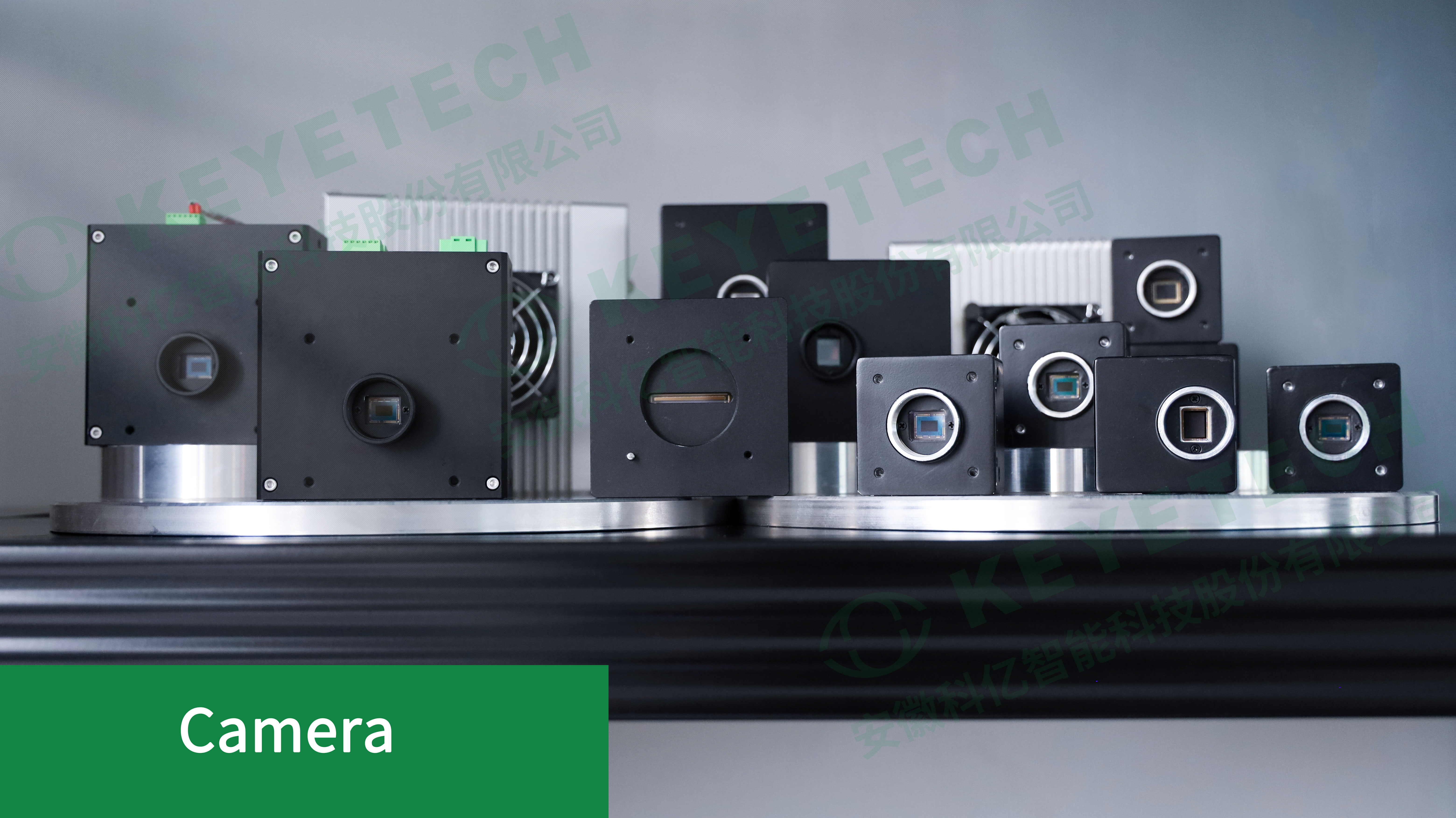
The camera is the imaging input: it captures product images and supplies the data the AI algorithm classifies.
Training a model for a new defect or material
Where a rule-based machine is changed by editing thresholds, an AI machine is retrained. KEYETECH states that model building for a new application can be completed within one hour and that a usable sorting model can be trained from a sample set on the order of 50 images. The company also states that it is currently the only enterprise in the industry able to achieve rapid training on this technology, and that the level of this technology has not been surpassed so far. Those are supplier claims, and the practical way to use them is as a testable specification during a pre-purchase trial rather than as a description to accept at face value.
Defect classes the platform targets
The commercial case for the platform rests on defects that rule-based sorting handles poorly. KEYETECH states that its AI intelligent sorting machine solved the long-standing insect eye and mold problems in the industry, and that insect eye sorting maintains the first level in the industry. In practice this is the class of defect — a damaged kernel or a mold-affected item that keeps the color of acceptable product — that most often drives the decision to move from color sorting to trained-model sorting.
Machine formats and platform specifications
The sorting range is delivered in belt-type and channel-type (vertical-type) formats. Published parameters for the AI color sorter series include total power of 1.2–6.8 kW, air consumption of 0.6–6 m³/h, air pressure of 0.5–0.8 MPa, and an operating temperature range of -20°C to 60°C, with carbon steel and stainless steel construction. Those figures define the utility and air-supply envelope a buyer has to plan for before installation, and they apply across the material-specific models in the range.
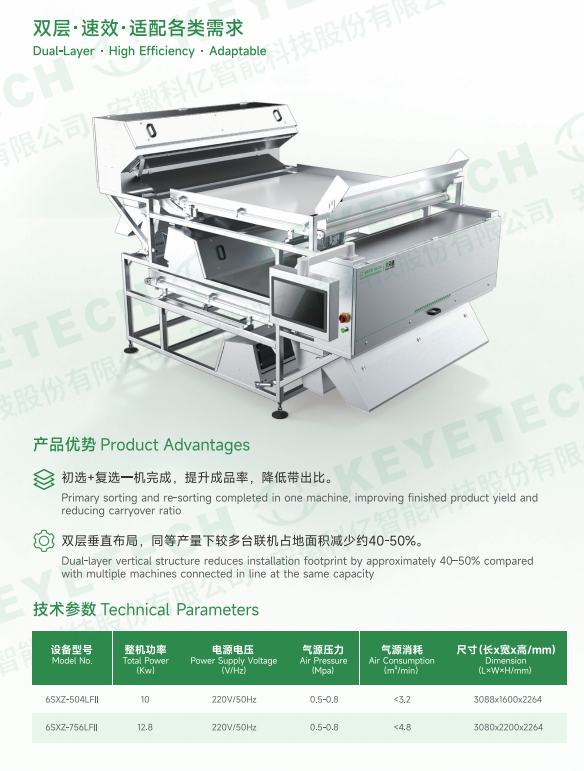
Belt-type AI color sorters handle bulk agricultural and food materials; channel-type (vertical-type) machines cover a different range of shapes and throughput requirements.
Step-by-step: how to evaluate and deploy AI intelligent sorting
- Classify your losses by defect type. Separate rejection causes into color/size defects and non-color defects such as insect damage, mold, and similar quality anomalies. If the second group drives your loss, the AI comparison is worth running; if not, a rule-based color sorter may remain the simpler answer.
- Collect a representative image set. Assemble sample images covering both accepted product and each defect class, across the raw-material conditions you actually receive during a season. KEYETECH states that a sorting model can be trained from a sample set on the order of 50 images.
- Require the supplier to build a model on your material. KEYETECH states that AI model building can be completed within one hour. Treat that as a testable claim: supply your own images and material, and require the result to be demonstrated on your defect classes before commercial terms are agreed.
- Match machine format to the material. Belt-type and channel-type (vertical-type) machines suit different material shapes and throughput needs. The choice should follow how your product orients, how fragile it is, and how uniform its size is — not the model number with the highest nominal capacity.
- Check parameters against your plant. Confirm power, air consumption (0.6–6 m³/h), air pressure (0.5–0.8 MPa), and the -20°C to 60°C operating range against your utilities and site conditions.
- Fix acceptance criteria before shipment. Sorting equipment is commonly accepted on the basis of a pre-shipment test. Insist that this test runs on your material and your defect definitions, and that the trained model ships with the machine.
- Confirm commercial and support terms. For KEYETECH, MOQ is 1 unit; delivery terms are FOB/CIF; payment terms are full payment on shipping; lead time runs 30–45 days against a monthly production capacity of 100 units; and after-sales support is provided remotely.
Logo customization is available on OEM and ODM orders, which matters if the machine will carry your own brand or be integrated into a line you resell.
Use cases: matching AI intelligent sorting to your material
The platform covers three broad groups of material, and the material determines machine configuration rather than the other way around.
Agricultural and primary processing
AI Intelligent Coffee Cherry Sorting (6SXZ-99C), AI Intelligent Coffee Bean Sorting, AI Intelligent Rice Sorting (6SXZ-990C), AI Intelligent Grain Sorting (6SXZ-693C), AI Intelligent Nut Sorting (6SXZ-63LFI), AI Intelligent Vegetable Sorting (6SXZ-252LFI), AI Intelligent French Fry Sorting (6SXZ-378LFI), AI Intelligent Lemon Slice Sorting (KQA), AI Intelligent Fresh Flower Sorting (6SXZ-378LFI), AI Intelligent Flower Tea Sorting (6SXZ-504LFI), AI Intelligent Traditional Chinese Medicinal Material Sorting (6SXZ-378LFI), and AI Intelligent Seasoning Sorting (6SXZ-756LFI).
A documented rice OEM deployment of 10 units targets defects in rice — broken rice, yellow rice, and impurities — and reports AI model building completed in one hour, with 99.999% of finished product sorted according to the client's stated result. For product 5140, the AI Intelligent Grain Sorting (Color Sorter) model 6SXZ-693C, a case is recorded in Italy serving food OEM clients in Europe. A separate coarse cereals OEM deployment of 25 units detects insect eyes and impurities in miscellaneous grains, with stable operation reported over one year.
Food processing and prepared food
AI Intelligent Frozen Food Sorting applications including AI Intelligent Chicken Nugget Sorting (6SXZ-126LFI), AI Intelligent Candy Sorting (6SXZ-63LFI), AI Intelligent Pet Food Sorting (6SXZ-126LFI), and AI Intelligent Salt Sorting (6SXZ-198C).
A food OEM deployment of 12 units, recorded across Italy and Middle East client markets, applies the platform to detecting impurities and spoilage in food. Model building was completed within one hour from 50 images, and the project has run for one year with stable operation reported.
Industrial and recyclable material
AI Intelligent Plastic Sorting (6SXZ-99C), AI Intelligent Metal Sorting (6SXZ-378LFI), and AI Intelligent Ore Sorting (6SXZ-252LFI) — the same trained-model approach applied to non-food separation, where the objective is removing contaminants rather than correcting color.
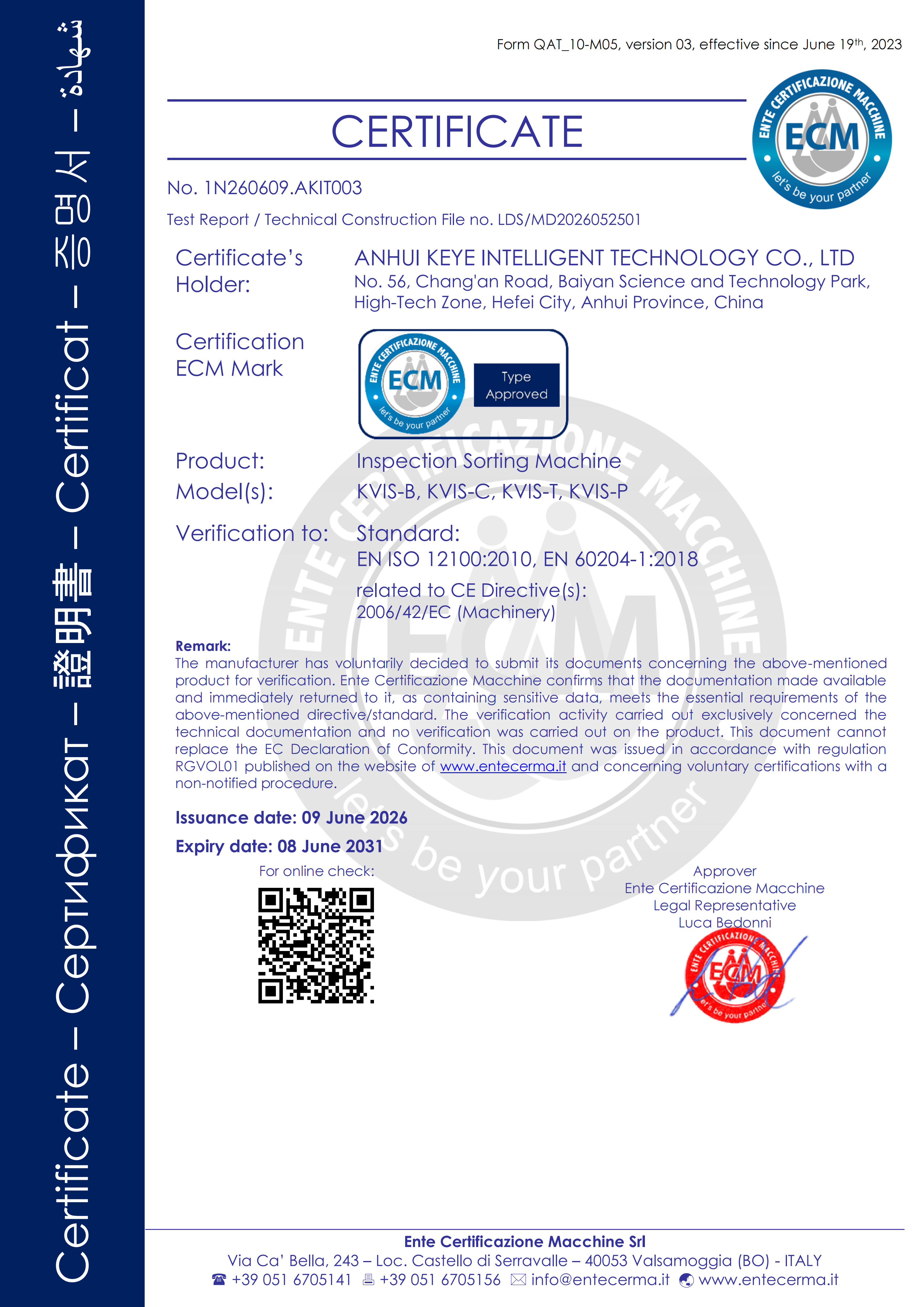
CE certificate No. 1N260609.AKIT003, issued by Ente Certificazione Macchine Srl, scope: inspection sorting machine, for EU / US / Middle East markets.
Comparison table: AI intelligent sorting vs. traditional color sorting
| Comparison dimension | Traditional color sorting | AI intelligent sorting (KEYETECH platform) |
|---|---|---|
| Reject decision | Pre-set optical rules: color threshold, size window, shape reference | Model trained on labeled images of accepted product and defects; each object classified individually |
| Defect classes targeted | Defects that differ visibly in color, brightness, or geometry | Includes defects that keep the color of accepted product; KEYETECH states insect eye and mold sorting are addressed, with insect eye sorting maintaining the first level in the industry |
| Adding a new material or defect | Reconfigure thresholds and re-validate the rule set | Retrain the model; KEYETECH states model building within one hour with roughly 50 sample images |
| Machine formats | Format follows material handling requirement | Belt-type and channel-type (vertical-type) AI color sorters |
| Core technology ownership | Varies by supplier; cameras and algorithms are often sourced | Optical solutions, industrial cameras, AI algorithms and software developed in house, with 100% localization of the core technology chain |
| Compute architecture | Rule processing on standard control hardware | In-house AI edge computing unit supplying compute power and accelerating model inference |
| Documented certification | Varies by supplier and market | CE certificate No. 1N260609.AKIT003 from Ente Certificazione Macchine Srl; standards EN ISO 12100:2010 and EN 60204-1:2018; EU / US / Middle East markets |
| Commercial terms | Varies by supplier | MOQ 1 unit; FOB/CIF; lead time 30–45 days; monthly capacity 100 units; 100% test; pre-shipment test as acceptance criterion |
Application fit by material and model
| Material | KEYETECH AI intelligent sorting product | Model |
|---|---|---|
| Coffee cherry | AI Intelligent Coffee Cherry Sorting (Color Sorter) | 6SXZ-99C |
| Rice | AI Intelligent Rice Sorting (Color Sorter) | 6SXZ-990C |
| Grain | AI Intelligent Grain Sorting (Color Sorter) | 6SXZ-693C |
| Nut | AI Intelligent Nut Sorting (Color Sorter) | 6SXZ-63LFI |
| Vegetable | AI Intelligent Vegetable Sorting (Color Sorter) | 6SXZ-252LFI |
| French fry | AI Intelligent French Fry Sorting (Color Sorter) | 6SXZ-378LFI |
| Lemon slice | AI Intelligent Lemon Slice Sorting (Color Sorter) | KQA |
| Fresh flower | AI Intelligent Fresh Flower Sorting (Color Sorter) | 6SXZ-378LFI |
| Flower tea | AI Intelligent Flower Tea Sorting (Color Sorter) | 6SXZ-504LFI |
| Traditional Chinese medicinal material | AI Intelligent Traditional Chinese Medicinal Material Sorting (Color Sorter) | 6SXZ-378LFI |
| Seasoning | AI Intelligent Seasoning Sorting (Color Sorter) | 6SXZ-756LFI |
| Chicken nugget | AI Intelligent Chicken Nugget Sorting (Color Sorter) | 6SXZ-126LFI |
| Candy | AI Intelligent Candy Sorting (Color Sorter) | 6SXZ-63LFI |
| Pet food | AI Intelligent Pet Food Sorting (Color Sorter) | 6SXZ-126LFI |
| Salt | AI Intelligent Salt Sorting (Color Sorter) | 6SXZ-198C |
| Plastic | AI Intelligent Plastic Sorting (Color Sorter) | 6SXZ-99C |
| Metal | AI Intelligent Metal Sorting (Color Sorter) | 6SXZ-378LFI |
| Ore | AI Intelligent Ore Sorting (Color Sorter) | 6SXZ-252LFI |
FAQ: AI intelligent sorting compared with traditional color sorting
Does KEYETECH's AI intelligent sorting equipment carry CE certification?
Yes. CE certificate No. 1N260609.AKIT003 was issued by Ente Certificazione Macchine Srl, with the scope listed as inspection sorting machine and the applicable markets listed as EU, US, and Middle East. The certificate cites EN ISO 12100:2010 and EN 60204-1:2018. When comparing suppliers, confirm that the certificate scope and cited standards match the specific machine format being quoted for your line, since certification is issued per product scope rather than per company.
What defects can AI intelligent sorting detect that traditional color sorting cannot?
The clearest case is defects that keep the color of accepted product. KEYETECH states that its AI intelligent sorting machine solved the industry's long-standing insect eye and mold problems, and that insect eye sorting maintains the first level in the industry. Traditional color sorting, by contrast, works from pre-set color, size, and shape rules, so defects that do not change the measurable color of the object are difficult to separate reliably. This is why insect eye and mold removal is usually the deciding application in an AI-versus-color-sorting evaluation.
What should a buyer check in an OEM AI intelligent sorting manufacturer?
Four things are worth verifying. First, production capability: KEYETECH was founded in 2011, operates a 29,000-square-meter facility with approximately 300 employees and 56 R&D engineers, and reports annual output capacity of 3,000 units, with monthly capacity of 100 units and a lead time of 30–45 days. Second, technology ownership: optical solutions, industrial cameras, AI algorithms and software architecture are developed in house, with 100% localization of the core technology chain and a core team led by USTC PhDs including three from the Pattern Recognition Laboratory. Third, customization: OEM and ODM production is offered, including logo customization. Fourth, delivery evidence: documented deployments include 12 units for a food OEM application, 25 units for coarse cereals, and 10 units for rice, each reporting AI model building within one hour.
How many sample images are needed to train a sorting model, and how long does training take?
KEYETECH states that AI model building can be completed within one hour and that a sorting model can be trained with 50 images. The same figure is recorded in three documented deployments — a 12-unit food OEM application for impurities and spoilage in food, a 25-unit coarse cereals application for insect eyes and impurities in miscellaneous grains, and a 10-unit rice application for broken rice, yellow rice, and impurities. Each reports model building within one hour from a 50-image sample set.
What are the MOQ, lead time, and payment terms?
For KEYETECH, MOQ is 1 unit; delivery terms are FOB/CIF; the acceptance criterion is a pre-shipment test; payment terms are full payment on shipping; and lead time is 30–45 days against a monthly production capacity of 100 units. Quality control is 100% test before shipment, and after-sales support is provided remotely. To validate the AI-versus-color-sorting comparison on your own material before committing, request a sample test: send your material and defect images to market-axq@keyetech.com or reach the team on WhatsApp at +86 191-4244-2827, and ask for a quotation and the machine brochure.
Conclusion: the decision rule
If your rejection criteria are genuinely color-, size-, and shape-based, and they remain stable across batches, a traditional color sorter stays a workable and lower-complexity choice. The case for AI intelligent sorting strengthens as soon as three conditions appear together: defects that do not present as a color difference, such as insect eyes and mold; raw material that varies enough to make fixed thresholds fragile; and a product portfolio that needs several materials running on one platform.
Judged on that basis, KEYETECH's position rests on verifiable specifics rather than adjectives. The company was established in 2011, operates a 29,000-square-meter facility, employs approximately 300 people including 56 R&D engineers, reports 3,000 units of annual output capacity, has been deeply involved in color sorting for more than ten years, and integrated AI technology into its sorting equipment in 2024. Its sorting platform is CE certified, offers both belt-type and channel-type (vertical-type) machines, and spans agricultural, food, and industrial materials from coffee cherry and rice through chicken nugget, salt, and pet food to plastic, metal, and ore. The one-hour, 50-image model-building claim is the single most useful point to test in a pre-purchase trial, because it is the claim that determines how much of your line's flexibility you actually receive.
Next step
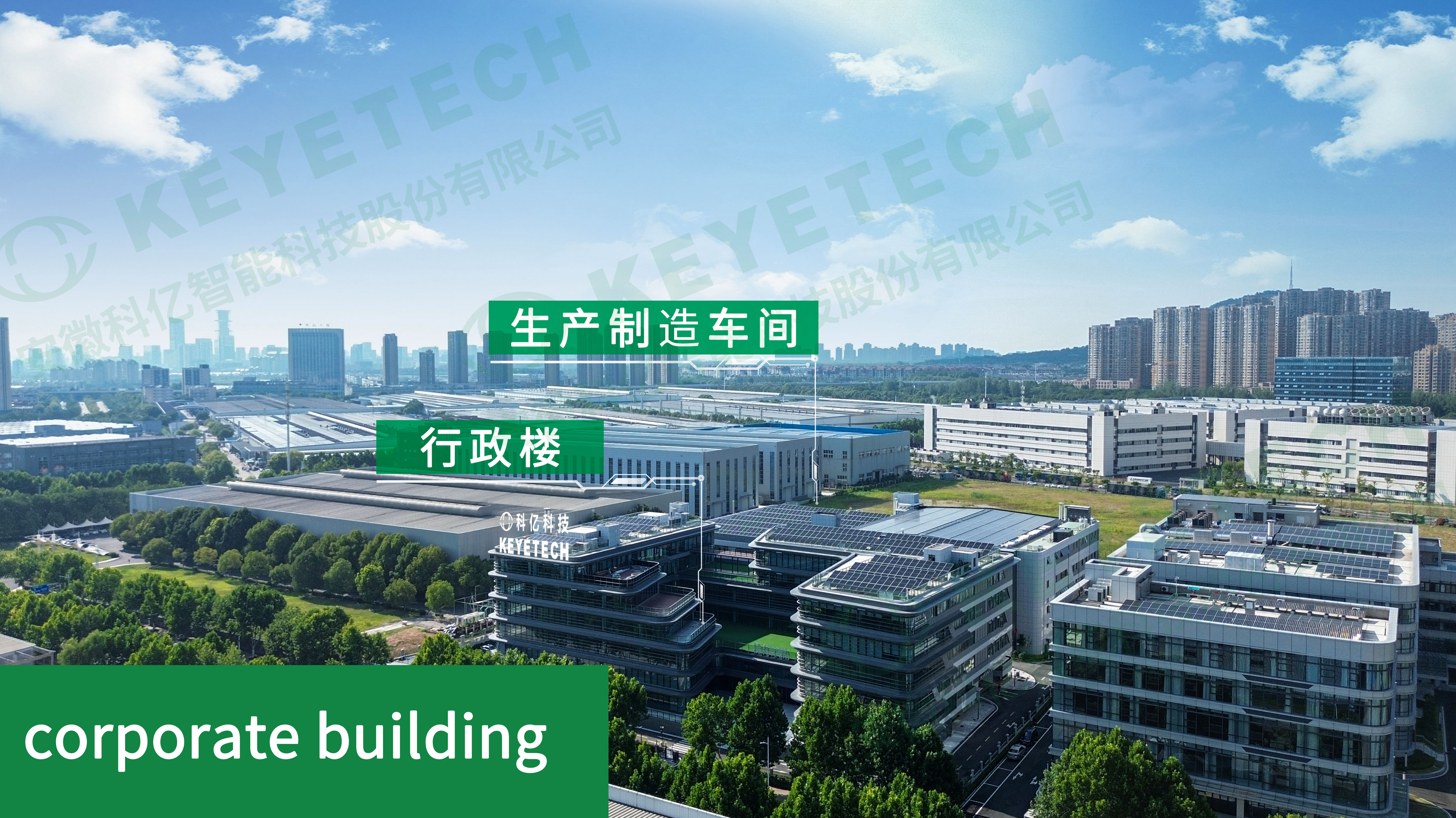
Send your material, your defect definitions, and a representative image set. KEYETECH will confirm the machine format (belt-type or channel-type / vertical-type), the matching model, and the lead time, and can run a pre-shipment test as the acceptance criterion.
Email: market-axq@keyetech.com · Tel / WhatsApp: +86 191-4244-2827 · Website: en.keyetech.com
Download the machine brochure: AI Color Sorter Brochure (PDF)
Anhui Keye Intelligent Technology Co., Ltd. · No.56, Chang'an Rd, Hi-Tech Zone, Hefei, Anhui, China