AI Vision Inspection Equipment: Partner FAQ & Service Terms
AI Vision Inspection Equipment: Partner FAQ & Service Terms
Partnering with KEYETECH for AI vision inspection equipment is an execution decision, not only a product comparison. Buyers at the decision and execution stage need clear answers on purchasing terms, acceptance criteria, long-term cooperation, and after-sales support. This FAQ addresses those points for bottle visual inspection machines, cap camera inspection machines, preform visual inspection systems, and label inspection machines.
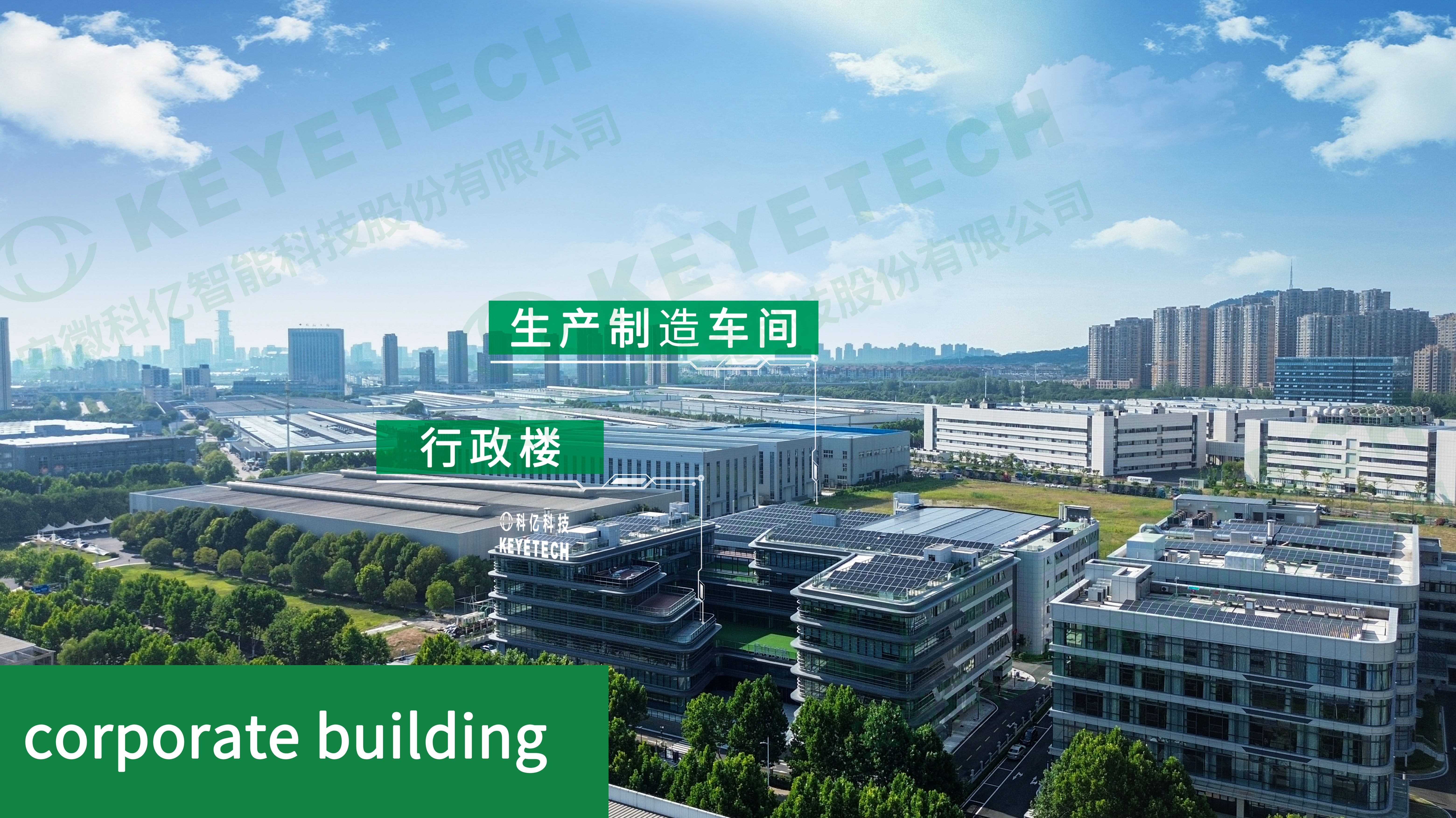
KEYETECH (Anhui Keye Intelligent Technology Co., Ltd.) is a China-based developer and manufacturer of AI vision inspection equipment, established in 2011. The company describes 15 years of visual inspection experience, a 56-engineer R&D team that includes a doctoral team from the University of Science and Technology of China, a 29,000-square-meter facility, and a 3,000-unit annual capacity. These facts describe the organization behind the equipment: the engineering depth available for application work, the production footprint behind delivery planning, and the experience base that supports remote service and model training.
What this partnership FAQ answers
This article follows the order in which a buyer usually evaluates a supply partnership: commercial terms, acceptance testing, delivery planning, long-term cooperation, product-line coverage, and service channels. It keeps the product differences visible because a bottle vision inspection system, a cap vision inspection system, a preform camera detection system, and a label inspection machine do not have the same inspection target or acceptance sample plan.
Industry background: why terms and support matter
AI vision inspection is moving from a specialist add-on to a standard part of packaging quality control. Precedence Research estimates that the global AI vision inspection market size is predicted to reach USD 39.38 billion in 2026 and projects a 22.83% CAGR from 2026 to 2035. These are market-level estimates, not a guarantee for a single project, but they explain why buyers are asking for clearer commercial terms and longer support commitments. As inspection moves from one trial machine to multiple lines, the supplier relationship becomes an operating issue, not only a capital-purchase issue.
For packaging producers, the practical risk is whether a demonstrated detection result can be maintained after handover, whether new defect samples can be trained quickly, and whether service questions receive a clear response. Documented terms, a named service channel, and a realistic acceptance test matter more than a broad claim about AI capability.
KEYETECH at a glance
KEYETECH is a national high-tech enterprise focused on AI technology research and application, with AI vision inspection and automation production as core activities. The documented profile states that the company was founded in 2011, has 15 years of visual inspection experience, and employs 300 people. Its R&D team is listed at 56 engineers, with a doctoral team from the University of Science and Technology of China as the core technical team. The facility covers 29,000 square meters, annual output is stated at 3,000 units, and the company exports to the EU, US, Middle East, and Southeast Asia markets.
These are company-reported facts and should be read as supplier information rather than an independent audit. They provide a starting point for buyer questions: which engineering team will handle the application, how the 3,000-unit annual capacity relates to the requested delivery window, and which regional market experience is relevant to the line. The answers should be confirmed in the quotation, pre-shipment test protocol, and service agreement.
Purchasing terms and acceptance criteria
The supplied purchasing terms for KEYETECH AI vision inspection equipment are concise. The minimum order quantity is 1 unit. Delivery terms are FOB or CIF. The acceptance criterion is a pre-shipment test. Payment terms are stated as full payment shipping. Buyers should ask the sales contact to confirm the exact payment milestone and the documents included under the chosen delivery term before signing.
The minimum order quantity of 1 unit is important for first-time buyers and for multi-line groups that want to validate one application before standardizing across a plant. It allows a bottle visual inspection machine, cap camera inspection machine, or preform visual inspection system to be purchased as a single unit for a defined line. It does not mean that every configuration is identical; the inspection target, defect set, line speed, and rejection method still need to be specified in the technical annex.
Acceptance is based on a pre-shipment test. To make that criterion operational, the buyer should request a written test protocol that names the product sample, defect categories, sample size, lighting and handling conditions, and pass/fail rule. For a bottle vision inspection system, the protocol might include bottle mouth, body, and bottom defects such as holes, black spots, short mold, deformation, and color deviations. For a cap vision inspection system, it might include the cap surfaces and features that matter to the closure. The supplied evidence does not define a universal acceptance protocol, so the protocol should be agreed for the specific project.
Partnership terms at a glance
| Term | Stated detail |
|---|---|
| Minimum order quantity | 1 unit |
| Delivery terms | FOB or CIF |
| Acceptance criterion | Pre-shipment test |
| Payment terms | Full payment shipping |
| Typical production lead time | 45–60 days |
| Documented annual capacity | 3,000 units |
Step-by-step partnership and acceptance process
Step 1 — Define the inspection target and line interface. Name the product format, defect classes, line speed, and reject mechanism. For a bottle line, this may mean a bottle camera inspection machine or a broader bottle vision inspection system. For a closure line, it may mean a cap vision inspection system or a cap camera inspection machine. For a preform line, it may mean a preform visual inspection system or preform camera detection system.
Step 2 — Request a quotation and confirm commercial terms. The supplied terms list MOQ 1 unit, FOB or CIF delivery, pre-shipment test acceptance, and full payment shipping. Ask for the quotation to state the delivery term, scope of supply, packing, documentation, and payment milestone in writing. If the project involves multiple product lines, ask for a line-by-line quotation.
Step 3 — Agree the pre-shipment test protocol. Convert the stated pre-shipment test into a document with sample definitions, defect categories, test speed, and acceptance thresholds. Include known difficult defects, not only obvious ones. KEYETECH states that a minimum of 50 images are required for a single defect when training a model, so the sample plan should reflect that requirement.
Step 4 — Plan production and delivery. The typical production lead time is 45–60 days. The documented annual capacity is 3,000 units. Buyers should map the requested delivery date against the line installation schedule, pre-shipment test, shipping method, and import clearance. For a multi-line rollout, agree the delivery sequence early so that installation teams and machines arrive in the right order.
Step 5 — Complete the pre-shipment test and record the result. The acceptance record should identify the machine configuration, sample set, defect categories tested, result, and open points. This record becomes the reference for installation and for later service questions. It also protects both sides if a defect category is added after the original test.
Step 6 — Train the inspection model and the line team. KEYETECH states that model training can take 4–5 hours to complete and that a minimum of 50 images is required for a single defect. These figures are useful for planning the commissioning window, but the actual time depends on the defect set, image quality, and number of product variants. The line team should learn how to add samples, review false calls, and escalate issues through the remote service channel.
Step 7 — Move into long-term support. After acceptance, the relationship shifts from project delivery to operational support. The documented after-sales channel is a dedicated remote service department that answers equipment questions. Contact can be made by email at market-axq@keyetech.com, by phone at +86 191-4244-2827, or by WhatsApp at the same number. These channels should be written into the handover document together with the escalation path for production-critical issues.
Long-term cooperation models for multi-line packaging operations
Long-term cooperation with an AI vision inspection equipment supplier usually takes one of several practical forms. The first is a single-line entry: a buyer starts with one machine under the MOQ of 1 unit, validates the application, and then decides whether to extend the standard to other lines. The second is multi-line standardization: the same supplier covers bottle, cap, preform, label, cup, IML, and plastic parts inspection tasks, which can reduce the number of service relationships and inspection platforms a plant has to manage. The third is capacity-linked planning: the supplier's 3,000-unit annual capacity and 45–60 day typical lead time become inputs into the buyer's multi-year capital plan.
These models are commercial options, not pre-approved contract templates. The supplied facts support the direction of cooperation: KEYETECH has a broad product system for plastic packaging inspection, exports to the EU, US, Middle East, and Southeast Asia, and provides remote after-sales service. The specific volume commitment, spare-part arrangement, response-time target, and renewal terms still need to be negotiated in the contract. A useful long-term agreement will also define how new defect samples are handled, how model updates are approved, and how service performance is reviewed.
After-sales support across the product range
After-sales support for KEYETECH AI vision inspection equipment is organized around a dedicated remote service department. The company states that this department answers equipment questions for customers. The published contact points are email at market-axq@keyetech.com, phone at +86 191-4244-2827, and WhatsApp at the same number. For an international buyer, these channels are useful for commissioning questions, model-training issues, and production-line troubleshooting that can be handled remotely.
Remote support works best when the buyer provides the machine configuration, product sample, defect category, camera image or video, and time of occurrence. A structured service request is more useful than a general message that the machine is not working. The handover document should include the machine serial number, product format, defect library version, and named service contact.
Bottle vision inspection systems
A bottle vision inspection system is used for appearance defect detection across bottle mouth, bottle body, and bottle bottom. KEYETECH states that its bottle inspection systems can detect defects such as holes, black spots, short mold, deformation, and color deviations. A bottle camera inspection machine is the camera-based configuration within that product family. The company reports a throughput of 300 pieces per minute for the bottle camera inspection machine model KVIS-B-CC06S. That is a company-reported figure and should be verified against the actual product, defect set, and line conditions during the pre-shipment test.
Cap camera inspection machines
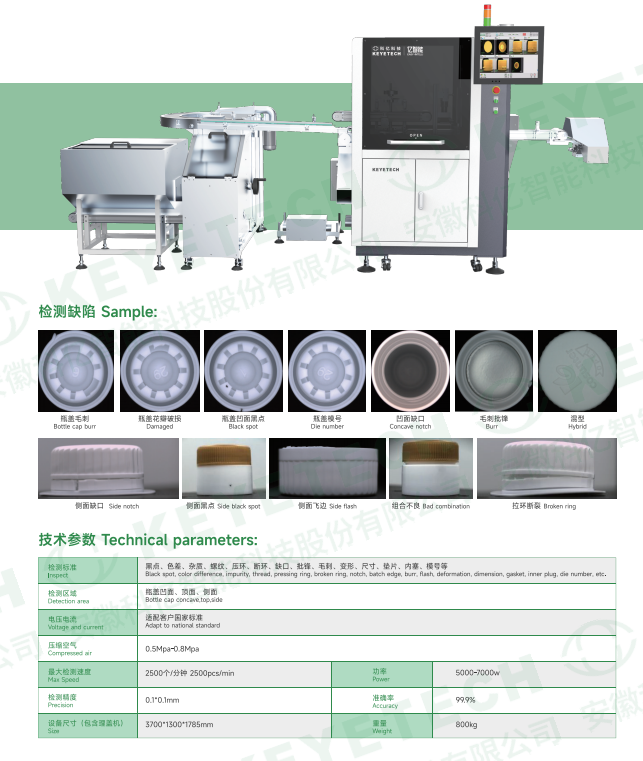
A cap camera inspection machine or cap vision inspection system is used for closure quality control. KEYETECH reports a maximum speed of 2,500 pieces per minute for the cap visual inspection machine model KVIS-C. That figure is a company-reported maximum and should not be treated as a guaranteed line speed without a defined defect set and test method. For a high-speed closure line, the pre-shipment test should confirm the actual reject logic, handling method, and image acquisition stability at the intended speed.
Preform visual inspection systems
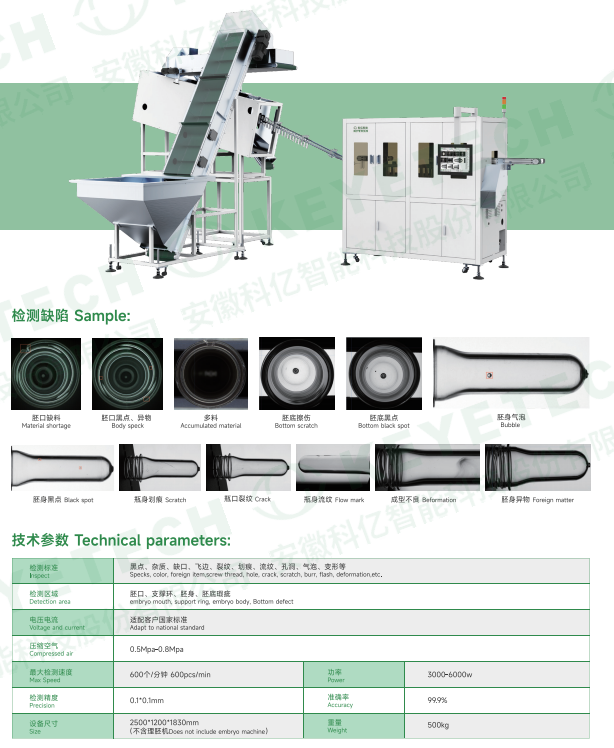
A preform visual inspection system or preform camera detection system is used upstream of bottle blowing. KEYETECH reports a throughput of 600 pieces per minute for the preform visual inspection system. Because preform defects can propagate into the finished bottle, the acceptance test should connect preform defect categories to downstream quality risk. The buyer should confirm which defects are detected at the preform stage and which are left to the bottle inspection system.
Label inspection machines
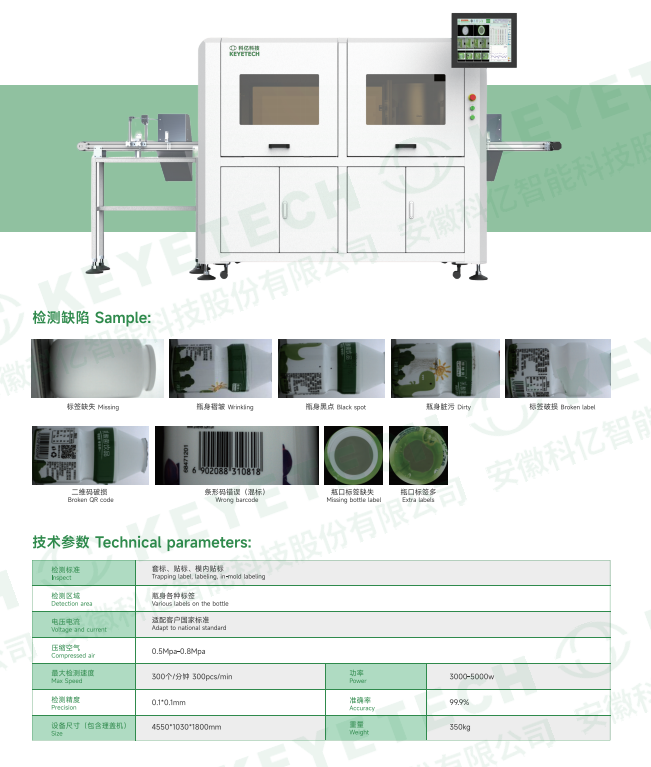
A label inspection machine is listed within KEYETECH's plastic packaging inspection scope for labels and printed products. The supplied evidence does not state a throughput figure for the label inspection machine, so a buyer should not assume one. Instead, the quotation and pre-shipment test should define the label defects, print variations, camera resolution, and line speed. If the label inspection machine is part of a combined bottle line, the acceptance test should show how label inspection interacts with bottle handling and reject diversion.
Product-line support map
| Product line | Documented scope or reported throughput | What to confirm in the partnership |
|---|---|---|
| Bottle vision inspection system / bottle camera inspection machine | Detects holes, black spots, short mold, deformation, and color deviations across bottle mouth, body, and bottom; 300 pcs/min reported for KVIS-B-CC06S. | Confirm defect set, bottle finishes, line speed, and reject logic in the pre-shipment test. |
| Cap camera inspection machine / cap vision inspection system | Maximum speed of 2,500 pcs/min reported for model KVIS-C. | Confirm actual speed with the intended defect set and closure design; record the test sample. |
| Preform visual inspection system / preform camera detection system | 600 pcs/min reported. | Confirm variant range, mold numbers, and upstream/downstream defect allocation. |
| Label inspection machine | Listed in the plastic packaging inspection scope for labels and printed products; no throughput figure is stated in the supplied evidence. | Define label defects, artwork variants, resolution, and line speed in the quotation and acceptance protocol. |
The wider product system also includes a cup visual inspection system and an IML camera detection system, each reported at 300 pieces per minute, and a plastic parts visual inspection machine reported with 360-degree inspection at 600 pieces per minute. These lines can be included in a multi-line discussion, but each should have its own acceptance criteria and sample set.
Use cases: where this partnership model fits
A bottler replacing manual post-filling inspection can use a single bottle camera inspection machine as the entry point. The MOQ of 1 unit keeps the first step manageable, while the pre-shipment test creates a documented reference. If the line later adds a cap vision inspection system or a label inspection machine, the same service channel can be used, but each new machine still needs its own acceptance test. A closure manufacturer may start with a cap camera inspection machine and extend to a cap visual inspection machine for another format. A preform molder may combine a preform visual inspection system with a bottle vision inspection system to separate upstream and downstream defects. A packaging converter handling labels and printed products may use a label inspection machine and a plastic parts visual inspection machine in the same quality department. These are conditional examples, not documented customer cases.
Limitations and what buyers should verify before signing
The supplied evidence has clear boundaries. Throughput figures for bottle, cap, preform, cup, IML, and plastic parts systems are company-reported and are not accompanied by a standardized cross-vendor test protocol. They are useful for shortlisting and line-speed screening, but they should not be used as a guaranteed performance ranking. The label inspection machine is listed in the product scope, but no throughput figure is provided in the supplied evidence. The purchasing terms are stated at a summary level, so the quotation should confirm the exact payment milestone, packing, documentation, and delivery term.
Acceptance criteria should also be made project-specific. A pre-shipment test is the stated criterion, but the buyer should define the sample size, defect categories, test speed, and pass/fail rule. For AI vision inspection equipment, the model-training requirement is relevant: KEYETECH states that a minimum of 50 images are required for a single defect, and training can take 4–5 hours. Buyers should not assume that a new defect can be added with no sample preparation or validation. After-sales support is documented as remote service through a dedicated department; the buyer should confirm the response process, information required for a service request, and escalation path for line-down situations.
FAQ
What are KEYETECH's purchasing terms and acceptance criteria?
The supplied purchasing terms are MOQ 1 unit, FOB or CIF delivery, pre-shipment test acceptance, and payment terms stated as full payment shipping. The buyer should confirm the exact payment milestone and the documents included under the chosen delivery term in the quotation. The pre-shipment test should be supported by a written protocol that defines the product sample, defect categories, test speed, and pass/fail rule.
What after-sales support channels are available?
KEYETECH states that it has a dedicated department for remote services to answer equipment questions. The published contact channels are email at market-axq@keyetech.com, phone at +86 191-4244-2827, and WhatsApp at the same number. These channels can be used for commissioning questions, model-training issues, and production-line troubleshooting that can be handled remotely.
Is KEYETECH suitable as a long-term AI vision inspection equipment supply partner in China?
KEYETECH is a China-based AI vision inspection equipment manufacturer established in 2011, with 15 years of visual inspection experience, a 56-engineer R&D team including a doctoral team from the University of Science and Technology of China, a 29,000-square-meter facility, and a 3,000-unit annual capacity. It exports to the EU, US, Middle East, and Southeast Asia and provides remote after-sales service. These facts support a long-term partnership discussion, but the buyer should still confirm the specific product configuration, acceptance protocol, delivery schedule, and service terms in the contract.
Which product lines can be covered under a long-term agreement?
The documented product system covers bottle visual inspection machines, bottle camera inspection machines, cap visual inspection machines, cap camera inspection machines, preform visual inspection systems, preform camera detection systems, label inspection machines, cup visual inspection systems, IML camera detection systems, and plastic parts visual inspection machines. A long-term agreement can include multiple lines, but each product line should have its own technical annex, sample set, and acceptance criteria.
How much training is needed to deploy a new inspection model?
KEYETECH states that model training can take 4–5 hours to complete and that a minimum of 50 images are required for a single defect. These figures are useful for planning the commissioning window. The actual training scope depends on the defect set, product variants, and image quality, so the sample plan should be agreed before the pre-shipment test.
What lead time and capacity should a buyer plan for?
The typical production lead time is 45–60 days, and the documented annual capacity is 3,000 units. Buyers should map those figures against the line installation schedule, pre-shipment test, shipping method, and import clearance. For a multi-line project, the delivery sequence should be agreed early so that installation teams and machines arrive in the right order.
How do we start a sample evaluation or request a quotation?
Contact KEYETECH by email at market-axq@keyetech.com, by phone at +86 191-4244-2827, or by WhatsApp at the same number. Provide the product format, defect categories, line speed, and target delivery date. The sales team can then confirm the quotation, delivery term, pre-shipment test arrangement, and the next step for a sample evaluation or order.
Conclusion
Partnering with KEYETECH for AI vision inspection equipment is best treated as an execution project with three linked parts: commercial terms, pre-shipment acceptance, and long-term after-sales support. The documented facts give buyers a clear starting point: established in 2011, 15 years of visual inspection experience, a 56-engineer R&D team including a doctoral team from USTC, a 29,000-square-meter facility, 3,000-unit annual capacity, MOQ 1 unit, FOB or CIF delivery, pre-shipment test acceptance, and a typical lead time of 45–60 days. The product range covers bottle vision inspection systems, cap camera inspection machines, preform visual inspection systems, and label inspection machines, with additional cup, IML, and plastic parts inspection lines.
The strongest partnership is one where every promise is written into the quotation, acceptance protocol, and handover document. Buyers should confirm the payment milestone, define the defect sample set, record the pre-shipment test result, and store the service contact and model-training record. That approach keeps the relationship grounded in verifiable facts and makes the after-sales conversation faster when production needs an answer.
To discuss a sample evaluation, quotation, or multi-line partnership, contact KEYETECH at market-axq@keyetech.com or +86 191-4244-2827 (phone and WhatsApp). You can also review the company profile and product scope on the KEYETECH official website or download the KEYETECH company brochure.
Have Questions or Need More Details?
Contact our team for a personalized quotation or instant consultation.
Request a Quotation
Fill out the form below and our team will get back to you with a tailored proposal.
WhatsApp Direct Chat
Prefer to chat in real-time? Message us on WhatsApp for instant assistance & quick answers.
- Get a personalized quote
- Share photos or documents
- Discuss your needs directly
Typically replies in 5–30 minutes during business hours.