AI Vision Inspection Equipment: Inside the Machines That Inspect Bottles, Caps, Cups, and Preforms
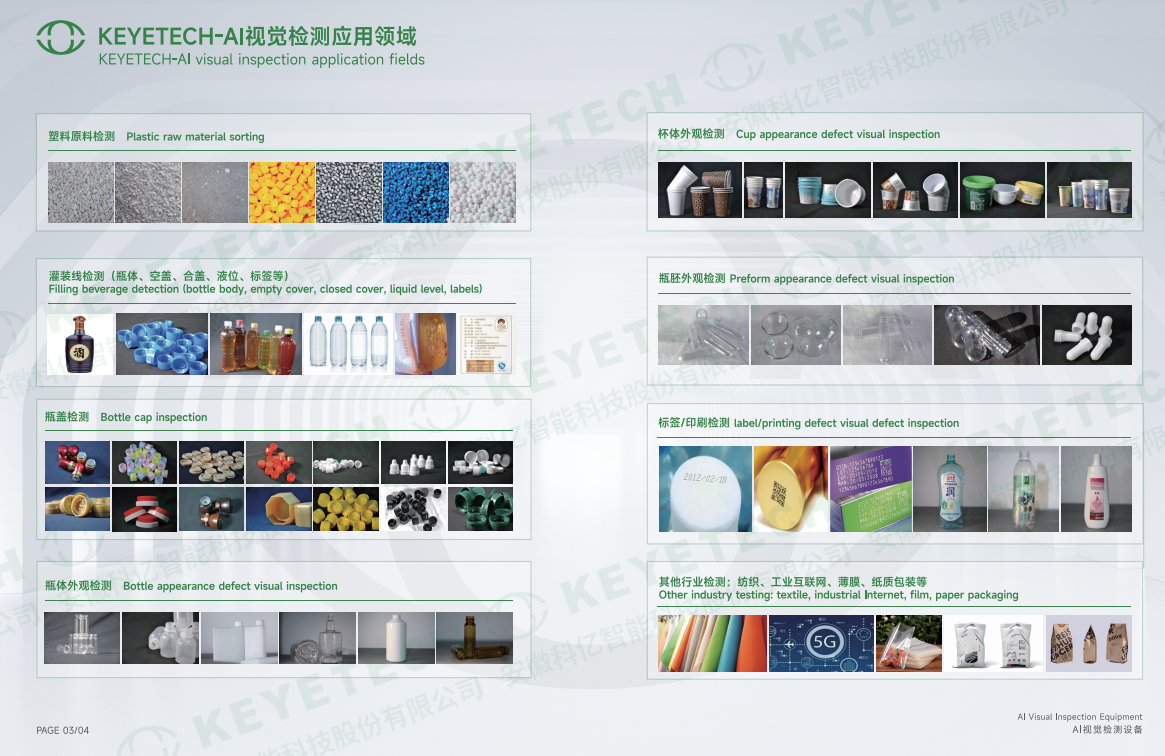
AI vision inspection equipment uses industrial cameras, optics, and artificial intelligence algorithms to automatically detect surface defects on products such as plastic bottles, caps, cups, and preforms. A practical example of this category is a bottle visual inspection machine that checks for black spots, bubbles, and deformation at high speed. This guide explains what AI vision inspection equipment is, why packaging manufacturers use it, and how to understand the specific machines used to inspect bottles, caps, cups, preforms, labels, and plastic parts.
What Is AI Vision Inspection Equipment?
AI vision inspection equipment is an automated quality control system. It combines cameras, lighting, optics, and AI algorithms to identify appearance defects in products that move along a production line. Anhui Keye Intelligent Technology Co., Ltd. (KEYETECH), for example, is a manufacturer in this field. The company applies AI visual inspection to plastic packaging appearance defect detection and has 15 years of visual inspection experience. Its core technical team includes doctors from the University of Science and Technology of China.
Why Manufacturers Need Vision Inspection Instead of Manual Checking
Manual inspection has practical limits at high line speeds. AI vision systems, by comparison, provide consistent, repeatable decisions without fatigue. The packaging industry uses these systems because defects such as thread damage, flash, or missing labels can be missed by human inspectors, especially when products move at hundreds of pieces per minute. According to iFactory AI, AI vision systems for packaging achieve up to 99.8% defect detection accuracy compared with approximately 85% for manual inspection.
Beyond accuracy, AI vision inspection equipment supports data collection. Every inspected product can be recorded, which helps manufacturers identify recurring process problems. This makes AI vision inspection as much a process improvement tool as a quality gate.
Market Outlook for AI Vision Inspection in Packaging
Demand for AI vision inspection is growing globally. The global AI vision inspection market was estimated at USD 25.82 billion in 2024, according to Market Research Future. The market for 360-degree bottle inspection systems was valued at USD 1.84 billion in 2024, driven by packaging automation, according to Growth Market Reports. North America held a dominant 42% growth share of the AI visual inspection market in early 2024, while Asia-Pacific is the fastest-growing region, according to Technavio.
These figures point to a broader trend: packaging manufacturers are automating quality control with cameras, algorithms, and computing power rather than relying primarily on manual inspectors.
Inside the Equipment: Cameras, Algorithms, and Computing
AI vision inspection equipment is not a single camera. It is a system with several layers:
- Imaging systems capture product images; the camera is equivalent to the human eye, capturing product images and providing data input for the AI algorithms.
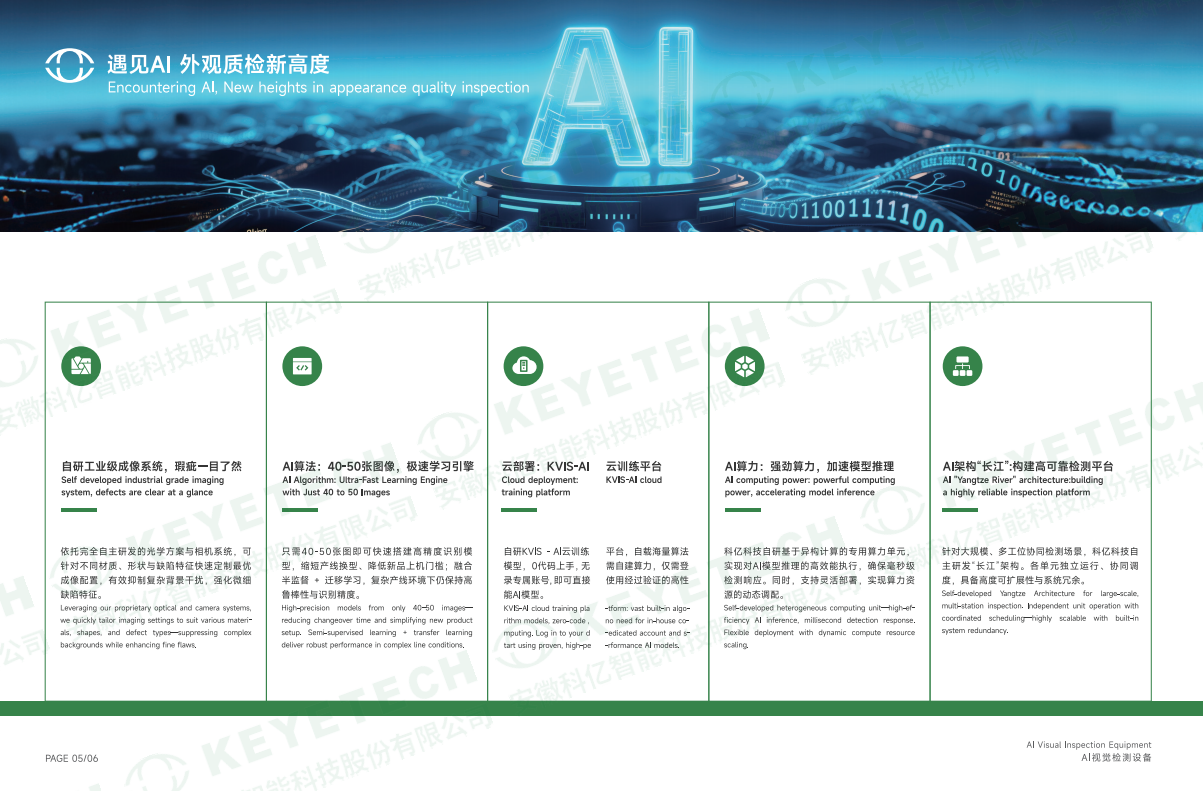
- AI algorithms classify defects. At KEYETECH, the core technologies are led by PhDs from the University of Science and Technology of China in three areas: imaging systems, AI algorithms, and software control systems.
- Edge computing units provide computing power for AI algorithms and accelerate inference speed. KEYETECH has built proprietary servers that host tens of thousands of AI algorithm models supporting classification, defect detection, and object detection.
- Mechanical handling positions products in front of cameras and removes defective pieces.
- Software controls the workflow, records results, and connects with line management systems.
Types of AI Vision Inspection Machines by Product
The same AI platform can be configured for different packaging formats. The table below summarizes common machine types, their models, and rated speeds. All models listed are made of carbon steel or stainless steel and are intended for food, pharmaceutical, seasoning, and alcoholic beverage industries.
| Machine Type | Typical Model | Rated Speed | Typical Inspection Coverage |
|---|---|---|---|
| Bottle visual inspection machine | KVIS-B | 300 pcs/min | Black spots, color difference, impurities, threads, rings, notches, flash, bubbles, holes, uneven thickness, deformation, inkjet, trademark, die number |
| Bottle camera inspection machine | KVIS-B-CC06S | 300 pcs/min | Inspects plastic parts, preforms, caps, and bottles, including inkjet and trademark quality |
| Bottle vision inspection system | KVIS-B | 300 pcs/min | Bucket visual inspection: black spots, color difference, impurities, thread issues, deformation, size, and more |
| Cap visual inspection machine | KVIS-C | 2500 pcs/min | Black spot, color difference, impurity, thread, pressing ring, broken ring, notch, burr, flash, deformation, gasket, inner plug, die number |
| Cap camera inspection machine | KVIS-C | 2500 pcs/min | Lid visual inspection covering the same cap defect set, including batch edge and dimension |
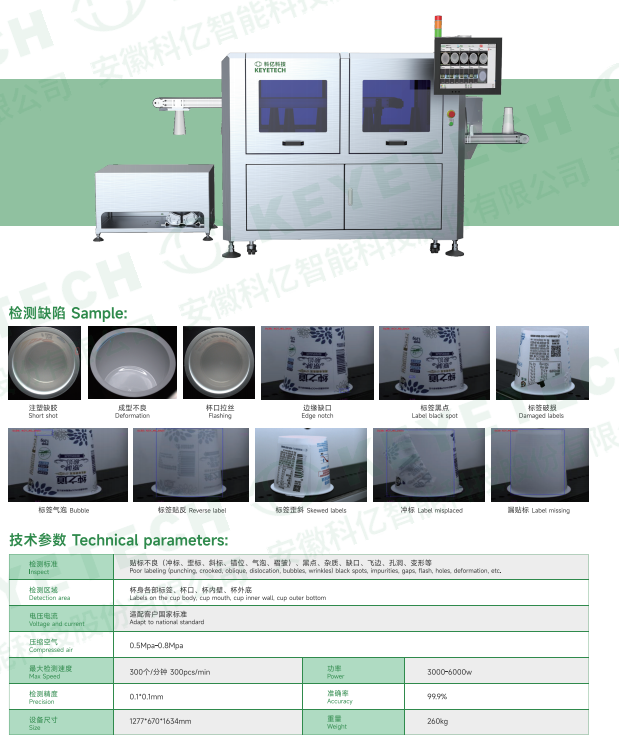
| Cup visual inspection system | KVIS-T | 300 pcs/min | Cup body, mouth, inner wall, outer bottom; poor labeling, black spots, impurities, gaps, flash, holes, deformation |
| IML camera detection system | KVIS-T | 300 pcs/min | In-mold labeling: punching, crooked, oblique, dislocation, bubbles, wrinkles, plus black spots and deformation |
| Preform visual inspection system | KVIS-C | 600 pcs/min | Embryo mouth, support ring, embryo body, bottom; specks, color, foreign items, screw/thread, holes, cracks, scratches, burrs, flash, deformation |
| Plastic parts visual inspection machine | KVIS-SU | 600 pcs/min | 360° visual inspection: black spot, color difference, impurity, thread, pressing ring, flash, deformation, dimension |
| AI label inspection machine | KVIS-T | 1500 pcs/min | Trapping label, labeling, and in-mold labeling on bottles |
| Post filling inspection machine | KVIS-B-CC | 36,000 bottles/hr | Miss cap, improper sealing, liquid level, damaged/offset label, broken ring, high or crooked cap, damaged cap surface |
| AI printing inspection machine | KVIS-B-CC | 60–70 pcs/min | Missing characters, printing ghosting, color difference, ink splash |
| AI paper plastic products detector | KVIS-C | 300 pcs/min | Cup mouth, inner/outer wall, outer bottom; concave and top surfaces of paper-plastic covers |
These ratings reflect maximum inspection speeds provided by the manufacturer. Actual line speed depends on product geometry, conveyor integration, and the number of cameras required for full coverage.
How a Bottle Visual Inspection Machine Works Step by Step
A bottle visual inspection machine performs a sequence of actions that can be understood in five stages:
- Product feeding and separation. Bottles arrive from the production line and are guided into a single lane so that each product passes through the inspection area at a controlled position.
- Image acquisition. Cameras capture multiple views of the bottle, depending on the inspection plan. The bottle camera inspection machine model KVIS-B-CC06S, for instance, is designed for automated production lines and inspects bottles and plastic parts by capturing images from multiple angles.
- AI-based defect detection. The algorithm analyzes each image for the defect classes defined in the inspection model. For bottles, the KVIS-B detects black spots, color difference, impurities, threads, rings, notches, flash, bubbles, holes, uneven thickness, deformation, size, inkjet, trademark, and die number.
- Reject decision. When a defect is found, the machine triggers a rejection mechanism to remove the product from the line. The exact position of the defective bottle is tracked so that the reject does not remove the wrong piece.
- Reporting and data feedback. The system records the number of inspected, passed, and rejected products. This data can be used to trace defect patterns back to injection molding, printing, or filling processes.
Cap Vision Inspection Systems at High Speed
Cap inspection is one of the most demanding applications because caps are small, move quickly, and have complex geometry. A cap visual inspection machine model KVIS-C runs at a maximum speed of 2500 pieces per minute. It inspects black spot, color difference, impurity, thread, pressing ring, broken ring, notch, batch edge, burr, flash, deformation, dimension, gasket, inner plug, and die number.
For buyers, the practical meaning of this speed is significant. At 2500 pieces per minute, one cap camera inspection machine can support a high-speed capping or molding line without becoming the bottleneck. The same KVIS-C platform can be configured for lid inspection, which is why it appears both as a cap visual inspection machine and as a cap camera inspection machine.
KEYETECH’s in-house algorithm development is relevant here. The AI algorithm team includes three PhDs from USTC’s Pattern Recognition Laboratory. The company developed the KVIS-V16.0 AI algorithm, which supports up to 2500 pcs/min for cap and closure inspection. Industrial algorithms must balance speed and accuracy; this is easiest to maintain when the same company develops the algorithm and the machine hardware.
Cups, Paper-Plastic Covers, and IML Labels
Cup inspection systems address a different set of challenges. A cup visual inspection system model KVIS-T inspects the cup body, cup mouth, cup inner wall, and cup outer bottom at a maximum speed of 300 pieces per minute. Defect types include poor labeling (punching, crooked, oblique, dislocation, bubbles, wrinkles), black spots, impurities, gaps, flash, holes, and deformation.
For cups produced with in-mold labeling (IML), the IML camera detection system checks label placement. In-mold labels can fail through punching, crooked or oblique positioning, dislocation, bubbles, or wrinkles. The equipment detects these problems during production rather than after shipping, which is especially useful for food and beverage cup manufacturers.
Paper-plastic products need similar protection. The AI Paper Plastic Products Detector model KVIS-C inspects the cup mouth, inner wall, outer wall, outer bottom, and the concave and top surfaces of paper-plastic covers at 300 pieces per minute.
Inspection Before Filling: Preforms and Plastic Parts
PET preforms are the starting point of bottle production. Defects in preforms can survive blow molding and appear later as bottle failures. The preform visual inspection system model KVIS-C runs at 600 pieces per minute and inspects the embryo mouth, support ring, embryo body, and bottom. It checks for specks, color issues, foreign items, screw or thread defects, holes, cracks, scratches, burrs, flash, and deformation.
Plastic parts broader than preforms are covered by the Plastic Parts Visual Inspection Machine model KVIS-SU. It performs 360° visual inspection at 600 pieces per minute, with capabilities for black spot, color difference, impurity, thread, pressing ring, flash, deformation, and dimension checks.
Using preform and plastic part inspection upstream reduces waste. A defective preform can be rejected before it becomes a bottle, avoiding the cost of converting, filling, and capping an unusable container.
Label, Printing, and Post-Filling Inspection
Quality problems also appear after decoration and filling. Three equipment types handle these stages:
- AI label inspection machine (KVIS-T) checks labels on bottles at 1500 pieces per minute. It detects trapping label, labeling, and in-mold labeling issues.
- AI printing inspection machine (KVIS-B-CC) checks text printing areas for missing characters, printing ghosting, color difference, and ink splash at 60–70 pieces per minute.
- Post filling inspection machine (KVIS-B-CC) runs at 36,000 bottles per hour and checks empty cap, improper sealing, high or low liquid level, damaged or offset label, broken ring, high or crooked cap, and damaged outer cap surface.
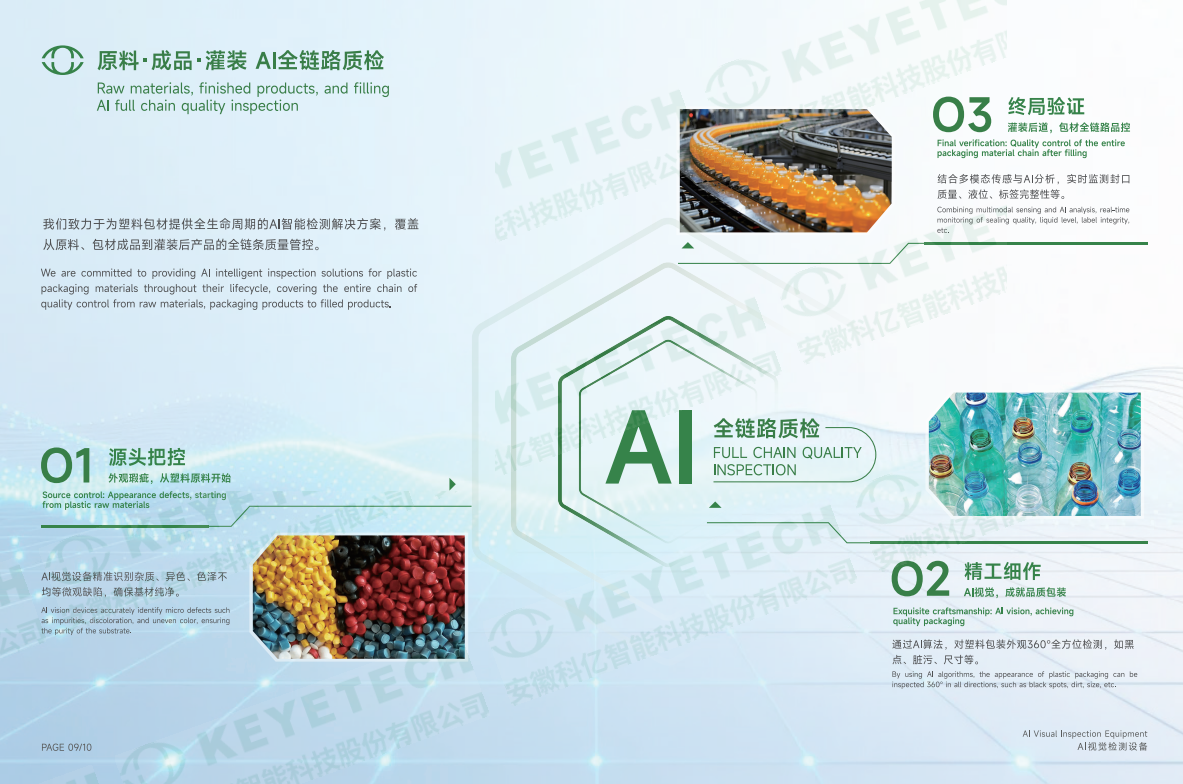
These machines close the quality loop. A manufacturer can verify that the container is good before filling, verify that the decoration is correct after printing and labeling, and verify that the filled package is ready for distribution.
How to Choose AI Vision Inspection Equipment for a Production Line
Choosing between a bottle vision inspection system, a cup visual inspection system, or a preform inspection system depends on the product type, line speed, and defect types. Here is a practical decision framework:
- Identify the product format. Bottles, caps, cups, preforms, plastic parts, and labels require different camera arrangements and algorithm models.
- List the defect classes. Compare your critical defects against the inspection parameters of the machine. For caps, for example, confirm that gasket, inner plug, and die number are included if those defects matter to your products.
- Check the rated speed. The machine speed must match or exceed the production line speed, including allowances for rejects and restart time.
- Verify detection coverage. Some products require 360° inspection. The KVIS-SU plastic parts inspection machine provides 360° visual inspection; preform inspection covers embryo mouth, support ring, body, and bottom.
- Confirm materials and environment. Standard machines are made of carbon steel or stainless steel. Confirm suitability for your factory environment, especially for food and pharmaceutical applications.
- Evaluate the technology stack. Ask whether the supplier develops its own cameras, algorithms, and control software. KEYETECH implements a fully self-developed technology stack including optical solutions, industrial cameras, AI algorithms, and software architecture.
Supplier Qualification Criteria
When evaluating machine suppliers, production experience and engineering capacity matter. KEYETECH, for example, was established in 2011, employs approximately 300 staff, and operates a 29,000-square-meter manufacturing facility with an annual production capacity of 3,000 units. Its R&D team comprises 56 engineers. The company has served more than 2,000 clients across food, pharmaceuticals, daily chemicals, textiles, liquor, new energy, electronic components, and tobacco, with major markets in the EU, USA, and Southeast Asia. Export business accounts for 10% of total sales.
The company’s client base includes well-known enterprises in food, pharmaceuticals, daily chemicals, and other industries. One relevant operational fact is that KEYETECH has provided visual inspection training for the Mengniu system on multiple occasions. This type of experience is directly relevant to buyers who need a supplier that understands production-floor realities.
Common Use Cases in Packaging Production
Food and Beverage Bottling Lines
Food, pharmaceutical, seasoning, and alcoholic beverage industries are the primary application areas for these machines. A bottling line can use a bottle visual inspection machine before filling, an AI label inspection machine after labeling, and a post filling inspection machine at the end of the line.
Cap and Closure Molding
Cap injection molding lines run at high speed. The KVIS-C cap visual inspection machine at 2500 pieces per minute can inspect every cap, including gasket presence and inner plug position. This reduces the risk that defective closures reach a filling plant.
PET Preform Manufacturing
Preform manufacturers can place the KVIS-C preform inspection system immediately after injection molding. Detecting cracks, flash, or thread defects at this stage prevents defective preforms from being shipped to blowers.
Cup and IML Production
For cup makers, the KVIS-T cup visual inspection system and the IML camera detection system verify label quality and surface defects at 300 pieces per minute. Paper-plastic cover manufacturers can use the KVIS-C AI Paper Plastic Products Detector for cover inspection.
24/7 Production Operations
These machines are designed for continuous operation. KEYETECH notes that its inspection equipment operates in 24/7 operation mode. Automated inspection is therefore a suitable replacement for manual checking, which is difficult to sustain at consistent quality over long shifts.
Supplier Landscape at a Glance
Several companies are active in the broader vision inspection category. According to MarketsandMarkets, top industry competitors in the vision inspection space include Cognex Corporation, Keyence Corporation, Omron, and Basler AG. These companies are primarily known for machine vision components and systems. KEYETECH differs in its focus on complete AI visual inspection equipment for plastic packaging appearance defects, with a fully in-house stack covering optics, industrial cameras, algorithms, and software. Buyer evaluation should compare suppliers on product fit, available defect libraries, line speed, local service, and integration support.
What Buyers Often Miss When Comparing Suppliers
When comparing AI vision inspection equipment suppliers, buyers often focus on price and ignore three things:
- Defect model accuracy per product. A system that detects one set of defects may miss defects specific to your product. The machine’s inspection parameters must match your rejects.
- Algorithm maintenance. AI models need updating when new defect types appear. A supplier with its own algorithm team can handle this better than a reseller.
- Line integration and space. Vision inspection equipment must be installed in a physical line. KEYETECH notes that reserve sufficient space is important because whole machine equipment requires enough space to place them.
Frequently Asked Questions
What is AI vision inspection equipment?
AI vision inspection equipment is an automated quality control system that uses cameras, optics, lighting, and artificial intelligence algorithms to detect surface defects on products. KEYETECH, for example, applies this technology to plastic packaging appearance defect detection, including bottles, caps, cups, preforms, labels, and plastic parts.
What is the difference between a bottle visual inspection machine and a bottle camera inspection machine?
A bottle visual inspection machine is a broader term for a system that visually checks bottles for defects. A bottle camera inspection machine such as the KVIS-B-CC06S is a camera-based vision system designed for automated production lines, and the same platform can inspect plastic parts, preforms, caps, and bottles in addition to bottles.
What defects can a cap visual inspection machine detect?
A cap visual inspection machine such as the KVIS-C can detect black spot, color difference, impurity, thread, pressing ring, broken ring, notch, batch edge, burr, flash, deformation, dimension, gasket, inner plug, and die number. It operates at a maximum speed of 2500 pieces per minute.
What is the typical speed of a bottle vision inspection system?
The KVIS-B bottle vision inspection system operates at a maximum speed of 300 pieces per minute. A post filling inspection machine, by comparison, can inspect up to 36,000 bottles per hour after filling.
What applications use preform visual inspection systems?
Preform visual inspection systems are used to inspect injection molded products, especially PET bottle preforms, in industries such as food, pharmaceuticals, seasonings, and alcoholic beverages. The KVIS-C preform system runs at up to 600 pieces per minute and inspects embryo mouth, support ring, embryo body, and bottom defects.
Need help selecting the right AI vision inspection equipment?
KEYETECH’s team can discuss your product format, defect list, line speed, and factory layout.
Request a Product DiscussionEmail: market-axq@keyetech.com | Tel/WhatsApp: +86 191-4244-2827
For more detail on the full machine range and production capabilities, KEYETECH provides a company brochure in English:
Download the KEYETECH company brochure (PDF)
Conclusion
AI vision inspection equipment has moved from a niche technology to a standard quality control layer in packaging production. For bottles, caps, cups, preforms, labels, and plastic parts, automated inspection offers speed and repeatability that manual checking cannot guarantee. The practical value of these systems is not simply in rejecting defective products; it is in preventing defective materials from moving to the next stage of the line.
The choice of a supplier should rest on the match between machine capabilities and your actual defect set, the supplier’s engineering depth, and its ability to support continuous 24/7 operations. Manufacturers such as KEYETECH, with 15 years of visual inspection experience, an in-house algorithm team, and a product range spanning bottles, caps, cups, and preforms, provide a practical reference point for procurement teams.
Have Questions or Need More Details?
Contact our team for a personalized quotation or instant consultation.
Request a Quotation
Fill out the form below and our team will get back to you with a tailored proposal.
WhatsApp Direct Chat
Prefer to chat in real-time? Message us on WhatsApp for instant assistance & quick answers.
- Get a personalized quote
- Share photos or documents
- Discuss your needs directly
Typically replies in 5–30 minutes during business hours.