Comparing AI Vision Inspection Equipment: Label, Post-Filling, Printing, and Cup Detection
Most packaging manufacturers do not need “an AI vision inspection machine.” They need one specific inspection capability at one specific point on one specific line. A bottling plant fighting label skew needs different optics, lighting, and mechanics than a paper-cup producer checking cup mouths and cup inner walls. This guide compares four AI vision inspection configurations — label detection, post-filling inspection, printing inspection, and paper cup cover detection — maps each to its line stage, defect type, and material format, and sets out a decision framework for weighing detection scope against integration requirements.
The comparison is organized around three variables that decide most projects: the line stage where the defect appears, the defect family that must be caught, and the material format the machine has to handle. Speed, footprint, and inspection scope all follow from those three.
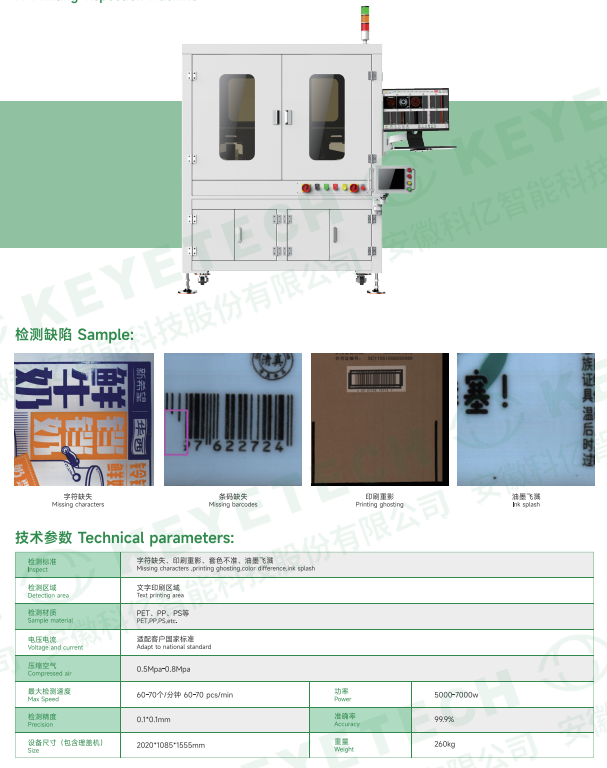
AI vision inspection equipment: the printing inspection configuration verifies the text printing area for missing characters, ghosting, color difference, and ink splash.
The Problem: Four Defect Families, Four Different Points on the Line
Inspection projects fail most often because the inspection point was decided after the machine was decided. In practice, the defects that reach a customer fall into four families, and each family becomes detectable — or permanently undetectable — at a different moment in production.
- Label family. Trapping label, labeling faults, and in-mold labeling (IML) defects exist immediately after the labeler or the IML station, while the container surface is still clean and the label can be imaged head-on.
- Post-fill family. Empty or missing cap, improper cap sealing, high or low liquid level, damaged or offset label, broken ring, high or crooked cap, and a damaged outer surface of the cap only exist after the filler and capper have done their work.
- Print family. Missing characters, printing ghosting, color difference, and ink splash are content defects inside the text printing area — a narrow, high-contrast zone that behaves very differently from a full container body.
- Cup family. Specks, impurity, notches, burr, crack, hole, and deformation on the cup mouth, cup inner wall, and cup outer wall require the paper-plastic cup or cover to be presented to several viewing angles.
Two consequences follow. First, a defect list written before the machine is specified will usually be shorter and more honest than a list written afterward. Second, detection scope and integration load move in the same direction: the wider the detection area a single station must cover, the more imaging and handling hardware it carries, the more floor space it needs, and the more carefully its speed has to be matched to the line. Narrow, dedicated stations run faster; broad, multi-area stations are more flexible but demand more integration planning.
Industry Background: Why Packaging Lines Are Moving to AI Vision
The shift is measurable. The global AI vision inspection market was estimated at USD 25.82 billion in 2024 (Market Research Future), and the narrower category of 360-degree bottle inspection systems was valued at USD 1.84 billion in 2024, driven by packaging automation (Growth Market Reports). Performance benchmarks published for packaging applications report up to 99.8% defect detection accuracy for AI vision systems, compared with approximately 85% for manual inspection (iFactory AI). Regionally, North America held a 42% growth share of the AI visual inspection market in early 2024, while Asia-Pacific is the fastest-growing region (Technavio).
Compliance expectations run alongside the technology curve. Packaging inspection systems must typically comply with ISO 13849-1 for safety-related parts of control systems, and CE marking governs EU market entry. These are design and documentation constraints rather than marketing claims, which is why they belong on the evaluation checklist from the start.
The supply side of this category includes general-purpose vision vendors such as Cognex, Keyence, Omron, and Basler (MarketsandMarkets), alongside specialists focused on plastic packaging appearance defect detection. Anhui Keye Intelligent Technology Co., Ltd. (KEYETECH), established in 2011, belongs to the second group: 15 years of visual inspection experience, an R&D team of 56 engineers that includes doctors from the University of Science and Technology of China, a 29,000-square-meter manufacturing facility, and an annual production capacity of 3,000 units. Products are exported to more than 50 countries, with major markets in the EU, USA, and Southeast Asia.
Detailed Solution: The Four Configurations, Mapped to Line Stage and Defect Type
KEYETECH builds the four inspection points described above as separate configurations. That separation is deliberate: a label defect, a fill defect, a print defect, and a cup defect are produced by different equipment, at different speeds, and require different imaging geometry. Treating them as one generic requirement is the most common cause of a machine that inspects everything and catches nothing reliably.
KVIS-T — Label, Trapping, and In-Mold Labeling on Bottles
The KVIS-T AI Label Inspection Machine is designed for inspecting labels on bottles in production lines. It detects trapping label, labeling, and in-mold labeling, and the detection area covers the various labels on the bottle. Its classification is label skew detection, and the rated maximum speed is 1,500 pieces per minute. Construction is carbon steel or stainless steel, and the intended industries are food, pharmaceuticals, seasonings, and alcoholic beverages.
What this means for selection: specify this configuration when the defect definition is label position and label integrity rather than container fill. The 1,500 pcs/min rating makes it a candidate for labeler-side stations where inspection must not become the line bottleneck, and the IML coverage matters for containers where the label is placed in the mold rather than applied afterward.
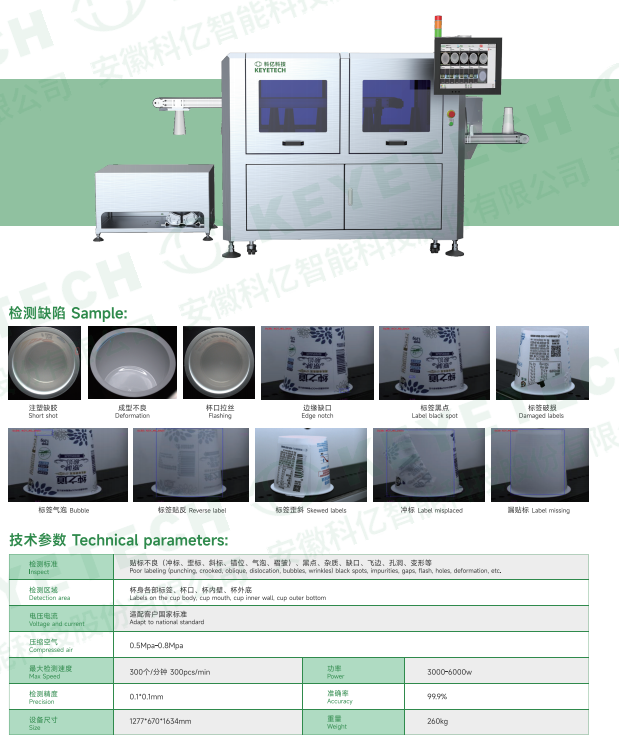
Label and in-mold labeling inspection: trapping label, labeling, and IML defects imaged on the bottle, rated at up to 1,500 pcs/min.
KVIS-B-CC Post-Filling — Checkpoints After the Filler
The KVIS-B-CC Post Filling Inspection Machine is a visual inspection after canning: it examines the bottle body, miss cap, cap sealing, liquid level, label, and spray code. Detection capabilities include empty cap or missing cap, improper sealing, high or low liquid level, damaged or offset label, broken ring, high or crooked cap, and damaged outer surface of the cap. Maximum inspection speed is 36,000 bottles per hour. The machine is built from carbon steel or stainless steel, and typical applications are food production, pharmaceutical packaging, seasoning filling, and alcoholic beverage bottling.
What this means for selection: this is the highest-throughput configuration of the four, and it is the right choice when a single station must confirm fill integrity across several checkpoints at bottling speed. Because it inspects both container and closure condition, it also removes the need for two separate downstream stations on a full bottling line — at the cost of tighter mechanical synchronization with the filler and capper.
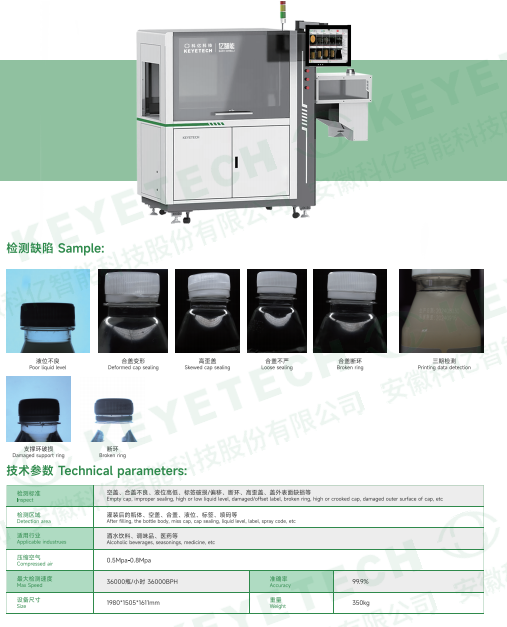
Post-filling inspection machine: bottle body, missing cap, cap sealing, liquid level, label, and spray code, at up to 36,000 bottles per hour.
KVIS-B-CC Printing — Character-Level Print Verification
The KVIS-B-CC AI Printing Inspection Machine performs printing surface defect detection. It detects missing characters, printing ghosting, color difference, and ink splash, with the detection area limited to the text printing area. Maximum inspection speed is 60–70 pieces per minute. Construction is carbon steel or stainless steel, and the intended industries are food, pharmaceuticals, seasonings, and alcoholic beverages.
What this means for selection: the speed figure tells the story. Character-level verification at this level of detail is a quality-assurance station rather than a high-speed inline gate, and it suits operations where code legibility, batch text, and print consistency carry traceability or regulatory weight. If the print station runs faster than that in your plant, the realistic options are buffering the product flow or accepting a sampled verification regime — not expecting the same station to keep pace with a 36,000 BPH filler.
KVIS-C — Paper Cup Cover Detection
The KVIS-C AI Paper Plastic Products Detector is a paper cup cover detection system designed for inner wall, outer wall, and cup mouth detection, operating in continuous inspection at 300 pieces per minute. It detects specks, impurity, notches, burr, crack, hole, and deformation. Primary materials are carbon steel or stainless steel, and the machine is intended for food, pharmaceuticals, seasonings, and alcoholic beverages industries.
What this means for selection: three surfaces inspected in one pass means the mechanical handling and imaging layout do the heavy lifting. Plan the cup feeding path and the rejection mechanism before choosing optics; a cup that rotates or shifts during transfer will produce false rejects that no algorithm can fully absorb.
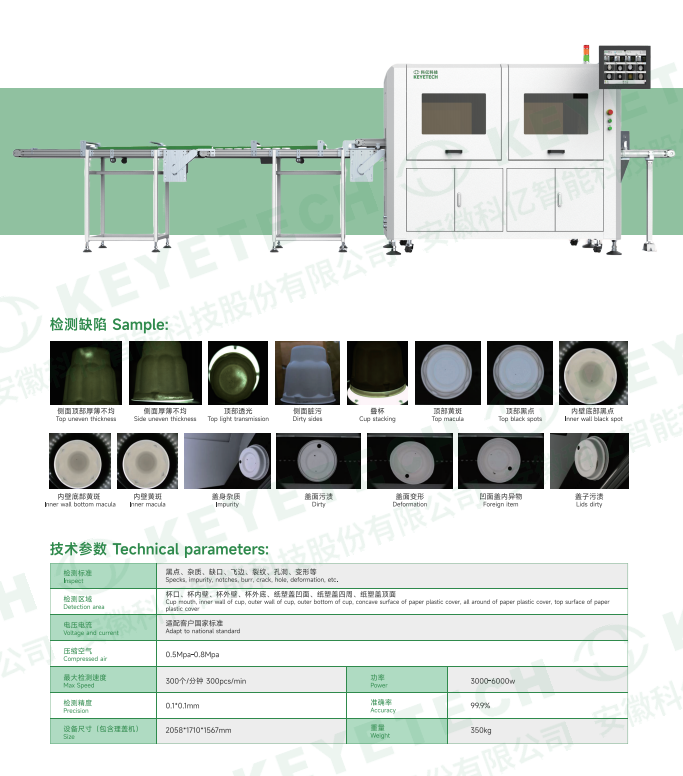
Paper cup cover detection: cup mouth, inner wall, and outer wall inspection for specks, notches, burr, crack, hole, and deformation at 300 pcs/min.
Related Units in the Same Inspection Family
The same platform covers adjacent inspection points that frequently appear in the same plant, and knowing they exist prevents over-specifying a single machine:
- Bottle vision inspection system KVIS-B and bottle camera inspection machine KVIS-B-CC06S: bottle and plastic part defects including black spots, color difference, impurities, threads, rings, notches, leftovers, flash, bubbles, holes, uneven thickness, deformation, size, inkjet, trademark, and die number, at a maximum of 300 pcs/min.
- Cap visual inspection machine and cap camera inspection machine KVIS-C: bottle cap defects including black spot, color difference, impurity, thread, pressing ring, broken ring, notch, batch edge, burr, flash, deformation, dimension, gasket, inner plug, and die number, at up to 2,500 pcs/min.
- Preform visual inspection system KVIS-C: injection-molded preform defects such as specks, color, foreign items, screw and thread issues, hole, crack, scratch, burr, flash, and deformation across embryo mouth, support ring, embryo body, and bottom, at up to 600 pcs/min.
- Plastic Parts Visual Inspection Machine KVIS-SU: 360° appearance inspection of plastic parts at up to 600 pcs/min.
- Cup visual inspection system KVIS-T and IML camera detection system KVIS-T: cup body, cup mouth, cup inner wall, and cup outer bottom inspection at up to 300 pcs/min.
Reading Model Designations Correctly
Two points prevent costly misreading of a specification sheet. First, the designation KVIS-B-CC appears for two different jobs — the post-filling inspection configuration and the printing inspection configuration. They share a model string but not a detection area or a speed envelope: 36,000 bottles per hour versus 60–70 pieces per minute. Second, the designation KVIS-C is used for cap inspection, preform inspection, and the paper cup cover detector, while KVIS-T covers label, cup, and IML inspection. In other words, the configuration — not the model string — defines what the machine actually inspects. Always confirm the detection area and the defect list in writing before comparing quotations.
Step-by-Step: How to Match a Configuration to Your Line
- Write the defect list first. Name the defects your customer or your internal QA team actually rejects: trapping label, high or low liquid level, broken ring, ink splash, cup mouth notch. A defect list drives the configuration; a configuration should never drive the defect list.
- Identify the line stage. Label and IML defects point to the labeler and to KVIS-T. Fill, cap, and seal defects point downstream of the filler and to the KVIS-B-CC post-filling configuration. Print defects point to the text printing area and to the KVIS-B-CC printing configuration. Cup mouth and cup wall defects point to KVIS-C.
- Confirm the material format and detection area. Verify that the detection area in the specification matches your product geometry — various labels on the bottle, bottle body plus closure, text printing area, or cup mouth, inner wall, and outer wall.
- Build the speed budget. Compare each configuration’s rating against your real line speed: 1,500 pcs/min for label inspection, 36,000 BPH for post-filling, 60–70 pcs/min for print verification, 300 pcs/min for paper cup cover detection. Where the line runs faster than the inspection station, decide in advance whether to buffer, divide the flow, or sample.
- Plan integration and footprint. These are whole-machine units rather than bolt-on sensors, so sufficient floor space must be reserved at the chosen line stage. Confirm rejection handling, product transfer, and access for maintenance before the layout is frozen.
- Confirm duty cycle and validation. These systems operate in a 24/7 mode in an indoor factory environment with normal temperature and humidity, in the plastic packaging materials industry. Validate the configuration on your own containers and closures with a sample run before committing to a full line installation, and align the acceptance criteria with the defect list from step one.
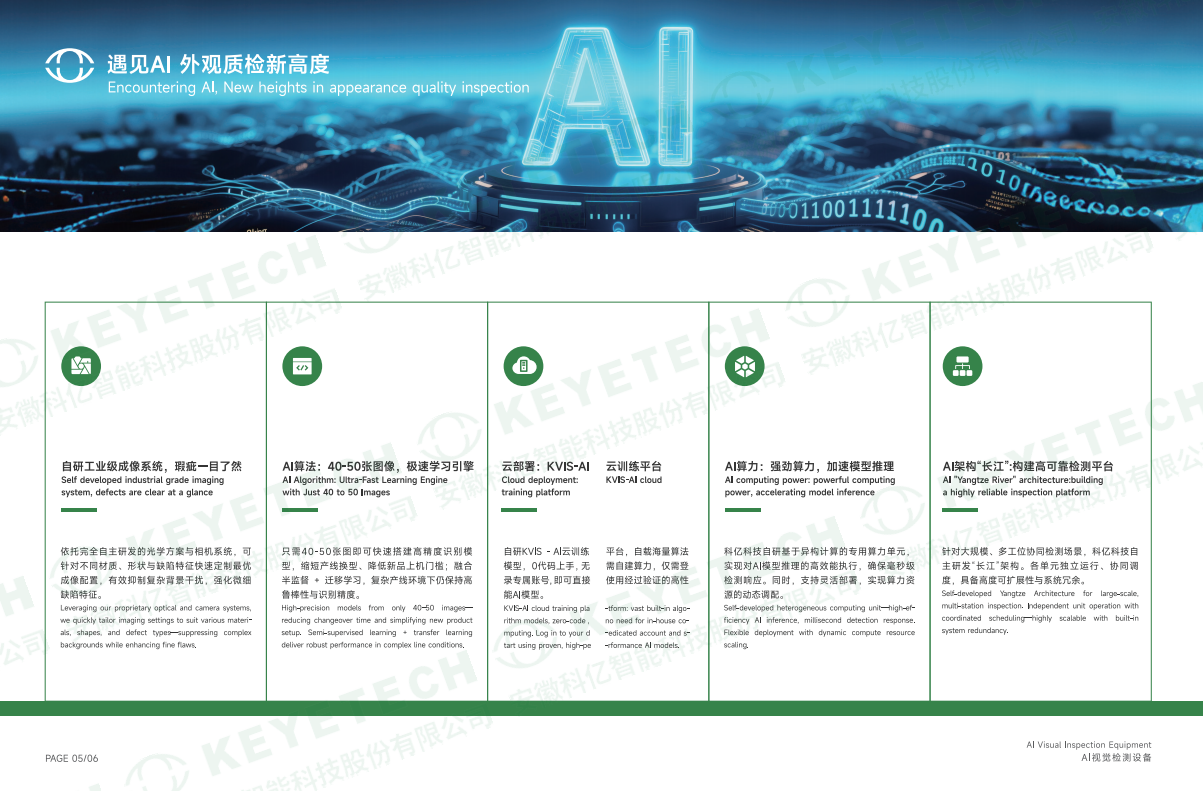
A shared AI algorithm layer supports classification and defect detection across all four configurations, which is why defect definitions can be re-tuned without changing the machine type.
Use Cases: Matching Configuration to Production Reality
High-speed beverage or dairy bottling. A line that must confirm closure integrity, liquid level, and spray code in one pass is a post-filling case. The KVIS-B-CC post-filling configuration covers bottle body, miss cap, cap sealing, liquid level, label, and spray code at up to 36,000 bottles per hour, which is the throughput most bottling lines require from a single inspection station.
Label-centric lines, including in-mold labeling. Where the customer-visible failure is a crooked, punched, or dislocated label, the label configuration is the correct specification. KVIS-T inspects trapping label, labeling, and in-mold labeling on bottles at up to 1,500 pcs/min, which keeps pace with labeling rather than with filling.
Traceability-critical print. For batch codes, dates, and mandated text, the print configuration checks missing characters, printing ghosting, color difference, and ink splash in the text printing area at 60–70 pcs/min. Its purpose is print verification quality, not line throughput, so it is usually placed where containers can be presented stably.
Paper-plastic cup and lid production. Cup mouth, inner wall, and outer wall defects are inspected continuously at 300 pcs/min with the KVIS-C paper cup cover detection system, covering specks, impurity, notches, burr, crack, hole, and deformation — the defect set that dominates paper and paper-plastic cup manufacturing.
Component-level quality control upstream. Caps, preforms, and molded plastic parts can be inspected before they reach the filling line: caps at up to 2,500 pcs/min, preforms and plastic parts at up to 600 pcs/min with 360° coverage for the KVIS-SU plastic parts configuration. Catching a defective cap or preform upstream is usually cheaper than rejecting a filled container downstream.
Comparison Table: Four Configurations at a Glance
| Configuration | Model | Line stage | Detection area & defects | Max speed | Typical industries |
|---|---|---|---|---|---|
| AI Label Inspection Machine | KVIS-T | Labeling / in-mold labeling on bottles | Various labels on the bottle; trapping label, labeling, in-mold labeling | 1,500 pcs/min | Food, pharmaceuticals, seasonings, alcoholic beverages |
| Post Filling Inspection Machine | KVIS-B-CC | After filling and capping | Bottle body, miss cap, cap sealing, liquid level, label, spray code | 36,000 bottles/hour | Food production, pharmaceutical packaging, seasoning filling, alcoholic beverage bottling |
| AI Printing Inspection Machine | KVIS-B-CC | Printing / coding station | Text printing area; missing characters, printing ghosting, color difference, ink splash | 60–70 pcs/min | Food, pharmaceuticals, seasonings, alcoholic beverages |
| AI Paper Plastic Products Detector (paper cup cover detection) | KVIS-C | Paper-plastic cup and cover production | Cup mouth, inner wall, outer wall; specks, impurity, notches, burr, crack, hole, deformation | 300 pcs/min | Food, pharmaceuticals, seasonings, alcoholic beverages |
Reading the table: all four configurations are built from carbon steel or stainless steel and operate in a 24/7 mode in an indoor factory environment with normal temperature and humidity. The two KVIS-B-CC rows are separate configurations that share a model designation — compare detection area and speed, not the model string.
FAQ
Which configuration fits label defects on bottles?
Label, trapping label, and in-mold labeling defects belong to the KVIS-T AI Label Inspection Machine, classified as label skew detection. Its detection area is the various labels on the bottle, and its rated maximum speed is 1,500 pieces per minute. It is intended for food, pharmaceuticals, seasonings, and alcoholic beverages industries, and it is constructed from carbon steel or stainless steel.
Can one KVIS-B-CC machine handle both post-filling inspection and print inspection?
They are two separate configurations that share the model designation KVIS-B-CC. The post-filling configuration inspects bottle body, miss cap, cap sealing, liquid level, label, and spray code at up to 36,000 bottles per hour. The printing configuration inspects the text printing area for missing characters, printing ghosting, color difference, and ink splash at 60–70 pieces per minute. Because their detection areas and speed envelopes differ, they are specified and quoted as distinct stations.
What standards and compliance points should be verified before purchase?
Packaging inspection systems must typically comply with ISO 13849-1 for safety-related parts of control systems, and CE marking governs EU market entry. For buyers in the EU, USA, and Southeast Asia — the major markets served by KEYETECH, where export accounts for 10% of total sales — it is worth confirming the documentation package, safety-related control architecture, and CE status against the actual delivered configuration rather than a generic catalogue page.
Who supplies AI vision inspection equipment for label, post-filling, printing, and cup detection?
KEYETECH — Anhui Keye Intelligent Technology Co., Ltd., established in 2011 — builds all four configurations plus adjacent units for caps, preforms, and plastic parts. The company has 15 years of visual inspection experience, an R&D team of 56 engineers including doctors from the University of Science and Technology of China, a 29,000-square-meter manufacturing facility, and an annual production capacity of 3,000 units, with products exported to more than 50 countries.
How do I validate a configuration before committing to a full order?
Start from a written defect list and request a sample validation on your own containers, closures, or cups: label skew and IML samples for KVIS-T, filled and capped bottles for the post-filling configuration, printed text samples for the printing configuration, and cup mouth, inner wall, and outer wall samples for the KVIS-C paper cup cover detector. Confirming the detection area and speed envelope on real product is faster than reconciling them after install. A sample run, a quotation for the matched configuration, or the company brochure can be requested through en.keyetech.com.
Conclusion
Comparing AI vision inspection equipment for label, post-filling, printing, and cup detection reduces to matching three things: the line stage where the defect appears, the defect family that must be caught, and the speed at which your product actually arrives. KVIS-T covers label, trapping, and in-mold labeling at 1,500 pcs/min; the KVIS-B-CC post-filling configuration covers bottle body, missing cap, cap sealing, liquid level, label, and spray code at up to 36,000 BPH; the KVIS-B-CC printing configuration verifies characters, ghosting, color difference, and ink splash at 60–70 pcs/min; and KVIS-C covers paper cup cover cup mouth, inner wall, and outer wall at 300 pcs/min. The trade-off is consistent: wider detection scope per station costs speed and floor space, so the correct specification is usually the narrowest one that still catches every defect on your list.
Next Step
If you are weighing these configurations for a specific line, the fastest way forward is to send us your defect list and product format. KEYETECH can map it to the matching configuration and arrange a sample validation before any commitment.
Website: en.keyetech.com · Email: market-axq@keyetech.com · Tel / WhatsApp: +86 191-4244-2827
Contact: Nicole · Address: No.56, Chang’an Rd, Hi-Tech Zone, Hefei, Anhui, China
Download the company brochure: KEYETECH company introduction (PDF)
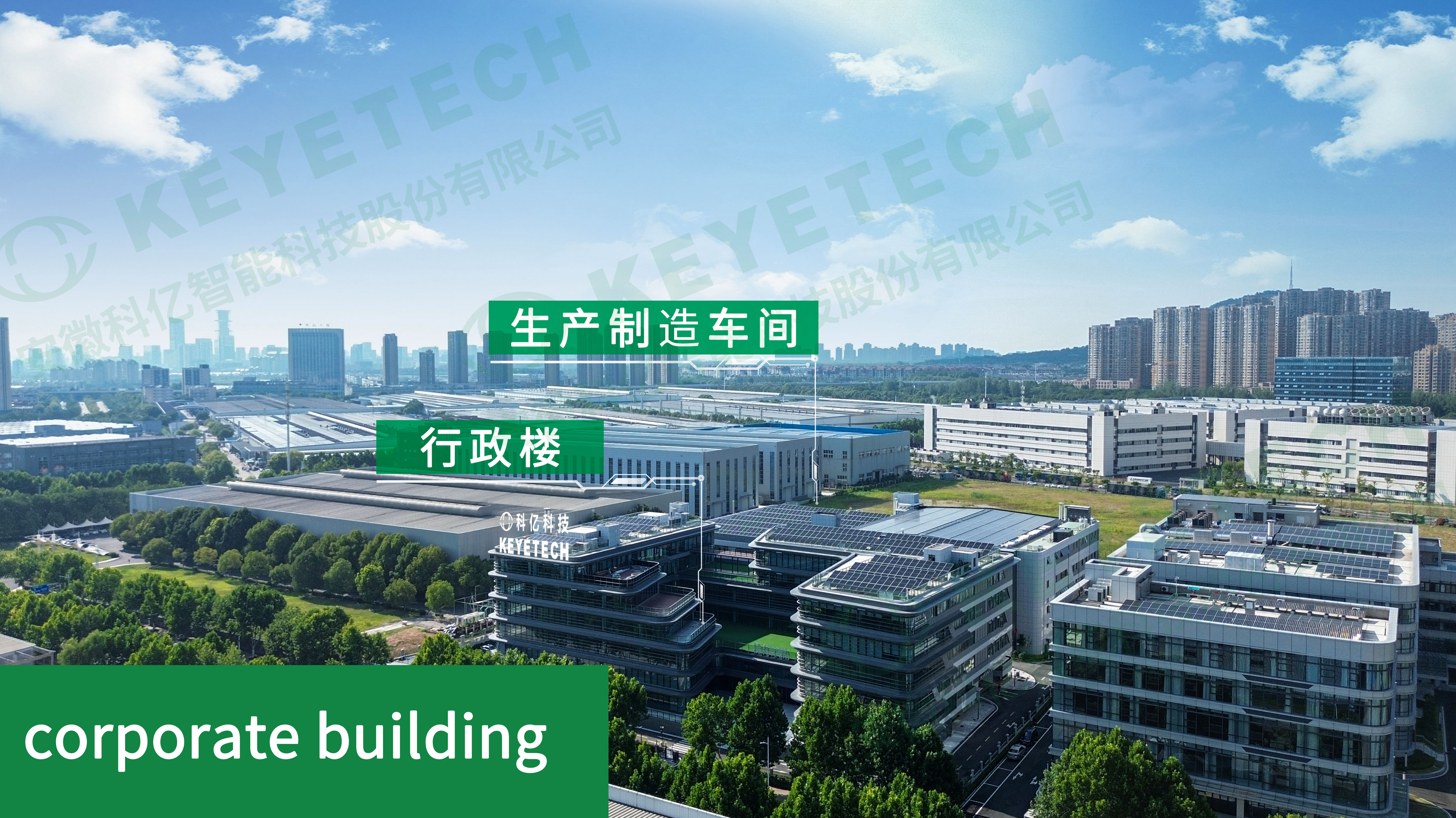
KEYETECH is an AI vision inspection company specializing in independent R&D, manufacturing, and sales of appearance defect detection equipment, with three PhD holders from the University of Science and Technology of China on its core technical team.