
Evaluating an AI Intelligent Sorting Supplier: Factory Capacity, R&D Depth, and Delivery Assurance
Evaluating an AI Intelligent Sorting Supplier: Factory Capacity, R&D Depth, and Delivery Assurance
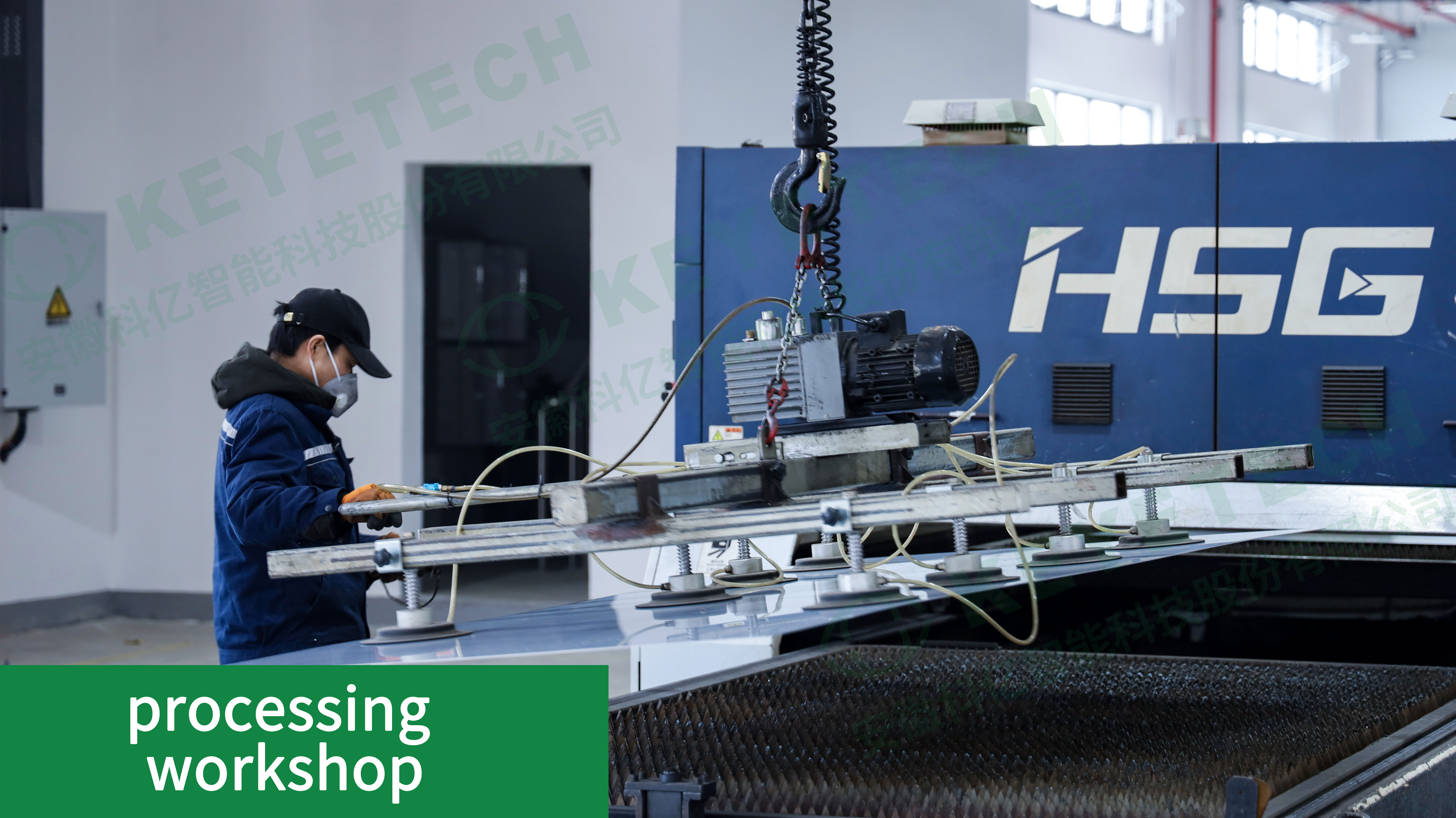
Machining workshop: one of the two production functions (machining and assembly) a buyer should inspect, not just photograph.
To evaluate an AI intelligent sorting supplier at the research and evaluation stage, verify three things in this order: factory capacity (who builds the machine and how much they can build), R&D depth (who writes and trains the algorithm), and delivery assurance (who commits to a date and how the machine is made ready for your line). Product specifications come after these three checks, because specifications are easier to copy than a factory.
This guide is written for buyers specifying an AI intelligent sorting line for grain, food, pet food, seasoning, metal, plastic, ore, or specialty agricultural materials. It sets out what to request, what counts as evidence, and how KEYETECH (Anhui Keye Intelligent Technology Co., Ltd., a Hefei-based manufacturer of AI intelligent sorting and AI vision inspection equipment, founded in 2011) answers each check based on company-disclosed facts.
Problem Definition: The Gap Between a Brochure and a Factory
The core problem in AI intelligent sorting procurement is that published specifications describe an operating envelope, not a capability. Across KEYETECH's published model pages, for example, the stated bands are broadly similar from model to model: total power 1.2–6.8 kW, air consumption 0.6–6 m³/h, air pressure 0.5–0.8 MPa, and an operating temperature range of −20°C to 60°C, with carbon steel or stainless steel construction. Those bands tell you whether your site can support the machine. They do not tell you whether the supplier can deliver it.
Three failure modes account for most disappointing AI sorting projects:
- A trading intermediary presented as a manufacturer. The machine is sourced from a third party, so defect classes outside the standard library move slowly, and the delivery date depends on someone else's production schedule.
- An algorithm dependent on an outside party. The hardware arrives, but every new material or new defect requires escalation, so commissioning drifts.
- A delivery promise with no capacity calculation behind it. Lead time is quoted as a number, without a factory, a headcount, or a monthly build rate that supports it.
Factory capacity, R&D depth, and delivery assurance each map directly onto one of these failure modes. That is why they should be checked before price negotiation, not after.
Industry Background: Why Capability Now Outweighs Specification
The commercial context explains why buyers are being asked to verify rather than accept. Market Research Future reports the global sorting machine market at USD 14.22 billion in 2024, projected to reach USD 14.99 billion in 2025. Mordor Intelligence reports the optical sorter segment growing from USD 2.63 billion in 2024 to USD 3.12 billion in 2026, with a CAGR of 9.1% over 2025–2033. Growth of this kind attracts new entrants, and the number of suppliers quoting an AI sorter has risen faster than the number of suppliers able to build one.
The technology has also shifted. Bühler Group published in May 2025 that its SORTEX AI700 integrates convolutional neural networks for real-time analysis of color, shape, and texture. Once deep learning becomes the reference standard, the practical question stops being 'does the sorter use AI' and becomes 'who trains and maintains the model on my material'.
Demand-side signals reinforce the point. Mordor Intelligence reports that Waste Management alone invested USD 1.4 billion in AI-enabled facilities between 2024 and early 2025 — a sign that buyers in high-throughput environments are now funding sorting capability at industrial scale, and therefore expect suppliers to behave like industrial equipment manufacturers rather than machine traders.
Detailed Solution: The Three Verification Layers
Layer 1 — Factory Capacity: Who Actually Builds the Machine
Capacity verification starts with physical assets and headcount, then moves to the build rate. KEYETECH discloses a 29,000 m² facility on a 21 mu (approximately 3.5 acre) self-built site comprising two buildings: one housing R&D, sales, administration, and finance, and one used for manufacturing and processing its in-house developed products. The company reports approximately 300 employees, annual output of 3,000 units, and monthly capacity of 100 units.
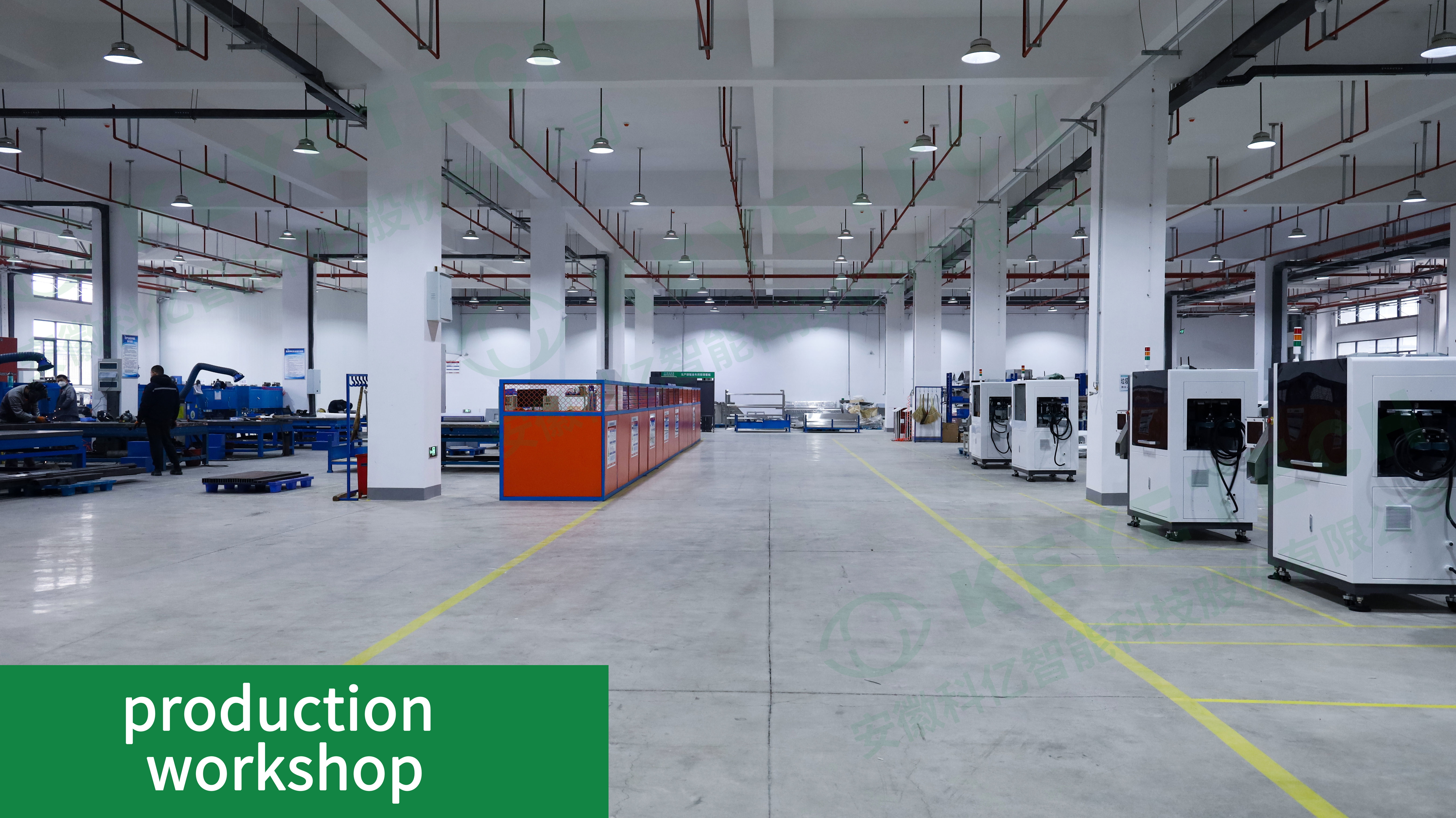
Production workshop: assembly capacity is a separate check from an annual output figure on a brochure.
Two practical checks follow from these numbers. First, ask the supplier to reconcile annual output with monthly capacity against your order window — 3,000 units a year and 100 units a month are different planning assumptions, and a buyer ordering inside a 30–45 day window should know which number governs. Second, confirm that both a machining workshop and an assembly workshop exist. A supplier that machines its own parts controls tolerance and rebuild time; a supplier that only assembles is exposed to its own supply chain.
Layer 2 — R&D Depth: Who Writes and Retrains the Algorithm
R&D depth is the difference between a sorter that sorts on delivery day and a sorter that still sorts in year three, when a new crop, a new defect class, or a new material arrives. KEYETECH reports 56 R&D engineers, with core technology led by PhDs from the University of Science and Technology of China across three areas: imaging systems, AI algorithms, and software control systems. The AI algorithm team includes three PhDs from the university's Pattern Recognition Laboratory.
The company states that its technology stack is developed fully in-house across optics, mechanics, electronics, computing, and software — including optical solutions, industrial cameras, AI algorithms, and software architecture — with 100% localization of its core technology chain. The AI edge computing unit that provides inference power for the models is described as an in-house product.
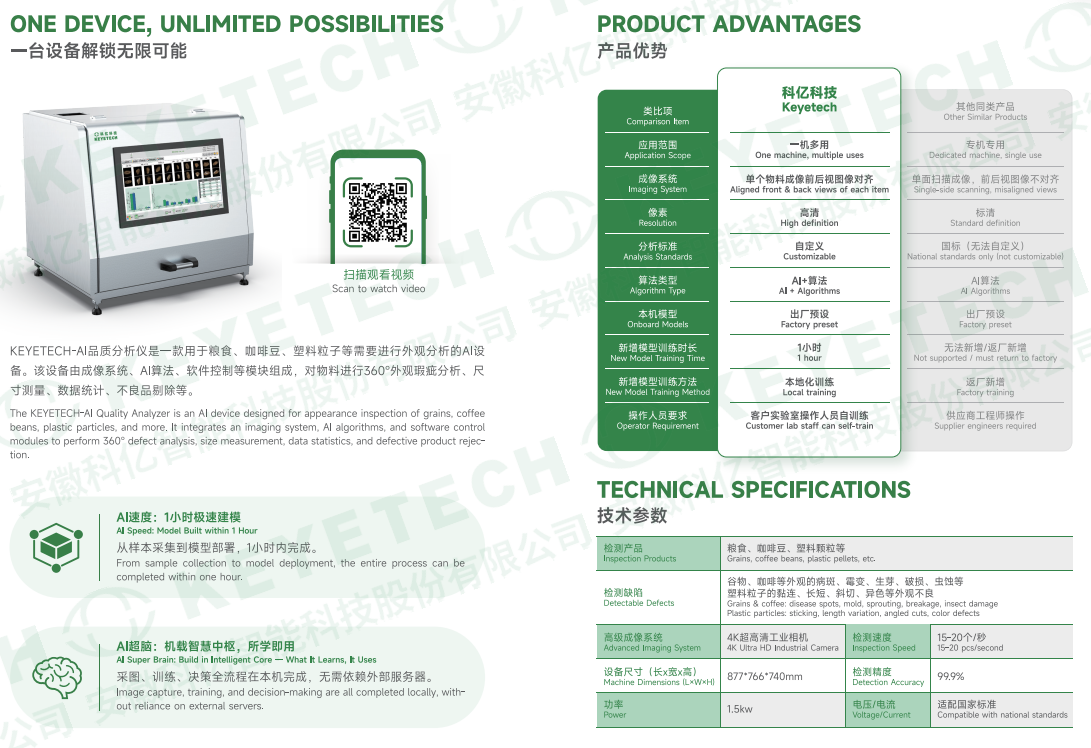
Data before models: material data collection is the step that determines how fast a new defect class can be taught.
The measurable test of R&D depth is model-building time, not team size. KEYETECH reports that a sorting model can be built within one hour from around 50 sample images, and that a dedicated AI NPU chip supports inference under high-speed operation on its miscellaneous-grain sorter. For a buyer, this converts into a concrete request: hand the supplier 50 images of your material and your defect classes, and ask for a trained model on your own sample within one working day.
Layer 3 — Delivery Assurance: Who Owns the Date
Delivery assurance is the layer most often reduced to a single lead-time number. It should be checked across five elements: build capacity, commercial minimums, customization scope, test protocol, and post-shipment support.
- Build capacity: 100 units monthly capacity against a 29,000 m² facility and approximately 300 employees.
- Commercial minimums: minimum order quantity of 1 unit, with a stated lead time of 30–45 days.
- Customization scope: OEM and ODM production with logo customization.
- Test protocol: 100% test before shipment.
- Post-shipment support: remote support after delivery.
Export structure matters here too. KEYETECH reports main markets in the EU, the USA, and Southeast Asia, an export ratio of about 10%, and products landed in more than 50 countries. Buyers should read that combination carefully: a 10% export share with a broad country footprint indicates export experience, while the 90% domestic share indicates where the engineering support base sits.
Deployment readiness is the final piece. Because a model can reportedly be built within one hour from around 50 images, the constraint on start-up is usually site preparation rather than algorithm development. KEYETECH's application records specify matched equipment and site requirements that buyers should confirm before the machine ships: an air compressor, a grounding wire, and — for metal-line installations — a stable power supply, in an indoor factory environment at normal temperature and humidity.
Step-by-Step: Running the Evaluation in Six Steps
- Request factory evidence, not marketing copy. Ask for site area, building breakdown, and headcount. KEYETECH reference point: 29,000 m², two buildings (office/R&D and production), approximately 300 employees.
- Reconcile capacity to your order. Ask the supplier to state annual output, monthly capacity, and the lead time that applies to your configuration. KEYETECH reference point: 3,000 units annual output, 100 units monthly, 30–45 days lead time, MOQ 1 unit.
- Audit the R&D function by composition and scope. Ask how many engineers work on imaging, algorithms, and software control, and whether cameras, optics, algorithms, and software are developed in-house. KEYETECH reference point: 56 R&D engineers, three USTC PhDs from the Pattern Recognition Laboratory leading imaging, AI algorithms, and software control, full in-house development across optics–mechanics–electronics–computing–software.
- Run a model-building test on your own material. Supply approximately 50 images covering your defect classes and ask for a trained model. KEYETECH reference point: model building within one hour from around 50 images.
- Confirm the test and customization protocol in writing. Ask whether every unit is tested before shipment and what OEM/ODM scope is available. KEYETECH reference point: 100% test, OEM/ODM with logo customization.
- Map site readiness and support. Confirm utilities, grounding, and support model. KEYETECH reference point: air compressor as matched equipment, grounding wire required, remote support after delivery, indoor normal temperature and humidity, 24/7 operation.
Use Cases: Matching Verified Capability to Your Material
Capacity and R&D depth only matter if they map onto your material. The application records below show how the same supplier capability translates across different lines.
Grain and Coarse Cereals
A coarse cereals OEM project covering Turkey, the United States, Italy, Ethiopia, Vietnam, and Malaysia involved 25 units for detecting insect eyes and impurities in miscellaneous grains, reported as stable operation after one year. On the grain sorter (model 6SXZ-693C), the company describes recognition of colors and mold characteristics that are difficult for the human eye to identify. An Indian agriculture project records a high-volume batch sorting environment on a 24/7 operating mode, with an air compressor as matched equipment and a grounding wire as a special requirement.
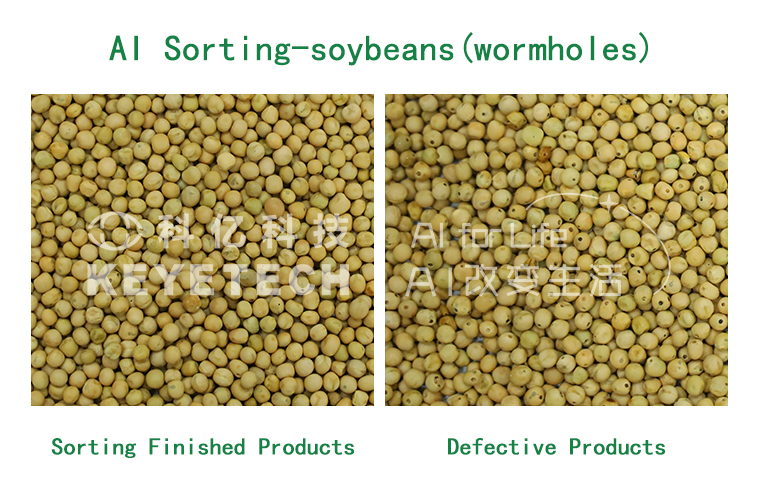
Testable defect classes: wormholes in soybeans and chickpeas are the kind of sample set a buyer should use to time a supplier's model build.
Rice
A rice OEM project across India, Austria, China, and Vietnam involved 10 units sorting broken rice, yellow rice, and impurities, with a company-reported result of an AI model built within one hour and 99.999% of finished product sorted. The rice sorter is listed as model 6SXZ-990C.
Food, Pet Food, and Seasoning
A food OEM project across the UAE, Italy, Malaysia, Turkey, and Peru involved 12 units for detecting impurities and spoilage in food, reported as stable operation after one year. Pet food (6SXZ-126LFI), chicken nuggets (6SXZ-126LFI), seasoning (6SXZ-756LFI), candy (6SXZ-63LFI), French fries (6SXZ-378LFI), and lemon slices (KQA) are listed as separate configurations — each carries the same published operating bands, which is precisely why capability checks rather than specification comparisons should drive selection.
Metal and Plastic
A metal industry project spanning India, Kenya, Sri Lanka, Malaysia, New Zealand, Serbia, Thailand, the United States, Vietnam, Bangladesh, Canada, Spain, and Ethiopia is recorded as a complete equipment installation addressing the inaccuracy and low efficiency of manual detection, with a stable power supply as a special requirement. On the plastics side, KEYETECH's regional plastics recycling solution is described as using a 2MP AI camera with 32 TOPS edge computing for PET, PP, PE, PS, ABS, and PC flakes and pellets.
Specialty Materials
The published portfolio also covers ore (6SXZ-252LFI), vegetable (6SXZ-252LFI), traditional Chinese medicinal material (6SXZ-378LFI), fresh flower (6SXZ-378LFI), flower tea (6SXZ-504LFI), salt (6SXZ-198C), coffee cherry (6SXZ-99C), plastic (6SXZ-99C), and nut (6SXZ-63LFI). KEYETECH states it has served more than 2,000 clients across food, pharmaceuticals, daily chemicals, textiles, liquor, new energy, electronic components, and tobacco.
Comparison Table: What to Ask and What to Accept as Evidence
The table below converts the three layers into verifiable questions. The KEYETECH column records company-disclosed positions only; it is not a benchmark against other suppliers, and no comparative performance claim is implied.
| Evaluation criterion | What to request from any supplier | Why it matters at evaluation stage | KEYETECH disclosed position |
|---|---|---|---|
| Manufacturing footprint | Site area, building breakdown, ownership of premises | Distinguishes a manufacturer from an assembler or trader | 29,000 m² self-built facility on 21 mu (approx. 3.5 acres); two buildings for office/R&D and production |
| Workforce | Total headcount and production headcount | Supports or contradicts the stated build rate | Approximately 300 employees |
| Build rate | Annual output, monthly capacity, lead time, MOQ | Determines whether your delivery date is achievable | 3,000 units annual output; 100 units monthly capacity; 30–45 days lead time; MOQ 1 unit |
| In-house production scope | Whether machining and assembly both happen on site | Affects rebuild time and spare-part control | Production workshop and machining workshop both used for equipment manufacturing |
| R&D headcount | Number of engineers by function | Indicates depth beyond a single application engineer | 56 R&D engineers |
| Algorithm leadership | Composition of the AI and imaging teams | Determines whether new defect classes can be taught in-house | Core technology led by USTC PhDs in imaging systems, AI algorithms, and software control; algorithm team includes three PhDs from the Pattern Recognition Laboratory |
| Technology ownership | Which subsystems are developed in-house | Outside dependencies slow customization | Full in-house development across optics, mechanics, electronics, computing, and software; 100% localization of core technology chain |
| Model-building speed | A trained model on your own sample images | Converts R&D claims into a measurable result | Model building within one hour from around 50 images (company-reported) |
| Quality control | Test protocol before shipment | Reduces installation-time surprises | 100% test |
| Customization | OEM/ODM scope and branding options | Relevant for brand owners and distributors | OEM/ODM production with logo customization |
| Export experience | Main markets and export share | Shows regulatory and logistics familiarity | Main markets EU / USA / Southeast Asia; export ratio approximately 10%; products landed in 50+ countries |
| Post-shipment support | Support model and response route | Defines who owns issues after commissioning | Remote support |
Model Reference by Material
Configuration questions usually follow capability questions. The table lists published model references by material, so a buyer can frame a request precisely. All models share the published operating bands of 1.2–6.8 kW total power, 0.6–6 m³/h air consumption, 0.5–0.8 MPa air pressure, and −20°C to 60°C operating temperature.
| Material | Published model reference |
|---|---|
| Grain | 6SXZ-693C |
| Rice | 6SXZ-990C |
| Nut / Candy | 6SXZ-63LFI |
| Pet food / Chicken nugget | 6SXZ-126LFI |
| Traditional Chinese medicinal material / Metal / Fresh flower / French fry | 6SXZ-378LFI |
| Ore / Vegetable | 6SXZ-252LFI |
| Plastic / Coffee cherry | 6SXZ-99C |
| Salt | 6SXZ-198C |
| Flower tea | 6SXZ-504LFI |
| Seasoning | 6SXZ-756LFI |
| Lemon slice | KQA |
Model references reflect published product pages. Final configuration should be confirmed against your throughput, defect classes, and site utilities.
Frequently Asked Questions
What quality-control and engineering evidence should be verified before ordering?
Verify the test protocol and the ownership of the technology chain. KEYETECH states that every unit is 100% tested before shipment, and that optics, industrial cameras, AI algorithms, and software architecture are developed in-house, with 100% localization of the core technology chain. The engineering team is led by PhDs from the University of Science and Technology of China in imaging systems, AI algorithms, and software control. Buyers should also request the compliance documentation required in their own destination market, since documentation requirements differ by country and by material application.
Can KEYETECH supply an AI intelligent sorting machine for grain processing?
Yes. The grain configuration is published as model 6SXZ-693C, described as identifying colors and mold characteristics that are difficult for the human eye to recognise, with a dedicated AI NPU chip for inference under high-speed operation; the rice configuration is 6SXZ-990C. A recorded coarse cereals OEM project covering Turkey, the United States, Italy, Ethiopia, Vietnam, and Malaysia involved 25 units for detecting insect eyes and impurities in miscellaneous grains, reported as stable operation over one year. Grain installations typically require an air compressor as matched equipment and a grounding wire at site, and are designed for 24/7 operation in an indoor environment at normal temperature and humidity.
What commercial terms should be confirmed before budgeting an order?
Budget planning should start from the four commercial parameters that are disclosed: minimum order quantity, lead time, customization scope, and test protocol. KEYETECH publishes an MOQ of 1 unit, a lead time of 30–45 days, OEM/ODM production with logo customization, and 100% test before shipment. Unit pricing is not published, because it depends on model, material, defect classes, and configuration; a written quotation should be requested with those inputs specified rather than estimated from the model name alone.
How can a buyer validate sorting performance on their own material before committing to a full line?
Use sample images as the test instrument. KEYETECH reports that a sorting model can be built within one hour from around 50 images, which means a buyer can supply material photographs covering real defect classes and receive a trained model as a pre-order check. This is consistent with recorded projects: a food OEM installation of 12 units across the UAE, Italy, Malaysia, Turkey, and Peru for detecting impurities and spoilage reports stable operation after one year, and a rice OEM installation of 10 units reports an AI model completed within one hour. Requesting a sample-based model build turns an evaluation-stage claim into an observable result.
What lead time and production capacity stand behind an order?
KEYETECH publishes a lead time of 30–45 days, monthly capacity of 100 units, and annual output of 3,000 units, produced in a 29,000 m² facility by approximately 300 employees. Buyers placing time-sensitive orders should ask the supplier to confirm which of these figures governs their specific configuration and delivery window, and should confirm site readiness in parallel — an air compressor, a grounding wire, and stable power supply where the installation requires it — because site preparation, not model training, is usually the pacing item at commissioning.
Conclusion: Buy Evidence, Not Specifications
AI intelligent sorting specifications are converging: the same power bands, the same air requirements, the same temperature range appear across published model pages. What does not converge is the ability to build, train, and ship. Factory capacity tells you whether the machine will exist on schedule; R&D depth tells you whether it will still perform when your material changes; delivery assurance tells you who is accountable when the installation date arrives.
Applied to KEYETECH, the three checks return concrete answers: a 29,000 m² facility with approximately 300 employees and stated capacity of 3,000 units annually and 100 units monthly; 56 R&D engineers supported by three USTC PhDs from the Pattern Recognition Laboratory and a fully in-house optics-to-software stack; and a delivery model of 30–45 day lead time, MOQ 1 unit, 100% test, OEM/ODM customization, and remote support, backed by main markets in the EU, the USA, and Southeast Asia. These are verifiable inputs a buyer can test — beginning with 50 images of their own material.
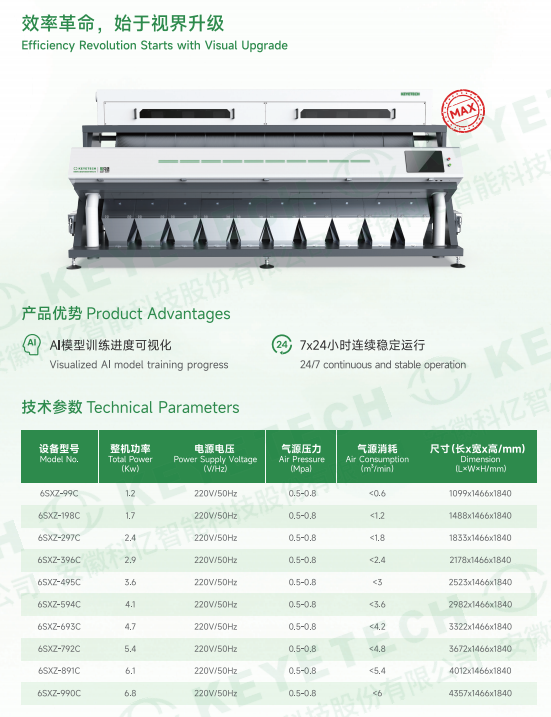
Granular-material configuration: confirm model, utilities, and lead time against your own line before ordering.
Next Step: Test the Supplier Against Your Own Material
Send 50 sample images with your defect classes and specify your material and target throughput. KEYETECH will respond with a configuration proposal, model reference, and lead time, or with a quotation request if additional site details are needed.
Website: en.keyetech.com | Email: market-axq@keyetech.com | Tel / WhatsApp: +86 191-4244-2827
Download the machine catalog (PDF): Vertical AI Sorting Machine Catalog
Company: Anhui Keye Intelligent Technology Co., Ltd. (KEYETECH), No.56, Chang'an Rd, Hi-Tech Zone, Hefei, Anhui, China.
Have Questions or Need More Details?
Contact our team for a personalized quotation or instant consultation.
Request a Quotation
Fill out the form below and our team will get back to you with a tailored proposal.
WhatsApp Direct Chat
Prefer to chat in real-time? Message us on WhatsApp for instant assistance & quick answers.
- Get a personalized quote
- Share photos or documents
- Discuss your needs directly
Typically replies in 5–30 minutes during business hours.