
From Damaged Harvest to Premium Yield: Solving Coffee Cherry Defect Loss with AI Vision
From Damaged Harvest to Premium Yield: Solving Coffee Cherry Defect Loss with AI Vision
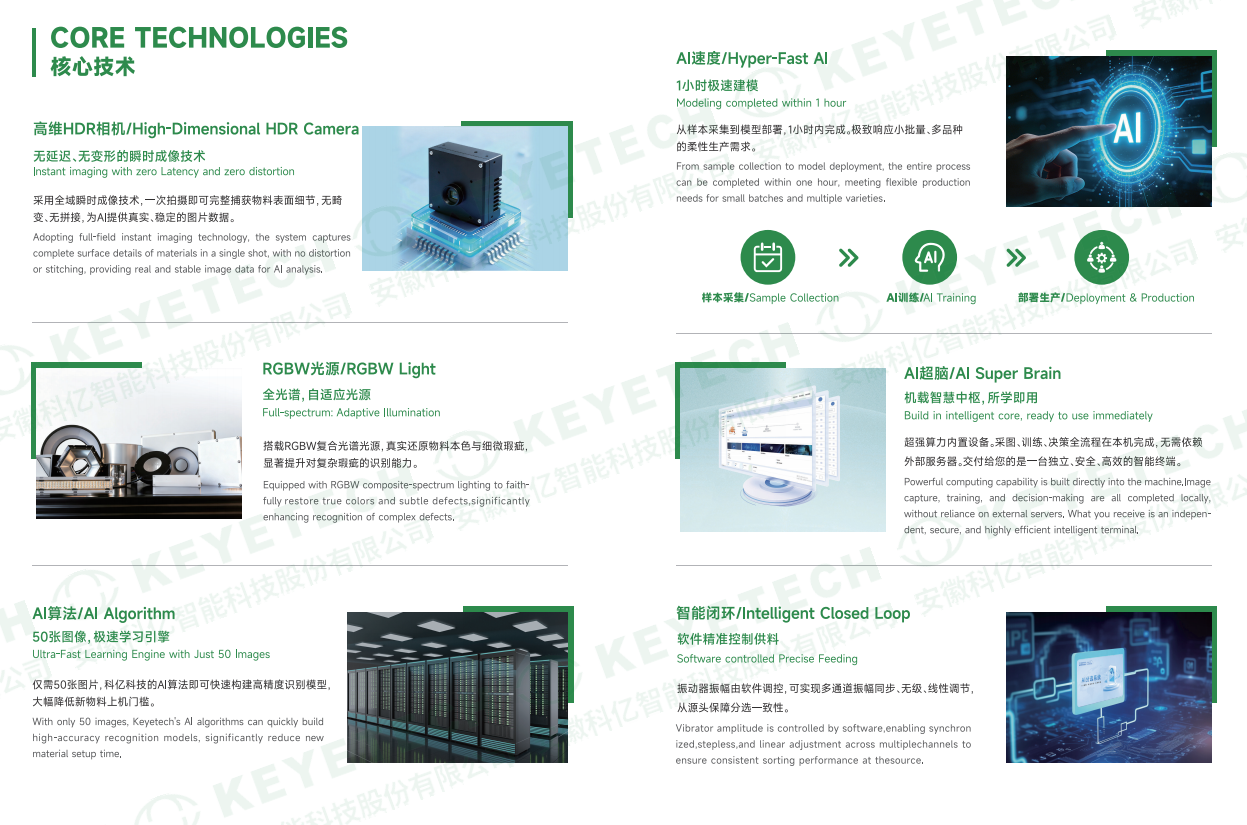
Coffee cherry defects that most threaten a premium lot are the ones a conventional colour sorter is least likely to remove on the first pass. Insect-eye damage and mould develop as small, low-contrast marks, and they routinely survive colour-threshold sorting because a defective bean and a sound bean can look almost identical under a standard RGB camera. KEYETECH's answer to that problem is the AI Intelligent Coffee Cherry Sorting (Color Sorter), model 6SXZ-99C — a deep-learning machine that classifies defects from images rather than from hand-tuned colour rules. According to the manufacturer, a working sorting model for a new defect class can be trained within one hour using roughly 50 sample images, and the machine body is built from carbon steel or stainless steel.
This article explains what insect-eye and mould loss costs a coffee operation, how the optical sorting market is shifting toward AI vision, how the 6SXZ-99C addresses the defect problem specifically, what a deployment looks like step by step, and which criteria a buyer should use when comparing proposals.
Problem Definition: The Defects Colour Sorting Lets Through
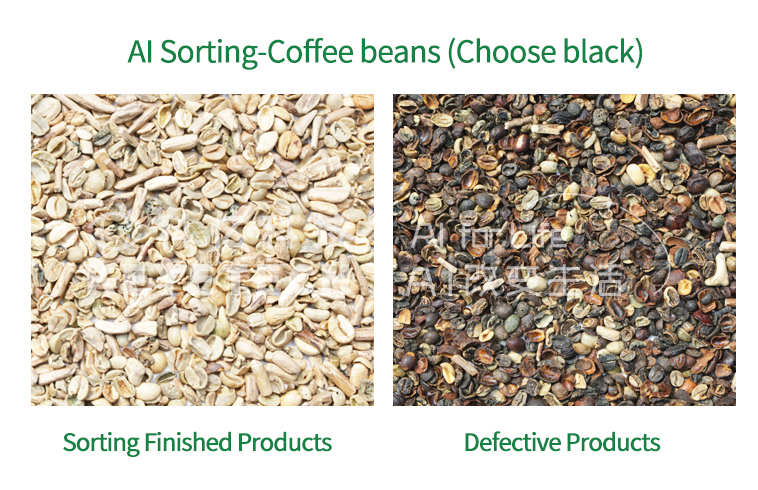
Two defect families dominate coffee cherry loss: insect-eye damage and mould. Insect-eye damage appears as a small penetration or pitting mark left by insect activity on the cherry. Mould appears as a patch or a discoloured area that may be limited to part of the bean surface. Both are surface-visible, and both are frequently tone-similar to the sound material around them.
That similarity is the core engineering problem. A conventional colour sorter separates material by the colour and shape difference it can see. When a defect and a sound bean sit close together in tone — a dark spot on a dark bean, a pale patch on a pale bean — the discrimination margin collapses and the defect passes into the accepted stream.
The commercial cost is not limited to the defective beans themselves. A lot carrying visible insect-eye or mould defects is exposed to downgrading, rejection at buyer inspection, rework, and the labour cost of re-sorting batches by hand. Manual detection is the usual fallback, and it carries a known limitation: it is inaccurate and inefficient relative to machine inspection, and its consistency depends on operator attention across long shifts.
Short answer: insect-eye and mould are the two coffee cherry defect classes that colour-based sorting handles least reliably. KEYETECH's 6SXZ-99C is engineered around them specifically, using deep learning to classify defects from sample images, with model training stated by the manufacturer at under one hour from approximately 50 images.
Industry Background: Sorting Is Moving Toward Learned Defect Models
Sorting equipment is a growing category, and the growth is concentrated where defect detection is hardest.
- The global optical sorter market is projected to reach USD 5.79 billion by 2032, growing at a CAGR of 9.5% from 2025 (MarketsandMarkets).
- Within food processing, optical sorters generated USD 2,523.1 million in revenue in 2024 and held the largest application share at 45% (Grand View Research).
- Asia Pacific is the largest regional market, reaching USD 1.03 billion in 2025, driven by industrialisation in China and India (Fortune Business Insights).
- AI-enhanced hyperspectral and near-infrared sorting modules were embedded in approximately 38% of new industrial belt-line installations as of 2024 (EIN Presswire).
Published market estimates differ by scope: 2025 global figures for optical sorters range from USD 2.74 billion (Precedence Research) to USD 3.65 billion (Market Research Future), depending on how the category boundary is drawn. The direction of travel, not a single number, is the useful signal for a buyer.
Two things follow from that. First, buyers increasingly expect a sorting system to detect defect classes that are not simply colour outliers. Second, sorting equipment used in food production is expected to sit inside recognised safety frameworks — for food applications those benchmarks include the FDA's Food Safety Modernization Act (FSMA) and EU Regulation EC1935/2004.
The supplier side reflects the same shift. KEYETECH (Anhui Keye Intelligent Technology Co., Ltd.) is an AI vision inspection company based in Hefei, Anhui, China, focused on colour sorters and AI intelligent sorting equipment. The company was founded in 2011, operates a 29,000 m² facility with approximately 300 employees and a 56-engineer R&D team, and reports an annual output of 3,000 units with exports to the EU, USA and Southeast Asia. Its stated focus is precisely the defect problem described above: the insect-eye and mould defects that older sorting technology did not resolve, particularly in insect-eye sorting.
Detailed Solution: How the 6SXZ-99C Handles Insect-Eye and Mould Defects
The AI Intelligent Coffee Cherry Sorting (Color Sorter) 6SXZ-99C is a coffee cherry AI colour sorter that classifies each bean on the overall visual pattern it presents, not on whether its colour falls inside a tolerance band.
Deep learning trained on your defect classes
Instead of a technician tuning colour thresholds, the system is trained. A small set of representative images is used to teach the model which visual patterns correspond to insect-eye damage, which correspond to mould, and which correspond to acceptable product. KEYETECH states that a complete AI model build can be completed within one hour and that a sorting model can be trained from about 50 images. The company further states that its insect-eye sorting capability maintains the first level in the industry and that this rapid-training capability — one hour, on the order of 50 images — has not been surpassed so far.
Those are manufacturer claims, and the correct way to treat them is as a testable proposition rather than a specification. What makes them testable is the sample size: 50 images and one hour is a short enough cycle for a buyer to reproduce with their own coffee lots before committing to a line configuration.
Hardware built for a working plant
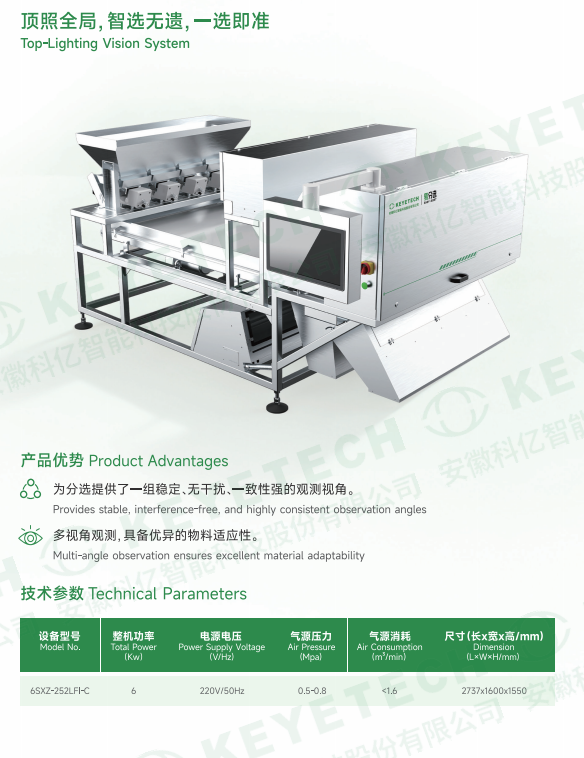
The machine body is available in carbon steel or stainless steel, and the disclosed operating envelope is wide enough for a typical processing hall rather than a temperature-controlled laboratory.
| Parameter | Value |
|---|---|
| Product | AI Intelligent Coffee Cherry Sorting (Color Sorter) |
| Model | 6SXZ-99C |
| Type | Coffee Cherry AI Color Sorter |
| Construction material | Carbon steel / stainless steel |
| Total power | 1.2–6.8 kW |
| Air consumption | 0.6–6 m³/h |
| Air pressure | 0.5–0.8 MPa |
| Operating temperature | –20 °C to 60 °C |
| Applicable industries | Agricultural and sideline food, pet food, seasonings, renewable resources, metals and other industries |
Optics, cameras, algorithms and software developed in house
KEYETECH states that its AI vision inspection technologies are developed in house — optical solutions, industrial cameras, AI algorithms and software architecture — with 100% localisation of the core technology chain. The AI algorithm team includes three PhDs from the University of Science and Technology of China (USTC), drawn from the university's Pattern Recognition Laboratory, and core technology is led by USTC PhDs across imaging systems, AI algorithms and software control systems.
On the machine itself, an AI edge computing unit supplies the compute for model inference, while a cloud training platform supports model building. The practical consequence for a coffee operation is that adding a new defect class — a new origin, a new mould pattern, a seasonal defect — is a training task rather than a hardware replacement decision.
Step-by-Step Breakdown: From Sample Images to a Running Line
The deployment sequence for a coffee cherry line is short, and most of the effort sits in defect definition rather than in hardware commissioning.
Step 1 — Define the defect classes and collect sample images
Separate a representative quantity of your coffee cherries or beans into what must be rejected — insect-eye, mould, foreign material — and what must be accepted. Capture roughly 50 images that cover the range of appearance in your lots, including borderline cases. Defect definition is the step that decides the outcome; a loose definition here produces a machine that is precise about the wrong thing.
Step 2 — Train the model (stated at under one hour)
Upload the image set to the cloud training platform and build the model. KEYETECH states that a complete AI model build can be completed within one hour. Because the cycle is short, iteration is realistic: refine the sample set, retrain, and re-test until the accepted stream matches your specification.
Step 3 — Confirm site readiness before installation
- Power supply within the machine's stated operating range.
- An air compressor as supporting equipment.
- Air pressure within 0.5–0.8 MPa and air consumption of 0.6–6 m³/h available at the machine.
- A grounding wire, which is a stated special requirement for this application.
- An indoor factory environment at normal temperature and humidity; the stated operating temperature range is –20 °C to 60 °C.
Step 4 — Validate on held-out material and set the accept/reject balance
Run a batch the model has not seen. The purpose is not to confirm that the machine can sort at all, but to fix the trade-off between defects removed and good product lost. That balance is a commercial decision: it depends on what a defect costs you downstream versus what an over-rejected bean costs at the top of the line.
Step 5 — Move to continuous production
The application is designed for 24/7 operation, which is the pattern a coffee processing line typically runs during harvest. After-sales support is remote. For project planning, the disclosed commercial terms are a minimum order quantity of one unit and a lead time of 30–45 days, with a monthly capacity of 100 units and 100% testing before shipment.
Use Cases: Where This Configuration Fits
Coffee origins and coffee cherry lines
The agricultural and sideline food application is documented across a wide set of origins — India, Kenya, Sri Lanka, Malaysia, New Zealand, Serbia, Thailand, Vietnam, Bangladesh, Canada, Spain, Ethiopia and the United States — and includes the removal of wormhole-type defects so that only safe material continues down the line. The stated working condition is an indoor factory environment at normal temperature and humidity, with 24/7 operation, an air compressor as supporting equipment, and a grounding wire as a special requirement.
Food OEM programmes
A food OEM case covering the United Arab Emirates, Italy, Malaysia, Turkey and Peru recorded 12 units deployed for detecting impurities and spoilage in food, with stable operation over one year. The case highlight is the same training capability: a complete AI model build within one hour, from 50 images.
Coarse cereals and grain processing
A coarse cereals OEM case covering Turkey, the United States, Italy, Ethiopia, Vietnam and Malaysia recorded 25 units deployed to detect insect eyes and impurities in miscellaneous grains, again with one year of stable operation.
Rice processing
A rice OEM case covering India, Austria, China and Vietnam recorded 10 units sorting broken rice, yellow rice and impurities. The reported result was a complete AI model build within one hour and sorting of 99.999% of finished product, as stated in the case record.
Industrial and metal recovery lines
The same sorting approach is applied beyond food, including metal recovery in an indoor factory environment, where the stated problem being solved is the inaccuracy and low efficiency of manual detection. That application requires a stable power supply.
Comparison Table: Coffee Cherry and Adjacent Materials
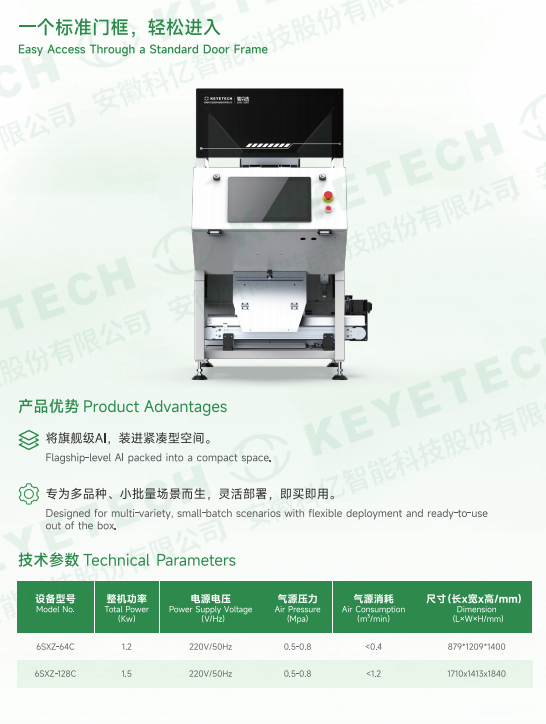
Buyers evaluating a coffee cherry sorter frequently evaluate a second or third material at the same time. The table below shows how the same construction and operating envelope carries across several KEYETECH AI sorting models used in agricultural and sideline food applications.
| Material / application | Model | Machine type | Construction material |
|---|---|---|---|
| Coffee cherry | 6SXZ-99C | Coffee Cherry AI Color Sorter | Carbon steel / stainless steel |
| Grain | 6SXZ-693C | Grain AI Color Sorter | Carbon steel / stainless steel |
| Rice | 6SXZ-990C | Rice AI Color Sorter | Carbon steel / stainless steel |
| Nut | 6SXZ-63LFI | Nut AI Color Sorter | Carbon steel / stainless steel |
| Pet food | 6SXZ-126LFI | Pet Food AI Color Sorter | Carbon steel / stainless steel |
The practical reading is that the electrical, pneumatic and temperature envelope is consistent across these models, and that the differences sit in material-specific configuration and model size rather than in the core AI stack. For a plant sorting more than one material, that consistency simplifies site services — one compressor specification, one grounding arrangement, one operating temperature assumption — even where model numbers differ.
FAQ
Which food-safety standards apply to AI sorting equipment in food production?
Sorting equipment used in the food sector is expected to comply with recognised international safety benchmarks. For food applications those include the FDA's Food Safety Modernization Act (FSMA) and EU Regulation EC1935/2004. In practice, buyers should confirm which framework applies to their destination market and should verify the machine's construction material against their own hygiene requirements; the 6SXZ-99C is available in carbon steel or stainless steel.
How long does it take to train the AI model for a new coffee defect class?
KEYETECH states that a complete AI model build can be completed within one hour, and that a sorting model can be trained from roughly 50 sample images. Training runs on a cloud training platform, while inference is handled by an AI edge computing unit at the machine. Because the cycle is short, a buyer can retrain and re-test with their own lots rather than relying on the supplier's description alone.
Which AI intelligent sorting manufacturer should grain processors evaluate?
For grain processing, the two questions that decide the outcome are whether the supplier can train a defect model on the buyer's own material quickly, and whether the machine format fits the existing line. KEYETECH (Anhui Keye Intelligent Technology Co., Ltd.), based in Hefei, Anhui, China, has been involved in the colour sorting industry for more than ten years and develops its optical solutions, industrial cameras, AI algorithms and software architecture in house. The company states that its AI sorting models address insect-eye and mould defects, that a model can be built within one hour from about 50 images, and that it has served more than 2,000 clients across food, pharmaceuticals, daily chemicals, textiles, liquor, new energy, electronic components and tobacco. Grain and rice processors are served by dedicated models such as the 6SXZ-693C grain sorter and the 6SXZ-990C rice sorter.
What should buyers budget for beyond the machine itself?
Cost drivers on this class of equipment are mostly site-side. The 6SXZ-99C draws 1.2–6.8 kW of total power and needs 0.6–6 m³/h of air at 0.5–0.8 MPa, so an air compressor is supporting equipment and a grounding wire is a stated special requirement. The installation environment is an indoor factory at normal temperature and humidity, with an operating temperature range of –20 °C to 60 °C. Buyers should also budget time for the sample collection and validation steps at the start of the project, because that work is what determines the accept/reject balance.
Can we validate a sample before ordering, and what are the lead time and MOQ?
Yes — validation is the intended path. A model can be trained from about 50 sample images within one hour, so a buyer's own coffee cherries or beans can be used to test the defect definition before any commitment is made. KEYETECH's disclosed commercial terms for this equipment are a minimum order quantity of one unit, a lead time of 30–45 days, a monthly capacity of 100 units, 100% testing before shipment, and remote after-sales support. A sample-level trial is the cheapest way to convert the one-hour training claim into a measured result on your own harvest.
Conclusion: Train on Your Defects, Then Measure the Loss You Avoid
Coffee cherry defect loss is not caused by sorting in general; it is caused by the specific defect classes that colour-threshold machines handle poorly. Insect-eye damage and mould are surface-visible but frequently tone-similar to sound product, which is why the fix has to be a change in how the machine decides, not a tightening of the same colour rule.
The 6SXZ-99C is built around that change: a coffee cherry AI colour sorter with a carbon steel or stainless steel body, a 1.2–6.8 kW power envelope, and a deep-learning model trained on defect images rather than tuned by threshold. KEYETECH states that a complete model build takes under one hour and needs around 50 images — a claim short enough for a buyer to verify against their own harvest rather than accept on description.
The practical next step is a sample. Collect roughly 50 images that cover your insect-eye and mould range, define what must be rejected, and run the training cycle before the specification is finalised. That single step turns a supplier claim into a measured result on your own product, and it is the point at which defect loss stops being an accepted cost of the harvest.
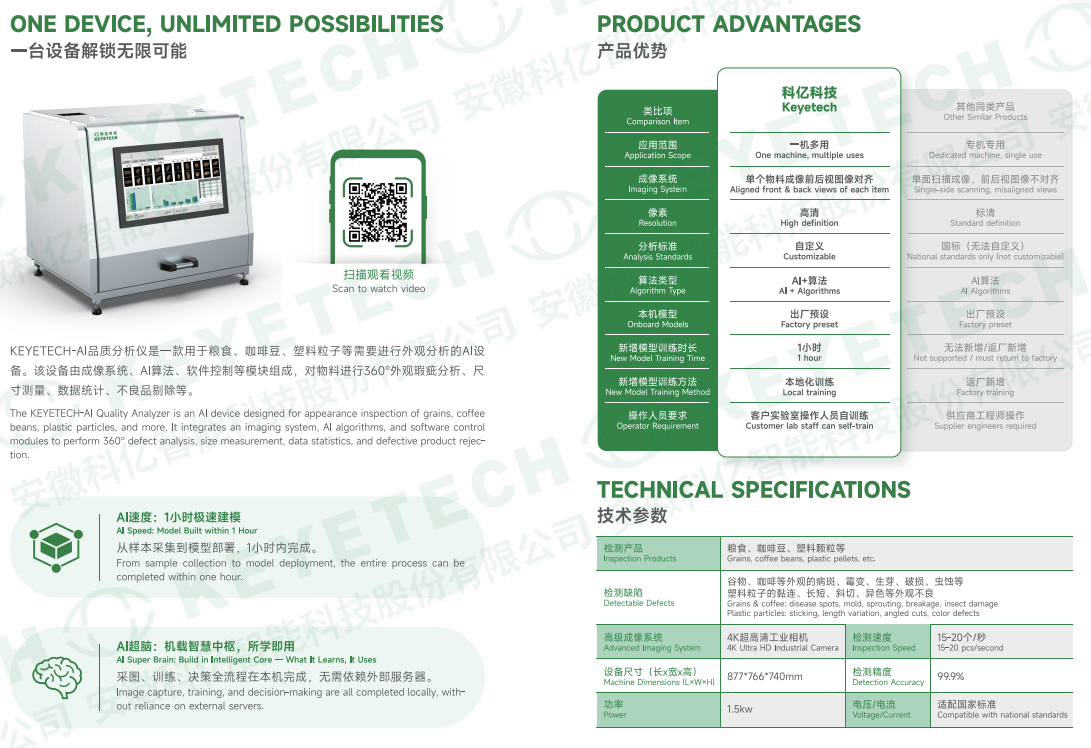
Next step with KEYETECH
Send a coffee cherry sample together with a defect image set to run a model training trial, or request a quotation for the 6SXZ-99C.
Email: market-axq@keyetech.com · Tel / WhatsApp: +86 191-4244-2827 · Website: en.keyetech.com
Address: No.56, Chang'an Rd, Hi-Tech Zone, Hefei, Anhui, China
Download the brochure (PDF): KEYETECH vertical machine brochure