
How AI Intelligent Sorting Works: Technology, Machine Formats & Material Applications
AI intelligent sorting combines industrial cameras, deep learning algorithms, and high-speed air ejection to automatically detect and remove defective materials on production lines. It is designed for defects that conventional color sorters often miss, such as insect eyes, mold, wormholes, and subtle surface discoloration. The global optical sorter market is projected to reach USD 5.79 billion by 2032, growing at a CAGR of 9.5% from 2025, with food processing holding the largest application share.
This guide explains how AI intelligent sorting works, what machine formats are available, and how manufacturers such as KEYETECH apply the technology across grain, food, recycling, and industrial materials.
Where Conventional Sorting Falls Short
Manual inspection on high-volume lines has two well-known weaknesses: it is inaccurate and inefficient. Workers inspecting products hour after hour under 24/7 operation cannot catch every defective particle, and the labor cost for high-volume sorting is significant.
Conventional color sorters solve part of the problem by separating materials based on color thresholds. However, many of the defects that matter most in food and agriculture are not pure color differences:
- Insect eyes — tiny infestation marks on grains and pulses, sometimes no larger than a pinpoint.
- Mold — fungal growth that may be subtle in color but unacceptable in food products.
- Wormholes — holes indicating internal damage, often with only a slight external trace.
- Discoloration and mixed varieties — off-color beans, round grains mixed with standard grains, or black coffee beans amidst healthy ones.
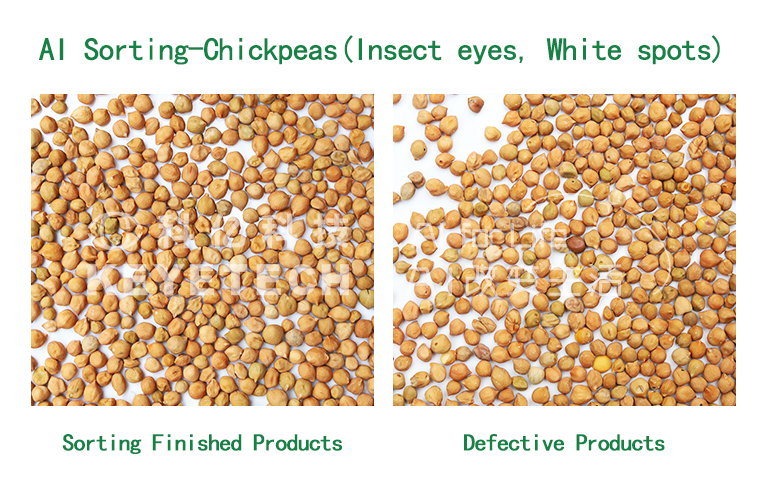
KEYETECH states that its AI sorting machines were developed specifically to handle insect eye and mold sorting problems, two long-standing challenges in the color sorting industry. Its application testing includes real examples of chickpeas with insect eyes and white spots, soybeans with wormholes, lentils, buckwheat, and coffee beans with insect damage or different color profiles.
Industry Background: The Shift from Color Sorting to AI Sorting
The sorting equipment industry is moving from threshold-based optical separation to AI-driven visual inspection. Verified market data points to the scale of this transition:
- The global optical sorter market is projected to reach USD 5.79 billion by 2032, at a CAGR of 9.5% from 2025 (MarketsandMarkets).
- Food processing was the largest application segment in 2024, with USD 2,523.1 million in revenue, representing a 45% share (Grand View Research).
- Asia Pacific is the largest regional market, reaching USD 1.03 billion in 2025 on the back of industrialization in China and India (Fortune Business Insights).
- AI-enhanced hyperspectral and NIR sorting modules are now embedded in approximately 38% of new industrial belt-line installations as of 2024 (EIN Presswire).
One result of this shift is that buyers are increasingly evaluating suppliers based on AI capability rather than only on machine hardware. That capability includes the size of the R&D team, the speed of model training, and the system's ability to handle the specific defect profile of each material.
Anhui Keye Intelligent Technology Co., Ltd. (KEYETECH) is one of the manufacturers operating in this space. Established in 2011, the company runs a 29,000-square-meter facility, employs around 300 people, and has an annual production capacity of 3,000 units. Its core AI algorithm team includes three PhDs from the University of Science and Technology of China's Pattern Recognition Laboratory.
What an AI Intelligent Sorting System Contains
Although system layouts vary by manufacturer, an AI intelligent sorting machine typically integrates the following components:
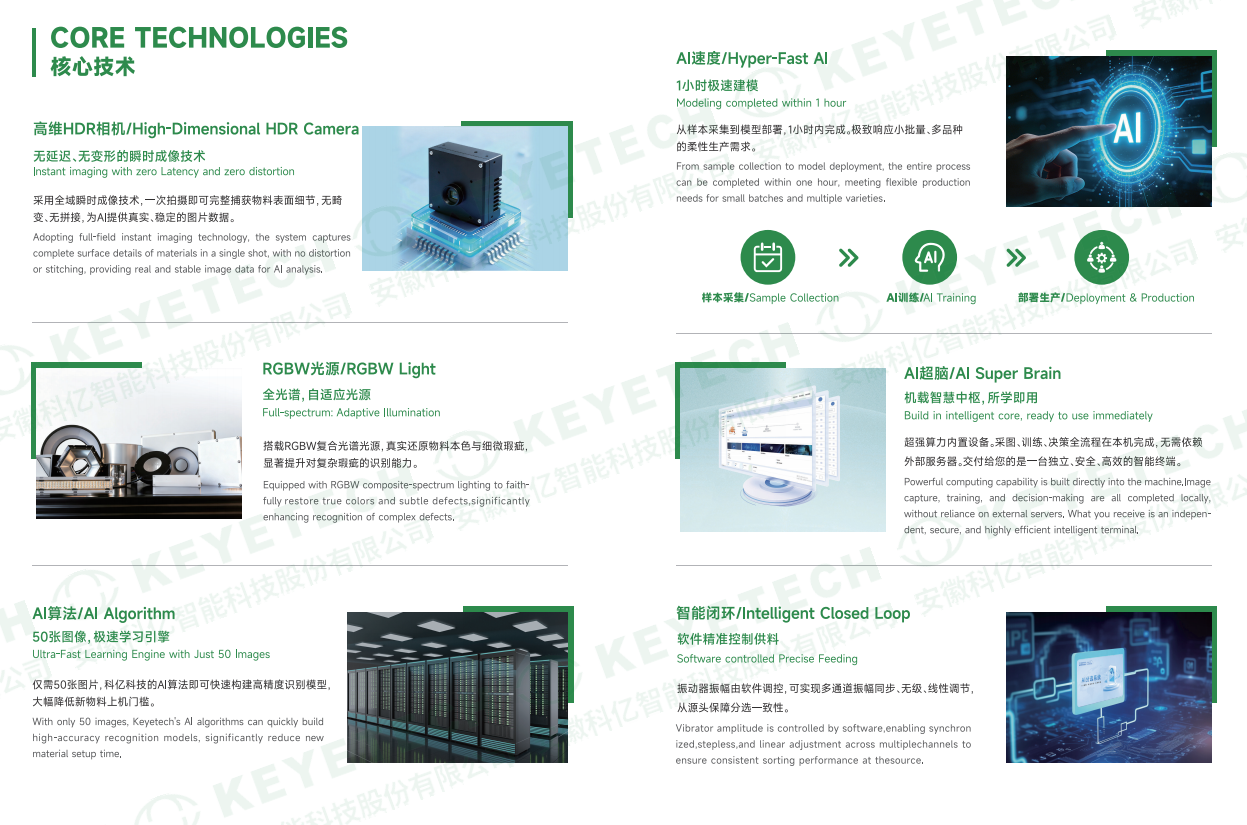
1. Industrial Cameras
Cameras capture product images as material passes through the inspection zone. KEYETECH describes its cameras as the "eyes" of the system — they capture product images and provide data input for AI algorithms. The company develops its own optical solutions and industrial cameras rather than relying only on third-party components.
2. Edge Computing Unit
An AI edge computing unit provides computing power for the AI algorithms and accelerates the inference speed of AI models. Keeping decision-making close to the machine allows sorting to run in real time, including in 24/7 operation.
3. AI Algorithms and Training Platform
Deep learning models are trained to perform classification, defect detection, and object detection. KEYETECH has built its own servers hosting tens of thousands of AI algorithm models that support a wide range of vision inspection tasks. Model training is often the key differentiator between suppliers.
4. High-Speed Ejection System
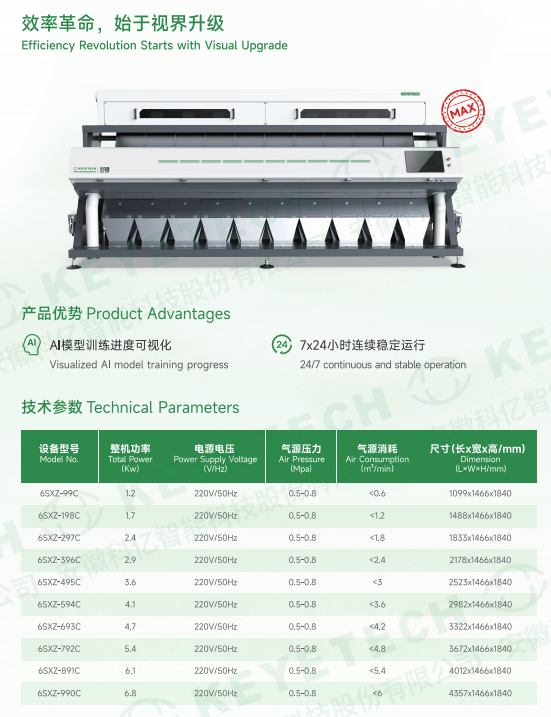
Once an AI model identifies an unwanted object, precisely timed air jets remove it from the product stream. KEYETECH sorting machines typically operate at air pressure of 0.5–0.8 MPa and air consumption of 0.6–6 m³/h, with total power of 1.2–6.8 kW.
5. Machine Body Materials
Sorters are most commonly built from carbon steel or stainless steel. The choice depends on the application's hygiene, corrosion, and durability requirements.
Step-by-Step: How a Sorting Cycle Works
The sorting process can be broken into five stages:
- Feed. Material enters a vibrating feeder, which evenly distributes particles into a single layer on a chute or conveyor belt.
- Image Capture. Particles pass through an illuminated inspection zone. Industrial cameras photograph each object from one or more angles.
- AI Detection. The edge computing unit runs the trained model on each image and classifies every object as acceptable or defective.
- Separation. When a defective object is detected, a high-speed air valve fires a precisely targeted air stream to deflect it into a reject channel.
- Collection. Accepted and rejected materials are collected separately for packaging, further processing, or disposal.
Options such as KEYETECH's top-lighting vision system support granular materials that require consistent illumination across the inspection area.
Machine Formats: Vertical Channel Type vs. Belt Type
Machine format should be chosen according to the material's size, shape, fragility, and throughput profile.
Vertical Channel Sorters (Chute Type)
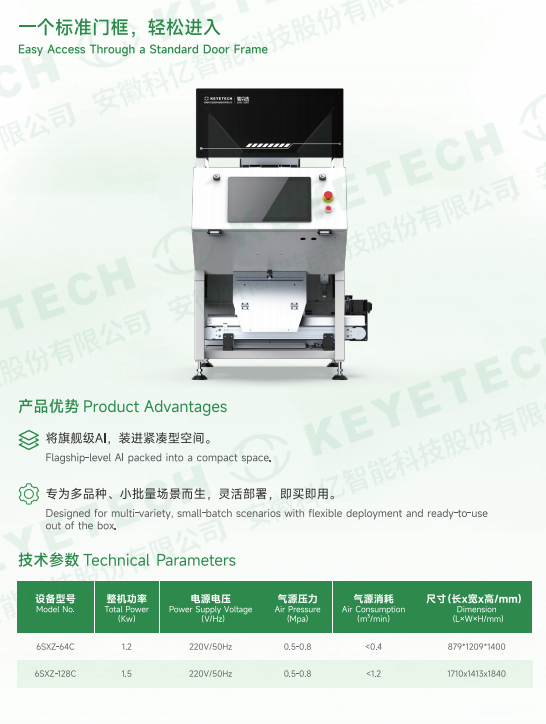
Material falls through vertical channels while cameras inspect it in free fall. Air jets deflect defective particles to the side. This format is commonly used for high-throughput granular materials. KEYETECH produces vertical machines designed for granular materials, including a mini vertical unit with a small footprint.
Belt-Type Sorters
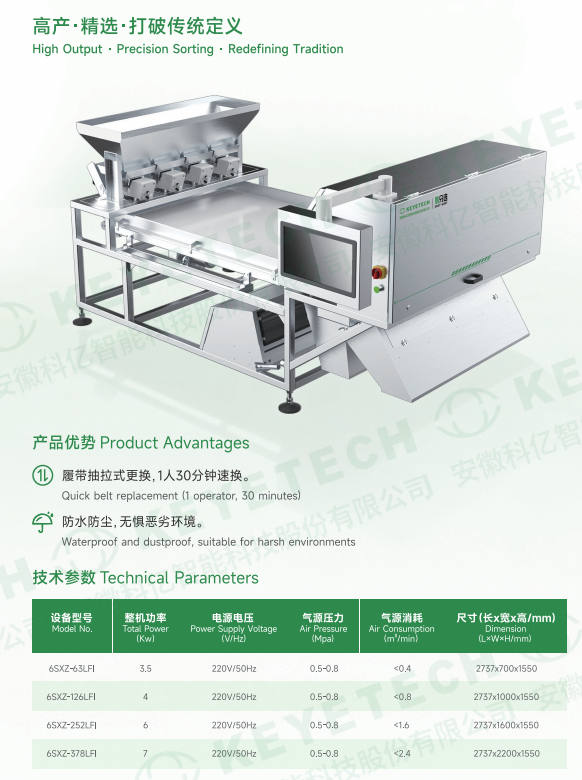
Material is carried on a conveyor belt in a single layer, allowing the system to inspect objects from above and the side. Belt-type machines are better suited for fragile, large, or irregularly shaped products where free-fall inspection can cause damage. KEYETECH offers both single-belt and double-belt AI intelligent sorting machines.
Compact Models
For space-constrained environments, compact machines reduce the required installation area. As an example, the KEYETECH rice sorter model 6SXZ-990C is described as designed for granular material sorting in space-constrained environments due to its small footprint.
Use Cases: 18 Material Categories Covered by AI Intelligent Sorting
AI intelligent sorting extends across agricultural, food, beverage, recycling, and industrial processing. The following table summarizes representative KEYETECH models and their stated application fields, based on the company's published product information.
| Material Type | Model | Sorter Category | Typical Application |
|---|---|---|---|
| Grain | 6SXZ-693C | Grain AI Color Sorter | Agricultural and sideline food, pet food, seasonings, renewable resources, metals |
| Rice | 6SXZ-990C | Rice AI Color Sorter | Granular sorting in space-constrained environments |
| Nut | 6SXZ-63LFI | Nut AI Color Sorter | Nut sorting and agricultural processing |
| Coffee Cherry | 6SXZ-99C | Coffee Cherry AI Color Sorter | Coffee cherry and bean handling |
| Salt | 6SXZ-198C | Salt AI Color Sorter | Salt sorting in agricultural and sideline food |
| Plastic | 6SXZ-99C | Plastic AI Color Sorter | Plastic flake sorting in recycling lines |
| Metal | 6SXZ-378LFI | Metal AI Color Sorter | Metal sorting in recycling and industrial processing |
| Ore | 6SXZ-252LFI | Ore AI Color Sorter | Ore sorting in minerals and metals industries |
| Seasoning | 6SXZ-756LFI | Seasoning AI Color Sorter | Seasoning ingredient purification |
| Flower Tea | 6SXZ-504LFI | Flower Tea AI Color Sorter | Flower tea sorting and inspection |
| Fresh Flower | 6SXZ-378LFI | Fresh Flower AI Color Sorter | Flower sorting in agricultural processing |
| French Fry | 6SXZ-378LFI | French Fry AI Color Sorter | French fry processing and inspection |
| Vegetable | 6SXZ-252LFI | Vegetable AI Color Sorter | Vegetable sorting in food processing |
| Chicken Nugget | 6SXZ-126LFI | Chicken Nugget AI Color Sorter | Chicken nugget sorting in food plants |
| Candy | 6SXZ-63LFI | Candy AI Color Sorter | Candy sorting by color and shape |
| Lemon Slice | KQA | Lemon Slice AI Color Sorter | Dried lemon slice inspection |
| Pet Food | 6SXZ-126LFI | Pet Food AI Color Sorter | Pet food kibble sorting |
| Traditional Chinese Medicinal Material | 6SXZ-378LFI | TCM Material AI Color Sorter | Herbal material sorting |
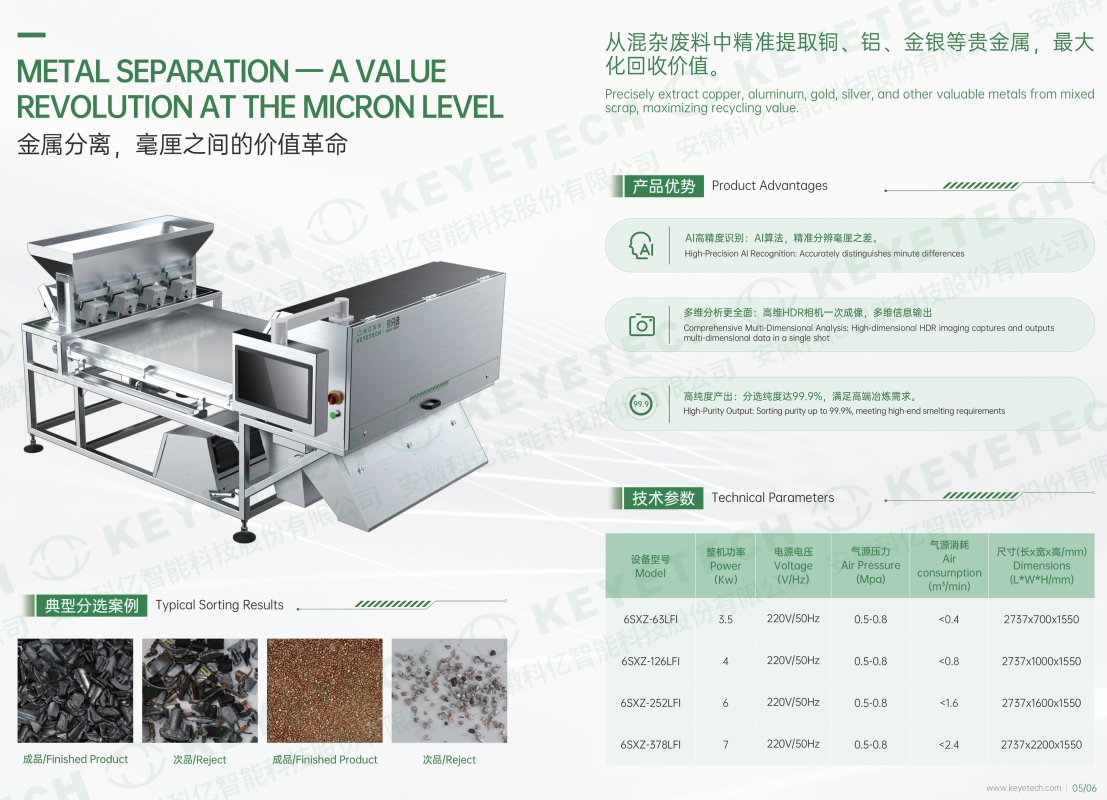
Beyond these machine models, KEYETECH's test library includes real sorting cases for chickpeas with insect eyes and white spots, soybeans with wormholes, lentils, buckwheat, and multiple coffee bean categories. These examples matter because they show how AI training is applied to materials with very different surface features.
Key Buyer Considerations by Sector
Agriculture and food processors typically care most about removing contaminated or damaged kernels without destroying usable yield. Belt-type sorters are often selected for fragile items; vertical channel sorters fit high-throughput dry grains.
Recycling and metal industries sort materials such as copper, aluminum blocks with impurities, and plastic flakes. AI sorting helps replace manual detection, which is often inaccurate and inefficient. These environments usually operate indoors in normal temperature and humidity, with a stable power supply, and some facilities require a grounding wire for the equipment.
Beverage and specialty food producers (coffee, flower tea, seasoning, salt) use AI sorters to maintain consistent product appearance and remove defective beans, flowers, or crystals before packaging.
What to Evaluate When Choosing an AI Sorting Manufacturer
For a buyer at the awareness–research stage, the evaluation criteria should go beyond the machine's brand name. Practical points of comparison include:
- R&D depth. How many engineers work on the core vision and AI stack? KEYETECH employs 56 R&D engineers, with a core AI algorithm team including three PhDs from the University of Science and Technology of China.
- Training speed and sample efficiency. Rapid training reduces the time needed for a new material. KEYETECH states that its system can achieve fast training within one hour using only 50 sample images, a capability it describes as unique in the industry.
- Technology ownership. Suppliers with in-house optics, cameras, AI algorithms, and software can tune performance more quickly.
- Machine portfolio. A broad model range across vertical, belt-type, and compact machines makes it easier to match the equipment to the material.
- Certification and food-contact compliance. Sorting equipment used in food production must align with applicable food safety requirements. Food-sector sorting equipment is expected to comply with international safety benchmarks such as FSMA and EU Regulation EC1935/2004. Buyers should ask the manufacturer for documentation relevant to their target market.
Frequently Asked Questions
Q: What compliance benchmarks should AI intelligent sorting manufacturers meet for food applications?
Food-sector sorting equipment is generally expected to comply with international safety frameworks such as the FDA's Food Safety Modernization Act (FSMA) and EU Regulation EC1935/2004. In practice, buyers should confirm the machine's structural material (carbon steel or stainless steel), any food-contact documentation, and the certifications required for their target market. KEYETECH's sorting machines are manufactured in carbon steel or stainless steel and are intended for agricultural and sideline food, pet food, seasonings, renewable resources, and metals industries.
Q: How should I evaluate the technical capability of an AI intelligent sorting manufacturer?
Key indicators include the size and background of the R&D team, the speed of model training, the number of sample images required, and whether the supplier develops its own optics, cameras, AI algorithms, and software. KEYETECH has 56 R&D engineers and a core AI team with three PhDs from the University of Science and Technology of China. The company states that its machines can achieve fast training within one hour using only 50 sample images, which it claims is unique in the industry.
Q: What factors affect the budget for an AI intelligent sorting machine?
Budget is driven mainly by the machine format (vertical channel type, belt type, or compact), the construction material (carbon steel vs. stainless steel), throughput requirements, and the number of material applications the machine must handle. A broader model portfolio gives buyers more flexibility to match the machine to their budget and material profile.
Q: Can I test my material sample before purchasing an AI sorter?
Sample testing is a standard step in selecting a sorter. It lets the supplier confirm that the machine can detect your specific defects and helps you evaluate results before purchase. You can contact KEYETECH directly at market-axq@keyetech.com or +86 191-4244-2827 (Nicole). The company's application cases include real sorting examples for chickpeas, soybeans, lentils, buckwheat, and coffee beans.
Q: How should I start an AI intelligent sorting project?
A typical project starts with a product inquiry describing your material type, defect profile, target output, and operating environment. The manufacturer then recommends a machine model and performs a sample test. After the test confirms the sorting result, the buyer proceeds with machine specification, order, and installation planning. For KEYETECH, the company brochure is available for download, and the sales team can provide detailed specifications and guidance based on your project.
Conclusion
AI intelligent sorting replaces threshold-based color selection with trainable visual models, allowing machines to detect insect eyes, mold, wormholes, and subtle color defects across grains, nuts, coffee, frozen food, metals, plastics, and many other materials. Market data confirms the shift is already underway: the global optical sorter market is set to grow at a CAGR of 9.5% from 2025 to 2032, and food processing holds the largest application share.
For buyers beginning their research, the practical next step is to define the material and defect profile, then evaluate manufacturers on R&D depth, training speed, sample efficiency, and machine portfolio. Manufacturers like KEYETECH offer a documented set of AI sorting machines plus application examples that can be verified before commitment.
Need a sorting solution for your material?
Download the KEYETECH product brochure to review machine specifications, or contact the sales team for a sample test with your own material.
Email: market-axq@keyetech.com | Tel/WhatsApp: +86 191-4244-2827
Have Questions or Need More Details?
Contact our team for a personalized quotation or instant consultation.
Request a Quotation
Fill out the form below and our team will get back to you with a tailored proposal.
WhatsApp Direct Chat
Prefer to chat in real-time? Message us on WhatsApp for instant assistance & quick answers.
- Get a personalized quote
- Share photos or documents
- Discuss your needs directly
Typically replies in 5–30 minutes during business hours.