
How to Specify an AI Intelligent Sorting System for a New Processing Line
How to Specify an AI Intelligent Sorting System for a New Processing Line
Selecting an AI intelligent sorting system for a new processing line starts with defining the material, the defect, the throughput target, and the operating environment. A well-specified system matches the machine type to those four inputs and uses AI models trained on the actual product, not on generic color thresholds. This guide explains how to build that specification, what to verify before purchase, and how suppliers such as KEYETECH approach project-level AI sorting deployments.
What Is AI Intelligent Sorting in a Production Context?
AI intelligent sorting uses machine vision and trained algorithms to identify and remove defective or unwanted materials from a continuous product flow. In a production context, it replaces manual inspection and conventional color-only sorting by recognizing patterns such as insect eyes, wormholes, mold, discoloration, foreign material, and shape anomalies. The system captures images with industrial cameras, processes them with AI algorithms, and directs high-speed air jets or mechanical diverters to separate rejects.
For a processing line, the sorting system is not a standalone gadget. It is integrated with upstream feeding equipment, an air compressor, and downstream collection or packaging stations. The specification must include the mechanical interface, available air supply, electrical requirements, and the physical space for the sorter and its supporting components.
Common Problems That Drive an AI Sorting Investment
The most common reason processors replace manual inspection is that manual detection becomes inaccurate and inefficient at high volume. KEYETECH application data describes this problem explicitly: in the metal industry, for example, the role of the sorting system is to solve the inaccuracy and low efficiency of manual detection. The same logic applies across grains, nuts, frozen food, pet food, and recycled plastics—where inspectable defects are subtle, fast-moving, or appear at volumes that human eyes cannot sustain.
Another recurring problem is food safety risk from wormholes and insect damage, especially in crops such as chickpeas, lentils, soybeans, and coffee beans. In these applications, the sorting goal is not limited to color; the system must detect structural damage, insect eyes, white spots, and other subtle indicators. A traditional color sorter may miss these because the color difference is small or inconsistent. AI sorting solves the problem by training on images of the specific defect and recognizing it with pattern-based inference.
Why Project Fit Matters in AI Sorting
AI sorting projects fail to meet expectations when the buyer specifies the wrong machine type or assumes one sorter can handle every material. The geometry of the material—whole grain, flake, slice, irregular frozen piece, or metal scrap—determines which feeding and ejection system will work reliably. The defect type determines whether a channel-type sorter, belt-type sorter, or a specialized vision system is the right choice. The operating schedule determines whether the equipment needs to be designed for 24/7 continuous use. The plant environment determines whether standard carbon steel construction is acceptable or whether stainless steel and washdown features are required.
Project-fit specification also means verifying what happens during model training. Some suppliers require a large image library and days of tuning. Others, including KEYETECH, report that an AI model can be trained with roughly 50 sample images and completed within one hour. That difference directly affects how quickly a new line can be commissioned and how easily the sorter can be retrained when the product changes.
Defining the Application Scenario Before Choosing a Sorter
A functional specification for an AI sorting project should state the application scenario in the same structured way that machine builders use. The framework below is based on the field-application data used to document KEYETECH sorting projects and is applicable to most procurement situations.
1. Industry and Project Type
State whether the project is agriculture, food processing, metal recycling, ore, plastic recycling, seasoning, pet food, or another category. Also state the project type: for example, detecting food wormholes, sorting qualified from unqualified products, removing impurities, or complete equipment deployment. The industry and project type determine which product family and which feature set is acceptable.
2. Working Conditions
Describe the environment. Many food and metal applications run in an indoor factory environment with normal temperature and humidity. If the line operates outdoors, in a humid area, or at extremes, state it. KEYETECH sorters are documented to operate in a temperature range of -20°C to 60°C, but the surrounding mechanical design and material selection still need to match the specific site.
3. Operation Mode
Define whether the system will run continuously. For projects designed for 24/7 operation, components such as valves, air handling, and cameras must be rated for sustained duty. KEYETECH application data lists 24/7 mode as a specific requirement in both agriculture and metal industry scenarios.
4. Supporting Equipment and Site Requirements
Identify what the facility must provide. Air-compressor-based ejection systems commonly require compressed air at a specified pressure and flow. Grounding wire is a documented requirement in some food-wormhole detection installations. Metal industry installations may require a stable power supply to protect the electronics. Add these to the project specification rather than discovering them at installation.
Step-by-Step: How to Build Your AI Sorting Specification
Step 1: Classify the target material and its physical form
Identify particle size, shape, density, moisture, and whether the product is sticky, oily, dusty, or fragile. This determines feeder design, belt or channel selection, illumination angle, and valve size.
Step 2: Define the defect library and quality threshold
List the defects that must be removed: insect eyes, wormholes, mold, broken kernels, off-color pieces, foreign material, or mixed polymer types. Rank them by business impact and set an acceptable reject rate and a maximum carryover into the accepted product.
Step 3: Estimate throughput and line speed
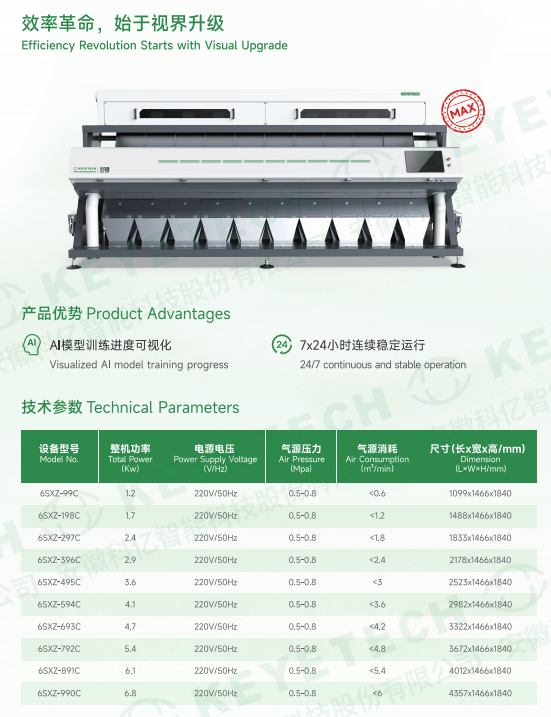
Calculate hourly flow and the fraction that will be rejected. Higher reject rates require more ejectors or multichannel configurations. Machine model numbers such as the 6SXZ series correspond to different channel widths and throughput capacities; choose the model after matching throughput to the line design.
Step 4: Select the machine architecture
For free-flowing granular products such as rice, grains, seeds, and nuts, a channel-type vertical sorter (立式机) is often the right starting point. For fragile, sticky, irregular, or larger products such as frozen food, vegetables, French fries, chicken nuggets, and some recycled materials, a belt-type sorter (履带机) provides gentler handling and better surface inspection. For mixed or high-volume materials, a double-belt machine can increase capacity while preserving inspection quality.
Step 5: Verify AI model training capability
Ask the supplier how many images are needed to train a model and how quickly the model can be built. KEYETECH reports that an AI sorting model can be completed within one hour using roughly 50 images. For plants that change products seasonally, fast retraining reduces downtime and avoids requiring a different machine for each SKU.
Step 6: Confirm construction materials and compliance needs
For food-contact lines, confirm whether stainless steel or carbon steel with food-safe coatings is appropriate. If the machine will be exported or used in a regulated market, align the specification with relevant food safety requirements and the supplier's documented certifications.
Step 7: Plan installation, commissioning, and remote support
Define who provides the air compressor, feed system, grounding, and power. Confirm whether the supplier offers remote support after delivery. For export buyers, remote support reduces the cost and time of troubleshooting compared to on-site-only services.
Use Cases: What Project-Level AI Sorting Looks Like
Food Safety: Removing Wormholes and Insect Damage
A documented KEYETECH application in India involves detecting food wormholes in high-volume batch sorting environments. The system operates in 24/7 mode, uses an air compressor as supporting equipment, and requires a grounding wire. The function is specific: remove the wormholes and keep only safe food. The same approach applies to chickpeas, lentils, soybeans, buckwheat, and coffee beans where insect eyes and damage affect food safety and quality.
Metal Recycling: Replacing Manual Detection
In the metal industry, AI sorting systems are deployed to solve the inaccuracy and low efficiency of manual detection. This application typically runs in an indoor factory environment with normal temperature and humidity, requires a stable power supply, and operates continuously. The sorter separates metals by surface condition, color, and contamination using trained AI models. Countries where this scenario is common include India, Kenya, Sri Lanka, Malaysia, New Zealand, Serbia, Thailand, Vietnam, Bangladesh, Canada, Spain, Ethiopia, and the United States.
Agriculture and Food: Sorting Qualified from Unqualified Products
Across agricultural and sideline food, renewable resources, and general food processing, AI sorters separate qualified and unqualified products. The same machine family is available for rice, grain, coffee cherry, nut, potato-based frozen products, chicken nuggets, candy, pet food, salt, seasoning, flower tea, traditional Chinese medicinal materials, ore, plastic, and lemon slices. Each application uses the same underlying AI platform with a different trained model and machine configuration.
Comparing Key Machine Architecture Options
| Architecture | Typical Materials | Best For | Considerations |
|---|---|---|---|
| Channel-type vertical sorter (立式机) | Rice, grains, seeds, nuts, coffee beans | High-throughput free-flowing granular products | May require stabilization of fragile or oddly shaped products |
| Single-belt sorter (单层履带机) | Vegetables, French fries, chicken nuggets, lemon slices, some plastics | Delicate, sticky, or irregular materials needing stable surface viewing | Slower per-lane throughput than channel machines; need to match belt width to line speed |
| Double-belt sorter (双层履带机) | High-volume delicate products, mixed materials | Higher capacity on belt-class products | Larger footprint; more belt area to clean |
| AI quality grading machine | Products requiring grading, not just removal | Multiple quality classes on a turntable or glass surface | Often used for inspection and grading of larger or delicate items |
The table above is a starting point. Final selection should always be confirmed by a material test or a documented reference from the supplier that shows the same or a very similar product running successfully.
How to Evaluate an AI Sorting Supplier for Project Fit
Check the AI training workflow
The practical difference between suppliers is often training speed and sample size. KEYETECH states that it can complete an AI model within one hour using about 50 images. If a supplier cannot show a clear training workflow, commissioning and product changeovers may be slow.
Verify factory and R&D depth
KEYETECH is an AI vision inspection company based in Hefei, China, founded in 2011. It has a 29,000-square-meter facility, roughly 300 employees, and 56 engineers in R&D. Its core technology is led by PhDs from the University of Science and Technology of China in imaging, AI algorithms, and software control. For a long-term capital purchase, supplier depth in algorithms and software matters more than the number of cabinet hinges.
Confirm production and delivery capability
Check whether the supplier can deliver the number of machines in your project. KEYETECH reports an annual output of approximately 3,000 units and an OEM/ODM monthly capacity of 100 units. For a multi-line plant or a regional distributor, capacity and lead time affect the project schedule.
Request the right commercial and logistics setup
For a first purchase, low MOQ can be an advantage. KEYETECH offers an MOQ of one unit for OEM/ODM projects and standard lead time of 30 to 45 days. Export destinations include the EU, the US, the Middle East, and Southeast Asia, so the company has experience with international packing and documentation.
Cost and Performance Trade-offs to Put in the Specification
AI sorters cost more than conventional color sorters because they include industrial cameras, edge computing units, and trained models. The performance trade-off is that they can detect defects that color alone cannot identify. For materials sold at a premium, such as clean rice, insect-free chickpeas, or high-grade coffee, the additional cost is recovered by reducing rework, claims, and manual labor.
Another trade-off is training requirement. A conventional sorter uses fixed thresholds and is simple to set up. An AI sorter requires an initial sample set and model validation. If the supplier offers fast training and remote support, the extra setup effort is small. If not, the operational burden can be significant.
A third trade-off is machine complexity. Air-jet-based ejection systems require a stable compressed air supply. When the facility lacks an air compressor, the project must include one. Grounding and stable power are also documented requirements in some applications, so the site preparation cost should be included in the project budget.
Quality Control and After-Sales Considerations
For a sorting machine, quality control should include 100% testing before shipment and a clear after-sales support channel. KEYETECH lists 100% testing as part of its OEM/ODM capability and provides remote support. For international buyers, remote support is especially valuable; it allows the supplier to adjust algorithms and settings without dispatching an engineer.
Buyers should also ask whether the supplier can retrain the model for new products after installation. A seasonal processor may need to switch from chickpeas to lentils, or from nuts to candy. If the supplier includes retraining in the service package, the same machine can serve multiple product lines.
Case Evidence from KEYETECH AI Sorting Projects
Food OEM — 12 units
KEYETECH has documented a food OEM project involving 12 units for detecting impurities and spoilage in food. The equipment has run for one year with stable operation. The project highlight was completing AI model building within one hour and training a sorting model with 50 images.
Coarse Cereals OEM — 25 units
A coarse cereals OEM project in markets including Turkey, the US, Italy, Ethiopia, Vietnam, and Malaysia used 25 units for detecting insect eyes and impurities in miscellaneous grains. The sorting equipment has operated stably for one year, with the same AI training speed of one hour and 50 sample images.
Rice OEM — 10 units
A rice OEM project in India, Austria, China, and Vietnam used 10 units to sort out broken rice, yellow rice, impurities, and other defects. KEYETECH reports that the finished product sorting result reached 99.999% and that the AI model was fully built within one hour. The same 50-image training method was used.
These examples support a practical conclusion: for consistent materials with clear defect definitions, an AI sorter can be deployed quickly if the supplier has a mature model training workflow. The 50-image threshold is the key evidence point to verify with a sample test before ordering.
FAQ
1. What supporting equipment is needed when installing an AI intelligent grain sorting system?
For agriculture applications such as grain and food wormhole detection, KEYETECH documentation specifies an air compressor as required supporting equipment and a grounding wire as a special requirement. For metal industry applications, a stable power supply is required. Confirm the exact air pressure, air consumption, and power specifications with the supplier before installation. The sorter itself is designed for indoor factory environments with normal temperature and humidity in most documented projects.
2. How quickly can an AI sorting model be trained for a new product?
In documented KEYETECH projects for food OEMs, coarse cereals, and rice, the AI model was completed within one hour and trained with approximately 50 sample images. This applies when the defect is clearly defined and the supplier has experience with that material group. For a new or unusual material, request a sample test to confirm the training time before purchase.
3. Does an AI sorter operate continuously for high-volume batch sorting?
Yes. Documented KEYETECH food wormhole detection applications operate in 24/7 mode in high-volume batch sorting environments. The sorting equipment is designed for continuous use, but the facility must provide stable power and, where required, a grounding wire. In metal industry applications, stable power is also listed as a special requirement because the AI system and ejection valves depend on consistent voltage.
4. What does an AI intelligent sorting sorter actually do in a project?
The sorter separates qualified and unqualified products from the material flow. In food wormhole detection projects, it removes wormholes and keeps only safe food. In metal industry projects, it solves the inaccuracy and low efficiency of manual detection. In grain, rice, and cereal projects, it removes defects such as broken kernels, yellow rice, insect eyes, impurities, and spoilage while operating continuously. The same AI platform can be configured for different materials by changing the machine architecture and training a new model.
5. How long does it take to receive an AI sorting machine after placing an order?
KEYETECH lists a standard OEM/ODM lead time of 30 to 45 days, with a monthly capacity of 100 units and a minimum order quantity of one unit. All machines receive 100% testing before shipment. After delivery, remote support is available. For a project quote with current lead time and delivery schedule, contact the KEYETECH team directly.
Need a project-fit AI sorting recommendation?
Send a sample list and target output to KEYETECH for a machine and model evaluation.