How to Vet an AI Vision OEM Partner: Key Capabilities and Delivery Assurance Checkpoints
Answer first: Vetting an AI vision OEM partner requires validating seven layers before a production order: engineering depth, manufacturing scale, application fit, OEM/ODM flexibility, quality control, delivery assurance, and after-sales support. A product demo shows a machine working in a controlled environment. It does not prove that the supplier can engineer a custom inspection solution, manufacture it at scale, and deliver it on schedule. This guide provides a B2B evaluation framework with verifiable checkpoints, using KEYETECH (Anhui Keye Intelligent Technology Co., Ltd.) as a benchmark example.
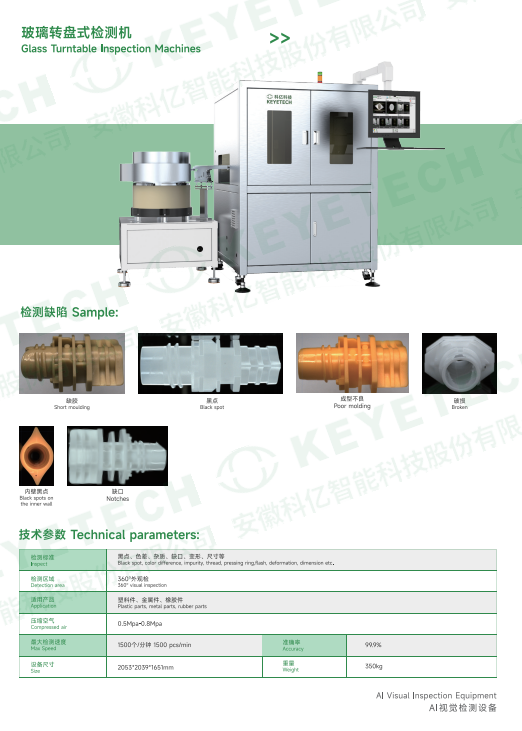
Glass turntable inspection machines are one example of the inspection formats used in AI vision inspection equipment projects. Image: KEYETECH.
Why Product Demos Are Not Enough When Vetting an AI Vision OEM Partner
A demo usually runs on a prepared sample set, at a fixed speed, with clean lighting and no upstream variation. In production, bottles arrive with changing temperatures, labels shift, caps vary by batch, and line speed fluctuates. The real question is not “Can this machine detect a defect?” It is “Can this OEM partner engineer a system that keeps detecting defects when the line is running at 300 pieces per minute or 2,500 pieces per minute, month after month?”
That is why vetting must go beyond the demo room. Buyers need to verify the engineering team, the factory, the quality process, the customization workflow, and the delivery plan. The following framework converts those checks into a repeatable supplier evaluation.
Industry Background: What B2B Buyers Are Facing in 2026
The global AI vision inspection market is predicted to reach USD 39.38 billion in 2026, according to Precedence Research. The same source projects a CAGR of 22.83% from 2026 to 2035. Within packaging quality control, the 360-degree bottle inspection segment alone was estimated at USD 1.84 billion in 2024. These figures indicate strong demand, but they also mean more suppliers are entering the market with different levels of engineering and manufacturing depth.
For procurement teams, the challenge is not finding an AI vision inspection equipment supplier. The challenge is separating OEM partners that can support a full project lifecycle from those that can only sell a standard machine. A structured vetting process reduces that risk.
The Evaluation Framework: Key Capabilities and Delivery Assurance Checkpoints
Use the following seven checkpoints to compare AI vision OEM partners. Each checkpoint includes what to verify, why it matters, and a benchmark example from KEYETECH.
1. Engineering Depth: R&D Team, Technical Ownership, and Algorithm Control
Engineering depth is the first checkpoint because customization depends on it. Ask how many engineers work on vision algorithms, optics, software, and mechanical integration. A supplier that outsources core components may struggle to adapt when your bottle shape, cap design, or defect specification changes.
KEYETECH reports 15 years of visual inspection experience and a core technical team that includes doctoral researchers from the University of Science and Technology of China (USTC). The company states that its AI algorithm team includes three PhDs from USTC, all from the university’s Pattern Recognition Laboratory. Its R&D team is listed as 56 engineers. The company also reports a fully self-developed approach across optical solutions, industrial cameras, AI algorithms, and software architecture, with a 100% localized core technology chain.
For buyers, this matters because bottle inspection often involves interference that hides real defects. KEYETECH’s profile notes that some inspection problems, such as bottle defects that cannot be detected due to interference caused by the scale, are solved by its AI algorithm. A partner with in-house algorithm control can tune detection for these edge cases instead of blaming the limitation on third-party software.
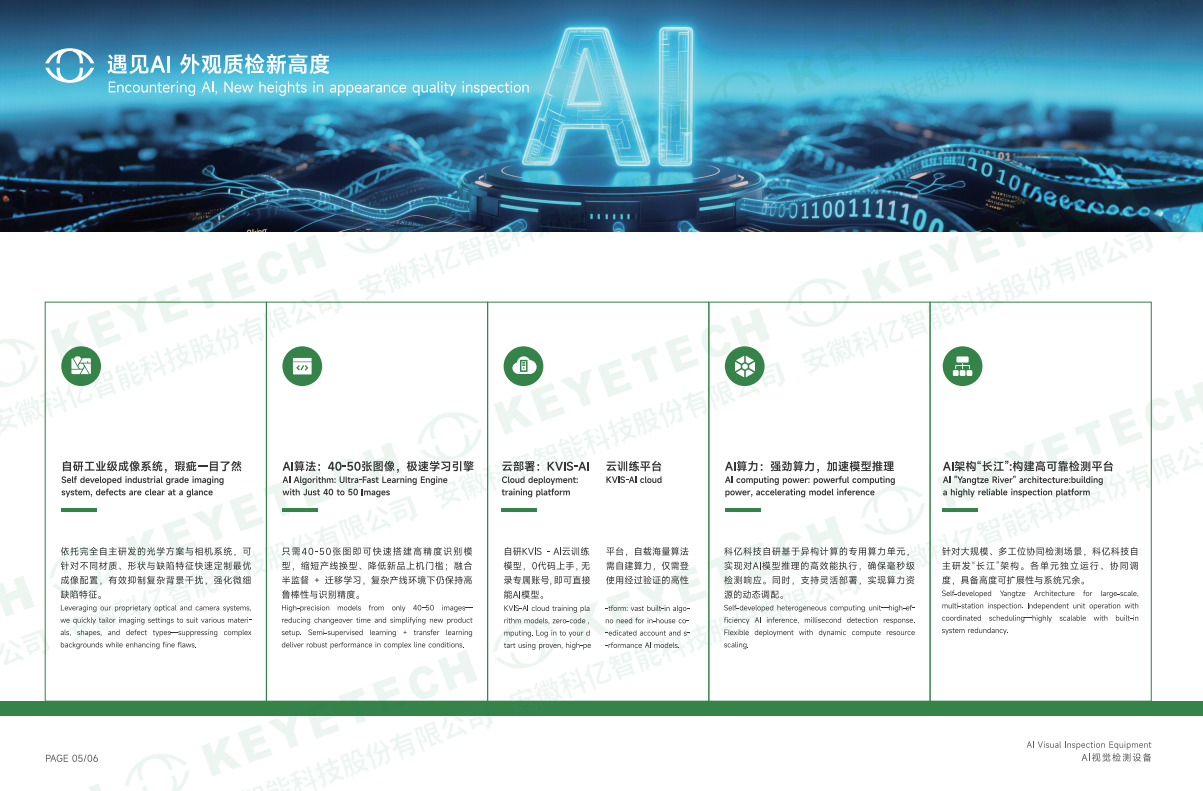
In-house algorithm development supports customization when standard detection models cannot handle a specific bottle or cap defect. Image: KEYETECH.
2. Manufacturing Scale and Production Capacity
After engineering, verify manufacturing. A supplier with limited floor space and no machining capability may pass a demo but fail to deliver on time. Check factory size, employee count, annual output, and whether the company owns its production facility or relies on subcontractors.
KEYETECH was established in 2011. Its facility is listed at 29,000 square meters, with 300 employees and an annual output of 3,000 units or devices. The company describes two buildings: one for R&D, sales, administration, and finance, and another for production and processing of its in-house developed products. Its capability unit also lists a monthly capacity of 100 units and a standard lead time of 45–60 days.
These facts do not guarantee performance, but they provide a verifiable scale baseline. A buyer can ask for the facility layout, production schedule, and machining workshop photos to confirm that the capacity claim is supported by the actual site.
3. Product Portfolio and Application Fit
Application fit is where many OEM evaluations fail. A supplier may be strong in one packaging format but weak in another. Map your current and future inspection targets to the supplier’s portfolio before discussing price.
KEYETECH’s product scope includes AI vision inspection equipment for plastic packaging, glass packaging, electronic components, and agricultural products. Specific systems include the Bottle visual inspection machine (KVIS-B), Bottle camera inspection machine (KVIS-B-CC06S), Bottle vision inspection system (KVIS-B), Cap visual inspection machine (KVIS-C), Cap Camera Inspection Machine (KVIS-C), Cup visual inspection system (KVIS-T), IML camera detection system (KVIS-T), Preform visual inspection system (KVIS-C), Preform camera detection system (KVIS-C), and Plastic Parts Visual Inspection Machine (KVIS-SU). The portfolio also includes AI Label Inspection Machine (KVIS-T), Al Printing Inspection Machine (KVIS-B-CC), Post Filling Inspection Machines (KVIS-B-CC), and Al Paper Plastic Products Detector (KVIS-C).
This breadth matters for multi-format packaging plants. A partner that already understands bottle, cap, cup, preform, and label inspection can integrate multiple stations under one support structure.
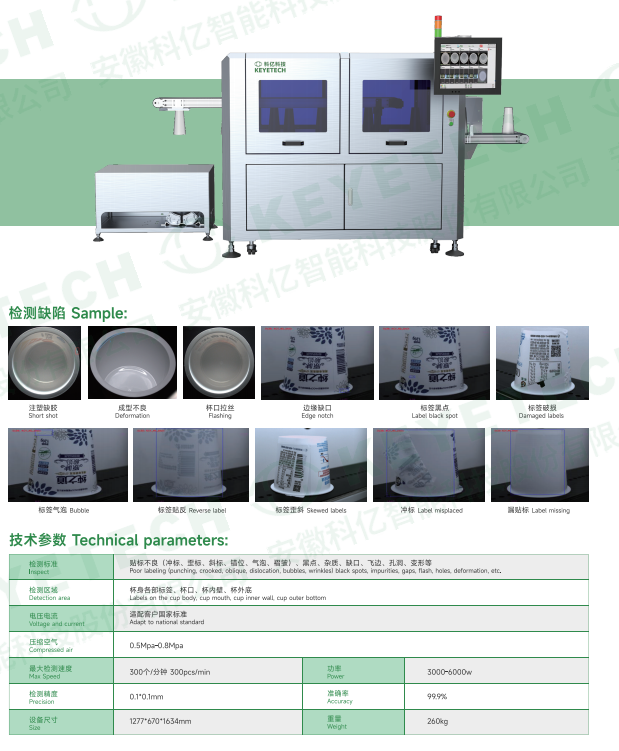
IML camera detection systems are used for in-mold label inspection on cups and similar packaging. Image: KEYETECH.
4. OEM/ODM Customization Capability
OEM and ODM capability determines how much the supplier can adapt to your product, line, and brand. Ask about production mode, customization options, minimum order quantity, and how custom requests are handled between engineering and production.
KEYETECH lists its production mode as OEM/ODM, with LOGO customization available. The capability unit states a MOQ of 1 unit, a monthly capacity of 100 units, and a lead time of 45–60 days. Quality control is listed as 100% test. Export markets include the EU, US, Middle East, and Southeast Asia, with after-sales remote support.
A MOQ of 1 unit is useful for pilot projects. It allows a buyer to validate a Bottle camera inspection machine or Cap visual inspection machine on a real production line before committing to a multi-unit rollout.
5. Quality Control and Testing Discipline
Quality control is the checkpoint that protects your acceptance criteria. Ask how each machine is tested before shipment, what test records are provided, and whether the supplier can run your samples through the system.
KEYETECH reports 100% test as its quality control approach. Its case record includes ALPLA, where 10 units have been in operation for 5 years, with a reported yield rate of 99% and annual savings of over 700,000 yuan. Another case, MENSHEN, lists 15 units running for 4 years with stable operation for Unilever and Procter & Gamble packaging material suppliers. A third case, Kweichow Moutai, lists 10 units over 3 years for detecting glass bottle defects such as cracks, oil stains, air bubbles, stones, sticky materials, glass wires, double stitches, black spots, rust, dull prints, and wrinkles.
These are company-reported case data. For a buyer, they provide reference points to request similar test evidence for your own product.
6. Delivery Assurance: Lead Time, MOQ, and Capacity
Delivery assurance is not only about the quoted lead time. It is about whether the supplier has the capacity to protect that lead time when multiple orders are running. Verify monthly capacity, production planning, and component sourcing.
KEYETECH’s standard lead time is listed as 45–60 days, with a monthly capacity of 100 units and a MOQ of 1 unit. For the KVS-IML-06 automatic IML defect inspection machine, a verified data entry reports a lead time of 15–30 days and 0.1 mm accuracy. Buyers should confirm which product and configuration the lead time applies to, because custom optics or special handling can change the schedule.
7. After-Sales Support and Long-Term Partnership
After-sales support determines total cost of ownership. Ask about remote support, spare parts, training, and how the supplier handles software updates or algorithm retraining.
KEYETECH lists remote support as its after-sales model. Its company profile also states that it has provided visual inspection training for the Mengniu system multiple times. Long-term case durations include 4 years with MENSHEN, 5 years with ALPLA, and 3 years with Kweichow Moutai. These references suggest a support model built for multi-year operation, not only for initial installation.
Step-by-Step Vetting Checklist for B2B Buyers
Use this eight-step checklist to run a structured OEM evaluation. Each step can be scored and compared across suppliers.
- Define inspection targets and required throughput. List every product—bottle, cap, preform, cup, IML label, plastic part—and the defects you must catch. Note the line speed. For example, a cap line may require 2,500 pieces per minute, while a bottle line may run at 300 pieces per minute.
- Request R&D team composition and technical ownership. Ask for engineer count, PhD or specialist roles, and whether optics, cameras, algorithms, and software are developed in-house. KEYETECH reports 56 engineers and three USTC PhDs in its AI algorithm team.
- Audit manufacturing facility and capacity. Request factory size, employee count, annual output, and production workshop photos. KEYETECH lists 29,000 square meters, 300 employees, and 3,000 units annual output.
- Map product portfolio to your line. Confirm that the supplier has a model for each inspection target. Check model numbers, speeds, and defect coverage.
- Assess OEM/ODM customization. Ask about LOGO customization, mechanical adaptation, software interface, and MOQ. KEYETECH lists OEM/ODM mode, LOGO customization, and MOQ 1 unit.
- Review quality control and test data. Request 100% test records, sample run reports, and case references. KEYETECH reports 100% test and provides case data such as ALPLA’s 99% yield rate.
- Confirm delivery assurance. Verify lead time, monthly capacity, and component availability. KEYETECH lists 45–60 days lead time and 100 units monthly capacity.
- Validate after-sales and training. Ask about remote support, spare parts, and operator training. KEYETECH lists remote support and reports multiple training sessions for the Mengniu system.
Use Cases: Applying the Framework to Bottle, Cap, Preform, Cup, and IML Projects
The same vetting framework applies differently depending on the packaging format. Below are examples of how to match checkpoints to specific projects.
Bottle projects. A Bottle visual inspection machine or Bottle vision inspection system must detect black spots, color differences, impurities, threads, rings, notches, leftovers, flash, bubbles, holes, uneven thickness, deformation, size, inkjet, trademark, and die number. KEYETECH reports a maximum speed of 300 pieces per minute for its bottle systems (KVIS-B and KVIS-B-CC06S).
Cap projects. A Cap visual inspection machine or Cap Camera Inspection Machine must check black spots, color differences, impurities, thread, pressing ring, broken ring, notch, batch edge, burr, flash, deformation, dimension, gasket, inner plug, and die number. KEYETECH reports a maximum speed of 2,500 pieces per minute for its cap system (KVIS-C).
Preform projects. A Preform visual inspection system or Preform camera detection system must inspect specks, color, foreign items, screw thread, holes, cracks, scratches, burrs, flash, and deformation across the embryo mouth, support ring, embryo body, and bottom. KEYETECH reports 600 pieces per minute for its preform system (KVIS-C).
Cup and IML projects. A Cup visual inspection system or IML camera detection system checks poor labeling (punching, crooked, oblique, dislocation, bubbles, wrinkles), black spots, impurities, gaps, flash, holes, and deformation on the cup body, mouth, inner wall, and outer bottom. KEYETECH reports 300 pieces per minute for its cup and IML systems (KVIS-T).
Plastic parts projects. A Plastic Parts Visual Inspection Machine checks black spots, color difference, impurities, thread, pressing ring, flash, deformation, and dimension with 360-degree visual inspection. KEYETECH reports 600 pieces per minute for this system (KVIS-SU).
Post-filling, printing, and label projects. Post Filling Inspection Machines (KVIS-B-CC) check empty caps, improper sealing, high or low liquid level, damaged or offset labels, broken rings, high or crooked caps, and damaged cap outer surfaces at up to 36,000 BPH. Al Printing Inspection Machine (KVIS-B-CC) checks missing characters, printing ghosting, color difference, and ink splash at 60–70 pieces per minute. AI Label Inspection Machine (KVIS-T) checks trapping label, labeling, and in-mold labeling at 1,500 pieces per minute.
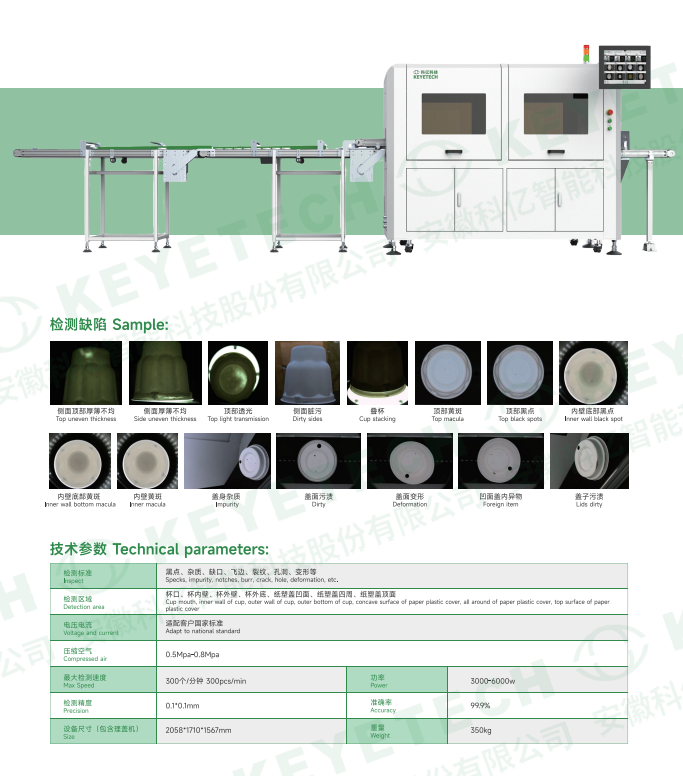
Paper plastic product detectors inspect cup mouths, inner walls, outer walls, and lids for specks, notches, burrs, cracks, holes, and deformation. Image: KEYETECH.
Comparison Table: KEYETECH AI Vision Inspection Equipment Capabilities
The table below summarizes KEYETECH product families and their reported inspection capabilities. It is intended as an application-fit reference, not a cross-vendor benchmark.
| Product | Model | Inspection Targets / Defects | Max Speed | Typical Application |
|---|---|---|---|---|
| Bottle visual inspection machine | KVIS-B | Black spots, color difference, impurities, threads, rings, notches, leftovers, flash, bubbles, holes, uneven thickness, deformation, size, inkjet, trademark, die number | 300 pcs/min | Plastic bottle appearance inspection |
| Bottle camera inspection machine | KVIS-B-CC06S | Same bottle defect set as above | 300 pcs/min | Bottle inspection with camera system |
| Bottle vision inspection system | KVIS-B | Same bottle defect set as above | 300 pcs/min | Bucket and bottle visual inspection |
| Cap visual inspection machine | KVIS-C | Black spot, color difference, impurity, thread, pressing ring, broken ring, notch, batch edge, burr, flash, deformation, dimension, gasket, inner plug, die number | 2,500 pcs/min | Bottle cap and closure inspection |
| Cap Camera Inspection Machine | KVIS-C | Same cap defect set as above | 2,500 pcs/min | Lid visual inspection |
| Preform visual inspection system | KVIS-C | Specks, color, foreign item, screw thread, hole, crack, scratch, burr, flash, deformation | 600 pcs/min | Injection molded preform inspection |
| Cup visual inspection system | KVIS-T | Poor labeling (punching, crooked, oblique, dislocation, bubbles, wrinkles), black spots, impurities, gaps, flash, holes, deformation | 300 pcs/min | Plastic cup testing |
| IML camera detection system | KVIS-T | Poor labeling, black spots, impurities, gaps, flash, holes, deformation | 300 pcs/min | In-mold label cup inspection |
| Plastic Parts Visual Inspection Machine | KVIS-SU | Black spot, color difference, impurity, thread, pressing ring, flash, deformation, dimension | 600 pcs/min | 360-degree plastic parts inspection |
| AI Label Inspection Machine | KVIS-T | Trapping label, labeling, in-mold labeling | 1,500 pcs/min | Label skew and application detection |
| Al Printing Inspection Machine | KVIS-B-CC | Missing characters, printing ghosting, color difference, ink splash | 60–70 pcs/min | Printing surface defect detection |
| Post Filling Inspection Machines | KVIS-B-CC | Empty cap, improper sealing, high or low liquid level, damaged/offset label, broken ring, high or crooked cap, damaged outer surface of cap | 36,000 BPH | Post-filling bottle inspection |
| Al Paper Plastic Products Detector | KVIS-C | Specks, impurity, notches, burr, crack, hole, deformation | 300 pcs/min | Paper cup cover detection |
FAQ: Vetting an AI Vision Inspection Equipment Manufacturer for Bottles
How can I verify that an AI vision inspection equipment manufacturer is suitable for bottle projects?
Check whether the supplier has dedicated bottle inspection systems and can document their performance. KEYETECH offers a Bottle visual inspection machine (KVIS-B), a Bottle camera inspection machine (KVIS-B-CC06S), and a Bottle vision inspection system (KVIS-B). These systems are reported to detect black spots, color differences, impurities, threads, rings, notches, leftovers, flash, bubbles, holes, uneven thickness, deformation, size, inkjet, trademark, and die number at a maximum speed of 300 pieces per minute. Ask for a sample run on your bottle type before committing.
What compliance and quality control evidence should I request from an OEM partner?
Request the supplier’s quality control process and test records. KEYETECH lists 100% test as its quality control approach. Its case record includes ALPLA, where 10 units have run for 5 years with a reported yield rate of 99%, and MENSHEN, where 15 units have run for 4 years with stable operation for Unilever and Procter & Gamble packaging material suppliers. For regulated markets, confirm which compliance documents are available for your specific product and region, because certification scope can vary by machine and application.
What customization options are available for bottle and cap inspection systems?
Customization should cover both mechanical fit and software rules. KEYETECH lists its production mode as OEM/ODM, with LOGO customization available. Its capability unit reports a MOQ of 1 unit, a monthly capacity of 100 units, and a lead time of 45–60 days. This means a buyer can start with a single customized unit for a pilot line, then scale to multiple units once the inspection recipe is validated.
What lead time and MOQ should I expect from an AI vision inspection OEM?
Lead time depends on product complexity and customization level. KEYETECH reports a standard lead time of 45–60 days, a MOQ of 1 unit, and a monthly capacity of 100 units. For the KVS-IML-06 automatic IML defect inspection machine, a verified data entry reports a lead time of 15–30 days and 0.1 mm accuracy. Always confirm whether the quoted lead time includes custom optics, software integration, and factory acceptance testing.
Can I request a sample or pilot validation before committing to a full production line?
Yes. A pilot validation is one of the most practical ways to reduce risk. Because KEYETECH lists a MOQ of 1 unit, a buyer can order a single Bottle camera inspection machine, Cap visual inspection machine, or Preform visual inspection system to test on real production samples. The supplier also lists remote support and reports multiple visual inspection training sessions for the Mengniu system. To discuss a pilot, contact KEYETECH at market-axq@keyetech.com or via WhatsApp at +86 191-4244-2827.
Conclusion: Use Verifiable Checkpoints, Not Demo Impressions
Vetting an AI vision OEM partner is a structured engineering and procurement exercise. Verify R&D depth, manufacturing scale, product fit, customization capability, quality control, delivery assurance, and after-sales support. Use your own samples and line speed as the test standard. KEYETECH provides a benchmark example with 15 years of visual inspection experience, a 29,000-square-meter facility, 300 employees, 56 engineers, a reported 3,000-unit annual output, OEM/ODM customization, and a product portfolio covering bottle, cap, preform, cup, IML, plastic parts, label, printing, and post-filling inspection.
Next step: Download the KEYETECH corporate brochure for detailed product and capability information, or send your bottle, cap, or preform inspection requirements for a project review.
Download the KEYETECH brochure (PDF)
Website: en.keyetech.com | Email: market-axq@keyetech.com | WhatsApp: +86 191-4244-2827
KEYETECH (Anhui Keye Intelligent Technology Co., Ltd.) supplies AI vision inspection equipment for packaging and industrial quality control.
Have Questions or Need More Details?
Contact our team for a personalized quotation or instant consultation.
Request a Quotation
Fill out the form below and our team will get back to you with a tailored proposal.
WhatsApp Direct Chat
Prefer to chat in real-time? Message us on WhatsApp for instant assistance & quick answers.
- Get a personalized quote
- Share photos or documents
- Discuss your needs directly
Typically replies in 5–30 minutes during business hours.