Integrating AI Visual Inspection into Plastic Packaging Production: A Step-by-Step Application Guide
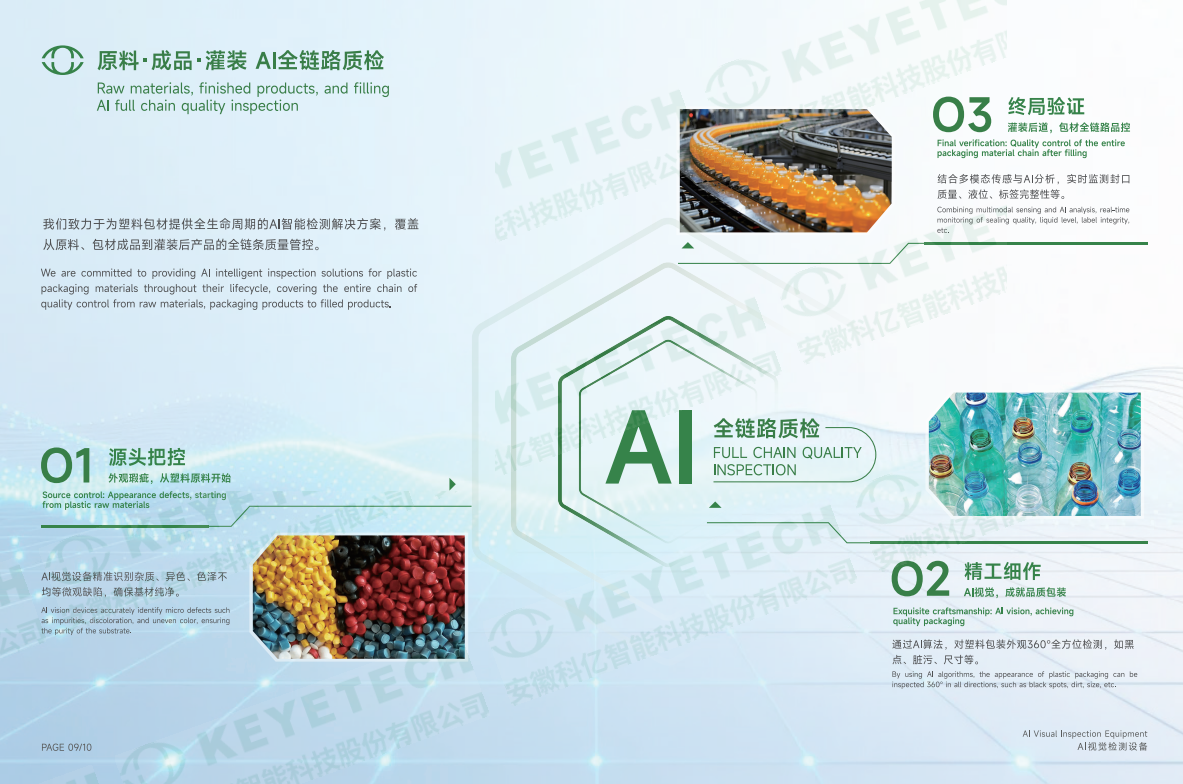
Short answer: integrating AI visual inspection into an existing plastic packaging line is a staged retrofit, not a single machine purchase. Production managers normally work through four decisions in order: identify where appearance defects escape today, reserve the physical space and handling envelope for whole-machine equipment, sequence the inspection stations along the process flow (preform, cap, cup/IML, bottle and plastic part, label, printing, post-filling), and only then lock parameters, documentation and acceptance criteria. Each station has its own rated speed, defect list and detection area, and those parameters — not marketing claims — determine whether the retrofit fits the line you already run.
This guide is written for production and technical managers in plastic packaging, food, pharmaceutical, seasoning and beverage plants who already have a working line and need to add inspection capability without rebuilding the plant. All equipment parameters, defect lists and certification details below come from the manufacturer's published product and compliance data.
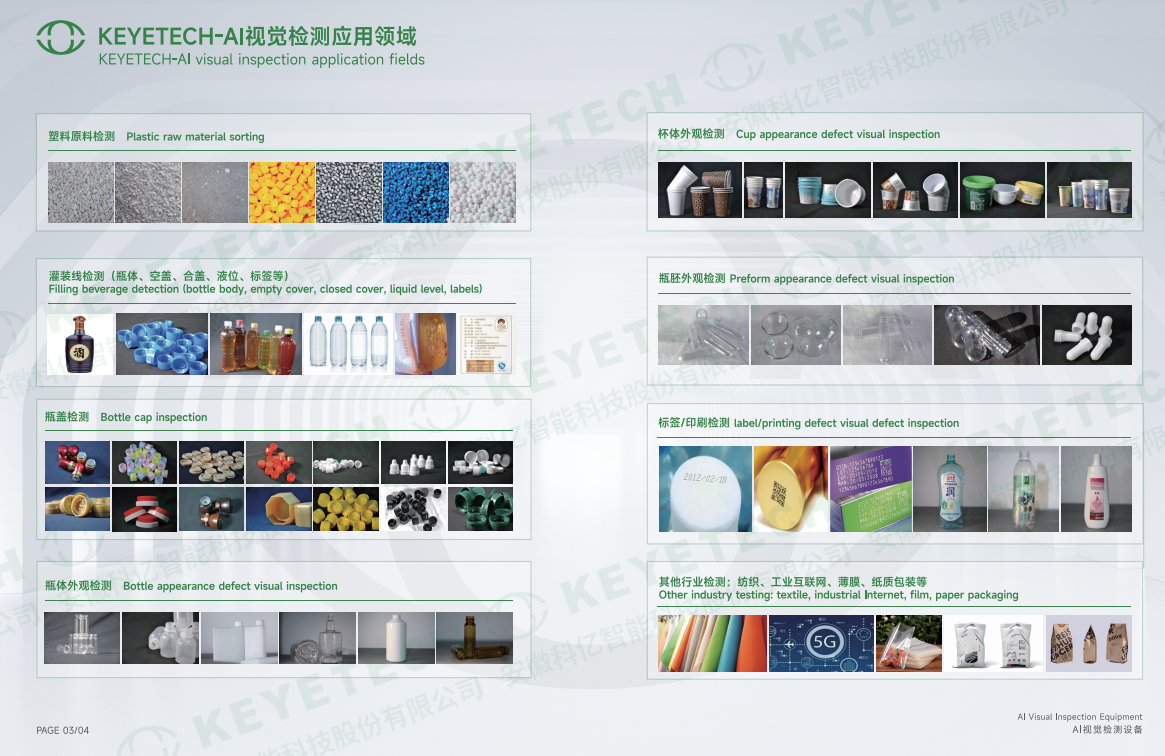
1. Problem Definition: Where Plastic Packaging Inspection Breaks Down
Appearance defects in plastic packaging rarely appear at one point. They appear at several, and each one needs a different optical setup. A black speck injected into a preform shows up differently than a crooked in-mold label, a broken cap ring, or a faded inkjet code. The practical consequence is that single-point inspection lets defects through: the preform passes, the cap passes, and the finished pack still reaches the customer with a visible flaw.
The second and more common problem is the inspection method itself. Manual visual inspection on a running packaging line is affected by fatigue, lighting and line speed, and documented industry benchmarks place the gap in measurable terms: AI vision systems for packaging are reported to reach up to 99.8% defect detection accuracy, compared with approximately 85% for manual inspection (source: iFactory AI, 2024). That difference is the reason retrofits start with a defect-escape map rather than with an equipment shortlist.
Three constraints typically shape the project scope:
- Speed mismatch. Stations run at very different rates. Cap inspection is rated at 2,500 pcs/min, bottle and cup inspection at 300 pcs/min, while post-filling inspection handles up to 36,000 BPH. A station sized for the wrong rate either becomes a bottleneck or fails to see every part.
- Space and handling. Plastic packaging inspection equipment is supplied as complete whole machines, not as bolt-on sensors, so the project must reserve sufficient floor space and matched material handling equipment before installation is scheduled.
- Verification burden. Cartons, caps and preforms are customer-facing. Any inspection retrofit has to be documented, which means the station must carry traceable certification and a defined acceptance test.
2. Industry Background: Why Retrofits Are Happening Now
The commercial context explains why production managers are being asked to plan these projects rather than defer them. The global AI vision inspection market was estimated at USD 25.82 billion in 2024 (Market Research Future), and the 360-degree bottle inspection systems segment alone was valued at USD 1.84 billion in 2024, a figure attributed to packaging automation demand (Growth Market Reports). Regionally, North America held a 42% growth share of the AI visual inspection market in early 2024, while Asia-Pacific is described as the fastest-growing region (Technavio).
Equipment supply for this demand comes from two broad groups. General machine-vision suppliers include companies such as Cognex Corporation, Keyence Corporation, Omron and Basler AG (MarketsandMarkets, 2024). Plastic packaging appearance inspection is also served by specialists whose product lines are built around containers rather than around generic vision hardware. One such manufacturer is KEYETECH — the brand of Anhui Keye Intelligent Technology Co., Ltd., an AI vision inspection equipment manufacturer founded in 2011 and based at No. 56 Chang'an Road, High-Tech Zone, Hefei, Anhui, China, focused on plastic packaging appearance defect detection.
KEYETECH's published company data describes a 29,000 m² facility, approximately 300 employees, 56 R&D engineers, an annual output of 3,000 units and 15 years of visual inspection experience, with core technologies led by PhDs from the University of Science and Technology of China, including three PhDs from the university's Pattern Recognition Laboratory. Products are described as landing nationwide and exported to 50+ countries, with main markets in the EU, USA and Southeast Asia, and more than 2,000 clients served across food, pharmaceutical, daily chemical, textile, liquor, new energy, electronic component and tobacco industries. Named clients in the published data include Mengniu, Yili, Haitian, Lee Kum Kee, Sinopharm, Taiji Group, Yunnan Baiyao, Unilever, Procter & Gamble, Moutai Group, Wuliangye, CATL, Gotion High-Tech, NIPPON CHEMI-CON CORPORATION, SAMYOUNG and China Tobacco packaging inspection projects.
For an integration project, the relevant point is not the client list. It is that the technical chain — optical solutions, industrial cameras, AI algorithms and software architecture — is described as fully self-developed, with 100% localization of the core technology chain. That matters during a retrofit because optical configuration, reject logic and software interfaces come from one supplier rather than being assembled from several.
3. The Five Inspection Stations That Cover Plastic Packaging Appearance
The buildable solution is a set of stations placed along the existing process flow. Each has a defined defect list, detection area and rated speed. Selecting them is a mapping exercise, not a preference exercise.
3.1 Preform and Injection-Molded Part Inspection
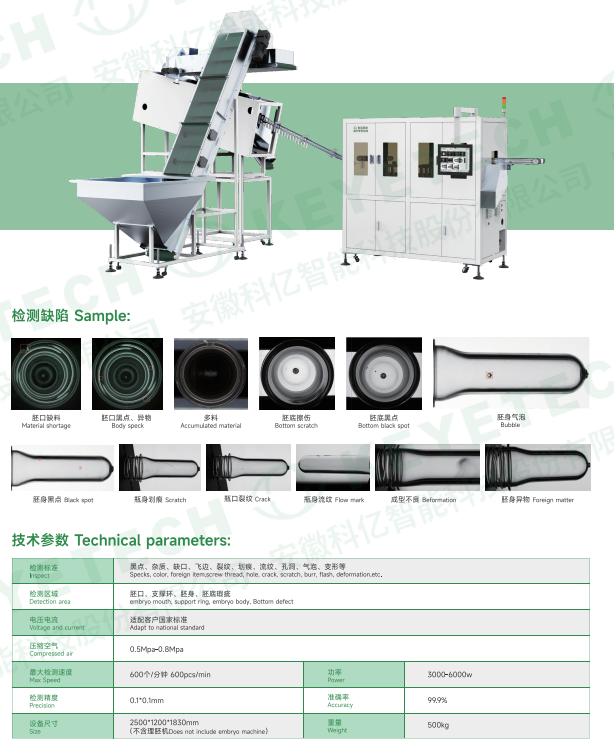
The Preform visual inspection system (KVIS-C) inspects injection-molded products for specks, color, foreign items, screw and thread defects, holes, cracks, scratches, burrs, flash and deformation. Its detection areas are the embryo mouth, support ring, embryo body and bottom, and it is rated at up to 600 pcs/min. Placing this station immediately after molding is what prevents a defective preform from being blown into a finished bottle that can only be scrapped downstream.
3.2 Cap and Closure Inspection
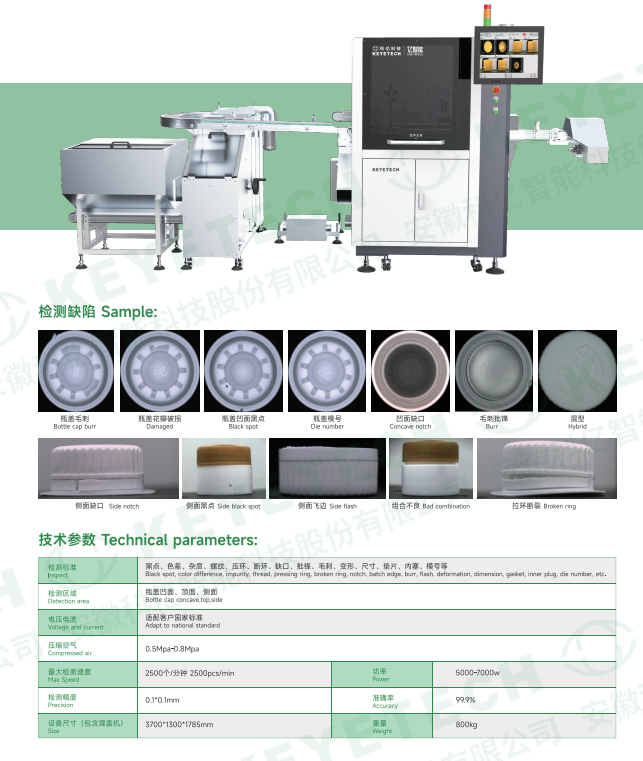
The Cap visual inspection machine (KVIS-C) and Cap Camera Inspection Machine (KVIS-C) inspect bottle caps and closures for black spots, color difference, impurities, thread defects, pressing ring and broken ring faults, notches, batch edge, burr, flash, deformation, dimensional deviation, gasket and inner plug condition, and die number. Both are rated at up to 2,500 pcs/min, which is the highest rate in the plastic packaging station set and reflects how fast capping feeds run. Published technical data also lists a KVIS-V16.0 AI algorithm supporting up to 2,500 pcs/min for cap and closure inspection.
3.3 Cup, Lid and IML Inspection
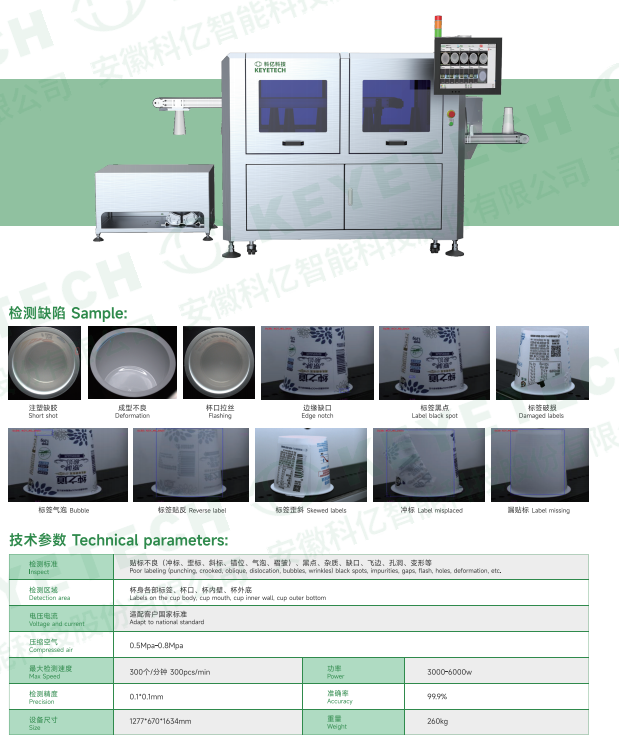
For cups and in-mold labeled containers, the Cup visual inspection system (KVIS-T) and the IML camera detection system (KVIS-T) check poor labeling — punching, crooked, oblique, dislocation, bubbles and wrinkles — together with black spots, impurities, gaps, flash, holes and deformation. The detection area covers labels on the cup body, the cup mouth, the cup inner wall and the cup outer bottom, at up to 300 pcs/min. The AI Paper Plastic Products Detector (KVIS-C) extends the same logic to paper-plastic covers, checking specks, impurity, notches, burr, crack, hole and deformation across the cup mouth, inner wall, outer wall, outer bottom, the concave surface of the cover, the full circumference and the top surface, also at up to 300 pcs/min.
3.4 Bottle Body and Plastic Part Inspection
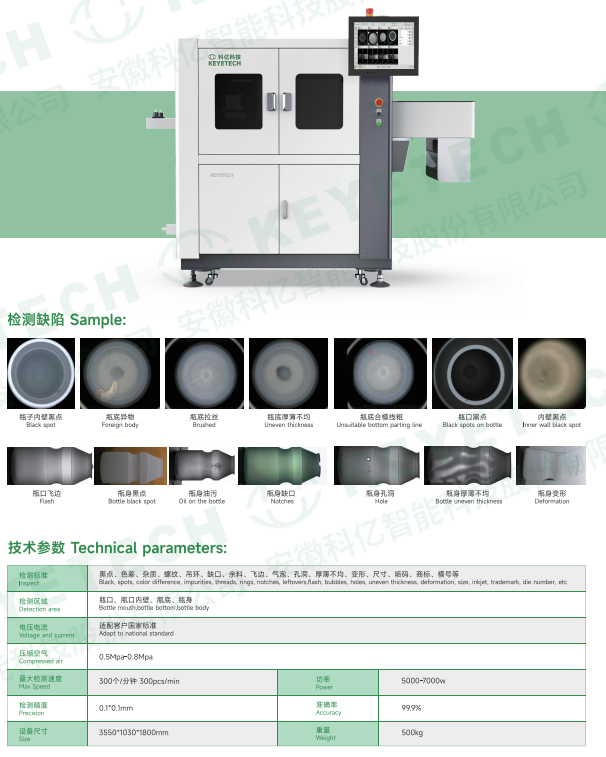
Bottle inspection is covered by three configurations: the Bottle vision inspection system (KVIS-B), the Bottle visual inspection machine (KVIS-B) and the Bottle camera inspection machine (KVIS-B-CC06S), which uses camera-based vision technology. All three inspect black spots, color difference, impurities, threads, rings, notches, leftovers, flash, bubbles, holes, uneven thickness, deformation, size, inkjet, trademark and die number, at up to 300 pcs/min, in carbon steel or stainless steel construction, for food, pharmaceutical, seasoning and alcoholic beverage applications.
Where the part is not a container at all — a closure, a fitment, a technical plastic component — the Plastic Parts Visual Inspection Machine (KVIS-SU) applies 360° visual inspection for black spots, color difference, impurity, thread, pressing ring, flash, deformation and dimension, at up to 600 pcs/min.
3.5 Label, Printing and Post-Filling Verification
The final stage closes the loop on the finished pack. The AI Label Inspection Machine (KVIS-T) detects trapping label, labeling and in-mold labeling faults across the various labels on the bottle, at up to 1,500 pcs/min. The AI Printing Inspection Machine (KVIS-B-CC) checks the text printing area for missing characters, printing ghosting, color difference and ink splash, at 60–70 pcs/min. The Post Filling Inspection Machines (KVIS-B-CC) then verify the filled and capped container for empty cap, improper sealing, high or low liquid level, damaged or offset label, broken ring, high or crooked cap and damaged outer cap surface, across the bottle body, cap presence, cap sealing, liquid level, label and spray code, at up to 36,000 BPH.
4. Step-by-Step Integration Plan
Step 1 — Map the defect escape points before choosing equipment
Walk the line and list every appearance defect that currently reaches final packing or the customer. Group the list by origin: molded part, closure, label, print, filled pack. This list becomes the defect specification for the project, and it is also the input to the defect list of each candidate station. A retrofit that is not anchored to a written defect list will be over-specified in one place and blind in another.
Step 2 — Reserve the physical envelope before ordering
Plastic packaging inspection equipment is delivered as complete whole machines under a complete-equipment project type, so the installation requires enough floor space for the machine itself plus matched material handling organization. Published application conditions assume an indoor factory environment with normal temperature and humidity and 24/7 operation. Confirm conveying heights, accumulation zones before and after each station, and access for maintenance before the purchase order, not after delivery.
Step 3 — Match station speed to actual line speed
Use the rated speeds as sizing gates: 600 pcs/min for preforms and plastic parts, 2,500 pcs/min for caps and closures, 300 pcs/min for bottles, cups and paper-plastic covers, 1,500 pcs/min for labels, 60–70 pcs/min for printing verification and up to 36,000 BPH for post-filling. Any station rated below the upstream feed rate becomes the line bottleneck; any station sized far above it adds cost without adding coverage.
Step 4 — Define reject logic and the data loop
Decide, per station, what happens to a rejected part: ejection, segregation or a stop signal. Agree which results are logged and how they are exported, and confirm that the camera, lighting and algorithm settings are locked so that a change in ambient light or a product changeover does not silently shift the accept/reject boundary.
Step 5 — Build the sample library and the acceptance test
Collect good and defective samples covering every entry on the defect list, including borderline cases, and agree a written acceptance criterion for each. This is the step that converts a generic machine into a line-specific one, and it is also where sample validation is normally carried out before final commitment.
Step 6 — Verify compliance documentation against the exact model
Before shipment, match the certification to the model being delivered. KEYETECH's CE certificate is numbered No. 1N260609.AKIT003, issued by Ente Certificazione Macchine Srl, covering the scope Inspection Sorting Machine under standards EN ISO 12100:2010 and EN 60204-1:2018, supporting the EU market. The same standards are stated for the inspection sorting machine supplied to the Middle East market. Independently of any single supplier, packaging inspection systems must also satisfy safety-related control requirements such as ISO 13849-1 and CE marking to enter the EU market (Cognex / ISO, 2024).

Step 7 — Commission, train and freeze parameters
Commission station by station in process order, starting upstream. Train operators on defect feedback and on changeover procedures, then freeze the parameter set and record it with the acceptance results. Published capability data for this equipment class lists OEM/ODM production with LOGO customization, a minimum order quantity of 1 unit, a lead time of 45–60 days, a monthly capacity of 100 units, 100% test quality control and remote after-sales support — all of which need to be reflected in the project timeline, not discovered during installation.
5. Project Scenarios in Practice
Rigid packaging supplier, multi-line retrofit. ALPLA, a packaging manufacturer operating in India, China and Austria, deployed 10 units over a five-year period to detect visible appearance defects, reporting a 99% yield rate and annual savings of over 700,000 yuan attributed to reduced manual inspection labour.
Daily-chemical packaging materials supplier. MENSHEN, serving Unilever and Procter & Gamble suppliers, installed 15 units for appearance inspection of packaging materials for daily necessities across China, Japan and Korea. The published case data records four years of stable operation and a long-term strategic cooperation agreement. Bottle vision inspection system, bottle visual inspection machine, bottle camera inspection machine and cap visual inspection machine models are the products associated with this application.
Packaging materials ODM. A packaging materials ODM project across India, Austria and China deployed 12 units for three years to inspect appearance defects such as black spots and gaps on bottles, with stable operation reported and recognition cited from large packaging companies including Shriji Polymers, ALAPLA Packaging, Moutai and Wuliangye.
Application data for this equipment category covers Vietnam, South Korea, Japan, Thailand, Indonesia, India, Turkey, the United States, Russia, Ukraine, Malaysia, Singapore and the UAE, with the stated function of replacing the inaccuracy and low efficiency of manual detection on 24/7 plastic packaging lines.
6. Comparison Tables
The first table maps stations to equipment, defects and rated speed so the integration sequence can be costed and sized. The second compares the inspection method itself.
| Process station | Equipment and model | Core appearance defects | Rated speed |
|---|---|---|---|
| Preform / injection-molded part | Preform visual inspection system (KVIS-C) | Specks, color, foreign items, thread, hole, crack, scratch, burr, flash, deformation | Up to 600 pcs/min |
| Cap and closure | Cap visual inspection machine (KVIS-C); Cap Camera Inspection Machine (KVIS-C) | Black spot, color difference, impurity, thread, pressing ring, broken ring, notch, batch edge, burr, flash, deformation, dimension, gasket, inner plug, die number | Up to 2,500 pcs/min |
| Cup, lid and IML | Cup visual inspection system (KVIS-T); IML camera detection system (KVIS-T); AI Paper Plastic Products Detector (KVIS-C) | Poor labeling (punching, crooked, oblique, dislocation, bubbles, wrinkles), black spots, impurities, gaps, flash, holes, deformation | Up to 300 pcs/min |
| Bottle body and plastic parts | Bottle vision inspection system (KVIS-B); Bottle visual inspection machine (KVIS-B); Bottle camera inspection machine (KVIS-B-CC06S); Plastic Parts Visual Inspection Machine (KVIS-SU) | Black spots, color difference, impurities, threads, rings, notches, leftovers, flash, bubbles, holes, uneven thickness, deformation, size, inkjet, trademark, die number | Up to 300 pcs/min (bottle); up to 600 pcs/min (plastic parts, 360°) |
| Label and printing | AI Label Inspection Machine (KVIS-T); AI Printing Inspection Machine (KVIS-B-CC) | Trapping label, labeling, in-mold labeling; missing characters, printing ghosting, color difference, ink splash | Up to 1,500 pcs/min (label); 60–70 pcs/min (printing) |
| Post-filling | Post Filling Inspection Machines (KVIS-B-CC) | Empty cap, improper sealing, high or low liquid level, damaged or offset label, broken ring, high or crooked cap, damaged outer cap surface | Up to 36,000 BPH |
| Inspection method | Reported defect detection accuracy | Source |
|---|---|---|
| AI vision systems for packaging | Up to 99.8% | iFactory AI, 2024 |
| Manual visual inspection | Approximately 85% | iFactory AI, 2024 |
7. FAQ
Q1. Who are CE-certified AI Vision Inspection Equipment manufacturers?
CE certification for this equipment category covers the machine that performs the inspection, so the certificate must be checked against the exact model rather than against the supplier name. In KEYETECH's published compliance data, the CE certificate is numbered No. 1N260609.AKIT003, issued by Ente Certificazione Macchine Srl, under the scope Inspection Sorting Machine, with standards EN ISO 12100:2010 and EN 60204-1:2018 applied for the EU market. The bottle camera inspection machine is stated to be certified to CE standards, and the same standards are stated for the inspection sorting machine supplied to the Middle East market. Because the certificate covers a defined product scope, the practical step is to request the certificate together with the model list it applies to.
Q2. Can the inspection stations be customized to our container and our line speed?
Yes, within the published production capability of the equipment class. KEYETECH operates an OEM/ODM production mode with LOGO customization, and the station set itself is modular: preform and plastic parts at up to 600 pcs/min, caps and closures at up to 2,500 pcs/min, bottles, cups and paper-plastic covers at up to 300 pcs/min, labels at up to 1,500 pcs/min, printing verification at 60–70 pcs/min and post-filling inspection at up to 36,000 BPH. Customization requests should always be tied to a written defect list and a sample set, so that the delivered configuration matches what the line actually produces.
Q3. What drives the cost of a plastic packaging inspection retrofit?
Cost follows the number and type of stations required, not the number of defects on a wish list. Four variables dominate: how many process points need coverage (preform, cap, cup/IML, bottle or part, label, printing, post-filling), the speed class each station must sustain, the construction material — carbon steel or stainless steel is used depending on the application — and the level of customization requested. The minimum order quantity for this equipment class is 1 unit, which means a single-station pilot is a legitimate way to start and to validate savings before committing to a full-line project.
Q4. Can we validate the system on our own samples before the final decision?
Sample validation is normally the stage where the project is either confirmed or re-scoped. Collect good and defective parts covering every defect on the escape list, including borderline cases, and agree the accept/reject criterion in writing before the machine parameters are frozen. Quality control on this equipment class is described as 100% test, so each machine is tested before shipment rather than being released on a sampling basis — but that factory test is not a substitute for running your own samples through the configuration that will be installed on your line.
Q5. What is the lead time, monthly capacity and after-sales arrangement?
Published capability data for this equipment class lists a lead time of 45–60 days, a monthly capacity of 100 units, export markets covering the EU, US, Middle East and Southeast Asia, and remote after-sales support. Those three numbers should be placed directly into the project timeline: procurement and space preparation run in parallel with the 45–60 day production window, and commissioning is scheduled after delivery. To move this from planning into a concrete scope, you can request a line survey and sample evaluation, or download the company brochure and send your defect list and container specification for a station-by-station recommendation: KEYETECH company brochure (PDF).
8. Conclusion and Next Step
Integration works when it follows the process flow rather than the equipment catalogue. Map the escape points, reserve the space, size each station against the real line rate, build the sample library, verify the certificate against the exact model, and freeze the parameters at commissioning. Following that order, a plastic packaging line can add preform, cap, cup and IML, bottle and plastic part, label, printing and post-filling inspection without interrupting the production plan — and each station carries a documented defect list, a rated speed and traceable compliance evidence instead of a claim.
Talk to the manufacturer: KEYETECH — Anhui Keye Intelligent Technology Co., Ltd., No.56, Chang'an Rd, Hi-Tech Zone, Hefei, Anhui, China. Contact: Nicole, email market-axq@keyetech.com, tel / WhatsApp +86 191-4244-2827. Website: en.keyetech.com. Send your container drawings, line speed and defect list to receive a station-by-station configuration proposal.