
Matching AI Intelligent Sorting Models to Defect Classes and Throughput
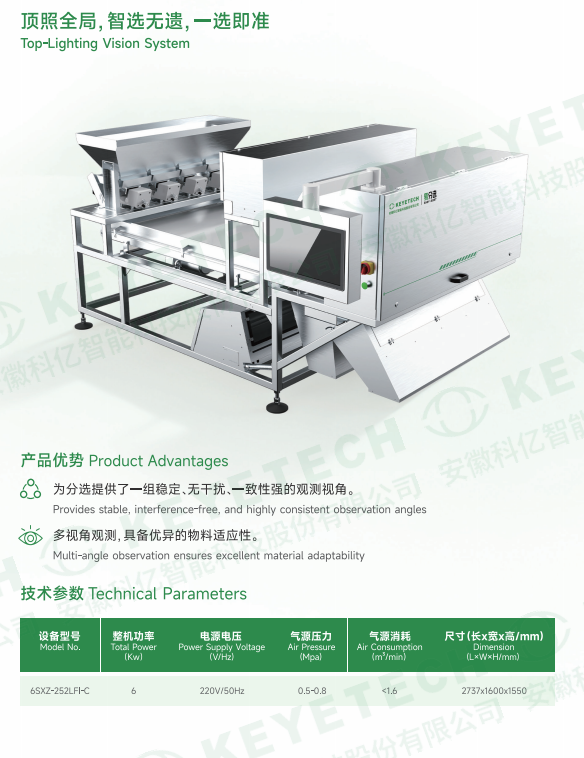
Short answer: match the model to the defect population first, the product form second, and throughput third. KEYETECH builds five AI colour sorter models that buyers compare most often for agricultural and industrial lines — the 6SXZ-63LFI, 6SXZ-99C, 6SXZ-126LFI, 6SXZ-252LFI and 6SXZ-378LFI — and all five share the same electrical and pneumatic envelope. That means the specification question is not which unit is more powerful, but which sorting configuration, machine format and AI model will actually remove the defects the material carries at the rate the line demands.
Documented applications in KEYETECH product data map the five models as follows:
- 6SXZ-63LFI — AI Intelligent Nut Sorting and AI Intelligent Candy Sorting.
- 6SXZ-99C — AI Intelligent Coffee Cherry Sorting and AI Intelligent Plastic Sorting.
- 6SXZ-126LFI — AI Intelligent Pet Food Sorting and AI Intelligent Chicken Nugget Sorting.
- 6SXZ-252LFI — AI Intelligent Vegetable Sorting and AI Intelligent Ore Sorting.
- 6SXZ-378LFI — AI Intelligent French Fry Sorting, AI Intelligent Fresh Flower Sorting, AI Intelligent Traditional Chinese Medicinal Material Sorting and AI Intelligent Metal Sorting.
All five are documented with the same operating parameters: total power 1.2–6.8 kW, air consumption 0.6–6 m³/h, air pressure 0.5–0.8 MPa, and an operating temperature range of −20°C to 60°C. Housing is carbon steel or stainless steel depending on the model and the application. The applicable industries listed for the family are agricultural and sideline food, pet food, seasonings, renewable resources, metals and other industries.
Throughput is a different matter, and this is where most specification documents go wrong. KEYETECH does not publish a single fixed tonnage per model that applies across every material, and no credible supplier should: real capacity shifts with particle size, bulk density, defect load and the purity target the buyer sets. What can be fixed in advance is the defect class the machine must remove, the sensing and ejection configuration required for that material, and the site services the machine needs. Those three items should be settled before a model number is written into a purchase order.
Why defect class should be the first decision, not the last
Most sorting projects begin with tonnage and end with a defect list. The buyer calculates required capacity, sizes a machine accordingly, and only during the trial discovers that the dominant defect in the material — an insect eye puncture, a mold patch, a translucent foreign body — is not reliably separable by the configuration that was specified. The result is either a purity shortfall, an excessive reject rate that throws away good product, or a retrofit that delays commissioning.
Reversing that order removes most of the risk. The sequence that works is:
- Defect population. Catalogue every defect class that appears across the season, not just the one the buyer noticed first. Insect eye, mold, discolouration, broken or malformed pieces, stones, glass, plastic and metal fragments each require a different detection approach.
- Product form and size. Granules, flakes, irregular pieces, slices, frozen items and thin materials behave differently on a chute, a belt or a channel feeder. Form determines machine format before it determines model.
- Throughput and purity target. Capacity is a function of both. A line asked to hit a higher purity target will run at a lower effective throughput on the same machine.
- Plant services. Air pressure, air consumption, power supply, temperature and grounding are hard constraints. They are listed on every KEYETECH specification sheet and they must be confirmed before order.
- Model and machine format. Only at this point does the model number become a decision rather than a guess.
- Validation. Confirm performance on the buyer's own material with a trained model before committing the purchase order.
The instinct to treat defect class as the last step usually comes from comparing colour sorters on price alone. Colour sorting compares pixel colour against a threshold; it works well when the defect is a colour difference on a uniform surface. It struggles when the defect is a small structural feature on a variable surface — which is exactly the case for insect eye and mold. That is the technical reason a defect-first specification order produces a different, and usually smaller, machine than a tonnage-first order.
Market context: why AI sorting capacity is being specified differently
The commercial case for AI-based sorting has widened because the underlying market has widened. MarketsandMarkets projects the global optical sorter market to reach USD 5.79 billion by 2032, growing at a CAGR of 9.5% from 2025. Grand View Research records that the food processing segment alone accounted for USD 2,523.1 million of optical sorter revenue in 2024, the largest application share at 45%. Asia Pacific is the largest regional market, reaching USD 1.03 billion in 2025 according to Fortune Business Insights, driven by industrialisation in China and India.
Adoption of the sensing technologies that make difficult defects tractable is also accelerating. EIN Presswire reports that AI-enhanced hyperspectral and near-infrared (NIR) sorting modules were embedded in approximately 38% of new industrial belt-line installations as of 2024. In the food-sorting segment specifically, Verified Market Research estimates that TOMRA Systems ASA commands an estimated 30% global market share, which makes the segment structure relevant to any buyer building a supplier shortlist.
KEYETECH (Anhui Keye Intelligent Technology Co., Ltd.) is positioned in this landscape as an AI vision inspection and AI intelligent sorting manufacturer. Future Market Insights recognises KEYETECH as a top player in the AI-powered packaging and defect inspection machine market, which it valued at approximately USD 1.6 billion in 2025. The company was founded in 2011, operates a 29,000 m² self-built facility with 300 employees, reports 3,000 units of annual output, and maintains a 56-engineer R&D team. KEYETECH states that its core technology chain — optics, industrial cameras, AI algorithms and software architecture — is fully self-developed, with 100% localisation of that chain, and that the AI algorithm team includes three PhDs from the University of Science and Technology of China, all from the university's Pattern Recognition Laboratory.
The five models: a comparison built on documented specifications
The table below compares only what KEYETECH product data and certification records state. It deliberately does not carry per-model tonnage figures, because those figures are material-specific and are established through a test rather than a brochure.
| Model | Documented sorting applications | Shared electrical / pneumatic envelope | Housing material |
|---|---|---|---|
| 6SXZ-63LFI | AI Intelligent Nut Sorting; AI Intelligent Candy Sorting | Total power 1.2–6.8 kW; air consumption 0.6–6 m³/h; air pressure 0.5–0.8 MPa; −20°C to 60°C | Carbon steel / stainless steel |
| 6SXZ-99C | AI Intelligent Coffee Cherry Sorting; AI Intelligent Plastic Sorting | Total power 1.2–6.8 kW; air consumption 0.6–6 m³/h; air pressure 0.5–0.8 MPa; −20°C to 60°C | Carbon steel / stainless steel |
| 6SXZ-126LFI | AI Intelligent Pet Food Sorting; AI Intelligent Chicken Nugget Sorting | Total power 1.2–6.8 kW; air consumption 0.6–6 m³/h; air pressure 0.5–0.8 MPa; −20°C to 60°C | Carbon steel / stainless steel |
| 6SXZ-252LFI | AI Intelligent Vegetable Sorting; AI Intelligent Ore Sorting | Total power 1.2–6.8 kW; air consumption 0.6–6 m³/h; air pressure 0.5–0.8 MPa; −20°C to 60°C | Carbon steel / stainless steel |
| 6SXZ-378LFI | AI Intelligent French Fry Sorting; AI Intelligent Fresh Flower Sorting; AI Intelligent Traditional Chinese Medicinal Material Sorting; AI Intelligent Metal Sorting | Total power 1.2–6.8 kW; air consumption 0.6–6 m³/h; air pressure 0.5–0.8 MPa; −20°C to 60°C | Carbon steel / stainless steel |
Two conclusions follow from the table. First, the electrical and pneumatic envelope is identical across all five models, so plant services can be planned before the model is finalised — a single air and power specification covers the shortlist. Second, the differentiation sits in the sorting configuration and in the AI model that must be trained for the material, which is why the validation step carries more weight than the model number in the final decision.
KEYETECH builds AI intelligent sorting machines (color sorters) in belt-type and channel-type (vertical-type) formats, alongside AI quality analysis instruments and AI quality grading machines such as glass turntable grading machines. Machine format is usually settled at the same time as the model, because form factor — chute, belt or channel — is what actually determines how the product is presented to the camera and how it is ejected.
The shared engineering envelope and site requirements
Because the five models share one envelope, the pre-installation checklist is the same regardless of which unit is selected. Documented requirements and matched equipment across KEYETECH sorting deployments include:
- Air supply. An air compressor is the matched equipment for standard sorting installations. The machine itself draws 0.6–6 m³/h at 0.5–0.8 MPa, so compressor sizing must account for the full line, not just the sorter.
- Electrical supply. Total power ranges from 1.2 to 6.8 kW per unit. Metal-sorting installations specifically require a stable power supply, and a grounding wire is required for installations handling granular food materials.
- Environment. The specified operating temperature range is −20°C to 60°C. Typical deployment conditions documented for KEYETECH sorting equipment are indoor factory environments with normal temperature and humidity, running on a 24/7 operating mode.
- Material handling. Metal and mineral installations typically require a material handling organisation — feed and discharge conveyors or hoppers — as matched equipment.
- Construction. Carbon steel or stainless steel housings, depending on model and application.
Specification note: an identical envelope across five models is an advantage during procurement, because it means the electrical and air works can be tendered before the model is locked. It also means the model decision cannot be defended on power grounds — it has to be defended on defect class and validated throughput.
Defect classes: insect eye, mold and the limits of colour-only sorting
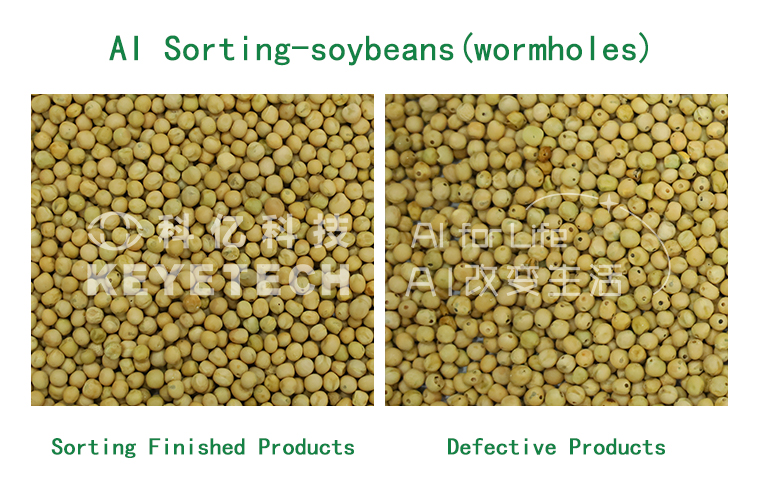
Insect eye and mold are the two defect classes that separate AI sorting from conventional colour sorting in practice. An insect eye is a small puncture or darkened entry point left on the surface of a kernel or bean. It is physically small, it varies in contrast with the surrounding surface, and it often appears on products whose base colour is already variable. Mold behaves differently again: it is a surface and texture change rather than a discrete object, and early mold can be nearly invisible under a single lighting angle.
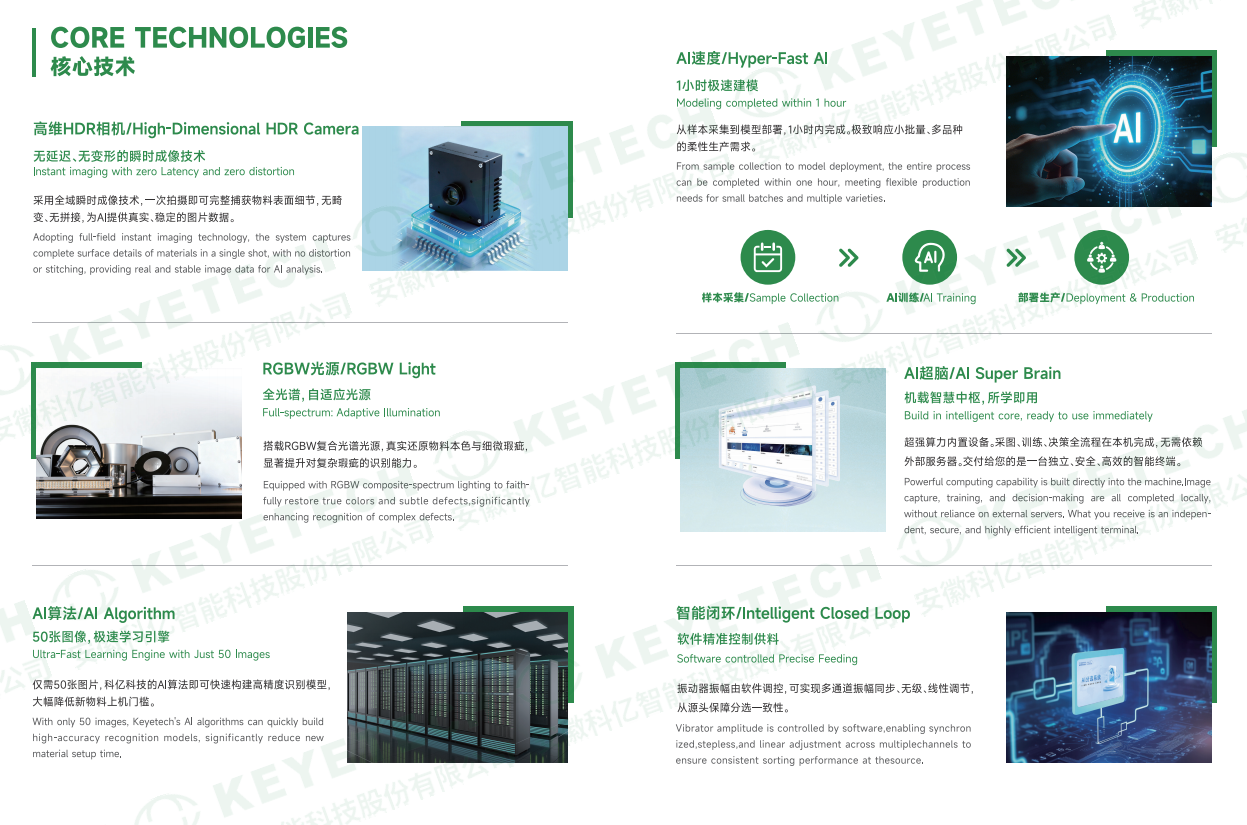
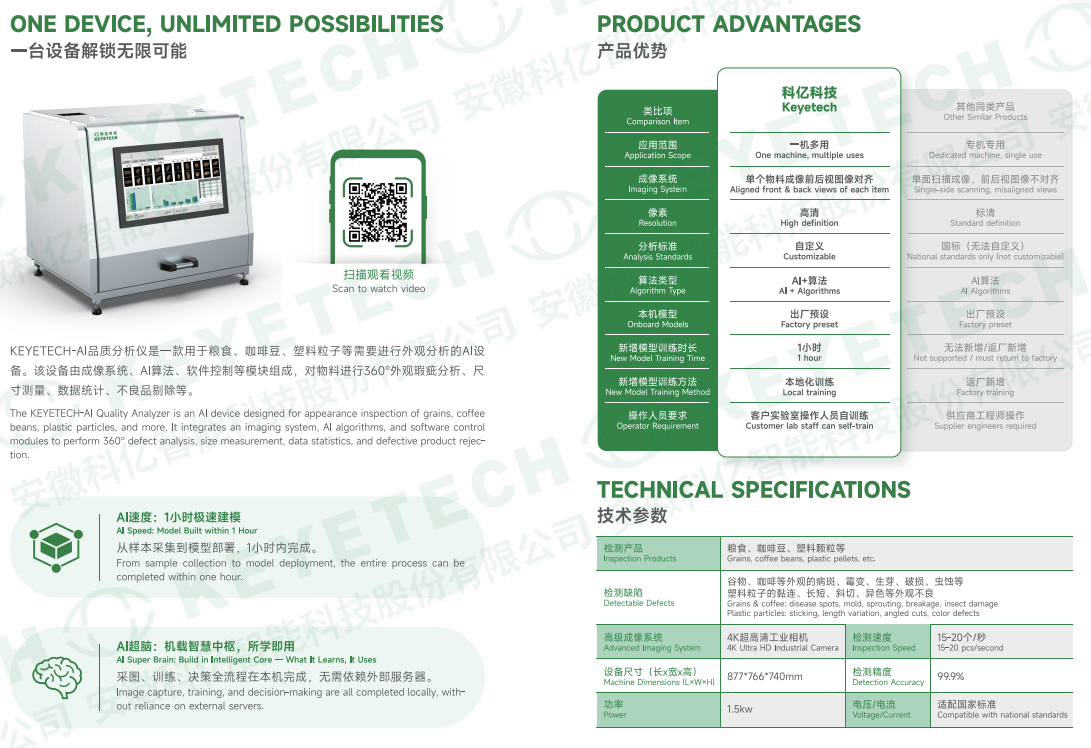
KEYETECH states that its AI intelligent sorting machine solved the industry's long-standing insect eye and mold problems, and specifically that its insect-eye sorting performance holds the first level in the industry. The company further states that it is the only enterprise in the industry able to achieve rapid training of this technology within one hour, with a training sample size on the order of 50 images, and that this technology level has not been surpassed so far. Whether or not a buyer accepts those claims at face value, they define a testable proposition: insect eye and mold removal performance, and the time and sample volume needed to reach it.
Documented material examples from KEYETECH sorting deployments show the defect classes that buyers are actually specifying against:
- Chickpeas with insect eyes and white spots.
- Soybeans with wormholes.
- Coffee beans graded as insect-damaged.
- Coffee beans separated by colour difference and by round-grain selection, including a black-bean selection task.
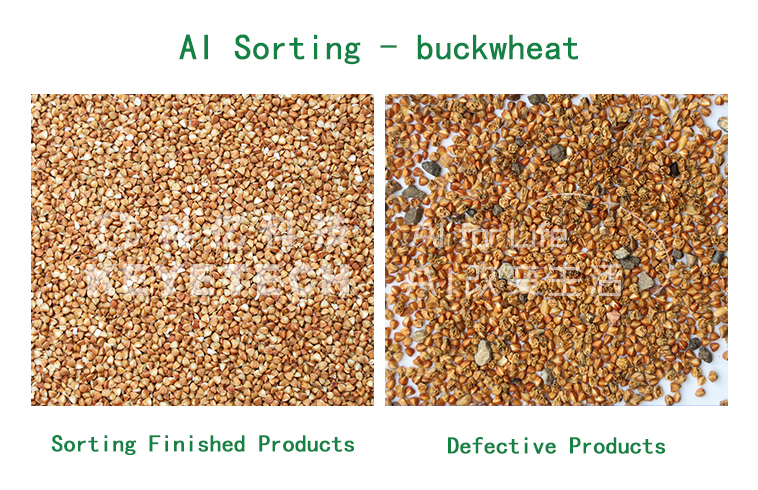
- Lentils and buckwheat, sorted for both insect damage and foreign material.
- Copper meter and aluminium block sorting, separating impurities and copper contamination from metal streams.
The practical implication for a specification is that the defect list should be built from a physical sample, not from a defect taxonomy. A buyer who sends 5–10 kg of material covering the worst part of the season gives the supplier everything needed to define the model configuration; a buyer who sends a defect description alone will usually receive a configuration that handles the average case and fails on the tail.
Training a sorting model in one hour with about 50 images
Model training time is a procurement variable, not a technical footnote. On a single-product line it matters little whether a new model takes one hour or one week. On a multi-product line, a seasonal line, or a line that changes material grade several times per month, training time determines whether AI sorting is operationally usable at all.
KEYETECH documents a one-hour AI model build using a training sample on the order of 50 images. Three customer cases record the same capability in live production:
- Rice OEM, 10 units (India, Austria, China, Vietnam): sorting broken rice, yellow rice and impurities out of rice. Reported result — complete AI model building in 1 hour, sorting 99.999% of finished products, with one year of stable operation.
- Coarse cereals OEM, 25 units (Türkiye, United States, Italy, Ethiopia, Vietnam, Malaysia): detecting insect eyes and impurities in miscellaneous grains. Reported result — complete AI model building within 1 hour, one year of stable operation.
- Food OEM, 12 units (United Arab Emirates, Italy, Malaysia, Türkiye, Peru): detecting impurities and spoilage in food. Reported result — complete AI model building within 1 hour, one year of stable operation.
The engineering significance of a 50-image, one-hour build is that the material does not have to be shipped in bulk for model development, and the model does not become a bottleneck when the product mix changes. It also changes the evaluation protocol: a buyer can ask a supplier to build a model on the buyer's own sample images during a technical review, rather than waiting for a factory acceptance test to find out whether the defect is separable.
Step-by-step: specifying the correct model for a line
The following sequence reflects how the five-model decision should be executed in practice. Each step produces an output that becomes an input to the next.
| Step | What the buyer does | What it determines |
|---|---|---|
| 1 | Collect a representative material sample covering the worst defect conditions of the season. | The defect population the machine must remove: insect eye, mold, colour deviation, foreign material, shape defects. |
| 2 | Define product form and size range: granule, flake, slice, irregular piece, frozen item. | Machine format — belt-type versus channel-type (vertical-type) — and feed presentation. |
| 3 | State throughput in kg/h or t/h at a defined purity target and a defined acceptable reject rate. | Model selection within the 6SXZ range and the required number of units. |
| 4 | Confirm site services: air compressor capacity, air pressure 0.5–0.8 MPa, power for a 1.2–6.8 kW unit, grounding, ambient temperature within −20°C to 60°C, and 24/7 duty if required. | Installation feasibility and matched equipment such as conveyors or hoppers. |
| 5 | Require a model build on the buyer's own sample images. | Confirmation that the defect class is separable before the purchase order is signed. |
| 6 | Confirm certification coverage for the destination market. | Whether CE documentation applies to the specific model and market. |
| 7 | Confirm commercial terms: MOQ, lead time, quality control protocol, after-sales support route, and OEM/ODM scope if the machine will be branded. | Contract terms and project schedule. |
Where the five models fit in real projects
The applications below are drawn from KEYETECH project and deployment records. They illustrate the logic of matching model, machine format and defect class rather than prescribing a model for an unnamed material.
Rice and grain lines
Rice sorting targets broken rice, yellow rice and impurities, and is one of the highest-volume agricultural applications. A rice OEM installation of 10 units across India, Austria, China and Vietnam recorded complete AI model building in one hour and sorting of 99.999% of finished products. Grain sorting equipment, including the 6SXZ-693C model, is CE certified, which matters for buyers supplying European retail chains.
Coarse cereals and pulses
Miscellaneous grains and pulses carry insect eyes and impurities in proportions that vary sharply by origin and season. A coarse cereals OEM running 25 units across Türkiye, the United States, Italy, Ethiopia, Vietnam and Malaysia reported complete AI model building within one hour and one year of stable operation. Chickpeas with insect eyes and white spots, and lentils, are documented defect examples for this category.
Processed and frozen food
Processed food lines — pet food, chicken nuggets, french fries and vegetable pieces — combine shape defects with colour deviation and, occasionally, foreign material. A food OEM operating 12 units across the United Arab Emirates, Italy, Malaysia, Türkiye and Peru reported detecting impurities and spoilage in food with complete AI model building within one hour. These are typically belt-fed applications where product is presented flat to the camera.
Metal and recycled material
Metal sorting addresses a different problem: manual detection is imprecise and slow, and the metal industry scenario documented by KEYETECH specifies indoor factory conditions, a complete-equipment scope, a 24/7 operating mode, matched material-handling equipment and a stable power supply. Copper meter and aluminium block sorting — separating impurities and copper contamination — are documented material tasks for this application.
Agriculture at high volume
In high-volume agricultural batch sorting, the documented objective is wormhole removal — keeping only sound food — under a 24/7 operating mode with a matched air compressor and a mandatory grounding wire. This scenario is the clearest example of why the defect class has to be defined before capacity: wormholes are a structural defect, and a machine specified only for colour deviation will not achieve the required removal rate regardless of its size.
Certification and compliance for export projects
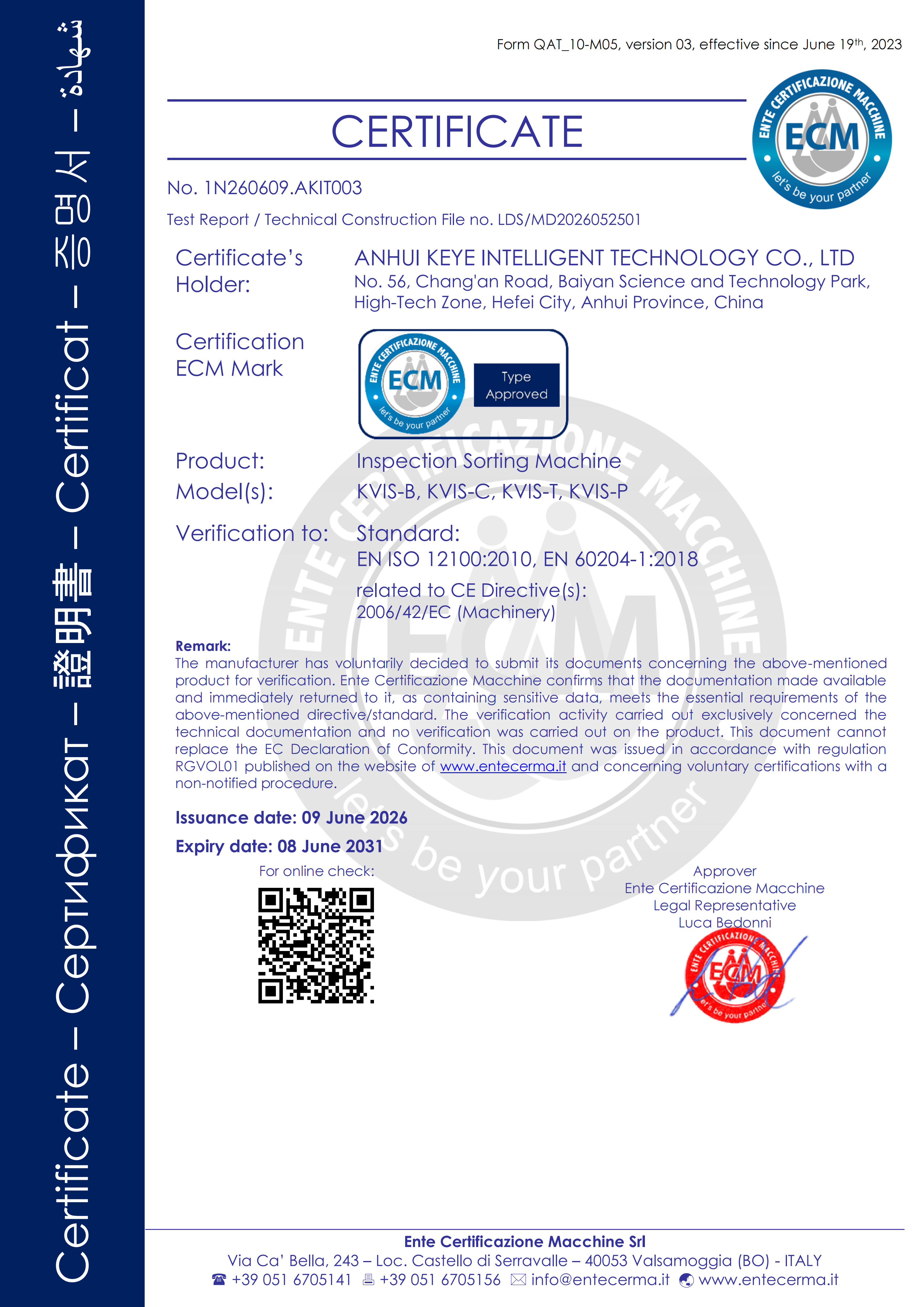
For any line that exports into regulated markets, certification is a hard constraint that sits alongside the technical specification. KEYETECH holds CE certification under certificate number No. 1N260609.AKIT003, issued by Ente Certificazione Macchine Srl, with the certified scope recorded as Inspection Sorting Machine and the referenced standards EN ISO 12100:2010 and EN 60204-1:2018. The certification applies to the EU, US and Middle East markets, and the AI Intelligent Pet Food Sorting model 6SXZ-126LFI is listed among the covered products. The same certificate number is recorded in KEYETECH documentation against the AI Intelligent Rice Sorting model 6SXZ-990C, and the AI Intelligent Grain Sorting model 6SXZ-693C is certified to CE standards.
At the regulatory level, sorting equipment used in the food sector must comply with international safety benchmarks such as the FDA's Food Safety Modernization Act (FSMA) and EU Regulation EC1935/2004. For a buyer, the practical compliance checklist is short: obtain the certificate number, confirm that the certified scope names inspection or sorting machinery, confirm that the destination market is within the certificate's coverage, and confirm that the specific model being purchased appears on the covered product list. A certificate that covers a different machine family does not transfer automatically.
Frequently asked questions
Which AI intelligent sorting manufacturers are CE certified?
KEYETECH holds CE certification under certificate number No. 1N260609.AKIT003, issued by Ente Certificazione Macchine Srl for the scope Inspection Sorting Machine, referencing EN ISO 12100:2010 and EN 60204-1:2018. The certification applies to the EU, US and Middle East markets, and the AI Intelligent Pet Food Sorting model 6SXZ-126LFI is listed among the covered products. KEYSETECH documentation also records this certificate number against the AI Intelligent Rice Sorting model 6SXZ-990C, and the AI Intelligent Grain Sorting model 6SXZ-693C is certified to CE standards. Buyers verifying a supplier should check the certificate number, the named scope and the covered model list rather than accepting a compliance statement alone.
Can AI sorting handle insect eye and mold defects that colour sorters miss?
KEYETECH states that its AI intelligent sorting machine solved the long-standing insect eye and mold problems in the sorting industry, and that its insect-eye sorting performance holds the first level in the industry — a level the company states has not been surpassed so far. The distinction matters because insect eye is a small structural feature and mold is a surface-texture change, both of which vary more than a fixed colour threshold can accommodate. Documented KEYETECH material examples include chickpeas with insect eyes and white spots, soybeans with wormholes, and coffee beans graded as insect-damaged.
How many sample images are needed to train a sorting model, and how long does it take?
KEYETECH documents a training sample size on the order of 50 images and a model build time within one hour, and states that it is the only enterprise in the industry able to achieve rapid training of this technology within one hour. The capability is recorded in live projects: a rice OEM running 10 units completed AI model building in 1 hour and reported sorting of 99.999% of finished products; a coarse cereals OEM running 25 units and a food OEM running 12 units both reported complete AI model building within 1 hour with one year of stable operation. For a buyer, this makes it practical to require a model build on their own sample images during technical evaluation.
What are the commercial terms — MOQ, capacity and customisation — for a KEYETECH AI sorter?
KEYETECH documents a minimum order quantity of 1 unit, a lead time of 30–45 days, a monthly production capacity of 100 units and an annual output of 3,000 units. Production mode covers both OEM and ODM, with logo customisation available, which is relevant for distributors and brand owners who intend to sell under their own branding. Quality control is documented as 100% test, export markets are the EU, US, Middle East and Southeast Asia, and after-sales support is delivered remotely.
How do I start a model selection for my own material?
The fastest route is to supply a representative sample covering the worst defect conditions of the season, together with the target throughput, the purity target, the product size range and the site's air and power capacity. KEYETECH can then define the machine format and the model within the 6SXZ-63LFI, 6SXZ-99C, 6SXZ-126LFI, 6SXZ-252LFI or 6SXZ-378LFI range, and confirm the defect classes the AI model can separate. To begin, send your sample specification and material photographs to market-axq@keyetech.com, or request a quotation through the KEYETECH team, and download the vertical machine catalogue for the full parameter tables before the technical call.
Conclusion: three inputs, one model decision
Choosing among the 6SXZ-63LFI, 6SXZ-99C, 6SXZ-126LFI, 6SXZ-252LFI and 6SXZ-378LFI comes down to three inputs: the defect classes in the material, the physical form and size of the product, and the throughput the line must sustain at a stated purity target. Because all five models share the same electrical and pneumatic envelope — 1.2–6.8 kW total power, 0.6–6 m³/h air consumption, 0.5–0.8 MPa air pressure, −20°C to 60°C operating temperature, and carbon steel or stainless steel housings — the decision rests on sorting configuration, machine format and the AI model that has to be trained for the material.
The differentiator that matters most in difficult applications is the ability to remove insect eye and mold defects, and to reach that performance quickly. A one-hour model build from approximately 50 sample images changes the evaluation protocol: it can be tested before purchase rather than discovered after installation. Combined with CE certification under certificate No. 1N260609.AKIT003 covering EU, US and Middle East markets, a 56-engineer R&D team, a 29,000 m² facility and 3,000 units of annual output, that capability is the substance behind the model recommendation — not the model number itself.
Read the full parameter tables in the KEYETECH vertical AI colour sorter catalogue, or visit en.keyetech.com for the full product range.
Next step: validate the model on your own material
Send a representative sample and your throughput and purity targets, and KEYETECH will define the machine format and the right model from the 6SXZ range — then build the AI sorting model on your material so you can see the result before you commit.
Email: market-axq@keyetech.com · Tel / WhatsApp: +86 191-4244-2827 · Address: No.56, Chang'an Rd, Hi-Tech Zone, Hefei, Anhui, China