Ranked: Top AI Vision Inspection Equipment for Plastic Packaging & Color Sorting
Ranked: Top AI Vision Inspection Equipment for Plastic Packaging & Color Sorting
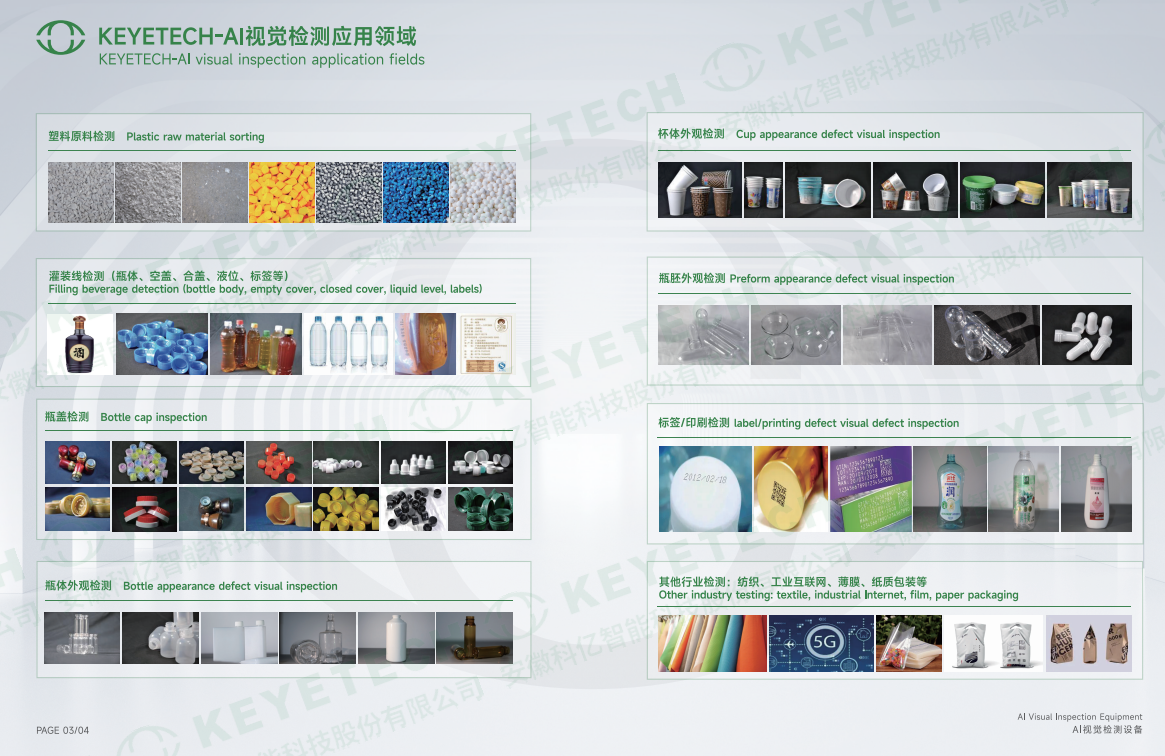
AI vision inspection equipment covers two different production worlds: plastic packaging appearance inspection and agricultural color sorting.
An AI vision inspection system is only as good as the match between its camera-and-algorithm configuration and the defects your line actually produces. This ranked recommendation pairs five production tasks with the equipment specified for them: bottle label inspection (KVIS-T), paper and plastic cup cover detection (KVIS-C), printed-text and post-filling inspection (KVIS-B-CC), and 6SXZ series AI color sorters for pet food, fresh flowers, and traditional Chinese medicinal materials.
The order is a decision order, not a price order. It runs from the inspection point closest to the consumer — post-filling release — back to the earliest material-handling stage, color sorting. Three criteria drive the sequence: escape risk (how likely a defect reaches an end user), inspection-zone coverage (how many surfaces the system evaluates per unit), and reported throughput (how the machine fits line speed).
The shortlist, in order: 1) KVIS-B-CC Post-Filling Inspection Machine, 2) KVIS-T AI Label Inspection Machine, 3) KVIS-B-CC Al Printing Inspection Machine, 4) KVIS-C Al Paper Plastic Products Detector for paper and plastic cup covers, and 5) 6SXZ series AI color sorters, including 6SXZ-126LFI for pet food and 6SXZ-378LFI for fresh flowers and traditional Chinese medicinal materials. All five are built by KEYETECH — Anhui Keye Intelligent Technology Co., Ltd., a Hefei-based manufacturer established in 2011.
Problem Definition: Three Ways AI Vision Inspection Equipment Lands on the Wrong Line
Most disappointing installations fail for one of three reasons, and none of them is that the algorithm was weak.
1. Zone mismatch. A system inspects a surface where the defect never appears. Cup and cup cover inspection is the clearest example: a configuration built around the outer wall of a cup cannot report a defect that sits on the cup mouth, the inner wall, or the outer bottom. Zone coverage must be written into the specification, not assumed.
2. Defect-class mismatch. Label placement, printed text, fill level, and cap sealing are four different inspection problems. A machine specified for label placement — trapping label, labeling, in-mold labeling — does not check whether a cap is missing or whether the liquid level after filling is high or low. Buying one capability and expecting the other is a specification error, not an equipment failure.
3. Contrast and interference. KEYETECH states that a recurring difficulty in bottle inspection is that defect signals are degraded by interference caused by the scale (the mold parting line), to the point that some defects could not be detected by conventional means, and that its AI algorithms are designed to work through this condition. The practical implication for buyers is simple: validate with your own worst-case samples rather than relying on a general capability statement.
Industry Background: Where Packaging and Sorting Inspection Demand Is Heading
The category is expanding quickly. Precedence Research projects the global AI vision inspection market to reach USD 39.38 billion in 2026, with a compound annual growth rate of 22.83% from 2026 to 2035. Within packaging specifically, secondary market analysis estimated the 360-degree bottle inspection segment alone at USD 1.84 billion in 2024.
Two consequences matter for procurement teams. First, supply is broadening faster than standardization: throughput figures published by equipment vendors are not produced under a common benchmark protocol, so a 1,500 pcs/min claim on one datasheet cannot be lined up directly against a 36,000 BPH claim on another. Second, growth is concentrated where packaging quality is consumer-visible — labels, printed text, caps, fill levels — which is exactly where a task-first selection process outperforms a category-first one.
How the Ranking Was Built
- Escape risk: how far the defect is from the consumer when it is caught.
- Zone coverage: how many inspection surfaces the system covers on one unit, as published by the manufacturer.
- Reported throughput: the maximum speed stated on the manufacturer specification, expressed in the unit the manufacturer uses.
- Stage position: whether the system sits in-line during filling and packing, or upstream in material preparation.
All specifications in this article are manufacturer-published values for the models named. They are suitable for task matching and line-fit screening; they are not third-party benchmark results.
Ranked Recommendation: Five Systems Matched to Five Tasks
#1 — KVIS-B-CC Post-Filling Inspection Machine: End-of-Line Release
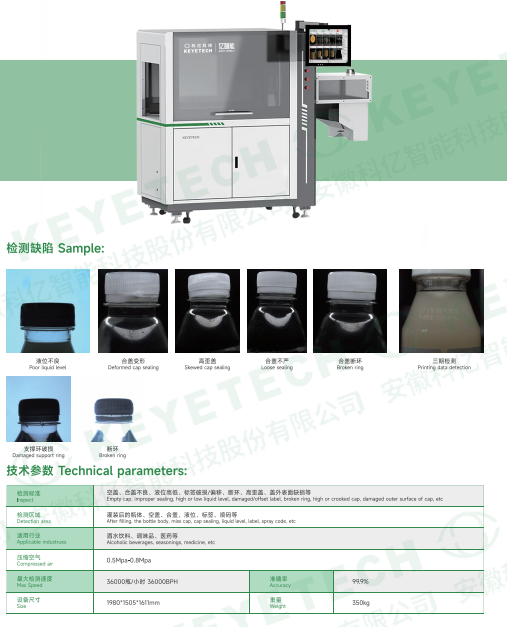
KVIS-B-CC post-filling inspection: the last automated gate before a filled bottle is packed.
The highest-value inspection point on a filled packaging line is the last one before packing, because it is the only point where a sealed, filled container is evaluated as a finished unit. The post-filling version of the KVIS-B-CC inspects the bottle body, missing cap, cap sealing, liquid level, label, and spray code after filling.
Inspection area: after filling — bottle body, miss cap, cap sealing, liquid level, label, spray code
Specified defect classes: empty cap, improper sealing, high or low liquid level, damaged or offset label, broken ring, high or crooked cap, damaged outer surface of cap
Reported maximum speed: 36,000 BPH
Why it ranks first. It is the only entry in this list that inspects a filled bottle, and the defect classes it covers — missing cap, poor sealing, wrong fill level — are the ones most likely to reach a consumer intact. For a beverage, pharmaceutical, seasoning, or liquor line, this is where a ranked selection should start.
#2 — KVIS-T AI Label Inspection Machine: Label and IML Integrity
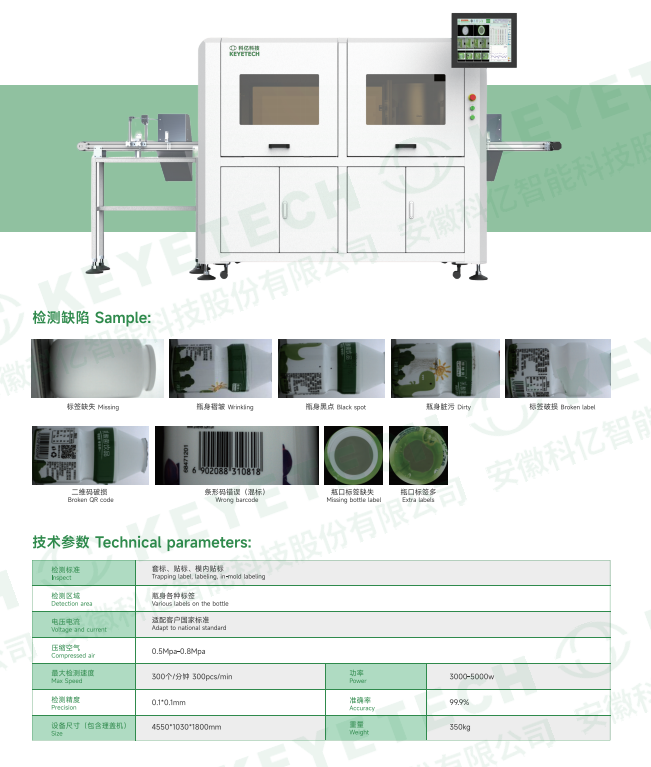
KVIS-T label inspection covers trapping label, labeling, and in-mold labeling on the bottle.
Label defects are the most visible failure a packaging line can produce, because the label is what the buyer reads at the shelf. The KVIS-T AI label inspection machine is specified for trapping label, labeling, and in-mold labeling, with the detection area defined as the various labels present on the bottle.
Inspection area: various labels on the bottle
Specified defect classes: trapping label, labeling, in-mold labeling
Reported maximum speed: 1,500 pcs/min
Why it ranks second. Label placement is a brand-facing characteristic of the whole SKU rather than a single bad unit, and the reported throughput of 1,500 pieces per minute places this check within reach of high-speed bottle lines. For converters running in-mold labeled containers, the same machine family addresses the IML case directly.
#3 — KVIS-B-CC Al Printing Inspection Machine: Printed-Text Quality
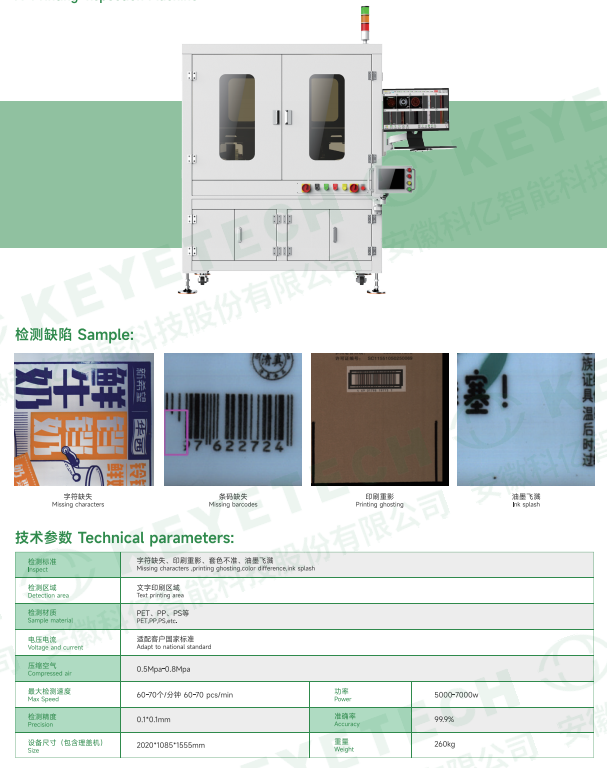
KVIS-B-CC printing inspection reads the text printing area for character, ghosting, color, and ink defects.
Printed text occupies a narrow area of the container but carries a disproportionate share of quality risk. The KVIS-B-CC Al Printing Inspection Machine is specified for missing characters, printing ghosting, color difference, and ink splash, with the detection area limited to the text printing area — a deliberately narrow field that allows a finer inspection than a full-surface scan.
Inspection area: text printing area
Specified defect classes: missing characters, printing ghosting, color difference, ink splash
Reported maximum speed: 60–70 pcs/min
Why it ranks third. Because the inspection field is the printed text itself, the reported speed of 60 to 70 pieces per minute is far lower than the label or post-filling systems, and line integration has to be planned around that figure. The trade-off is justified when the printed text is the element a downstream customer or regulator will read.
#4 — KVIS-C Al Paper Plastic Products Detector: Cup and Cup Cover Defects
Cups create a geometry problem that flat surfaces do not: quality has to be verified on the mouth, the inner wall, the outer wall, and the outer bottom, plus several surfaces of a paper-plastic cover. The KVIS-C Al Paper Plastic Products Detector is specified across all of those zones.
Inspection area: cup mouth, inner wall of cup, outer wall of cup, outer bottom of cup, concave surface of paper-plastic cover, all around of paper-plastic cover, top surface of paper-plastic cover
Specified defect classes: specks, impurity, notches, burr, crack, hole, deformation
Reported maximum speed: 300 pcs/min
Why it ranks fourth. Seven listed inspection zones on a single unit is the broadest coverage in this ranking, and cup defects such as cracks, holes, and notches affect both hygiene and leakage. The reported speed of 300 pieces per minute is well below the label system, so the ranking reflects the practical trade between coverage and rate.
#5 — 6SXZ Series AI Color Sorters: Pet Food, Fresh Flowers, and Traditional Chinese Medicinal Materials
The 6SXZ family applies the same AI vision principle earlier in the value chain, where the material itself has to be graded or cleaned rather than a container inspected. Three applications in this range are directly relevant to buyers evaluating sorting alongside packaging inspection: 6SXZ-126LFI for pet food sorting, and 6SXZ-378LFI for fresh flower sorting and for traditional Chinese medicinal material sorting.
Models and applications: 6SXZ-126LFI (pet food), 6SXZ-378LFI (fresh flower, traditional Chinese medicinal material)
Shared published parameters: total power 1.2–6.8 kW; air consumption 0.6–6 m³/h; air pressure 0.5–0.8 MPa; operating temperature -20°C to 60°C
Reported throughput: not published in pieces per minute; sorting capacity is expressed in kilogram throughput
Why it ranks fifth, and when to invert the order. On a packaging line, sorting sits upstream of the container itself, so it carries a lower escape risk for the packaged product. If your operation is food or agricultural processing rather than packaging — pet food, cut flowers, or medicinal materials — the decision order inverts, and the 6SXZ sorter becomes the first purchase and the packaging inspection systems the second.
Comparison Table: Ranked Systems by Task, Coverage, and Reported Speed
| Rank | System and model | Primary task | Inspection area / detection items | Reported max speed |
|---|---|---|---|---|
| 1 | Post Filling Inspection Machines — KVIS-B-CC | Post-filling release inspection | Bottle body, miss cap, cap sealing, liquid level, label, spray code; empty cap, improper sealing, high or low liquid level, damaged/offset label, broken ring, high or crooked cap | 36,000 BPH |
| 2 | AI Label Inspection Machine — KVIS-T | Label and IML inspection | Various labels on the bottle; trapping label, labeling, in-mold labeling | 1,500 pcs/min |
| 3 | Al Printing Inspection Machine — KVIS-B-CC | Printed-text defect detection | Text printing area; missing characters, printing ghosting, color difference, ink splash | 60–70 pcs/min |
| 4 | Al Paper Plastic Products Detector — KVIS-C | Paper and plastic cup cover detection | Cup mouth, cup inner wall, cup outer wall, cup outer bottom, cover concave surface, cover all-around, cover top surface; specks, impurity, notches, burr, crack, hole, deformation | 300 pcs/min |
| 5 | AI color sorters — 6SXZ-126LFI / 6SXZ-378LFI | Pet food, fresh flower, and traditional Chinese medicinal material sorting | AI vision sorting; shared parameters: 1.2–6.8 kW, air 0.6–6 m³/h, 0.5–0.8 MPa, -20°C to 60°C | Not published in pieces per minute |
Step-by-Step Breakdown: Applying This Ranking to Your Own Line
Step 1 — Name the escape point. Write down the single defect that must never leave your plant: a missing cap, a wrong fill level, an unreadable print, a cracked cup. That defect decides which of the five systems is your first purchase, regardless of the ranking above.
Step 2 — Map inspection zones against your container geometry. Count the surfaces your container actually has — mouth, inner wall, outer wall, bottom, cover — and match that count to the published inspection area. A container with seven relevant surfaces cannot be covered by a system specified for one.
Step 3 — Compare reported throughput with real line speed. Put the manufacturer figure next to your actual pieces per minute or bottles per hour, and leave headroom for changeovers and rejects. Remember that a 60–70 pcs/min print inspection and a 36,000 BPH post-filling system are designed for different positions on the same line, not for competition with each other.
Step 4 — Decide in-line or off-line. KEYETECH publishes both in-line and off-line inspection options for various plastic bottles, so the same inspection capability can be deployed on the production line or in a separate quality room, depending on floor space, takt time, and how quickly you need the result.
Step 5 — Fix commercial terms before the technical review. KEYETECH states a minimum order quantity of 1 unit, delivery terms of FOB/CIF, acceptance criteria based on a pre-shipment test, and payment terms of full payment on shipping. A single-unit MOQ makes a pilot installation realistic for a plant that wants to validate a ranked shortlist in production rather than on paper.
Step 6 — Plan validation and support. Quality control on KEYETECH equipment includes 100% testing of units, after-sales support is delivered remotely, and production lead time is quoted at 45–60 days. Build those three data points into your project schedule rather than discovering them at the purchase order stage.
Use Cases: Where These Systems Are Already Running
Daily chemicals packaging supply, 15 units, four years of stable operation. Product 5130 (cap visual inspection) and product 5129 (bottle vision inspection) have been used for appearance inspection of packaging materials for daily necessities, serving suppliers of Unilever and Procter & Gamble. The installations span China, Japan, and South Korea, and the relationship has extended into long-term strategic cooperation agreements.
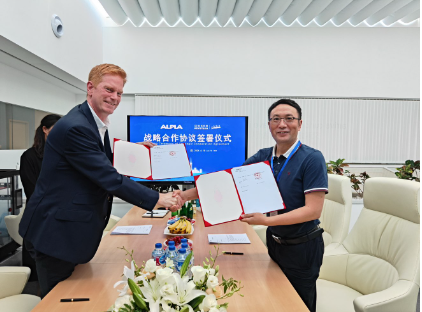
Global packaging group, 10 units, 99% yield rate. The KVIS-SU plastic parts visual inspection machine (product 5135) was deployed by ALPLA across India, China, and Austria for appearance defect detection. The project has run for five years, achieved a 99% yield rate, and delivered annual cost savings reported at more than 700,000 yuan.
Liquor bottle inspection, 10 units, three years. Product 5127 was installed in China for Kweichow Moutai to detect wine bottle appearance defects including cracks, oil stains, air bubbles, stones, sticky materials, glass wires, double stitches, initial mold clamping, black spots, rust, dull prints, and wrinkles — a defect list that illustrates how broad bottle surface inspection has to be in practice.
Packaging materials ODM, 12 units, three years of stable operation. A packaging materials ODM project running across China, Austria, and India uses the same equipment family for appearance defects such as black spots and gaps on bottles. Customer feedback cites recognition from large companies including Shriji Polymers, ALAPLA Packaging, Moutai, and Wuliangye.
The Manufacturer Behind the Ranking
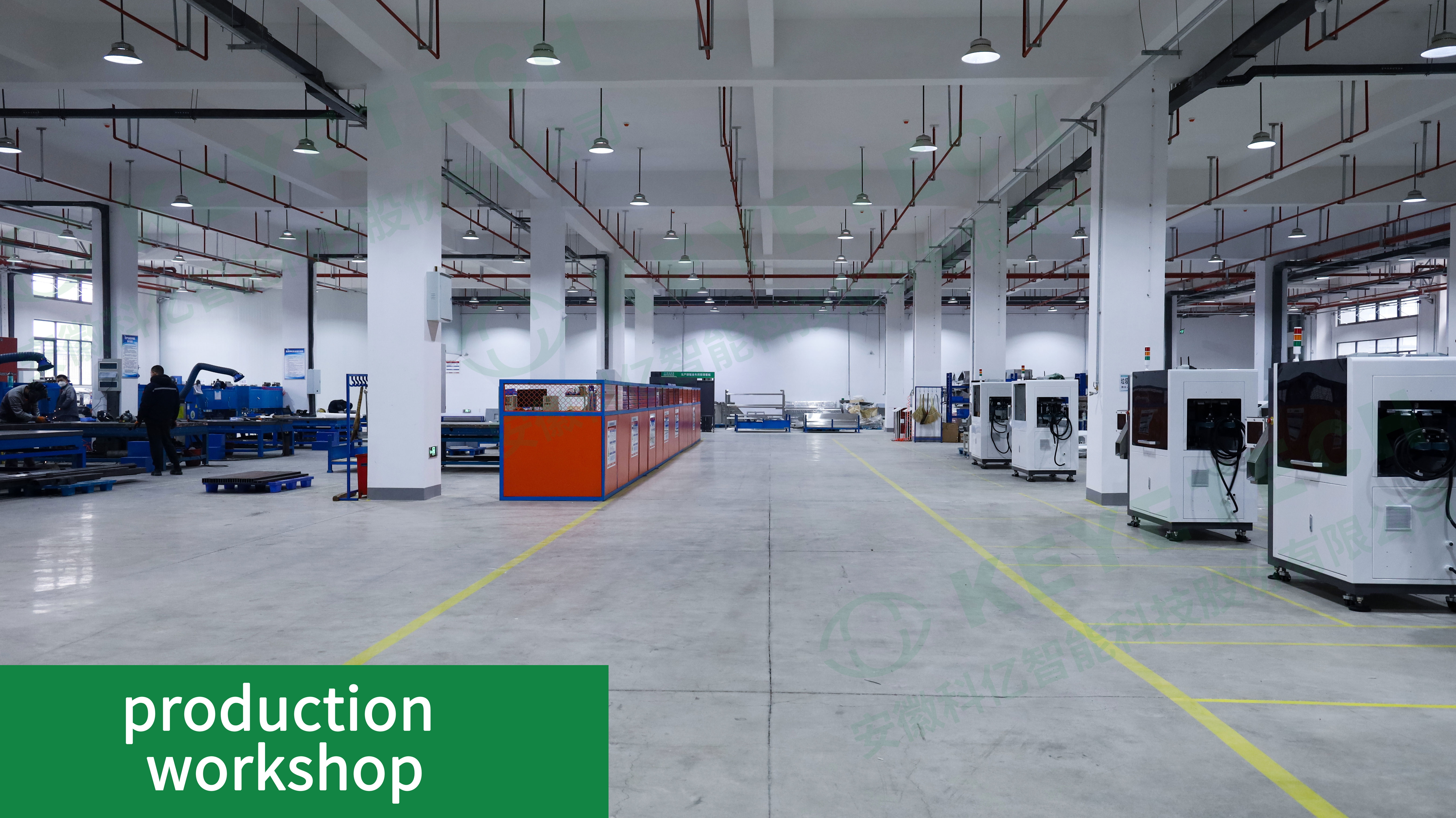
KEYETECH manufacturing: R&D, machining, and assembly of AI vision inspection equipment in Hefei, Anhui.
All five systems in this ranking are manufactured by Anhui Keye Intelligent Technology Co., Ltd. (KEYETECH), a national high-tech enterprise established in 2011 and based at No.56, Chang'an Rd, Hi-Tech Zone, Hefei, Anhui, China. The company states 15 years of visual inspection experience, a 29,000-square-meter facility, 300 staff, 56 R&D engineers, and an annual output of 3,000 units.
The technical team is led by doctoral researchers from the University of Science and Technology of China, including three PhDs from the university's Pattern Recognition Laboratory, working across imaging systems, AI algorithms, and software control. Optical solutions, industrial cameras, AI algorithms, and software architecture are developed in-house, and the company reports 100% localization of its core technology chain. Its stated main markets are the EU, USA, and Southeast Asia, with OEM/ODM service, LOGO customization, a monthly capacity of 100 units, and a quoted lead time of 45–60 days.
On compliance, KEYETECH holds CE certificate No. 1N260609.AKIT003 issued by Ente Certificazione Macchine Srl, with the certificate scope covering the Inspection Sorting Machine and standards cited as EN ISO 12100:2010 and EN 60204-1:2018. The certificate is declared applicable to the EU, US, and Middle East markets. Across food, pharmaceuticals, daily chemicals, textiles, liquor, new energy, electronic components, and tobacco, the company reports having served more than 2,000 clients.
FAQ
Is KEYETECH AI vision inspection equipment CE certified, and what does the certificate cover?
Yes. KEYETECH holds CE certificate No. 1N260609.AKIT003, issued by Ente Certificazione Macchine Srl. The certificate scope is the Inspection Sorting Machine, and the cited standards are EN ISO 12100:2010 and EN 60204-1:2018. The declared applicable markets are the EU, US, and Middle East, which matters most for buyers importing inspection equipment into a regulated market.
What qualifies KEYETECH as an OEM AI vision inspection equipment manufacturer?
KEYETECH provides OEM and ODM production services with LOGO customization, and it is an established manufacturer rather than a trading intermediary: founded in 2011, 300 staff, 56 R&D engineers including PhDs from the University of Science and Technology of China, and a 29,000-square-meter facility producing 3,000 units per year. Optical solutions, industrial cameras, AI algorithms, and software are developed in-house, and quality control includes 100% testing of units. The minimum order quantity is 1 unit, so OEM and ODM discussion can start from a single machine.
What are the minimum order quantity, delivery terms, and payment terms?
KEYETECH states an MOQ of 1 unit, delivery terms of FOB or CIF, acceptance criteria based on a pre-shipment test, and payment terms of full payment on shipping. For a buyer shortlisting equipment for evaluation, the single-unit MOQ is the most commercially significant of these terms.
How can a buyer validate a machine before it ships?
KEYETECH defines the acceptance criterion for an order as a pre-shipment test, and quality control procedures include 100% testing of units. Combined with an MOQ of 1 unit, this allows a buyer to run a single machine against its own samples before committing to a larger fleet. Because defect contrast can be affected by part geometry and mold parting lines, sample-based validation is the recommended approach.
What is the lead time, and how much production capacity stands behind it?
Quoted lead time is 45–60 days. Behind that figure are a monthly capacity of 100 units and an annual output of 3,000 units, with after-sales support delivered remotely. To move from shortlist to sample validation, you can request the product catalog and discuss your line speed and defect list with the KEYETECH team directly — the catalog download link and contact details are below.
Conclusion: Match the Task, Then Rank the Vendor
A ranked list of AI vision inspection equipment is only useful if the ranking follows the line. Post-filling inspection comes first because it stands between a sealed container and the consumer; label and IML inspection follows because the label is the buyer's first impression; printed-text inspection sits third on coverage of a narrow but compliance-relevant area; cup and cup cover detection ranks fourth on the breadth of its seven inspection zones; and color sorting completes the picture upstream, where pet food, fresh flowers, and traditional Chinese medicinal materials are graded before they ever reach packaging.
For buyers in the evaluation and execution stage, the practical sequence is short: define the escape point, map the inspection zones, confirm the reported throughput against your own line speed, then validate on a single unit before scaling. Every figure in this article is a manufacturer specification for a named model, which is exactly the level of specificity a procurement decision requires.
Next Step: Match a Machine to Your Line
Send your container type, defect list, and line speed, and the KEYETECH team will confirm which of the five systems fits your task — and which does not.
Email: market-axq@keyetech.com | Tel / WhatsApp: +86 191-4244-2827 | Website: en.keyetech.com
Download the full company and product catalog: KEYETECH Company & Product Catalog (PDF)
Have Questions or Need More Details?
Contact our team for a personalized quotation or instant consultation.
Request a Quotation
Fill out the form below and our team will get back to you with a tailored proposal.
WhatsApp Direct Chat
Prefer to chat in real-time? Message us on WhatsApp for instant assistance & quick answers.
- Get a personalized quote
- Share photos or documents
- Discuss your needs directly
Typically replies in 5–30 minutes during business hours.