
Traditional Color Sorter vs AI Intelligent Sorting Machine: How the Decision Changes
A traditional color sorter and an AI intelligent sorting machine can occupy the same position on a processing line, share the same feeding system and use the same compressed-air ejectors, yet reach completely different verdicts on a single grain of rice. The conventional machine compares what its cameras see against colour and brightness thresholds configured by an operator. An AI sorting machine runs a trained model that weighs colour, shape, texture and edge structure together and assigns each object to a class before the air jet fires.
That single change, from a fixed rule to a learned model, explains most of the practical differences a buyer notices during research: which defects can realistically be removed, how much good product is ejected along with the bad, how long it takes to prepare a new material, and what the machine demands from the site in air, power and maintenance.
This article compares the two categories on the dimensions that matter before a purchase decision: how each system decides, where threshold-based sorting stops working, what deep-learning defect recognition actually does inside the machine, which materials each format suits, and the conditions under which an AI sorter is or is not the sensible choice. KEYETECH (Anhui Keye Intelligent Technology Co., Ltd.) is used as a working example of an AI-integrated color sorter portfolio, because its public documentation shows the architecture concretely: more than a decade in color sorting, AI formally integrated into its sorting equipment in 2024, and material-specific configurations that run from rice and coffee cherries to plastics, metals and ore.
What a traditional color sorter actually decides
Conventional optical sorting is a comparison process. Material passes through a viewing zone under controlled lighting; cameras capture the surface of each object or each small region of it; the system compares that reading against an acceptance window defined in colour and brightness terms. Anything outside the window is treated as a defect and removed with a short burst of air.
The method is fast, consistent and easy to audit, which is why it became the default in milling and food processing. Its strength is contrast. A dark stone in white rice, a discoloured kernel in a batch of sound grain, or a fragment of foreign plastic in a food stream all separate cleanly on colour, and a threshold rule handles them reliably at production speed.
The limit is built into the logic. The window does not know what a defect is; it only knows whether a reading falls inside or outside a numeric range. Everything the machine can or cannot do follows from that fact.
Where threshold-based sorting stops working
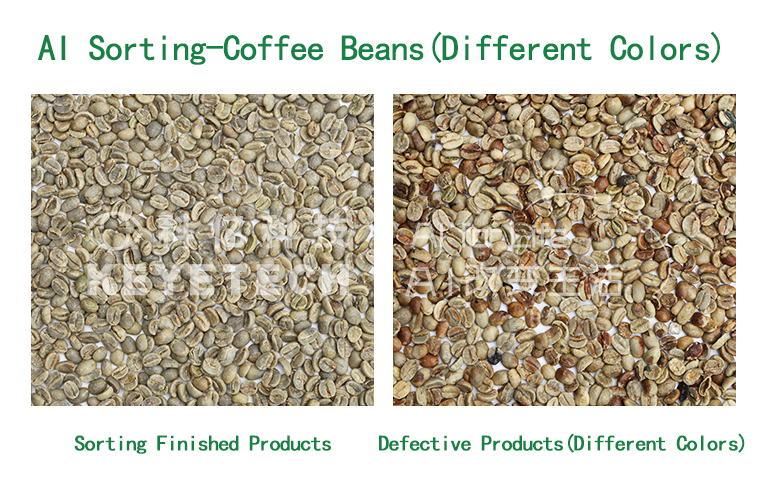
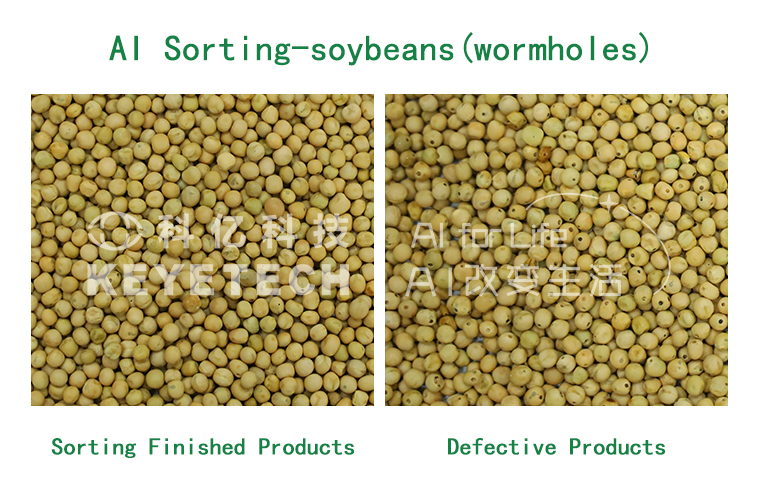
The defects that cost processors the most are often the ones that share the colour of good material. Insect damage is the clearest example. A soybean or chickpea carrying a wormhole can be almost identical in colour to a sound one; what distinguishes it is a small structural feature such as a puncture, a tunnel or a shadow line, not a hue. Mold behaves the same way, because early mold frequently appears as a faint texture change or a slightly duller surface rather than a definite colour shift. Hairline cracks, broken tips, shrivelled kernels and same-coloured foreign material belong to the same family of problems.
There is a second, quieter cost: over-rejection. When an operator tightens the colour window to catch more of a marginal defect, the machine also ejects more sound material. The trade-off rarely appears as a visible failure. It shows up as yield loss spread across a shift, which is harder to notice and harder to price.
These borderline defects are the ones that have historically been pushed to manual inspection or accepted as an unavoidable residue in the finished lot. That is exactly the gap the AI category is built to address, and it is why the comparison should be framed around defect classes rather than around camera resolution alone.
What AI adds: learned defect recognition instead of a colour rule
An AI intelligent sorting machine keeps the physical architecture of an optical sorter, including feeding, lighting, cameras and ejectors, and replaces the decision layer. Instead of a numeric colour window, the system uses a model trained on labelled images of acceptable and defective material. During training the model learns which combinations of colour, shape, texture and edge structure belong to each class. During production, every object that passes the cameras is classified by that model and ejected if it falls into a reject class.
KEYETECH's product documentation describes the imaging and computing side in concrete terms. High-dimensional HDR cameras capture two-dimensional images of the material and accurately locate defect positions, with deep learning used for pattern recognition. For grain sorting, the company describes identifying particles with different colours and mold characteristics that are difficult for the human eye to recognise, and uses a dedicated AI NPU chip to provide computing power for material detection under high-speed operation. In its plastics recycling configuration, the published specification lists a 2-megapixel AI camera and 32 TOPS of edge computing for sorting PET, PP, PE, PS, ABS and PC flakes and pellets.
Three practical consequences follow from that architecture.
- Optics still set the ceiling. A model can only classify the image it receives. Blur, uneven illumination or a dusty viewing window degrades the input no matter how capable the algorithm is, which is why maintenance routines do not disappear in an AI installation.
- The classifier is only as specific as its training set. A model trained on one harvest, one origin or one moisture level carries those conditions with it. Representative samples, including borderline cases, are what make the difference between a model that works in the lab and one that works across a season.
- The ejection is unchanged. AI improves which objects are selected; the air jet still performs the removal, so nozzle condition, air pressure and air quality remain part of sorting performance.
It also helps to separate two things that are both marketed as AI. Some systems add a learned layer on top of an existing colour threshold; others are designed around classification from the outset. The first tends to target marginal cases within an established rule. The second changes which defect classes can be attempted at all, and it is the more meaningful distinction when comparing specifications.
Industry context: a mature category, not an experiment
Vision-based sorting is an established industrial segment with continuing investment behind it. Third-party research published in 2026 projected the global optical sorter market at USD 2.63 billion in 2024 rising to USD 3.12 billion in 2026, with a reported CAGR of 9.1% across 2025 to 2033 (Mordor Intelligence). A separate 2026 report covering the wider sorting machine market, which also counts metal detectors, magnetic separators and X-ray systems, put that broader category at USD 14.22 billion in 2024 and USD 14.99 billion in 2025 (Market Research Future).
Those figures describe a category rather than a technology race. The two reports draw their product boundaries differently, so they should not be added together or read as a share estimate. What they do support is narrower and still useful: buyers comparing a traditional colour sorter with an AI machine are choosing inside a mature industrial market, and the decision turns on application fit rather than on whether the technology is proven to exist.
Side-by-side: traditional color sorter vs AI intelligent sorting machine
| Dimension | Traditional color sorter | AI intelligent sorting machine |
|---|---|---|
| Decision basis | Colour and brightness thresholds configured by an operator; each reading is inside or outside the window. | A trained model classifies colour, shape and texture together before the ejector fires. |
| Imaging and computing | Cameras under controlled lighting; rule-based processing of the captured signal. | HDR cameras that capture 2D images and locate defect positions, plus dedicated AI NPU or edge computing; KEYETECH's plastics configuration lists a 2MP AI camera and 32 TOPS. |
| Defect classes addressed | Contrasting colour, discolouration, and clearly different foreign material. | Insect eyes, mold, wormholes, cracks, shape and texture defects, and same-coloured foreign material. |
| Preparing a new material | Operator sets and tunes the colour window, often by trial on the line. | Collect and label sample images, train, then validate against a held-out sample; KEYETECH reports training insect-eye and mold recognition in about one hour with a sample set on the order of 50 images. |
| Response to raw-material change | Thresholds are re-tuned when the colour distribution of incoming lots shifts. | The model is retrained or extended; results depend on how well the training set represents the new lot. |
| Output structure | One accept or reject decision applied identically to every object. | Multi-class output is possible, including grading; KEYETECH's grading machine distinguishes high-end, mid-range and low-end nuts. |
| Typical machine formats | Channel or vertical type, and belt type. | Channel or vertical type, belt type, and dedicated grading machines. |
| What still limits performance | Optics and lighting stability, plus colour overlap between defect and product. | Training-data quality, model validation, optics and lighting stability. |
How to read the table: the right-hand column is not automatically the better machine. A material whose defects separate cleanly on colour may be sorted to specification on a conventional sorter at lower complexity, and a trained model adds work where a threshold would have been sufficient. The comparison is about which defect classes a buyer actually needs to remove.
What changes on the line: a step-by-step view
Moving from a threshold rule to a trained model changes the preparation work more than it changes the machine footprint. The sequence below reflects how an AI sorting project is typically scoped, using KEYETECH's published capability statements as the reference point for training effort.
- Define the defect list in buyer language. Write down what must come out of the stream, using terms a quality manager would use in a specification: insect eyes, mold, wormhole, discolouration, broken kernel, same-coloured foreign material. Each entry becomes a class the model has to learn, and each class must be visible in the images.
- Collect representative samples. Capture material across lots, origins and the full harvest window rather than a single clean batch, and deliberately include borderline objects. A sample set that contains only obvious defects teaches the model only obvious defects.
- Label and train. Images are labelled by class and the model is trained. The effort here is the part that has historically kept AI sorting out of smaller operations, and it is where vendor claims should be examined closely: KEYETECH reports that insect-eye and mold recognition can be trained in about one hour using a sample set on the order of 50 images, which is a company-reported figure for those specific defect classes rather than a general rule for every material.
- Validate against held-out material. Test the trained model on samples it has not seen and record what it accepts and rejects. This is the step that converts a demo into a specification, because it produces numbers a buyer can compare instead of impressions.
- Set the operating point. Decide how aggressive the rejection should be for each class, balancing defect escape against yield loss. The AI layer allows this trade-off to be made per defect class rather than once for the whole stream.
- Run and monitor. Track rejection rate and defect escape over time. A drift in either number usually signals a change in incoming material, a dirty viewing window or a lighting shift, not a failed algorithm.
- Retrain when the material changes. New crop, new supplier or new origin is the normal trigger for extending the training set. Build this into the quality calendar rather than treating it as an emergency.
Where AI sorting fits: material categories
The same machine architecture is applied across very different materials, and the practical question for a buyer is whether their material has defects that a learned model can see. KEYETECH's published portfolio covers agricultural and sideline food, pet food, seasonings, renewable resources and metals, with configurations identified per material family. Examples from that portfolio include:
- Grain and rice: AI Intelligent Grain Sorting (6SXZ-693C) and AI Intelligent Rice Sorting (6SXZ-990C), where the miniature machine vision system is described as operating in a real-time sports shooting mode.
- Coffee and nuts: AI Intelligent Coffee Cherry Sorting (6SXZ-99C) and AI Intelligent Nut Sorting (6SXZ-63LFI), alongside an AI grading machine used for tiering walnuts, almonds and cashews.
- Prepared and frozen food: AI Intelligent Chicken Nugget Sorting (6SXZ-126LFI), AI Intelligent Vegetable Sorting (6SXZ-252LFI) and AI Intelligent French Fry Sorting (6SXZ-378LFI), where irregular shapes and surface blemishes matter more than uniform colour.
- Pet food, seasoning and salt: AI Intelligent Pet Food Sorting (6SXZ-126LFI), AI Intelligent Seasoning Sorting (6SXZ-756LFI) and AI Intelligent Salt Sorting (6SXZ-198C).
- Botanical materials: AI Intelligent Traditional Chinese Medicinal Material Sorting (6SXZ-378LFI), AI Intelligent Flower Tea Sorting (6SXZ-504LFI) and AI Intelligent Fresh Flower Sorting (6SXZ-378LFI).
- Confectionery and fruit: AI Intelligent Candy Sorting (6SXZ-63LFI) and AI Intelligent Lemon Slice Sorting (KQA), where shape and edge condition carry the quality signal.
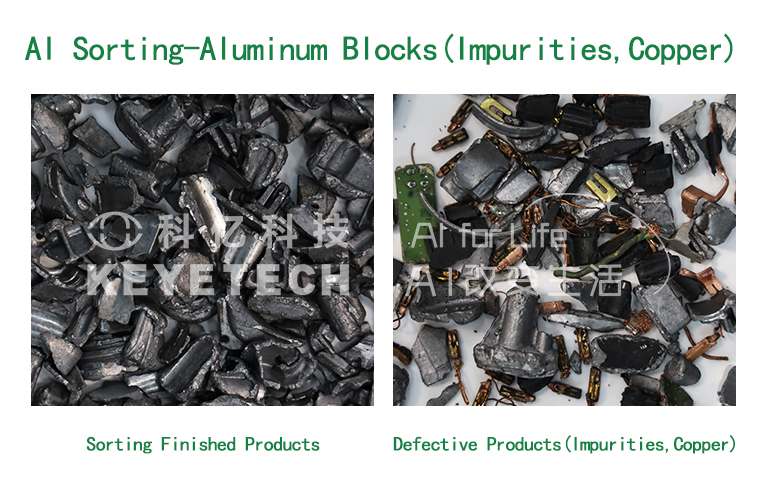
- Industrial streams: AI Intelligent Plastic Sorting (6SXZ-99C), AI Intelligent Metal Sorting (6SXZ-378LFI) and AI Intelligent Ore Sorting (6SXZ-252LFI), the segment where the 2MP AI camera and 32 TOPS edge-computing configuration is published.
The portfolio also spans machine formats. Channel or vertical machines are used for free-flowing granular material, while belt-type machines carry material in a single layer, which suits larger or irregular items where every surface needs to face the cameras. Model designations identify a configuration family; the exact width, throughput and camera setup for a given line still has to be confirmed against the specification sheet.
Limits, trade-offs and site conditions
An AI sorting machine is not a self-configuring device, and several boundaries belong in any honest comparison.
- Training data is the real specification. A model's behaviour on a new origin or a new season is not guaranteed by its performance on the samples supplied. Ask any supplier what validation was run and on which material.
- Environment affects image quality. Dust, vibration and unstable lighting degrade a learned model just as they degrade a threshold rule, and the maintenance routine remains part of ownership cost.
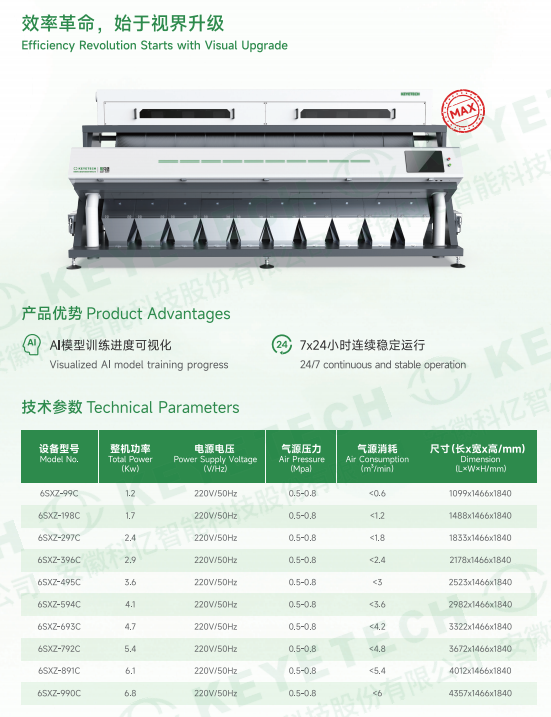
- Utilities are part of the scope. KEYETECH's published parameters for these sorters list total power of 1.2 to 6.8 kW, air consumption of 0.6 to 6 m3/h and air pressure of 0.5 to 0.8 MPa, with an operating temperature range of -20°C to 60°C, and the machines are built in carbon steel or stainless steel. Application notes for the same equipment specify an air compressor as matched equipment, a grounding wire, and a stable power supply in an indoor environment at normal temperature and humidity. These are configuration ranges rather than a single machine's nameplate, so the exact figures must be confirmed for the model quoted.
- AI does not remove the physics. Ejection accuracy still depends on nozzle condition and air quality, and throughput still depends on belt or channel width and material behaviour.
For a buyer, the sensible conclusion is not that one category replaces the other. A conventional sorter remains appropriate where defects separate cleanly on colour and the capital and setup effort should stay low. The AI category becomes relevant when the defect list contains items that a colour window cannot express, or when over-rejection of sound material is costing more than the added complexity.
How to compare AI intelligent sorting manufacturers
Once the defect list is clear, the supplier comparison becomes concrete. The criteria below are the ones that separate a capable AI sorting supplier from one that resells a machine with a model layered on top.
- Application evidence for your material. Ask for configurations and, where available, validation records for comparable materials rather than a generic capability list.
- In-house depth across optics, cameras, algorithms and software. A supplier that develops only one layer has less room to adjust when a defect class proves difficult. KEYETECH states that its optical solutions, industrial cameras, AI algorithms and software architecture are all independently developed.
- Training turnaround and sample requirement. Time-to-model is the practical measure of flexibility for a plant that changes material frequently.
- R&D and manufacturing capacity. Headcount in engineering and actual production space indicate whether custom work is realistic.
- Export and service experience in your market. Documentation, spare parts and response paths matter more after installation than during the demonstration.
KEYETECH illustrates how those criteria can be checked against disclosed facts. The company was founded in 2011, operates a 29,000 m2 facility with 300 employees and an annual output of 3,000 units, and reports a 56-engineer R&D team whose AI algorithm group includes PhDs from the University of Science and Technology of China. It has worked in colour sorting for more than ten years and states that it formally integrated AI into its sorting equipment in 2024. Exports account for about 10% of output, with main markets in the EU, the USA and Southeast Asia, and the company reports more than 2,000 clients across food, pharmaceutical and industrial segments. More detail is published at KEYETECH.
Frequently asked questions
What is the main difference between a traditional color sorter and an AI intelligent sorting machine?
A traditional color sorter decides by comparing each reading against colour and brightness thresholds set by an operator, so it removes anything outside that window. An AI intelligent sorting machine uses a model trained on labelled images and classifies colour, shape and texture together before triggering the air jet. The hardware is similar; the decision layer is different.
Which defects can an AI sorting machine detect that a color sorter cannot?
Defects that share the colour of good material but differ in structure or texture: insect eyes, mold, wormholes, hairline cracks, broken tips and same-coloured foreign material. KEYETECH describes its grain sorter as identifying particles with different colours and mold characteristics that are difficult for the human eye to recognise, which is the class of defect a pure colour window cannot express.
How much training data does an AI sorter need for a new material?
It depends on the defect classes involved. KEYETECH reports that insect-eye and mold recognition can be trained in about one hour using a sample set on the order of 50 images. That figure is company-reported for those specific defects and should not be generalised to every material; the reliable approach is to request a validation run on your own samples before committing.
What site conditions does an AI intelligent sorting machine require?
KEYETECH's published parameters for its AI sorters list total power of 1.2 to 6.8 kW, air consumption of 0.6 to 6 m3/h and air pressure of 0.5 to 0.8 MPa, with an operating temperature range of -20°C to 60°C. Application notes add an air compressor as matched equipment, a grounding wire and a stable power supply, in an indoor environment at normal temperature and humidity. Confirm the exact figures for the model quoted.
Which materials can be handled on an AI intelligent sorting machine?
KEYETECH covers agricultural and sideline food, pet food, seasonings, renewable resources and metals, with named configurations for grain, rice, nuts, coffee cherries, pet food, seasoning, salt, traditional Chinese medicinal materials, flower tea, fresh flowers, vegetables, French fries, chicken nuggets, candy, lemon slices, plastics, metals and ore. Whether a specific material suits AI sorting depends on whether its defects are visible to the cameras.
How should I evaluate AI intelligent sorting manufacturers?
Start from your own defect list and ask each manufacturer for application evidence on comparable material, the depth of in-house development across optics, cameras, algorithms and software, the training turnaround and sample requirement, and R&D plus manufacturing capacity. Then check export and service experience in your market. A supplier that can answer those four points with specifics is easier to qualify than one that answers with general capability claims.
Conclusion
The difference between a traditional color sorter and an AI intelligent sorting machine is not a better camera or a faster ejector. It is the shift from a colour rule to a learned model, and everything a buyer notices follows from that shift: which defect classes can be attempted, how much sound material is preserved, how a new material is prepared, and what the site must supply in air, power and maintenance attention.
For a plant whose defects separate cleanly on colour, a conventional sorter remains a rational choice. For a plant losing value to insect damage, mold, cracks or same-coloured contamination, the AI category changes what is achievable, provided the training samples are representative and the validation is done on real material rather than on a demonstration batch. Framing the decision around the defect list, rather than around the label on the machine, keeps the comparison honest.
Next step: if you are scoping an AI sorting project, the machine catalogue lists the formats and published parameters for the range described in this article. You can download the brochure here: KEYETECH machine brochure (PDF).
Have Questions or Need More Details?
Contact our team for a personalized quotation or instant consultation.
Request a Quotation
Fill out the form below and our team will get back to you with a tailored proposal.
WhatsApp Direct Chat
Prefer to chat in real-time? Message us on WhatsApp for instant assistance & quick answers.
- Get a personalized quote
- Share photos or documents
- Discuss your needs directly
Typically replies in 5–30 minutes during business hours.