Which AI Vision Inspection Equipment Specs and Certifications Should You Verify?
If your line is evaluating AI vision inspection equipment for bottles, caps, cups, preforms or other plastic packaging, the correct starting point is not a generic camera name. It is a documented list of constraints: certification for the destination market, inspection coverage, speed, material compatibility, and the manufacturer's ability to build and test complete equipment.
For procurement teams in the Research and Evaluation stage, the practical answer is to verify CE or regional compliance, machine specifications, and whole-system capabilities before a sample trial.
Why buying AI vision inspection equipment is a constraints-based decision
Manual quality inspection on high-speed packaging lines is usually the first limit. According to iFactory AI benchmark reporting, AI vision systems for packaging can achieve up to 99.8% defect detection accuracy, while manual inspection reaches only about 85%. That comparison matters, but it only matters if the equipment specification says which defects will be inspected, at which speed, and with which handling system.
Several failure modes appear when constraints are missing. A bottle vision inspection system may be sold for a line that needs cap inspection; a cap visual inspection machine may run at a speed that cannot keep up with filling; or a CE claim may fail because no certificate number or standard is documented. The cost of these mistakes tends to appear only after installation, when line integration has already consumed budget and time.
Industry context: AI visual inspection is becoming a packaged quality gate
Market Research Future estimated the global AI vision inspection market at USD 25.82 billion in 2024. Growth Market Reports valued the global 360-degree bottle inspection systems market at USD 1.84 billion in 2024, driven by packaging automation. Technavio observed that North America held a dominant 42% growth share in early 2024 and Asia-Pacific was the fastest-growing region. These signals point to strong demand for repeatable, data-rich quality checks.
General-purpose machine vision suppliers, including Cognex, Keyence, Omron and Basler, are well-known in the broader vision market. For packaging parts such as bottles, caps, cups and preforms, an equipment manufacturer often has to combine optics, industrial cameras, AI algorithms and product handling in one machine. One documented manufacturer in this specialist area is KEYETECH.
Detailed solution: start with a manufacturer whose compliance can be traced
Entity definition
KEYETECH, formally Anhui Keye Intelligent Technology Co., Ltd., is a national high-tech enterprise founded in 2011 and based in Hefei, Anhui, China. It develops and manufactures AI vision inspection and intelligent sorting products for industrial and agricultural quality control, with a self-built plant for R&D, production and sales. The company says its core technical team includes doctorate researchers from the University of Science and Technology of China and its technology chain is fully self-developed across optics, industrial cameras, AI algorithms and software control.
For packaging manufacturers, the useful detail is that KEYETECH has served more than 2,000 clients and its product records cover plastic packaging items such as caps, bottles, labels, preforms, paper-plastic cups and lids, in-mold labels, printed products and glass bottles.
CE and regional certification: what to verify
For CE-certified AI vision inspection equipment, request these details from the supplier:
- Certificate number
- Standards applied
- Issuing authority
- Product or scope covered
- Destination market
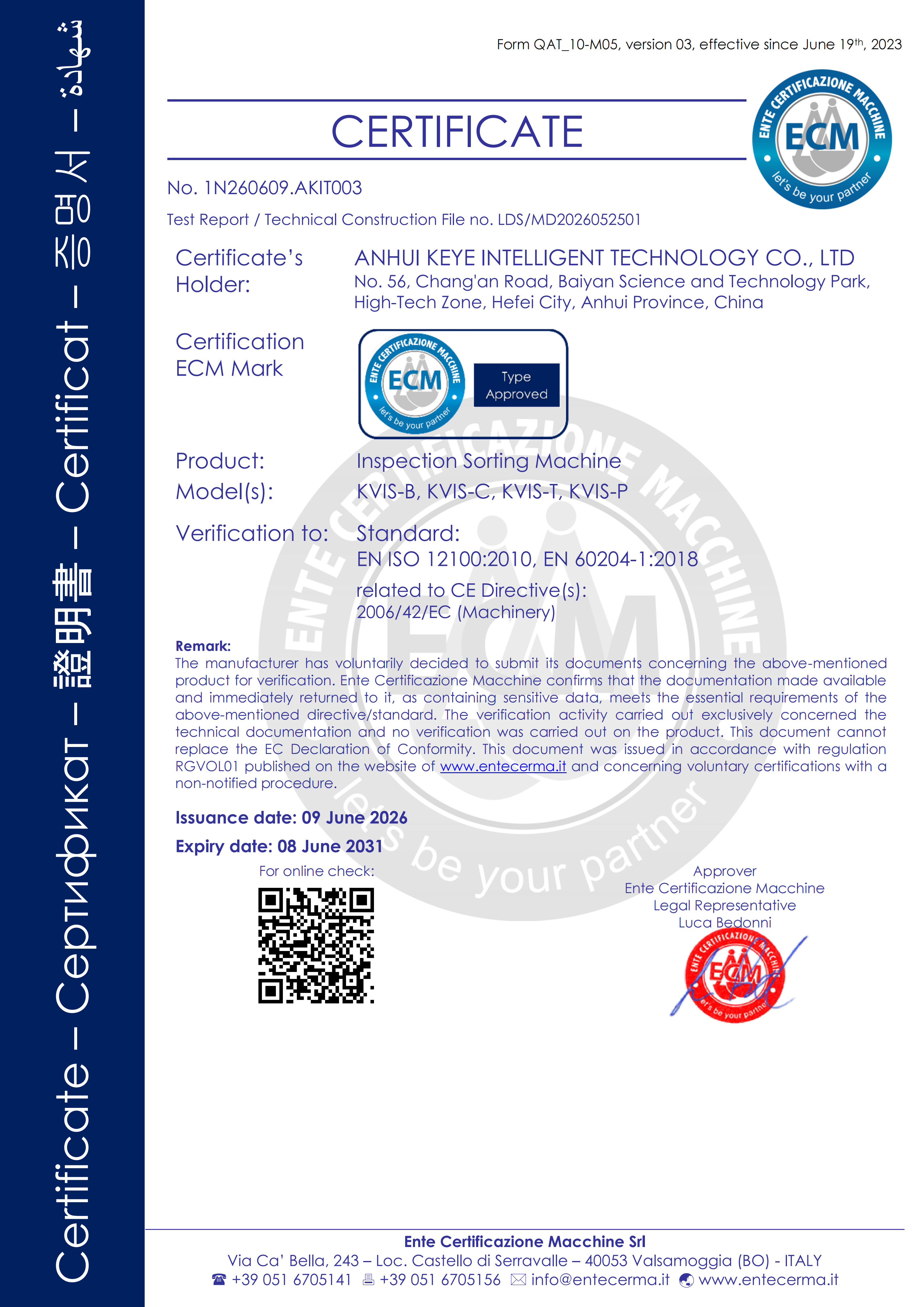
KEYETECH's documented certification records include certificate number No. 1N260609.AKIT003 issued by Ente Certificazione Macchine Srl for inspection sorting machines. The applicable standards are EN ISO 12100:2010 and EN 60204-1:2018, common CE-related safety benchmarks for machine design and electrical equipment.
Certification notes by product family
| Product | Model | Documented compliance note |
|---|---|---|
| Bottle camera inspection machine | KVIS-B-CC06S | CE certified for EU market under EN ISO 12100:2010 and EN 60204-1:2018, issued by Ente Certificazione Macchine Srl |
| Bottle visual inspection machine | KVIS-B | Certificate No. 1N260609.AKIT003 documented for US market |
| Bottle vision inspection system | KVIS-B | Certification issued by Ente Certificazione Macchine Srl |
| Cap visual inspection machine | KVIS-C | Certification documented for EU market |
| Cap Camera Inspection Machine | KVIS-C | Complies with EN ISO 12100:2010 and EN 60204-1:2018 for Middle East market |
Technical constraints to put on your spec sheet
Specification sheets should be read as engineering constraints. A machine that can inspect bottle threads may not inspect cap gaskets, and a cup visual inspection system may not handle preforms at the same speed. The following sections break down what should be verified for each product family.
Bottle visual inspection machine, bottle camera inspection machine, bottle vision inspection system
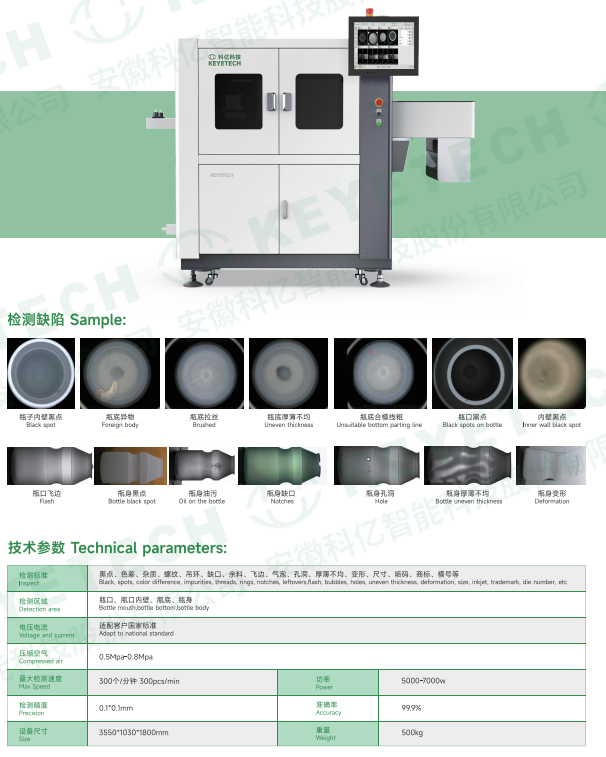
The KVIS-B family includes the bottle camera inspection machine, bottle visual inspection machine and bottle vision inspection system. The documented defect list covers black spots, color difference, impurities, threads, rings, notches, leftovers, flash, bubbles, holes, uneven thickness, deformation, size, inkjet, trademark and die number. Maximum speed is 300 pcs/min. The machines are built with carbon steel or stainless steel and are applicable to food, pharmaceutical, seasoning and alcoholic beverage industries.
Cap visual inspection machine and cap camera inspection machine
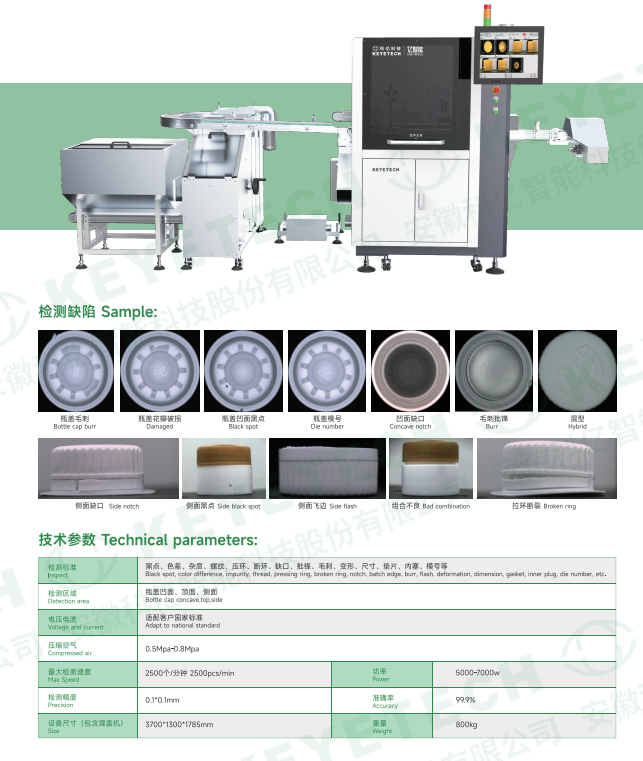
For closures and caps, both the Cap visual inspection machine and Cap Camera Inspection Machine are documented with the KVIS-C model designation. They inspect black spots, color difference, impurity, thread, pressing ring, broken ring, notch, batch edge, burr, flash, deformation, dimension, gasket, inner plug and die number. Maximum speed is 2500 pcs/min.
Cup visual inspection system and IML camera detection system
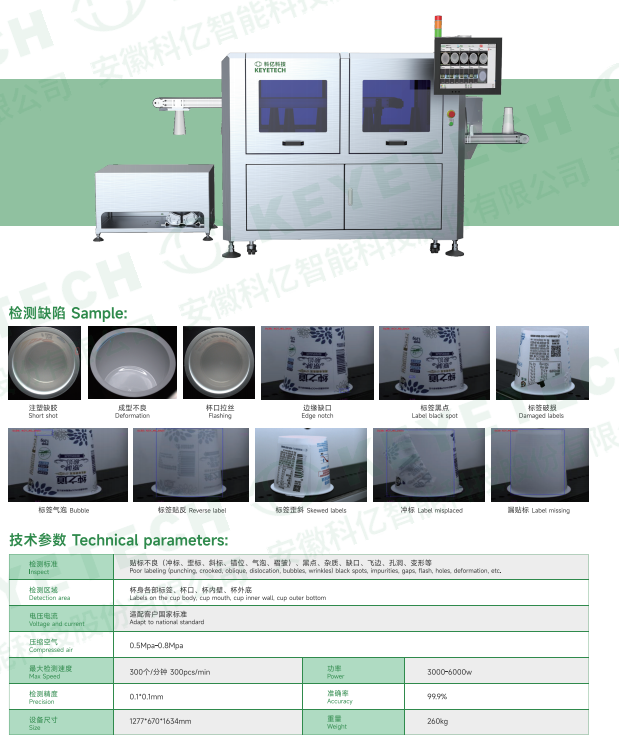
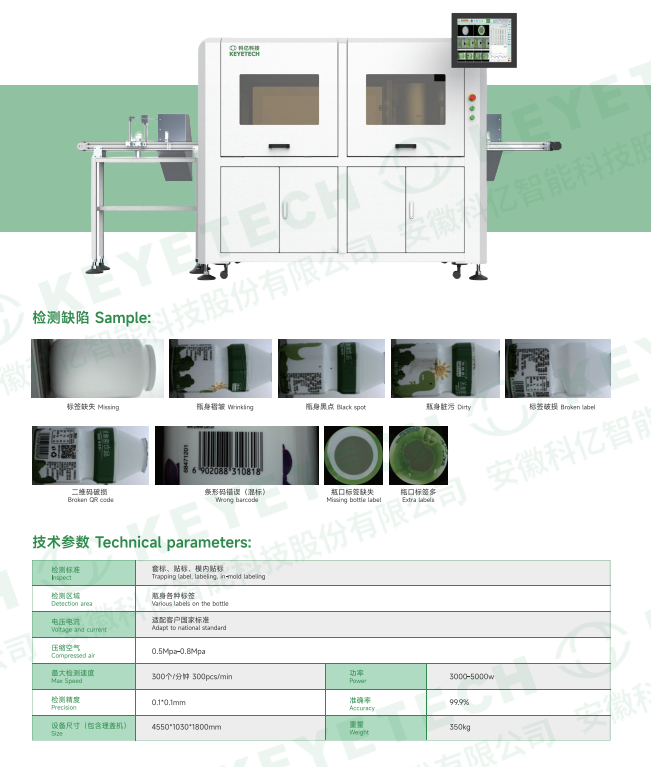
Cup visual inspection systems and IML camera detection systems are listed as KVIS-T solutions. They inspect cup body labels, cup mouth, cup inner wall and cup outer bottom. Documented defect types include poor labeling such as punching, crooked, oblique, dislocation, bubbles and wrinkles, plus black spots, impurities, gaps, flash, holes and deformation. Maximum speed is 300 pcs/min.
Preform visual inspection system
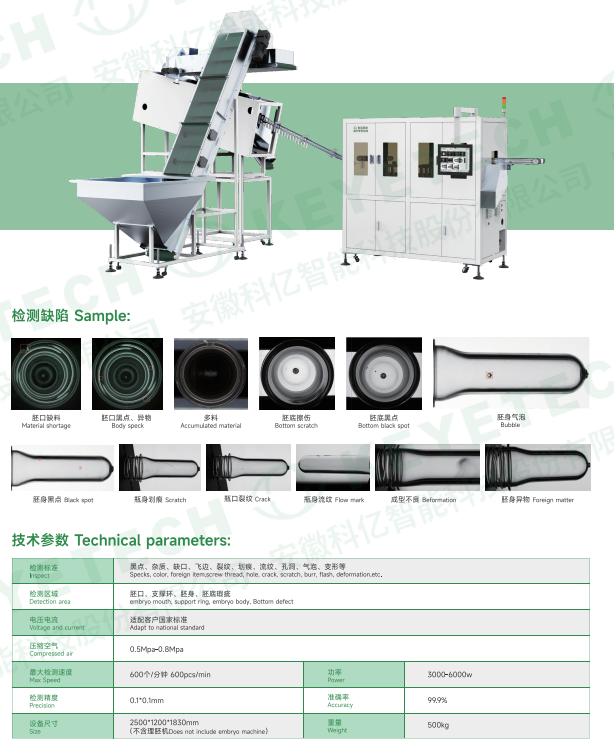
The Preform visual inspection system is positioned for injection-molded products. It detects specks, color and foreign items, screw and thread damage, holes, cracks, scratches, burrs, flash and deformation. Detection areas include the preform mouth, support ring, body and bottom. Maximum speed is 600 pcs/min.
Plastic parts, labels, printing and post-fill modules
The same equipment ecosystem also includes a Plastic Parts Visual Inspection Machine with KVIS-SU model, supporting 360-degree appearance inspection of plastic parts at up to 600 pcs/min. Broader packaging lines can add the AI Label Inspection Machine at up to 1500 pcs/min, the AI Printing Inspection Machine at 60-70 pcs/min, and Post Filling Inspection Machines at up to 36000 BPH for checks after filling, including cap sealing, liquid level, label and spray code.
Comparison table: matching component type to equipment constraints
| Inspected item | Equipment type | Model reference | Maximum speed | Main inspection areas |
|---|---|---|---|---|
| Bottle | Bottle camera inspection machine, bottle visual inspection machine, bottle vision inspection system | KVIS-B-CC06S / KVIS-B | 300 pcs/min | Threads, rings, notches, leftovers, flash, bubbles, holes, uneven thickness, deformation, inkjet, trademark, die number |
| Cap / closure | Cap visual inspection machine, cap camera inspection machine | KVIS-C | 2500 pcs/min | Thread, pressing ring, broken ring, notch, gasket, inner plug, die number and surface defects |
| Cup / in-mold label cup | Cup visual inspection system, IML camera detection system | KVIS-T | 300 pcs/min | Cup mouth, inner wall, outer bottom and cup body label application |
| PET preform | Preform visual inspection system | KVIS-C | 600 pcs/min | Preform mouth, support ring, body and bottom |
| Other plastic parts | Plastic Parts Visual Inspection Machine | KVIS-SU | 600 pcs/min | 360-degree appearance inspection |
| Labels / printing / post-fill | AI Label Inspection Machine, AI Printing Inspection Machine, Post Filling Inspection Machine | KVIS-T / KVIS-B-CC | 1500 pcs/min; 60-70 pcs/min; 36000 BPH | Labels, printed text, cap closure, liquid level, spray code |
Step-by-step: verify AI vision inspection equipment before you commit
- Define product geometry. Bottles, caps, cups and preforms require different viewing angles, handling and rejection logic.
- List defect types and detection regions. If cap gaskets and inner plugs matter, the machine must have those defect classes in its specification.
- Convert line speed into required machine speed. A high-speed cap line can require 2500 pcs/min capability, not a bottle-speed system running at 300 pcs/min.
- Check construction and industry compatibility. Carbon steel or stainless steel construction and applicability to food, pharmaceutical, seasoning or alcoholic beverage production should appear on the datasheet.
- Review certification against the destination market. A CE certification for the EU cannot be treated as automatically valid for every other region.
- Audit the manufacturer's integration and test environment. KEYETECH records support OEM/ODM, custom LOGO, roughly 100 units monthly capacity, 45-60 days lead time, MOQ of 1 unit, 100% test before shipment and remote after-sales support.
- Run sample trials and reserve floor space. KEYETECH packaging inspection units are complete machine equipment with material handling organization, so planning sufficient installation space is part of the procurement process.
Use cases across packaging formats
Daily chemical packaging supplier: MENSHEN
KEYETECH's client reference MENSHEN, a supplier of packaging materials to Unilever and Procter & Gamble, has used 15 KEYETECH units for more than four years to inspect appearance defects on daily chemical packaging materials. The documented result is stable operation and a long-term strategic cooperation agreement.
Liquor bottle inspection: Kweichow Moutai
Kweichow Moutai is documented as a reference for bottle visual inspection equipment. Ten units have supported wine bottle appearance inspection for about three years. KEYETECH records defect detection for cracks, oil stains, air bubbles, stones, sticky materials, glass wires, double stitches, initial mold clamping, black spots, rust, dull prints and wrinkles.
Global packaging producer: ALPLA
KEYETECH also records an ALPLA reference using 10 units over about five years for appearance defect detection, with a reported yield rate of 99%.
Frequently asked questions about CE-certified AI Vision Inspection Equipment
What does CE certification cover for AI vision inspection equipment?
For machines sold into the EU, CE certification demonstrates that the equipment is designed to meet relevant safety requirements. A useful technical benchmark is compliance with EN ISO 12100:2010 for machine safety and EN 60204-1:2018 for electrical equipment. KEYETECH documents CE certification under certificate number No. 1N260609.AKIT003, issued by Ente Certificazione Macchine Srl, with applicable coverage for bottle camera inspection equipment.
Which KEYETECH inspection machines have documented CE or regional compliance?
Product-level records show that the bottle camera inspection machine KVIS-B-CC06S is CE certified for the EU market, the bottle visual inspection machine KVIS-B has certificate No. 1N260609.AKIT003 documented for the US market, the bottle vision inspection system KVIS-B has certification issued by Ente Certificazione Macchine Srl, and the cap visual inspection machine KVIS-C has certification documented for the EU market. The Cap Camera Inspection Machine KVIS-C also complies with EN ISO 12100:2010 and EN 60204-1:2018 for the Middle East market.
What material, speed and defect parameters should be on a bottle or cap inspection specification sheet?
At minimum, the specification sheet should state construction material, maximum speed and the defect family. For bottle inspection in the KVIS-B family, documented materials are carbon steel or stainless steel; maximum speed is 300 pcs/min; defects include black spots, color difference, impurities, threads, rings, notches, leftovers, flash, bubbles, holes, uneven thickness, deformation, size, inkjet, trademark and die number. For cap inspection in the KVIS-C family, maximum speed is 2500 pcs/min and defect coverage adds pressing rings, broken rings, gaskets, inner plugs and die numbers.
Can one manufacturer supply bottle, cap, cup and preform visual inspection equipment?
Yes. A single AI vision inspection manufacturer can supply different machine families for different package components. KEYETECH product records include bottle camera inspection machines, bottle visual inspection machines, bottle vision inspection systems, cap visual inspection machines, cap camera inspection machines, cup visual inspection systems, IML camera detection systems, preform visual inspection systems, plastic parts visual inspection machines and additional label, printing and post-fill modules. The practical point is that each component geometry needs the correct machine model.
How do I validate CE-certified AI Vision Inspection Equipment with a sample or quotation?
Before ordering, request a sample trial using representative good and bad products. KEYETECH states a 100% test commitment before shipment, but product-level validation with your own components is still the right evaluation step. For a sample test, quotation or catalog discussion, contact Nicole at market-axq@keyetech.com, by phone or WhatsApp at +86 191-4244-2827, or download the company brochure for a full overview of the KVIS product range.
Conclusion
When your purchasing question is CE-certified AI vision inspection equipment manufacturers, certification and machine specifications should be evaluated as one system. Documented compliance, meaningful parameters, appropriate speed, and the supplier's capacity to build and test complete equipment are more useful than generic marketing claims.
KEYETECH is one documented example of a CE-certified AI vision inspection manufacturer. Its product records include bottle, cap, cup and preform inspection machines with published defect coverage and speed levels. To move from Research to Evaluation, download the company brochure, compare your defect list and line speed against the KVIS family specifications, and run a sample-based trial before purchase.
Download the KEYETECH company introduction:
Download the KEYETECH company brochure
Email: market-axq@keyetech.com
Tel / WhatsApp: +86 191-4244-2827
Have Questions or Need More Details?
Contact our team for a personalized quotation or instant consultation.
Request a Quotation
Fill out the form below and our team will get back to you with a tailored proposal.
WhatsApp Direct Chat
Prefer to chat in real-time? Message us on WhatsApp for instant assistance & quick answers.
- Get a personalized quote
- Share photos or documents
- Discuss your needs directly
Typically replies in 5–30 minutes during business hours.