Custom Manual Toothbrush: Specifications, Certifications and Packaging Checks Before You Order
A custom manual toothbrush is a specification plus a document set, not a single product. Two quotations that look identical on a purchase order can differ in bristle filament diameter, tuft density, handle material, tool ownership and packaging compliance — and none of those differences shows up in the unit price. For a buyer in the research and evaluation stage, the useful question is not "what does a custom toothbrush cost" but "what exactly is being quoted, and which document proves it".
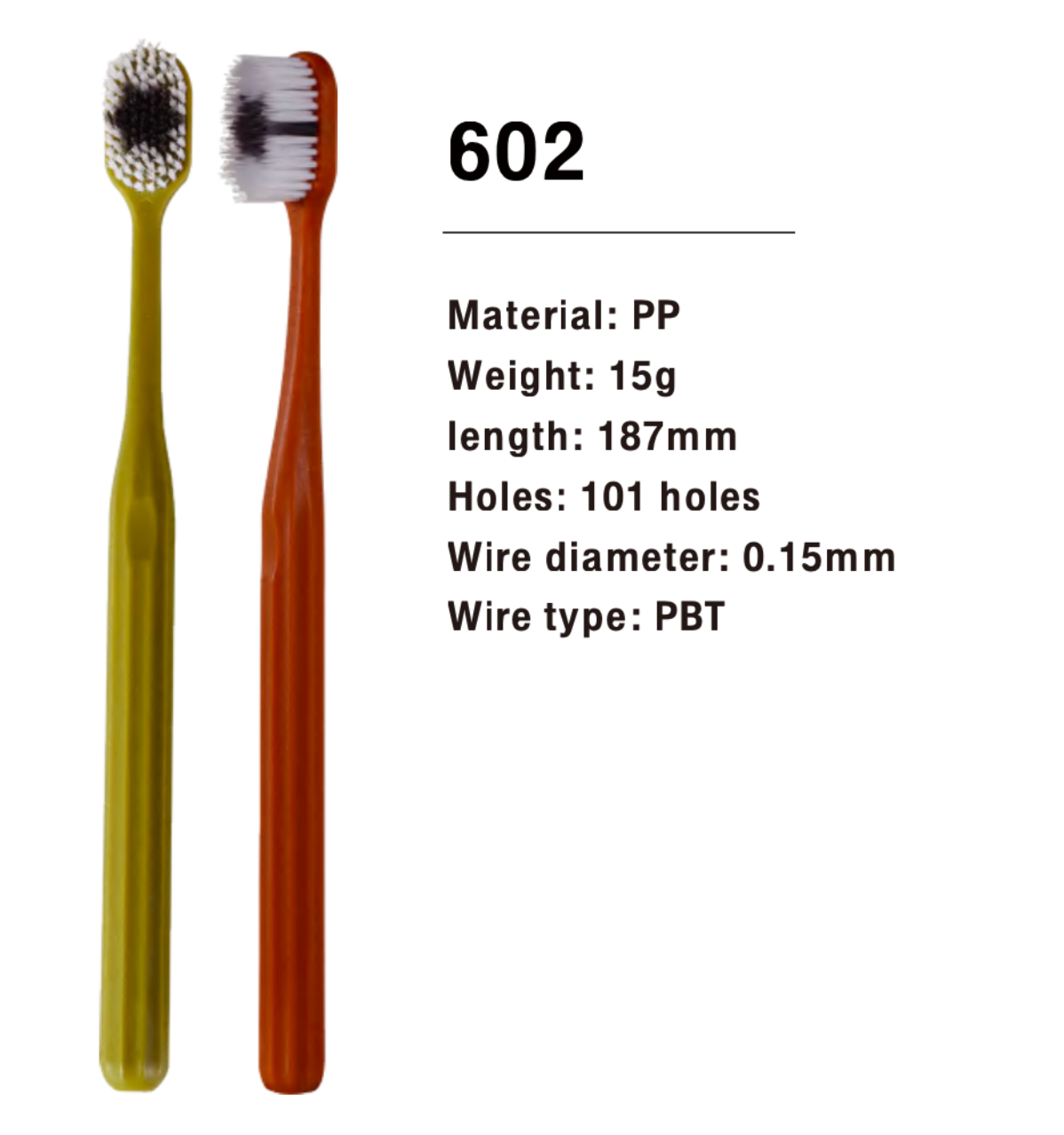
Figure 1 — Model 602, a custom adult manual toothbrush with a PP handle, PBT bristles and 101 bristle holes.
KISS CLEAN is the registered toothbrush trademark of Yangzhou Yuncheng Plastic Daily Chemical Co., Ltd., a toothbrush manufacturer based in Hangji Town, Yangzhou, Jiangsu, China, that produces OEM/ODM manual toothbrushes for retail and disposable programmes and exports to more than 20 countries and regions. This article sets out the three constraint layers a custom manual toothbrush order has to satisfy — product specification, verification documents, and destination-market rules — and shows what each one changes in a request for quotation.
What "custom manual toothbrush" actually covers
OEM/ODM custom toothbrush manufacturing means producing toothbrushes under a client's brand. In an OEM arrangement the factory follows the client's design; in an ODM arrangement the factory starts from a design it already holds. Either way, the deliverable is a manufacturable specification — handle material, filament type and diameter, tuft pattern, colour and packaging — rather than a logo applied to an existing handle.
The category is wider than it first appears. It includes adult retail toothbrushes, children's toothbrushes, orthodontic and ultra-soft designs, travel and hotel toothbrushes, disposable formats and pet toothbrushes, together with the packaging around them: blister cards, PVC/PP boxes, paper cards and 3D display stands. A buyer who compares suppliers across those sub-categories without separating them usually ends up comparing a 100 mm travel SKU against a 187 mm retail SKU and concluding that prices are inconsistent. They are not inconsistent; they are describing different products.
Why two custom toothbrush quotations rarely describe the same product
Four variables dominate a manual toothbrush specification: filament material and diameter, tuft density, handle material and length, and packaging format. Everything else — colour, logo, retail display — sits on top of those four. When a quotation names only "soft bristle, adult size, custom logo", it has described none of them.
The gap is easiest to see between two adult SKUs that both market themselves as gentle. Model 602 uses 101 bristle holes and 0.15 mm PBT filament on a 187 mm handle. Model 811 uses 39 bristle holes and 0.12 mm German PBT flat velvet filament on a 185 mm handle. Both are legitimate designs for daily oral care, but they consume different amounts of filament per unit, run different tufting programmes and reach different users. A buyer who does not lock the tufting pattern cannot compare the two quotations at all.
Softness is the second gap. ISO 22254 specifies a test method for the resistance of the tufted portion of a manual toothbrush to deflection — an objective measure linked to tuft stiffness. It does not create a standardised soft/ultra-soft grading ladder. Until a supplier ties the word "soft" to a cited test method and an accepted limit, it remains a supplier term rather than a specification.
The third gap is documentary. Design patent certificates are frequently presented as if they were product compliance documents. In this supplier's own document notes, design patent certificate ZL 202530468055.4 covers appearance design only: it is not a material test certificate, it does not contain batch traceability records, it is not a BPA-free declaration, and it is not a CE marking document for the EU market. Misreading that distinction is one of the most common evaluation errors in private label oral care.
Industry background: where custom manual toothbrush supply sits
Three reference points frame the supply side. The global manual toothbrush market was sized at USD 6.72 billion in 2025 and is projected to reach USD 12.8 billion by 2034 (Fortune Business Insights, 2026). Asia Pacific accounted for 34.81% of that market in 2024, and China alone recorded USD 980 million in toothbrush exports in 2024 under HS 9603.21 (OEC, 2026). By material, plastic handles held 93.43% of market share in 2024, while bamboo and wood alternatives are growing at a 9.63% CAGR (Mordor Intelligence, 2026).
The trade framework matters more than the headline size. Toothbrushes sit under a dedicated six-digit HS subheading, 9603.21, within heading 96.03 of the Harmonized System. That code measures how many toothbrushes move across borders; it does not reveal which specification tier a shipment meets, because it does not distinguish a 24-hole travel brush from a 101-hole retail brush. Two containers declared under the same code can be ten times apart in filament consumption.
Manufacturing is correspondingly clustered. Yangzhou Yuncheng operates under the "China's Toothbrush Capital · Yangzhou Hangji" origin designation, with a 5,000 m² factory, 50 employees, 9 horizontal and 6 vertical injection moulding machines, 8 tufting machines, 2 bristle end-rounding machines and 2 automated production lines, producing 30 million toothbrushes a year and 2.5 million a month. That equipment base is what makes it possible to hold several distinct specifications — retail, orthodontic, travel — in parallel rather than sequentially.
The three constraint layers that decide whether a quotation is comparable
| Layer | What it decides | Where evaluation usually fails |
|---|---|---|
| 1 — Product specification | What the brush physically is: handle material and length, filament type and diameter, hole count, weight, colour | The RFQ says "soft bristle, adult" and leaves tufting and filament to the supplier's default |
| 2 — Verification documents | What the supplier can prove about the process and the design | A design patent certificate is treated as material compliance or as an EU marking document |
| 3 — Market access | What the destination market requires of the brand owner, not only of the factory | Packaging artwork is fixed before the applicable packaging rules are reviewed |
Layer 1 — Product specification: the numbers that belong in writing
Three models illustrate how far apart apparently similar custom manual toothbrushes can sit. All three are covered by the same ISO 9001 quality management system certification and by the same design patent family, but they serve different channels.
| Item | Model 602 | Model 731 | Model 811 |
|---|---|---|---|
| Product type | Custom adult toothbrush | 5-in-1 custom travel toothbrush | Orthodontic custom toothbrush (Swiss-style ultra soft) |
| Handle material | PP | PP | PP |
| Bristle filament | PBT, 0.15 mm | Nylon, 0.12 mm | German PBT flat velvet, 0.12 mm |
| Bristle holes | 101 | 24 | 39 |
| Filament count | — | — | 6,000 |
| Overall length | 187 mm | 100 mm | 185 mm |
| Weight | 15 g | 2.3 g – 2.4 g | 15 g |
| Colour options for OEM/ODM | Olive green, amber and other colours | Teal, blue and other colours | Custom colour programme per order |
| Intended use | Adult daily oral care, retail | Travel, airline, hotel, restaurant, promotional kits | Orthodontic patients, sensitive gums, periodontal care, dental clinic |
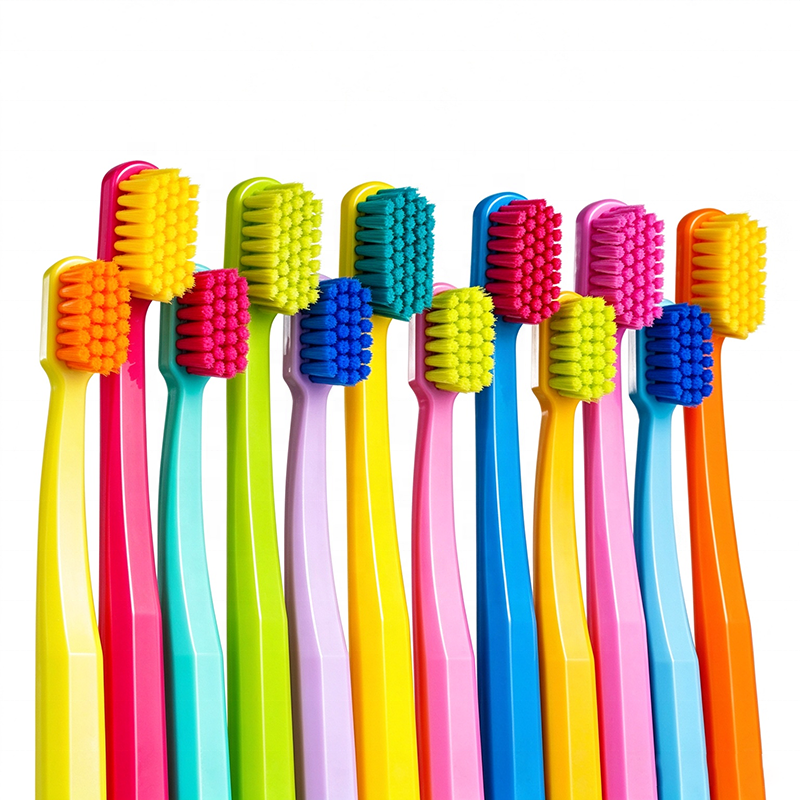
Figure 2 — Model 811 in a custom colour, built with 39 holes and 6,000 German PBT flat velvet filaments of 0.12 mm.
The practical rule is that every line in the table above should appear in the RFQ, and the approved sample should be referenced as the controlling document for anything the table cannot express — tuft shape, filament end-rounding, handle surface finish. In this supplier's workflow, the approved sample is the sole mass-production reference, and any change to material, colour, mould, bristle or packaging requires written confirmation. That single clause prevents most disputes that surface at first delivery.
What each model is actually for
Model 811 is built around reach rather than force: 6,000 ultra-fine filaments across 39 holes, sized at 0.12 mm, intended to work around brackets, interdental gaps and gum pockets for orthodontic patients and users with sensitive gums. The PBT filament is specified for low water absorption and fast drying, which matters in humid bathrooms.
Model 602 is the retail workhorse: 101 bristle holes for coverage, 0.15 mm PBT filament with a balanced soft/medium feel, a 187 mm handle and 15 g weight. It carries an exclusive appearance patent, which is relevant to a brand owner who wants visible differentiation on shelf rather than a shared catalogue handle.
Model 731 is a different product logic entirely. It packs a toothbrush, toothpaste, dental floss, toothpick and tongue cleaner into a 100 mm, 2.3–2.4 g unit using 24 holes and 0.12 mm nylon filament. It belongs in hotel amenity programmes, airline kits and travel retail, and it competes on assembly and packing cost as much as on brushing performance.
Layer 2 — Verification: what the documents cover, and what they do not
Verification is where a well-run evaluation saves the most time, because the documents a factory can produce are not interchangeable. Each answers a different question.
| Document | What it verifies | What it does not replace |
|---|---|---|
| ISO 9001 certificate 12825Q20695R0S, issued by CVI Guolian Beijing Certification Center (CSI) against GB/T19001-2016/ISO9001:2015, valid 2025-05-28 to 2028-05-27 | The quality management system covering "production and sales of toothbrushes and protective boxes"; the certificate covers models 602, 731 and 811 | Order-specific inspection records — request these separately for each purchase order |
| China design patent certificates, including ZL 202530468055.4, ZL 202530468049.9, ZL 202530178559.2, ZL 202530178562.4, ZL 202530468068.1, ZL 202530468040.8, ZL 202530178555.4 and No. 9621649, issued by CNIPA under China Patent Law | Appearance design protection for the toothbrush body and handles in the China market; ZL 202530468055.4 protects the appearance design of models 602, 731 and 811, and No. 9621649 was issued on 2025-11-14 for the CN market | Material testing, batch traceability, a BPA-free declaration, or CE marking for the EU market |
| In-house mechanical checks: bristle pull force tester, handle flexural/bending tester, bristle shedding tester, high-magnification magnifier, electronic scale and balance | The factory's own inspection points for tuft retention, handle strength and filament condition, applied with a 100% ex-factory pass rate and QC staff at 10% of the workforce | A third-party laboratory report, unless one is separately commissioned |
| ISO 20126 (manual toothbrushes — general requirements and test methods) and ISO 22254 (resistance of the tufted portion to deflection) | An international requirements framework and a repeatable deflection test method for writing performance criteria into a contract | A standardised soft/ultra-soft grading scheme — the standards do not provide one |
The single most useful question in this layer is: "Which document proves this specific claim?" A factory that holds nine design patents for toothbrushes and two registered trademarks (KISS CLEAN and DR COCO) can prove design protection. It cannot convert that into a material or market-access claim, and a buyer should not accept a proposal that tries.
The equipment list is what makes the document set credible. With 9 horizontal and 6 vertical injection moulding machines, 8 tufting machines, 2 bristle end-rounding machines and 2 automated production lines, inspection can be embedded in the process rather than appended at the end: 100% pre-shipment inspection, in-line QC during production, and AQL random sampling for the shipping lot.
Layer 3 — Market access: obligations that change the packaging, not the brush
Destination-market rules rarely change the toothbrush itself; they change what the brand owner must hold, print and be able to trace.
In the United States, the manual toothbrush is codified as a classified device under 21 CFR 872.6855, as a Class I device with 510(k) premarket notification exemption. The exemption removes premarket clearance, not the general controls: establishment registration and listing duties and labelling obligations remain, and those fall on the party placing the device on the market. Powered toothbrushes sit under a separate classification, 21 CFR 872.6865, which is why a mixed manual/powered range needs its scope boundary drawn early.
In the European Union, Regulation (EU) 2023/988 on general product safety (GPSR) applies to consumer products placed on the EU market, with application from 13 December 2024, and imposes traceability, risk-assessment and responsible-person obligations on economic operators. Separately, Regulation (EU) 2025/40 on packaging and packaging waste (PPWR) sets EU-wide requirements for packaging placed on the market, with obligations phased in over a staged timeline. Because packaging is usually the cheapest visual differentiator in the category, it is also the fastest-moving compliance surface — which argues for designing blister cards, PVC/PP boxes and paper cards against recyclability and labelling requirements from the first SKU, not retrofitting artwork mid-programme.
Whether a manual toothbrush is additionally a medical device under EU Regulation (EU) 2017/745 was not established here and should not be assumed in either direction. Buyers selling into the EU should confirm that point with their own regulatory adviser before the first shipment, and should name the EU responsible operator on the packaging artwork.
Step-by-step: how a custom manual toothbrush order runs
The workflow below reflects the process this factory applies to OEM/ODM programmes, with the buyer action that turns each step into a control point.
- Inquiry and consultation. The buyer shares target market, budget range, intended user and channel. Supplier input at this stage should include proposed handle and bristle options, not only a price. Buyer action: state the destination market, because US and EU obligations differ.
- Design and specification confirmation. Handle design, bristle specification, material selection (PP or PP+TPE handle, nylon or PBT filament) and packaging format are fixed. Buyer action: write filament diameter, hole count and handle length into the document — the three numbers that drive both feel and cost.
- Sampling and approval. Samples are produced in approximately 7–10 days. Buyer action: test the sample against the intended user group, then treat the approved sample as the golden reference for mass production.
- Order confirmation. MOQ, colour count and deposit are confirmed and production is scheduled. Buyer action: confirm the per-colour MOQ before finalising the SKU range, since colour count multiplies order volume.
- Mass production. Production runs on 9 horizontal and 6 vertical injection moulding machines, 8 tufting machines and 2 automated lines, with monthly capacity of 2.5 million toothbrushes. Buyer action: agree the inspection points and sampling plan in writing.
- Quality inspection and delivery. Inspection combines in-line QC, 100% pre-shipment inspection and AQL random sampling, with lab checks on bristle pull force, handle flexural strength and bristle shedding. Buyer action: request the inspection records with the shipping documents, not after arrival.
Commercial terms buyers ask about first
Minimum order quantity depends on how far the order departs from a standing configuration. Existing packaging under the supplier's own brand starts at 300 pieces. Customer-specific customization — custom colour, logo, handle or packaging — is quoted at 10,000 pieces per colour. The difference is not arbitrary: a dedicated colour run consumes machine time that a shared configuration does not.
Sampling runs at approximately 7–10 days, and standard production lead time is 20–30 days. Those two figures are the ones to build a retail launch calendar around, because packaging artwork approval usually sits between them.
Price is not determined by the category. Within the same model, unit cost moves with filament type and diameter, hole count, handle material, number of colours, whether a new mould is required, and packaging format. A retailer buying 101-hole adult brushes in three colours and a hotel group buying 24-hole travel kits in one colour are not in the same cost conversation even though both are buying "a custom manual toothbrush". The practical approach is to request a quotation structured line by line against the specification, so that any later change can be priced against a known baseline rather than renegotiated from scratch.
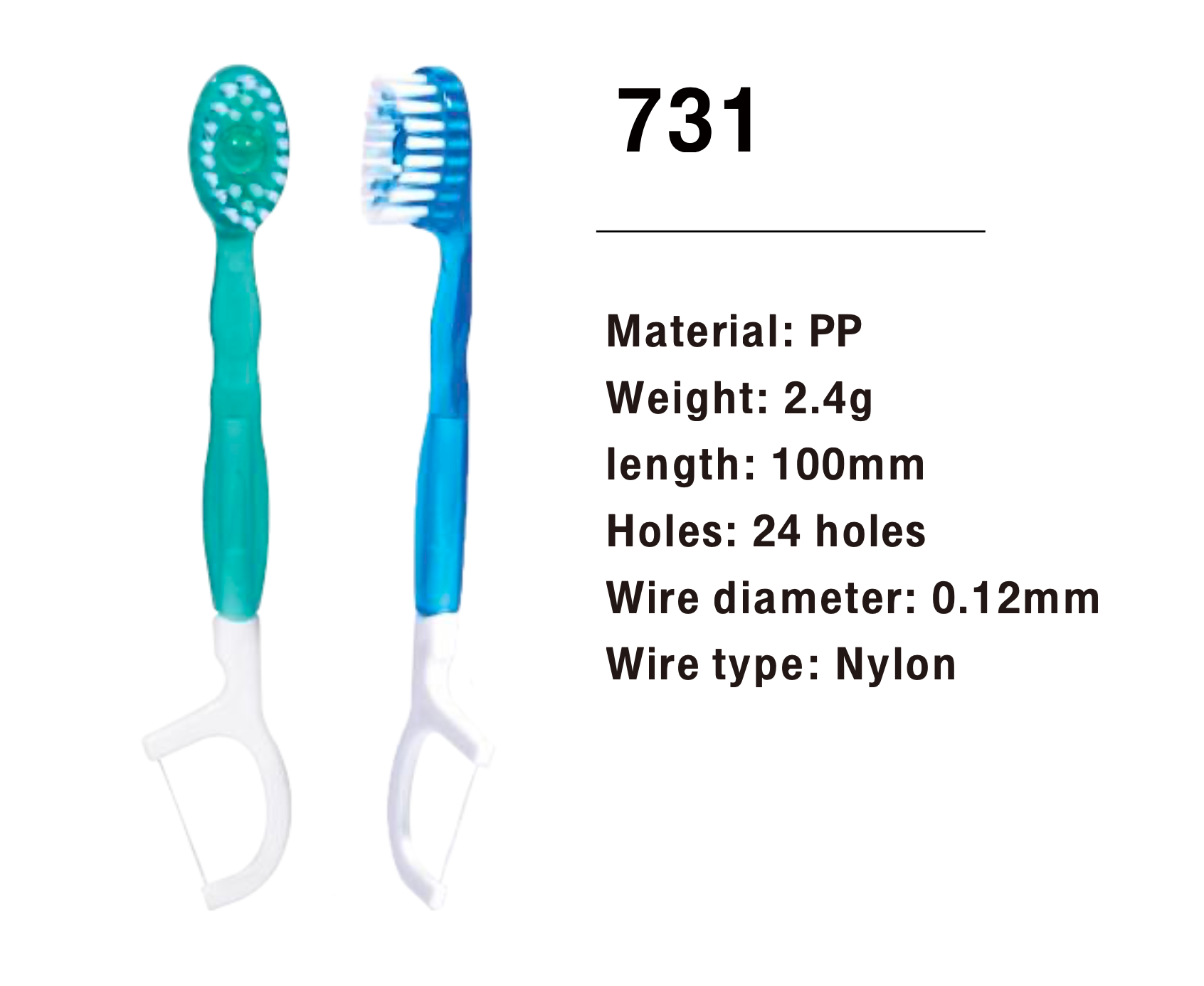
Figure 3 — Model 731, a 5-in-1 travel toothbrush at 100 mm and 2.3–2.4 g, with a PP handle and 0.12 mm nylon filament.
Use cases: matching the specification to the channel
Adult retail and supermarket private label
Retail programmes need a durable specification and a packaging format that survives shelf handling. Model 602, with 101 holes and a 187 mm handle, is the appropriate base. One European supermarket chain has run a 1,000,000-piece-per-order programme across Germany and France for three years, with a 100% pass rate and custom packaging launched successfully; sampling was completed in seven days. For a retail buyer, the lesson is that packaging approval, not brushing performance, is usually the critical path.
Orthodontic, sensitive gum and dental clinic channels
This is where filament diameter stops being a preference and becomes a clinical positioning decision. Model 811, with 6,000 filaments at 0.12 mm and a 39-hole pattern, is designed for brackets, interdental gaps and gum pockets. Clinics and orthodontic brands usually need a specification sheet that states filament diameter and hole count explicitly, because their customers ask.
Travel, hotel and airline amenity programmes
Amenity buyers optimise for packed volume, weight and assembly cost. Model 731 at 100 mm and 2.3–2.4 g, combining toothbrush, toothpaste, dental floss, toothpick and tongue cleaner, is built for that brief. Colour customization (teal, blue and others) supports hotel branding without new tooling.
Oral care brands and promotional gifting
A Japan/Korea oral care brand has run 500,000-piece orders for five years across retail and promotional gifting with zero quality complaints and 100% on-time delivery. Promotional programmes typically need tighter packaging coordination than retail, because the gift-with-purchase date is fixed by the campaign, not by the factory.
Pet oral care
Pet toothbrushes are a genuine OEM category rather than a relabelled human brush. A global FMCG pet product brand in the US and Australia has ordered 800,000 pieces per order for two years, with custom packaging and zero quality complaints. The specification discipline is the same; the tooling is not.
FAQ
What certifications should a custom manual toothbrush supplier provide?
At minimum: an ISO 9001 certificate whose scope covers toothbrush production, order-specific inspection records, and a clear statement of what any patent covers. KISS CLEAN's ISO 9001 certificate 12825Q20695R0S was issued by CVI Guolian Beijing Certification Center (CSI) against GB/T19001-2016/ISO9001:2015 for the scope "production and sales of toothbrushes and protective boxes", valid from 2025-05-28 to 2028-05-27, and covers models 602, 731 and 811. The China design patent certificates (including ZL 202530468055.4, ZL 202530468049.9, ZL 202530178559.2, ZL 202530178562.4, ZL 202530468068.1, ZL 202530468040.8 and ZL 202530178555.4) protect appearance design only — they are not material test certificates, contain no batch traceability records, are not a BPA-free declaration and are not CE marking documents.
Can a manufacturer supply private label packaging along with the toothbrush?
Yes — packaging is part of the customization scope rather than an afterthought. Custom toothbrush packaging here includes blister cards, PVC/PP boxes, paper cards and 3D display stands, designed together with the SKU, and customized orders are quoted at 10,000 pieces per colour. For EU-destined products, packaging should be reviewed against Regulation (EU) 2025/40 on packaging and packaging waste, which applies on a staged timeline, at the artwork stage rather than after tooling.
What is the minimum order quantity for a custom manual toothbrush?
Orders using existing packaging under the supplier's own brand start at 300 pieces. Customer-specific customization — custom colour, logo, handle or packaging — is quoted at 10,000 pieces per colour, because each additional colour consumes a separate production run. Buyers should fix the number of colours before finalising the SKU range, since colour count, not unit count alone, determines the order quantity.
How long does sampling take, and what does the approved sample control?
Sampling takes approximately 7–10 days. The approved sample then becomes the sole mass-production reference: changes to material, colour, mould, bristle specification or packaging require written confirmation before production restarts. That clause is what makes a 20–30 day production lead time predictable, because the factory and the buyer are measuring against the same physical object.
What is the production lead time for a custom manual toothbrush order?
Standard production lead time is 20–30 days after order confirmation, supported by monthly capacity of 2.5 million toothbrushes across 9 horizontal and 6 vertical injection moulding machines, 8 tufting machines, 2 bristle end-rounding machines and 2 automated production lines. To check a specification against that capacity — filament diameter, hole count, colour count and packaging format included — send the target spec to the KISS CLEAN team at xuyunjun@yuncheng-toothbrush.com or WhatsApp +8617714480566, and the full factory catalogue can be downloaded here: Yangzhou Yuncheng toothbrush catalogue (PDF).

Figure 4 — Injection moulding workshop: the equipment base behind the 2.5 million per month capacity.

Figure 5 — Tufting equipment: hole count and filament diameter are set here, not at the quotation stage.
Conclusion: lock the specification, then the documents, then the packaging
A custom manual toothbrush programme fails at the evaluation stage for a predictable reason: the buyer compares prices against three different specifications, then discovers at delivery that the document set does not support the claims made in the sales deck. The sequence that avoids this is straightforward. First, fix the product specification — filament type and diameter, hole count, handle material and length, weight — against the channel it serves. Second, match each claim to the document that proves it, and accept that a design patent proves design and nothing more. Third, check the destination market's obligations, especially packaging, before artwork is signed off.
Everything else in this category is negotiable. Those three layers are not.

Figure 6 — KISS CLEAN, the registered toothbrush trademark of Yangzhou Yuncheng Plastic Daily Chemical Co., Ltd.
Next step: compare your specification against the factory
Send the specification — filament diameter, hole count, handle length, colour count and packaging format — and the KISS CLEAN team will confirm what is feasible, what the sampling timeline looks like, and where the constrained items sit. Samples, quotations and the factory profile are available on request.
Contact: Jack — xuyunjun@yuncheng-toothbrush.com | Tel +86 15262226888 | WhatsApp +8617714480566 | yunchengtoothbrush.com
Address: Building 1, Qionghua Science-Technology Park, Weiye Road, Hangji Town, Guangling District, Yangzhou City, Jiangsu Province, P.R. China
Have Questions or Need More Details?
Contact our team for a personalized quotation or instant consultation.
Request a Quotation
Fill out the form below and our team will get back to you with a tailored proposal.
WhatsApp Direct Chat
Prefer to chat in real-time? Message us on WhatsApp for instant assistance & quick answers.
- Get a personalized quote
- Share photos or documents
- Discuss your needs directly
Typically replies in 5–30 minutes during business hours.