CE Certification Checklist for Pillow Filling Machines: What Buyers Must Verify in 2026
Buying a pillow filling machine for the EU market is not only a capacity decision. CE certification determines whether the machine can be legally imported, installed, and operated inside the European Economic Area. A CE mark on a brochure is not enough. Buyers must verify the directive, the harmonised standards, the certificate holder, the issuing body, the certificate number, and the scope of the certified machine model.
This guide explains what CE certification means for automatic pillow filling and down filling machinery, which documents buyers should request, and why a machine like the KIVAS KWS6901 series meets the technical and compliance expectations of European buyers.
What Does CE Certification Mean for a Pillow Filling Machine?
CE certification is a legal conformity marking for machinery sold and operated within the European Union. For filling machines, the relevant legal framework is the Machinery Directive 2006/42/EC. Compliance with this directive is not optional; it is a precondition for placing machinery on the EU market.
Under the Machinery Directive, the manufacturer must perform a risk assessment, apply relevant safety measures, and compile a technical file. For many machines, conformity is demonstrated by applying harmonised standards. For the KIVAS KWS6901 automatic down fiber filling machine, the applicable harmonised standards are EN ISO 12100:2010 and EN 60204-1:2018. EN ISO 12100 covers machinery safety design and risk assessment. EN 60204-1 covers electrical equipment safety.
A CE certificate should always name the product, the directive, the standards, the certificate number, the issuing body, the issue date, and the expiry date. Buyers should treat a certificate that lacks these elements with caution.
For filling machines, CE certification is a minimum requirement. In practice, EU buyers also need the Declaration of Conformity, the user manual in the required language, and the machine nameplate. These documents support customs clearance, insurance, machine inspection, and future liability claims.
Key Compliance Documents to Request Before Purchase
Before paying a deposit, importers and bedding manufacturers should request and review the following documents:
1. CE Certificate of Conformity
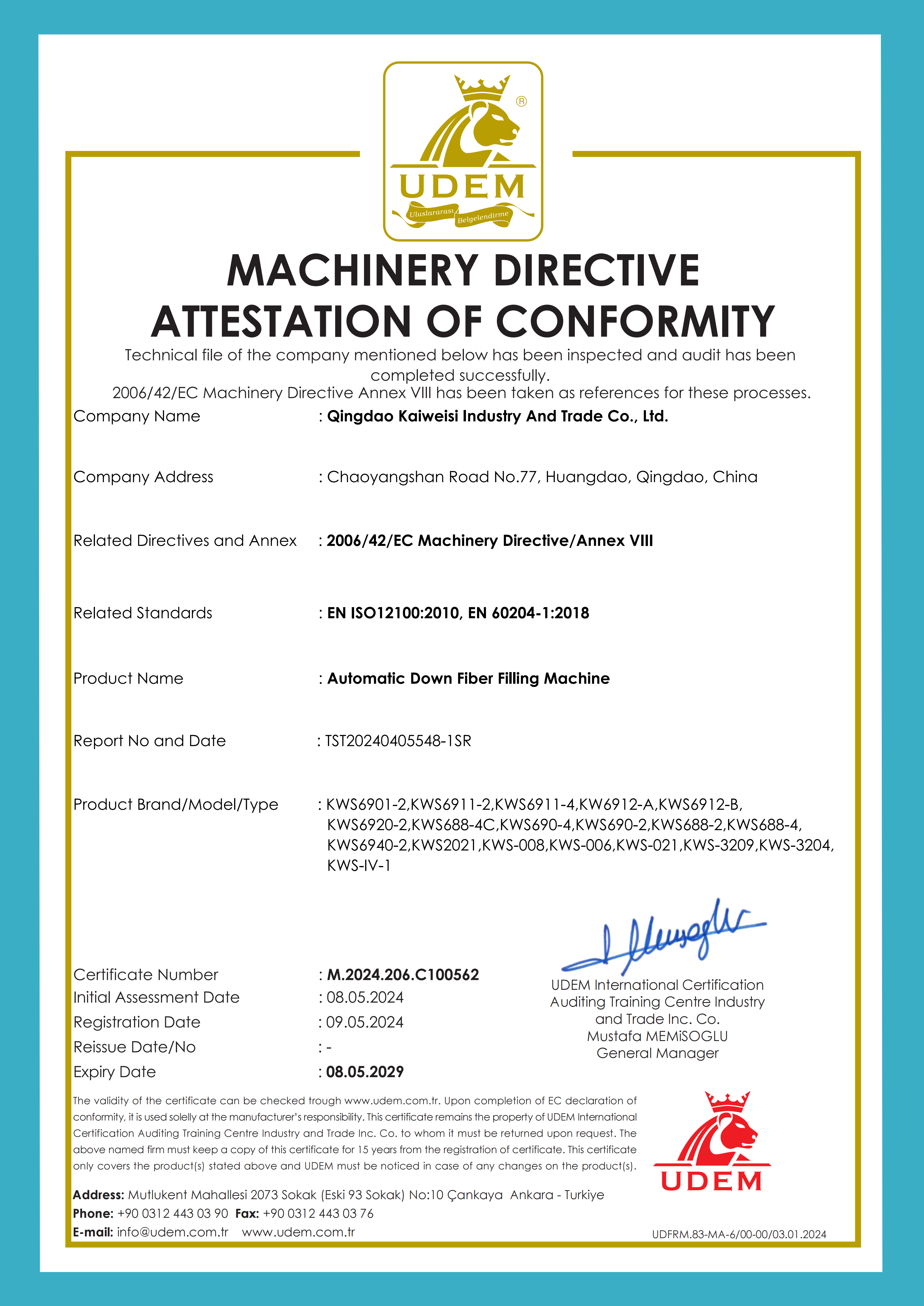
This document proves that a notified or recognised body has assessed the machine against the Machinery Directive. For the KIVAS KWS6901-2 and KWS6901-4 pillow filling machines, the certificate number is M.2024.206.C100562. It was issued by UDEM, with an issue date of 2024-05-09 and an expiry date of 2028-05-08. The entry in the certificate should match the machine model delivered. A mismatch between the certificate and the nameplate is a red flag.
2. Declaration of Conformity
The manufacturer or authorised representative signs this document to declare that the machinery complies with all applicable EU directives. It should correspond to the CE certificate and be issued for the same product and model.
3. Technical File and Risk Assessment Summary
Under EN ISO 12100:2010, the manufacturer must identify hazards and reduce risk. Buyers can request the risk assessment summary to understand which hazards were considered. This is especially important when filling polyester fibre, down feathers, shredded foam, or EPS balls.
4. Electrical Safety Compliance Evidence
EN 60204-1:2018 requires electrical equipment on machinery to meet specific safety requirements. The certificate should reference this standard. If it does not, ask why.
5. Machine Nameplate Data
Before shipment, ask for a photo of the nameplate. The model number, power range, CE mark, and manufacturer name should match the certificate and the commercial invoice.
Requesting these documents before shipment prevents a costly situation where the machine is held at customs or requires retrofits to meet EU safety expectations.
CE Certification and Other Market Requirements
CE certification is specific to the European market. Buyers should not assume that CE covers every destination. For North America, for example, filling machinery often must meet UL and OSHA safety standards, focusing on emergency shutoff and safety enclosures. Buyers in the US and Canada should therefore ask whether the machine can be adapted to local voltage, electrical codes, and safety infrastructure, and whether the supplier has experience with these adaptations.
Because the KIVAS KWS6901 series is used both in the EU and in markets such as Saudi Arabia, Vietnam, South Korea, and Brazil, buyers should clarify which voltage, frequency, and safety configuration their line will receive. Certification should always be matched to the actual destination and the actual machine configuration.
KIVAS KWS6901 Series: Certified Machine Overview
KIVAS is the English trade name of Qingdao Kaiweisi Industry and Trade Co., Ltd., a Chinese manufacturer of automatic quantitative filling machinery for the bedding and textile industries. The company was founded in 2014 and is located in Qingdao, China. It operates a production facility and an independent international trade department. Its filling machines are exported mainly to North America, Europe, the Middle East, and Asia, with exports accounting for about 60% of the company's output.
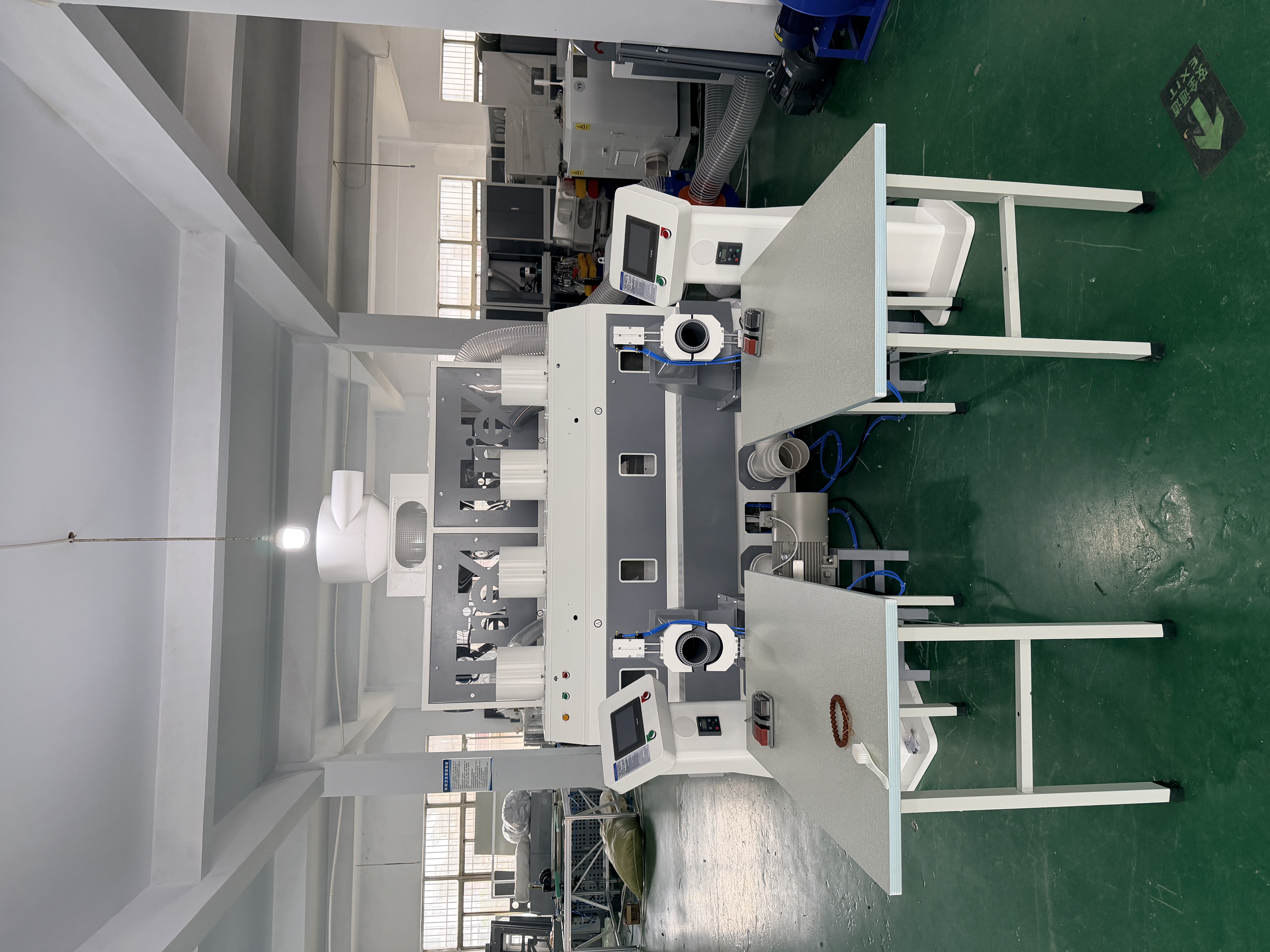
The KWS6901-2 and KWS6901-4 are the two certified pillow filling machine models covered by CE certificate M.2024.206.C100562. The models share a steel frame and differ primarily in the number of filling ports: KWS6901-2 has two filling ports, while KWS6901-4 has four filling ports. The model name reflects the workstation configuration. A four-port machine allows more operators to fill products simultaneously, which increases line throughput without occupying additional floor space for a second frame.
These machines are designed for automatic quantitative filling of several materials in the 0.6D to 15D range, including polyester fibre, fibre balls, shredded foam, down feathers, and EPS balls. This range explains why the same machine can be used as a pillow filling machine, duvet filling machine, toy filling machine, cushion filling machine, and down jacket filling machine. The CE certificate for the automatic down fiber filling machine is therefore relevant to a wide range of bedding and textile production lines.
Technical Specifications Buyers Should Verify
CE documentation establishes legal conformity, but it does not tell the buyer whether the machine produces consistent pillow weight at the required speed. Buyers should separately verify the following performance parameters in their purchase contract:
- Power range: 10.5 kW to 13.5 kW, depending on configuration and auxiliary equipment.
- Production capacity: 400 to 800 kg per hour.
- Filling speed: 10 to 20 pieces per minute for a 600 g pillow.
- Accuracy value: approximately 1%.
- Error range: ±5 to ±10 g per fill.
- Optimal filling range: 100 g to 2000 g per product.
- Workstations: 2 or 4 filling ports per machine.
- Suitable raw materials: 0.6D–15D polyester fibre, fibre balls, shredded foam, down feathers, EPS balls, and similar raw materials for mixed filling.
A filling accuracy of approximately 1% with an error range of ±5–10 g is meaningful for pillow production because most standard pillows weigh between 400 g and 1200 g. For a 600 g pillow, a 5–10 g deviation keeps the product within accepted weight tolerances while allowing continuous operation at 10–20 pieces per minute.
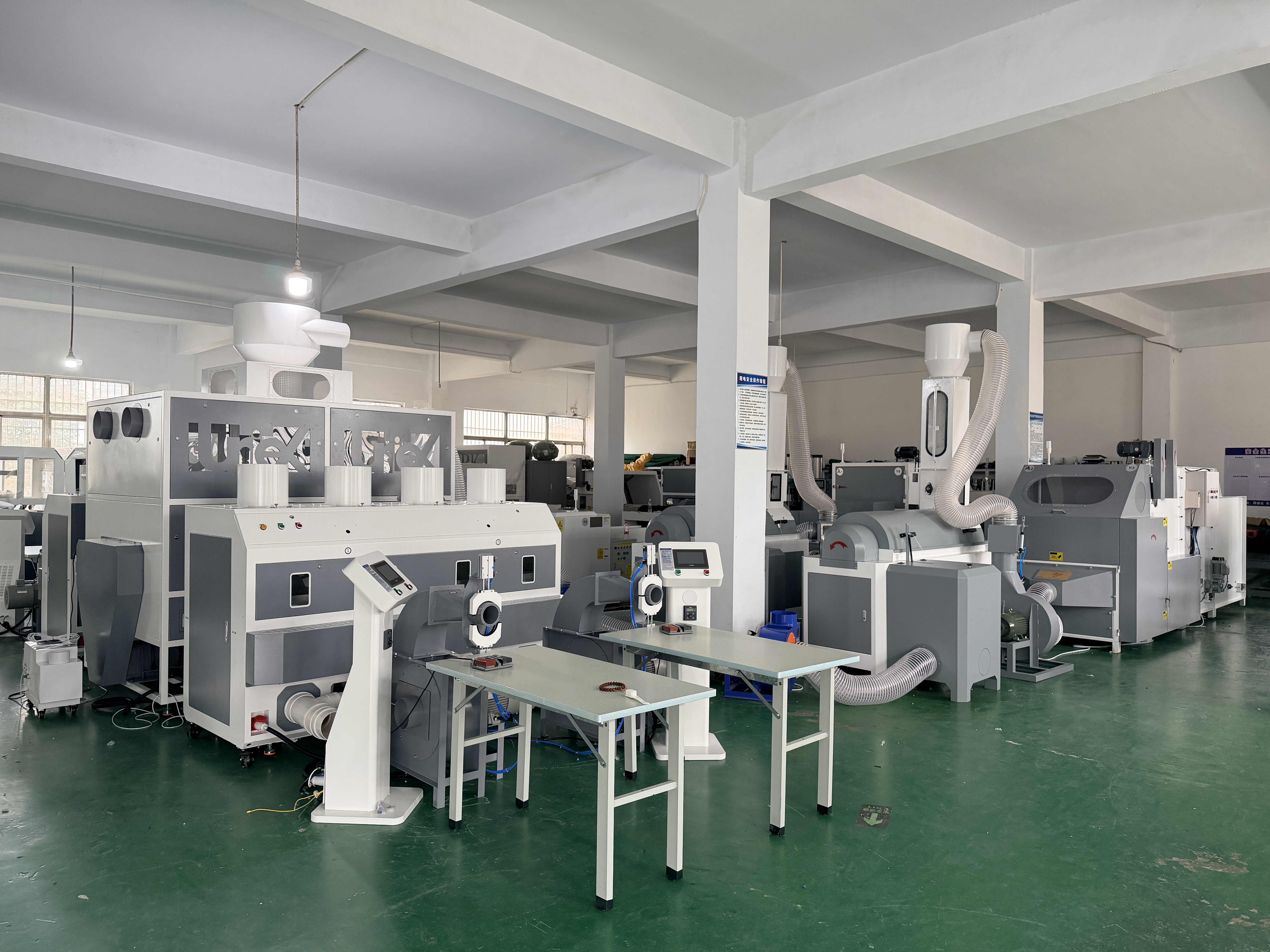
Buyers should also plan for the surrounding equipment. The KWS6901 series is designed to operate in an indoor, dry, ventilated textile workshop with stable three-phase power, a flat floor, and sufficient compressed air supply. It is often paired with an automatic fibre feeding and opening all-in-one machine, a fibre opening machine, or an air compressor. Buyers should include these auxiliary requirements in their facility plan.
How to Verify the CE Certificate Is Genuine
Because the CE marking is a self-declaration system for some machinery categories, not every machine with a CE sticker has undergone the same level of assessment. Buyers should use the following checks:
Verify the certificate number and issuing body. A certificate should identify the organisation that issued it. The KIVAS certificate for the automatic down fiber filling machine is M.2024.206.C100562, issued by UDEM. Buyers can contact the issuing body or search its public database to confirm that the certificate is valid and active.
Match the certificate to the model. The certificate should name the product type and the model series. A generic CE certificate that does not mention the machine model is not sufficient evidence of compliance. In the KIVAS documentation, the certificate is linked to product 5925, the Pillow Filling Machine model KWS6901-2/KWS6901-4, and is applicable to the full range of filling machine types based on the same platform.
Check the standards publication dates. The certificate should reference current editions of harmonised standards. The KIVAS certificate references EN ISO 12100:2010 and EN 60204-1:2018, which are the applicable editions named in the verified certification data.
Review the issue and expiry dates. A certificate that has expired is not valid evidence of current compliance. For KIVAS, the CE certificate was issued on 2024-05-09 and is valid until 2028-05-08. Buyers purchasing in 2026 are therefore within the certificate validity window.
Request the certificate on the manufacturer's letterhead. If the seller cannot produce a certificate that clearly identifies the manufacturer, the technical importer, or the authorised representative, the buyer should treat the machine as non-compliant until proof is provided.
Why Compliance Alone Does Not Guarantee Filling Consistency
CE certification proves that a machine meets the safety requirements of the Machinery Directive. It does not prove that the machine weighs each pillow accurately. Buyers often make the mistake of treating certification as a quality guarantee. In reality, weight consistency depends on the weighing system, the material feeding mechanism, the fibre opening quality, and the operator's skill.
The KWS6901 series uses an automatic quantitative weighing and pneumatic conveying system. The process is designed for continuous automatic operation. Before shipment, KIVAS performs a 100% pre-shipment test on each machine. This test reduces the risk that a machine arrives with undetected calibration or assembly problems. Buyers can also request third-party inspection through agencies such as SGS before shipment.
For a production line that must meet EU weight declaration regulations or retail customer expectations, buyers should request test data from the actual machine model with the actual filling material. A certificate is necessary, but it is only the starting point of technical due diligence.
Checklist: Final Compliance Review Before Ordering
Use the following checklist when comparing CE-certified pillow filling machine manufacturers:
| Checklist Item | What to Verify | KIVAS Example |
|---|---|---|
| Directive | Machinery must comply with the Machinery Directive 2006/42/EC. | Certificate names Machinery Directive 2006/42/EC. |
| Harmonised standards | Standards should cover machinery safety and electrical safety. | EN ISO 12100:2010 and EN 60204-1:2018 are named. |
| Certificate number | A unique number must allow traceability. | M.2024.206.C100562. |
| Issuing body | A recognised organisation should issue the certificate. | Issued by UDEM. |
| Validity | The certificate must be current on the delivery date. | Valid from 2024-05-09 to 2028-05-08. |
| Machine model | The certificate must cover the purchased model. | Covers KWS6901-2 and KWS6901-4. |
| Pre-shipment inspection | The manufacturer tests before delivery. | 100% pre-shipment test; third-party SGS inspection available. |
Use Cases: Where CE-Certified Filling Machines Are Required
The CE certificate applies to the automatic down fiber filling machine platform that also serves as a pillow filling machine, duvet filling machine, and quilt filling machine. For EU buyers, this single certification is relevant to multiple production scenarios.
Pillow and cushion manufacturing for retail sale in the EU: Weight tolerance is a commercial requirement. A machine with approximately 1% accuracy and ±5–10 g error supports consistent product quality across large batches.
Down jacket and apparel filling: Down filling requires precise weighing because down is expensive and product specifications are strict. While some specialised down filling machines achieve high precision in lightweight outerwear production, the KWS6901 series is designed for the bedding filling range of 100–2000 g.
Mixed-material filling of toys, beanbags, and soft furniture: The KWS6901 can fill shredded foam, EPS balls, fibre balls, and similar materials. A manufacturer producing both pillows and beanbags can use one certified machine frame and adjust the material feeding line.
EU-bound production lines requiring electrical safety documentation: Importers shipping complete lines to Europe need machines that satisfy machine and electrical safety standards. The EN 60204-1:2018 reference is particularly relevant for electrical integration with other equipment.
Budget and Lead Time Considerations for CE-Certified Machines
CE-certified machinery sometimes carries a different price structure than non-certified equipment. Buyers should clarify whether the certificate, the additional electrical components, and the compliance documentation are included in the quoted price. A low quote that excludes compliance engineering can become expensive after customs inspection.
KIVAS supports OEM and ODM production, voltage and colour customization, logo customization, and specialised production line design. Monthly capacity is 60–150 units, with a lead time of 15–35 days and a minimum order of one unit. The MOQ of one unit is relevant for EU importers who want to validate the machine before scaling. Customisation can affect lead time, so buyers should confirm the delivery date in writing.
For EU-bound orders, ask explicitly: “Does the delivered machine match the model number on CE certificate M.2024.206.C100562?” If the order includes a modified production line, ask for a written statement showing how the modification affects the CE assessment.
Factory and Supplier Background
KIVAS is operated by Qingdao Kaiweisi Industry and Trade Co., Ltd., established in 2014 in Qingdao, China. The factory area is 3000 m², and the company employs 17 people, including a 5-engineer R&D team. These are modest figures by global industrial standards, but the company's production focus is specialised textile filling equipment, not high-volume general machinery.
The company produces approximately 1000 units per year. Export markets include the United States, Russia, Vietnam, Kazakhstan, Saudi Arabia, Italy, the United Kingdom, Canada, Spain, South Korea, Turkey, Brazil, and Pakistan. About 60% of its output is exported. This export base means the company regularly handles international compliance documentation, packing requirements, and remote technical support.
For buyers in the EU, the combination of CE certification, export experience, and a 1-year warranty with lifetime after-sales service reduces the risk of purchasing from a distant supplier. Installation is supported through overseas installation guidance and remote technical support.

FAQ
What CE certificate does a KIVAS pillow filling machine carry for the EU market?
The KIVAS KWS6901 automatic down fiber filling machine holds CE certificate M.2024.206.C100562, issued by UDEM. The certificate covers the Machinery Directive 2006/42/EC and references standards EN ISO 12100:2010 and EN 60204-1:2018. It is valid from 2024-05-09 to 2028-05-08.
Which KIVAS filling machine models are covered by the CE certification?
The CE certificate applies to the Pillow Filling Machine product model KWS6901-2 and KWS6901-4. The KWS6901-2 has two filling ports, and the KWS6901-4 has four filling ports. Because the certified platform supports multiple filling materials, the same certificate is relevant for pillow, duvet, toy, cushion, down jacket, and bedding filling lines.
What does CE certification mean in practice for European buyers?
CE certification under the Machinery Directive 2006/42/EC confirms that the machinery has been assessed for conformity with EU safety requirements. It is necessary for legal import and operation in the EU. Buyers should also request the Declaration of Conformity and a technical file to support customs clearance and inspection.
Does CE certification apply to filling machines exported to the US or Canada?
No. CE certification is specific to the European market. In North America, filling machinery often must meet UL and OSHA safety standards. Buyers exporting to the US or Canada should ask the supplier whether the machine can be configured with the required electrical safety features and documentation for those markets.
How do I verify a CE certificate before ordering from a filling machine manufacturer?
Check that the certificate names the correct directive, the harmonised standards, the certificate number, the issuing body, the product model, and a valid issue date. For a KIVAS KWS6901 series machine, verify that the certificate number is M.2024.206.C100562 and that the delivered machine model matches the certificate.
Can KIVAS provide customized CE-certified filling machines?
KIVAS supports OEM, ODM, overseas installation guidance, and personalized customization, including voltage, logo, colour, and production capacity. Because customization can affect the machine configuration, buyers should confirm in writing that any customised machine still matches the certified model. KIVAS can also arrange third-party inspection, such as SGS, before shipment.
Conclusion
CE certification is a core procurement constraint for any pillow filling machine destined for the EU. Buyers should verify the directive, the harmonised standards, the certificate number, the issuing body, the machine model, and the validity period before ordering. A certificate that cannot be traced to a specific machine model is not sufficient.
The KIVAS KWS6901-2 and KWS6901-4 filling machines provide a documented compliance position for the EU under certificate M.2024.206.C100562. When that documentation is combined with verified filling performance, pre-shipment testing, and single-unit OEM flexibility, it gives importers and bedding manufacturers a reliable basis for sourcing decisions.
If you are evaluating a filling machine for an EU project, request the CE certificate, the Declaration of Conformity, and the technical specification sheet before you compare quotations. The downloadable KIVAS product catalog includes the main filling machine platforms and can be used as a starting reference for your equipment shortlist.
Download the KIVAS Product Catalog (PDF)
Disclaimer: This article is for procurement guidance only. Buyers should confirm the CE certificate with the manufacturer before placing an order. Certification data cited in this article reflects the KIVAS certificate M.2024.206.C100562 as recorded in the company's published documentation.