Choosing the Right Filling Machine: A Technical Parameter Guide for 100–2000 g Pillow Lines
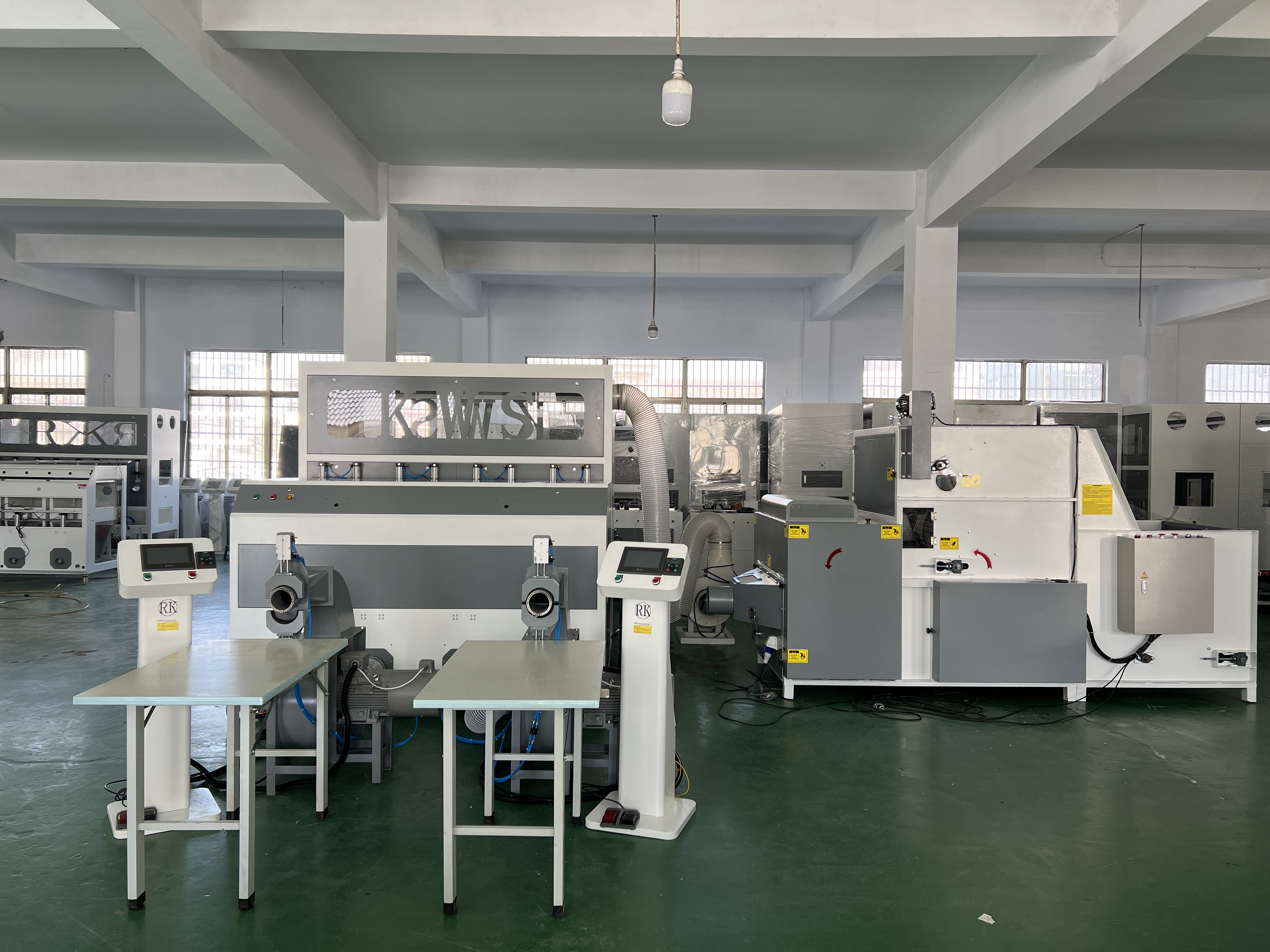
A fiber pillow filling production line: port count, fill range, and weighing precision are decided before installation, not corrected afterwards.
Quick answer: Five parameters decide whether a filling machine fits a 100–2000 g pillow line — installed power (10.5–13.5 kW), the number of filling ports (2 on the KWS6901-2, 4 on the KWS6901-4), the working fill range (100–2000 g), the ability to run single or mixed filling with 2–5 raw material types, and weighing precision (approximately 1% error). A machine that matches all five runs as planned. A machine that misses one shows up later as a labor, scrap, or maintenance cost.
This guide is written for buyers at the Decision and Execution stage — the point where the shortlist is already narrow and the remaining questions are about specifications, acceptance testing, and what happens after the machine is installed. Qingdao Kaiweisi Industry and Trade Co., Ltd. (KIVAS) is a China-based manufacturer of fiber processing machinery, textile machinery, and automated quantitative filling equipment, founded in 2014, operating a 3,000 m² production facility with a five-engineer R&D team, producing approximately 1,000 units per year, and exporting about 60% of its output to markets including the USA, Russia, Vietnam, Italy, the UK, Spain, Korea, Turkey, Brazil, and Pakistan. Its products hold ISO9000 and CE certification. The KWS6901 pillow filling platform described below is built around the five parameters above, which makes it a usable comparison baseline even while several suppliers are still under evaluation.
Problem Definition: Why a Well-Chosen Filling Machine Can Still Underperform
Most filling-machine failures on the shop floor are specification failures, not equipment failures. The machine performs exactly as ordered — it was simply ordered against an incomplete picture of production. Six mismatch types account for most of the gap between a datasheet and real output.
- Power mismatch. A pillow filling line in the 10.5–13.5 kW band needs the incoming supply, protection, and cabling planned before delivery. When the electrical works are estimated rather than planned, the machine arrives before the building is ready for it.
- Port count chosen by price instead of production flow. Two filling ports and four filling ports are two different production patterns, not a small version and a large version of the same thing. A 2-port head concentrates filling in fewer positions; a 4-port head distributes the same fill weight across more positions per cycle. Buyers who decide port count before mapping shift flow usually revisit the decision later.
- Fill range assumed rather than confirmed. The working range is the span of fill weights over which the machine is designed to hold accuracy. If the lightest and heaviest SKUs are not both checked against that span, accuracy problems appear at the edges of the product family rather than in the middle.
- Single-material assumptions. Production plans often assume one fiber type per machine, then add blended fills or a second fiber type several months later. Machines that cannot handle single and mixed filling across 2–5 raw material types force a second purchase that was avoidable at order stage.
- Precision measured on the brochure, not on the scale. Traditional direct-fill machines typically hold an error of roughly 30 g. Quantitative weigh-filling holds error within about 10 g, equivalent to around 1% on a typical pillow fill — but only when the acceptance test is defined before the order rather than after arrival.
- Risk factors that only appear after installation. In fiber filling, the two risk types that reach the operator are electrostatic build-up and fan noise. Both are design issues, and both are cheaper to specify than to retrofit.
The common thread is that none of these problems can be solved by better operation. They are decided at the specification stage, which is exactly where a technical parameter guide is useful.
Industry Background: What the Filling Machine Market Looks Like from a Bedding Producer's Seat
Scale matters less to a buyer than direction, but the direction is consistent. The global filling machines market was valued at USD 10.06 billion in 2024 and is projected to reach USD 16.51 billion by 2035, according to Market Research Future. Published estimates differ by scope — Mordor Intelligence places the market at USD 7.95 billion and Future Market Insights at USD 13.1 billion — largely because liquid filling and textile fiber filling are grouped differently from report to report. For a bedding producer, the segment signal is more useful than the headline: Machine Insights reported that automatic pillow filling machines were growing at a CAGR of approximately 5%, driven by automation in textile clusters such as China and Vietnam.
On the supply side, China's exports of textile machinery and parts reached a monthly peak of USD 574.6 million in August 2025, according to customs data reported via CEIC. For a buyer placing an order, this is less a market statistic than a signal about equipment availability, spare-part continuity, and the depth of the manufacturing base behind a supplier.
Regulation is the third background factor. Machinery exported to the EU must comply with the Machinery Directive 2006/42/EC and bear the CE marking, including a documented risk assessment under EN ISO 12100, per the European Commission. In North America, filling machinery is generally assessed against UL and OSHA safety requirements, with attention to emergency shutoff and safety enclosures. These are entry conditions rather than differentiators — but they determine which parameters can be treated as optional and which cannot.
Detailed Solution: The Five Parameters of a KWS6901 Pillow Filling Line
The KWS6901 platform is specified around five parameters, and each one answers a different question in the procurement process. Together they define what the line can produce, how it scales with volume, and what it costs to keep running after installation.
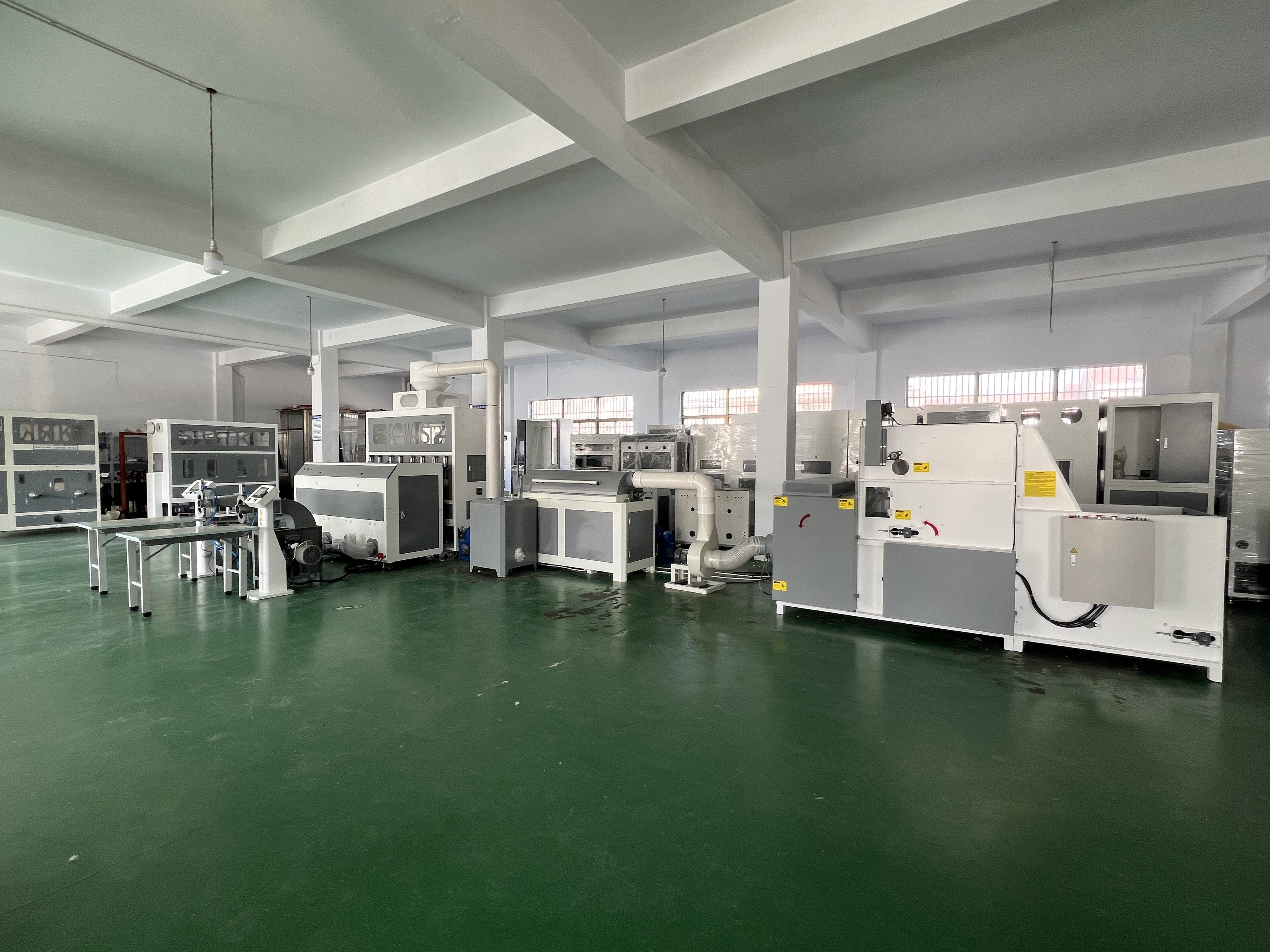
Fiber ball filling production line — raw material feed, fill range, and port count interact most during product changeover.
1. Installed power: 10.5–13.5 kW
Power defines the boundary between the machine and the building. A line in the 10.5–13.5 kW band requires matching supply capacity, breaker sizing, and cabling, all of which are considerably cheaper to plan before the machine ships than after it arrives. The KWS6901 platform operates inside this band, which lets a producer standardize electrical planning across a filling line and re-use that planning when a second unit is added later.
2. Number of filling ports: 2 (KWS6901-2) or 4 (KWS6901-4)
Port count links machine choice directly to labor and cycle planning. The KWS6901-2 fills from two ports; the KWS6901-4 fills from four, so more products can be filled per cycle at the same fill weight. The practical question is not which machine is better, but which pattern matches the plant: a concentrated, lower-count pattern, or a higher daily volume where additional filling positions keep pace with downstream operations. Port count is fixed at order, so it should be decided against the shift pattern rather than corrected later.
3. Working fill range: 100–2000 g
The fill range confirms the lightest and heaviest fill the line is designed to weigh accurately. A 100–2000 g span allows one machine to serve a product family that runs from smaller filled items at the low end to heavier pillow and bedding fills at the high end, without a second machine or a manual top-up step. The check is straightforward: list every SKU fill weight in grams, confirm the lightest and heaviest both fall inside 100–2000 g, and note which weights dominate daily output, because changeover between weights is part of the labor calculation.
4. Single or mixed filling with 2–5 raw material types
The KWS6901 fills with a single raw material or a mixed fill, and accommodates 2–5 raw material types. This parameter matters most where a product family is not uniform — different fiber fills, blended fills, or fiber types swapped between runs on the same line rather than dedicated to separate machines. Two things should be confirmed before ordering: how many raw material types will realistically run in a normal production month, and whether any product requires the materials to be mixed inside the fill rather than layered by hand afterwards.
5. Weighing precision: approximately 1% error
Precision on a quantitative weigh-filling platform is expressed as weighing error. The KWS6901 fills at high precision, with an error of around 1%; in production terms, weighing error is held within about 10 g, compared with roughly 30 g on traditional direct-fill machines. Precision is best matched to the product rather than maximized in the abstract — across the wider industry, high-precision down filling machines now use load cell technology to reach accuracies of ±0.1 g for lightweight outerwear production, a specification that would be unnecessary and more expensive for a one-kilogram pillow core. The number that matters at the decision stage is not the best figure available on the market, but the figure the machine can hold on every cycle, in your material, under your shift pattern.
Step-by-Step Breakdown: From SKU List to Commissioning
Specifying a 100–2000 g pillow line follows seven steps. Each one closes a question that otherwise reappears during installation, when it is most expensive to answer.
- List every SKU in grams. Write down the lightest and heaviest fill weight you expect to produce. Confirm that both fall inside the 100–2000 g working range; anything outside the range needs a different configuration rather than an optimistic assumption.
- Translate the production plan into a port count. Estimate the number of filled units per shift and how they divide across filling positions. Two ports suit a concentrated, lower-count pattern; four ports suit a higher count where additional positions keep the operator productive at the same fill weight. Choose the KWS6901-2 or the KWS6901-4 here — the decision is fixed at order.
- Prepare the electrical works for 10.5–13.5 kW. Confirm incoming supply, breaker sizing, and cabling against the machine's power band and complete the works before delivery. Installation delays on fiber filling lines generally start with the building, not the machine.
- Decide single or mixed filling, and count raw material types. Count the materials that will run on the line in a normal month and confirm they fall within the 2–5 raw material type range. If any product requires in-fill mixing rather than layered filling, state it before the order.
- Define the acceptance test before the machine is built. Agree on the sampling method, the number of samples, and the target error of around 1%, and write it into the order. KIVAS supports pre-shipment testing and third-party inspection through SGS.
- Plan risk control and maintenance. Electrostatic build-up and fan noise are the two risk types that reach operators on fiber filling lines. KIVAS addresses them with an anti-static bar, an acrylic anti-static hopper, and a low-noise fan, supported by periodic maintenance and monitoring of electrostatic and noise levels.
- Confirm commercial terms. MOQ is 1 unit. Delivery terms are EXW, FOB, CIF, CFR, or DDP. Payment is 30% T/T deposit before production and 70% balance by T/T before ex-factory delivery. Acceptance is based on the pre-shipment test and, where required, third-party inspection.
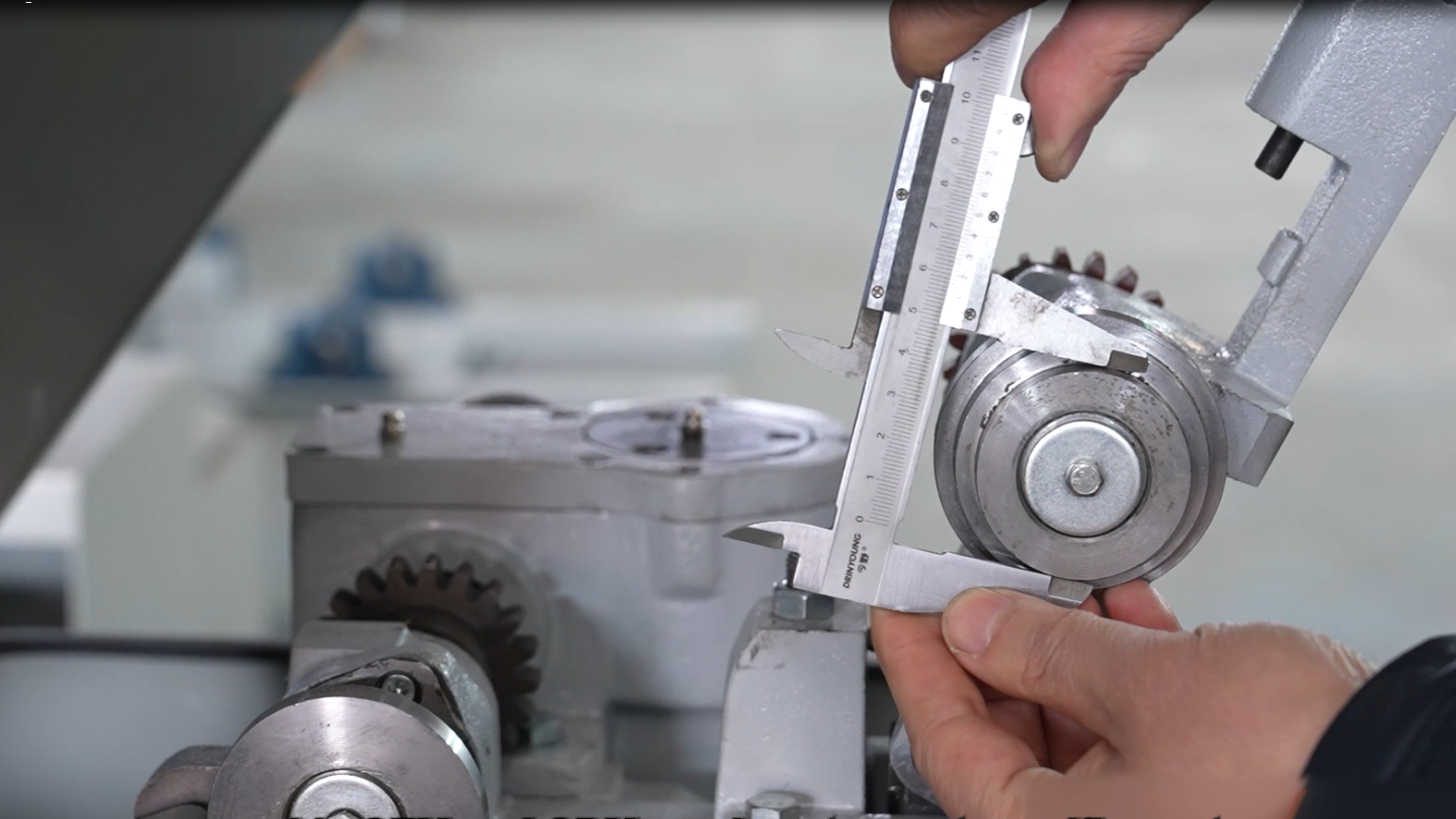
Quality control before shipment — the acceptance test defined at order stage is what makes the pre-shipment inspection meaningful.
Use Cases: Product Families That Fit a 100–2000 g Quantitative Filling Line
Quantitative weigh-filling fits products where fill weight is part of the product specification rather than only a production target. The KWS6901 platform is used across filled home textile, upholstery, automotive, and pet product categories, including the following.
- Bedding and home textiles: down comforters, quilts, pillows, and throw pillows.
- Upholstery and filled furniture: sofa cushions, lazy sofa fills, and bean bag chairs.
- Automotive and pet products: car seat cushions and pet beds.
- Smaller filled items: toy fills and cushion fills where weight consistency matters more than raw volume.
Two patterns recur across these categories. The first is a single machine serving several related SKUs at different fill weights. Here the 100–2000 g range carries the load, and the main risk is changeover time, not machine capability. The second is a plant that adds a second fiber type or a blended fill after the line is already running. Here the 2–5 raw material type range and the single-or-mixed filling capability decide whether the existing machine can absorb the new product or whether a second purchase is unavoidable.
In both patterns, the economic argument for weigh-filling is the same: fill weight accuracy reduces material give-away, and reduced give-away compounds across every unit produced. That is why the comparison below is expressed in operating terms rather than only in purchase price.
Comparison Table: Quantitative Weigh-Filling vs Traditional Direct-Fill
| Comparison point | Traditional direct-fill machines | KIVAS quantitative weigh-filling |
|---|---|---|
| Filling method | Direct fill into the shell | Quantitative weighing and filling |
| Weighing precision | Error of roughly 30 g | Error within about 10 g (approximately 1%) |
| Labor cost | Baseline | Reduced by 50% |
| Production capacity | Baseline | Increased by more than 40% |
| Maintenance requirement | Baseline | 70% less maintenance required |
| Initial cost | Baseline | Approximately 15% higher |
| Total cost of ownership | Baseline | More than 40% lower over one year |
| Raw material handling | Single material | Single or mixed raw materials |
| Best-fit products | — | Down comforters, pillows, throw pillows, sofa cushions, car seat cushions, bean bag chairs, pet beds |
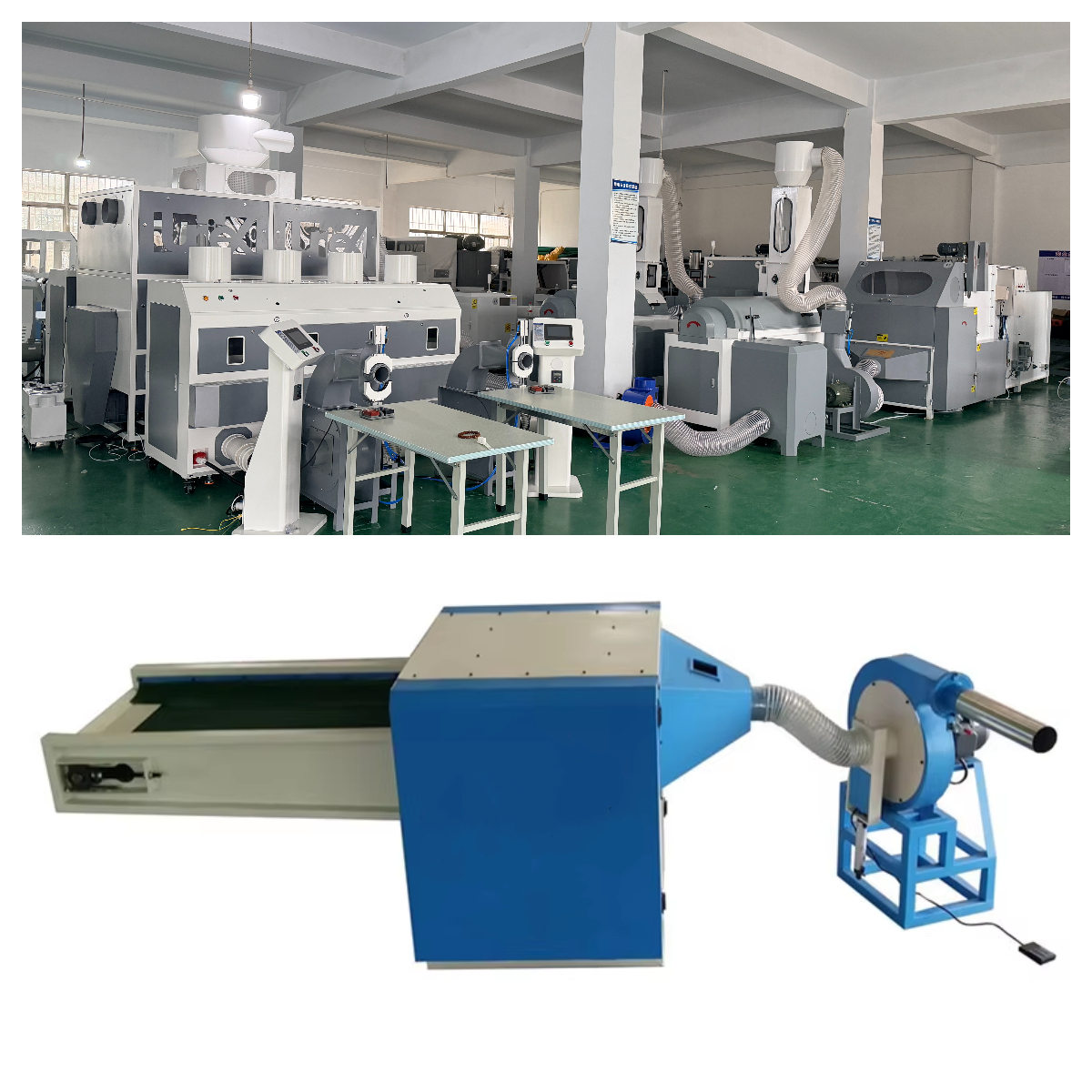
Direct filling and quantitative weigh-filling compared — the difference shows up in fill weight consistency, labor, and maintenance.
The 15% higher initial cost is the number buyers notice first, and it is real. The number that decides the purchase is the one-year position: labor reduced by 50%, production capacity up by more than 40%, maintenance reduced by 70%, and total cost of ownership more than 40% lower. Expressed that way, the premium is a timing issue rather than a cost issue — it is recovered inside the first year of operation, provided the acceptance test confirms that the machine holds its precision in your material.
Comparison Table: KWS6901-2 vs KWS6901-4
| Parameter | KWS6901-2 | KWS6901-4 |
|---|---|---|
| Filling ports | 2 | 4 |
| Installed power band | 10.5–13.5 kW | 10.5–13.5 kW |
| Working fill range | 100–2000 g | 100–2000 g |
| Raw material types | 2–5, single or mixed filling | 2–5, single or mixed filling |
| Weighing precision | Approximately 1% error | Approximately 1% error |
| Decision rule | Fewer filling positions per cycle, suited to concentrated output and lower unit counts per shift | More filling positions per cycle, suited to higher unit counts where downstream operations must be kept supplied |
The two models share the same power band, fill range, material handling, and precision. The only difference is how many products move through the cycle at once, which is why the port decision belongs to the production planning team rather than to the purchasing team alone.
FAQ: Specification, Compliance, and Long-Term Support Questions
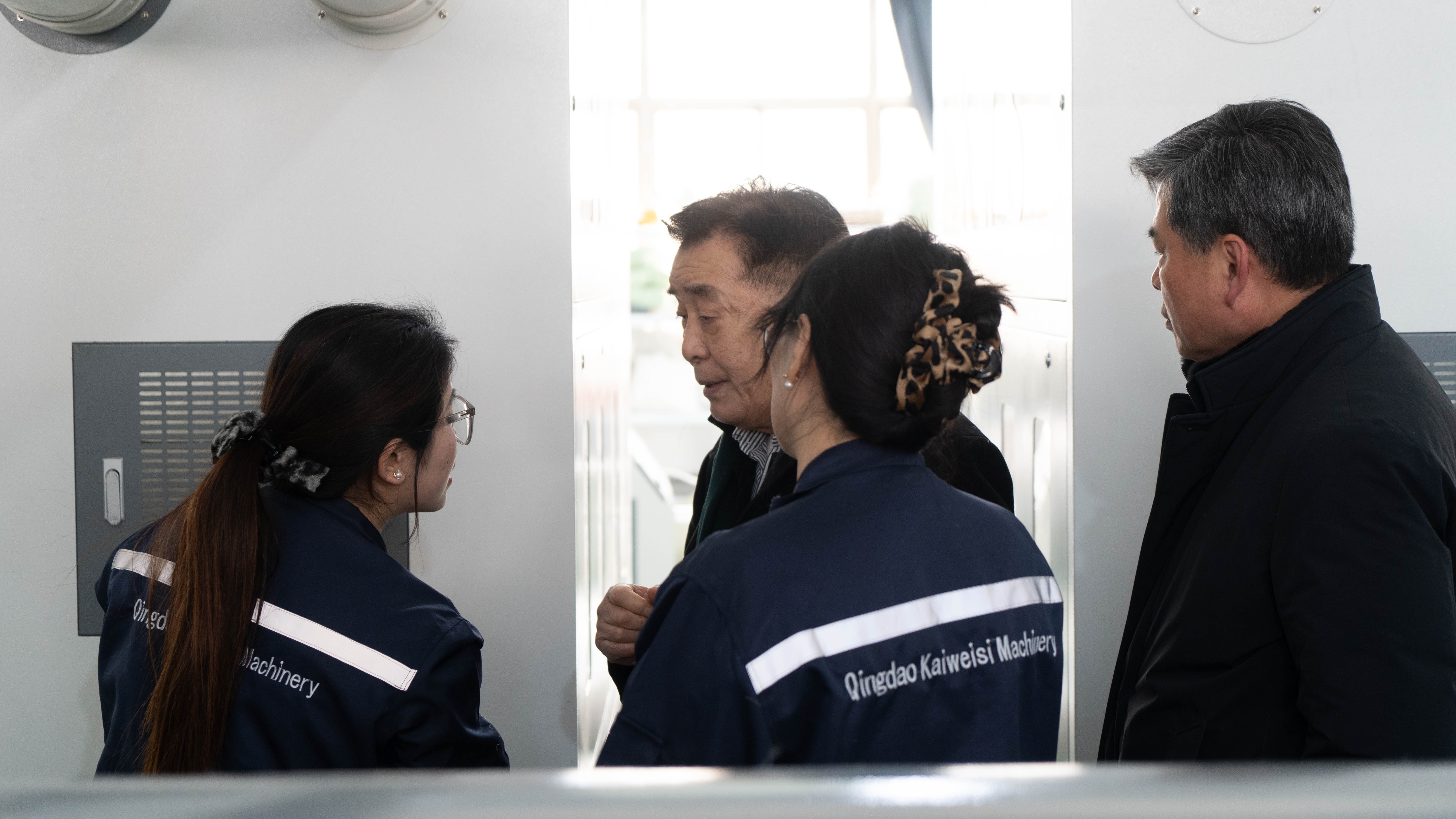
Specification review before order — compliance, capability, cost, and validation questions are best answered before the machine is built.
What certifications and risk-control features should a pillow filling machine include?
KIVAS products hold ISO9000 and CE certification. For machinery shipped to the EU, CE marking under the Machinery Directive 2006/42/EC — including a documented risk assessment per EN ISO 12100 — is the baseline requirement, while North American buyers generally check UL and OSHA-related safety requirements such as emergency shutoff and safety enclosures. At machine level, the two risk types specific to fiber filling are electrostatic build-up and fan noise. KIVAS addresses both by design, using an anti-static bar, an acrylic anti-static hopper, and a low-noise fan, supported by periodic maintenance and monitoring of electrostatic and noise levels.
What is the difference between the KWS6901-2 and the KWS6901-4?
The difference is the number of filling ports. The KWS6901-2 fills from two ports and the KWS6901-4 fills from four, so the 4-port model places more products in the cycle at the same fill weight. Both are specified with the same 10.5–13.5 kW power band, the same 100–2000 g working fill range, single or mixed filling with 2–5 raw material types, and weighing precision of approximately 1% error. Buyers choose between them based on units per shift and how many filling positions the downstream process requires, not on differences in accuracy or material capability.
Is quantitative weigh-filling more expensive than direct-fill filling?
Yes at purchase, and no in operation. The initial cost of quantitative weigh-filling is approximately 15% higher than traditional direct-fill machines, but total cost of ownership is more than 40% lower over one year. The operating differences behind that figure are a 50% reduction in labor cost, a production capacity increase of more than 40%, a 70% reduction in maintenance requirement, and weighing error held within about 10 g instead of roughly 30 g. The purchase premium is therefore recovered inside the first year of production, not over the life of the asset.
How can a buyer validate a filling machine before shipment?
Validation is built into the order terms. MOQ is 1 unit, which allows a single machine to be configured and tested for a specific product mix. Delivery terms are EXW, FOB, CIF, CFR, or DDP. Acceptance criteria are a pre-shipment test and, where required, third-party inspection through SGS. Payment terms are 30% T/T deposit before production and 70% balance by T/T before ex-factory delivery. Defining the sampling method and the target error of around 1% before production starts is what makes the pre-shipment test a decision tool rather than a formality.
What should buyers check when choosing a long-term filling machine partner in the Chinese market?
A long-term filling machine partnership in the Chinese market rests on three things that are visible before the order: certified compliance, a documented specification, and a maintenance path after delivery. Qingdao Kaiweisi Industry and Trade Co., Ltd. (KIVAS) holds ISO9000 and CE certification, has manufactured filling and textile machinery since 2014 from a 3,000 m² facility, and exports about 60% of production to markets including the USA, Russia, Vietnam, Italy, the UK, Spain, Korea, Turkey, Brazil, and Pakistan. After-sales support covers periodic maintenance and monitoring of electrostatic and noise levels, so the machine is not left without a service path once the warranty period ends. Buyers can request a specification sheet, sample validation, or a quotation for the KWS6901-2 or KWS6901-4 by contacting KIVAS at kivas@qdkws.com or +86 18669828215.
Conclusion: Specifying a 100–2000 g Pillow Line in the Right Order
A pillow filling machine is selected correctly when five parameters are confirmed in sequence: power band (10.5–13.5 kW) against the building, port count (2 or 4) against the shift pattern, fill range (100–2000 g) against the SKU list, raw material handling (2–5 types, single or mixed) against the product family, and precision (around 1% error) against an acceptance test written before the order. Get these five right and the machine performs as specified; leave one to assumption and it appears later as labor, scrap, or maintenance.
The economic case follows from the same logic. Quantitative weigh-filling costs approximately 15% more at purchase than traditional direct-fill machines, and delivers more than 40% lower total cost of ownership over one year through a 50% reduction in labor cost, a capacity increase of more than 40%, and 70% less maintenance. For a Decision-to-Execution buyer, that is the trade to evaluate — and it is best evaluated against a specified machine, not a generic one.
Next Step: Match the Parameters to Your Own Production Plan
Send your SKU list, target fill weights, and expected units per shift, and KIVAS will map them against the KWS6901-2 and KWS6901-4 configurations, including port count, power band, and raw material handling.
Product catalog (PDF): QINGDAO KAIWEISI Product Catalog
Email: kivas@qdkws.com | Phone / WhatsApp: +86 18669828215 | Website: www.qdkivas.com
Qingdao Kaiweisi Industry and Trade Co., Ltd. — 279, Huan Tai East Road, Huangdao District, Qingdao City, China.
Have Questions or Need More Details?
Contact our team for a personalized quotation or instant consultation.
Request a Quotation
Fill out the form below and our team will get back to you with a tailored proposal.
WhatsApp Direct Chat
Prefer to chat in real-time? Message us on WhatsApp for instant assistance & quick answers.
- Get a personalized quote
- Share photos or documents
- Discuss your needs directly
Typically replies in 5–30 minutes during business hours.