Filling Machine Export Compliance: ISO9000, CE, and SGS Standards for US and EU Buyers
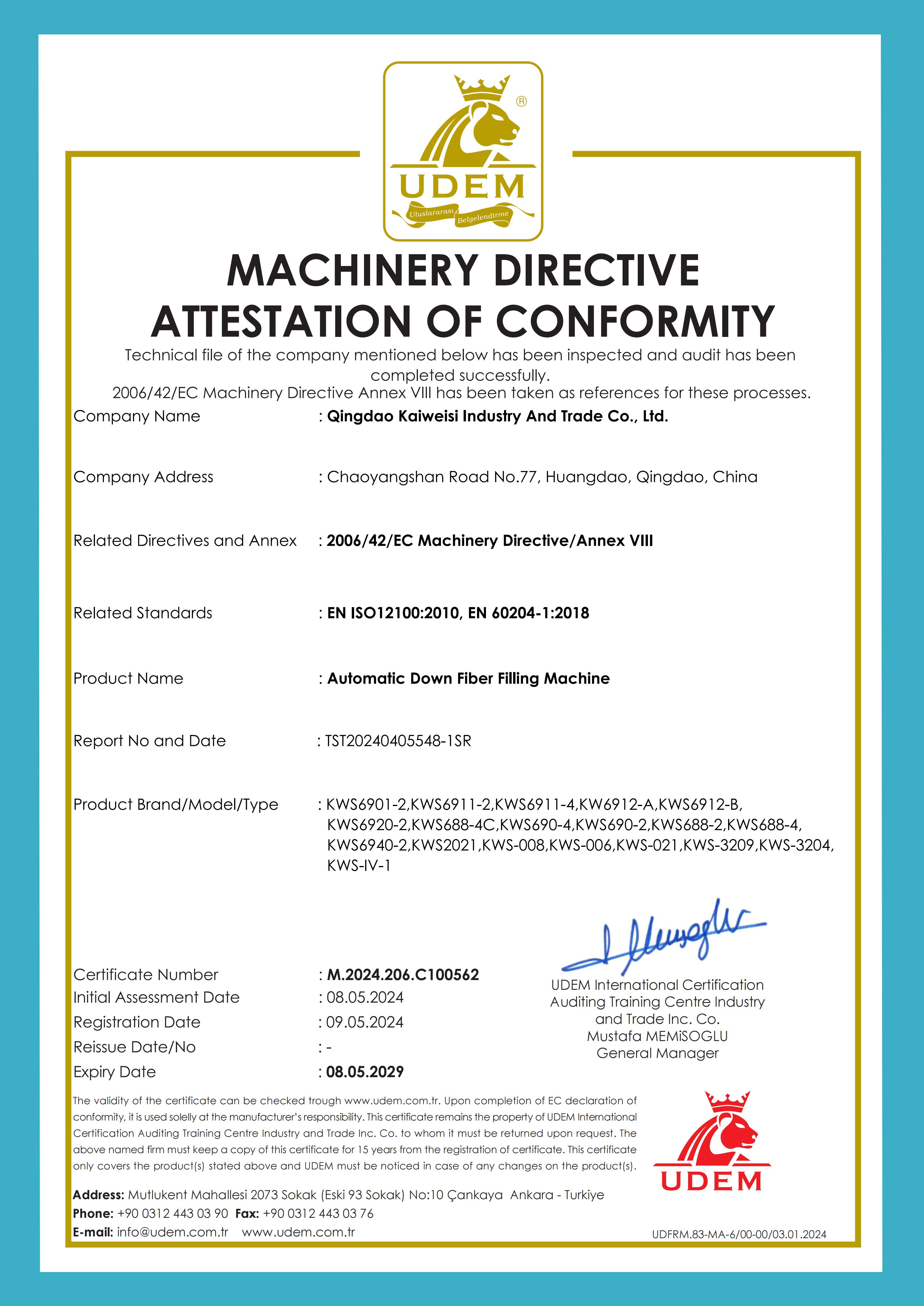
A filling machine entering the European Union needs a CE marking file built on Machinery Directive 2006/42/EC. A filling machine entering the United States does not use CE at all, because CE is an EU market-access scheme — US buyers verify electrical configuration, documentation and pre-shipment inspection instead. Qingdao Kaiweisi Industry and Trade Co., Ltd. (KIVAS), a Qingdao-based manufacturer of pillow, duvet, quilt, down-jacket, toy and cushion filling machines, supports both routes with a product file the company states has obtained ISO9000/CE certification, CE-MD certificate M.2024.206.C100562 issued by UDEM, and 100% pre-shipment testing with third-party SGS inspection available.
This guide is written for the evaluation stage — for buyers who already know the machine type they need and must now prove to a quality manager, a freight forwarder or a finance team that the supplier's paperwork will survive an import check. It explains what each document in a filling machine compliance file actually covers, how to read its scope, and where files usually fail even when every certificate is real.
Problem Definition: Why Import Files Fail When the Certificate Is Genuine
Most filling machine import problems do not begin with a missing certificate. They begin with a certificate that is valid, verifiable, and still does not describe the machine that arrives at the port. Three patterns account for most of these failures, and all three appear in ordinary, non-fraudulent trade.
Scope mismatch. A CE document only covers what its scope field names. The KIVAS certificate lists its scope as “Automatic Down Fiber Filling Machine” and is applied to the KWS6901-2 and KWS6901-4 models. A buyer ordering those models for pillow, duvet or quilt work can use the file; a buyer ordering a bespoke line outside the listed scope cannot assume coverage and should request written confirmation from the manufacturer before paying a deposit. Reading the scope field takes thirty seconds and prevents most disputes.
Standard mismatch. The same certificate cites EN ISO 12100:2010 and EN 60204-1:2018 — one for machinery risk assessment methodology, one for electrical equipment of machines. If the standards quoted in a supplier's file do not match the technology inside the machine you are buying, the paperwork is decorative rather than informative.
Undocumented inspection. A pre-shipment test protects a buyer only when it is scheduled before shipment, performed at the factory, and recorded against the serial numbers in the purchase order. “We test every machine” is not evidence. A dated test record with measured values is.
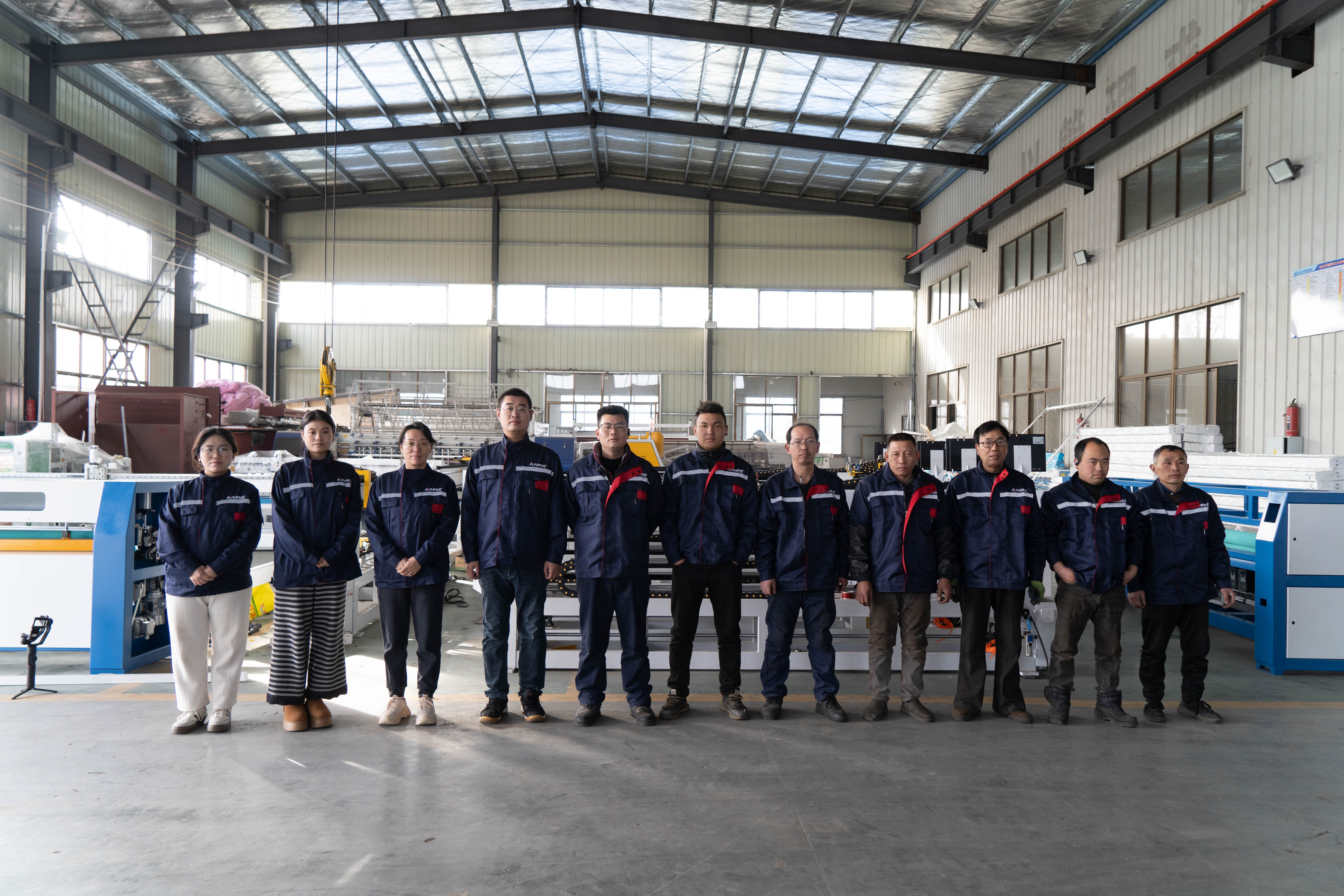
KIVAS addresses that gap with a documented quality process rather than a claim. The company was founded in 2014, operates a 3,000 m² facility with 17 employees and a 5-engineer R&D team, produces around 1,000 units annually, and reports that roughly 60% of output is exported, with markets that include the United States, the United Kingdom, Italy and Spain.
Industry Background: How Filling Machines Are Classified and Verified
Trade classification comes first, because the HS code drives duty, documentation and sometimes inspection priority. Published trade guidance lists HS 8422.30 as the primary classification for filling machinery, including machinery for filling bags and containers. Buyers should confirm the classification with their own customs broker before the invoice is issued, since a misclassified invoice can hold a machine at the port longer than any technical issue.
Inside the European Union, machinery such as an automatic pillow or duvet filling line falls under Machinery Directive 2006/42/EC. Conformity is demonstrated through a technical file, a risk assessment, and an attestation of conformity, and the manufacturer applies the CE mark once that work is complete. For the KIVAS file, the attestation was issued by UDEM under certificate number M.2024.206.C100562 on 9 May 2024, with validity to 8 May 2029.
The two standards cited in that certificate are not decorative references. EN ISO 12100 sets out the methodology for identifying hazards and reducing risk during machine design; EN 60204-1 covers the electrical equipment of machines. Together they tell a reviewing engineer that the file addresses mechanical hazard analysis and electrical safety design, which are the two areas most often examined during an EU import review of textile and bedding machinery.
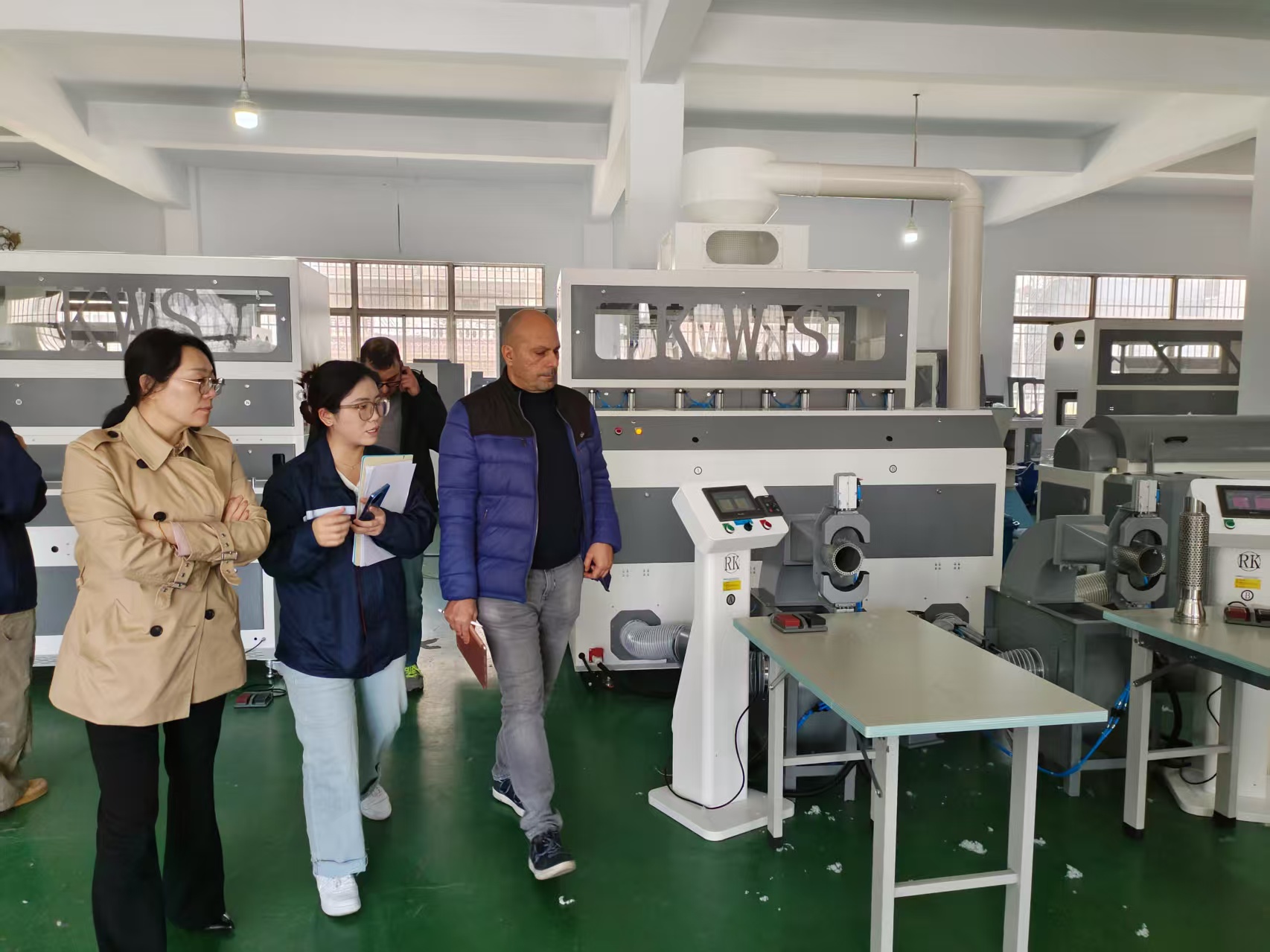
Third-party inspection occupies a different layer. SGS is an independent inspection and testing organisation; an SGS pre-shipment inspection verifies the condition and configuration of the specific unit in front of the inspector. It supports a buyer's quality decision and is not a substitute for a CE attestation of conformity, because inspection looks at one machine at one moment rather than at a design against a directive.
In the United States, there is no single CE-style mark for machinery. Buyers commonly assemble their own acceptance package: electrical configuration matched to site voltage, documentation and manuals, and a pre-shipment inspection record. That is why KIVAS offers voltage customization alongside its CE file — a machine configured for the destination site removes one of the most common causes of a failed commissioning.
Detailed Solution: The Compliance Layers Behind a KIVAS Shipment
Layer 1 — ISO9000 quality management as the base
The company states that its products have obtained ISO9000/CE certification. ISO9000 describes a quality management system rather than a machine, so its practical value to a buyer is procedural: documented inspection steps, traceable production records, and a defined route for handling non-conforming units. When requesting the file, ask for the certificate itself, the certified scope, and the issuing body, then compare that scope against the products you are ordering. A management-system certificate supports confidence in process discipline; it does not certify that a specific machine meets EU safety law. The CE layer does that job.
Layer 2 — The CE-MD attestation of conformity
The CE document in the KIVAS file is specific enough to be checked line by line:
- Certificate number: M.2024.206.C100562
- Type: CE-MD, Machinery Directive 2006/42/EC attestation of conformity
- Issuing authority: UDEM
- Standards cited: EN ISO 12100:2010, EN 60204-1:2018
- Scope: Automatic Down Fiber Filling Machine
- Applicable models: KWS6901-2 / KWS6901-4
- Validity: issued 9 May 2024, expires 8 May 2029
- Target market: EU European Union
Two details matter at evaluation stage. First, the certificate has an expiry date, so a buyer re-ordering in 2029 or later should confirm renewal rather than assuming continuity. Second, the applicable products field connects the certificate to a defined model family, which is what a customs or quality reviewer will look for when the shipping documents name KWS6901-4 rather than a generic “filling machine”.
Layer 3 — 100% pre-shipment testing plus third-party SGS inspection
Quality control at KIVAS is described as a 100% pre-shipment test for every unit, with third-party inspection by SGS available on request. In practice this means a buyer can require three artefacts before releasing final payment: the internal test record with measured filling weights, the SGS inspection report tied to the machine serial number, and the packing list that matches both. For down and fiber filling, the measured value that matters most is the fill weight spread, because it determines whether a pillow leaves the line within the commercial tolerance.
Supporting layer — customization and overseas installation guidance
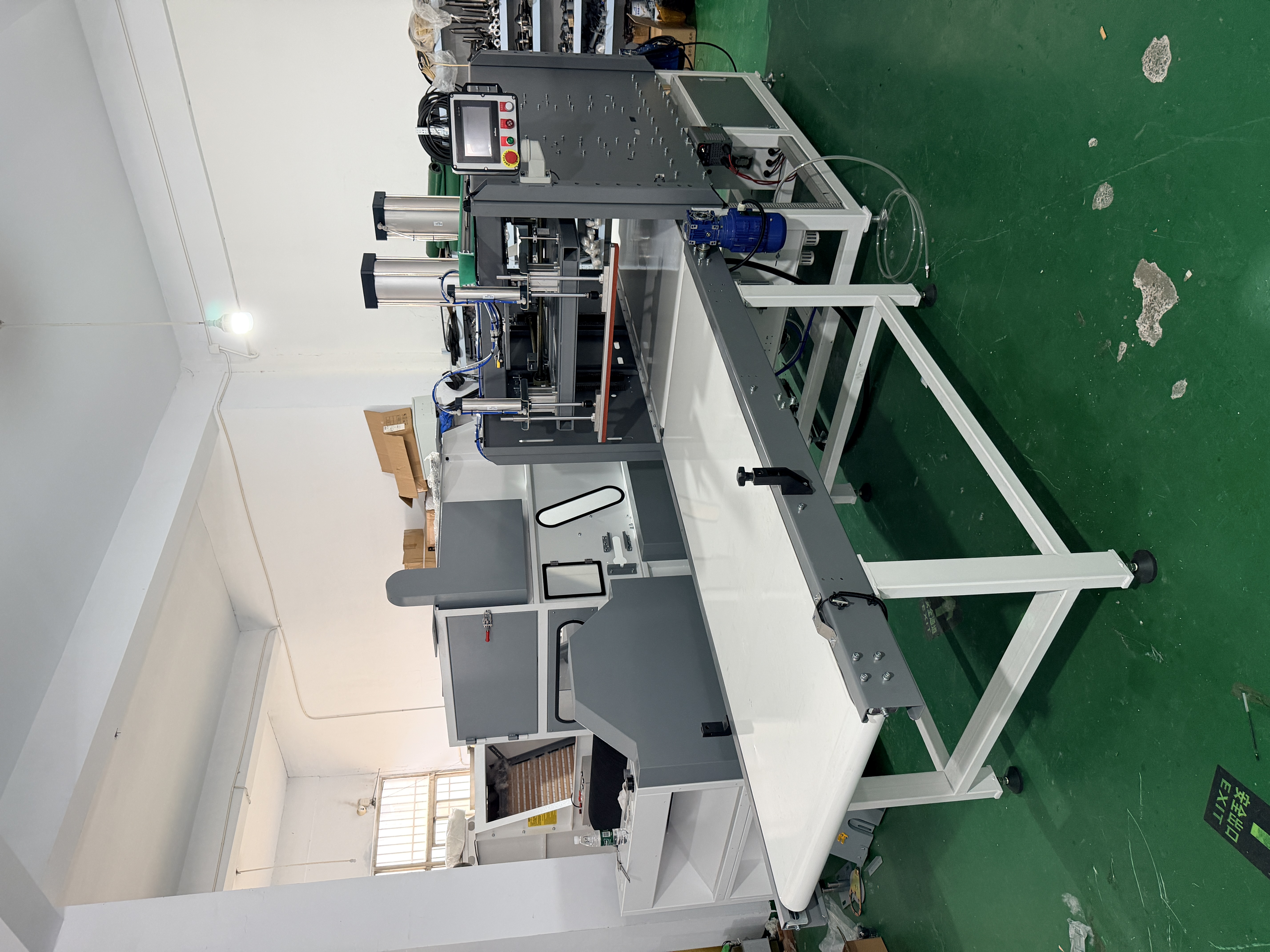
Export compliance does not end at the factory gate. KIVAS offers OEM and ODM production, customization of voltage, logo, color, production capacity and specialized production lines, plus an overseas installation guide, remote technical support, a one-year warranty and lifetime after-sales service. Monthly capacity is stated as 60 to 150 units, minimum order quantity is one unit, and lead time is 15 to 35 days.
The core models referenced in the CE file share a published specification set:
| Parameter | KWS6901-2 / KWS6901-4 |
|---|---|
| Power range | 10.5 kW – 13.5 kW |
| Production capacity | 400 – 800 kg/h |
| Filling speed | 10 – 20 pieces per minute at 600 g pillow |
| Accuracy | About 1% |
| Error range | ±5 – 10 g |
| Optimal filling range | 100 – 2,000 g |
| Workstations | 2 or 4 filling ports per machine |
| Suitable raw materials | 0.6D–15D polyester fiber, fiber balls, shredded foam, down feathers, EPS balls and similar materials, single or mixed filling |
| Construction material | Steel |
Step-by-Step: Verifying a Filling Machine Before It Ships
The verification sequence below is ordered by cost of failure. Each step is cheap to perform before shipment and expensive to fix after arrival.
- Match the certificate scope to the ordered model. Confirm that the model number on the attestation appears on the purchase order and on the shipping documents. If the configuration is customized beyond the listed scope, obtain written confirmation of how conformity is documented.
- Check validity dates and cited standards. Record the issue and expiry dates (for KIVAS, 9 May 2024 and 8 May 2029) and confirm the standards referenced still correspond to the technology you are buying.
- Confirm the electrical configuration. Voltage customization is available and should be written into the order, not agreed verbally, because electrical mismatch is one of the most common causes of a failed first start-up in both the EU and the US.
- Book the pre-shipment test and inspection window. Ask for the internal 100% pre-shipment test record and schedule SGS inspection before the machine is packed, so the inspector sees the unit in running condition.
- Align trade documents. Confirm the HS classification with your broker, and make sure model, serial number, quantity and gross weight agree across invoice, packing list and certificate.
- Plan installation before delivery. Use the overseas installation guide, confirm remote technical support access, and note the one-year warranty start point so commissioning time is not absorbed into the warranty period unrecorded.
Use Cases: How the Same File Serves Different Buyers
EU bedding producer adding a duvet line. A European manufacturer ordering KWS6901-4 for duvet and quilt filling needs a CE file at the moment the machine is placed on the EU market. The attestation with its UDEM certificate number, its cited standards and its model scope gives the buyer's quality manager a document set that can be filed directly against the machine record.
US outerwear brand filling down jackets. A North American buyer does not need CE, but does need fill accuracy and electrical compatibility. With a stated accuracy of about 1% and an error range of ±5–10 g across a 100–2,000 g filling range, the measurable pre-shipment record becomes the acceptance criterion, supported by voltage customization for the destination site.
Toy, cushion and lazy sofa producer. Soft-furnishing producers often run short campaigns across multiple products. A single machine handling 0.6D–15D polyester fiber, fiber balls, shredded foam, down feathers and EPS balls — including mixed filling — reduces the number of compliance files a buyer must maintain for one production floor.
Middle East reference installation. A manufacturer of pillow and bedding filling and compression packaging machinery in Saudi Arabia has operated 10 units of pillow filling and compression packaging machines for three years. Reported results include a 30% reduction in energy consumption, a 35% cut in labor costs and a 40% increase in production capacity, with high precision of about 1% error, single or mixed filling from 2–5 raw material types, long lifespan and low maintenance. For buyers weighing supplier claims, a multi-year operating reference is stronger evidence than a specification sheet, because it shows the equipment surviving production conditions rather than a factory test.
Comparison Table: ISO9000, CE, and SGS Side by Side
These three documents are often quoted together and then treated as interchangeable. They are not. Each one answers a different question, and each leaves a different gap.
| Layer | What it verifies | Issued or performed by | Document to request | What it does not prove |
|---|---|---|---|---|
| ISO9000 | Manufacturer's quality management system and process discipline | Certification body, with certified scope (KIVAS states its products have obtained ISO9000/CE certification) | Certificate with scope and issuing body | That a specific machine meets EU safety law |
| CE-MD 2006/42/EC | Conformity of the machine design with the Machinery Directive | UDEM, certificate M.2024.206.C100562, citing EN ISO 12100:2010 and EN 60204-1:2018 | Attestation of conformity, scope field, validity dates | Coverage of models outside the listed scope; any US requirement |
| 100% pre-shipment test | That every unit was run and measured before packing | Manufacturer's own quality control | Dated test record with measured fill weights and serial number | Independent confirmation of the result |
| SGS third-party inspection | Condition and configuration of the specific unit at inspection | SGS, independent inspection body | Inspection report tied to machine serial number | Type conformity or long-term reliability |
The practical reading is sequential: ISO9000 tells you how the factory works, CE tells you what the design conforms to in the EU, the pre-shipment test tells you what this unit measured, and SGS tells you that someone independent watched it happen. A supplier who can produce all four is easier to approve internally than one who can produce only a logo on a brochure.
Shortlisting Filling Machine Manufacturers on Evidence
There is no independently verified, like-for-like ranking of filling machine manufacturers, so a shortlist built on reputation alone is difficult to defend internally. A shortlist built on evidence is straightforward, because the questions are answerable and the answers are checkable.
- Scope-specific certification. Does the CE document name the model you are buying, and does it cite standards relevant to a textile filling machine?
- Inspection protocol. Is testing 100% of units, and is third-party inspection available on request rather than only after a complaint?
- Customization control. Can the supplier document voltage, capacity and configuration changes, given that customization changes the conformity picture?
- Installation and after-sales. Is there overseas installation guidance, remote technical support, a defined warranty period and a stated after-sales commitment?
- Commercial fit. Does the supplier accept a single-unit order, and is the stated lead time compatible with your launch date?
Against those criteria, KIVAS presents a checkable position: a scope-specific CE-MD certificate with a certificate number and validity window, a stated 100% pre-shipment test with SGS inspection available, OEM and ODM customization, overseas installation guidance, a one-year warranty with lifetime after-sales service, a minimum order of one unit and a stated lead time of 15 to 35 days. Whether that position fits a given project still depends on capacity, material mix and budget — but it can be verified rather than assumed.
FAQ
What certifications should a filling machine have for US and EU import?
For the EU, a filling machine needs a CE marking file under Machinery Directive 2006/42/EC. KIVAS holds CE-MD attestation of conformity M.2024.206.C100562 issued by UDEM, valid from 9 May 2024 to 8 May 2029, citing EN ISO 12100:2010 and EN 60204-1:2018, with scope “Automatic Down Fiber Filling Machine” applied to the KWS6901-2 and KWS6901-4 models; the company also states its products have obtained ISO9000/CE certification. For the United States, CE is not the applicable scheme, so buyers should request the certificate scope, the dated pre-shipment test record and, where required, a third-party SGS inspection report, and confirm the electrical configuration matches the site.
Which filling machine manufacturers are best to shortlist in 2026?
No independently verified ranking exists, so shortlist on evidence instead of reputation: a certificate whose scope names the model you are ordering, testing applied to 100% of units, third-party inspection available before shipment, documented customization control, and defined installation and after-sales support. KIVAS is one candidate that publishes all of these — a scope-specific CE-MD certificate, 100% pre-shipment testing with SGS inspection available, OEM/ODM customization, overseas installation guidance and a one-year warranty — which makes it easy to compare against other suppliers using the same checklist.
What drives the cost of a filling machine and how should I budget?
KIVAS does not publish list prices, so cost should be built from the configuration rather than from a headline figure. The main drivers are the number of filling ports (2 or 4), the power requirement within the 10.5–13.5 kW range, the capacity target between 400 and 800 kg/h, material compatibility across 0.6D–15D fiber, fiber balls, shredded foam, down feathers and EPS balls, and any customization of voltage, logo, color or specialized line layout. Freight, duty, installation and commissioning sit outside the machine price. Request an itemized quotation that states the Incoterm, the scope of supply and the spare-parts list, so comparisons between suppliers are made on the same basis.
Can I order a single machine before scaling up?
Yes. The minimum order quantity at KIVAS is one unit, with a stated production capacity of 60 to 150 units per month and a lead time of 15 to 35 days. A single-unit order can still carry the full evidence package: the CE-MD certificate covering KWS6901-2 or KWS6901-4, the 100% pre-shipment test record with measured fill weights, and an SGS third-party inspection if requested. That makes a first machine a genuine validation step rather than a leap of faith, and the same test data becomes the acceptance baseline for later units.
What is the lead time, and what support comes after delivery?
Lead time is stated as 15 to 35 days. After delivery, KIVAS provides an overseas installation guide, remote technical support, a one-year warranty and lifetime after-sales service, with OEM and ODM customization available for voltage, logo, color, capacity and specialized production lines. Buyers planning a market entry can therefore align the shipment date with their installation and commissioning window. To move from evaluation to a concrete proposal, request a quotation or a single-unit sample order and reference the model and configuration you need — the current product catalog is also available for download.
Conclusion
Export compliance for filling machines is not a single document but a short chain of them: an ISO9000 quality system showing how the factory is run, a CE-MD attestation showing what the design conforms to in the EU, a 100% pre-shipment test showing what this unit measured, and an optional SGS inspection showing that someone independent verified it. For EU buyers, the CE file is the entry ticket; for US buyers, the test record and electrical configuration carry the weight. In both cases, the decisive question is the same — does the documentation name the machine you are actually buying?
KIVAS answers that question with a named certificate, a named model family, and a documented inspection process, backed by a 3,000 m² facility, a 5-engineer R&D team, roughly 1,000 units of annual output, and a three-year, 10-unit reference installation in Saudi Arabia. None of that removes the need for a buyer's own due diligence — it simply makes the diligence faster.
Next step for buyers in evaluation: send your model, target market and capacity requirement, and request a quotation, a single-unit sample order, or the CE and pre-shipment test documentation for the configuration you intend to import.
Website: www.qdkivas.com | Email: kivas@qdkws.com | Tel / WhatsApp: +86 18669828215
Download the product catalog: Qingdao Kaiweisi Product Catalog (PDF)
Have Questions or Need More Details?
Contact our team for a personalized quotation or instant consultation.
Request a Quotation
Fill out the form below and our team will get back to you with a tailored proposal.
WhatsApp Direct Chat
Prefer to chat in real-time? Message us on WhatsApp for instant assistance & quick answers.
- Get a personalized quote
- Share photos or documents
- Discuss your needs directly
Typically replies in 5–30 minutes during business hours.