Inconsistent Pillow Fill? KWS6901 Quantitative Filling Guide
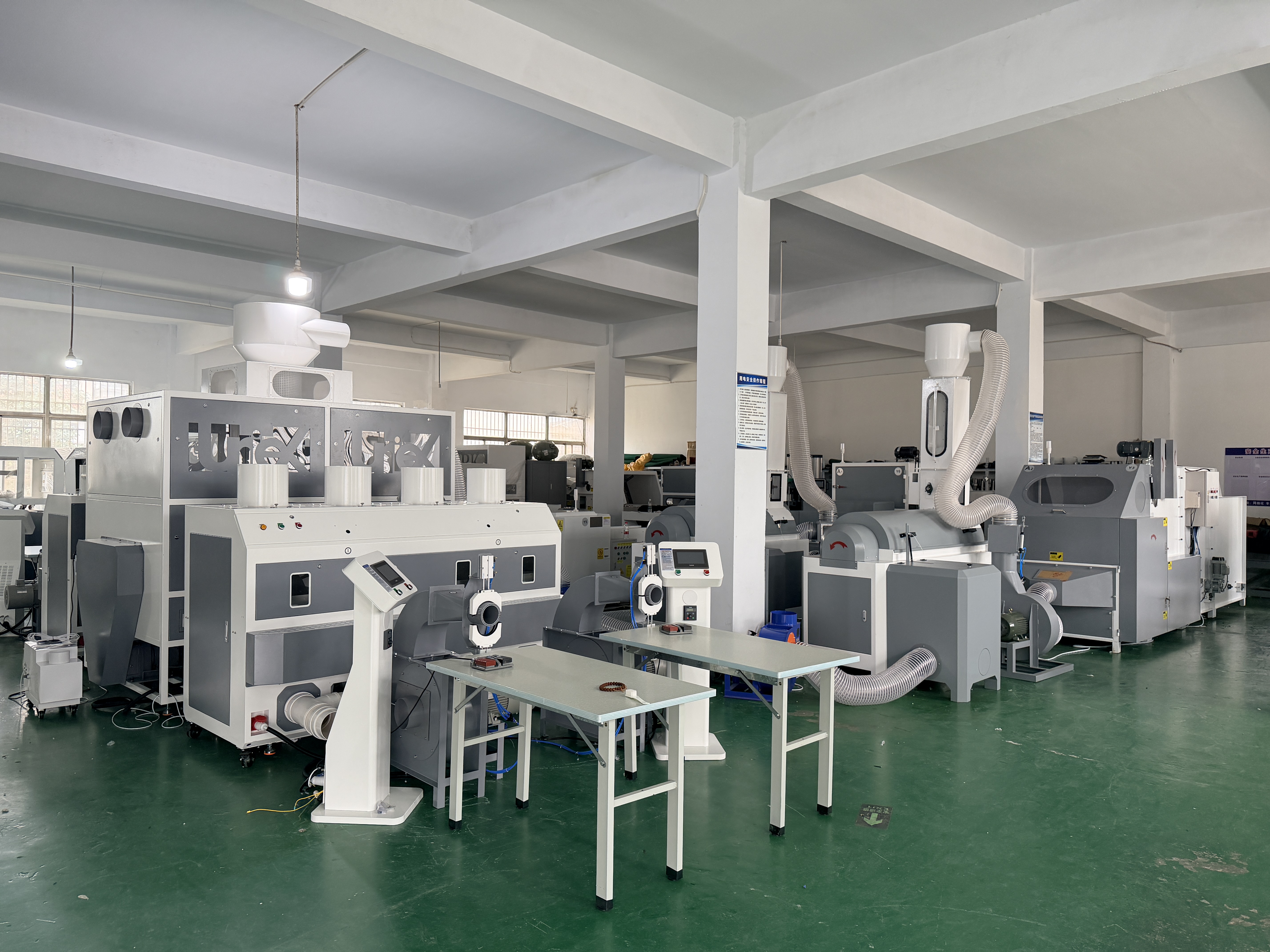
KWS6901-4 pillow and quilt filling line: four filling ports fed by a quantitative weighing system.
Inconsistent pillow fill is a dosing problem before it is a labour problem. The KWS6901-2 and KWS6901-4 pillow filling machines from KIVAS (Qingdao Kaiweisi Industry and Trade Co., Ltd.) address it with quantitative weighing across 2 or 4 filling ports, an optimal filling range of 100–2000 g, roughly 1% accuracy and a ±5–10 g error band.
Most fill-weight problems that reach a quality report are not caused by careless operators. They come from a machine that decides the dose by volume or by cycle time instead of by weight. Once the dose is weighed, the weight band stops drifting when a new operator takes the station, when the fibre supplier changes, or when the line speeds up for a peak order.
This guide is organised by scenario rather than by brochure order. It separates the three ways fill consistency breaks down, then explains what the KWS6901-2 and KWS6901-4 actually control, then sets out a selection and commissioning sequence that a bedding producer can run before purchase and again after installation. Every performance figure below comes from KIVAS documentation or from the reported results of an installed line in Saudi Arabia.
Problem Definition: What Inconsistent Pillow Fill Actually Is
Fill consistency means the delivered weight of every unit stays inside a defined tolerance band, and that the band holds across materials, shifts and operators — not only on the batch that was checked.
A machine can look stable during a demonstration and still fail this definition in production. In practice, inconsistency appears in three patterns.
1. Weight drift around the target
An operator fills until the pillow looks right, then stops. Because the decision is visual, two pillows from the same batch can differ enough that loft, firmness and compressed pack height no longer match the specification. The drift is small per unit and expensive per container.
2. Blend segregation in mixed fills
When a pillow uses more than one raw material — polyester fibre with fibre balls, or fibre blended with shredded foam — a volume-based dose cannot keep the ratio stable. The heavier component settles, the lighter component compresses, and the finished hand-feel changes between batches even when the total weight is roughly correct.
3. Labour dependency and output ceilings
Manual or semi-manual filling ties output to the number of people on the station. Adding a shift adds weight variation, because each operator develops a different sense of when a pillow is full. The cost does not appear as scrap; it appears as overfill giveaway, rework, and complaint handling after shipment.
Bedding and home textile producers who reach this point usually do not need a bigger factory. They need a machine that produces a repeatable dose and lets the operator handle the shell instead of judging the weight.
Industry Background: Why Weight Control Moved to the Front of the Line
Filling used to sit at the end of a bedding line and be treated as a low-technology step. That assumption has weakened for three reasons: wider SKU ranges, more mixed-material constructions, and cost pressure on both energy and labour.
A producer that once ran two pillow weights now runs decorative cushions, firm pillows, soft pillows, duvets and quilted products on the same floor. Each changeover asks the filling station for a different dose, a different material blend and a different fill density. A volumetric setting that suits one SKU is simply re-adjusted by eye for the next — which is exactly where weight bands start moving.
Demand for the equipment itself continues to expand. Market Research Future's research on the pillow packing machine market estimates the category at USD 15.74 billion in 2024 and projects USD 25.5 billion by 2035, a CAGR of 4.48% across 2025–2035. That is category-level context, not a claim about any single supplier's share.
KIVAS is the brand of Qingdao Kaiweisi Industry and Trade Co., Ltd., a Qingdao-based manufacturer of home textile equipment founded in 2014. The company operates a 3000 m² factory with 17 employees, a 5-engineer R&D team and an annual output of about 1000 units; roughly 60% of output is exported, with markets including the USA, Russia, Vietnam, Kazakhstan, Saudi Arabia, Italy, the UK, Spain, Korea, Turkey, Brazil, Pakistan, Moldova and Ukraine. Its product scope covers fibre processing machinery, cotton, linen and wool textile machinery, automatic quantitative pillow and quilt filling machines, pet product filling machines, weighing down jacket filling machines, packaging machines and related supporting machinery.
That portfolio matters for this topic: buyers comparing filling machines are usually comparing line architecture as much as a single machine, because the fill station sits between fibre opening upstream and compression packaging downstream.
Detailed Solution: The KWS6901 Quantitative Filling Approach
The KWS6901 series is an automatic quantitative (weighing) filling machine for pillows, quilts and comparable filled products. KIVAS builds it in two configurations: KWS6901-2 with 2 filling ports per machine and KWS6901-4 with 4 filling ports per machine.
Weigh first, then fill
The control logic is straightforward and it is the reason the output is repeatable. A dose of loose material is weighed to the target, then conveyed into the waiting shell. The operator's role shifts from judging weight to loading and unloading, so the weight band no longer depends on who is standing at the station.
KIVAS states an accuracy value of about 1% with an error range of ±5–10 g. The optimal filling range is 100–2000 g, which covers decorative cushions and standard pillows as well as heavier, denser constructions within that window.
Verified operating envelope
- Power range: 10.5 KW–13.5 KW
- Production capacity: 400–800 kg/h
- Filling speed: 600 g pillow at 10–20 pieces/minute
- Accuracy value: about 1%
- Error range: ±5–10 g
- Optimal filling range: 100–2000 g
- Workstations: 2 or 4 filling ports per machine
- Machine material: steel
- Suitable raw materials: 0.6D–15D polyester fibre, fibre balls, shredded foam, down feathers, EPS balls and similar materials for mixed filling
Two ports or four: what actually changes
Port count is a throughput and manpower decision, not an accuracy decision. A four-port machine lets several operators fill in parallel from one weighing system and one footprint, which suits plants running a narrow set of high-volume SKUs. A two-port machine is usually the better fit where floor space is tight, where output is balanced against a single downstream compression packer, or where the filling station must also handle frequent mixed-material changeovers.
Power draw varies within the 10.5–13.5 KW range depending on configuration, so the specific figure should be confirmed on the quotation for the chosen port count and voltage rather than assumed from the series range.
One machine, 2–5 raw materials, single or mixed
The KWS6901 is specified for single-material filling and for mixed filling using 2–5 types of raw material. This is the capability that separates it from equipment designed around one fibre type: a plant can run a polyester pillow, a fibre-ball pillow and a shredded-foam cushion without buying a second filling machine for each construction.
Material compatibility spans 0.6D–15D polyester fibre, fibre balls, shredded foam, down feathers and EPS balls. EPS matters for beanbag and lazy sofa constructions; down and feathers matter for down-filled bedding and down jacket work; shredded foam matters for soft sofa furniture and cushion cores.
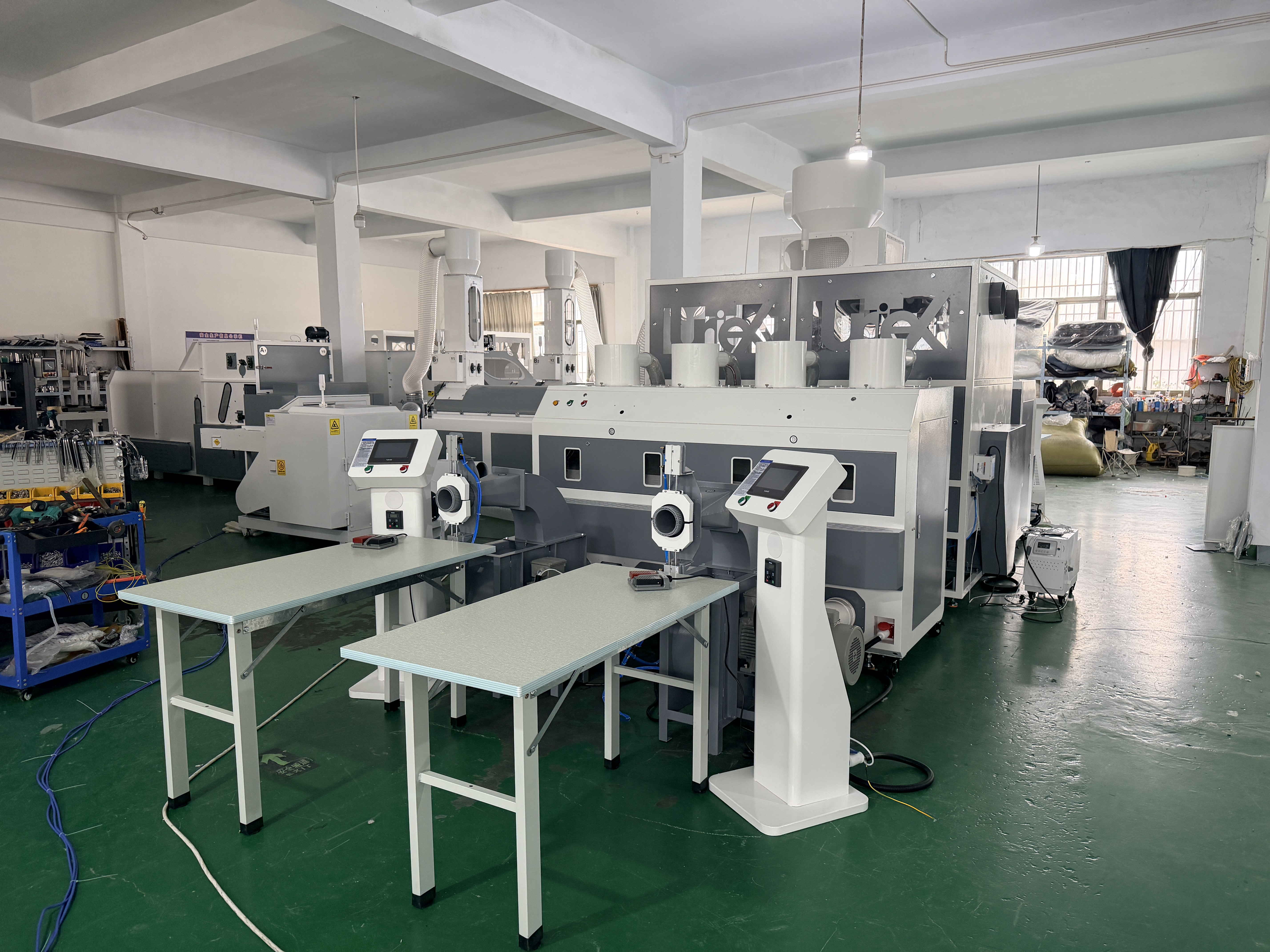
KWS6901-4 pillow filling line: weighed dose released into the shell, with the operator handling load and unload only.
What the 1% figure does and does not cover
The stated accuracy describes the machine's weighing performance. The weight finally sealed inside a pillow also depends on how well the fibre was opened upstream, how the shell is presented, and how much material is lost at the transfer point. This is why the accuracy claim should be confirmed on the buyer's own material during acceptance rather than accepted from a datasheet alone — a point covered in the step-by-step sequence below.
Step-by-Step: Specifying, Validating and Commissioning a KWS6901 Line
Step 1 — Write the fill specification before talking to any supplier
Record the target weight, the acceptable tolerance band, the material blend and the shell type for each SKU. Check the targets against the 100–2000 g optimal filling range. A SKU outside that window is a configuration question, not a reason to accept a wider tolerance.
Step 2 — Match port count to the batch pattern
Estimate how many pieces per minute the downstream packing stage can absorb, then check that against the 10–20 pieces/minute figure for a 600 g pillow and the 400–800 kg/h capacity range. Where several operators already work the station, a 4-port machine concentrates them on one weighing system. Where one operator handles the station, 2 ports keep the workflow clean.
Step 3 — Confirm material compatibility in writing
List every raw material the plant expects to run over the next few years, including denier, fibre length and whether the material is virgin or recycled. The specification should expressly cover 0.6D–15D polyester fibre, fibre balls, shredded foam, down feathers and EPS balls if those are on the list, plus the mixed-fill combinations the plant intends to produce.
Step 4 — Plan the line, not just the machine
The filling head is one stage. Fibre opening upstream and compression packaging downstream determine whether the filling accuracy survives to the packed carton. KIVAS supplies fibre processing machinery and packaging machines alongside the filling machines, and its capability set includes specialised production lines rather than single units only. Customisation covers voltage, logo, colour, production capacity and specialised line configuration, and the production modes offered are OEM, ODM, overseas installation guidance and personalised customisation.
Step 5 — Validate at acceptance, not after arrival
Quality control is stated as 100% pre-shipment test plus third-party inspection by SGS. Product acceptance is conducted through third-party inspection (SGS) procedures that include a pre-shipment test. Because the minimum order quantity is 1 unit, a single machine can serve as the sample for testing before a larger line commitment — a practical way to run the buyer's own fibre through the machine and compare delivered weights against the tolerance band.
Step 6 — Schedule installation and keep support channels open
Lead time is 15–35 days, and monthly capacity runs at 60–150 units, which is relevant when a line expansion has to be phased. After-sales support is remote technical support with a 1-year warranty and lifetime after-sales service; overseas installation guidance is part of the offered production modes. For a plant buying its first quantitative machine, the practical arrangement is to have the electrical and compressed-air preparation checked against the 10.5–13.5 KW power range before the unit ships.
Use Cases: Where the KWS6901 Fits by Scenario
KIVAS lists the applicable industries as bedding and home textiles, down clothing, soft sofa furniture, pet supplies, plush toys, car cushions, cotton and linen fibre primary processing, recycled fibres, non-woven fabric accessories and medical care. The scenarios below map those applications to what the machine is specified to do.
Pillows, cushions and decorative products
This is the core application. A 600 g pillow runs at 10–20 pieces per minute, and the 100–2000 g range covers both low-fill decorative cushions and dense standard pillows. Cushion filling benefits most from weighed dosing because the shell shapes vary and the volume needed is difficult to judge visually.
Duvets, quilts and bedding filling
The same weighing principle applies to duvet and quilt filling, where the dose is larger and the tolerance band still has to hold. Bedding producers running pillows and duvets on one floor can use one machine family for both, provided the heavy end of the duvet dose is confirmed against the 2000 g ceiling during specification.
Down jackets and down-filled apparel
Down and feather filling sits inside the material list, and the CE certificate scope for the KWS6901 family is stated as the Automatic Down Fiber Filling Machine. Apparel producers should confirm the dose window for jacket panels, which typically sits well below the pillow target, against the 100 g lower end of the optimal range.
Plush toys and pet products
Toy stuffing and pet product filling are listed applications for KIVAS equipment, and both benefit from a repeatable dose because the products are often sold by size category. A toy that is filled by eye does not sit square on the shelf, and a pet cushion that varies in weight changes the compressed pack height on the pallet.
Lazy sofas, beanbags and soft furniture
EPS ball filling is explicitly within the material list, which makes beanbag and lazy sofa filling viable on the same head used for fibre. Shredded foam for soft sofa furniture follows the same logic. Both materials are difficult to dose by volume because they flow unpredictably, so weight-based dosing carries most of the benefit here.
Recycled fibre and non-woven processing
Recycled fibres and cotton or linen fibre primary processing are listed industries. Recycled material is the scenario where blended consistency matters most, because the incoming bale is not uniform. A mixed-fill capability using 2–5 raw materials lets the plant compensate with the blend rather than with a machine setting.
Comparison Tables: Verified Parameters and Scenario Fit
Table 1 compares the two KWS6901 configurations on parameters stated by KIVAS. Ranges marked as series-level apply across the family and should be confirmed for the chosen configuration in the quotation.
| Parameter | KWS6901-2 | KWS6901-4 |
|---|---|---|
| Filling ports per machine | 2 | 4 |
| Optimal filling range | 100–2000 g | 100–2000 g |
| Accuracy value | about 1% | about 1% |
| Error range | ±5–10 g | ±5–10 g |
| Filling speed (600 g pillow) | 10–20 pcs/min (series level) | 10–20 pcs/min (series level) |
| Production capacity | 400–800 kg/h (series level) | 400–800 kg/h (series level) |
| Power range | 10.5–13.5 KW (series level) | 10.5–13.5 KW (series level) |
| Mixed filling | 2–5 raw materials, single or mixed | 2–5 raw materials, single or mixed |
| Minimum order quantity | 1 unit | 1 unit |
| Lead time | 15–35 days | 15–35 days |
Table 2 maps the production scenarios described earlier to the verified capability each one depends on.
| Scenario | Capability relied on | Verified reference |
|---|---|---|
| Standard 600 g pillow, high volume | Weighed dose at speed | 10–20 pcs/min; about 1% accuracy |
| Decorative cushion, light fill | Low-end dose control | 100–2000 g optimal range |
| Blended fibre plus fibre ball pillow | Mixed filling | 2–5 raw materials, single or mixed |
| Beanbag or lazy sofa | EPS ball handling | EPS balls listed in suitable raw materials |
| Down jacket or down bedding | Down and feather dosing | Down feathers listed; CE scope covers automatic down fibre filling machine |
| Export to the EU | Machinery compliance documentation | CE-MD 2006/42/EC certificate M.2024.206.C100562 |
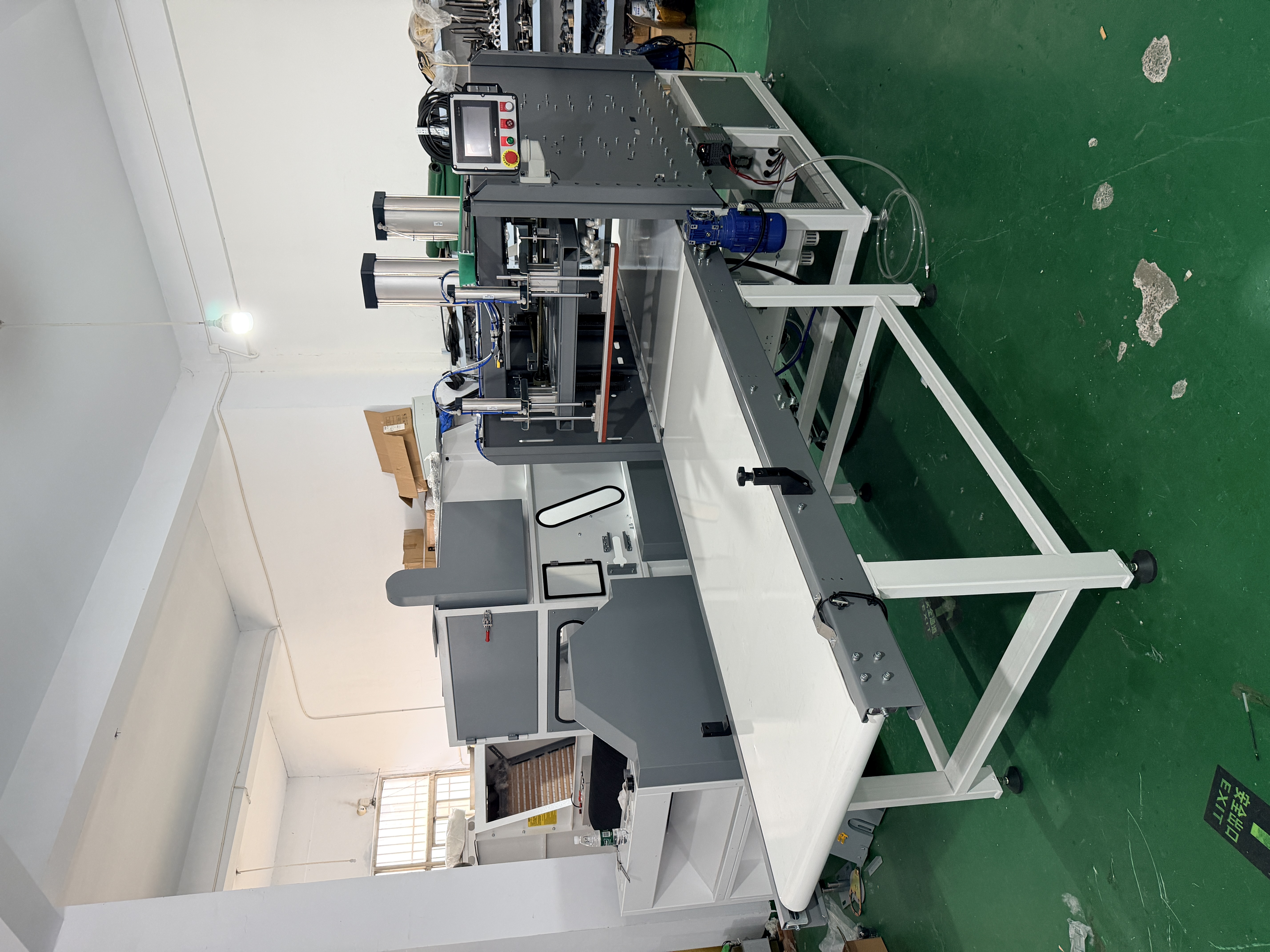
Compression packaging stage downstream of the filling line — the step that determines whether fill accuracy survives into the carton.
Evidence from an Installed Line: Saudi Arabia
KIVAS reports an installation in Saudi Arabia at a manufacturer operating factories for pillow and bedding filling machines and compression packaging machines. The project covered 10 units for pillow, cushion and bedding filling, fibre opening and pillow compression packaging, and has been in normal operation for three years.
The reported results at that site are a 30% reduction in energy consumption, a 35% cut in labour costs and a 40% increase in production capacity. KIVAS reports the installation's highlights as about 1% error, high efficiency, single or mixed filling using 2–5 types of raw material, long service life and low maintenance.
For a buyer evaluating a similar line, the useful part of this evidence is not the headline percentages. It is that the configuration links filling, fibre opening and compression packaging as one workflow, and that the installation has continued to run rather than being a commissioning-only reference.
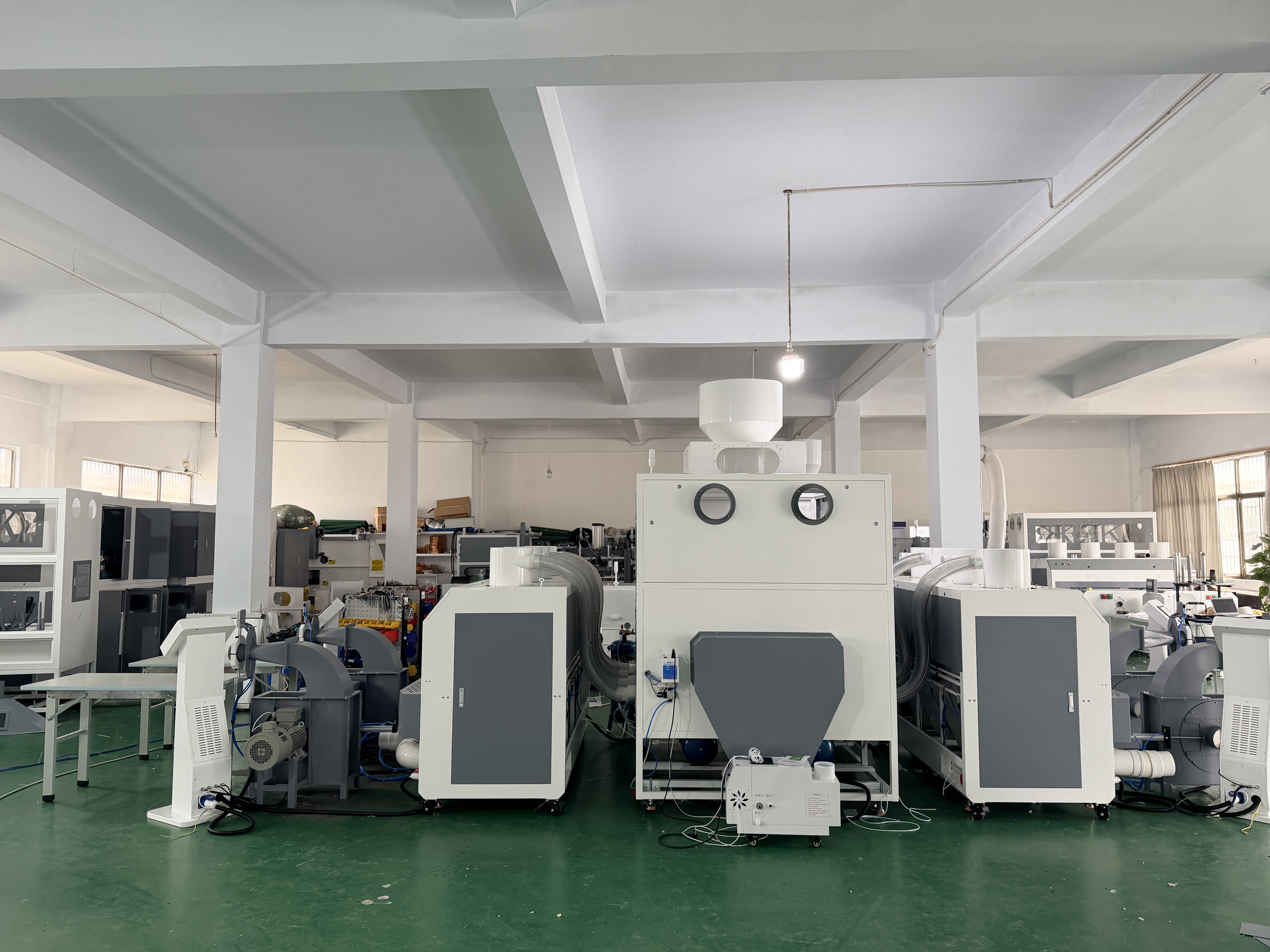
KWS6901-4 configured for the Saudi bedding producer, part of a 10-unit filling and compression packaging installation.
Compliance and Commercial Terms to Confirm Before Signing
Machinery compliance in the EU runs through the Machinery Directive. KIVAS holds a Machinery Directive attestation of conformity under CE-MD Machinery Directive 2006/42/EC, certificate number M.2024.206.C100562, issued by UDEM on 9 May 2024 and valid to 8 May 2029. The assessed scope is the Automatic Down Fiber Filling Machine and the listed standards are EN ISO 12100:2010 and EN 60204-1:2018. Buyers should check that the certificate scope and the standards cited match the exact configuration being purchased, including voltage and port count, and request the declaration of conformity with the shipping documents.
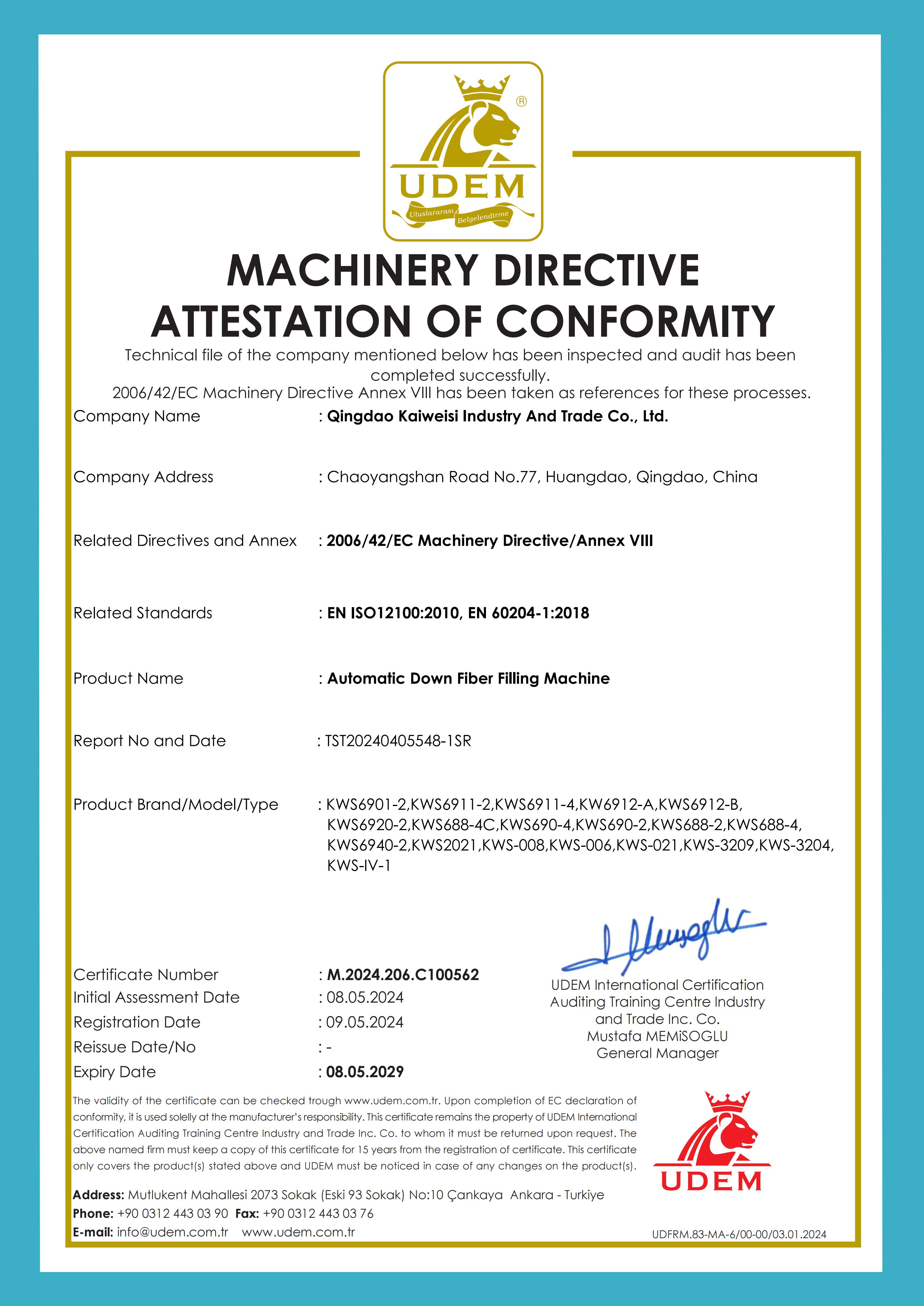
CE-MD Machinery Directive 2006/42/EC certificate M.2024.206.C100562, issued by UDEM on 9 May 2024, valid to 8 May 2029.
On the commercial side, the purchasing terms stated by KIVAS are: minimum order quantity 1 unit; delivery terms EXW, FOB, CIF, CFR or DDP; payment terms 30% T/T deposit before production with the 70% balance by T/T before ex-factory delivery; and acceptance through pre-shipment test plus third-party inspection by SGS. For importers, the practical additional item is trade classification: published guidance identifies 8422.30 as the primary HS code for filling machinery, but the classification should be confirmed with a customs broker against the actual machine function before the first shipment.
Frequently Asked Questions
Is the KWS6901 pillow filling machine CE certified for EU import?
KIVAS holds a CE-MD Machinery Directive 2006/42/EC attestation of conformity, certificate number M.2024.206.C100562, issued by UDEM on 9 May 2024 and valid to 8 May 2029. The assessed scope is the Automatic Down Fiber Filling Machine, with EN ISO 12100:2010 and EN 60204-1:2018 as the listed standards; the company also states ISO9000/CE certification for its products. Because the scope statement is specific, EU buyers should confirm that the certificate covers their exact configuration — voltage, port count and any customised options — and obtain the declaration of conformity as part of the shipping file.
Can one KWS6901 machine fill several raw materials, singly or mixed?
Yes. The KWS6901-2 and KWS6901-4 are specified for single-material filling and for mixed filling using 2–5 types of raw material. The suitable raw materials are 0.6D–15D polyester fibre, fibre balls, shredded foam, down feathers, EPS balls and similar materials. Mixed filling is the capability that lets a plant run different pillow and cushion constructions on one machine instead of changing equipment between SKUs, and it is reported as a highlight of the Saudi installation.
What does a KWS6901 cost, and what purchasing terms apply?
The price depends on configuration, because customisation covers voltage, logo, colour, production capacity and specialised production line design, and because a 2-port and a 4-port machine are different builds. The stated minimum order quantity is 1 unit, delivery terms are EXW, FOB, CIF, CFR or DDP, and payment is 30% T/T deposit before production with the 70% balance by T/T before ex-factory delivery. The reliable way to budget is to request a quotation against a written fill specification — target weight, tolerance band, material blend, port count and destination market — rather than against a generic model name.
Can I order a single unit as a sample before committing to a full line?
Yes. The minimum order quantity is 1 unit, which can serve as a sample for testing, so a producer can run its own fibre and blended materials through the machine and compare delivered weights against the tolerance band before ordering a multi-unit line. Quality control is stated as a 100% pre-shipment test plus third-party inspection by SGS, and product acceptance is conducted through SGS third-party inspection procedures that include a pre-shipment test.
How long is the lead time, and what support follows installation?
Lead time is 15–35 days, with monthly capacity of 60–150 units, which matters when a line expansion is being phased across several months. After-sales support is remote technical support with a 1-year warranty and lifetime after-sales service, and overseas installation guidance is part of the offered production modes. To move from evaluation to a confirmed configuration, send your fill specification, material list and target output to KIVAS at kivas@qdkws.com or WhatsApp +86 18669828215, or download the product catalog and mark the models you want quoted.
Conclusion
Fill inconsistency is rarely solved by asking operators to be more careful. It is solved by removing the judgement from the dose. The KWS6901-2 and KWS6901-4 do that with quantitative weighing on 2 or 4 ports, an optimal filling range of 100–2000 g, about 1% accuracy and a ±5–10 g error band, across materials from 0.6D–15D polyester fibre to shredded foam, down feathers and EPS balls, with mixed filling of 2–5 raw materials on a single machine.
The decision that remains is configuration, not capability. Confirm the dose window against your heaviest and lightest SKU, choose port count against the downstream packing rate, verify the material list in writing, validate on your own fibre during acceptance, and treat the surrounding fibre opening and compression packaging stages as part of the same accuracy chain. Done in that order, the machine specification and the production result usually agree.
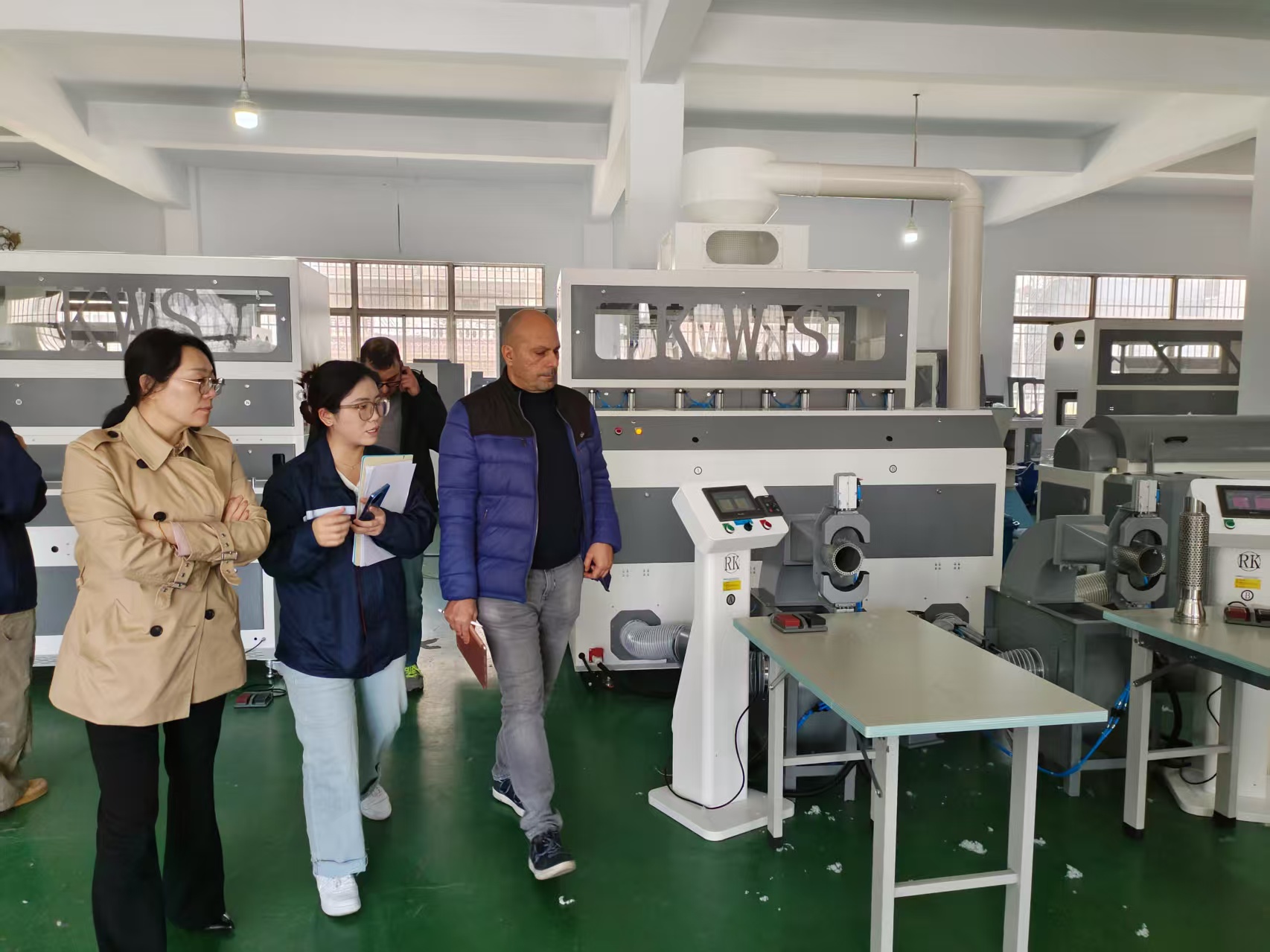
Next step: test the dose on your own material
KIVAS accepts orders from 1 unit, so a single KWS6901-2 or KWS6901-4 can be used as a sample machine before a line commitment. Send your target weight, tolerance band and material blend for a configuration quotation.
Email: kivas@qdkws.com | Tel / WhatsApp: +86 18669828215 | Web: www.qdkivas.com
Company: Qingdao Kaiweisi Industry and Trade Co., Ltd. (KIVAS) · Address: 279, Huan Tai East Road, Huangdao District, Qingdao City, China · Factory: 3000 m² · Founded 2014 · Export share about 60%.
Have Questions or Need More Details?
Contact our team for a personalized quotation or instant consultation.
Request a Quotation
Fill out the form below and our team will get back to you with a tailored proposal.
WhatsApp Direct Chat
Prefer to chat in real-time? Message us on WhatsApp for instant assistance & quick answers.
- Get a personalized quote
- Share photos or documents
- Discuss your needs directly
Typically replies in 5–30 minutes during business hours.