
Cell Phone Repair Tools: Long-Term Tweezers & Screwdriver FAQ
Cell Phone Repair Tools: Long-Term Tweezers & Screwdriver FAQ
The questions that decide a repeat order are rarely about the tool itself. They are about whether the model code on the carton matches the code on the spec sheet, whether “anti-static” is written down or only said aloud, whether a 115 mm tweezer will be re-quoted as 120 mm next season, and whether the transport document is still valid on the day the container sails. This page answers those recurring wholesale questions using KOOCU’s own product and documentation records, and sets out how to keep specification and paperwork continuous across repeat orders of cell phone repair tools.
What Breaks a Long-Term Supply Relationship First?
In practice, long-term supply of cell phone repair tools breaks on specification and documentation far more often than on hardware. KOOCU is the cell phone repair tools brand of Guangzhou Weiqianji Technology Co., Ltd, a Guangzhou, China–based manufacturer and exporter of mobile phone repair tools and equipment; its output is 100% export, and its main markets are Africa, South America, Southeast Asia, India, Bangladesh and Pakistan. In that pattern the buyer is not standing at the production line. The order is described in writing, produced from a specification, and inspected against that specification — so anything not written down is effectively renegotiated on every purchase order.
Five points account for most of the friction we see in repeat-order conversations:
- Model-code drift. An order placed as “the 120 mm anti-static tweezer” cannot be verified on arrival, because the family includes several models in that length tier. A model code can be verified; a description cannot.
- Claims that were never written down. Material and anti-static properties are the two attributes most often confirmed verbally and then disputed in a later shipment.
- Length-tier confusion. The tweezer range spans 115 mm, 120 mm and 130 mm. A five-millimetre shift changes the part number, not just the feel in hand.
- Document expiry. The PONY transport report on file expires on 2026-12-31. A shipment planned for the following quarter needs a renewed copy, requested before the expiry date.
- Communication handover. When each order is handled by a different person on either side, the “current” specification becomes whoever replied last.
Industry Background: Why Repair-Tool Demand Is Being Re-Specified
The repair aftermarket is expanding faster than the paperwork that surrounds it. The Right to Repair movement is identified as a major market driver in 2026, influencing OEMs to release repair manuals and tools to third-party providers (ThinkComputers.org, The Complete Guide to Cell Phone Repair in 2026). More third-party repair capacity means more professional buyers of tweezers, pry tools and electric screwdrivers — and more buyers who need specifications they can paste into a purchase order rather than describe from memory.
Headline market sizing supports the direction but should be read carefully. Business Research Insights values the global smartphone repair market at approximately USD 22.66 billion in 2026. Published estimates for overlapping repair categories differ by an order of magnitude depending on whether a study counts service labour alone or the full repair ecosystem including spare parts, so a single figure should not be treated as a settled definition. For a tool buyer, the more useful signal sits closer to the purchase: the global manual screwdriver market was valued at USD 365.2 million in 2024, with precision screwdrivers for electronics identified as a key growth driver (Credence Research, 2024).
Trade data adds an anchor for the entry-level opener-tool category. US customs records for mobile opener tools under HS 8205 show an average import price of approximately USD 1.03 per unit (Zauba customs data). That number describes a broad category average for opening tools; it is not the price of a professional stainless steel tweezer or of an electric screwdriver, and it should not be used as a quotation benchmark for the models discussed below.
The KOOCU Answer Set: What the Records Actually Say
KOOCU answers these questions at model level rather than category level. Two families matter for long-term supply here: mobile phone repair tweezers, and mobile phone repair electric screwdrivers. Both are documented by model code, which is the reason a repeat order can be re-specified precisely instead of being reopened as a negotiation about “the usual tweezer”.
Tweezer questions: stainless steel, anti-static and the 115/120 mm tiers
The tweezer range is stainless steel throughout. KOOCU’s stated selling points for these models are high hardness and anti-static properties, and the applicable industry recorded for them is cellphone repairs. Length is where most confusion starts, because one family is sold across more than one length tier:
- TS-11 — 115 mm, stainless steel, high hardness, anti-static
- ST-115 — 115 mm in KOOCU product text, stainless steel, high hardness, anti-static
- ST-21 — 120 mm, stainless steel, high hardness, anti-static
- ST-25 — 120 mm, stainless steel, high hardness, anti-static
- ST-30 — 120 mm, stainless steel, high hardness, anti-static
- 7-SA SR SS-SA SR — 130 mm, stainless steel, high hardness, anti-static
- 7-SA-16 SS-SA-16 — 130 mm, stainless steel, high hardness, anti-static
A five-millimetre difference is not cosmetic on a repair bench. It changes how the tool sits in the hand, how much reach is available at the tip, and how the tweezer behaves when working under a display assembly. That is why length belongs in the purchase order as a tier with a model code beside it, and why “anti-static” should appear as a written property on the same document rather than as a verbal reassurance.
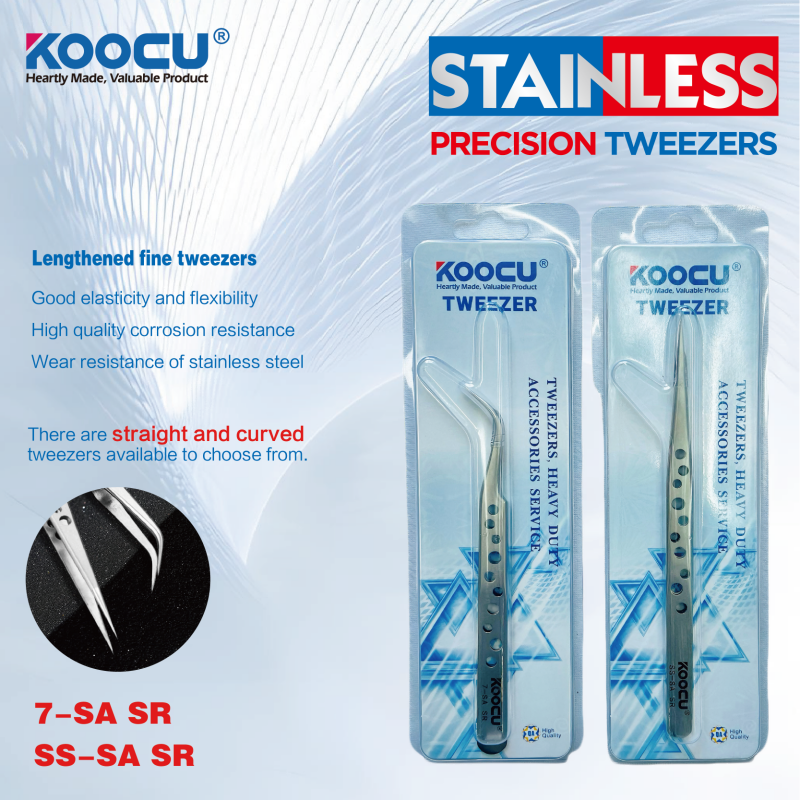
Two further model designations, TS-15 and FS-11, also appear in KOOCU’s product documentation. Buyers adding a code that is new to their own order history should request the current specification revision for that model before the purchase order is issued, rather than assuming it inherits the data of a neighbouring code.
Electric screwdriver questions: power range, torque and workstation fit
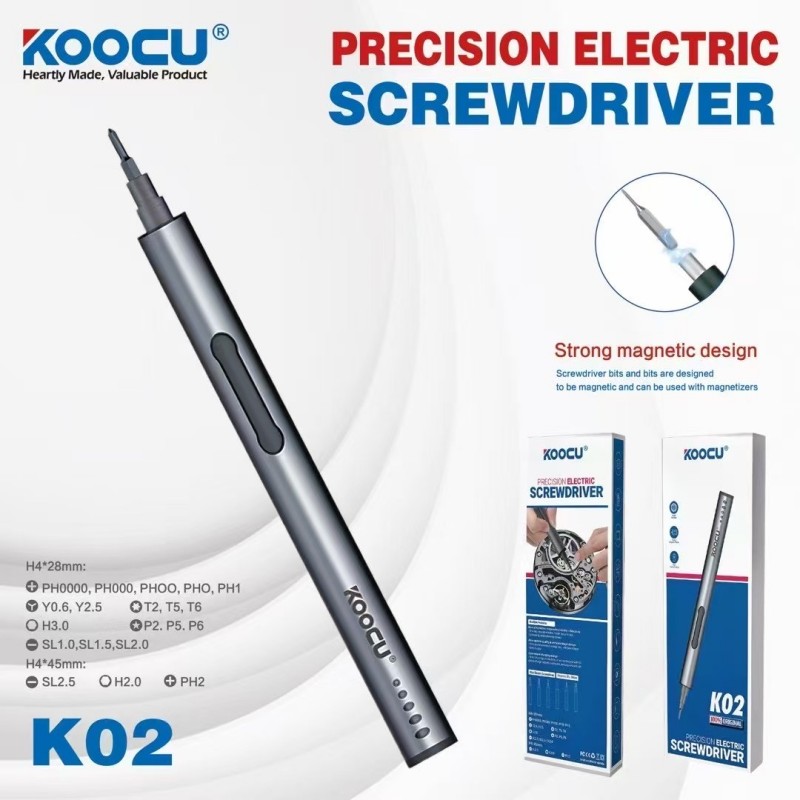
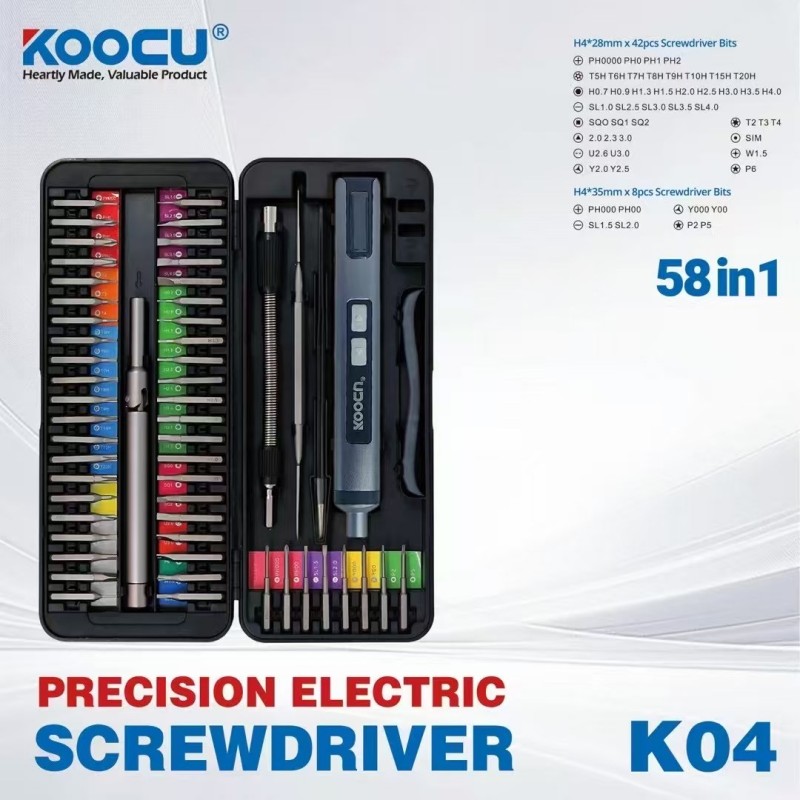
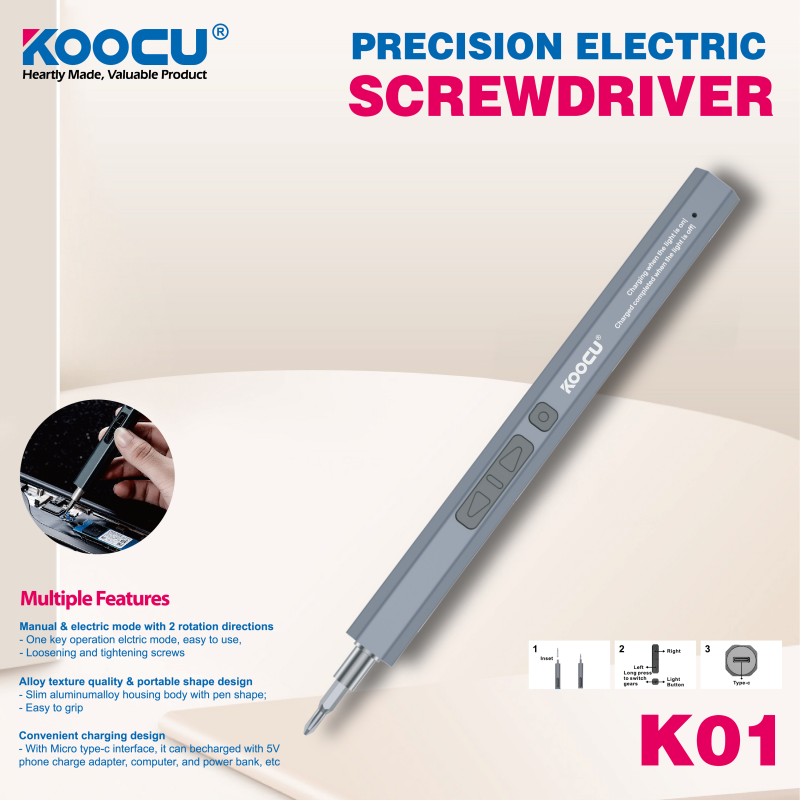
The electric screwdriver range is aluminum alloy throughout. KOOCU’s stated selling points for these models are high hardness, high toughness and strong magnetic attraction, and the intended application is mobile phone repair. Models differ mainly by power range:
- K01 — 1.5W–15W, aluminum alloy
- K01 pro — 2W–15W, aluminum alloy
- K02 — 2W–20W, aluminum alloy
- K04 — 2W–20W, aluminum alloy
- K07 — 2W–30W, aluminum alloy
KOOCU’s specification statement for the K01 electric screwdriver lists an output torque of 1–8 N·m and describes the benefit in repair terms: electric torque output reduces the manual physical effort of repeated screw removal compared with a hand screwdriver. The recorded application for K01 is screw removal on a factory line — rotate-and-twist operation, a matched screwdriver bit, indoor normal temperature conditions, and an explosion-proof special requirement for the power-supply working condition. Buyers whose site has its own hazardous-area rules should confirm that requirement in writing; it is a working-condition specification, not something to infer from a product photograph.
Documentation questions: what the PONY report covers and what it does not
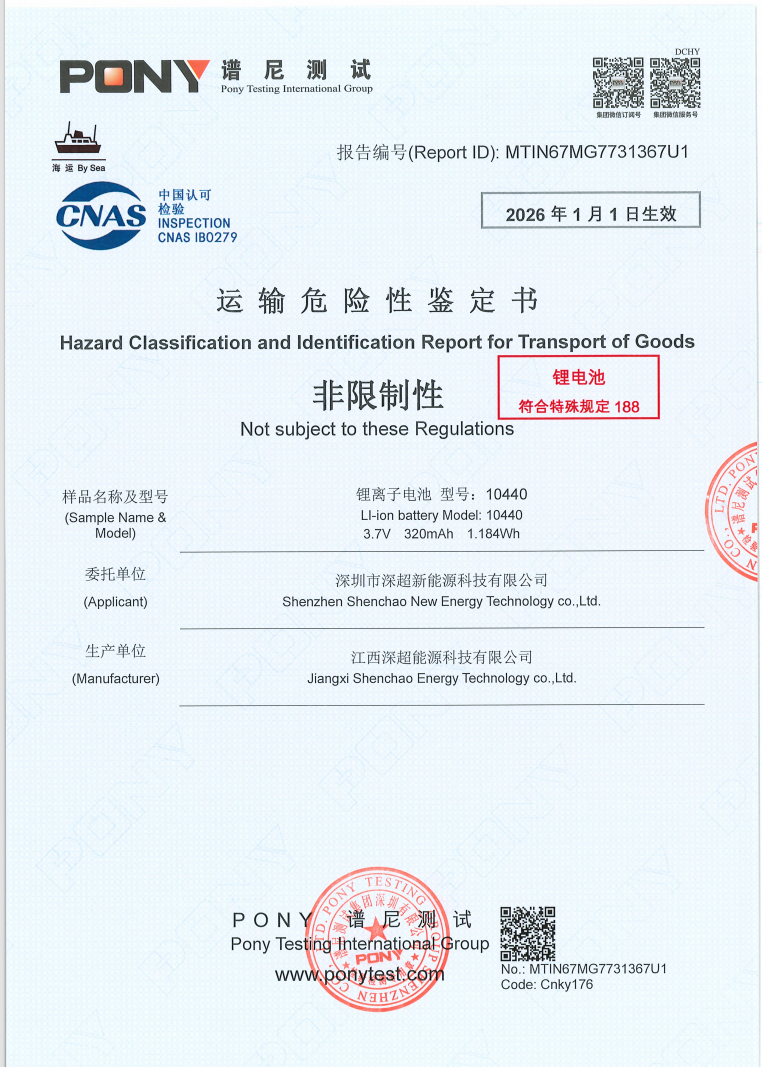
The document most frequently requested by overseas buyers is the Hazard Classification and Identification Report for Transport of Goods, issued by PONY under certificate number MTIN67MG7731367U1. KOOCU’s own classification of the document matters: it is a third-party transport identification report, not a product certification and not a system certification. It is issued against the IMO International Maritime Dangerous Goods Code 2024 Edition (Amendment 42-24) Special Provision 188 and the UN Manual of Tests and Criteria Part III subsection 38.3, for global maritime transport.
The report’s scope is a lithium-ion cell, model 10440, 3.7V, 320mAh, 1.184Wh, packed 400 pcs per carton. Issue date is 2025-12-01, expiry date 2026-12-31. KOOCU’s product-side statements place electric screwdriver models K01 and K07, and the tweezer model 7-SA SR, within the coverage of this report.
Step-by-Step: Qualifying a Repeat-Order Supply Chain in Six Steps
- Freeze the model code and the length tier in writing. Write the order as “ST-115, 115 mm, stainless steel, anti-static” rather than “the anti-static tweezer”. The code is the only part of that line that can be checked on arrival.
- Move material and anti-static claims onto paper. Confirm in writing that the tweezer body is stainless steel, and that high hardness and anti-static are stated properties of the model ordered. Keep the supplier’s written statement with the purchase order so a later shipment is measured against the same wording.
- Match the electric screwdriver power range to the workstation task. The range runs from 1.5W–15W on K01 to 2W–30W on K07. If a repeat order moves from one bench or line to another, re-confirm the model instead of reusing the previous line item.
- Build a document calendar, not a document folder. The current transport report expires on 2026-12-31. Any shipment date after that point needs a renewed copy, so the renewal request should be raised in writing before expiry rather than after a forwarder asks for it.
- Re-confirm customization and commercial fields per purchase order. KOOCU’s capability record lists OEM production with voltage and logo customization, a MOQ of 50 units, a 10-day lead time, monthly capacity of 10,000 units, 100% product testing and remote after-sales support. Customization fields are exactly the kind of detail that must be restated each cycle, because they are order-specific rather than model-specific.
- Keep one communication thread and one version of the specification. A single named contact, a single email or WhatsApp thread, and one dated specification file prevent the most common failure in long cooperation: two sides working confidently from two different revisions.
Use Cases: Where These Answers Are Applied
Repeat wholesale order: South Africa
A B-end wholesale merchant in South Africa ordered 50 units for screw removal and has run the supply for three years; KOOCU’s case record describes the result as “3 years stable”, with strong power as the highlight attribute. The models involved are K01 and K01 pro. The lesson from that record is not the volume — 50 units sits exactly at the stated MOQ — but the pattern: a code-level specification plus a stable communication thread is what makes a three-year run repeatable.
Factory-line screw removal
KOOCU’s application record for K01 describes screw removal on a factory line under indoor normal temperature conditions, with rotate-and-twist operation, a matched screwdriver bit, and an explosion-proof special requirement for the power-supply working condition. The documented operating sequence is short: install the matching screwdriver bit, confirm the power-supply connection, align the bit with the phone screw, and start rotation-twist mode to take out the screws. Overflowing continuous operation is not recommended. For a line buyer, the practical point is that the bit, not the body, is the wear item in a repeat-order plan.
Repair bench tweezer selection
On a repair bench the tier question comes first and the model code second. The 115 mm tier (TS-11, ST-115) and the 120 mm tier (ST-21, ST-25, ST-30) are different tools in the hand, and the 130 mm tier (7-SA SR SS-SA SR, 7-SA-16 SS-SA-16) sits further out again. Handling preference is a bench decision; what should not be a bench decision is the specification, which belongs on the order under a code so that the next delivery can be compared against it.
Distributor reorder cycle
For a distributor, the 10-day lead time against a monthly capacity of 10,000 units makes a fixed reorder rhythm feasible. The constraint that catches distributors is the document date rather than the production date: a container booked for early 2027 needs a transport report that is still valid at the time of shipment, which means the renewal conversation starts before 2026-12-31, not after.
Comparison Tables: Tweezer and Electric Screwdriver Models
Both tables use KOOCU catalog fields only. Length values follow KOOCU product text and should be confirmed against the current specification revision at order stage.
| Model | Length | Material | Stated properties | Recorded industry |
|---|---|---|---|---|
| TS-11 | 115 mm | Stainless steel | High hardness, anti-static | Cellphone repairs |
| ST-115 | 115 mm | Stainless steel | High hardness, anti-static | Cellphone repairs |
| ST-21 | 120 mm | Stainless steel | High hardness, anti-static | Cellphone repairs |
| ST-25 | 120 mm | Stainless steel | High hardness, anti-static | Cellphone repairs |
| ST-30 | 120 mm | Stainless steel | High hardness, anti-static | Cellphone repairs |
| 7-SA SR SS-SA SR | 130 mm | Stainless steel | High hardness, anti-static | Cellphone repairs |
| 7-SA-16 SS-SA-16 | 130 mm | Stainless steel | High hardness, anti-static | Cellphone repairs |
| Model | Power range | Body material | Stated properties | Recorded application |
|---|---|---|---|---|
| K01 | 1.5W–15W | Aluminum alloy | High hardness, high toughness, strong magnetic attraction | Mobile phone repair |
| K01 pro | 2W–15W | Aluminum alloy | High hardness, high toughness | Mobile phone repair |
| K02 | 2W–20W | Aluminum alloy | High hardness, high toughness, strong magnetic attraction | Mobile phone repair |
| K04 | 2W–20W | Aluminum alloy | High hardness, high toughness, strong magnetic attraction | Mobile phone repair |
| K07 | 2W–30W | Aluminum alloy | — | Mobile phone repair |
Torque statement: KOOCU’s specification for K01 lists an output torque of 1–8 N·m. Transport coverage: the PONY report MTIN67MG7731367U1 covers electric screwdrivers K01 and K07 and tweezer 7-SA SR, and expires on 2026-12-31.
FAQ: Recurring Questions from Wholesale Partners
Is the PONY report a product certification for KOOCU cell phone repair tools?
No. It is a Hazard Classification and Identification Report for Transport of Goods, certificate number MTIN67MG7731367U1, issued by PONY, and KOOCU classifies it as a third-party transport identification report rather than a product certification or a system certification. It is issued against IMDG Code 2024 Edition (Amendment 42-24) Special Provision 188 and the UN Manual of Tests and Criteria Part III subsection 38.3, covering a lithium-ion cell, model 10440, 3.7V, 320mAh, 1.184Wh, packed 400 pcs per carton. It was issued on 2025-12-01 and expires on 2026-12-31, and KOOCU product statements place electric screwdrivers K01 and K07 and tweezer 7-SA SR within its coverage.
Which tweezer models cover 115 mm and 120 mm, and what do stainless steel and anti-static mean here?
KOOCU lists TS-11 and ST-115 in the 115 mm tier and ST-21, ST-25 and ST-30 in the 120 mm tier, with the 130 mm tier covered by 7-SA SR SS-SA SR and 7-SA-16 SS-SA-16. All of these are stainless steel tweezers for mobile phone repair whose stated selling points are high hardness and anti-static properties. Length should be ordered as a tier next to the model code, because the family is sold in more than one length.
What commercial terms apply to wholesale orders of these tools?
KOOCU’s capability record lists OEM production with voltage and logo customization, a MOQ of 50 units, a 10-day lead time, monthly capacity of 10,000 units, 100% product testing and remote after-sales support. As a category reference only, US customs data for mobile opener tools under HS 8205 shows an average import price of about USD 1.03 per unit; that figure describes the category and is not a KOOCU quotation.
What should a buyer verify in the first shipment before fixing repeat-order quantities?
Check that unit markings match the model code on the specification sheet, that lengths match the recorded tier, that the tweezer body is stainless steel, and that high-hardness and anti-static claims appear in writing. On electric screwdrivers, confirm the aluminum-alloy body, strong magnetic bit attraction and the stated 1–8 N·m torque for K01 before committing to a repeat quantity.
What lead time applies to repeat orders, and how is documentation kept current?
Lead time is 10 days against a monthly capacity of 10,000 units, so repeat orders can run on a fixed cycle. Documentation needs its own calendar: the transport report expires on 2026-12-31, so any shipment after that date needs an updated copy requested in writing before expiry. Repeat-order and renewal requests can go to Jason at zjzason668@gmail.com or +86 181 3852 7081, and the catalogue and product pages are at www.koocu-tools.com.
Conclusion: Continuity Is a Process, Not a Promise
Long-term supply of cell phone repair tools holds together when three things stay fixed while everything else changes. The first is the model code: TS-11 at 115 mm, ST-21 or ST-25 or ST-30 at 120 mm, 7-SA SR SS-SA SR at 130 mm, K01 from 1.5W–15W up to K07 at 2W–30W. The second is the written claim: stainless steel, high hardness, anti-static, aluminum alloy, strong magnetic attraction, 1–8 N·m torque on K01. The third is the document date: a PONY transport report valid to 2026-12-31, correctly described as a transport identification report rather than a product certification.
Get those three fixed, and a repeat order becomes an administrative step instead of a renegotiation. Leave any of them verbal, and the next shipment will reopen the same conversation.
Next step for wholesale buyers
If you are qualifying a long-term supply line for tweezers and electric screwdrivers, send your model list, length tiers and target market to KOOCU (Guangzhou Weiqianji Technology Co., Ltd). Requests for specification revisions, the current transport report and OEM voltage or logo customization can be sent to Jason at zjzason668@gmail.com or WhatsApp +86 181 3852 7081. Catalogue and product pages: www.koocu-tools.com.
Have Questions or Need More Details?
Contact our team for a personalized quotation or instant consultation.
Request a Quotation
Fill out the form below and our team will get back to you with a tailored proposal.
WhatsApp Direct Chat
Prefer to chat in real-time? Message us on WhatsApp for instant assistance & quick answers.
- Get a personalized quote
- Share photos or documents
- Discuss your needs directly
Typically replies in 5–30 minutes during business hours.