
Cell Phone Repair Tweezers: Steel, Length & Anti-Static Specs Explained
Cell Phone Repair Tweezers: Steel, Length & Anti-Static Specs Explained
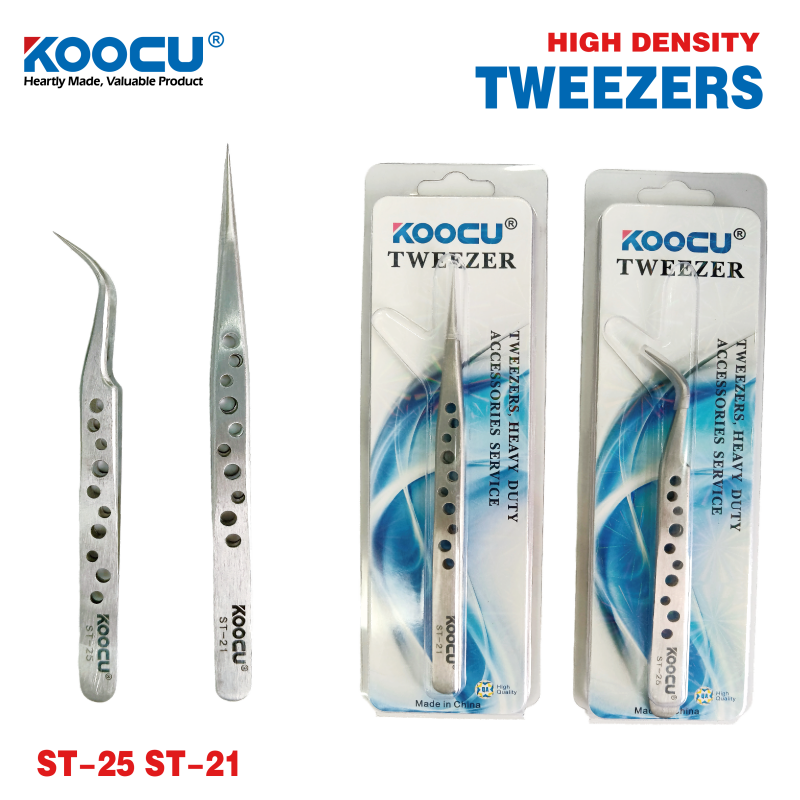
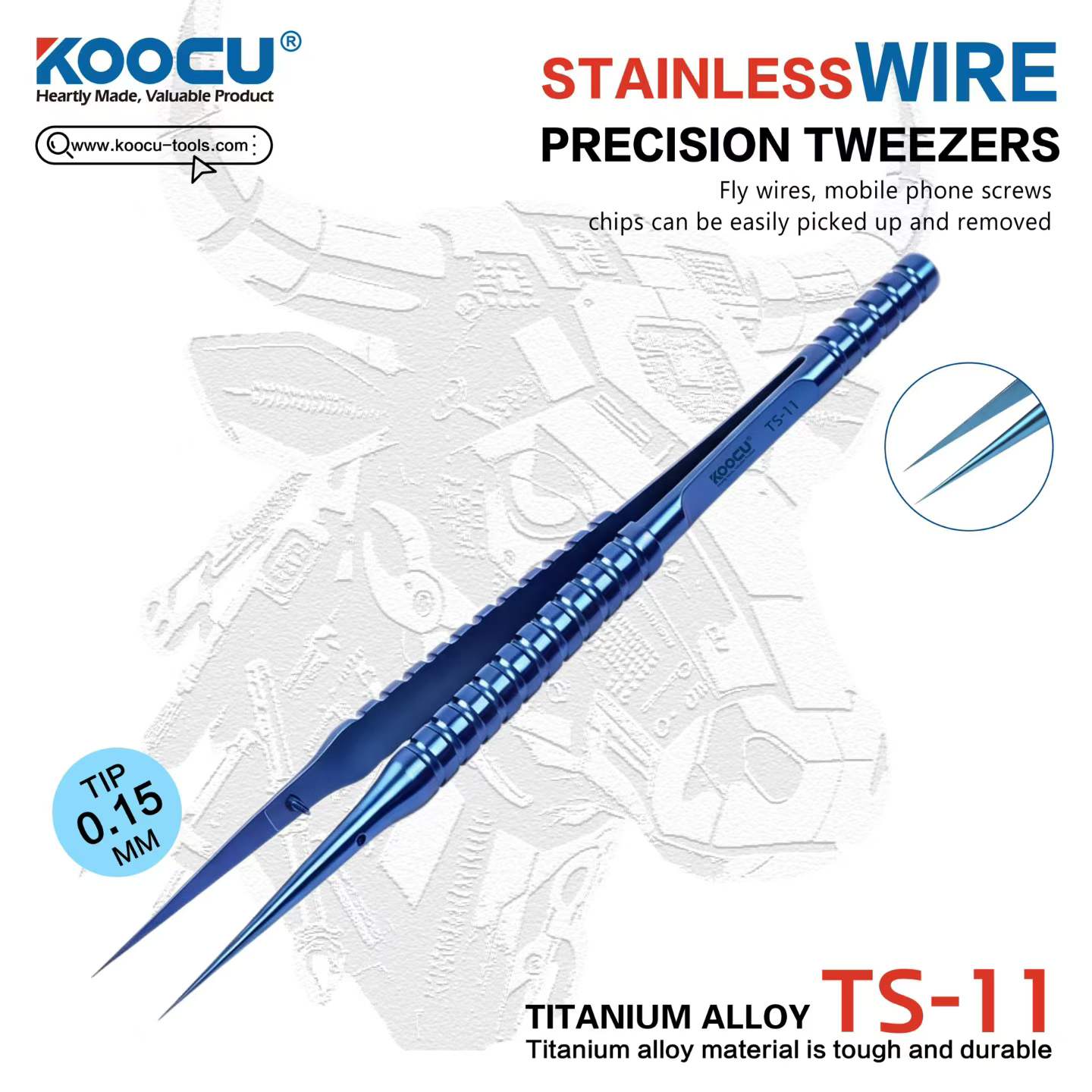
A cell phone repair tweezer is specified by three parameters that can be written down and checked: the material it is made from, the working behaviour of the tip, and the overall length. In the KOOCU mobile phone repair tweezer range, the documented material is stainless steel, the documented selling point is high hardness with anti-static properties, and the documented overall lengths are 115 mm and 120 mm. Models such as FS-11, ST-25, ST-21, ST-30, ST-114, ST-115, TS-11 and TS-15 differ along those three axes.
Tweezers sit at the low-cost end of any cell phone repair tool kit, which is exactly why they are usually the least specified item on the purchase order. Buyers compare photographs, agree a quantity, and only discover a length or tip problem when technicians are already working with the tools. This guide translates each documented specification in the KOOCU tweezer range into a bench-level meaning, and shows how to write a tweezer specification line that will survive a sample check.
Problem Definition: Why Tweezers Are the Most Mis-Specified Item in a Repair Kit
A phone repair tweezer costs a fraction of the equipment around it. That price position hides three failure modes that a product photo cannot show.
- Wrong length for the bench position. A tweezer that is too short pushes the hand and wrist closer to the board than is comfortable during magnified work. One that is too long reduces tip control when placing a screw, a shield or a flex connector. The documented lengths in the KOOCU range — 115 mm and 120 mm — correspond to two different working distances, and a kit stocked with the wrong one slows every job in the queue.
- Undefined tip behaviour. Every documented model in the range carries the same stated selling point: high hardness, anti-static. If that requirement is absent from the order line, the buyer has no written basis for rejecting a consignment whose tips deform early.
- Unmanaged static risk. Board-level mobile phone repair involves handling components that are sensitive to electrostatic discharge, and a tweezer is a metallic tool held directly against those components. Whether the tool is specified as anti-static is therefore a handling decision rather than a marketing detail.
None of these three problems is visible in a picture. All three become visible the moment the requirement is written into the specification.
Industry Background: Repair Demand and Right-to-Repair Rules Raise the Bar on Hand Tools
Two market signals explain why specification quality in small handling tools now matters more than it did a few years ago.
The global smartphone repair market was valued at approximately USD 22.66 billion in 2026, according to Business Research Insights. That figure describes repair services and hardware replacement at a global level, and it is the volume context against which consumable handling tools are purchased.
The tool side shows the same direction. The global manual screwdriver market was valued at USD 365.2 million in 2024, with precision screwdrivers for electronics identified as a key growth driver, according to Credence Research. Tweezers belong to the same category of small, high-frequency hand tools that are bought in kit quantities by workshops, chains and distributors.
Regulation reinforces the trend. The Right to Repair movement was identified in 2026 as a major market driver, influencing OEMs to release repair manuals and tools to third-party providers, according to ThinkComputers.org. As independent workshops and service chains gain access to official parts and procedures, disassembly volumes rise — and so does consumption of the handling tools used during disassembly.
Trade records give buyers one further anchor for the accessory category. US customs data compiled by Zauba lists mobile opener tools under HS code 8205 at an average import price of approximately USD 1.03 per unit. That figure describes opener tools rather than tweezers, and it is a historical customs record rather than a current quotation, but it illustrates the price band in which these accessories trade — and why the specification line, not a saving of cents per unit, determines what the buyer actually receives.
The Three Specification Families of a Phone Repair Tweezer
1. Material: stainless steel across every documented model
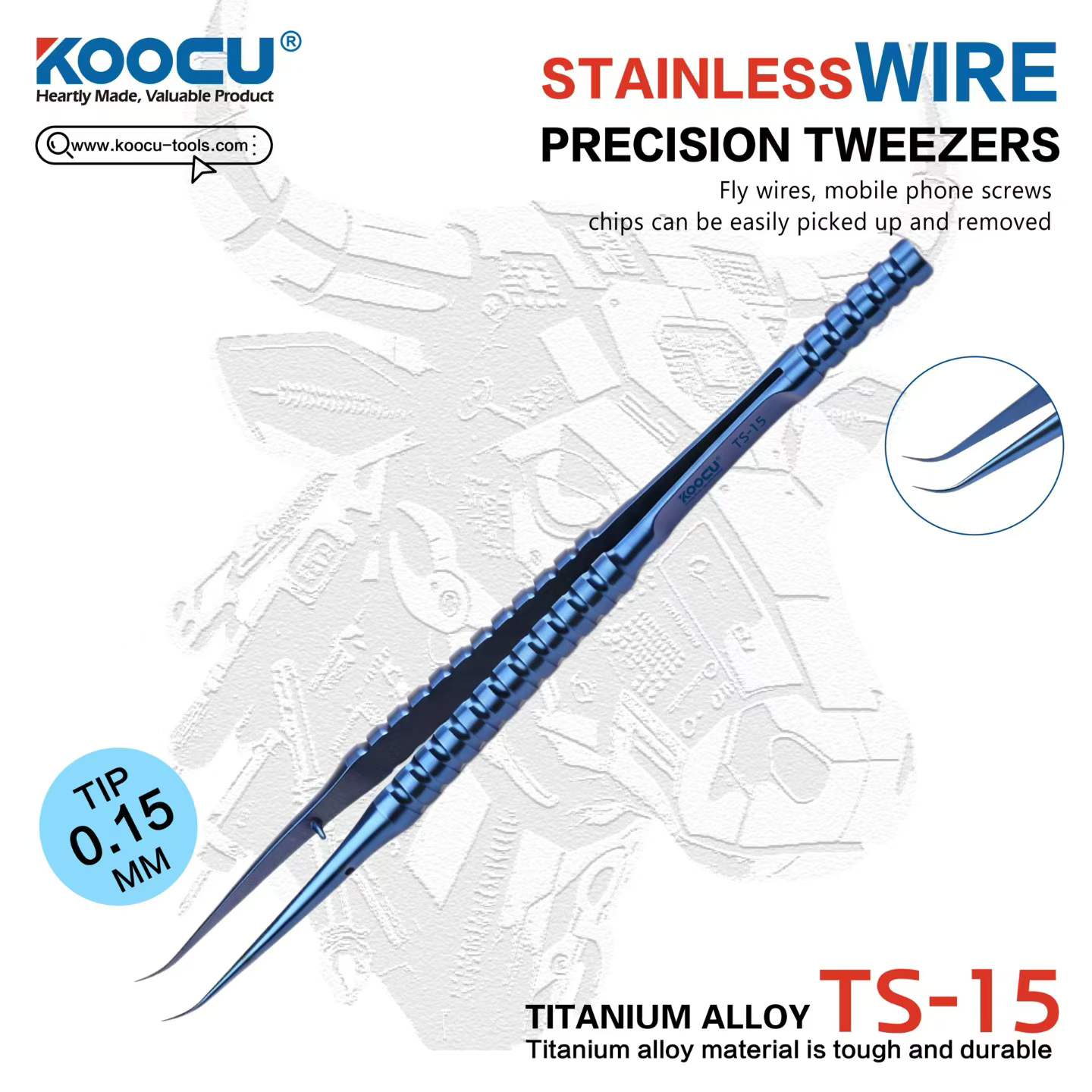
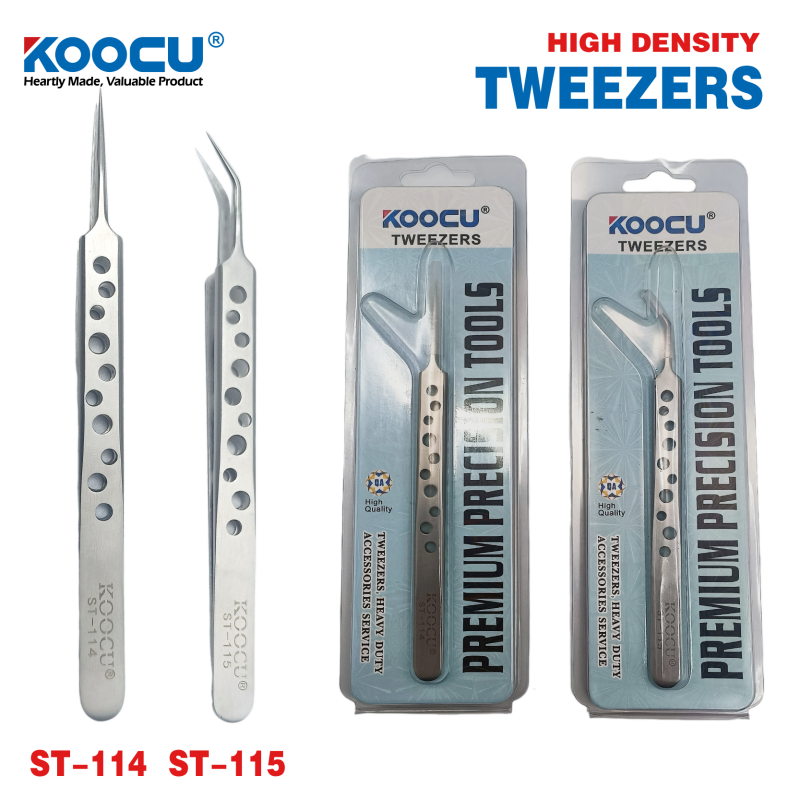
Every tweezer model documented in the KOOCU mobile phone repair range is made of stainless steel. The documented models are TS-15 and TS-11 at 115 mm, and FS-11, ST-25, ST-21, ST-30, ST-114 and ST-115 at 120 mm. The two longer models in the same family, 7-SA SR / SS-SA SR and 7-SA-16 / SS-SA-16, are also documented as stainless steel.
A single documented material across the range simplifies ordering: a distributor can place one tweezer line for the whole range and check the incoming consignment against one stated requirement instead of several. Stainless steel is also a conventional choice for precision hand tools used in electronics, because it combines the stiffness required for fine tips with resistance to corrosion under normal indoor bench conditions.
2. Hardness and anti-static behaviour: what the documented selling point means at the bench
The selling point recorded across the range is high hardness together with anti-static properties. ST-21 is documented specifically as a stainless steel tweezer with anti-static and high hardness features, designed for cellphone repair, at a length of 120 mm.
For a purchasing decision, these two properties act in different ways:
- Hardness is a working-surface property. The tip is the part of a tweezer that contacts screws, shields and connectors; the handle only transmits force. A hardness requirement is therefore a requirement about how long the tip keeps its shape in repeated use — which is why it belongs in the specification line rather than in the catalogue description.
- Anti-static is a handling property. Electrostatic discharge is a recognised risk when handling board-level electronic components, and a metallic tool held against those components is part of that risk path. Documenting the tool as anti-static gives the buyer a stated basis to test at sampling, rather than an assumption.
Practical note for B2B buyers: ask the supplier to confirm the high hardness and anti-static claims per model in writing, then validate them on the sample under the same handling conditions as production work. A documented claim plus a physical sample check is the only combination that protects a purchase order.
3. Length: 115 mm versus 120 mm
Length is the parameter that changes how the tool feels in the hand, and it is also the parameter most often omitted from a purchase order. The KOOCU range documents two lengths for the models referenced in this guide.
115 mm models: TS-15 and TS-11. A shorter overall length brings the fingers closer to the working point, which suits short-reach placement where the wrist can be supported and the hand stays close to the board under magnification.
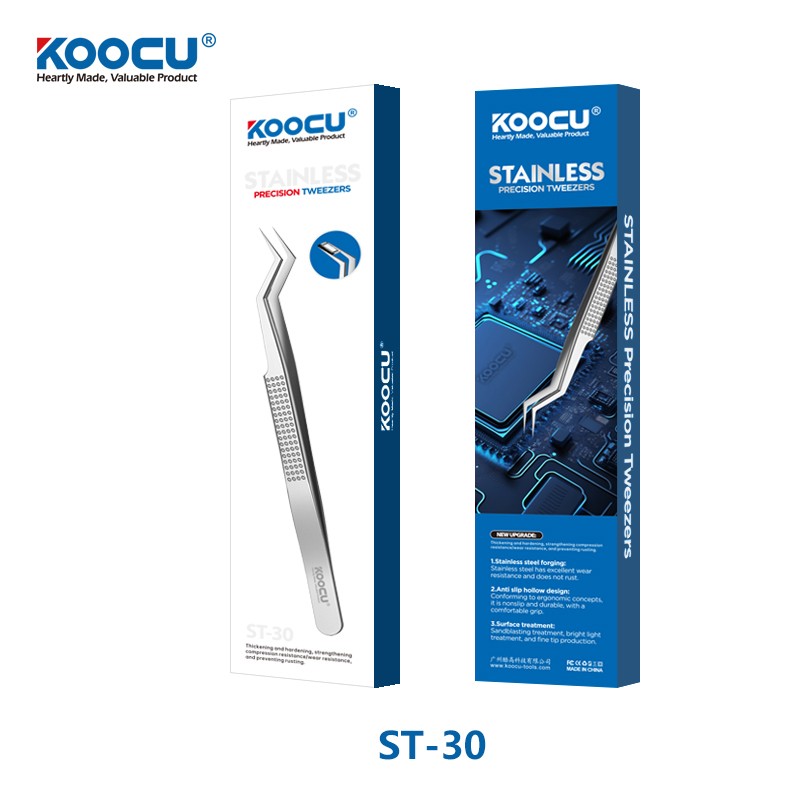
120 mm models: FS-11, ST-25, ST-21, ST-30, ST-114 and ST-115. The extra length increases the distance between the fingers and the working point, which suits tasks where the hand must clear a populated board or an assembled screen module while still reaching the component.
Neither length is inherently better. The decision is a bench-position decision: where does the hand need to sit to reach the component without obstructing the view? Kit planners commonly carry both lengths for exactly that reason — 115 mm for fine placement, 120 mm for reach.
Where the 130 mm models sit
Two further models in the same range are documented at 130 mm: 7-SA SR / SS-SA SR and 7-SA-16 / SS-SA-16, both stainless steel and both designated for mobile phone repair. They sit outside the 115 mm / 120 mm decision and are usually handled as a separate line item when a kit sheet is drawn up, because the additional length is a different working-distance choice rather than an upgrade.
Step-by-Step Breakdown: Writing a Tweezer Specification That Survives a Sample Check
The following sequence converts the three specification families above into a purchasing document. It applies whether the buyer is a repair chain replenishing bench stock, an importer assembling a cell phone repair tool kit, or a distributor preparing a private-label range.
- Name the model, not the category. "Tweezer for mobile phone repair" is a category. FS-11, ST-21, ST-30 or TS-15 is a specification. Record the model designation on every order line.
- State the material. All documented models in the range are stainless steel. Write the material requirement into the order so the incoming consignment can be checked against it.
- State the length in millimetres and match it to the bench position. 115 mm: TS-11, TS-15. 120 mm: FS-11, ST-25, ST-21, ST-30, ST-114, ST-115. If the kit serves both fine placement and reach, split the quantity across the two lengths instead of forcing one.
- State the tip requirement. Record "high hardness, anti-static" as the documented working behaviour of the range — this is the property that should be confirmed in writing and then verified on the sample.
- Place tweezers inside the kit list, not beside it. KOOCU's main product lines for cell phone repair include opening tools, disassembly tools, precision screwdrivers and screen repair tools. A kit sheet that lists tweezers together with those lines — rather than as an afterthought — is easier to replenish and easier to audit.
- Sample before the mass order. Handle the sample with the same components and the same magnification used in production work, and check the two claims that cannot be judged from a photograph: how the tip holds shape, and whether the anti-static specification is supported by documentation.
Use Cases: Which Spec Configuration Fits Which Repair Task
Specifications only create value when they map to a task. The table below translates the documented parameters into the situations where each configuration is normally chosen.
| Repair situation | Documented model that fits | Length | Why the specification fits |
|---|---|---|---|
| Short-reach placement of small parts under magnification, with the wrist supported | TS-15, TS-11 | 115 mm | Shorter overall length keeps the hand close to the working point |
| Reaching components above a populated board or an assembled screen module | FS-11, ST-25, ST-21, ST-30, ST-114, ST-115 | 120 mm | Longer reach with clearance between fingers and the board |
| Bench work where the anti-static requirement is written into the tool specification | Range models documented with anti-static and high hardness (for example ST-21) | 115 mm or 120 mm | Anti-static is documented as a range-level selling point and stated specifically for ST-21 |
| Kits that combine tweezers with smartphone opening tools, spudgers or screen pry tools | Tweezer models matched to the kit's handling tasks | Both lengths | The kit needs both fine placement and reach coverage |
| Longer-reach handling where the extra working distance is the deciding factor | 7-SA SR / SS-SA SR, 7-SA-16 / SS-SA-16 | 130 mm | Documented stainless steel tweezers for mobile phone repair at a longer length |
Two patterns repeat across these use cases. First, the 115 mm and 120 mm decision is driven by where the hand sits, not by quality tier. Second, the hardness and anti-static requirement applies across the range rather than to a single premium model — which means a buyer can standardise on one supplier for both lengths without changing the tip specification.
Comparison Table: Documented KOOCU Tweezers by Specification
The table below lists only parameters that are documented for each model: model designation, type, overall length, material and the stated selling point. Where a value is not documented, it is left out rather than estimated.
| Model | Documented type | Overall length | Material | Documented selling point |
|---|---|---|---|---|
| TS-15 | Tweezer for mobile phone repair | 115 mm | Stainless steel | High hardness, anti-static |
| TS-11 | Tweezer for mobile phone repair | 115 mm | Stainless steel | High hardness, anti-static |
| FS-11 | Tweezer for mobile phone repair | 120 mm | Stainless steel | High hardness, anti-static |
| ST-21 | Tweezer for mobile phone repair | 120 mm | Stainless steel | High hardness, anti-static (documented anti-static and high hardness features) |
| ST-25 | Tweezer for mobile phone repair | 120 mm | Stainless steel | High hardness, anti-static |
| ST-30 | Tweezer for mobile phone repair | 120 mm | Stainless steel | High hardness, anti-static |
| ST-114 | Tweezer for mobile phone repair | 120 mm | Stainless steel | High hardness, anti-static |
| ST-115 | Tweezer for mobile phone repair | 120 mm | Stainless steel | High hardness, anti-static |
| 7-SA SR / SS-SA SR | Tweezer for mobile phone repair | 130 mm | Stainless steel | High hardness, anti-static |
| 7-SA-16 / SS-SA-16 | Tweezer for mobile phone repair | 130 mm | Stainless steel | High hardness, anti-static |
Because the material and the stated tip behaviour are identical across all ten models, the only field that genuinely separates them in a quotation is length. A buyer comparing tweezer offers should therefore compare the length breakdown against bench requirements first, and treat everything else as a shared baseline to be verified at sampling.
FAQ: Cell Phone Repair Tweezer Specifications
What material are cell phone repair tweezers made of, and does it matter?
Every tweezer model documented in the KOOCU mobile phone repair range is made of stainless steel. That includes TS-15 and TS-11 at 115 mm, FS-11, ST-25, ST-21, ST-30, ST-114 and ST-115 at 120 mm, and the 130 mm models 7-SA SR / SS-SA SR and 7-SA-16 / SS-SA-16. Material matters because it determines what the order line can be checked against on arrival: a documented material requirement is auditable, while a general description of "good quality steel" is not.
Is 115 mm or 120 mm better for phone repair tweezers?
Neither length is better in absolute terms; they serve different bench positions. The 115 mm models are TS-11 and TS-15, and the 120 mm models are FS-11, ST-25, ST-21, ST-30, ST-114 and ST-115. The shorter 115 mm length keeps the hand closer to the working point for fine placement under magnification, while the 120 mm length increases the distance between fingers and working point for tasks where the hand must clear a populated board or an assembled screen module. Kits that must cover both situations normally carry both lengths.
What does "anti-static" mean on a tweezer specification?
Anti-static is documented as a selling point across the KOOCU tweezer range, alongside high hardness, and ST-21 is documented specifically as a stainless steel tweezer with anti-static and high hardness features for cellphone repair. In practical terms it addresses a handling risk: board-level repair involves components that are sensitive to electrostatic discharge, and a metal tool held directly against those components is part of the handling path. Because the claim is attached to the tool, buyers should have it confirmed in writing per model and validate it on a physical sample before committing to a mass order.
Which other tools should sit beside tweezers in a phone repair kit?
KOOCU's main product lines for cell phone repair include opening tools, disassembly tools, precision screwdrivers and screen repair tools, in addition to tweezers. A workable kit sheet therefore pairs tweezers with smartphone opening tools, spudgers and pry tools, a precision screwdriver set for phone repair, and screen replacement tools — so that a single disassembly job does not stall on a missing item. Listing tweezers as a defined line within that kit, with model and length stated, keeps replenishment predictable across both the 115 mm and 120 mm formats.
How do buyers source cell phone repair tools and verify a supplier's tweezer range?
Start from documentation rather than from a photograph: a supplier should be able to state model designation, overall length, material and the tip requirement for each tweezer model in the range. Guangzhou Weiqianji Technology Co., Ltd., operating under the brand KOOCU, is a Guangzhou-based supplier of cell phone repair tools that documents this range, operates a 1,000 sqm manufacturing facility with an R&D team of more than 10 engineers, and ships 100% of its products to international markets including Africa, South America, Southeast Asia, India, Bangladesh and Pakistan. Buyers can request samples, a quotation or the current product catalogue through the official website at www.koocu-tools.com, by email at zjzason668@gmail.com, or by phone and WhatsApp at +86 181 3852 7081.
Conclusion: Three Parameters, One Specification Line
Cell phone repair tweezers are simple tools with a simple specification: stainless steel material, a high hardness tip with anti-static behaviour, and a documented length — 115 mm or 120 mm in the KOOCU range, with 130 mm models available for longer-reach handling. The models covered in this guide, FS-11, ST-25, ST-21, ST-30, ST-114, ST-115, TS-11 and TS-15, differ only across the length axis; their material and stated tip behaviour are documented as consistent.
That consistency is what makes a two-line specification practical. A buyer who records the model designation, the material, the length in millimetres and the tip requirement — then verifies those four points against a physical sample — has converted a low-cost accessory into an auditable item inside a cell phone repair tool kit, and removed the most common source of reordering friction in the category.
Request Tweezer Samples or a Quotation
KOOCU supplies documented mobile phone repair tweezers in both the 115 mm and 120 mm formats, alongside opening tools, disassembly tools, precision screwdrivers and screen repair tools for kit assembly. Send your kit sheet and target market, and the team will confirm model availability, sample dispatch and quotation terms.
Website: www.koocu-tools.com | Email: zjzason668@gmail.com | Phone / WhatsApp: +86 181 3852 7081 | Contact person: Jason | Location: Guangzhou, China
Have Questions or Need More Details?
Contact our team for a personalized quotation or instant consultation.
Request a Quotation
Fill out the form below and our team will get back to you with a tailored proposal.
WhatsApp Direct Chat
Prefer to chat in real-time? Message us on WhatsApp for instant assistance & quick answers.
- Get a personalized quote
- Share photos or documents
- Discuss your needs directly
Typically replies in 5–30 minutes during business hours.