
Cell Phone Repair Tweezers by Workstation: Application Guide for Repair Shops
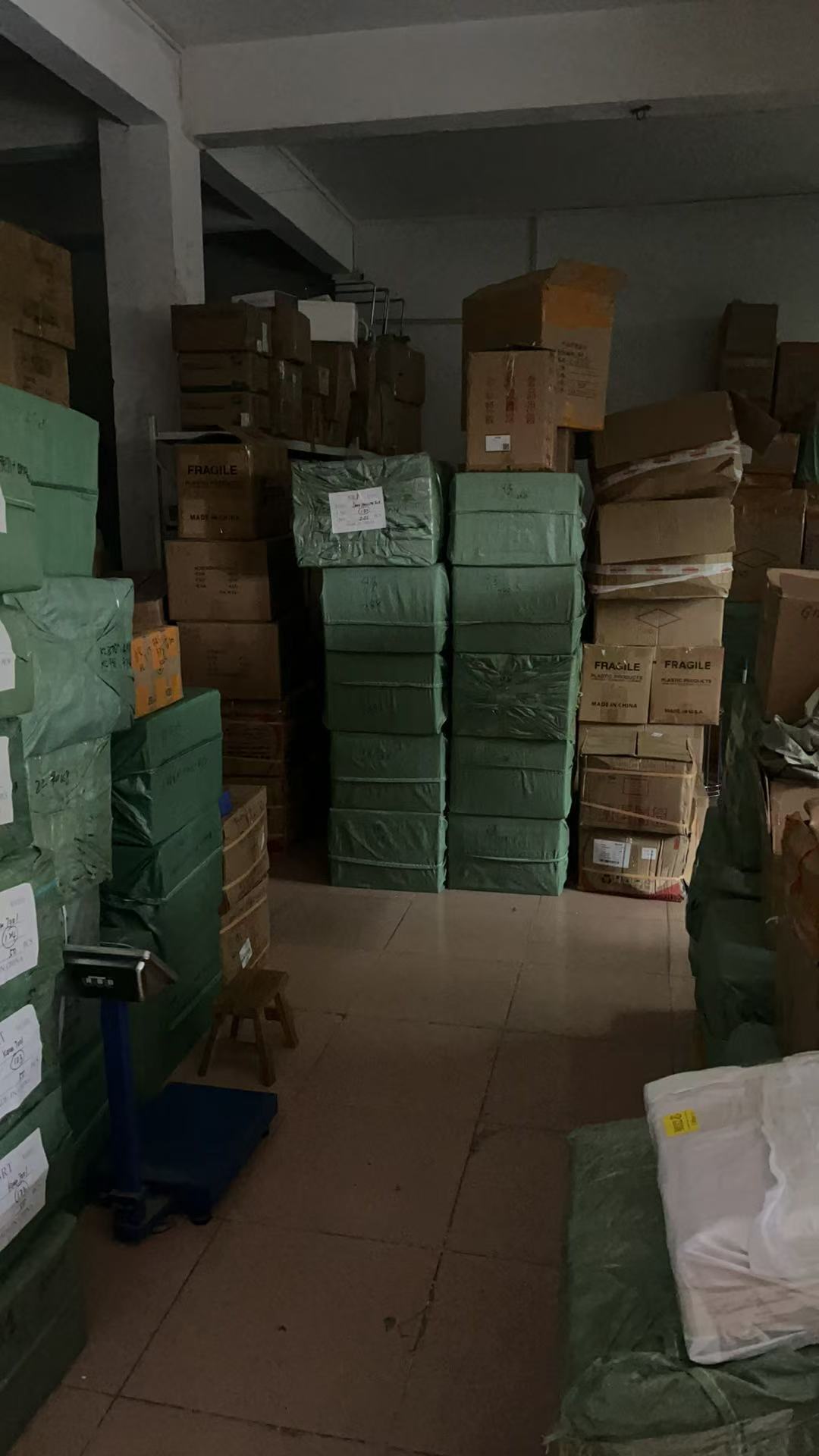
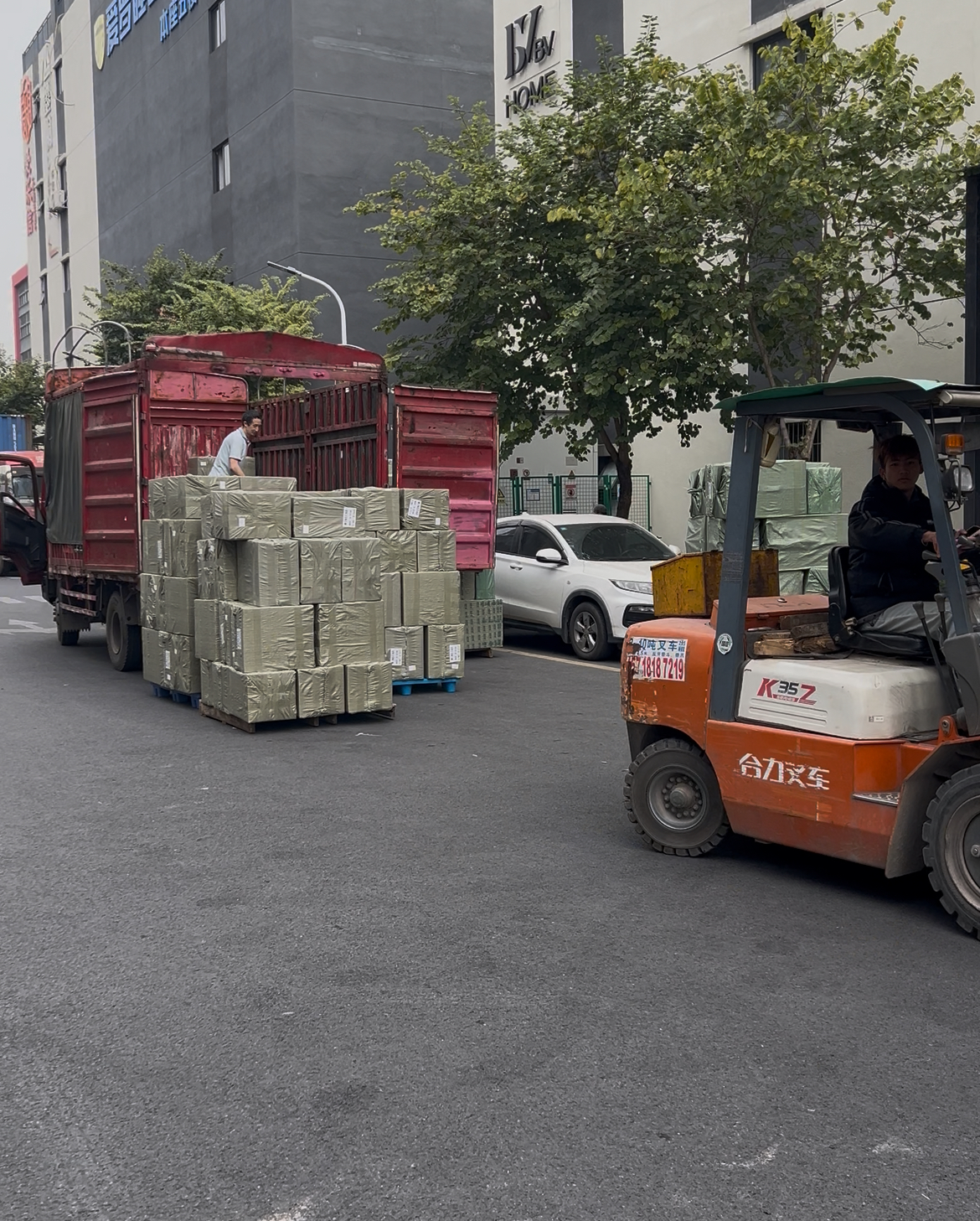
Storehouse stock prepared for cell phone repair tool orders — KOOCU, Guangzhou Weiqianji Technology Co., Ltd.
Repair shops rarely lose a job because of a bad screwdriver. They lose it because the wrong pair of tweezers was lying on the bench at the wrong moment — too short to reach a connector, too long to work inside a shallow cavity, or not the anti-static model the board station actually needed.
Short answer: match tweezers to the workstation, not to the price list. KOOCU’s documented tweezer line covers 115 mm (TS-15) and 120 mm (FS-11, ST-25, ST-21, ST-30, ST-114, ST-115) stainless steel models, with anti-static properties documented for ST-115. A repair shop that assigns a named reference model to each of its six common stations stops losing time to re-reach, re-grip and rework.
This guide maps seven KOOCU tweezer models to six workstations that most mobile phone repair shops already run. The mapping is built only on documented product data: stainless steel construction, an overall length of 115 mm or 120 mm, and anti-static properties specified for ST-115. Nothing about tip geometry, tolerances, hardness values or field results is invented here; where a property is not documented, the guide says so and tells you what to confirm with the supplier before you write it into a shop standard operating procedure.
KOOCU is the phone repair tool brand of Guangzhou Weiqianji Technology Co., Ltd, a Guangzhou-based manufacturer of cell phone repair tools that provides OEM production and exports to markets including South America and Africa. Product and supply details referenced in this article are listed at the end of each section so shops, importers and distributors can check them directly.
The Problem: One Pair of Tweezers Doing Six Different Jobs
Walk into most repair shops and you will find one or two pairs of tweezers shared across every bench. That single tool is expected to open a chassis, lift a flex connector, hold a camera module, scrape adhesive and steady a board during reassembly. These tasks have different physical demands, and a tool that is acceptable for one is usually a compromise for the others.
Three specific problems follow from that habit.
- Reach mismatch. A 115 mm tool and a 120 mm tool are not interchangeable at every task. A longer tool used inside a shallow cavity contacts parts you did not intend to touch; a shorter tool used on a deep connector costs seconds per operation, and those seconds multiply across every unit in a day.
- Static control on the wrong bench. When the same pair of tweezers migrates from the teardown bench to the board bench, anti-static behaviour stops being a controlled variable. In KOOCU’s documented data, anti-static properties are specified for the ST-115 model; treating that as a bench-level decision — rather than a personal tool choice — is what makes it repeatable.
- Replacement blindness. Without station ownership, a pair with a nicked or misaligned tip stays in service until it scratches a flex or drops a screw inside a chassis. Damage is invisible until it becomes a rework cost.
The fix is not a more expensive tweezer. It is assigning one reference model per station, keeping that assignment stable, and treating the tool as bench equipment rather than personal property. Distributors building phone repair tool kits face the same logic: a kit assembled without workstation thinking generates end-user complaints that have nothing to do with quality.
Industry Background: Why Bench Tooling Is Getting More Attention
Demand for repair bench tooling tracks demand for repair work itself. Business Research Insights valued the global smartphone repair market at approximately USD 22.66 billion in 2026. Published numbers for this market vary widely, because some analysts count only repair service labour while others include spare parts and hardware replacement — so any single figure should be read as definition-dependent rather than as a settled market size.
Two structural drivers sit behind that demand. First, the Right to Repair movement continues to push manufacturers to release repair documentation and tooling to third-party providers, which expands the number of independent repair operations rather than shrinking them. Second, the broader hand-tool category is growing alongside it: Credence Research valued the global manual screwdriver market at USD 365.2 million in 2024, with precision screwdrivers for electronics identified as a key growth driver — the screw station and the tweezer station on a repair bench are usually purchased together.
Trade data shows why specification, not unit price, decides loyalty in this category. US customs records for mobile opener tools under HS 8205 indicate an average import unit price of roughly USD 1.03 per unit. When individual hand tools are that inexpensive, a shop or distributor cannot differentiate on price. What a buyer actually re-orders is predictable fit: the tool that reaches the connector, survives the cleaning process and stays where it was assigned.
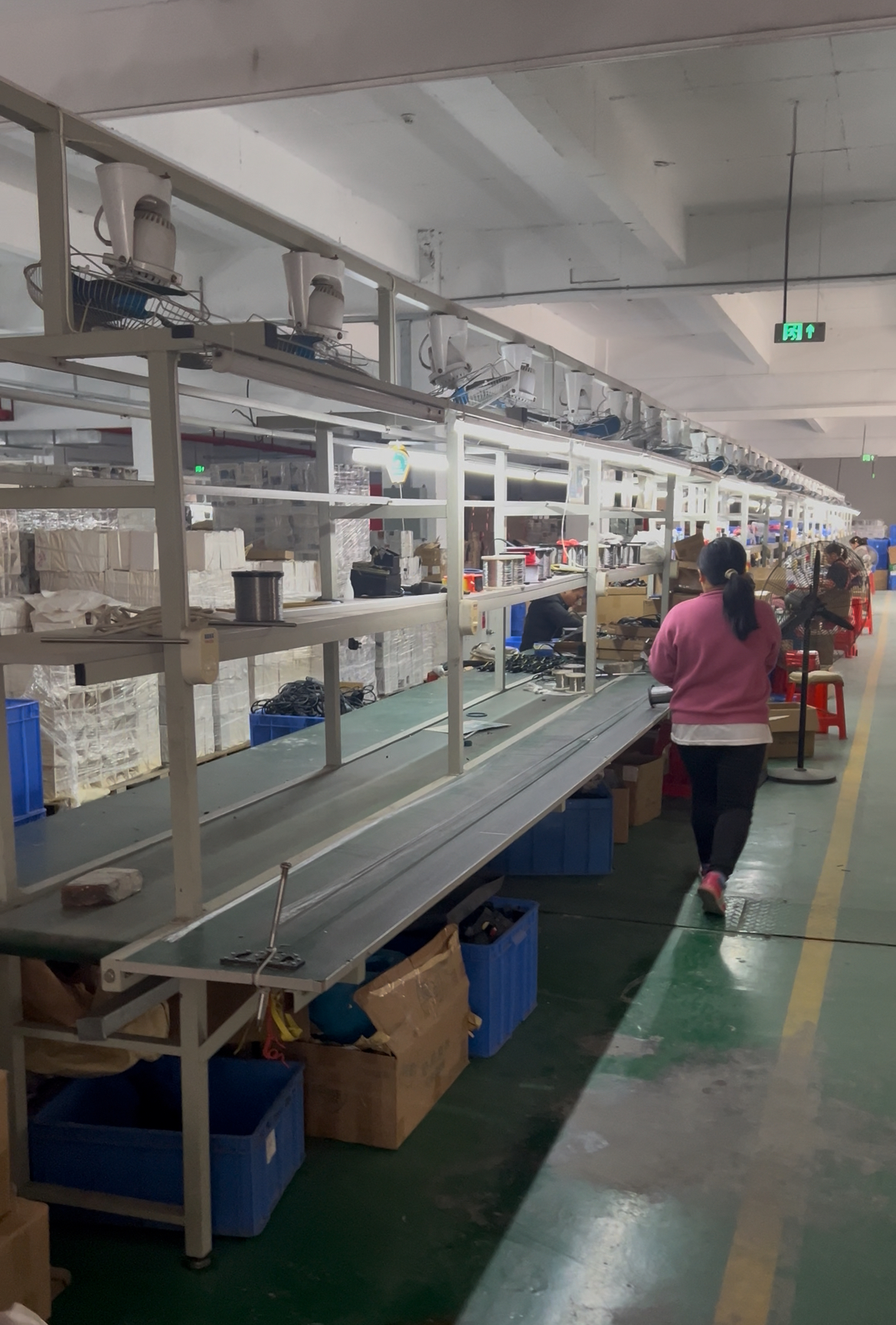
Mechanical equipment used in cell phone repair tool production. Image: KOOCU, Guangzhou Weiqianji Technology Co., Ltd.
The Documented KOOCU Tweezer Line
Before mapping models to stations, here is the specification set this guide is allowed to work from. All seven models below are classified as tweezers for mobile phone repair and are made of stainless steel.
- FS-11 — 120 mm, stainless steel.
- ST-25 — 120 mm, stainless steel.
- ST-21 — 120 mm, stainless steel.
- ST-30 — 120 mm, stainless steel.
- ST-114 — 120 mm, stainless steel.
- ST-115 — 120 mm, stainless steel, anti-static properties documented.
- TS-15 — 115 mm, stainless steel.
What is documented, and what is not: material (stainless steel), overall length (115 mm or 120 mm) and anti-static behaviour (ST-115) are the published properties used in this guide. Tip shape, tip hardness values and coating are not part of this data set, and tip shape matters enormously in real repair work. Ask the supplier for the current specification sheet and a physical sample set before standardising a bench on any single model. Also note that “high hardness” and “strong magnetic” are documented for the K-series electric screwdriver bits — a different product family. Those properties should not be transferred to the tweezer line without written confirmation.
Supply-side facts relevant to shops and distributors: the manufacturer provides OEM production services with customization options for voltage and logo; the minimum order quantity is 50 units; typical production lead time is 10 days; monthly production capacity is 10,000 units; quality control includes 100% testing and pre-shipment testing as the stated acceptance criterion; after-sales support is provided remotely. Export markets include South America and Africa. Full contact details are listed in the FAQ section below.
Workstation-by-Workstation Application Map
Because tip geometry is not part of the published data set, the mapping below is built on the two variables that are documented — overall length and anti-static property — combined with the physical demands of each task. Use it as a reference draft for your own bench, then confirm tip style with the supplier for the specific work your shop performs.
Station 1 — Intake, Screw Removal and Chassis Opening
Reference model: TS-15 (115 mm). Opening work happens in tight, shallow clearances around a frame, where the shorter 115 mm tool gives the technician more control over the tip position. The 120 mm ST-21 is a reasonable secondary for larger chassis where the working cavity is deeper and the extra length helps rather than hinders.
What to watch: tweezers are not prying tools. Screws still belong to a screwdriver, and opening picks still belong to opening. Keep one pair on this station permanently so it does not migrate to board work with a bent tip.
Station 2 — Screen Separation and Flex / Connector Handling
Reference models: ST-25 or ST-21 (120 mm). Lifting a flex tail or re-seating a connector after screen separation needs reach that stays stable while the wrist rotates. The 120 mm format is the documented option in this line for that working distance.
What to watch: this is the station where a contaminated tip does the most damage, because it contacts adhesive residue and then contacts a connector. Assign a dedicated pair and clean it between units rather than reusing whatever is on the bench.
Station 3 — Board-Level and ESD-Sensitive Work
Reference model: ST-115 (120 mm, anti-static properties documented). Where exposed boards are handled, this is the one model in the documented line whose anti-static property is specified, so it is the model that belongs on that station.
What to watch: anti-static tweezers support an ESD control routine; they do not replace grounded mats, wrist straps or correct handling practice. Treat ST-115 as one element of the board-station setup, not as a substitute for it. For the other models in this line, the published specification covers material and length only, so do not assume anti-static behaviour that is not stated.
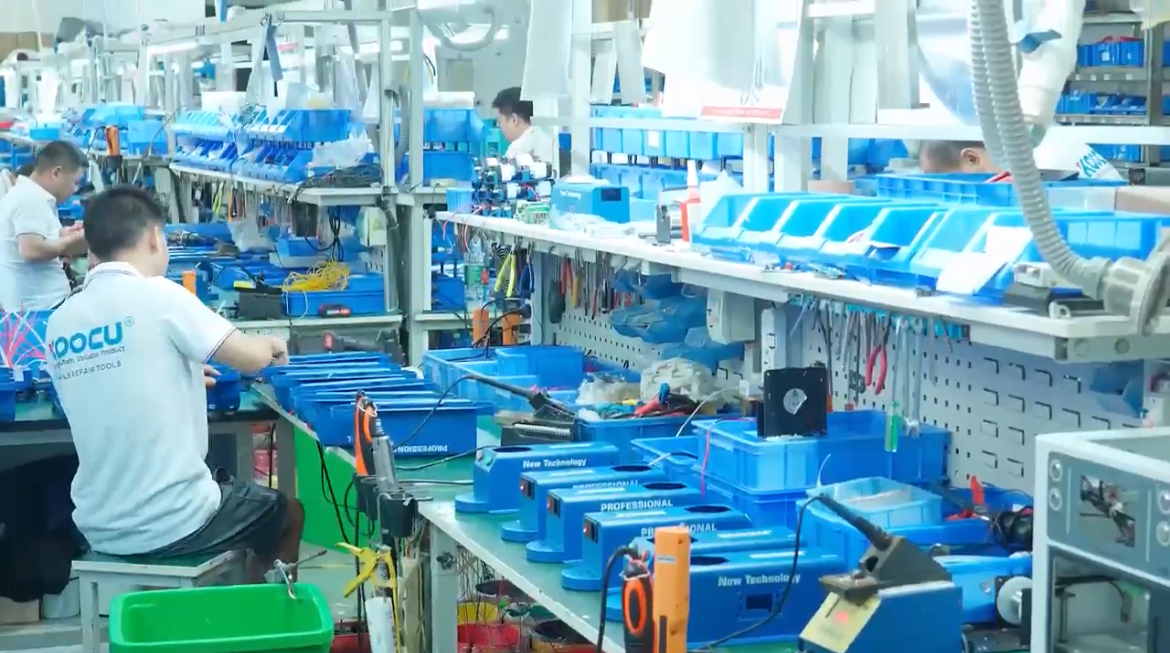
Factory environment where cell phone repair tools are produced. Image: KOOCU, Guangzhou Weiqianji Technology Co., Ltd.
Station 4 — Camera Module and Small-Part Placement
Reference model: FS-11 (120 mm). Placement tasks reward a consistent tool length across a shift, because the technician builds muscle memory around one reach distance. FS-11 is the assigned 120 mm model for this station in the reference setup.
What to watch: FS-11, ST-25, ST-21, ST-30 and ST-114 share the same documented 120 mm length and stainless steel material, so they are parallel options at the 120 mm format. The difference that matters for your shop is tip style, which is not in this data set. Confirm the exact tip shape you need before committing a full station to a single model.
Station 5 — Adhesive, Gasket and Debris Removal
Reference models: ST-30 or ST-114 (120 mm). Scraping adhesive and clearing gasket residue is abrasive work that shortens the life of any tip. Dedicating one model to this station protects the tools used on parts and connectors.
What to watch: one-way retirement. When a pair from Station 2 or Station 3 wears out, it can be demoted to adhesive removal or discarded — but a cleaning tool should never be promoted back to board work.
Station 6 — Reassembly, Screw Reinstallation and Final QC
Reference model: any 120 mm model, paired with a K-series electric screwdriver. Reassembly is where tweezers and powered tools are used in the same motion sequence: the tweezer positions the part, the screwdriver reinstates the screw. KOOCU’s electric screwdriver range is documented as special screwdrivers for mobile phone repair, made of aluminum alloy, with power ranges of 1.5W–15W (K01), 2W–15W (K01 pro), 2W–20W (K02, K04) and 2W–30W (K05, K07).
Field reference: KOOCU’s case record for a B2B wholesale merchant in South Africa lists 50 units of the K01 electric screwdriver used for screw removal, with three years of stable operation and strong power as the highlighted result. For shops running repetitive reassembly, the tweezer and the screwdriver should be planned as one station, not two separate purchases.
Step-by-Step: Building a Tweezer Standard for Your Shop
The mapping above only becomes useful when it is written down and enforced. Use this eight-step process to turn it into a working shop standard.
- List the tasks on each bench. Write down what technicians actually do with tweezers at each station: opening, connector work, board work, placement, cleaning, reassembly. Do not describe the tools; describe the motions.
- Count how often tweezers are picked up per task. The station with the highest pickup frequency deserves the most reliable model and the strictest replacement rule.
- Assign one reference model per station. Use the documented variables: 115 mm for tight, shallow work; 120 mm for standard bench reach; ST-115 where exposed boards are handled.
- Set a minimum quantity per station, not per technician. At least two pairs per station per bench means a damaged tip does not stop the line while a replacement is sourced.
- Label and store by station. A labelled slot or colour-coded tray removes the daily decision about which model to pick up.
- Define replacement triggers. Visible tip misalignment, nicked tips or adhesive contamination should trigger demotion or disposal — not a decision made under time pressure mid-repair.
- Plan the supply maths. Typical production lead time is 10 days and the minimum order quantity is 50 units, against a monthly production capacity of 10,000 units. That combination allows a shop to build a mixed workstation starter pack, or a distributor to plan a monthly re-stock, within one order.
- Train and document. Put the station list into the shop SOP and into new-hire training. A standard that only exists in the owner’s head reverts to one shared pair within a month.
Use Cases: Three Shop Profiles
Profile A — Single-Counter Repair Shop (2–3 Benches)
A small shop does not need the full line, but it does need to separate board work from everything else. A practical starter mix assigns TS-15 to intake and teardown, ST-21 to screen and connector work, and ST-115 to the board bench. Ordering this as a 50-unit mixed batch — the documented minimum order quantity — gives the shop spare pairs per station instead of a single high-risk pair per model.
Profile B — Urban Multi-Bench Service Chain
A multi-bench operation with standardised technician roles benefits from the complete six-station list: TS-15, ST-21, ST-25, FS-11, ST-30 or ST-114, and ST-115, plus K-series electric screwdrivers at the reassembly station. With two pairs per station and a 10-day typical lead time, replenishment can be scheduled at a fixed point in the month rather than triggered by failures.
Profile C — Distributor or Kit Assembler
For distributors building a private-label cell phone repair tool kit, workstation logic is a selling point. A kit that can be explained as “teardown, screen, board, cleaning, reassembly” is easier to justify to a repair shop than a numbered list of tools. OEM production services are available with customization options for voltage and logo — voltage applies to the powered tools in the kit, such as the K-series electric screwdrivers, while logo customization covers the kit and branded tools. Delivery terms are quoted as FOB or CIF, with pre-shipment testing stated as the acceptance criterion. Export markets include South America and Africa.
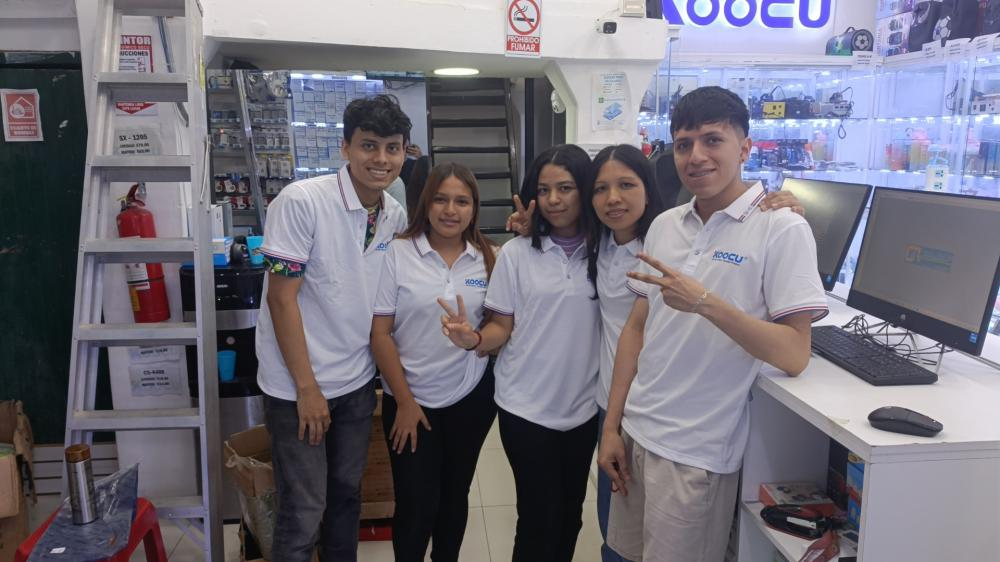
KOOCU serves large B2B clients in South America, alongside Africa and other export markets.
Model-to-Workstation Comparison Table
| Model | Length | Material | Anti-static (documented) | Reference workstation |
|---|---|---|---|---|
| TS-15 | 115 mm | Stainless steel | Not specified in this data set | Intake, screw removal, tight-cavity opening |
| ST-21 | 120 mm | Stainless steel | Not specified in this data set | Larger chassis teardown; screen and flex handling |
| ST-25 | 120 mm | Stainless steel | Not specified in this data set | Screen separation; connector re-seating |
| FS-11 | 120 mm | Stainless steel | Not specified in this data set | Camera module and small-part placement |
| ST-30 | 120 mm | Stainless steel | Not specified in this data set | Adhesive, gasket and debris removal |
| ST-114 | 120 mm | Stainless steel | Not specified in this data set | Adhesive and debris removal (secondary) |
| ST-115 | 120 mm | Stainless steel | Yes | Board-level and ESD-sensitive work |
“Not specified in this data set” means the property is not published in the source data used for this guide. It does not mean the model lacks the property. Confirm anti-static behaviour in writing with the supplier before assigning any model other than ST-115 to board-level work.
FAQ
1. Are KOOCU repair tweezers ESD-safe, and what documentation should a buyer request?
Anti-static properties are documented for the ST-115 model, which is the model this guide assigns to board-level, ESD-sensitive work. For the other models covered here — FS-11, ST-25, ST-21, ST-30, ST-114 and TS-15 — the published specification covers stainless steel material and length (115 mm or 120 mm); anti-static behaviour is not stated, so a shop should not assume it. Two documents are worth requesting before an SOP is written: the current specification sheet for the exact model and batch, and any test documentation the supplier can provide. Separately, where battery-containing items are shipped, the manufacturer holds a third-party transport identification report issued by PONY (report number MTIN67MG7731367U1, valid to 2026-12-31), covering lithium-ion cell transport under IMDG Special Provision 188 — note that this document concerns transport of lithium-ion cells, not tweezer performance.
2. Can tweezers be supplied inside a private-label repair tool kit?
Yes. The manufacturer provides OEM production services and offers customization options for voltage and logo. Voltage customization applies to the powered tools inside a kit, such as the K-series mobile phone repair electric screwdrivers — K01 (1.5W–15W), K01 pro (2W–15W), K02 and K04 (2W–20W), and K05 and K07 (2W–30W), all with aluminum alloy bodies. Logo customization covers the kit and the branded tools. From a kit-design perspective, a private-label set organised by workstation — teardown, screen, board, cleaning, reassembly — is easier to explain to end users than a set organised by price tier.
3. What is the minimum order quantity, and how are these tools priced?
The minimum order quantity is 50 units and the typical production lead time is 10 days, with a monthly production capacity of 10,000 units. Tools in this range are quoted by inquiry rather than from a public retail price list; delivery terms are quoted as FOB or CIF, and pre-shipment testing is the stated acceptance criterion. Because the minimum applies per order rather than per model, a shop or distributor can use the 50-unit minimum to build a mixed workstation pack instead of committing the whole quantity to a single model.
4. How should a shop validate tweezer models before placing a larger order?
Use the 50-unit minimum as a validation batch, then test it against your own benches rather than against a catalogue. Assign one or two pairs to each station, run them on live jobs for a defined period, and check three things: whether the 115 mm TS-15 or the 120 mm models reach your typical connector positions more comfortably; whether the tip condition survives your cleaning process; and whether the board station stays on the anti-static ST-115 model. Standardise only the models that survive those tests. To start that process, send your station list to the supplier at zjzason668@gmail.com or on WhatsApp at +86 181 3852 7081 and request the current specification sheet for the models you plan to test.
5. What lead time and capacity should a distributor plan around?
Typical production lead time is 10 days, with monthly production capacity of 10,000 units. Export markets include South America and Africa, and after-sales support is provided remotely. For a distributor, that means replenishment can be planned inside a normal monthly buying cycle, provided orders are placed against the 50-unit minimum and confirmed in advance. To confirm current scheduling for a mixed tweezer and electric screwdriver order, contact Jason at zjzason668@gmail.com or +86 181 3852 7081, WhatsApp +86 181 3852 7081, or visit www.koocu-tools.com.
Conclusion: Assign the Model, Then Re-Order the Same Model
Tweezer selection in a repair shop is a workstation decision, not a price decision. With documented lengths of 115 mm (TS-15) and 120 mm (FS-11, ST-25, ST-21, ST-30, ST-114, ST-115), a stainless steel construction across the line, and anti-static properties specified for ST-115, a shop can build a repeatable six-station standard from facts rather than from habit. Confirm tip geometry with the supplier, then lock the assignment, label the trays and re-order exactly what survived on your benches.
Build your workstation tweezer standard with KOOCU. Send us your station list — intake, screen, board, placement, cleaning, reassembly — and we will map the models, confirm tip styles and quote a mixed batch from the 50-unit minimum, with a typical 10-day production lead time.
Email: zjzason668@gmail.com | Tel / WhatsApp: +86 181 3852 7081 | Chat on WhatsApp | www.koocu-tools.com
Guangzhou Weiqianji Technology Co., Ltd, Guangzhou, China — OEM cell phone repair tools for South America, Africa and other export markets.
Have Questions or Need More Details?
Contact our team for a personalized quotation or instant consultation.
Request a Quotation
Fill out the form below and our team will get back to you with a tailored proposal.
WhatsApp Direct Chat
Prefer to chat in real-time? Message us on WhatsApp for instant assistance & quick answers.
- Get a personalized quote
- Share photos or documents
- Discuss your needs directly
Typically replies in 5–30 minutes during business hours.