
FS-11 vs ST-30: 120 mm Anti-Static Cell Phone Repair Tools Compared
FS-11 and ST-30 are the same tweezer type, the same length and the same material. Both are 120 mm stainless steel tweezers in the KOOCU cell phone repair tools range, and both are positioned as anti-static. The single documented difference is that ST-30 also carries a high-hardness claim. For a B2B buyer, that turns the decision into one question: does your bench need a wear-resistance claim, and can you verify it before committing to a 50-unit order?
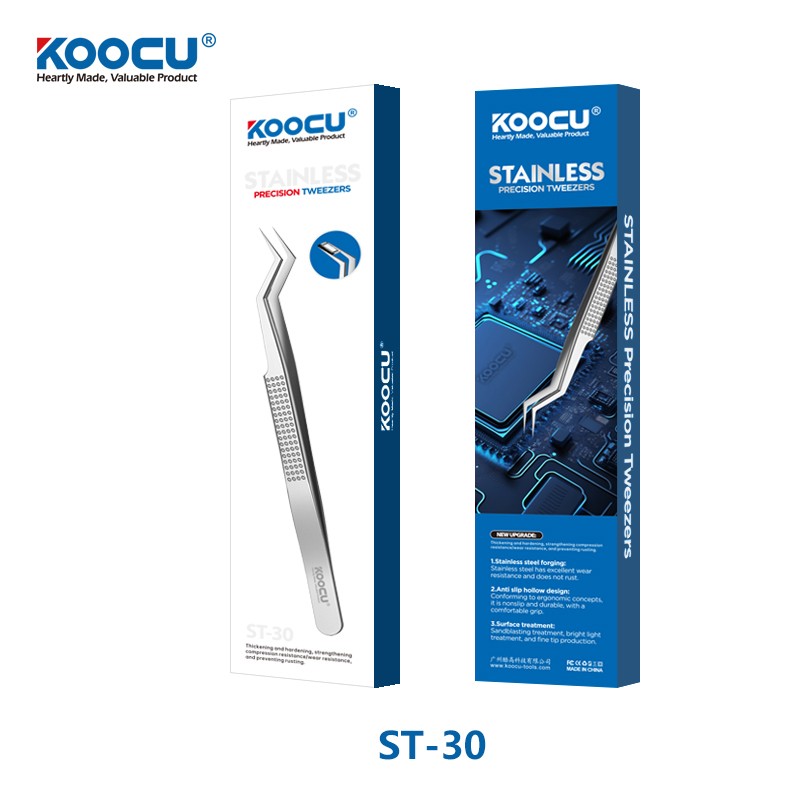
ST-30: 120 mm, stainless steel, anti-static positioning, plus a supplier-stated high-hardness claim.
This comparison is written for importers, distributors, kit assemblers and repair-chain buyers who have already decided they need a 120 mm anti-static tweezer and now have to choose between two models whose published attributes almost completely overlap. It sets out the shared specification, isolates the one documented difference, states plainly what neither model's documentation covers, and gives a sample validation sequence that can be run before a minimum order is placed.
The Problem: When Two Specification Sheets Read the Same
Tweezer comparisons usually fail because the specification sheet is too short to compare. FS-11 is documented as a 120 mm stainless steel tweezer for mobile phone repair. ST-30 is documented at the same 120 mm in the same stainless steel, with the same anti-static positioning. When three attributes match exactly, a buyer has nothing left to evaluate except price, availability and how fast the supplier replies, and none of those predicts whether the tool will still hold alignment after months of bench use.
Two failure modes matter in practice. The first is tip degradation: tweezer tips bend, cross or lose their flat contact area long before the body shows any damage, and a misaligned tip is what scratches a flex cable or drops a shield cover at the wrong moment. The second is static-related component damage during handling, a fault that is usually blamed on the operator rather than traced back to the tool.
That narrows the real question. It is not "which model is better" in the abstract, because on paper the two are equivalent. It is whether ST-30's additional high-hardness claim changes anything on your specific bench, and whether that claim can be tested before purchase. Everything else in this decision is shared ground.
Industry Background: Why a 120 mm Anti-Static Tweezer Became a Specification Decision
Demand for hand tools in phone repair tracks repair volume. Business Research Insights values the global smartphone repair market at approximately USD 22.66 billion in 2026, a figure reflecting repair services and hardware replacement across batteries, screens and cameras.
The policy environment is pushing more of that work toward independent shops. A 2026 ThinkComputers guide identifies the "Right to Repair" movement as a major market driver, with OEMs increasingly releasing repair manuals and tools to third-party providers. Every shop that begins doing board-level or screen work under its own process also begins specifying its own consumables, tweezers included, instead of accepting whatever a branded bundle contains.
Precision hand tools as a segment point the same way. Credence Research put the global manual screwdriver market at USD 365.2 million in 2024 and named precision screwdrivers for electronics as a key growth driver. The pattern is consistent: tools once bought as part of a kit are now specified line by line, with model numbers, materials and lengths written into purchase orders and private-label kit sheets.
Shared Ground: What FS-11 and ST-30 Have in Common
The 120 mm length is the anchor specification
FS-11 measures 120 mm and is made of stainless steel; ST-30 is documented at the same 120 mm in the same material. An identical length means the two models can occupy the same position on a kit line. Reach under a display assembly, access into a chassis and hold a component at a consistent working distance are all governed by that one dimension. For export kit assembly, a single length also simplifies the catalog entry and the spare-part line.
Stainless steel is the shared material baseline
Both models are stainless steel. In a repair environment, that supports corrosion resistance against flux residues and cleaning agents and helps keep a clean, non-shedding tip surface. Material sameness also means any durability difference between the two models has to come from the hardness claim rather than from a different base alloy, which is why the hardness claim is worth examining on its own.
Anti-static positioning is shared, but it remains a positioning claim
Both FS-11 and ST-30 are positioned as anti-static. That is the right attribute to demand for handling flex cables, display connectors and logic boards, where the risk is a discharge path through a component rather than damage to the tool itself. What the available documentation does not contain is a measured surface resistance value, a named test method, or a third-party anti-static certificate specific to either model. Buyers should therefore treat anti-static as a stated design property to be confirmed on samples, not as a finished compliance status.
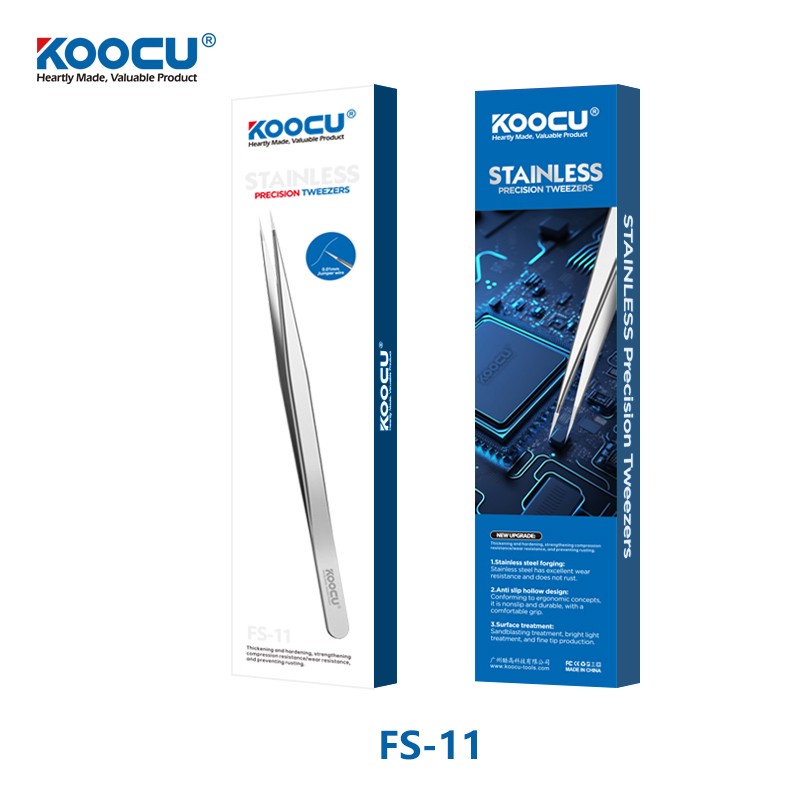
FS-11: 120 mm stainless steel tweezer for mobile phone repair, with anti-static positioning.
The Only Documented Difference: ST-30's High-Hardness Claim
The single differentiation available in the documentation is that ST-30 carries a high-hardness claim. Hardness in a tweezer is not an abstract property. It governs how long the tip keeps its geometry under repeated gripping and light levering. A tip that deforms slowly holds alignment longer, which extends the interval between tip adjustments and reduces the chance that a worn tip damages a component mid-repair.
What the claim does not yet tell you is scale or method. The available material states high hardness without a stated hardness scale, a target value or a test procedure. That does not make the claim false; it makes it a hypothesis. The correct buyer response is neither to discount it nor to accept it, but to test it: run both models through the same handling cycle and measure tip alignment before and after.
The claim is most likely to matter on benches that repeatedly pry and lift shields, connectors and adhesive films, where the same pair of tweezers is used hundreds of times per shift. It is likely to matter less on low-cycle benches doing occasional component placement, or on kit lines sold to end users whose workload cannot be predicted. In the second case, FS-11 meets the same 120 mm anti-static requirement without asking the buyer to underwrite a property nobody has measured.
What Neither Model's Documentation Covers
Three gaps are worth stating plainly, because buyers often assume documentation exists when it does not. First, no tip geometry or tolerance figure is published for either model: tip width, tip style and alignment tolerance are not stated in the available material. Second, no per-unit price is published for either model. Third, there is no product conformity certificate for the tweezers themselves.
On that third point, the supplier's certification file does contain a third-party document, and it is routinely misread in tenders. It is a Hazard Classification and Identification Report for Transport of Goods issued by PONY under number MTIN67MG7731367U1, issued 1 December 2025 and valid to 31 December 2026. Its scope is a lithium-ion cell, model 10440, 3.7 V, 320 mAh, 1.184 Wh, packed 400 pieces per carton, assessed against the IMO International Maritime Dangerous Goods Code 2024 Edition (Amendment 42-24) Special Provision 188 and the UN Manual of Tests and Criteria Part III subsection 38.3. That is a dangerous-goods transport identification report for a cell. It is not a tweezer certificate and should not be presented as one.
There is also no consolidated third-party review data for either model, so peer references cannot substitute for sample testing in this decision.
Supplier Context: Guangzhou Weiqianji Technology and the KOOCU Range
Guangzhou Weiqianji Technology Co., Ltd, which sells under the KOOCU brand, is a Guangzhou-based manufacturer and supplier of cell phone repair tools. The company states a 1,000 m² production facility, a 10+ engineer R&D team, OEM production capability, and customization options covering voltage and logo. For tweezer programs, the logo element is the relevant part of that scope; voltage customization applies to electric screwdrivers such as the K01.
Commercial parameters that apply to the tweezer range: minimum order quantity 50 units, typical production lead time 10 days, monthly production capacity 10,000 units, 100% test before shipment, and remote after-sales support. Delivery terms are FOB or CIF, acceptance is based on pre-shipment test, and payment terms are 100% cash payment. Export markets are South America and Africa.
Supply continuity is supported by an existing account record rather than by a tweezer case study. A B2B wholesale merchant in South Africa ordered 50 units of the K01 electric screwdriver for screw removal and reports three years of stable operation with strong power. That is evidence the supplier sustains repeat B2B accounts in export markets. It is not evidence about tweezer performance and should not be read as such.
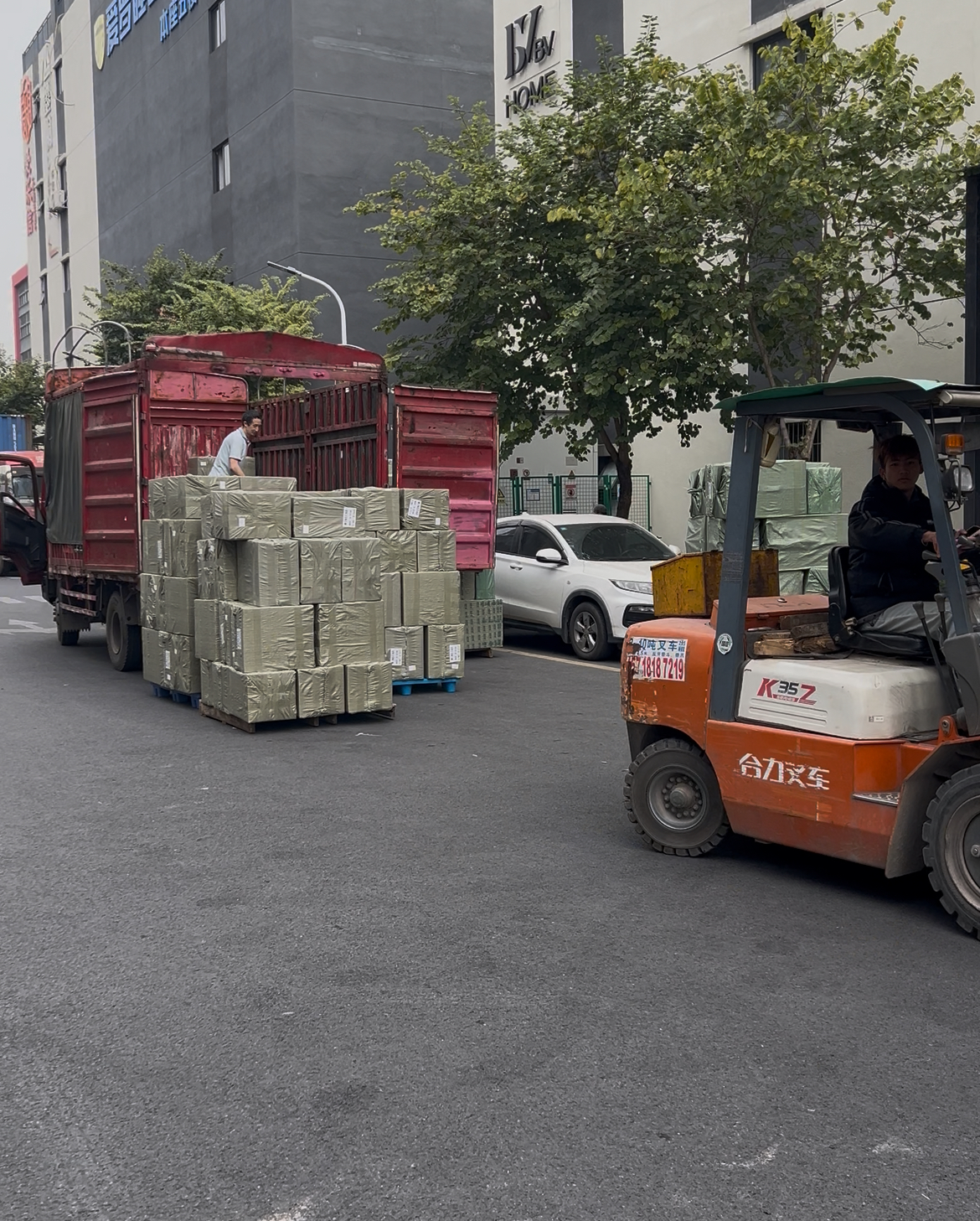
Production capacity stated by the supplier: 10,000 units per month, typical lead time 10 days, 100% test before shipment.
Step-by-Step: Choosing Between FS-11 and ST-30 in Six Steps
- Lock the specification line first. Write 120 mm, stainless steel, anti-static and mobile phone repair into the requirement before comparing models. Without that line, neither model can be rejected on specification and the decision collapses into price.
- Separate shared attributes from differentiating attributes. Shared on both sides: 120 mm length, stainless steel, anti-static positioning. Present on the ST-30 side only: the high-hardness claim. Anything that appears on one side only is the only thing worth testing.
- Request model-specific documentation in writing. Ask for tip geometry, the anti-static test method if one exists, and any model-level conformity document. Expect the transport report described above to be offered as "the certificate"; clarify that it covers a lithium-ion cell model 10440, not the tweezers.
- Design a sample test that can actually fail. Confirm length and material; inspect tip alignment under magnification; run the same handling cycle on FS-11 and ST-30 and re-check alignment afterwards; check anti-static behavior with the meter your own lab already uses; wipe both tips with the cleaning agent your shop uses and inspect for surface change.
- Match commercial terms to the test outcome. Both models run on the same terms: MOQ 50 units, 10-day typical lead time, 10,000 units monthly capacity, pre-shipment test acceptance, FOB or CIF, and 100% cash payment. If the ST-30 hardness claim survives your test, settle the premium in the quotation, because no price is published.
- Set the private-label and reorder baseline. Confirm that logo customization, packaging and insert documentation fall inside the OEM scope, keep the tested sample as the reference standard, and set the reorder trigger on tip alignment rather than on calendar time.
Use Cases: Which Model Fits Which Bench
Standard kit assembly and catalog distribution: FS-11
When the requirement is a 120 mm stainless steel anti-static tweezer and the kit will move through distributors in South America or Africa, FS-11 covers the specification without an extra property to justify. The catalog entry stays simple: one length, one material, one static-safety positioning, one model number.
High-cycle benches with measurable wear: ST-30
Where tweezers are used continuously for prying and lifting, tip deformation is the replacement driver. ST-30's high-hardness claim is aimed at exactly that interval. A buyer who runs the wear comparison on samples converts the claim into a documented decision and can defend the selection internally without relying on supplier wording.
Mixed export kits: both models in one line
Because length, material and anti-static positioning are shared, FS-11 and ST-30 can occupy the same slot in a kit line, with FS-11 as the standard option and ST-30 as the wear-resistant option, without changing packaging dimensions or workstation layout.
Where neither model is the answer
If the underlying problem is a static-damage rate, a tweezer alone will not fix it. Grounding, mats and ionization belong to the process, and the tweezer only contributes the handling surface. In that scenario the priority purchase is process equipment and the model decision becomes secondary.
Comparison Table: FS-11 vs ST-30 on Documented Attributes
| Attribute | FS-11 | ST-30 |
|---|---|---|
| Model type | Tweezer for mobile phone repair | Tweezer for mobile phone repair |
| Length | 120 mm | 120 mm |
| Material | Stainless steel | Stainless steel |
| Anti-static positioning | Yes | Yes |
| Hardness claim | Not stated in available material | High-hardness claim (supplier-stated) |
| Documented evidence in this comparison | Model, 120 mm length, stainless steel, anti-static positioning | Model, 120 mm length, stainless steel, anti-static positioning, high-hardness claim |
| Verification before a bulk order | Tip alignment, static check | Tip alignment, static check, wear comparison for the hardness claim |
| Published price | Not published | Not published |
Only attributes present in the available documentation are listed. A blank or "not published" entry means the value is not stated for that model, not that the model lacks the property.
Commercial Terms That Apply to Both Models
| Parameter | Value |
|---|---|
| Minimum order quantity | 50 units |
| Typical production lead time | 10 days |
| Monthly production capacity | 10,000 units |
| Quality control | 100% test |
| Delivery terms | FOB / CIF |
| Acceptance criteria | Pre-shipment test |
| Payment terms | 100% cash payment |
| OEM | Available; customization options include voltage and logo |
| After-sales | Remote support |
| Export markets | South America, Africa |
These terms describe the supplier's cell phone repair tools range. Because no per-model term sheet and no price list are published for FS-11 or ST-30, confirm the exact scope for a tweezer-only order or a private-label kit in the quotation.
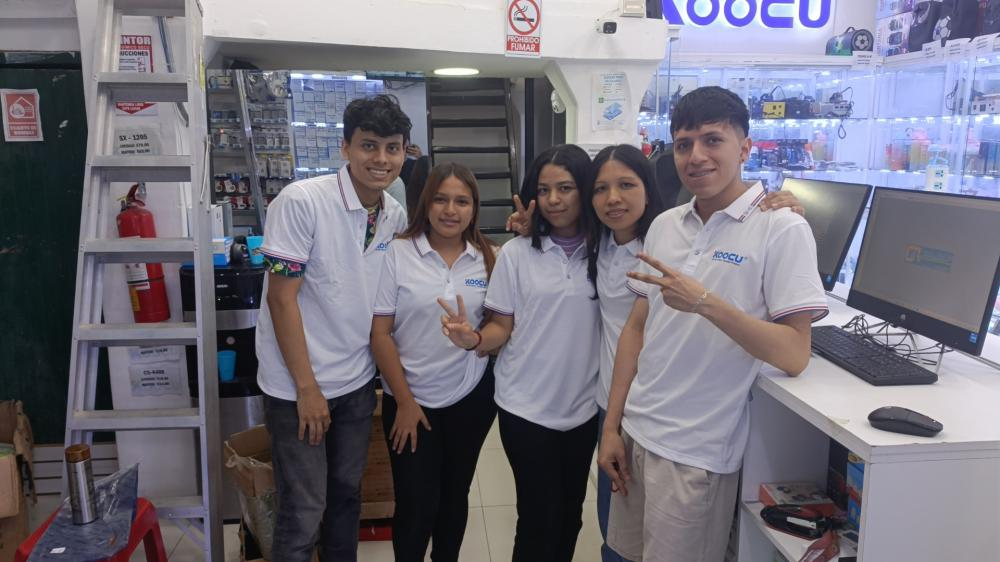
Stated export markets for the KOOCU range: South America and Africa.
FAQ: FS-11 vs ST-30 for B2B Buyers
Are FS-11 and ST-30 certified products?
No product conformity certificate for either tweezer appears in the available documentation. The supplier's certification file holds a PONY Hazard Classification and Identification Report for Transport of Goods, number MTIN67MG7731367U1, issued 1 December 2025 and valid to 31 December 2026, covering a lithium-ion cell model 10440 at 3.7 V, 320 mAh, 1.184 Wh, packed 400 pieces per carton, assessed under IMDG Code 2024 Edition Special Provision 188 and the UN Manual of Tests and Criteria Part III subsection 38.3. That document is a dangerous-goods transport report for a cell, not a tweezer certificate. Buyers should request model-specific material and anti-static documentation in writing rather than accept a generic certificate.
Can a Chinese OEM manufacturer supply private-label kits built around these tweezers?
OEM production is offered, with customization options listed as voltage and logo. For tweezers, logo customization is the applicable element; voltage customization applies to electric screwdrivers such as the K01. Commercial terms for the range are MOQ 50 units, typical production lead time 10 days, monthly production capacity 10,000 units, 100% test before shipment and remote after-sales support. Buyers should confirm in writing that the private-label scope covers tweezer body marking, packaging and insert documentation, since no per-model term sheet is published.
What drives the per-unit cost of a 120 mm anti-static tweezer in a private-label kit?
No price is published for FS-11 or ST-30, so cost has to be quoted. The variables that move it are the model selected (the ST-30 hardness claim is the only documented technical difference), the branding and packaging scope inside the OEM program, order volume relative to the 50-unit MOQ, and freight terms, which are FOB or CIF. For orientation only, US customs-derived data for mobile opener tools under HS code 8205 shows an average import unit price of roughly USD 1.03. That is a historical average for opener tools, not a tweezer quotation and not a price band for either model.
How should a buyer validate FS-11 and ST-30 samples before ordering?
Four checks separate the two models. First, confirm the 120 mm length and stainless steel material on the actual sample. Second, inspect tip alignment under magnification, because tip geometry is not published for either model. Third, run the same repeated handling cycle on both and re-check alignment afterwards, which is the only way to test the ST-30 high-hardness claim. Fourth, check anti-static behavior with the meter your own lab already uses, since no measured surface resistance value is published. Acceptance is based on pre-shipment test with 100% test stated, and payment terms are 100% cash payment, so all sample questions should be resolved before payment.
What is the lead time and reorder model for these tweezers?
Minimum order quantity is 50 units, typical production lead time is 10 days, and monthly production capacity is 10,000 units, which supports repeat ordering without a long queue. Export markets are South America and Africa, and after-sales support is handled remotely. As a practical next step, request FS-11 and ST-30 samples side by side so the wear comparison is run on your own bench before a kit line is committed.
Conclusion: Decide on the Claim You Can Test
FS-11 and ST-30 are not separated by length, material or static-safety positioning; all three are shared. They are separated by one claim: ST-30's high hardness. That makes this an unusually clean purchasing decision. If your bench does high-cycle prying and lifting, test the hardness claim on samples and treat a positive result as the justification for the ST-30 option. If your requirement is a standardized 120 mm anti-static tweezer for kit assembly and distribution, FS-11 meets the specification without asking you to underwrite a property nobody has measured.
Either way, close the documentation questions first. In the available material there is no tweezer conformity certificate, no published tip geometry and no published price for either model, and the transport report in the supplier's file covers a lithium-ion cell rather than a tweezer. A buyer who knows those limits in advance negotiates from a stronger position than one who discovers them after the first shipment.
Next Step: Compare FS-11 and ST-30 on Your Own Bench
Guangzhou Weiqianji Technology Co., Ltd (KOOCU) supplies cell phone repair tools to B2B buyers in South America, Africa and other export markets, with OEM production, MOQ 50 units, a typical 10-day lead time, 10,000 units monthly capacity, 100% test before shipment and remote after-sales support.
Request paired samples of FS-11 and ST-30, or ask for a quotation with your private-label and packaging scope included.
Contact: Jason | Email: zjzason668@gmail.com | Tel / WhatsApp: +86 181 3852 7081 | Website: www.koocu-tools.com
Have Questions or Need More Details?
Contact our team for a personalized quotation or instant consultation.
Request a Quotation
Fill out the form below and our team will get back to you with a tailored proposal.
WhatsApp Direct Chat
Prefer to chat in real-time? Message us on WhatsApp for instant assistance & quick answers.
- Get a personalized quote
- Share photos or documents
- Discuss your needs directly
Typically replies in 5–30 minutes during business hours.