
FS-11 vs ST-30 Tweezers: Head-to-Head Choice for Phone Repair Pros
FS-11 and ST-30 are both 120 mm stainless steel tweezers with anti-static properties, made for mobile phone repair by KOOCU, the brand of Guangzhou Weiqianji Technology Co., Ltd. Placed side by side in a catalogue, their published specifications overlap almost completely. That overlap is the reason this comparison is difficult: there is one documented attribute-level difference to work with, and every other part of the decision has to be made on written requirements, packing and order terms rather than on product claims.
The short answer. If your purchase specification contains a hardness clause, ST-30 is the model that matches it, because ST-30 is documented with a high hardness feature. If your specification stops at 120 mm length, stainless steel material and anti-static properties — the usual shape of a tweezer line item inside a cell phone repair tool kit — both models satisfy the written requirement, and the decision moves to branding, packing, MOQ and lead time.
Problem Definition: Why Two Nearly Identical Tweezers Are Hard to Choose Between
FS-11 and ST-30 share the same product type, the same 120 mm length, the same stainless steel material and the same anti-static property. They are sold into the same repair environment and the same applicable industry, Cellphone Repairs. When two SKUs are that close, a comparison cannot be settled by looking at them, and it should not be settled by preference.
The real problem is documentation, not product preference. Tweezers are a small line item in a larger order of mobile phone disassembly tools, so they usually receive the least attention during sourcing and carry the most avoidable risk afterwards. Three failure patterns show up repeatedly:
- Buying on appearance. The two models look like the same tool, the order is placed without a written attribute list, and there is nothing to inspect the delivery against.
- Over-specifying. A buyer adds hardness numbers or resistance values to a purchase order that no model-level document supports. The supplier cannot confirm them, and the order stalls at the confirmation stage.
- Under-specifying. A chat message is treated as a specification. When a batch is questioned later, there is no document to fall back on.
The FS-11 versus ST-30 decision is therefore not “which tweezer is better.” It is “which documented attribute set matches the requirement I can actually write down, and what must be verified before I commit to volume.”
Industry Background: Where Tweezers Sit in Cell Phone Repair Tools
Demand for repair hand tools follows repair volume, and repair volume remains large. The global smartphone repair market is valued at approximately USD 22.66 billion in 2026, according to Business Research Insights. Separately, the Right to Repair movement is described as a major market driver in 2026, influencing OEMs to release repair manuals and tools to third-party providers, per ThinkComputers.org.
Both signals point the same way for tool buyers. As repair work becomes more distributed across independent shops, chain workshops and small factory lines, the tools that support that work move in larger and more standardized quantities. Tweezers are a fixed part of that basket. In a typical smartphone teardown tool kit they sit alongside smartphone opening tools, pry tools and spudger sets, precision screwdrivers and screen replacement tools. Buyers assembling a professional cell phone repair kit usually want one supplier for the whole set, because a single supplier means one specification conversation, one packing standard and one shipment.
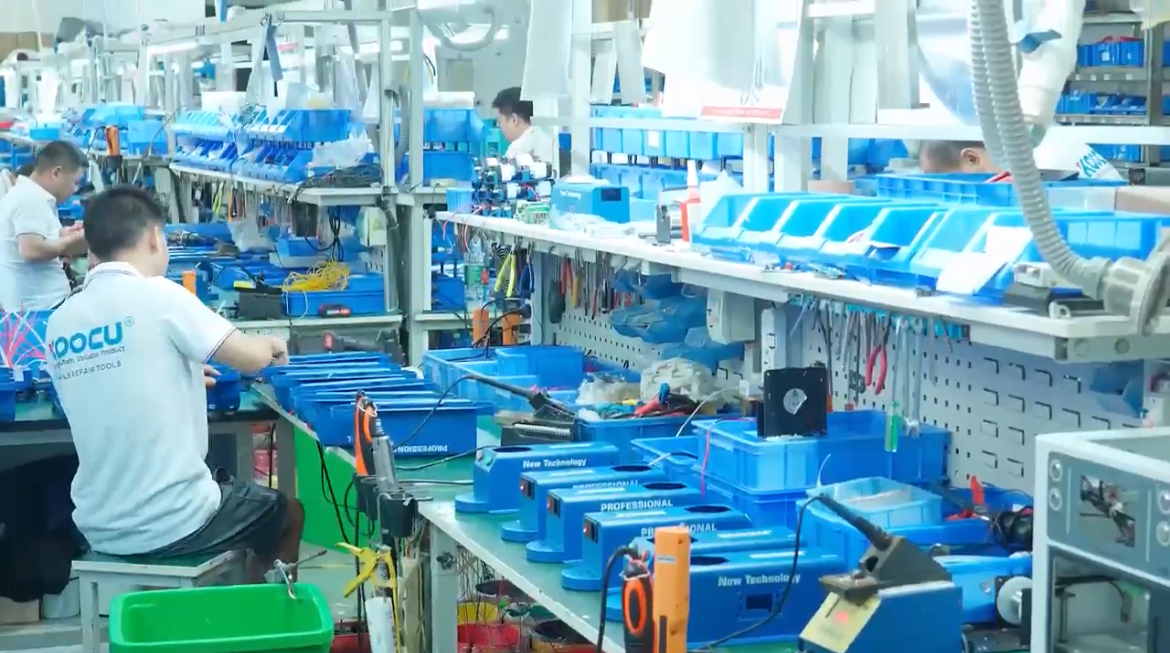
On the supply side, the category is concentrated in southern China. Guangzhou Weiqianji Technology Co., Ltd operates a 1,000 m² factory and an R&D team of 10+ engineers, works with a 100% export ratio, and supplies markets including Africa, South America, Southeast Asia, India, Bangladesh and Pakistan. Its KOOCU range covers both tweezers and electric screwdrivers, which is why the same buyer often evaluates FS-11 and ST-30 in the same session as a powered tool order.
Detailed Solution: Reading the FS-11 and ST-30 Specifications Correctly
What the FS-11 documentation establishes
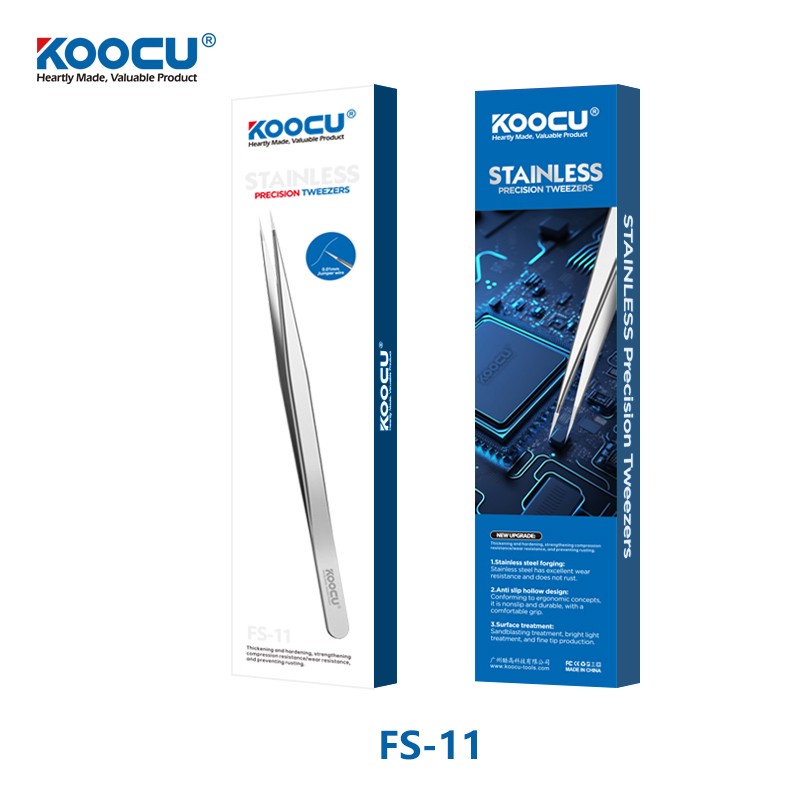
The model designation is FS-11. It is a tweezer for mobile phone repair, 120 mm in length, made of stainless steel, with anti-static properties documented. The applicable industry is Cellphone Repairs. Those are the facts a buyer can put into a purchase order today without further confirmation.
What the ST-30 documentation establishes
The model designation is ST-30. It is likewise a tweezer for mobile phone repair, 120 mm in length, made of stainless steel, with anti-static properties documented, and it carries a documented high hardness feature. The applicable industry is Cellphone Repairs. The hardness point is the only model-level attribute difference that separates the two SKUs in the published data.
What the shared baseline does and does not cover
- 120 mm length. Identical length means the two models are interchangeable in kit layout and at the bench: the same foam cut-out, the same slot, no retraining. Length is a genuine variable across the KOOCU tweezer range rather than a constant — the 7-SA-16 SS-SA-16 is documented at 130 mm with stainless steel, high hardness and anti-static properties — so 120 mm is a deliberate compact choice, not the only option available.
- Stainless steel. The documentation states the material family, not a grade. If your incoming inspection requires a specific stainless grade on the specification sheet, request it in writing; do not infer one from the material name.
- Anti-static. This is documented as a property, not as a measured resistance value. If your process control needs a numeric ESD figure, ask the supplier explicitly. The published data reviewed here contains no numeric value for either model.
- Hardness. Documented for ST-30 as a feature. No numeric hardness figure is published for either model. If your quality plan needs a number, request it as a model-specific written confirmation.
Documentation note. KOOCU’s published product data lists “high hardness, anti-static” among the selling points for its tweezer line, and ST-30 is the model documented with a high hardness feature at model level. This guide does not claim that FS-11 lacks hardness. It states only that the model-level documentation available for FS-11 covers 120 mm length, stainless steel material and anti-static properties. Where a hardness requirement exists, treat ST-30 as the documented option and obtain written confirmation from the supplier before using FS-11 in that role.
Step-by-Step Breakdown: How to Choose Between FS-11 and ST-30
Step 1 — Write the requirement before opening the catalogue. Build a single specification line with these fields: model, product type, length, material, anti-static (yes/no), hardness required (yes/no), branding, packing. Two SKUs that look identical become distinguishable the moment the requirement is written down.
Step 2 — Test each model against the hardness clause. If hardness is required, ST-30 is the documented match and the comparison ends there. If hardness is not required, both models qualify on paper and the decision shifts to commercial and packing terms.
Step 3 — Ask for model-specific written confirmation. Request one sheet per model code, confirming length, material, anti-static status and hardness for that exact code. A confirmation covering the whole tweezer family is not the same document as a confirmation for FS-11 and ST-30 individually.
Step 4 — Sample both models. Order a sample of each, label the sample bags with the model code, and inspect against the same written requirement used in the purchase order. Keep the confirmed specification sheet filed with the sample so the reference survives staff changes.
Step 5 — Confirm OEM branding and packing. KOOCU documents an OEM production mode with voltage and logo customization. For a passive hand tool such as a tweezer, the logo and branding dimension is the relevant one; voltage customization applies to the powered tools in the range. Confirm logo artwork, placement and packing format before the production slot is booked.
Step 6 — Check the scope of the shipping documentation. KOOCU materials reference a Hazard Classification and Identification Report for Transport of Goods issued by PONY, report number MTIN67MG7731367U1, issued 2025-12-01 and valid to 2026-12-31, aligned with IMDG Code Special Provision 188. That report is a third-party transport identification report, not a product certification and not a system certification. Its covered items are the lithium-ion cell model 10440 (3.7 V, 320 mAh, 1.184 Wh, packed 400 pcs per carton) and, as referenced in KOOCU materials, the electric screwdrivers K01 and K07 and the tweezer model 7-SA SR. FS-11 and ST-30 are not listed among the covered models, so do not assume the report applies to a tweezer-only order; ask the supplier which documents apply to your shipment.
Step 7 — Fix MOQ, lead time and reorder rules. The documented supply terms are a MOQ of 50 units, a lead time of 10 days, a monthly capacity of 10,000 units, 100% test before shipment and remote after-sales support. Record the model code on every reorder so a mixed FS-11/ST-30 history does not turn into a specification dispute.
Use Cases: Where Each Model Fits in a Repair Workflow
Private-label kit assembly for distributors
When a distributor builds a professional cell phone repair kit under its own brand, one tweezer model per kit is usually the cleaner choice. A single model means a single specification line, a single packing slot and a single claim. Distributors shipping into Africa, South America and Southeast Asia typically standardize on one tweezer code across the whole kit range for exactly this reason.
Bench work where hardness is written into shop procedure
Where a chain workshop or repair line has written the hardness requirement into its own tooling standard, ST-30 is the model whose documentation supports that standard. Where the shop procedure specifies only length, material and anti-static performance, FS-11 satisfies the written requirement and keeps the specification simple.
Screen replacement and disassembly sequences
Tweezers are used after the opening stage, when pry tools and spudgers have separated the assembly and small parts have to be lifted and positioned. Because the same tweezer is used through the whole sequence, consistency of length matters more than variety: identical 120 mm tools let a technician move between benches without adjusting grip or reach.
Multi-technician shops and training environments
In shops with several technicians or an in-house training bench, purchasing one model in volume is simpler to control than mixing. Both FS-11 and ST-30 are 120 mm stainless steel anti-static tweezers in the same product type, so either can anchor a standardized bench layout.
Wholesale catalogue listing
When a wholesaler lists both models, the listing should carry only the documented attributes: length, material, anti-static property, hardness where documented, and the applicable industry. Adding unverified tip geometry, resistance figures or durability claims to a listing creates a claim the buyer can hold you to and the supplier cannot support.
Comparison Table: FS-11 vs ST-30 on Verified Attributes
| Attribute | FS-11 | ST-30 |
|---|---|---|
| Model designation | FS-11 | ST-30 |
| Product type | Tweezer for mobile phone repair | Tweezer for mobile phone repair |
| Length | 120 mm | 120 mm |
| Material | Stainless steel | Stainless steel |
| Anti-static | Documented | Documented |
| High hardness | Not stated in the model-level documentation used here (see documentation note) | Documented high hardness feature |
| Applicable industry | Cellphone Repairs | Cellphone Repairs |
| Manufacturer | Guangzhou Weiqianji Technology Co., Ltd (KOOCU) | Guangzhou Weiqianji Technology Co., Ltd (KOOCU) |
Every value in the table comes from KOOCU product data. No estimated, rounded or inferred values have been added, and no numeric hardness or resistance figure is claimed for either model because none is published.
Frequently Asked Questions
Does the PONY transport report cover FS-11 and ST-30?
The report does not list FS-11 or ST-30 among its covered models. The Hazard Classification and Identification Report for Transport of Goods issued by PONY (report number MTIN67MG7731367U1, issued 2025-12-01, valid to 2026-12-31) covers the lithium-ion cell model 10440, 3.7 V, 320 mAh, 1.184 Wh, packed 400 pcs per carton, under IMDG Code Special Provision 188. KOOCU materials additionally reference this report for the electric screwdrivers K01 and K07 and for the tweezer model 7-SA SR. It is a third-party transport identification report, not a product certification. For a tweezer-only order of FS-11 or ST-30, ask the supplier which documents apply to your shipment before booking freight.
Can FS-11 and ST-30 be supplied with OEM logo customization?
KOOCU documents an OEM production mode with voltage and logo customization, a monthly capacity of 10,000 units, 100% test, remote after-sales support and export markets including South America and Africa. For a passive hand tool such as a tweezer, the logo and branding dimension is the relevant customization path; voltage customization applies to the powered tools in the range, not to a tweezer. Confirm logo artwork, placement and packing format with the supplier before production is scheduled.
How should a buyer compare cost between FS-11 and ST-30 when neither model has a published price?
Neither model has a published unit price in the available data, so the comparison has to be made on a quotation. Because both are the same product type, the same 120 mm length and the same stainless steel material from the same manufacturer, the cost gap between them will come from the model-level specification — the documented hardness feature of ST-30 — plus branding, packing and order quantity, not from length or material. Request one quotation covering both models at the same quantity and the same packing so the comparison is like-for-like, and keep the specification sheet attached to the quote.
How should a buyer validate FS-11 and ST-30 samples?
Order both models and keep the sample bags labelled with the model code, because the two tools are visually close. Check each sample against the same written requirement used in the purchase order: 120 mm length, stainless steel material, anti-static property, and for ST-30 the documented hardness feature. Ask for the anti-static claim and any hardness claim in writing at model level, since neither is published as a numeric value. File the confirmed specification sheet together with the sample so the reference is available for future batches and for any claim raised by your own customers.
What MOQ and lead time apply, and how does a buyer start the order?
The documented supply terms are a MOQ of 50 units and a lead time of 10 days, with 100% test before shipment, a monthly capacity of 10,000 units and remote after-sales support. A practical starting sequence is: send the written requirement for the model you have selected, request a sample of each model if the hardness clause is still open, confirm branding and packing, then place the volume order. To begin, contact KOOCU (Guangzhou Weiqianji Technology Co., Ltd) through www.koocu-tools.com, email zjzason668@gmail.com, or WhatsApp +86 181 3852 7081 and ask for a sample and quotation for FS-11 and ST-30.
Conclusion: The Right Choice Is the One Your Specification Can Prove
FS-11 and ST-30 are not separated by length or material. They are both 120 mm stainless steel anti-static tweezers for mobile phone repair, produced by the same manufacturer in the same applicable industry. The separation is documentation: ST-30 carries a documented high hardness feature at model level, while the model-level documentation available for FS-11 covers 120 mm length, stainless steel material and anti-static properties.
That produces a simple decision rule for repair professionals and the buyers who supply them. Write the requirement first, including an explicit yes or no on hardness. If hardness is required, specify ST-30 and attach its documentation. If hardness is not required, both models meet the written requirement and the decision belongs to branding, packing, MOQ and lead time rather than to the product itself. In either case, confirm the choice in writing at model level before volume production, and do not let a certificate or a claim intended for another model follow the order.
Request FS-11 and ST-30 Samples
KOOCU supplies cell phone repair tools with OEM logo customization, MOQ 50 units, 10-day lead time, 100% test before shipment and remote after-sales support, exporting to Africa, South America, Southeast Asia, India, Bangladesh and Pakistan.
Website: www.koocu-tools.com | Email: zjzason668@gmail.com | WhatsApp: +86 181 3852 7081 | Contact: Jason
Have Questions or Need More Details?
Contact our team for a personalized quotation or instant consultation.
Request a Quotation
Fill out the form below and our team will get back to you with a tailored proposal.
WhatsApp Direct Chat
Prefer to chat in real-time? Message us on WhatsApp for instant assistance & quick answers.
- Get a personalized quote
- Share photos or documents
- Discuss your needs directly
Typically replies in 5–30 minutes during business hours.