
How B2B Buyers Should Select Mobile Phone Repair Electric Screwdrivers
A mobile phone repair electric screwdriver for B2B supply is qualified on seven verifiable parameters: torque control, speed settings, ESD-safe design, bit compatibility, ergonomics, lithium-battery transport documentation, and the supplier's OEM plus batch-consistency capability. Colour options, packaging artwork and catalogue adjectives do not change whether a tool survives a repair bench or clears customs. This technical guide explains how each parameter is checked, then maps them against KOOCU's published K-series parameters and third-party transport documentation.
The guide is written for importers, wholesalers, private-label kit builders and repair-chain operators evaluating cell phone repair tools at the research and evaluation stage, rather than buyers purchasing one screwdriver.
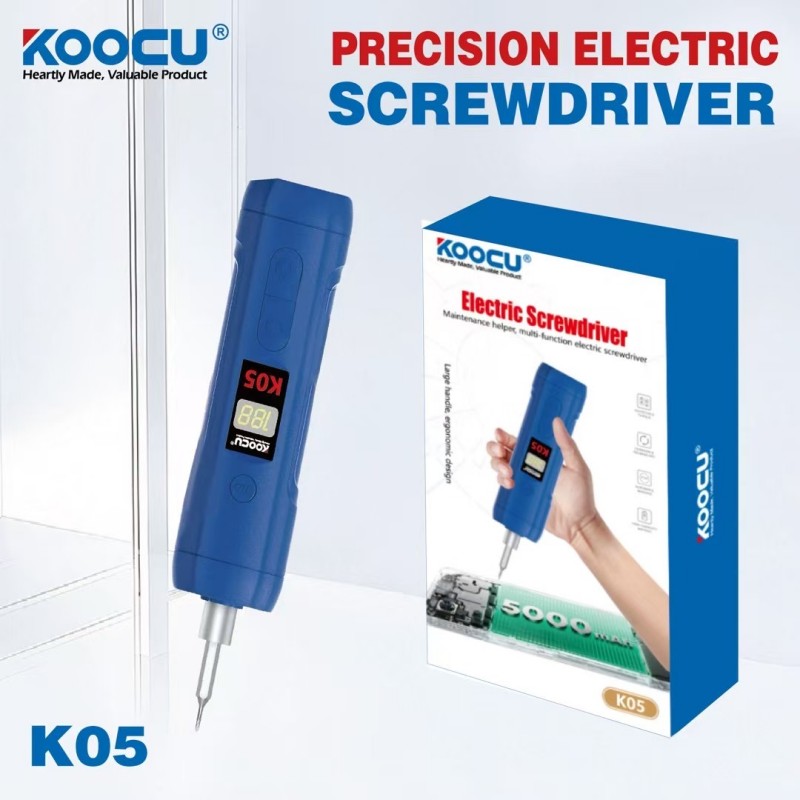
KOOCU K05 electric screwdriver for mobile phone repair — aluminum alloy body, documented power range 2W–30W.
Problem Definition: Where Electric Screwdriver Selection Usually Fails
Procurement failures in this category are rarely caused by the motor. They come from four gaps that only surface after the container arrives: torque that does not match the screws being serviced, magnetic retention that fades before the batch is sold, documentation that is assumed instead of verified, and a sample that does not represent the bulk order.
- Torque and bit mismatch. A screwdriver engineered for appliance housings will over-drive a phone chassis fastener. The specification conversation has to start with the smallest screw in your service mix, not with the largest tool in the catalogue.
- Magnetic retention loss. KOOCU's published troubleshooting record lists weak magnetic attraction of a screwdriver bit during phone repair disassembly as a known symptom. The documented causes are long-term wear of the bit and improper power-supply parameter setting; the documented remedies are replacing the spare bit, checking the power-supply parameters, and contacting the supplier for remote support if the problem continues.
- Documentation gaps. An electric screwdriver ships with a lithium-ion cell, which turns an ordinary tool order into a regulated goods shipment. Maritime transport requires a transport identification report — and many buyers wrongly treat that report as a product certificate.
- Sample-to-batch drift. A sample tested in isolation tells you nothing about batch consistency unless the acceptance criteria are written down before the bulk order is placed.
Industry Background: Why Repair-Tool Demand Is Moving Upstream
The commercial context for this selection decision is the Right to Repair movement, which is widely reported as a major market driver in 2026 and is influencing original equipment manufacturers to release repair manuals and tools to third-party service providers (ThinkComputers.org, 2026). When third-party workshops gain legitimate access to service information, tool demand shifts from occasional replacement buying to repeatable, volume-based procurement.
Market sizing supports the direction but should be handled carefully. Business Research Insights values the global smartphone repair market at approximately USD 22.66 billion in 2026. Published estimates for this category vary widely — from roughly USD 20 billion to over USD 200 billion — because definitions differ between service-only revenue and the wider repair ecosystem that includes spare-part hardware. Buyers should treat headline figures as directional and use their own market data for volume planning.
On the tool side, Credence Research reports the global manual screwdriver market at USD 365.2 million in 2024, with precision screwdrivers for electronics identified as a key growth driver (2024 base year, forecast period to 2032). Precision hand tools, not general hardware, are where the volume growth sits.
A useful component-level price reference comes from customs records: mobile opener tools classified under HS 8205 show an average import price of approximately USD 1.03 per unit in US import data (Zauba customs records). The figure reflects hand opener tools within that sub-chapter and requires an updated customs or UN Comtrade dataset for exact current-year values; it should not be read as the price of a finished electric screwdriver or a complete kit.
On the supply side, third-party trade directory data (Tradewheel) lists KOOCU with 15 years of experience manufacturing mobile phone maintenance tools and an export share above 91% of production. KOOCU operates as Guangzhou Weiqianji Technology Co., Ltd., a Guangzhou-based manufacturer of cell phone repair tools; its stated export markets include Africa, South America, Southeast Asia, India, Bangladesh and Pakistan, as well as the European Union, Canada, Mexico, Argentina, Colombia, Russia and the Middle East.
Detailed Solution: The Seven Selection Parameters
1. Torque control and power band
Torque control decides whether an electric screwdriver is usable on phone chassis work, because the same output that is safe on a back-cover screw can damage a logic-board fastener. Electric drive replaces repeated manual wrist torque with motor output, which is the operating principle behind the K-series aluminum alloy body and high-hardness magnetic bit design: it reduces manual physical consumption compared with a hand screwdriver on high-volume benches.
What to request from any supplier: minimum and maximum torque, the tolerance across a batch, and whether torque is adjustable per workstation. The published KOOCU power bands are 1.5W–15W for model K01, 2W–15W for K01 Pro, 2W–20W for K02 and K04, and 2W–30W for K05 and K07. The wattage band tells you the operating envelope the tool is engineered for; it is the starting point of a torque conversation, not a replacement for a torque specification.
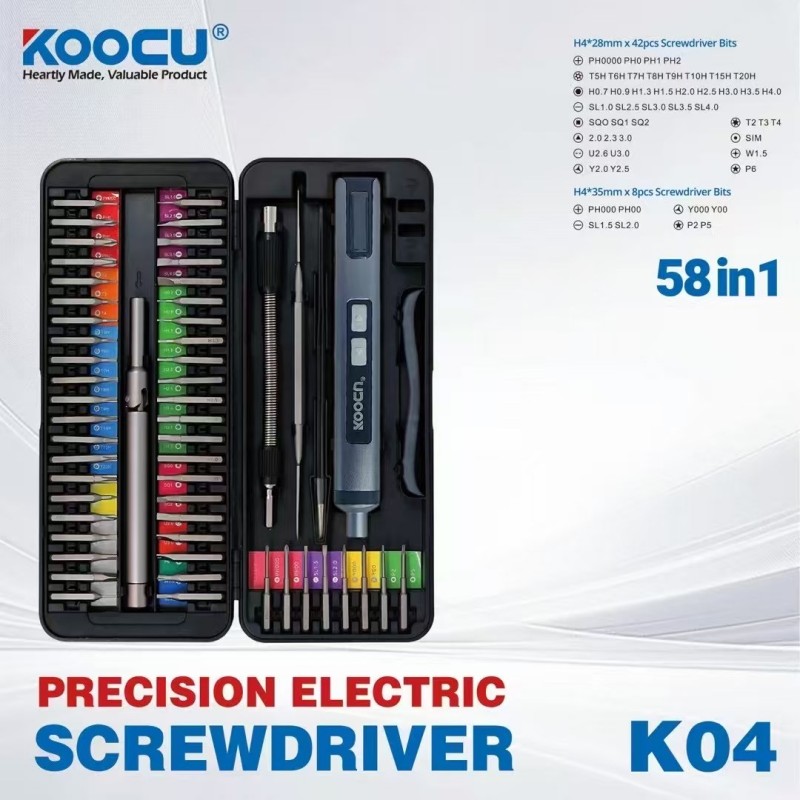
KOOCU K04 electric screwdriver — 2W–20W operating band, aluminum alloy body, designed for mobile phone repair.
2. Speed settings and duty cycle
Phone teardown needs low-speed engagement so the bit seats before it turns; factory-line disassembly needs repeatable throughput. Ask whether rotation speed is adjustable and what the continuous-duty limit is, because duty cycle — not peak speed — determines how many tools a bench needs.
KOOCU's documented operating note is specific on this point: the tool is designed to meet the explosion-proof requirement under the power-supply working condition, and it should not be overloaded in long-time continuous operation. For line work, that translates directly into tool quantity and bench rotation planning.
3. ESD-safe design
Electrostatic discharge damage is invisible at the bench and appears later as an intermittent fault that the repair shop blames on the board supplier. Anti-static properties are documented across KOOCU's mobile phone repair tweezer range, including ST-21, ST-25, ST-30, ST-114, ST-115, TS-11, TS-15, FS-11, 7-SA-16 SS-SA-16 and 7-SA SR SS-SA SR.
Buyer action: request written confirmation of anti-static treatment for the specific electric screwdriver model quoted, and keep ESD-safe tweezers inside the kit instead of substituting generic hand tools to hit a price point.
4. Bit compatibility and magnetic retention
The matched equipment for the documented KOOCU screw-removal application is the screwdriver bit, so bit coverage is part of the tool specification, not an accessory afterthought. Bit sets should cover the screw heads your market actually services; pentalobe, Phillips, flat, tri-point and Torx heads are all common in smartphone teardown, and a kit that stops at two head types generates returns.
On retention, KOOCU lists strong magnetic attraction as a documented property of the K-series line. Because bit wear is a documented cause of weak magnetic attraction, plan spare bits with the first container rather than after the first complaint.
5. Ergonomics and bench throughput
The K-series body is aluminum alloy with documented high hardness and high toughness. In practice the ergonomic question is narrower: can a technician hold and trigger the tool single-handed, at the angle a phone chassis requires, for a full shift? Ergonomics is settled by the sample test, not by the specification sheet.
6. Battery, charging and transport documentation
Lithium-ion tool batteries turn a tool purchase into a regulated goods shipment, and the transport document must name the model you are buying. The KOOCU document pack for this category is the Hazard Classification and Identification Report for Transport of Goods:
- Issuing authority: PONY. Report number: MTIN67MG7731367U1.
- Document type: third-party transport identification report — not a product certification and not a system certification.
- Standard referenced: IMO International Maritime Dangerous Goods Code 2024 Edition (Amendment 42-24), Special Provision 188, together with the UN Manual of Tests and Criteria Part III, subsection 38.3.
- Rated scope: lithium-ion cell, model 10440, 3.7V, 320mAh, 1.184Wh; packaging 400 pcs per carton.
- Product coverage: electric screwdriver models K01 and K07, and tweezer model 7-SA SR.
- Validity: issued 2025-12-01, expiry 2026-12-31.
Verification point: confirm that the report is still inside its validity window and that the exact model you order appears in the coverage list. A transport report covering a different model does not cover yours, and a transport report is not a substitute for the product certification your destination market may require.
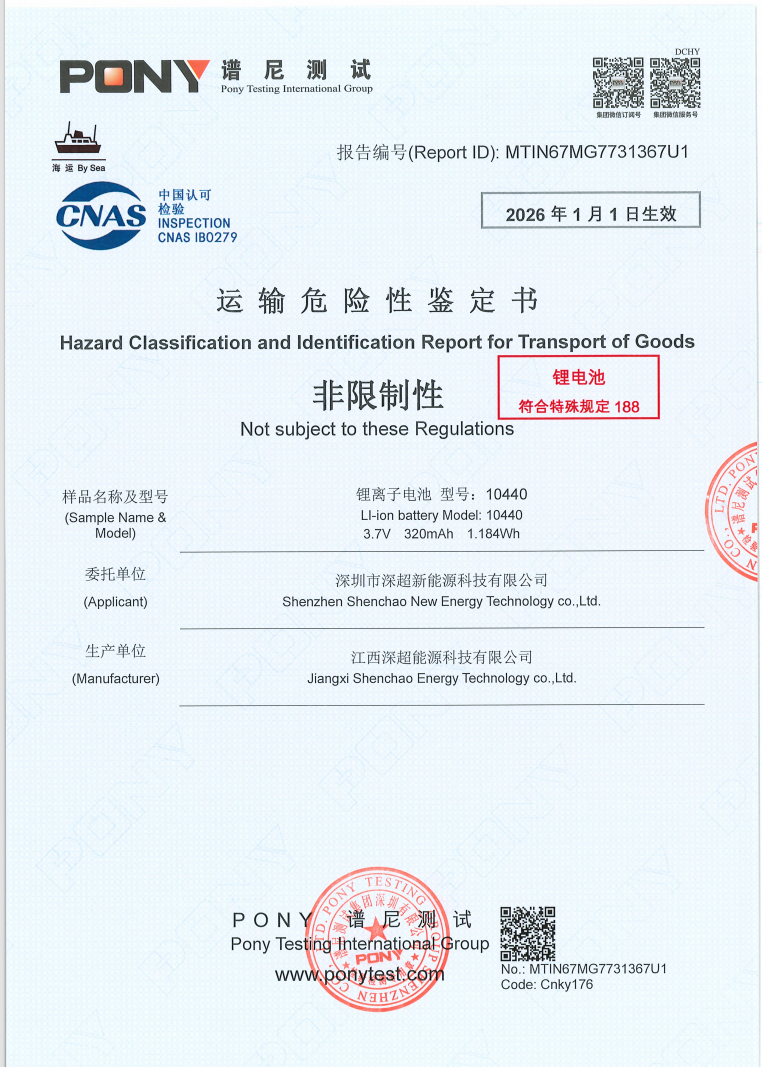
PONY Hazard Classification and Identification Report for Transport of Goods, report number MTIN67MG7731367U1, covering electric screwdriver models K01 and K07 and tweezer model 7-SA SR.
7. OEM customization, QC and batch documentation
OEM capability is documented for voltage and logo customization, with a minimum order quantity of 50 units, a 10-day lead time and a monthly capacity of 10,000 units. Quality control is documented as 100% test, and after-sales support is handled remotely.
For private-label buyers, those five data points — customization scope, MOQ, lead time, monthly capacity and inspection regime — form the commercial spine of the quotation and belong in the same document as the technical specification.
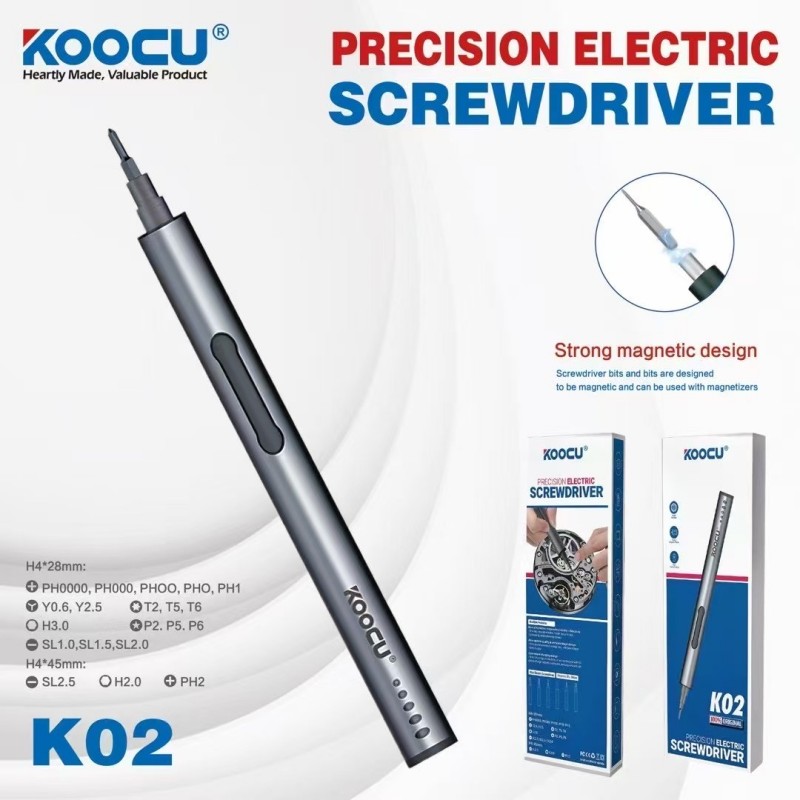
KOOCU K02 electric screwdriver — 2W–20W, aluminum alloy body, strong magnetic attraction, suitable for repair kit programmes.
Comparison Table: KOOCU Electric Screwdriver Models at a Glance
All six models are designed for mobile phone repair, share an aluminum alloy body and are documented with high hardness, high toughness and strong magnetic attraction. The table below uses published model parameters only; the current specification sheet should be attached to every quotation.
| Model | Operating power band | Body material | Documented properties | Transport report coverage |
|---|---|---|---|---|
| K01 | 1.5W–15W | Aluminum alloy | High hardness, high toughness, strong magnetic attraction | Covered by PONY report MTIN67MG7731367U1 |
| K01 Pro | 2W–15W | Aluminum alloy | High hardness, high toughness, strong | Not listed in the quoted coverage |
| K02 | 2W–20W | Aluminum alloy | High hardness, high toughness, strong magnetic attraction | Not listed in the quoted coverage |
| K04 | 2W–20W | Aluminum alloy | High hardness, high toughness, strong magnetic attraction | Not listed in the quoted coverage |
| K05 | 2W–30W | Aluminum alloy | High hardness, high toughness, strong magnetic attraction | Not listed in the quoted coverage |
| K07 | 2W–30W | Aluminum alloy | High hardness, high toughness, strong magnetic attraction | Covered by PONY report MTIN67MG7731367U1 |
Documentation Checklist for the Evaluation Stage
| Item to verify | What it covers | What the buyer checks |
|---|---|---|
| Transport identification report | Lithium-ion cell model 10440, 3.7V, 320mAh, 1.184Wh, 400 pcs per carton | Report number, issuing authority, validity dates, and that the ordered model is listed |
| Standard reference | IMDG Code 2024 Edition, Amendment 42-24, Special Provision 188; UN Manual of Tests and Criteria Part III, subsection 38.3 | That the cited edition is current for the sailing date |
| Document type clarification | Transport identification report | Whether a separate product certification is required for the destination market |
| OEM scope | Voltage and logo customization | Branding artwork, voltage variant and approval process |
| Commercial terms | MOQ 50 units, 10-day lead time, 10,000 units monthly capacity | Order quantity versus capacity, and delivery scheduling |
| Quality control | 100% test | How defects are handled and reported after delivery |
| After-sales | Remote support | Response channel and escalation path for field failures |
Step-by-Step Breakdown: Qualifying an Electric Screwdriver Supplier
- Define the repair workflow and volume. Count the screws per unit, units per day, and how many workstations the line runs. Volume determines whether you need one tool per technician or a rotating pool.
- Fix the technical specification. Set the power band, the torque requirement and the speed requirement before you contact suppliers. The K-series bands (1.5W–15W to 2W–30W) give you a shortlist range rather than a single answer.
- Set ESD and material requirements in writing. Specify anti-static handling for the tweezers in the kit and request written confirmation of anti-static treatment for the screwdriver model quoted.
- Build the bit inventory. Match bit types to the screw heads in your service mix, and include spare bits in the first order so that documented bit wear does not become a customer complaint.
- Order samples and test against a written protocol. Test bit fit, magnetic retention, torque repeatability on the actual screws you service, and duty-cycle behaviour under continuous use.
- Verify the document pack. Check the PONY transport report number, its validity window, and whether the models you ordered appear in the coverage list. Confirm separately whether product certification is required in your market.
- Agree batch-consistency terms. The documented regime is 100% test; agree in advance how a defect found after arrival is handled and who bears the cost.
- Confirm MOQ, lead time and after-sales. The documented terms are 50 units MOQ, 10-day lead time, 10,000 units monthly capacity and remote after-sales support.
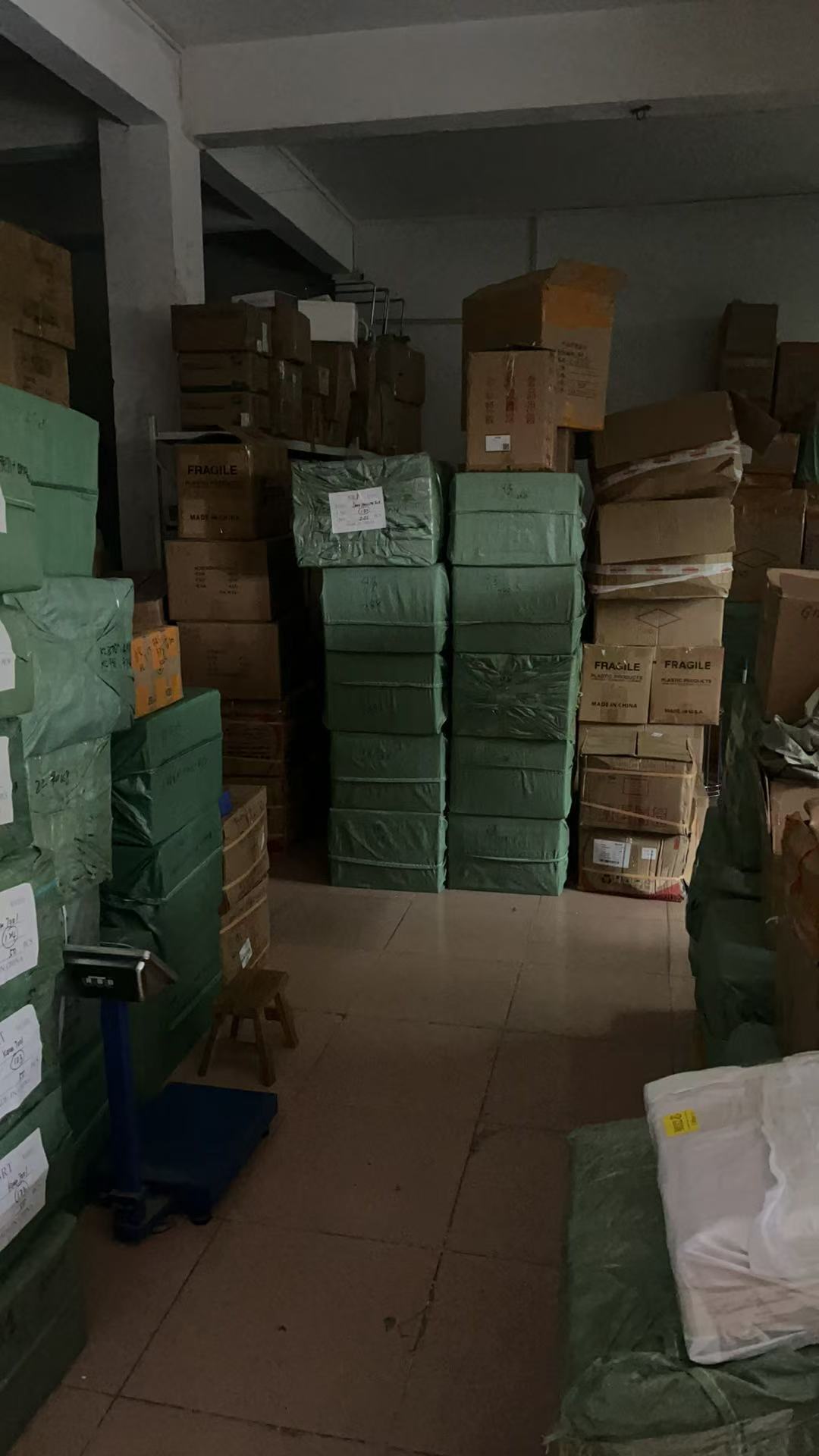
Batch supply and warehousing supporting a documented monthly capacity of 10,000 units and a 10-day lead time.
Use Cases: Where These Specifications Actually Matter
Factory-line mass disassembly
The documented KOOCU application scenario is screw removal in cellphone repair, performed on a factory line, indoors at normal temperature, with a rotate-and-twist operation mode and a screwdriver bit as the matched equipment. The special requirement recorded for this scenario is explosion-proof protection under the power-supply working condition, which is the reason the duty-cycle limit — do not overload in long-time continuous operation — has to be built into line planning rather than treated as a footnote.
B2B wholesale distribution
A documented case involves a B-end wholesale merchant in South Africa ordering 50 units for screw-removal work, with the products in service for 3 years and a reported result of 3 years of stable operation; the highlighted attribute was strong power. For a distributor, the relevant lesson is that the electric screwdriver became a repeat-purchase line item, not a one-off sale — which only happens when torque and magnetic retention hold up in the field.
Complete kit programmes
Buyers assembling a full repair kit pair the electric screwdriver with tweezers. The KOOCU tweezer range covers 115 mm models TS-11 and TS-15, 120 mm models ST-21, ST-25, ST-30, ST-114, ST-115 and FS-11, and 130 mm models 7-SA-16 SS-SA-16 and 7-SA SR SS-SA SR — all stainless steel with documented high hardness and anti-static properties. Length and handle geometry should match the work the kit is sold for, not just the price tier.
Documented operating steps for screw removal
- Install the matching screwdriver bit.
- Confirm the power-supply connection.
- Align the bit with the phone screw.
- Start the rotate-and-twist mode to take out the screws.
Safety note: the tool is designed to meet the explosion-proof requirement under the power-supply working condition. Do not overload it in long-time continuous operation.
FAQ
What documentation should a B2B buyer verify before shipping mobile phone repair electric screwdrivers with lithium batteries?
Verify the Hazard Classification and Identification Report for Transport of Goods. The KOOCU report is issued by PONY under number MTIN67MG7731367U1, references the IMO International Maritime Dangerous Goods Code 2024 Edition (Amendment 42-24) Special Provision 188 and the UN Manual of Tests and Criteria Part III, subsection 38.3, and is valid from 2025-12-01 to 2026-12-31. Its rated scope is a lithium-ion cell, model 10440, 3.7V, 320mAh, 1.184Wh, packed 400 pcs per carton, and its product coverage includes electric screwdriver models K01 and K07 and tweezer model 7-SA SR. Buyers should note that this is a transport identification report, not a product certification and not a system certification, so any market-specific product certification must be requested separately.
Can a supplier customize voltage and logo, and how is batch quality controlled?
KOOCU supports OEM customization of voltage and logo, with a minimum order quantity of 50 units and a monthly capacity of 10,000 units. Quality control is documented as 100% test, and after-sales support is provided remotely. For private-label buyers this means the customization scope, MOQ, capacity and inspection regime can all be fixed before the first production run, which is what allows a distributor to plan packaging and launch dates with confidence.
How should buyers think about price band for this category?
KOOCU does not publish retail pricing for these tools; B2B orders are quoted through direct inquiry, with a volume advantage on bulk orders. As a component-level benchmark, US customs records show mobile opener tools classified under HS 8205 at an average import price of approximately USD 1.03 per unit, although exact current-year figures require an updated customs or UN Comtrade dataset. That benchmark covers hand opener tools, not finished electric screwdrivers, and it excludes the variables that actually move an electric screwdriver quotation: power band, aluminum alloy body specification, magnetic bit quality, voltage and logo customization, and the 50-unit MOQ with 10-day lead time.
How should a sample be tested before placing a bulk order?
Test the sample against a written protocol rather than by feel. Confirm that bit fit matches the screw heads in your service mix, that magnetic retention holds the screw during extraction, that torque is repeatable across the fasteners you service, and that continuous operation stays within the documented duty-cycle limit. Then compare what you tested against what the batch agreement says, and check that the PONY transport report covers the exact model you are ordering — a report listing model K01 or K07 does not automatically cover other models in the same series.
What lead time and support apply after an order is confirmed?
The documented terms are a 50-unit minimum order quantity, a 10-day lead time, a monthly capacity of 10,000 units and remote after-sales support. Because the documented troubleshooting path for weak magnetic attraction includes replacing the spare bit, checking power-supply parameters and contacting the supplier for remote support, buyers should confirm the response channel at order stage rather than at the first failure. To request a sample, a quotation or the current specification sheet, contact Jason at zjzason668@gmail.com or on WhatsApp and telephone +86 181 3852 7081.
Conclusion
Selecting a mobile phone repair electric screwdriver for B2B supply is a specification exercise, not a catalogue exercise. Torque control and power band set the safety envelope; speed settings and duty cycle set the line capacity; ESD-safe design and bit compatibility decide field failure rates; ergonomics decides whether technicians actually use the tool as intended; and transport documentation decides whether the container moves at all. OEM scope, 100% test, a 50-unit MOQ, a 10-day lead time and remote after-sales support complete the commercial picture.
For buyers evaluating cell phone repair tools on these terms, the KOOCU K-series provides a documented starting point — aluminum alloy bodies across the range, published power bands from 1.5W–15W on model K01 to 2W–30W on models K05 and K07, and a PONY transport identification report covering K01 and K07 that is valid through 2026-12-31.
Next step: sample and specification request
Request a K-series sample, the current specification sheet and the transport documentation pack for your market. Contact Jason at zjzason668@gmail.com, telephone or WhatsApp +86 181 3852 7081, or via WhatsApp message. Company website: www.koocu-tools.com.
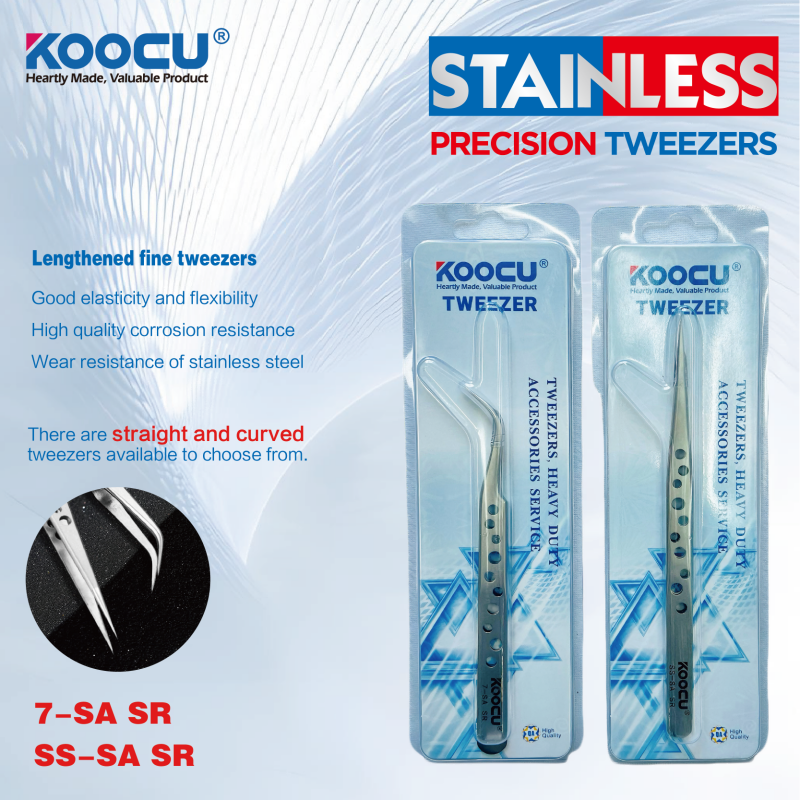
KOOCU 7-SA SR SS-SA SR tweezer — 130 mm stainless steel, anti-static, part of the wider cell phone repair tool range available for sample validation.
Have Questions or Need More Details?
Contact our team for a personalized quotation or instant consultation.
Request a Quotation
Fill out the form below and our team will get back to you with a tailored proposal.
WhatsApp Direct Chat
Prefer to chat in real-time? Message us on WhatsApp for instant assistance & quick answers.
- Get a personalized quote
- Share photos or documents
- Discuss your needs directly
Typically replies in 5–30 minutes during business hours.