
Ranking Cell Phone Repair Tweezers: 8 Stainless Steel, Anti-Static B2B Picks
Eight tweezers in the KOOCU range share one documented baseline for mobile phone repair work: a stainless steel body, an anti-static property, a high-hardness claim, and a measured length of either 115 mm or 120 mm. Ranked for B2B assortment building, they are FS-11, ST-25, ST-21, ST-30, ST-114 and ST-115 at 120 mm, plus TS-11 and TS-15 at 115 mm.
The order below is an assortment-role ranking, not a quality hierarchy. All eight models carry the same four published attributes in the KOOCU specification data, so the shortlist is ordered by what a buyer can actually verify — the length platform a market needs and the way the catalogue presents each model — rather than by tip geometry or performance figures that the specification sheet does not contain.
Shortlist at a glance
- 120 mm platform (6 models): FS-11, ST-25, ST-21, ST-30, ST-114, ST-115
- 115 mm platform (2 models): TS-11, TS-15
- Shared documented attributes: stainless steel, anti-static, high hardness, mobile phone repair application
- Supplier terms documented for KOOCU: MOQ 50 units, 10-day lead time, 100% testing, OEM production mode
Problem Definition: Why Tweezer Selection Stalls a Repair Tool Assortment
For a distributor or a chain repair workshop, tweezers are the smallest line item in a cell phone repair tool kit and, for that same reason, the easiest line to over-stock and to under-justify. A catalogue can carry eight tweezer SKUs that look identical on paper, because the published specification data records only four differentiators: material, anti-static treatment, hardness and length.
Two failures follow from that. The first is SKU inflation — listing every model a supplier offers, including near-identical lengths, until the catalogue becomes harder to navigate for the repair shops that buy from it. The second is the opposite mistake: buying one generic tweezer line and discovering that technicians in a target market specify a different length than the one stocked, which turns a low-value item into a recurring re-order problem.
Buyer behaviour compounds the difficulty. In the research and evaluation stages, most B2B tool purchases start as a shortlist request rather than a single-model enquiry: a wholesale buyer asks a supplier for a tweezer range, receives eight similar specification rows, and must then decide which rows become listings and which stay in the price file. Without a stated selection rule, that decision defaults to unit price or to whatever the supplier recommends — neither of which produces a defensible assortment.
The practical question is therefore not "which tweezer is best", because no verified data supports that comparison. It is: which models belong in an assortment, in what order of priority, and on the basis of which documented facts. The rest of this article answers that question for the eight KOOCU models in the 115 mm and 120 mm tweezer range.
Industry Background: Repair Demand and the Hand-Tool Layer Behind It
Tweezer assortment decisions sit downstream of repair demand, and that demand is large and publicly measured. Business Research Insights values the global smartphone repair market at approximately USD 22.66 billion in 2026, covering repair services and hardware replacement for batteries, screens and cameras. That figure should be read with one caveat: definitions differ across research houses, and estimates for the wider repair ecosystem that includes spare parts run substantially higher than service-only estimates, so the number is best used as an order of magnitude rather than a precise planning input.
Regulation points in the same direction. ThinkComputers' 2026 repair guide identifies the "Right to Repair" movement as a major market driver, one that pushes OEMs to release repair manuals and tools to third-party providers. More independent benches and more third-party repair capacity translate into more repeat consumption of the small hand tools — tweezers among them — that a bench cannot operate without.
The hand-tool layer is expanding too. Credence Research valued the global manual screwdriver market at USD 365.2 million in 2024 and identifies precision screwdrivers for electronics as a key growth driver — the same buyer profile that purchases stainless steel repair tweezers. On the unit-economics side, US customs records for mobile opener tools under HS 8205 show an average import price of about USD 1.03 per unit, a reminder that hand tools of this class earn their place in an assortment through breadth and reorder frequency rather than through a high price per piece.
KOOCU (Guangzhou Weiqianji Technology Co., Ltd) operates in exactly this layer. The company develops and produces cell phone repair tools and equipment, with production sites in Guangzhou, Foshan and Dongguan and a marketing and service network that reaches the European Union, Canada, India, Mexico, Argentina, Colombia, Russia, Southeast Asia, South America, the Middle East and Africa. Documented export markets for the repair tool line cover Africa, South America, Southeast Asia, India, Bangladesh and Pakistan. For a B2B buyer evaluating tweezers, that coverage matters: it shows which regional repair markets the supplier already serves at volume.
Tweezers are also rarely bought alone. The same purchase order usually carries smartphone opening tools, a spudger tool set for phone repair, a precision pry tool set, a magnetic screwdriver set for electronics repair and screen replacement tools for iPhone and Android devices. Because tweezers share that order, the same supplier terms and the same shipping schedule as the rest of the kit, the tweezer decision should be made inside the toolkit decision rather than separately from it.
The Shortlist: 8 KOOCU Tweezers Ranked for Repair Assortments
How this ranking was built
Because the published specification data for these models is identical apart from length and catalogue pairing, the shortlist is ordered on three verifiable criteria:
- Documented baseline compliance — stainless steel, anti-static, high hardness and mobile phone repair application. All eight models pass; this is the inclusion gate, not a differentiator.
- Length platform — 120 mm (standard-length group) or 115 mm (compact group). Length is the only geometry variable recorded in the specification data.
- Catalogue presentation — whether the model is documented as a standalone item or as one half of a documented model pair, which affects how easily a distributor can build, photograph and maintain the listing.
Within each platform, positions follow that catalogue grouping. No position implies a performance advantage, and a buyer serving a market that works at compact length can invert the platform priority without contradicting any documented fact.
Positions 1–6: the 120 mm stainless steel platform
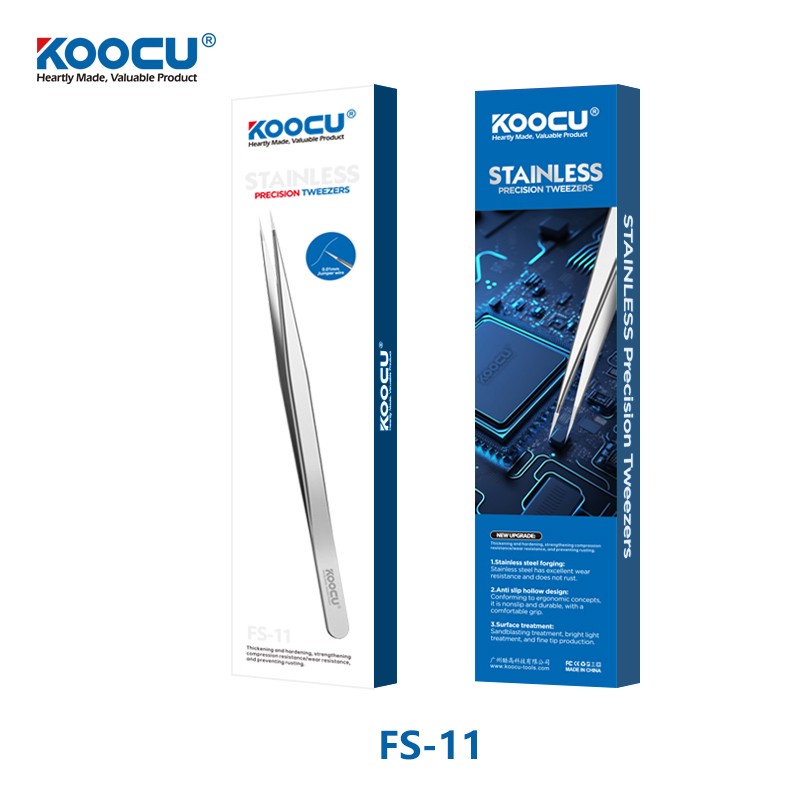
1. FS-11 — 120 mm. FS-11 takes the first position because it carries the full documented baseline in a single, standalone SKU: stainless steel body, anti-static property, high-hardness claim and a 120 mm length for mobile phone repair. For a buyer starting a tweezer line from zero, a standalone 120 mm model is the simplest first listing — one model, one image, one specification block.
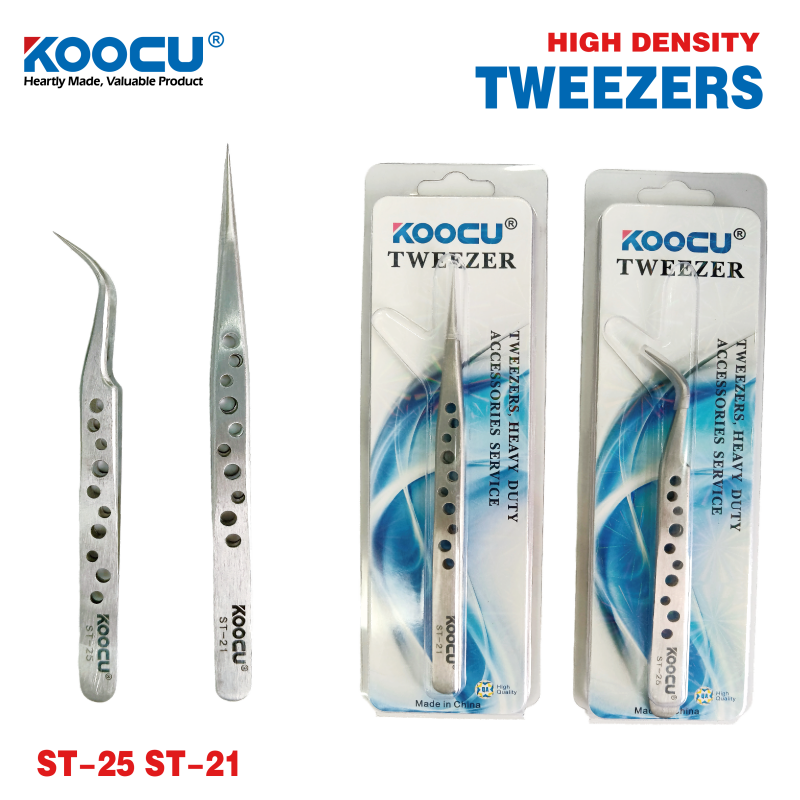
2. ST-25 — 120 mm. ST-25 carries the identical documented specification and is presented in the KOOCU catalogue together with ST-21 in a single model image. That documented pairing is why it ranks above the standalone ST-30: a distributor can add two SKUs using one verified catalogue asset.
3. ST-21 — 120 mm. ST-21 is the companion model in the same documented pair. Buyers who stock one member of a documented pair usually stock the other, so the two occupy adjacent positions rather than being treated as separate decisions.
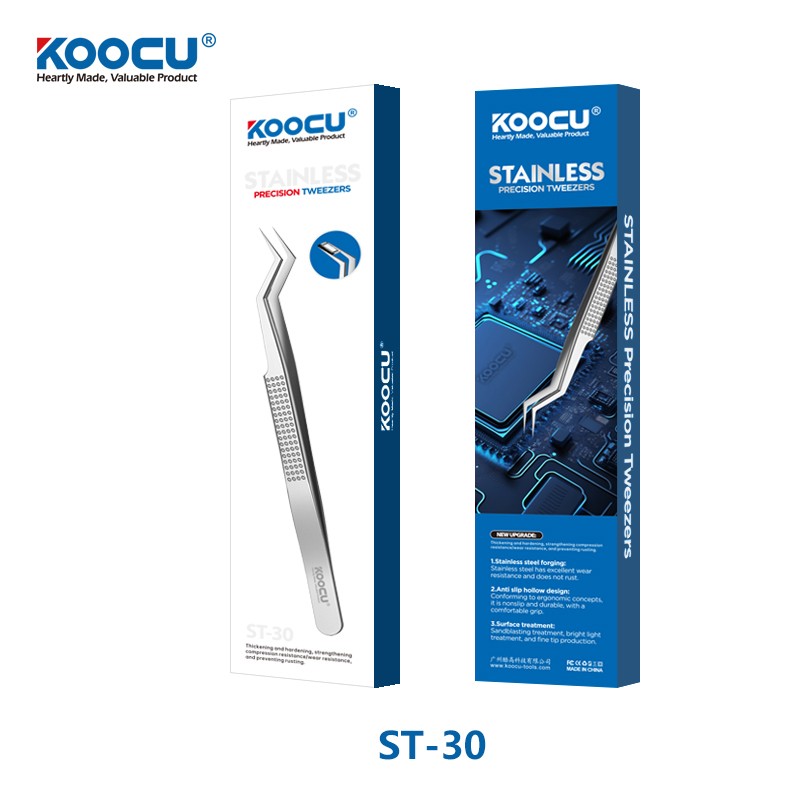
4. ST-30 — 120 mm. ST-30 carries the same 120 mm stainless steel, anti-static, high-hardness specification and is documented as a standalone model with its own product image. In assortment terms it is a breadth SKU: most useful once a buyer already holds the leading positions and needs additional 120 mm coverage for a distributor catalogue.
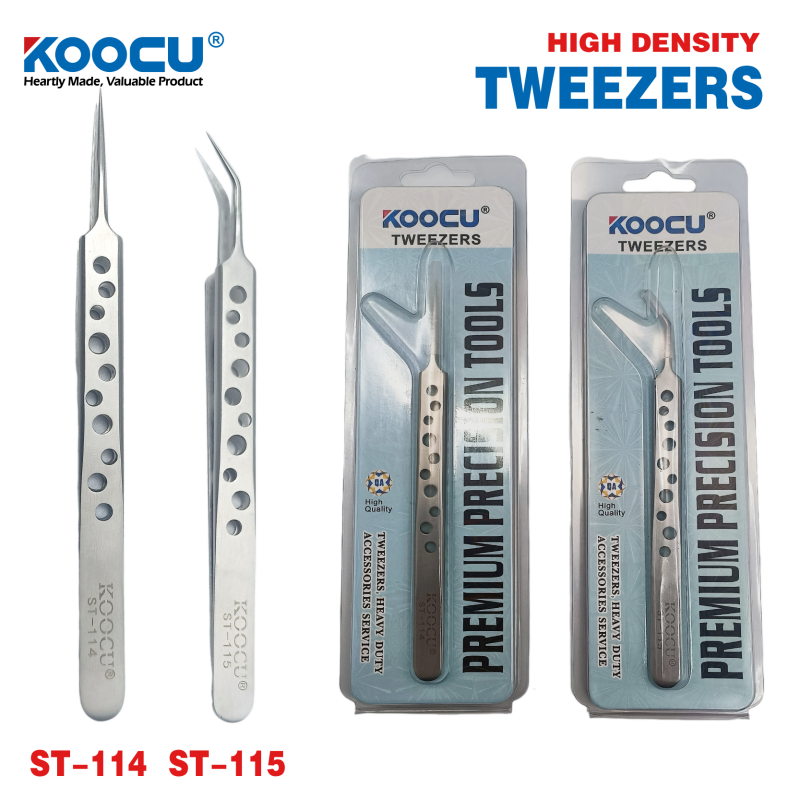
5. ST-114 — 120 mm. ST-114 opens the second documented pair, catalogued together with ST-115. Its position reflects that pairing plus the shared 120 mm platform; the specification data records the same stainless steel body, anti-static property, high-hardness claim and mobile phone repair application as the models above it.
6. ST-115 — 120 mm. ST-115 completes the ST-114/ST-115 pair and closes the 120 mm group. Buyers who list ST-114 for range completeness typically list ST-115 in the same step, which is why the pair is positioned together rather than split across the ranking.
Positions 7–8: the 115 mm compact platform
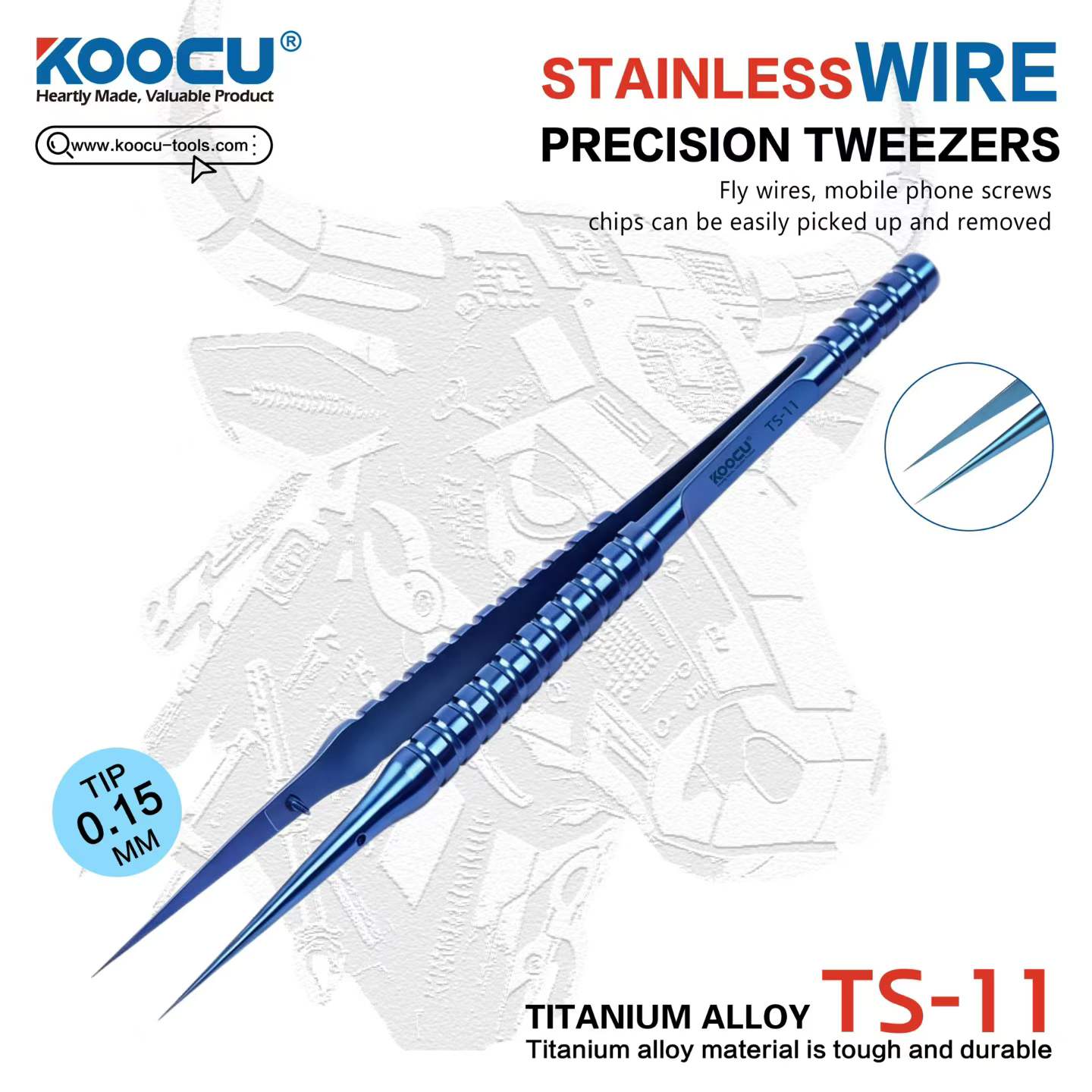
7. TS-11 — 115 mm. TS-11 moves the shortlist to the compact platform. It is documented as a 115 mm stainless steel tweezer for mobile phone repair, with an anti-static property and a high-hardness claim. The 5 mm difference from the 120 mm group is the only recorded geometry distinction, so the platform choice should follow what technicians in the target market reorder rather than an assumed preference.
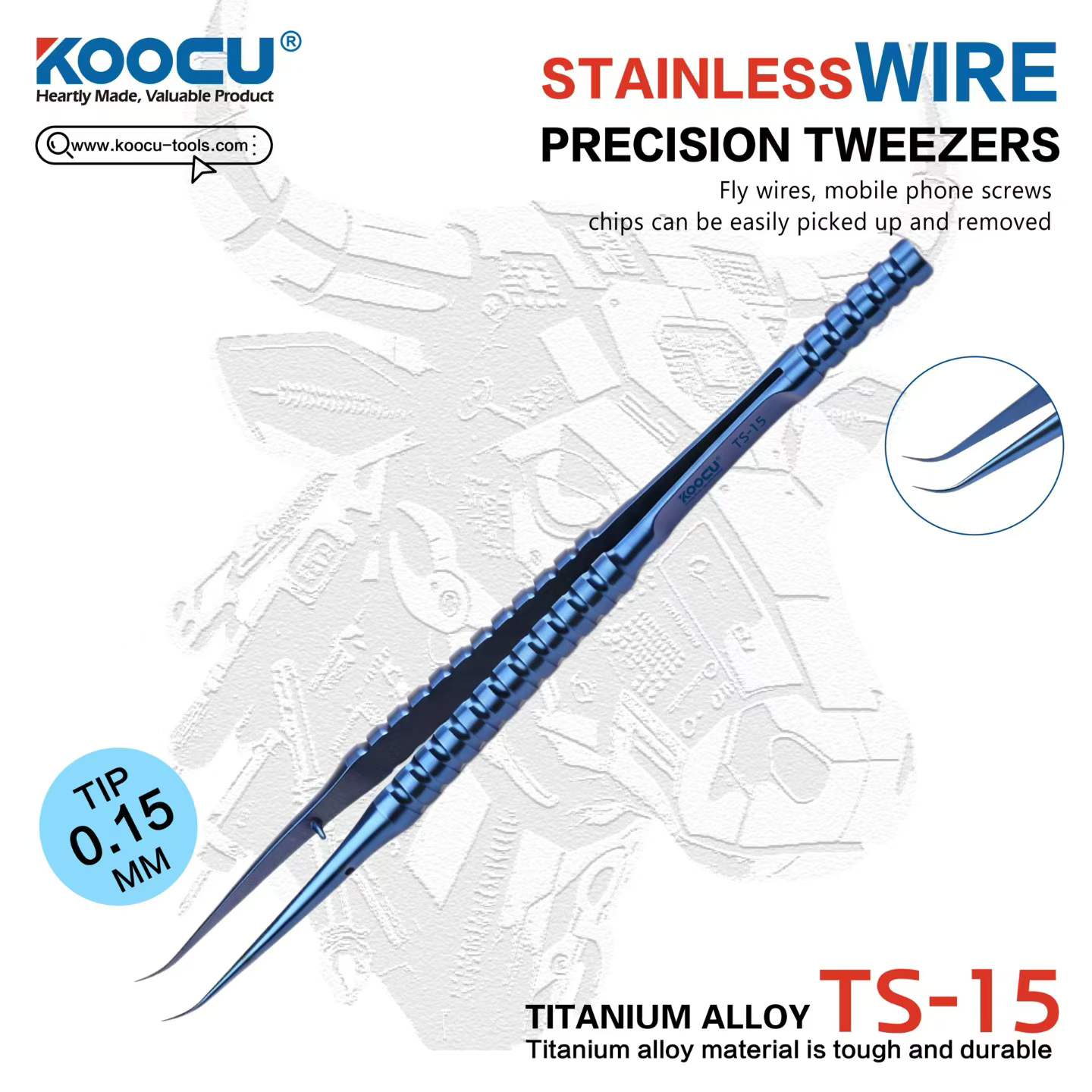
8. TS-15 — 115 mm. TS-15 shares the TS-11 specification exactly at 115 mm and is documented as a standalone model. It sits last in this order for the same reason TS-11 sits seventh: the ranking is built for a buyer whose baseline is the 120 mm platform. A buyer whose market works compact can read the list in reverse with no change to the underlying facts.
Scope note: KOOCU also lists 130 mm tweezers (7-SA-16 SS-SA-16 and 7-SA SR SS-SA SR). They fall outside the 115 mm / 120 mm scope of this shortlist and are not ranked here.
Comparison Table: Verified Specifications at a Glance
| Rank | Model | Length | Material | Anti-static | Hardness claim | Catalogue pairing | Assortment role |
|---|---|---|---|---|---|---|---|
| 1 | FS-11 | 120 mm | Stainless steel | Yes | High hardness | Standalone | Lead 120 mm SKU |
| 2 | ST-25 | 120 mm | Stainless steel | Yes | High hardness | Paired with ST-21 | Core pair, first SKU |
| 3 | ST-21 | 120 mm | Stainless steel | Yes | High hardness | Paired with ST-25 | Core pair, second SKU |
| 4 | ST-30 | 120 mm | Stainless steel | Yes | High hardness | Standalone | Breadth SKU |
| 5 | ST-114 | 120 mm | Stainless steel | Yes | High hardness | Paired with ST-115 | Range extension |
| 6 | ST-115 | 120 mm | Stainless steel | Yes | High hardness | Paired with ST-114 | Range extension |
| 7 | TS-11 | 115 mm | Stainless steel | Yes | High hardness | Standalone | Compact platform |
| 8 | TS-15 | 115 mm | Stainless steel | Yes | High hardness | Standalone | Compact platform |
All eight models are documented as tweezers for mobile phone repair. Only attributes present in the KOOCU specification data are listed; tip geometry, torque or durability figures are not published for these models.
Inclusion Logic: How B2B Buyers Decide Which Tweezers to Stock
A ranking is only useful if it converts into a stocking decision. The gates below turn the shortlist into an assortment rule set that a purchasing team can apply without adding unverified claims to its own catalogue copy.
Gate 1 — Baseline specification
Include a tweezer only if the supplier documents all four attributes: stainless steel construction, anti-static property, high-hardness claim and an explicit length. All eight models above pass. A model missing any of the four should be excluded, because there is nothing left to separate it from an unbranded item in the catalogue.
Gate 2 — Length platform fit
Decide the platform before the model. The 120 mm group (FS-11, ST-25, ST-21, ST-30, ST-114, ST-115) and the 115 mm group (TS-11, TS-15) are the two documented options. Ask target repair shops which length they currently reorder; that answer sets the primary platform, and the other platform becomes an optional extension rather than a default.
Gate 3 — SKU count discipline
Do not list all eight simply because they exist. A defensible sequence is: open with the lead 120 mm model (FS-11), add the first documented pair (ST-25, ST-21) when the catalogue needs visible range, extend with ST-30 and the second pair (ST-114, ST-115) for distributor breadth, then add TS-11 and TS-15 only where a market specifically works at compact length.
Gate 4 — Catalogue asset efficiency
Documented pairs reduce listing work: ST-25 and ST-21 share one image, and ST-114 and ST-115 share another. A buyer building a distributor catalogue with limited photography capacity gets two SKUs per verified asset, which is a practical reason to prioritise these pairs over comparable standalone models.
Gate 5 — Supplier terms and capacity
Product specification is only half of the decision. KOOCU's documented production capability includes OEM production mode, customization covering voltage and logo, a monthly capacity of 10,000 units, 100% testing, a minimum order quantity of 50 units and a lead time of 10 days, with remote after-sales support. For tweezers as hand tools, the commercially decisive items in that list are order quantity, delivery window and logo customization; voltage customization applies to the powered tools in the same range.
Gate 6 — Validate before you list
Order samples of the exact model and length and check them against your own bench requirements before a SKU goes live. The supplier's documented quality control step is 100% testing, which is a pre-shipment production control and not a substitute for the buyer's own validation.
Step-by-Step Breakdown: Building the Tweezer Line in a Repair Tool Assortment
- Define the assortment role. Tweezers are handling tools inside the repair workflow rather than a stand-alone purchase. In KOOCU's application records, cell phone repair work covers repair shops and factory-line projects, runs at indoor normal temperature, and can carry special requirements such as explosion-proof design in some scenarios — a constraint that applies to the powered equipment in the same workflow.
- Set the baseline specification. Write stainless steel, anti-static and a hardness claim into the product brief so every candidate SKU is measured against the same four attributes.
- Choose the length platform. Confirm 120 mm, 115 mm, or both, based on what the target market actually reorders.
- Apply the ranking. Start with the lead 120 mm model, add the documented pairs, extend with breadth SKUs, and add the compact platform only if required.
- Verify supplier terms. Confirm MOQ (documented at 50 units), lead time (documented at 10 days), monthly capacity (documented at 10,000 units), testing policy (documented at 100% test) and after-sales support (documented as remote support).
- Validate with samples. Check the delivered tweezer against the model, length and specification you ordered before publishing the listing.
- Plan replenishment. Because unit values in this hand-tool class are low — US customs data for mobile opener tools under HS 8205 averages about USD 1.03 per unit — assortment performance depends on reorder rhythm, so agree a restocking interval with the supplier at the same time as the first order.
Use Cases: Where Each Tweezer Platform Fits
Independent repair shops. A single-bench operation usually needs one or two tweezers rather than a range. The 120 mm models are the practical entry point because they match the standard-length group in this shortlist, with FS-11 as the single-SKU start and ST-25/ST-21 as the first expansion step.
Chain workshops and factory-line projects. Multi-bench operations buy for repeatability. KOOCU's application records describe cell phone repair use in repair shops and factory-line projects under indoor normal-temperature conditions, and flag explosion-proof design as a special requirement in some scenarios, which is a specification point for the powered tools in the same workflow rather than for hand tools.
Distributors and wholesale assortments. Distributors sell breadth. The documented pairs (ST-25/ST-21 and ST-114/ST-115) give two SKUs per catalogue asset, and the two-platform structure gives a distributor a legitimate reason to list a longer tweezer line instead of a single generic item.
OEM and private-label kit assembly. Buyers assembling a branded complete phone repair tool set need a supplier that produces under OEM terms. KOOCU documents OEM production mode with customization covering voltage and logo, an MOQ of 50 units and a 10-day lead time — the configuration kit builders should verify against their own launch schedule before committing to packaging artwork.
Export-oriented buyers. Documented export markets for the repair tool line are Africa, South America, Southeast Asia, India, Bangladesh and Pakistan, while the wider KOOCU network also serves the EU, Canada, Mexico, Argentina, Colombia, Russia and the Middle East. A buyer entering one of those markets is working with a supplier whose existing channels already point the same way. Across the broader range, KOOCU also has a documented field record with B-end wholesale merchants — a South African buyer ran 50 units of KOOCU electric screwdrivers for three years — which is the type of reference purchasing teams ask for when they move from tweezer samples to a full toolkit order.
FAQ: Cell Phone Repair Tweezers for B2B Buyers
Do KOOCU repair tweezers come with certification?
The tweezer specification data documents material (stainless steel), an anti-static property, a high-hardness claim and the length of each model; it does not list a tweezer-specific certificate. Certification documentation is recorded elsewhere in the KOOCU range: the company's electric screwdriver line carries PONY CNAS certificate MTIN67MG7731367U1 against the EN 10440 standard, together with 100% pre-shipment testing. Buyers who must attach a compliance document to a tweezer SKU should confirm with the supplier which document type applies to their order before purchasing.
Can tweezers be produced under OEM or private-label terms?
KOOCU documents OEM as its production mode, with customization covering voltage and logo, a monthly capacity of 10,000 units, 100% testing and remote after-sales support. Tweezers are hand tools, so the customization parameter that applies to a branded tweezer program is logo, while voltage customization relates to the powered tools in the range. The documented minimum order quantity is 50 units.
What should buyers budget for cell phone repair tweezers?
KOOCU does not publish retail prices for its repair tools; pricing is handled through B2B quotation, which is why MOQ, lead time and order mix matter more than a list price at the evaluation stage. As a market reference point, US customs data for mobile opener tools under HS 8205 shows an average import price of approximately USD 1.03 per unit — a useful benchmark for the low unit value of hand tools in this category, although it describes opener tools rather than tweezers specifically.
How should a buyer validate a tweezer model before listing it?
Order a sample of the exact model and length — for example FS-11 at 120 mm or TS-15 at 115 mm — and check it against the four documented attributes: stainless steel body, anti-static property, high-hardness claim and stated length. KOOCU's documented quality control step is 100% testing before shipment, but that is a production control and does not replace the buyer's own bench validation of the model and length they intend to sell.
What are the MOQ and lead time for a tweezer order?
The documented terms are a minimum order quantity of 50 units and a lead time of 10 days, with a monthly capacity of 10,000 units and remote after-sales support. Buyers planning a multi-model tweezer line should confirm the quantity and delivery window for the specific model mix they intend to list, since the ranking above assumes a mix drawn from both the 120 mm and 115 mm platforms. To start, request a sample or a quotation for the models in this shortlist through www.koocu-tools.com or by email at zjzason668@gmail.com.
Conclusion: A Shorter, Verifiable Tweezer Line
The eight models in this shortlist — FS-11, ST-25, ST-21, ST-30, ST-114 and ST-115 at 120 mm, plus TS-11 and TS-15 at 115 mm — are the KOOCU tweezers that meet a documented baseline of stainless steel construction, anti-static property, a high-hardness claim and a stated length. That baseline, plus the choice between a 120 mm and a 115 mm platform and the option of buying in documented pairs, is everything a B2B buyer needs to decide what belongs in the assortment. Anything beyond it — tip geometry, durability ratings, comparative performance — is not in the published specification data, and should not appear in your catalogue copy either.
Next step for B2B buyers
Request a sample of the exact tweezer model and length you plan to list, or ask for a quotation covering a full tweezer line for your market. KOOCU (Guangzhou Weiqianji Technology Co., Ltd) supplies cell phone repair tools with OEM production, a minimum order quantity of 50 units and a 10-day lead time.
Website: www.koocu-tools.com | Email: zjzason668@gmail.com | Tel / WhatsApp: +86 181 3852 7081
Have Questions or Need More Details?
Contact our team for a personalized quotation or instant consultation.
Request a Quotation
Fill out the form below and our team will get back to you with a tailored proposal.
WhatsApp Direct Chat
Prefer to chat in real-time? Message us on WhatsApp for instant assistance & quick answers.
- Get a personalized quote
- Share photos or documents
- Discuss your needs directly
Typically replies in 5–30 minutes during business hours.