
Top 7 Tweezer Picks for Cell Phone Repair: Ranking Our Bench-Ready Models
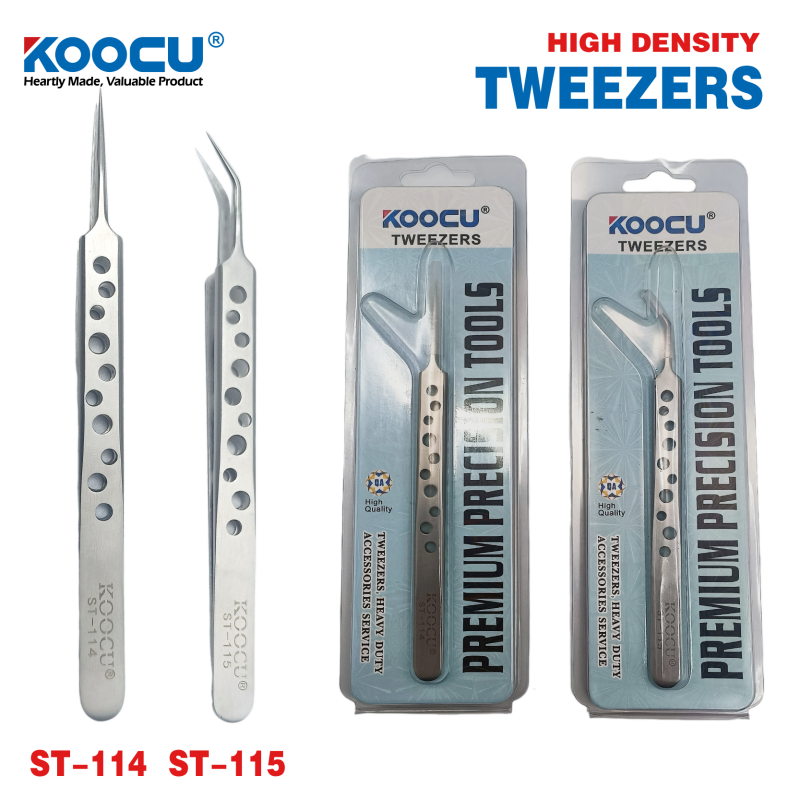
Quick answer: the ST-30 takes first place because it is the only model in this seven-tweezer set where 120 mm length, a stainless steel body, anti-static properties and high hardness are all documented together. Second is the ST-25 on documented anti-static and high-hardness construction plus a stated mobile-phone-repair application. Third is the ST-115, the anti-static option at 115 mm. FS-11 and ST-114 follow as 120 mm stainless steel models without an anti-static claim, TS-15 covers 115 mm stainless steel, and ST-21 ranks seventh because its published data confirms repair use but not length, material or anti-static status.
On a purchase order, seven tweezer codes look interchangeable. At the bench they are not. The differences that actually change which tool goes to which workstation are the ones a specification can prove: whether the tool is anti-static, what the body is made of, how long it is, and whether a cellphone-repair application is documented for that exact code.
This ranking is written for buyers at the evaluation stage — distributors assembling a cell phone repair tool kit, workshop owners standardising benches, and importers who have to justify every line item in a kit specification. It uses only the specifications supplied by KOOCU, the brand of Guangzhou Weiqianji Technology Co., Ltd, a manufacturer of mobile phone repair tools and equipment based in Guangzhou, China.
The Selection Problem: Seven Codes, Four Verifiable Differences
Tweezers are used for the steps where a screwdriver cannot reach — lifting a connector, steadying a flex, retrieving a screw that has dropped into the chassis cavity. Choosing a model that is too short forces the technician to angle the tips and lose control; choosing a model without anti-static protection on a static-sensitive assembly introduces a handling risk that the process was designed to exclude.
The common failure in kit buying is not selecting a poor tool. It is selecting a tool whose claimed attributes cannot be verified. Two codes can share the same length and the same material and still differ on anti-static status — and that single difference decides which station the tweezer can be issued to. When those two codes sit on the same kit line, the buyer absorbs the risk.
So this article scores each model only on attributes documented for that model. Where a value is absent from the supplied specification, the model is not credited with it, and the gap is named as a pre-order confirmation item instead of being smoothed over.
Industry Background: More Repair Volume, More Standardised Benches
The global smartphone repair market is valued at approximately USD 22.66 billion in 2026, according to Business Research Insights. Tool demand follows repair volume, and repair volume is being reinforced by access to parts and information: the Right to Repair movement is identified as a major market driver in 2026, influencing OEMs to release repair manuals and tools to third-party providers, as reported by ThinkComputers.org.
For tool buyers, the practical effect is standardisation. When independent shops, chain workshops and wholesale distributors all service the same handset families, they converge on kits with fixed contents — and every line in a kit needs a documented reason to exist. A tweezer range is one of the harder lines to standardise, because the physical differences between models are measured in millimetres and in material claims rather than in visible design.
The same logic applies to the rest of the bench: smartphone opening tools, a precision pry tool set, spudgers, and a precision screwdriver set for phone repair all have to be specified the same way. A tweezer range that cannot be differentiated on paper weakens the whole kit specification, because the buyer can no longer explain why one code was chosen over another.
KOOCU manufactures mobile phone repair tools and equipment and exports to markets including South America and Africa. Its stated capability profile includes OEM services with customisation of voltage and logo, a monthly capacity of 10,000 units, a typical lead time of 10 days, a minimum order quantity of 50 units, 100% test quality control, and after-sales support delivered through remote support.
Ranking Criteria: What Earns a Position
Four criteria are applied to all seven models, in this order of weight:
- Anti-static status (documented). Static control is a process requirement on board-level phone work, so a documented anti-static property carries more weight than length.
- Body material. Stainless steel is credited only where it is stated for that model.
- Overall length. 120 mm models rank above 115 mm models when the other attributes are equal, because reach into a chassis cavity is the reason the tool is on the bench.
- Documented repair application. A stated cellphone-repair use is credited as evidence; it is not assumed for every model in the range.
Tie-break rule: where two models carry identical documented attributes, the model whose product record states length, material and application together ranks higher, because that record can be verified as a single reference during supplier qualification.
Discipline rule: a model is never credited with an attribute that is missing from its supplied specification. Missing values are listed as confirmation items, not assumed in the buyer's favour.
The Top 7 Tweezer Picks, Ranked
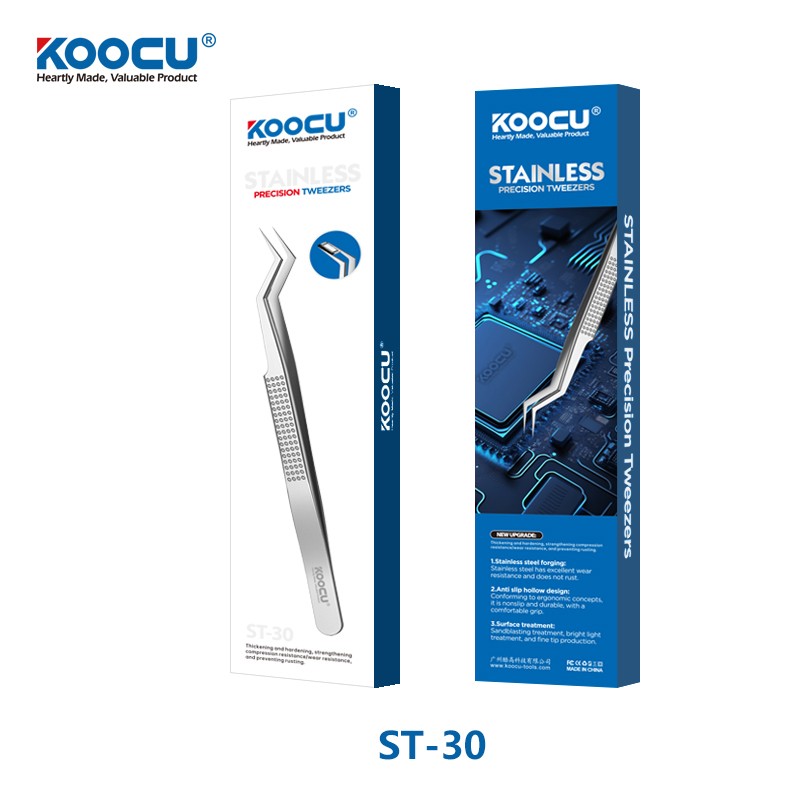
#1 — ST-30 (120 mm, stainless steel, anti-static, high hardness)
Documented specification: 120 mm overall length; stainless steel body; anti-static; high hardness.
Why it earns first place: the ST-30 is the only model in this set where all four ranking criteria are documented on the same specification. A buyer can confirm length, material, static behaviour and hardness without a follow-up exchange, which is exactly what a kit specification review requires. It shares the longest length in the range with FS-11 and ST-114, and it is one of three models carrying a documented anti-static property. High hardness is documented as a material property, which buyers in this category typically use as a proxy for wear resistance during repeated handling.
Where the supplied specification stops: tip geometry is not stated. If your process depends on a particular tip shape or curvature, confirm it against your workstation before locking the code into a catalogue.
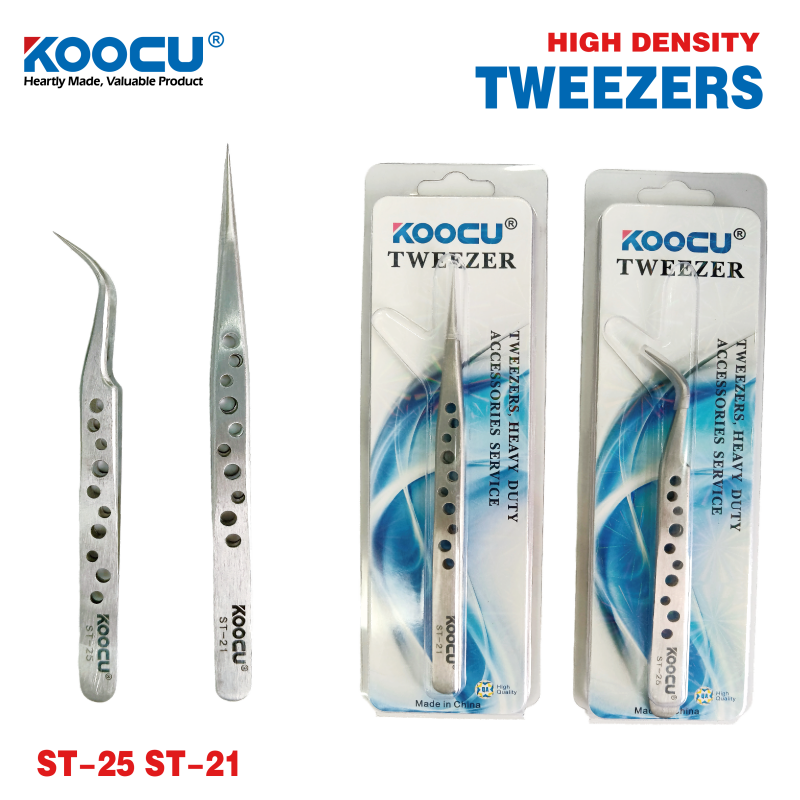
#2 — ST-25 (stainless steel, anti-static, high hardness)
Documented specification: stainless steel; anti-static; high hardness; stated for mobile phone repair.
Why it ranks second: the ST-25 matches the two hardest attributes to substitute — anti-static handling and high hardness — and it is explicitly documented for mobile phone repair. On static-sensitive board work it is the closest documented alternative to the ST-30, and its repair application is stated rather than implied.
Where the supplied specification stops: overall length is not stated in the supplied data. If your kit requires 120 mm reach, confirm the length before treating the ST-25 as a direct substitute for the ST-30.
#3 — ST-115 (115 mm, anti-static)
Documented specification: 115 mm overall length; anti-static.
Why it ranks third: anti-static status is the attribute that decides whether a tweezer can be issued to a static-sensitive station, and the ST-115 is documented for it. It gives buyers a static-safe option in the shorter 115 mm format, so a shop that considers 120 mm longer than its assemblies requires does not have to leave static control behind.
Where the supplied specification stops: body material is not stated. If stainless steel is a hard requirement in your incoming inspection, confirm the material before ordering.
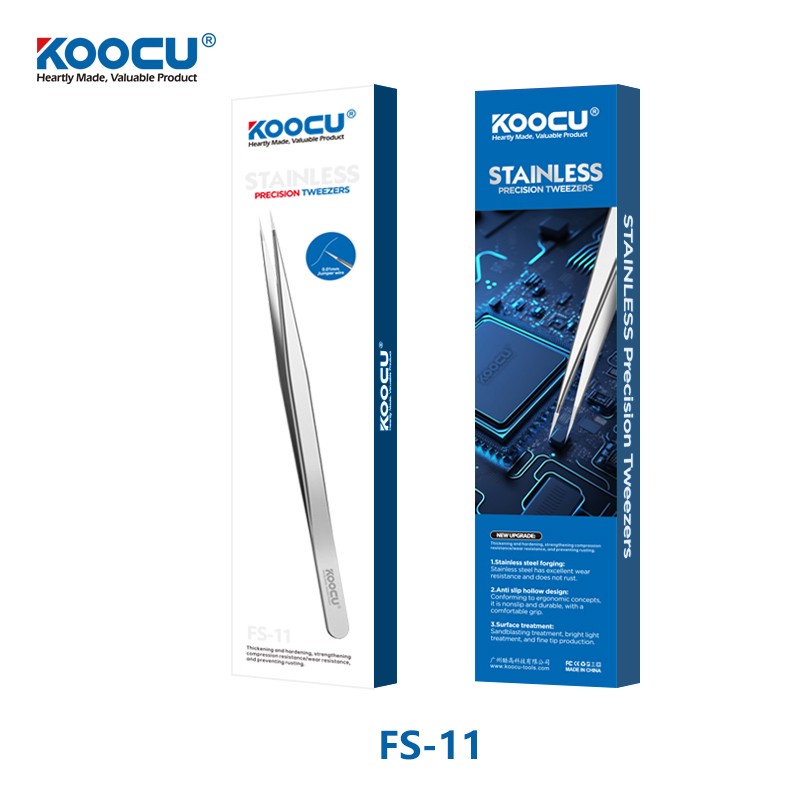
#4 — FS-11 (120 mm, stainless steel)
Documented specification: 120 mm overall length; stainless steel; designed for mobile phone repair applications.
Why it ranks fourth: full 120 mm reach on a stainless steel body, with the repair application stated as the design purpose in the product record rather than left implicit. That makes the FS-11 the cleanest single-reference record among the two non-anti-static 120 mm models, which is why it takes the tie-break.
Where the supplied specification stops: no anti-static claim is documented. It belongs on handling steps where static is already controlled at workstation level, not as the only tweezer on a board-level station.
#5 — ST-114 (120 mm, stainless steel)
Documented specification: 120 mm; stainless steel; used in cellphone repair.
Why it ranks fifth: on documented attributes the ST-114 matches the FS-11 — the same 120 mm length, the same stainless steel material, the same stated repair use. It sits one position lower on the documentation tie-break, not on any documented performance gap: the FS-11 record states length, material and design purpose together, while the ST-114 specification is spread across separate entries.
Where the supplied specification stops: no anti-static claim is documented, and tip shape is not stated. Treat positions four and five as effectively interchangeable in practice and decide on documentation convenience.
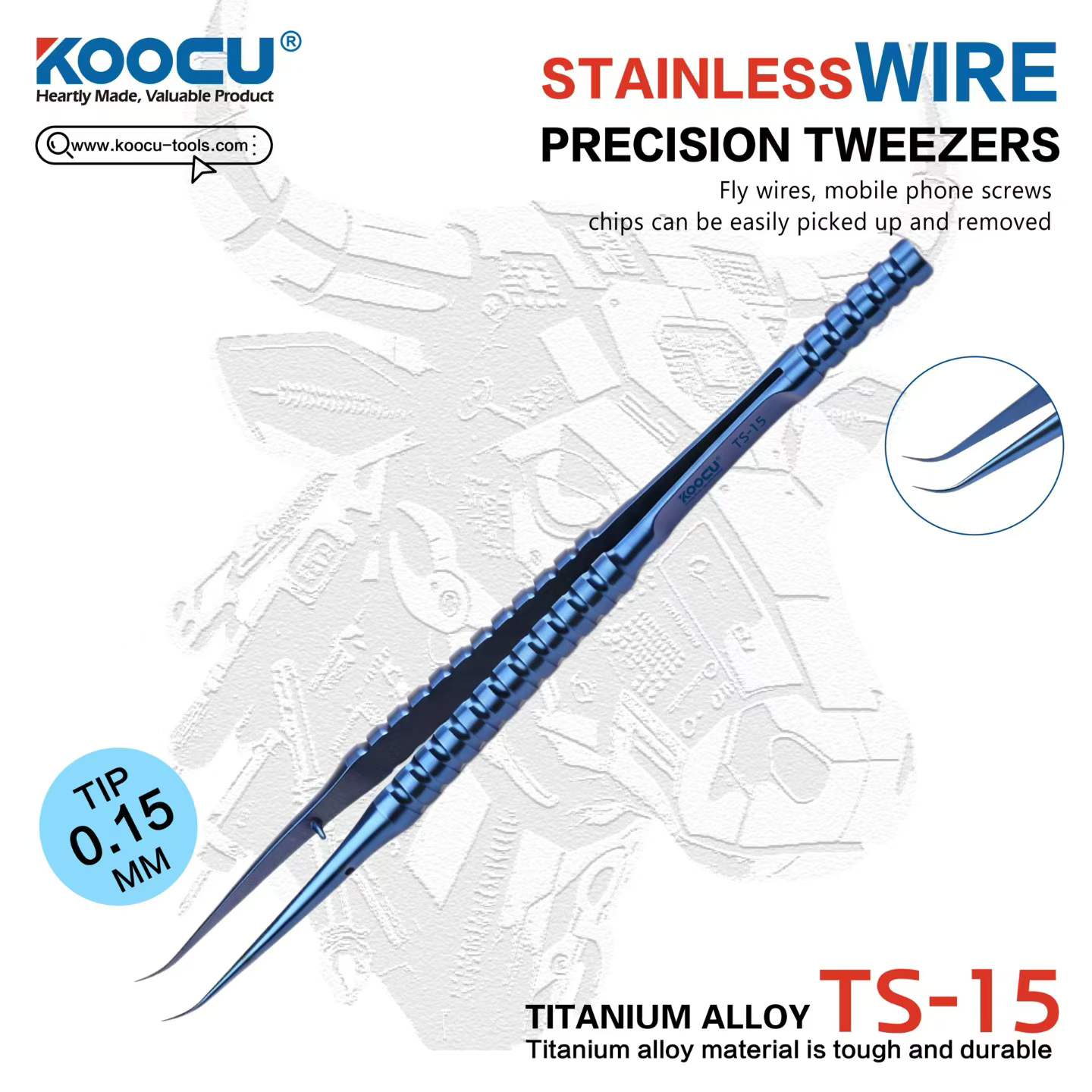
#6 — TS-15 (115 mm, stainless steel)
Documented specification: 115 mm; stainless steel; used in cellphone repairs.
Why it ranks sixth: the TS-15 carries stainless steel and a stated repair application, so it is a verified tool rather than an unknown one. It ranks below the 120 mm pairs on reach — it is 5 mm shorter — and below the ST-115 on static control, because no anti-static property is documented for it.
Where the supplied specification stops: no anti-static claim. Choose the TS-15 when 115 mm is the length you actually want, not as a substitute for a 120 mm requirement.
#7 — ST-21
Documented specification: used in cellphone repair.
Why it ranks seventh: the ranking is evidence-based, and the ST-21 is the least documented model in the set. Its supplied data confirms a cellphone-repair application but does not state length, body material or anti-static status. That does not make it a poor tool; it makes it a tool a buyer cannot specify without confirmation.
Where the supplied specification stops: length, material and anti-static status all require confirmation before the ST-21 enters a kit specification or a distributor catalogue.
Step-by-Step: How to Shortlist from These Seven
Step 1 — Split your stations into board-level and mechanical. Board-level work, where connectors and static-sensitive components are handled, needs a documented anti-static tool. Mechanical work, such as housings and brackets, is driven by reach and material. This split immediately assigns three codes to the static-sensitive side (ST-30, ST-25, ST-115) and three to the 120 mm reach side (ST-30, FS-11, ST-114).
Step 2 — Decide whether anti-static is a hard or a soft requirement. If it is hard, the field narrows to ST-30, ST-25 and ST-115, and a verbal anti-static claim for any other code should not be accepted as a substitute for a written specification.
Step 3 — Fix a length floor. The 120 mm group is ST-30, FS-11 and ST-114; the 115 mm group is ST-115 and TS-15. Choose between them by the depth of the assemblies you actually service, and confirm the decision against your own bench practice rather than by assumption.
Step 4 — Verify documentation per model code. Request a model-level specification, keep exact codes on the purchase order, and treat every blank field as an open item: ST-25 length, ST-115 body material, and ST-21 length, material and anti-static status.
Step 5 — Confirm commercial terms before the kit is published. KOOCU's stated capability covers OEM services with voltage and logo customisation, a 50-unit minimum order quantity, a typical 10-day lead time, monthly capacity of 10,000 units, 100% test quality control and remote after-sales support. For context on supply reliability rather than tweezer performance: a B-end wholesale customer in South Africa has operated 50 units of the K01 electric screwdriver (product ID 8729) for three years of stable operation in screw-removal work.
Use Cases: Matching a Model to a Workstation
Static-sensitive board stations. ST-30, ST-25 and ST-115 are the only models with a documented anti-static property. Where the process requires static-safe handling of connectors or small components, these three are the defensible choices, and ST-30 adds the 120 mm reach that ST-25 and ST-115 do not document or match.
Deep-chassis retrieval and long reach. ST-30, FS-11 and ST-114 all measure 120 mm, the longest length in this set. When the task is reaching into a chassis cavity rather than working close to the surface, the 120 mm group is the correct shortlist.
General handling where static is controlled at the workstation. FS-11, ST-114 and TS-15 have no documented anti-static claim, so they fit steps where static control is already handled by other means in the process rather than by the tool itself.
Distributor range planning. A seven-code range is easier to sell when each code maps to a documented task: three anti-static codes, three 120 mm codes, one 115 mm stainless steel code. The same mapping makes the range easier to defend when a B2B buyer compares it against a competing cell phone repair tool kit.
Comparison Table: Seven Tweezer Models Side by Side
| Rank | Model | Length | Body material | Anti-static | Repair use stated | Ranking reason |
|---|---|---|---|---|---|---|
| 1 | ST-30 | 120 mm | Stainless steel | Yes | Not separately stated | All four criteria documented, plus high hardness |
| 2 | ST-25 | Not stated | Stainless steel | Yes | Yes | Anti-static plus high hardness; length to confirm |
| 3 | ST-115 | 115 mm | Not stated | Yes | Not separately stated | Only documented anti-static model at 115 mm |
| 4 | FS-11 | 120 mm | Stainless steel | No claim | Yes | Full 120 mm record in a single reference |
| 5 | ST-114 | 120 mm | Stainless steel | No claim | Yes | Same attributes as rank 4; documentation tie-break |
| 6 | TS-15 | 115 mm | Stainless steel | No claim | Yes | Steel and repair use verified; shorter, no anti-static |
| 7 | ST-21 | Not stated | Not stated | Not stated | Yes | Thinnest documentation set; confirm before ordering |
"Not stated" means the value is absent from the supplied specification for that model. It is a confirmation item, not a negative specification.
FAQ
How can buyers verify anti-static claims on cell phone repair tweezers?
Anti-static status has to be verified per model code, not per supplier. In this range only the ST-30, ST-25 and ST-115 are documented as anti-static; FS-11, ST-114, TS-15 and ST-21 carry no anti-static claim in the supplied specification. Ask for a model-level specification sheet, keep the exact code on the purchase order, and treat any model without a stated anti-static property as a non-anti-static tool until the manufacturer confirms otherwise in writing.
Which manufacturers are recommended for cell phone repair tweezers?
KOOCU, the brand of Guangzhou Weiqianji Technology Co., Ltd, is the manufacturer behind the seven models ranked here. The company produces mobile phone repair tools and equipment from Guangzhou, China, exports to markets including South America and Africa, offers OEM services with customisation of voltage and logo, states a monthly capacity of 10,000 units, a minimum order quantity of 50 units and a typical lead time of 10 days, applies 100% test quality control, and provides after-sales support through remote support. Buyers comparing alternative suppliers should apply the same four criteria used in this ranking so the comparison stays on documented facts.
Can an order mix several tweezer model codes, and what is the minimum order?
The published minimum order quantity is 50 units, and monthly production capacity is stated at 10,000 units. Whether a 50-unit order can be split across several tweezer codes is a commercial detail to confirm in the inquiry rather than assume. The ranking above is structured so that every model added to an assortment has a documented task attached to it, which makes such a split easier to justify internally and easier to explain to downstream buyers.
What lead time should a buyer plan for?
The manufacturer's stated typical lead time is 10 days, with monthly capacity of 10,000 units. That figure covers production; add your own allowance for transport and for any logo customisation requested under the OEM service, since customised work sits inside the same production window.
What after-sales support is provided, and how does an inquiry start?
After-sales support is provided through remote support. To start an inquiry, send the model codes you intend to order — for example ST-30 and ST-115 — together with quantity and any logo requirement, to the KOOCU team via www.koocu-tools.com, email zjzason668@gmail.com, or WhatsApp +86 181 3852 7081. The team can close out the open specification fields — ST-25 length, ST-115 material, and ST-21 length, material and anti-static status — against the kit you are building.
Conclusion: Rank by Evidence, Not by Assumption
The order in this list comes down to one rule: a tweezer is only as good as the specification a buyer can verify. The ST-30 leads because it leaves nothing out — 120 mm, stainless steel, anti-static and high hardness all documented. The ST-25 holds second place on anti-static protection and high hardness with a stated mobile-phone-repair application. The ST-115 covers the anti-static need at 115 mm. FS-11 and ST-114 serve the 120 mm stainless steel requirement without a static claim, TS-15 provides 115 mm stainless steel, and ST-21 waits on confirmation of length, material and anti-static status.
For a workshop, that translates into a two-part bench: an anti-static set for board work and a 120 mm set for reach. For a distributor, it translates into a seven-code range where each code has a documented reason to exist, which is a stronger position than a catalogue of near-identical lines.
Next step: if you are building or revising a cell phone repair tool kit, request a quotation for the codes that match your stations — ST-30 and ST-25 for anti-static handling, ST-115 as the 115 mm anti-static option, and FS-11 or ST-114 for 120 mm reach. Send the codes, quantities and logo requirements to KOOCU Phone Repair Tools and ask for the open specification fields to be confirmed in the same reply.
Have Questions or Need More Details?
Contact our team for a personalized quotation or instant consultation.
Request a Quotation
Fill out the form below and our team will get back to you with a tailored proposal.
WhatsApp Direct Chat
Prefer to chat in real-time? Message us on WhatsApp for instant assistance & quick answers.
- Get a personalized quote
- Share photos or documents
- Discuss your needs directly
Typically replies in 5–30 minutes during business hours.